*Corresponding author:Thaiba Reinai ISSN: 0976-3031
Research Article
CORRELATION OF REACTION TIME AND VISUAL ATTENTION WITH FEAR OF
FALLS IN ELDERLY POPULATION
*Thaiba Reinai and Sampada S Jahagirdar
Department of Physiotherapy, Amar Jyoti Institute of Physiotherapy, Delhi University, New Delhi-92
DOI: http://dx.doi.org/10.24327/ijrsr.2018.0910.2857
ARTICLE INFO ABSTRACT
Reaction time (RT) and Visual attention (VAT) are slowed and associated with problems of mobility in elderly. Fear of falling is also an intrinsic aspect that influences balance. The relationship of Fear of Falls (FOF) with reaction time and visual attention needs to be studied in order to understand the mechanism of falls and activity restriction. This knowledge would enable development of more focused assessment and intervention for balance rehabilitation amongst community dwelling elderly. In the present study, 232 subjects aged 60 years and above were assessed for FOF, reaction time and attention by using Activities-specific Balance Confidence scale (ABC), Visual Reaction Time(VRT) and Trail Making Test- Part A (TMT-A) respectively. Balance tests namely, Timed Up and Go (TUG), Functional Reach Test (FRT) and Berg Balance Scale (BBS) were also assessed secondarily. Data was analysed using Pearson’s Correlation test. Fear of fall was found to be higher in subjects having poorer visual reaction time and attention. In addition, people with more reduction in functional balance ability tend to have higher level of fear of fall. Also, as a lot of elderly (15.52%) had a level of fear of fall corresponding to a high risk of fall, it is suggested that fear of fall is an important factor that influences function and fall behaviour of elderly and must be routinely evaluated and treated during balance rehabilitation.
INTRODUCTION
The process of aging is characterized by generalized progressive slow-down in the ability to respond to external or internal stresses, decline in physical activity(1), decrease in muscle strength, endurance(2), increased postural sway(3,4), and decreased balance function(5). In addition, elderly have a limited capacity for balance reactions such as stepping or reaching movements because of delayed onset latencies of
postural muscles(6-8), reduction in conduction rate of nervous
system(4) and deterioration in compensation strategies(9). Reduced flexibility with ageing, also decreases the ability to recover quickly from a perturbation (10, 11). These factors put together increase risk of falls and impair the ability to perform activities of daily living independently(12).
Older individuals display increased sway patterns and usually require stepping reactions as a protective mechanism. When this is coupled with decreased reaction time with age, the elderly individual does not have enough time to react to prevent the fall(13). Reaction time, i.e., the interval time between the presentation of a stimulus and the initiation of the muscular response to that stimulus and It is a physiological entity that
has been linked to the incidence of falls in the elderly population(13). As age increases, there is an increase in movement time and decision time (14). This is largely attributed to reduction in motor nerve conduction velocity(15)and increase in both initiation and response times. In various researches, it has been noted that older people who have a tendency to fall are significantly slower in simple as well as choice reaction time tests that involve complicated motor responses than non-fallers(14). Slower reaction time has especially been seen during various attention demanding tasks. In addition to slowed reaction time with aging, the visual attention time (VAT) or visual processing speed is also slowed. This is associated with problems of mobility in elderly(16). VAT is defined as, “a process that enables stimuli falling within a limited area to be detected more rapidly and more accurately”(17). Visually guided obstacle avoidance declines with ageing. It is proposed to affect stepping over obstacles leading to falls(18).
Another important intrinsic aspect that influences balance is anxiety or fear of falling. It is defined as low perceived self-efficacy at avoiding falls during essential, non-hazardous activities of daily living. Though it is a protective response
Available Online at http://www.recentscientific.com
International Journal of
Recent Scientific
Research
International Journal of Recent Scientific Research
Vol. 9, Issue, 10(E), pp. 29414-29419, October, 2018
Copyright © Thaiba Reinai and Sampada S Jahagirdar, 2018, this is an open-access article distributed under the terms of the Creative Commons Attribution License, which permits unrestricted use, distribution and reproduction in any medium, provided the original work is properly cited.
DOI: 10.24327/IJRSR CODEN: IJRSFP (USA)
Article History: Received 06th July, 2018 Received in revised form 14th August, 2018
Accepted 23rd September, 2018 Published online 28th October, 2018
Key Words:
which alerts the individuals against a fall(19), it is also related to activity restrictions followed by a decrease in physical capacity and an increase in the risk for future falls (20). 30% to 50% of elderly people have compromised mobility due to FOF(21).It is observed in older individuals irrespective of previous history of falls(13, 22).
Reaction Time (RT) seems to be a very important factor for the study of falls as it is one of the sensitive markers of aging central nervous system and is adversely affected when task becomes more attention demanding(13). Thus, it seems important to study relationship of physical factors like RT and VAT with psychological factor like fear of falls (FOF) in order to understand the mechanism of falls and activity restriction. Balance is an important component of most activities of daily and living-balance impairment is considered a major risk factor for developing falls and also FOF, it seemed interesting to study them along with VAT, VRT and FOF. This knowledge would enable development of more focused assessment and intervention for balance rehabilitation amongst community dwelling elderly.
MATERIALS AND METHOD
Methodolgy
The study was a correlational study. Approval was taken from Amar Jyoti Institutional Review Board- Ethical Committee. 232 community-dwelling elderly aged 60 years and above were recruited through convenience sampling method from Amar Jyoti Rehabilitation and Research Centre and different urban residential areas in Delhi.
Inclusion criteria
Males and females aged 60 and above.
Having capability to walk with or without any support device such as a cane or walker.
Ability to understand spoken instruction
With normal or corrected-to-normal vision(23).
Exclusion criteria
Subjects with known neurological disorders.
Chronic alcoholism.
Equipment
Audio-visual reaction timer code no.09 by Medisystems Haryana.
Two standard chairs (one with and one without arm rests)
Footstool
Other materials: measuring tape, cone and stopwatch
Pen and pencil
Study Procedure
An informed consent was obtained from the participants after informing them about the objectives and data collection process of the study. They were then included in the study based on the inclusion and exclusion criteria. Once included, their balance confidence, visual reaction time and visual attention were evaluated by using Activities-specific Balance Confidence scale (ABC), Visual Reaction Time (VRT) and Trail Making Test-Part A (TMT-A) respectively. In addition, static, dynamic
and functional balance were assessed using Functional Reach Test (FRT), Time Up and Go Test (TUG) and Berg Balance Scale (BBS). Total time spent in giving instruction, interviewing, and examination was about 40 min per participant.
ABC Scale was used in English as well as Hindi version for evaluating FOF and percentage of elderly at high risk of fall. The ABC consisted 16-subscale and ratings consist of whole numbers (0-100) for each item. The ratings are added (possible range = 0 -1600) and divided by 16 to get each subject’s final ABC score(13). The participants were asked to rate his/her confidence in relation to performing 16 different activities on a scale from 0% (no confidence) to 100% (complete confidence), where higher score indicate stronger confidence(24, 25).
VRT was assessed by using the audio-visual reaction timer apparatus in sitting position. It was recorded for the light which served as stimulus. As soon as the stimulus was perceived by the subject, he responded by pressing the lower limb foot paddle. The time taken by the subject is measured in liquid crystal display meter i.e., known as his reaction time. The display indicated the response time in millisecond. After the trial was done, the subject was tested. The interval between the stimuli was randomly varied from 2-5 seconds. The least reading of three was taken as the value for VRT and was noted. The minimum time indicates good reaction time(12, 26).
TMT Part-A was evaluated by drawing lines quickly connecting consecutive numbered circles from 1 to 25 printed on a paper sheet in a standardized random layout(14, 27, 28).The number had to be connected in the sequence correctly using pen or pencil. A trial run (from number 1 to 8) was first conducted to make sure that the subject understood the procedure. Only after the trial was done, the subject was asked to do the test. The score was measured in seconds. Higher scores reflected a longer time to complete this task (worse performance), and thus indicated poor VAT(28).
FRT was tested by placing a measuring tape on the wall, parallel to the floor, at the height of the acromion of the subject's dominant arm. The subject was asked to stand with the feet comfortable distance apart, make a fist, and forward flex the dominant arm to approximately 90 degrees. The subject was asked to reach forward as far as possible without taking a step or touching the wall. The distance between the start and end point was then measured using the head of the metacarpal of the third finger as the reference point(29).
TUG Test: The study subjects were instructed to sit on a chair (46cm height) without arm rest(30-32). They were instructed to get up from chair on command, walk at a comfortable pace, walk around the cone which was marked 3m ahead and return to a seated position on the original chair. The stop watch was started as soon as the subject lifted buttocks off the chair and it was stopped at the point where the subject sat back in the chair after completing walking. The total time taken by each subject to complete the task was noted as the final score (33).
International Journal of Recent Scientific Research Vol. 9, Issue, 10(E), pp. 29414-29419, October, 2018
Statistical Analysis
The data was analysed using SPSS Windows version 16.0. Descriptive statistics was performed to describe the baseline demographic data. Statistical value of outcome measures was expressed as Mean ±SD. Pearson correlation test was then used to study the association between Visual Reaction Time and Visual Attention Time with Fear of Falls. Secondary measures of balance were also statistically correlated with FOF using Pearson correlation test. The independent t-test was used to compare the fear of falls between the two genders. Statistical significance was considered at p value of<0.05.
RESULTS
The sample consisted of 232 community-dwelling older adults with mean age of 67.34±6.97 years. Out of the total subjects, there were total 154 subjects aged between 60-69 years, 60 subjects aged between 70-79 years old, 18 subjects aged between 80-89 years old.
Percentage of elderly at high risk of fall (ABC score <67% predictive of future fall) (13)
15.52% of the total 232 subjects studied, were found to be having a high risk of falls. Between the ages of 60-69 years, 12.33% of subjects had high risk of fall. This percentage increased to 20.00% and 27.78% for 70-79 and 80-89 year age groups respectively (Table 1).
Table 1 Percentage of elderly at high risk of fall (ABC score <67% predictive of future fall)(13).
Age
(year) N Males Females Total No. Percentage
All subjects 232 13 23 36 15.52
60-69 154 6 13 19 12.33
70-79 60 3 9 12 20.0
80-89 18 4 1 5 27.78
Level of physical functioning of elderly as indicated by ABC scores (Table 2)
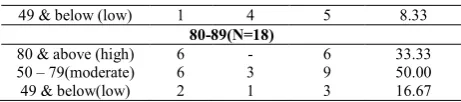
As indicated by the ABC scores, 67.24% of total elderly population aged 60 years and above, have high level of physical function while 26.3% have moderate and 6.46% have low level of physical functioning. In the age group of 60-69 years, 75.32% have high, 20.13% have moderate and 4.54% have low levels of physical functioning. In the age group of 70-79 years,56.67%have high, 35.00% have moderate and 8.33% have low levels of physical functioning. In the age group of 80-89 years,33.33% have high, 50.00% have moderate and 16.67%have low levels of physical functioning.
Table 2 Level of physical functioning of elderly as indicated by ABC scores.
ABC Score Males Females Total
number Percentage
All Subjects (N=232)
80 & above (high) 84 72 156 67.24
50 – 79 (moderate) 22 39 61 26.3
49 & below (low) 4 11 15 6.46
60-69(N=154)
80 & above (high) 58 58 116 75.32
50 – 79 (moderate) 9 22 31 20.13
49 & below (low) 1 6 7 4.54
70-79(N=60)
80 & above (high) 20 14 34 56.67
50 – 79(moderate) 7 14 21 35.00
49 & below (low) 1 4 5 8.33
80-89(N=18)
80 & above (high) 6 - 6 33.33
50 – 79(moderate) 6 3 9 50.00
49 & below(low) 2 1 3 16.67
Comparison between males and females for FOF (Table 3)
There is no significant difference between FOF reported by both the genders.
Table 3 Comparision between males and females for FOF
Outcome Measures
Males Mean±SD
Females
Mean±SD T p
FOF 87.86±15.56 80.02±18.79 3.44 3.44ns
ns Not significant at p >0.05
Correlation of FOF with VRT (Table 4)
FOF is negatively correlated with VRT. The correlation for all the subjects together is weak but significant (r=-0.24, p<0.05). For age groups 60-69 years and is weak but significant (r=-0.33, p<0.05). The correlation is weak and insignificant for age groups 70-79years(r=-0.17, p>0.05). Correlation is moderate and insignificant for 80-90 years group (r=0.35, p>0.05).
Table 4 Correlation of FOF with VRT.
Age (Years)
Total No(N)
FOF (Mean±SD)
VRT.
(Mean±SD) r p
All
subjects 232 83.74±17.73 42.40±12.00 -.24 .00*
60-69 154 86.13±17.09 41.40±11.95 -.33 .00*
70-79 60 80.45±17.94 43.50±12.00 -.17 .20ns
80-89 18 74.26±18.52 40.00±12.71 .35 .15ns
* Correlation is significant at p < 0.05 level (2-tailed)
ns Not significant at p >0.05
Correlation of FOF with VAT (Table 5)
FOF is negatively correlated with VAT. The correlation for all the subjects together is weak but significant (r=-0.15, p<0.05). For age groups 60-69 years and is weak but significant (r=-0.16, p<0.05). The correlation is weak and insignificant for age groups 70-79years(r=-0.15, p>0.05). Correlation is moderate and insignificant for 80-90 years group (r=0.04, p>0.05).
Table 5 Correlation of FOF with VAT
Age (Years)
Total No (N)
FOF (Mean±SD)
VAT
(Mean±SD) r p
All subjects 232 83.74±17.73 61.00±30.56 -.15 .03*
60-69 154 86.13±17.09 55.00±17.55 -.16 .05*
70-79 60 80.45±17.94 68.90±24.95 -.15 .26ns
80-89 18 74.26±18.52 85.10±80.94 .04 .89ns
* Correlation is significant at p < 0.05 level (2-tailed)
ns Not significant at p >0.05
Correlation of FOF with Secondary outcome measures (Functional Reach Test, Time Up& Go, Berg Balance Scale) (Table 6)
DISCUSSION AND CONCLUSION
Out of 232 subjects studied, majority of the subjects belonged to the age group of 60-69 year with mean age of 67.34. The ratio of male subjects to female subjects is 0.98:1 suggesting almost equal participation of both the genders, females being slightly more in number than males. This was unlike the other studies done in past which show feminization of elderly population.
In this study, ABC scale was used as a measure for FOF. Low scores on ABC indicate low level of balance confidence in doing daily activities owing to high fear of fall. As FOF and risk of falls are closely related, researches done in past have suggested cut-off value of 67% as an indicator for high risk of fall. Based on this, 15.52% of the total subjects had score below 67%. In the ages of 60-69 years, 70-79 years and 80-89 years this percentage was 12.33%, 20.00% and 27.78% respectively. This shows the magnitude of problem in the existing population as a large percentage of peoples are adversely affected due to fear of fall. It was found that the risk of fall steadily increases as the age increases. Fear of fall is directly related to the amount of physical function done by a person on daily basis. This adversely affects the independence and thus, quality of life. 67.24% of total elderly population aged 60 years and above have high level of physical function while 26.3% have moderate and 6.46% have low level of physical functioning. Higher level of physical functioning indicates high balance confidence and low fear of falls. In the age group of 60-69 years, 75.32% have high level of physical functioning. This number goes down among the older age groups, i.e., 70-79 years and years 80-89, being 56.67% and 33.33% respectively. Against to this, the percentage of people involved in low levels of physical functioning steadily increases from 4.54%, 8.33%and 16.67% across the three age groups.
FOF is found to be negatively correlated with VRT. This means that longer reaction time is related to increased fear of falls and that their balance confidence is low. This correlation, though weak was significant for all the subjects together and age group 60-69 years. This similarity is because most of the people in the sample belong to the age group of 60-69 years. Correlation is mild as well as insignificant for age groups 70-79 years and moderate and insignificant for 80-89 years group. This insignificance is probably because of small size of these age groups.
A study done by Wang et al, had suggested that increased reaction time (as choice stepping reaction time) was significantly associated with increased risk of falls. They proposed that prevention of falls depended upon the timely initiation of appropriate postural responses, which in older adults were characterized by the absence of speed and dexterity
that was necessary to ensure the recovery of stability in challenging situations that are seen in daily activities. Subjects with a history of falls had significantly increased reaction times compared with non-fallers(34).
FOF is negatively correlated with VAT. This suggests that people with poor attention are more fearful of falls. The correlation of all the subjects together and age groups 60-69 years and was weak but significant. The correlation was insignificant for age groups 70-79 years while it was moderate but insignificant for 80-89 years. Attention helps in selecting a particular stimulus for an action while ignoring irrelevant stimuli. Reduced attention elevates the risk of falls. Numerous studies have shown that dual task effects are larger among elderly fallers and patients with neurological disease, such as stroke compared with healthy older adults(35). Another study done on feedback delays has shown that older. adults prioritize vision to control posture(36). This information along with the findings of the present study supports that poorer visual attention is correlated with fear of fall, which in itself is also a factor for future falls. In addition to this, it is also noted in the present study that visual attention of males is significantly better than females, while there is no significant difference between visual reaction time and fear of fall experienced by both the genders.
The significant correlation of FOF with balance measures, FRT, TUG and BBS has shown that poor balance status relates to increased FOF. Fear of fall is positively correlated with Functional reach test and Berg Balance Scale and negatively correlated with Time Up and Go test. The correlation is found to be mild for FRT while it is strong for BBS and TUG. This indicates that balance during mobility may be more adversely affected by FOF than balance that is compromised during a reaching activity that is performed while maintaining a particular Base of support. Balancing reactions such as rapid stepping or reaching movements are relatively more impaired in healthy older adults, thus, compensatory postural adjustments which are crucial to balance recovery are significantly affected by the ageing process.(8)
It can be said that FOF in most cases is a credible measure of one’s balance ability. It is also proposed to be a more pervasive and serious problem than falls in older adults(37). This fear can trigger reduction in Quality of life of the older adult due to restrictions of basic and instrumental activities of daily living, reduction of physical fitness and an increased risk of falls.
These findings have important implications to FOF and suggest that interventions that enhance RT and/or VAT may reduce FOF. But as correlation alone does not talk about cause and effect of variables that are studied, it may also indicate that reduction in FOF by psychological counselling or balance training exercises may improve RT and/or VAT. Studies done in the past have also indicated reactive and volitional stepping as an intervention to reduce falls among older adults by almost 50%. Improvements in reaction time have been proposed as reason for clinically significant reduction of falls (38).
Limitation
The study population was conveniently selected from the general population of community-living older, mostly from Table 6 Correlation of FOF with Secondary outcome
measures (Functional Reach Test, Time Up and Go, Berg Balance Scale).
Outcome Measures (Mean±SD)
FRT
(11.29±2.79)
TUG
(11.67±3.64)
BBS
(52.16±4.93)
FOF
(83.74±17.73) .31* -.49* .60*
International Journal of Recent Scientific Research Vol. 9, Issue, 10(E), pp. 29414-29419, October, 2018
East Delhi. Also, this study design limits interpretation of the results with regard to causality.
Future Research
Further steps in this area would be to find if the use of training for VRT and VAT as a part of balance training for elderly is beneficial for reducing fear of fall and falls in elderly. Another research area may be the studying of development of fear of falling in various age groups using a longitudinal design and focussing on how early and what interventions can effectively prevent falls and improve outcomes.
CONCLUSION
FOF is seen to be higher when VRT and VAT are poor. In addition, people who have more reduction in functional balance tend to have higher level of FOF. As, a lot of elderly (15.52%) had a level of FOF which puts them at high risk of fall, it can be said that FOF is an important factor that influences function and fall behaviour of elderly and must be routinely evaluated and treated during balance rehabilitation.
References
1. Takagi D, Nishida Y, and Fujita D. (2015). Age-associated changes in the level of physical activity in elderly adults. Journal Physical Therapy Science, 27:3685-3687.
2. Rahal MA, Alonso CA, and Andrusaitis FR. (2015). Analysis of static and dynamic balance in healthy elderly practitioners of Tai Chi Chuan versus ball room dancing. Clinics, 70(3):157-161.
3. Lee IH, and Park S. (2013). Balance Improvement by Strength Training for the Elderly. Journal of Physical Therapy and Science, 25:1591–1593.
4. Jeon MY, Jeong HC, Petrofsky J, Lee H, and Yim JE. (2014). Effects of a Randomized Controlled Recurrent Fall Prevention Program on Risk Factors for Falls in Frail Elderly Living at Home in Rural Communities. Medical Science Moniort, 20: 2283-2291.doi: 10.12659/MSM.890611.e-ISSN 1643-3750.
5. Almeida ST, Soldera CLC, Gomes GA, and Resendes TL. (2012). Analysis of extrinsic and intrinsic factors that predispose elderly individuals to fall. Revista da Associacao Medica Brasileira, 58(4):427- 433.
6. Lin SI, Woollacott MH, and Jensen JL. (2004). Postural response in older adults with different levels of functional balance capacity. Aging Clinical and
Experimental Research,16:369–374.
7. Maki BE, and McIlroy WE. (2006). Control of rapid limb movements for balance recovery: age-related changes and implications for fall prevention. Age Ageing, 35(Suppl 2):ii12–ii18.
8. Kanekar N, and Aruin AS. (2014). Aging and balance control in response to external perturbations: role of anticipatory and compensatory postural mechanisms. Age, 36:1067–1077. Doi: 10.1007/s11357-014-9621-8.
9. Pasma JH, Engelhart D, Maier AB, Schouten AC, Kooij HV, and Meskers CGM. (2015). Changes in sensory reweighting of proprioceptive information during standing balance with age and disease. Journal of Neurophysiologyl, 114(6):3220-3233.
10. Rubenstein ZL, Josephson RK, and Trueblood RP. (2000). Effects of a group exercise program on strength,
mobility, and falls among fall-prone elderly men. Journal of Gerontology, 55 A(6):M317-M321.
11. Schwenk M, Jordan DE, and Honarvararagahi B. (2013). Effectiveness of foot and ankle exercise programs on reducing the risk of falling in older adults. Journal of the American Padiatric Medical Association, 103(6). 12. Batra A, Vyas S, Gupta J, Gupta K, and Hada R. (2014).
A comparative study between young and elderly Indian males on audio-visual reaction time. Indian Journal Scientific Research and Technology, 2(1):25-29.ISSN:-2321-9262. http://www.indjsrt.com.
13. Lajoie Y, and Gallagher SP. (2004). Predicting falls within the elderly community: comparison of postural sway, reaction time, the Berg balance scale and the Activities-specific Balance Confidence (ABC) scale for comparing fallers and non-fallers. Archives of Gerontology and Geriatrics, 38:11–26.
14. Lord SR, and Fitzpatrick RC. (2001). Choice Stepping Reaction Time: A Composite Measure of Falls Risk in Older People. Journal ofGerontology, 56 A(10):M627– M632.
15. Ricotti L, Rigosa J, Niosi A, and Menciassi A. (2013). Analysis of Balance, Rapidity, Force and Reaction Times of Soccer Players at Different Levels of Competition. Plosone, 8(10): e77264. doi:10.1371/journal.pone.0077264.
16. Owsley C, and McGwin GJ. (2004). Association Between Visual Attention and Mobility in Older Adults. Journal of American Geriatric Society, 52(11):1901– 1906.
17. Steinman SB, Steinman BA, Trick GL, and Lehmkuhle S. (1994). A sensory explanation for visual attention deficits in the elderly. Optiometry and vision Science, 71(12):743-749.
18. Alexander NB, Ashton-Miller JA, Giordani B, Guire,K, and Schultz AB. (2005). Age Differences in Timed Accurate Stepping With Increasing Cognitive and Visual Demand: A Walking Trail Making Test. Journal of Gerontology: medical sciences, 60 A (12):1558–1562. 19. Moreira BS, Anjos DMC, Pereira DS, Sampaio RF,
Pereira LSM, Dias RC, and Kirkwood RN. (2016). The geriatric depression scale and the timed up and go test predict fear of falling in community-dwelling elderly women with type 2 diabetes mellitus: a cross-sectional study. BioMed Central Geriatrics, 16(56):1-10. doi:10.1186/s12877-016-0234-1.
20. Wollesen B, Köhler B, and Mattes K. (2016). Influence of Fear of Falling and Multiple Falls Risks on Gait Performance under Single and Dual-Task Conditions. Gerontology Geriatrics Research, 2(4):id1021:1-6. 21. Dsouza SA, Rajashekar B, Kumar KB, and Dsouza HS.
(2014). Falls in Indian older adults: a barrier to active ageing. Asian Journal Gernotol Geriatric, 9:33-40. 22. Scheffer AC, Schuurmans MJ, Vandijk N, Hooft TV,
and De Rooij SE, (2008). Fear of falling: measurement strategy, prevalence, risk factors and consequences among older persons. Age and Ageing, 37:19–24.doi: 10.1093/ageing/afm169.
Reaction Time in Older Adults. Journal of Geriatric Physical Therapy, 32(3)09:103-110.
24. Liu-Ambrose T, Katarynych LA, Ashe MC, Nagamatsu LS, and Hsu CL. (2009). Dual-Task Gait Performance among Community-Dwelling Senior Women: The Role of Balance Confidence and Executive Functions. The Journals of Gerontology Series A Biological Sciences and Medical Sciences, 64(9):975-82.
25. Hjalmarson HV, Jutengren G, and Möller M. (2013). Widening the perspectives of fracture prevention in osteoporosis by identifying subgroups based upon psychological aspects and health behaviour. Health, 5(7A2):1-11. http://dx.doi.org/10.4236/health. 57A2001 26. Karia RM, Ghuntla TP, Mehta HB, Gokhale PA, and
Shah CJ. (2012). Effect of Gender Difference On Visual Reaction Time: A Study On Medical Students Of Bhavnagar Region. The International Organization of Scientific Research, Journal of Pharmacy, 2(3): 452-454 27. Gaudino EA, Geisler MG, and Sqires NK. (1995).Construct validity in the trail making test: What makes part B harder?.Journal of Clinical and Experimental Neuropsychology, 17(4):529-535.
28. Votruba KL, Persad C, and Giordani B. (2016). Cognitive Deficits in Healthy Elderly Population With ‘‘Normal’’ Scores on the Mini-Mental State Examination. Journal of Geriatric Psychiatry and Neurology, 29(3):126-132 .
29. Duncan PW, Weiner DK, Chandler J, and Studenski S. (1990). Functional Reach: A New Clinical Measure of Balance. Journal of Gerontology,45(6):192-197
30. Podsiadlo D, and Richardson S. (1991). "The timed "Up & Go": a test of basic functional mobility for frail elderly persons. Journal of American Geriatrics Society, 39(2):142-148.
31. Belgen B, Beninato M, Sullivan PE, and Narielwalla K. (2006). The association of balance capacity and falls self- efficacy with history of falling in community- dwelling people with chronic stroke. Archives physical and medicine rehabilitation, 87:554-561.
32. Kubicki A, Bonnetblanc F, Petrement G, Ballay Y, and Mourey F. (2012). Delayed postural control during self-generated perturbations in the frail older adults. Clinical Interventions in Aging, 7:65–75.
33. Jeon MY, Gu MO, and Yim JE, (2017) . Comparison of Walking, Muscle Strength, Balance, and Fear of Falling Between Repeated Fall Group, One-time Fall Group, and Non fall Group of the Elderly Receiving Home Care Service. Asian Nursing Research,11;290-296.
34. Wang D, Jian Z, Yuliang S, Wenfei Z, Shiliu T, and Yu L. (2016). Evaluating the fall risk among elderly population by choice step reaction test. Clinical Intervention in Aging, 11: 1075–1082.
35. Segev-Jacubovski O, Herman T, Yogev-Seligmann G, Mirelman A, Giladi N, and Hausdorff JM. (2011).The interplay between gait, falls and cognition: can cognitive therapy reduce fall risk?. Expert Review of Neurotherapeutics, 11(7): 1057–1075. doi:10.1586/ ern.11.69.
36. Yeh TT, Cluff T, and Balasubramaniam R. (2014). Visual Reliance for Balance Control in Older Adults Persists When Visual Information Is Disrupted by Artificial Feedback Delays. Plos One, 9(3):e91554. doi:10.1371/journal.pone.0091554).
37. McAuley EM, Mihalko SL, and Rosengren K. (1997).Self-efficacy and balance correlates of fear of falling in the elderly. Journal of Aging and Physical Activity,5: 329-40.
38. Okubo Y, Schoene D, and Lord SR. (2016). Step training improves reaction time, gait and balance and reduces falls in older people: a systematic review and meta-analysis. (Abstract) British Journal of Sports and Medicine. doi: 10.1136/bjsports-2015-095452.
How to cite this article:
Thaiba Reinai and Sampada S Jahagirdar.,2018, Correlation of Reaction Time And Visual Attention With Fear of Falls In Elderly Population. Int J Recent Sci Res. 9(10), pp.29414-29419. DOI: http://dx.doi.org/10.24327/ijrsr.2018.0910.2857