A Monthly Double-Blind Peer Reviewed Refereed Open Access International e-Journal - Included in the International Serial Directories Indexed & Listed at:
Ulrich's Periodicals Directory ©, ProQuest, U.S.A., EBSCO Publishing, U.S.A., Index Copernicus Publishers Panel, Poland, Open J-Gage, India [link of the same is duly available at Inflibnet of University Grants Commission (U.G.C.)]
VOLUME NO.2(2012),ISSUE NO.2(FEBRUARY) ISSN2231-5756
CONTENTS
CONTENTS
CONTENTS
CONTENTS
Sr.No.
TITLE & NAME OF THE AUTHOR (S)
Page No.
1. EFFECT OF SPIRITUAL TOURISM ON FINANCIAL HEALTH OF THE UTTARAKHAND STATE OF INDIA
HIMADRI PHUKAN, Z. RAHMAN & P. DEVDUTT
1
2. A FUZZY EOQ INVENTORY MODEL WITH LEARNING EFFECTS INCORPORATING RAMP –TYPE DEMAND, PARTIAL BACKLOGGING AND INFLATION UNDER TRADE CREDIT FINANCING
SAVITA PATHAK & DR. SEEMA SARKAR (MONDAL)
8
3. DETERMINANTS OF CAPITAL STRUCTURE DECISIONS: EVIDENCE FROM ETHIOPIAN MANUFACTURING PRIVATE LIMITED COMPANIES (PLCs)
DR. FISSEHA GIRMAY TESSEMA & Y. L. LAVANYA
19
4. INFORMATION AND COMMUNICATION TECHNOLOGY (ICT) AND ORGANIZATIONAL PRODUCTIVITY AND GROWTH: UNIVERSITY OF BENIN IN PERSPECTIVE
OMOREGBE OMORODION, DR. ANTHONY.A. IJEWERE & BELLO DEVA VINCENT
29
5. ORGANIZATION DEVELOPMENT IN CITY TRAFFIC POLICE LAHORE- A CASE STUDY
BINISH NAUMAN
34
6. THE RESPONSIBILITY OF THE AUDITOR ABOUT DISCOVERING FRAUD THE FINANCIAL STATEMENTS ACCORDING TO THE IAS. NO. 240
SULTAN HASSAN MOHAMMED AHMED
40
7. A PERCEPTUAL STUDY ON THE CRITICAL SUCCESS FACTORS FOR ERP ADOPTION IN THE SMALL AND MEDIUM ENTERPRISES
S. VIJAYAKUMAR BHARATHI & DR. SHRIKANT PARIKH
44
8. INFORMATION TECHNOLOGY TOOLS TOWARDS OPTIMIZING ENERGY CONSERVATION AND ENVIRONMENTAL PROTECTION INITIATIVES
NISHIKANT C. PRATAPE
50
9. COST REDUCTION INNOVATION IN SME’s – AN EMPHERICAL STUDY (WITH REFERENCE TO HANDLOOM SILK SAREES IN CHIKKABALLAPUR DISTRICT)
DR. S. MURALIDHAR, NARASAPPA. P.R, K.S. SAILAJA & K. SHARADA
52
10. INTERDEPARTMENTAL SOCIAL NETWORK ANALYSIS – A PRACTICAL APPROACH
DR. J. SRINIVASAN & K. UMA DEVI
58
11. AWARENESS TOWARDS E-MARKETS AMONG THE PEOPLE OF KURNOOL CITY OF A. P.
DR. G. RAMA KRISHNA, DR. A. HARI HARA NATH REDDY, K. UMA SHANKAR & N.NARASIMHAM
62
12. MENTAL HEALTH PERSPECTIVES IN ORGANIZATIONS: ISSUES AND CHALLENGES
SARVESH SATIJA
66
13. DOES COMPETATIVE ADVANTAGE WORK IN E.BUSINESS?
DR. M. P. NAYAK
77
14. E-GOVERNANCE AS A CONTRIBUTION TO CITIZENS’ IDENTITY - A DISTRICT LEVEL STUDY OF PUNE MUNICIPAL CORPORATION
DR. R. K. MOTWANI, DR. MANISH BADLANI & PUSHPA PARYANI
82
15. DETERMINANTS OF MIGRATION IN PUNJAB, INDIA: A CASE STUDY OF AMRITSAR DISTRICT
DR. HARINDER SINGH GILL, JATINDER BIR SINGH & SHIVANI SINGH
85
16. CONCEPTUAL FRAMEWORK OF PERFORMANCE MANAGEMENT: AN INDIAN PRESPECTIVE
DR. SATYAWAN BARODA, CHHAVI SHARMA & PREETI AGGARWAL
89
17. A COMPARATIVE STUDY OF WORK AUTONOMY AND WORK ENVIRONMENT OF SELECTED ENGEENIARING UNITS OF VITTHAL UDYOGNAGAR
RIDDHI A. TRIVEDI & JAIMIN H. TRIVEDI
96
18. MICROFINANCE IN FINANCIAL INCLUSION
DR. S. RAJARAJESWARI & R. SARANYA
99
19. A SURVEY OF STATISTICAL DISTRIBUTION OF JOURNAL IMPACT FACTORS
RAJESHWAR SINGH
103
20. A STUDY ON STRUTURE AND GROWTH OF STEEL INDUSTRY IN INDIA
DR. S. SIVAKUMAR
106
21. A STUDY: EMPLOYEE’S JOB SATISFACTION, ITS ANTECEDENTS AND LINKAGE BETWEEN CUSTOMER SATISFACTION AND EMPLOYEE SATISFACTION
LALITA KUMARI
112
22. PRODUCT DEVELOPMENT STRATEGIES FOR ROCKET MOTOR DEVELOPMENT - A STUDY ON COST AND TIME COMPRESSION STRATEGIES
A. LAXMI & SURESH CHANDRA.CH
120
23. AN ASSESSMENT ON SERVICE QUALITY IN INDIAN INSURANCE INDUSTRY WITH SPECIAL REFERENCE TO UTTAR PRADESH REGION
PRIYANKA ANJOR
126
24. IMPACT OF REFORMS ON CAPITAL ADEQUACY REQUIREMENTS OF INDIAN BANKS
SAHILA CHAUDHRY
130
25. UNDERSTANDING THE EFFECT OF ENVIRONMENT FRIENDLY TECHNOLOGY USAGE ON CONSUMER PURCHASING PREFERENCES IN KOLKATA CITY
HINDOL ROY
134
INTERNATIONAL JOURNAL OF RESEARCH IN COMMERCE, IT & MANAGEMENT
CHIEF PATRON
CHIEF PATRON
CHIEF PATRON
CHIEF PATRON
PROF. K. K. AGGARWAL
Chancellor, Lingaya’s University, Delhi
Founder Vice-Chancellor, Guru Gobind Singh Indraprastha University, Delhi
Ex. Pro Vice-Chancellor, Guru Jambheshwar University, Hisar
PATRON
PATRON
PATRON
PATRON
SH. RAM BHAJAN AGGARWAL
Ex. State Minister for Home & Tourism, Government of Haryana
Vice-President, Dadri Education Society, Charkhi Dadri
President, Chinar Syntex Ltd. (Textile Mills), Bhiwani
CO
CO
CO
CO----ORDINATOR
ORDINATOR
ORDINATOR
ORDINATOR
AMITA
Faculty, Government M. S., Mohali
ADVISORS
ADVISORS
ADVISORS
ADVISORS
DR. PRIYA RANJAN TRIVEDI
Chancellor, The Global Open University, Nagaland
PROF. M. S. SENAM RAJU
Director A. C. D., School of Management Studies, I.G.N.O.U., New Delhi
PROF. M. N. SHARMA
Chairman, M.B.A., Haryana College of Technology & Management, Kaithal
PROF. S. L. MAHANDRU
Principal (Retd.), Maharaja Agrasen College, Jagadhri
EDITOR
EDITOR
EDITOR
EDITOR
PROF. R. K. SHARMA
Professor, Bharti Vidyapeeth University Institute of Management & Research, New Delhi
CO
CO
CO
CO----EDITOR
EDITOR
EDITOR
EDITOR
DR. BHAVET
Faculty, M. M. Institute of Management, Maharishi Markandeshwar University, Mullana, Ambala, Haryana
EDITORIAL ADVISORY BOARD
EDITORIAL ADVISORY BOARD
EDITORIAL ADVISORY BOARD
EDITORIAL ADVISORY BOARD
DR. RAJESH MODI
Faculty, Yanbu Industrial College, Kingdom of Saudi Arabia
PROF. SANJIV MITTAL
University School of Management Studies, Guru Gobind Singh I. P. University, Delhi
PROF. ANIL K. SAINI
Chairperson (CRC), Guru Gobind Singh I. P. University, Delhi
DR. SAMBHAVNA
Faculty, I.I.T.M., Delhi
DR. MOHENDER KUMAR GUPTA
VOLUME NO.2(2012),ISSUE NO.2(FEBRUARY) ISSN2231-5756
DR. SHIVAKUMAR DEENE
Asst. Professor, Government F. G. College Chitguppa, Bidar, Karnataka
MOHITA
Faculty, Yamuna Institute of Engineering & Technology, Village Gadholi, P. O. Gadhola, Yamunanagar
ASSOCIATE EDITORS
ASSOCIATE EDITORS
ASSOCIATE EDITORS
ASSOCIATE EDITORS
PROF. NAWAB ALI KHAN
Department of Commerce, Aligarh Muslim University, Aligarh, U.P.
PROF. ABHAY BANSAL
Head, Department of Information Technology, Amity School of Engineering & Technology, Amity University, Noida
PROF. A. SURYANARAYANA
Department of Business Management, Osmania University, Hyderabad
DR. ASHOK KUMAR
Head, Department of Electronics, D. A. V. College (Lahore), Ambala City
DR. SAMBHAV GARG
Faculty, M. M. Institute of Management, Maharishi Markandeshwar University, Mullana, Ambala, Haryana
DR. V. SELVAM
Divisional Leader – Commerce SSL, VIT University, Vellore
DR. PARDEEP AHLAWAT
Reader, Institute of Management Studies & Research, Maharshi Dayanand University, Rohtak
S. TABASSUM SULTANA
Asst. Professor, Department of Business Management, Matrusri Institute of P.G. Studies, Hyderabad
SURJEET SINGH
Asst. Professor, Department of Computer Science, G. M. N. (P.G.) College, Ambala Cantt.
TECHNICAL ADVISOR
TECHNICAL ADVISOR
TECHNICAL ADVISOR
TECHNICAL ADVISOR
AMITA
Faculty, Government H. S., Mohali
MOHITA
Faculty, Yamuna Institute of Engineering & Technology, Village Gadholi, P. O. Gadhola, Yamunanagar
FINANCIAL ADVISORS
FINANCIAL ADVISORS
FINANCIAL ADVISORS
FINANCIAL ADVISORS
DICKIN GOYAL
Advocate & Tax Adviser, Panchkula
NEENA
Investment Consultant, Chambaghat, Solan, Himachal Pradesh
LEGAL ADVISORS
LEGAL ADVISORS
LEGAL ADVISORS
LEGAL ADVISORS
JITENDER S. CHAHAL
Advocate, Punjab & Haryana High Court, Chandigarh U.T.
CHANDER BHUSHAN SHARMA
Advocate & Consultant, District Courts, Yamunanagar at Jagadhri
SUPERINTENDENT
SUPERINTENDENT
SUPERINTENDENT
SUPERINTENDENT
SURENDER KUMAR POONIA
INTERNATIONAL JOURNAL OF RESEARCH IN COMMERCE, IT & MANAGEMENT
CALL FOR MANUSCRIPTS
CALL FOR MANUSCRIPTS
CALL FOR MANUSCRIPTS
CALL FOR MANUSCRIPTS
Weinvite unpublished novel, original, empirical and high quality research work pertaining to recent developments & practices in the area of Computer, Business, Finance, Marketing, Human Resource Management, General Management, Banking, Insurance, Corporate Governance and emerging paradigms in allied subjects like Accounting Education; Accounting Information Systems; Accounting Theory & Practice; Auditing; Behavioral Accounting; Behavioral Economics; Corporate Finance; Cost Accounting; Econometrics; Economic Development; Economic History; Financial Institutions & Markets; Financial Services; Fiscal Policy; Government & Non Profit Accounting; Industrial Organization; International Economics & Trade; International Finance; Macro Economics; Micro Economics; Monetary Policy; Portfolio & Security Analysis; Public Policy Economics; Real Estate; Regional Economics; Tax Accounting; Advertising & Promotion Management; Business Education; Management Information Systems (MIS); Business Law, Public Responsibility & Ethics; Communication; Direct Marketing; E-Commerce; Global Business; Health Care Administration; Labor Relations & Human Resource Management; Marketing Research; Marketing Theory & Applications; Non-Profit Organizations; Office Administration/Management; Operations Research/Statistics; Organizational Behavior & Theory; Organizational Development; Production/Operations; Public Administration; Purchasing/Materials Management; Retailing; Sales/Selling; Services; Small Business Entrepreneurship; Strategic Management Policy; Technology/Innovation; Tourism, Hospitality & Leisure; Transportation/Physical Distribution; Algorithms; Artificial Intelligence; Compilers & Translation; Computer Aided Design (CAD); Computer Aided Manufacturing; Computer Graphics; Computer Organization & Architecture; Database Structures & Systems; Digital Logic; Discrete Structures; Internet; Management Information Systems; Modeling & Simulation; Multimedia; Neural Systems/Neural Networks; Numerical Analysis/Scientific Computing; Object Oriented Programming; Operating Systems; Programming Languages; Robotics; Symbolic & Formal Logic and Web Design. The above mentioned tracks are only indicative, and not exhaustive.
Anybody can submit the soft copy of his/her manuscript anytime in M.S. Word format after preparing the same as per our submission guidelines duly available on our website under the heading guidelines for submission, at the email addresses: [email protected]or
GUIDELINES FOR SUBMISSION OF MANUSCRIPT
GUIDELINES FOR SUBMISSION OF MANUSCRIPT
GUIDELINES FOR SUBMISSION OF MANUSCRIPT
GUIDELINES FOR SUBMISSION OF MANUSCRIPT
1. COVERING LETTER FOR SUBMISSION:
DATED: _____________
THE EDITOR
IJRCM
Subject: SUBMISSION OF MANUSCRIPT IN THE AREA OF .
(e.g. Finance/Marketing/HRM/General Management/Economics/Psychology/Law/Computer/IT/Engineering/Mathematics/other, please specify)
DEAR SIR/MADAM
Please find my submission of manuscript entitled ‘___________________________________________’ for possible publication in your journals.
I hereby affirm that the contents of this manuscript are original. Furthermore, it has neither been published elsewhere in any language fully or partly, nor is it under review for publication elsewhere.
I affirm that all the author (s) have seen and agreed to the submitted version of the manuscript and their inclusion of name (s) as co-author (s).
Also, if my/our manuscript is accepted, I/We agree to comply with the formalities as given on the website of the journal & you are free to publish our contribution in any of your journals.
NAME OF CORRESPONDING AUTHOR:
Designation:
Affiliation with full address, contact numbers & Pin Code: Residential address with Pin Code:
Mobile Number (s): Landline Number (s): E-mail Address: Alternate E-mail Address:
NOTES:
a) The whole manuscript is required to be in ONE MS WORD FILE only (pdf. version is liable to be rejected without any consideration), which will start from
the covering letter, inside the manuscript.
b) The sender is required to mention the following in the SUBJECT COLUMN of the mail:
New Manuscript for Review in the area of (Finance/Marketing/HRM/General Management/Economics/Psychology/Law/Computer/IT/
Engineering/Mathematics/other, please specify)
c) There is no need to give any text in the body of mail, except the cases where the author wishes to give any specific message w.r.t. to the manuscript. d) The total size of the file containing the manuscript is required to be below 500 KB.
e) Abstract alone will not be considered for review, and the author is required to submit the complete manuscript in the first instance.
f) The journal gives acknowledgement w.r.t. the receipt of every email and in case of non-receipt of acknowledgment from the journal, w.r.t. the submission
of manuscript, within two days of submission, the corresponding author is required to demand for the same by sending separate mail to the journal.
2. MANUSCRIPT TITLE: The title of the paper should be in a 12 point Calibri Font. It should be bold typed, centered and fully capitalised.
3. AUTHOR NAME (S) & AFFILIATIONS: The author (s) full name, designation, affiliation (s), address, mobile/landline numbers, and email/alternate email address should be in italic & 11-point Calibri Font. It must be centered underneath the title.
4. ABSTRACT: Abstract should be in fully italicized text, not exceeding 250 words. The abstract must be informative and explain the background, aims, methods,
VOLUME NO.2(2012),ISSUE NO.2(FEBRUARY) ISSN2231-5756 5. KEYWORDS: Abstract must be followed by a list of keywords, subject to the maximum of five. These should be arranged in alphabetic order separated by
commas and full stops at the end.
6. MANUSCRIPT: Manuscript must be in BRITISH ENGLISH prepared on a standard A4 size PORTRAIT SETTING PAPER. It must be prepared on a single space and
single column with 1” margin set for top, bottom, left and right. It should be typed in 8 point Calibri Font with page numbers at the bottom and centre of every page. It should be free from grammatical, spelling and punctuation errors and must be thoroughly edited.
7. HEADINGS: All the headings should be in a 10 point Calibri Font. These must be bold-faced, aligned left and fully capitalised. Leave a blank line before each
heading.
8. SUB-HEADINGS: All the sub-headings should be in a 8 point Calibri Font. These must be bold-faced, aligned left and fully capitalised.
9. MAIN TEXT: The main text should follow the following sequence:
INTRODUCTION
REVIEW OF LITERATURE
NEED/IMPORTANCE OF THE STUDY
STATEMENT OF THE PROBLEM
OBJECTIVES
HYPOTHESES
RESEARCH METHODOLOGY
RESULTS & DISCUSSION
FINDINGS
RECOMMENDATIONS/SUGGESTIONS
CONCLUSIONS
SCOPE FOR FURTHER RESEARCH
ACKNOWLEDGMENTS
REFERENCES
APPENDIX/ANNEXURE
It should be in a 8 point Calibri Font, single spaced and justified. The manuscript should preferably not exceed 5000 WORDS.
10. FIGURES &TABLES: These should be simple, centered, separately numbered & self explained, and titles must be above the table/figure. Sources of data should be mentioned below the table/figure. It should be ensured that the tables/figures are referred to from the main text.
11. EQUATIONS: These should be consecutively numbered in parentheses, horizontally centered with equation number placed at the right.
12. REFERENCES: The list of all references should be alphabetically arranged. The author (s) should mention only the actually utilised references in the preparation
of manuscript and they are supposed to follow Harvard Style of Referencing. The author (s) are supposed to follow the references as per the following:
•
All works cited in the text (including sources for tables and figures) should be listed alphabetically.•
Use (ed.) for one editor, and (ed.s) for multiple editors.•
When listing two or more works by one author, use --- (20xx), such as after Kohl (1997), use --- (2001), etc, in chronologically ascending order.•
Indicate (opening and closing) page numbers for articles in journals and for chapters in books.•
The title of books and journals should be in italics. Double quotation marks are used for titles of journal articles, book chapters, dissertations, reports, workingpapers, unpublished material, etc.
•
For titles in a language other than English, provide an English translation in parentheses.•
The location of endnotes within the text should be indicated by superscript numbers.PLEASE USE THE FOLLOWING FOR STYLE AND PUNCTUATION IN REFERENCES: BOOKS
•
Bowersox, Donald J., Closs, David J., (1996), "Logistical Management." Tata McGraw, Hill, New Delhi.•
Hunker, H.L. and A.J. Wright (1963), "Factors of Industrial Location in Ohio" Ohio State University, Nigeria. CONTRIBUTIONS TO BOOKS•
Sharma T., Kwatra, G. (2008) Effectiveness of Social Advertising: A Study of Selected Campaigns, Corporate Social Responsibility, Edited by David Crowther &Nicholas Capaldi, Ashgate Research Companion to Corporate Social Responsibility, Chapter 15, pp 287-303. JOURNAL AND OTHER ARTICLES
•
Schemenner, R.W., Huber, J.C. and Cook, R.L. (1987), "Geographic Differences and the Location of New Manufacturing Facilities," Journal of Urban Economics,Vol. 21, No. 1, pp. 83-104. CONFERENCE PAPERS
•
Garg, Sambhav (2011): "Business Ethics" Paper presented at the Annual International Conference for the All India Management Association, New Delhi, India,19–22 June.
UNPUBLISHED DISSERTATIONS AND THESES
•
Kumar S. (2011): "Customer Value: A Comparative Study of Rural and Urban Customers," Thesis, Kurukshetra University, Kurukshetra.ONLINE RESOURCES
•
Always indicate the date that the source was accessed, as online resources are frequently updated or removed.WEBSITE
INTERNATIONAL JOURNAL OF RESEARCH IN COMMERCE, IT & MANAGEMENT
INTERDEPARTMENTAL SOCIAL NETWORK ANALYSIS – A PRACTICAL APPROACH
DR. J. SRINIVASAN
ASSOCIATE PROFESSOR
PG DEPARTMENT OF COMMERCE
ARIGNAR ANNA GOVERNMENT ARTS COLLEGE
CHEYYAR
K. UMA DEVI
ASST. PROFESSOR & HEAD
BBA DEPARTMENT
GURU NANAK COLLEGE (SHIFT –II)
VELACHERY
ABSTRACT
Companies often restore to interdepartmental team work to invent new product line, discuss new promotion strategy or evolve long term plan and short-term tactics. To derive optimal benefit from these teams, it is imperative to understand the team dynamics including who is the natural leader, who will help in quick information dispersal, who has the most influence in the team and how cohesive is the team. One of the tools used to understand this team dynamics is SNA or Social Network Analysis. This study was carried out at a major Automobile parts manufacturer in Chennai. The objectives of the study were: identify the most influential personnel in the team, identify key member who forms the central figure, identify the member who has access to information flow and identify the member who can be used to disseminate information among the team. 25 employees in the most active interdepartmental team were analyzed. The network was analyzed for Degree Centrality, Closeness Centrality and Betweenness Centrality and key personnel were identified to fulfill the study objectives.
KEYWORDS
Social Network Analysis, Centrality Measures, SNA.
INTRODUCTION
he increased competitive environment and squeezing profit margins have forced companies to find new ways to tackle the competition. Interdepartmental teams in companies try to come up with new product line, discuss new promotion strategy or evolve long term plan and short-term tactics. To derive optimal benefit from these teams, it is imperative to understand the team dynamics including who is the natural leader, who will help in quick information dispersal, who has the most influence in the team and how cohesive is the team One of the tools used to understand team dynamics is SNA or Social Network Analysis. Measuring and mapping of flow between people, groups, organizations and other entities is called Social Network Analysis. It is often abbreviated as SNA. The nodes in the network are the people and groups while the links show relationships between the nodes. Social network analysis is being used in varied fields like study of local communities, politics and power, lobbying, voting network, uncloaking terrorist network, economic conspiracies, online social communities, data mining of emails and varied other socioeconomic fields.
One of the Chennai based Auto Parts Company wanted to analyse and get optimal advantage from its most active interdepartmental team. The authors with the help of personnel department carried out Social Network Analysis to achieve the objectives.
OBJECTIVES
1. Identify natural leader in the network instead of the appointed leader. 2. Identify the most influential personnel in the interdepartmental network.
3. Identify the member who has access to information flow in the network and who forms the anchor between various departments in the network. 4. Identify the member who can be used to disseminate information.
5. Measure the length of network.
METHOD
PARTICIPANTSTwenty five employees from of the most active interdepartmental team were identified for survey. The key personnel were surveyed to find whom they will contact for work related and personal related doubts. If an employee A looks to personnel B for advice or opinion then an arrow is drawn from node A to node B. The pattern of direct and indirect arrows surrounding a node helps determine the influence of that person.
TABLE 1: PARTICIPANT DESCRIPTIVE STATISTICS Employee Department Employee Code Number of Employees Marketing MM01 to MM10 10
Production PP01 to PP07 7 Finance FF01 to FF06 6 R&D RD01 to RD02 2 MEASURE AND PROCEDURE
The participants were administered questionnaire based on Organizational Network Survey. The data was fed into UCInet Matrix spreadsheet editor. The matrix was the basis for calculation of various Social Network indexes including Degree Centrality, Betweeness Centrality and Closeness Centrality. Netdraw software was used for drawing the organisation’s interdepartmental personnel Network and Ucinet software was used for analysis.
Key terms: To understand Social Network Analysis, it is imperative to understand some terms. They are delineated below: 1. Nodes: Nodes are people connected to the network. Nodes are also called ‘actor’.
2. Size of Network: The size of a network can be determined in terms of the number of nodes of the network, alternatively, as the number of edges in the network. Size in terms of nodes can be critical for the structure of social relations because of the limited resources that each actor may have for building and maintaining ties.
3. Degrees: The number of direct connections a node has.
4. Degree Centrality: Network activity for a node is measured by using the concept of degrees. Common wisdom in social networks is "the more connections, the better." This is not true. What is important is where those connections lead to , and how they connect the otherwise unconnected.
VOLUME NO.2(2012),ISSUE NO.2(FEBRUARY) ISSN2231-5756 5. Betweenness Centrality : Betweenness centrality views an actor as being in a favored position to the extent that the actor falls on the geodesic paths
between other pairs of actors in the network.
6. Degree Centrality: Personnel who have more ties to other personnel may be in advantaged positions. Because they have many ties, they may have alternative ways to satisfy needs, and hence are less dependent on other individuals. A very simple, but often very effective measure of a personnel’s centrality and power potential is their degree. In undirected data, actors differ from one another only in how many connections they have. With directed data, however, it can be important to distinguish centrality based on in-degree from centrality based on out-degree. If an actor receives many ties, they are often said to be prominent, or to have high prestige. That is, many other actors seek to direct ties to them, and this may indicate their importance. Actors who have unusually high out-degree are actors who are able to exchange with many others, or make many others aware of their views. Actors who display high out-degree centrality are often said to be influential actors.
SOFTWARES FOR NETWORK ANALYSIS
Many software are available for analysis. Famous software are - UCINet, Cytoscape, ORA, Pajek, GUESS. Private GUI packages are Orgnet, Keyhubs, and KXEN. Other SNA platforms, such as Idiro SNA Plus, have been developed for industries such as telecoms and online gaming where massive data sets are analysed. AutoMap, cFinder, Detica NetReveal, Dsicourse Network Analyzer, DyNet, EgoNet, Gephi, Graphviz, Idiro SNA Plus, igraph, iPoint, JUNG Framework, NetMiner, SNA-Network are some other main application packages.
DATA ANALYSIS AND RESULTS
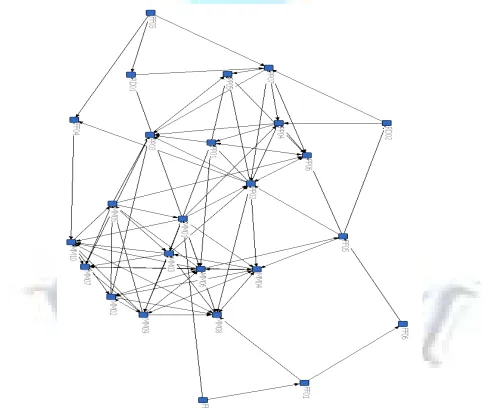
DEGREE CENTRALITYAnalysis of degree centrality of the interdepartmental employee network (Appendix: Figure 1) is shown in Table 2. ‘In Degree’ Centrality refers to the number of ties that the actor (employee) receives and ‘Out Degree’ centrality refers to the ties that an actor seeks to have. Employee Numbers MM01 and PP02 have the highest out degree of 8 and 8. These two employees are the best node to disseminate information to the network. The ‘In Degree’ is highest for Employees MM06 and MM10 with a score of 7. It can be concluded that they are the most influential employees.
TABLE 2: DEGREE CENTRALITY
Emp No. Out Degree In Degree MM01 8 4 PP02 8 5 MM04 6 6 MM09 6 4 MM08 5 7 PP07 5 4 MM07 5 4 PP01 5 3 MM03 5 5 PP06 5 6 MM06 5 7 MM02 4 4 MM10 4 7 MM05 4 5 FF05 4 2 PP04 3 5 FF03 3 0 FF01 2 1 PP03 2 6 FF02 2 0 RD02 2 1 FF04 1 2 RD01 1 2 FF06 1 1 PP05 0 5
EIGEN VALUE
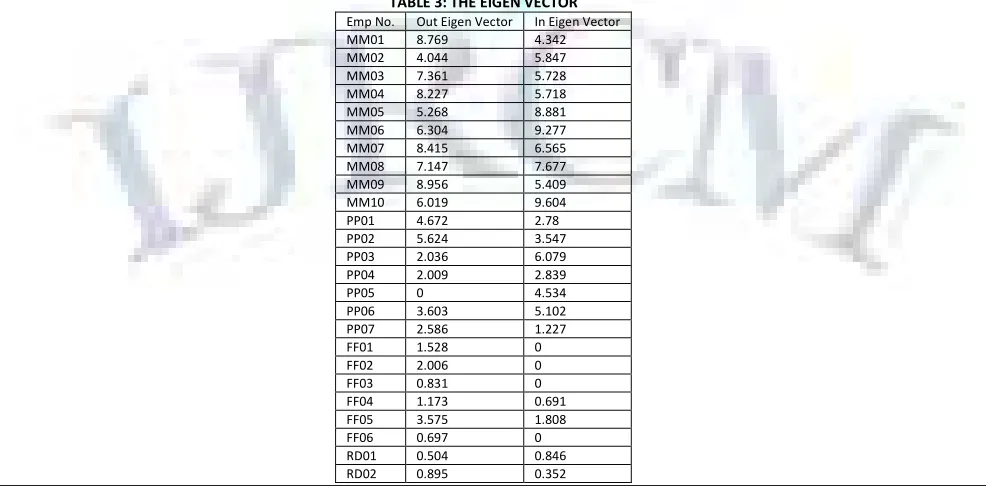
Eigen value can be used to determine which employee is more central among high degree employee. It was found in the earlier table that the ‘In Degree’ is highest for Employees MM06 and MM10 with a score of 7. The ‘In Eigen’ vector value (Table 3) for Employee MM10 (SCORE: 9.604) is the highest. It means most employees seek his help in the interdepartmental network. Thus he is the natural leader of the network.
TABLE 3: THE EIGEN VECTOR
INTERNATIONAL JOURNAL OF RESEARCH IN COMMERCE, IT & MANAGEMENT
CLOSENESS CENTRALITY
Analysis of Closeness centrality of the interdepartmental employee network (Appendix: Figure 1) is shown in Table 4. ‘inFarness’ is the sum of the column of the geodesic distance. ’OutFarness’ is the sum of row of the geodesic distance. Employee Number P05 is the closest to highest number of other employees (inCloseness score 43.63). This employee can be used to spread information or new skill in the fastest possible time.
TABLE 4: CLOSENESS CENTRALITY
Emp No. inFarness outFarness inCloseness outCloseness
P05 55 600 43.636 4
PP03 71 159 33.803 15.094
MM08 71 142 33.803 16.901
MM04 71 143 33.803 16.783
PP06 71 146 33.803 16.438
MM06 72 142 33.333 16.901
MM07 74 144 32.432 16.667
MM10 74 147 32.432 16.327
MM03 75 139 32 17.266
PP02 75 137 32 17.518
PP04 78 150 30.769 16
MM05 80 142 30 16.901
MM02 80 145 30 16.552
MM09 81 143 29.63 16.783
MM01 81 133 29.63 18.045
PP07 84 149 28.571 16.107
PP01 85 139 28.235 17.266
FF05 89 141 26.966 17.021
FF04 92 163 26.087 14.724
RD01 96 165 25 14.545
RD02 108 159 22.222 15.094
FF06 553 137 4.34 17.518
FF01 576 111 4.167 21.622
FF03 600 135 4 17.778
FF02 600 81 4 29.63
BETWEENESS CENTRALITY
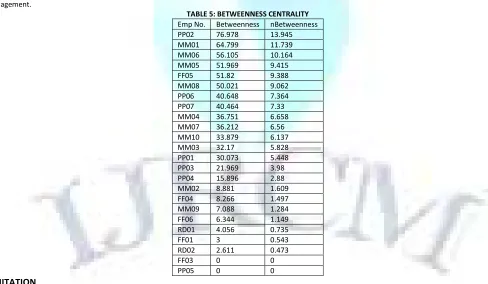
A node with high betweenness has great influence over what flows - and does not - in the network. They form the ‘broker’ and know the general thought process of the network. Table 5 shows that Employee numbers PP02 and MM01 have 76.9 and 64.7 betweenness . They form the anchor between various departments in the network. To understand the viewpoint of network and to understand the information flow, these employees can be tapped by the management.
TABLE 5: BETWEENNESS CENTRALITY Emp No. Betweenness nBetweenness PP02 76.978 13.945 MM01 64.799 11.739 MM06 56.105 10.164 MM05 51.969 9.415 FF05 51.82 9.388 MM08 50.021 9.062 PP06 40.648 7.364 PP07 40.464 7.33 MM04 36.751 6.658 MM07 36.212 6.56 MM10 33.879 6.137 MM03 32.17 5.828 PP01 30.073 5.448 PP03 21.969 3.98 PP04 15.896 2.88 MM02 8.881 1.609 FF04 8.266 1.497 MM09 7.088 1.284 FF06 6.344 1.149 RD01 4.056 0.735
FF01 3 0.543
RD02 2.611 0.473
FF03 0 0
PP05 0 0
LIMITATION
The study has the following limitations:
1. The results of this network analysis cannot be extrapolated to other similar shaped network as the nodes and connections in the network may differ in other studies.
2. If some key employees studied in the network leave the organization, the entire network needs to be reanalyzed.
3. The selection of participants was based on Management and employees input. Selection could have been made more objective by management independent survey.
DISCUSSION
VOLUME NO.2(2012),ISSUE NO.2(FEBRUARY) ISSN2231-5756 1. The natural leader in the interdepartmental network is Employee MM10 (‘In Eigen’ vector value: 9.604).
2. The two influential personnel in the interdepartmental network are Employees MM06 and MM10 with a ‘In Degree’ score of 7 each.
3. The members who have access to information flow in the network and who form the anchors between various departments in the network are Employee numbers PP02 and MM01 with ‘betweenness’ value of 76.9 and 64.7 respectively .
4. The member who can be used to disseminate information is Employee Number P05 with a ‘inCloseness’ score of 43.63. This employee can be used to spread information or new skill in the fastest possible time.
5. Measure the length of network.
CONCLUSION AND IMPLICATIONS FOR FUTURE RESEARCH
This study has contributed to research in practical use of Social Network Analysis. By establishing that the analysis will be helpful in critical management – interdepartmental negotiations, the study paves the way for other similar research in organization, not only in interdepartmental negotiations but also in routine management aspects like network study of multidisciplinary teams, study of interdepartmental projects, intra department issues, Branding, CRM and similar organizational issues.
REFERENCES
1. Allen, J., James, A. D., & Gamlen, P. (2007). Formal versus informal knowledge networks in R&D: a case study using social network analysis. R&D Management, 37(3), 179-196. Blackwell Publishing Limited.
2. Freeman, Linton. (2006). The Development of Social Network Analysis. Vancouver: Empirical Pres, 2006; Wellman, Barry and S.D. Berkowitz, eds., 1988. Social Structures: A Network Approach. Cambridge: Cambridge University Press.
3. Izquierdo, L. R., & Hanneman, R. A. (2006). INTRODUCTION TO THE FORMAL ANALYSIS OF SOCIAL NETWORKS USING MATHEMATICA. Network, 60. University of California–Riverside, CA.
4. Kronenfeld, D. B. (2001). Introduction: The uses of formal analysis re cognitive and social issues. Anthropological Theory, 1(2), 147-172. 5. Tilly, Charles. (2005). Identities, Boundaries, and Social Ties. Boulder, CO: Paradigm press. ISBN 1-59451-131-4
APPENDIX
FIGURE 1: SOCIAL NETWORK GRAPH OF KEY INTERDEPARTMENTAL MEMBERS
• The numbers in the Graph nodes represent the Employee Numbers (Dummy numbers have replaced the actual employee number in this paper to maintain privacy of employees).
INTERNATIONAL JOURNAL OF RESEARCH IN COMMERCE, IT & MANAGEMENT
REQUEST FOR FEEDBACK
Dear Readers
At the very outset, International Journal of Research in Commerce, IT and Management (IJRCM)
acknowledges & appreciates your efforts in showing interest in our present issue under your kind perusal.
I would like to request you to supply your critical comments and suggestions about the material published
in this issue as well as on the journal as a whole, on our E-mails i.e.
[email protected] or
[email protected] for further improvements in the interest of research.
If you have any queries please feel free to contact us on our E-mail [email protected].
I am sure that your feedback and deliberations would make future issues better – a result of our joint
effort.
Looking forward an appropriate consideration.
With sincere regards
Thanking you profoundly
Academically yours
Sd/-