Please cite this article as: M. Nikravesh, G. H. Akbari, A. Poladi, Mechanical Properties and Microstructural Evolution of Ta/TaNx Double Layer Thin Films Deposited by Magnetron Sputtering, International Journal of Engineering (IJE), TRANSACTIONS B: Applications Vol. 30, No. 2, (February 2017) 288-293
International Journal of Engineering
J o u r n a l H o m e p a g e : w w w . i j e . i r
Mechanical Properties and Microstructural Evolution of Ta/TaN
xDouble Layer Thin
Films Deposited by Magnetron Sputtering
M. Nikravesh*a, G. H. Akbaria, A. Poladib
a Department of Material Science and Engineering, Shahid Bahonar University, Kerman, Iran. b Faculty of Materials Science and Engineering, Semnan University, Semnan, Iran.
P A P E R I N F O
Paper history: Received 04 January 2017
Received in revised form 09 January 2017 Accepted 22 January 2017
Keywords: Nano-indentation Tantalum Thin film Grain size
Phase characterization
A B S T R A C T
Crystalline tantalum thin films of about 500nm thickness were deposited on AISI 316L stainless steel substrate using magnetron sputtering. To investigate the nano-mechanical properties of tantalum films, deposition was performed at two temperatures (25°C and 200°C) on TaNx intermediate layer with different N2/Ar flow rate ratio from 0 to 30%. Nano-indentation was performed to obtain the mechanical properties of the films including hardness, Young’s modulus and plasticity free of substrate influence. Cross sectional FESEM was performed to measure the thickness of films. To evaluate the results, the grain size and crystallographic structure of the films was obtained, using atomic force microscopy (AFM) and X-Ray diffraction (XRD) respectively. It was found that, increasing sputtering temperature up to 200°C leads to slight decrease in hardness and Young’s modulus, and small increase in plasticity due to grain growth without any phase transformation. Whereas, using TaNx interlayer promoted formation of cubic-tantalum with higher plasticity and lower hardness in comparison to tetragonal structure. Therefore, it can makes tantalum film an applicable product for mechanically protecting.
doi: 10.5829/idosi.ije.2017.30.02b.16
1. INTRODUCTION1
In the last decades, many research efforts have been made in the area of wear protection of materials using hard, tough and thermally stable coatings. In this regard, tantalum and tantalum alloys, have attracted considerable interest because of their attractive properties such as low ductile-to-brittle transition temperature, high ductility, good corrosion resistance and high strength at high temperatures [1-5]. As the imposing of tantalum coatings has lower environmental pollution, tantalum is an alternative material replace chromium coatings [6].
Tantalum has two crystallographic structures; cubic and tetragonal. Although tetragonal tantalum has higher hardness [7, 8], cubic tantalum thin films are preferred for mechanically protecting applications, because of higher ductility and plasticity, and lower Young’s
1*Corresponding Author’s Email: [email protected] (M. Nikravesh)
modulus [6, 7], which results in higher fatigue strength [9] and lower film residual stresses [10].
Plasticity is the capacity to resist plastic deformation.
It is defined as the ratio of plastic displacement divided by the total displacement in the
load-displacement curve of the nano-indentation
measurements Equation (1) [11]:
Plasticity=εp/εtot (1)
probability of cubic tantalum formation, because its lattice constant is very close to that of tantalum [16-19]. The motivation of this work is producing tantalum thin film which can be applied as mechanically protective coating materials. This paper presents the mechanical properties data of thin tantalum films (i.e. hardness, Young’s modulus and plasticity) using load-displacement curves of nano-indentation [20-23]. Atomic force microscope (AFM) and X-Ray diffraction has been utilized to investigate the effect of applying tantalum nitride interlayer and substrate temperature on grain size and structural variations, respectively. Also, the thickness of the deposited films were measured using field emission scanning electron microscopy (FESEM).
2. MATERIALS AND METHOD
AISI 316L stainless steel discs with 30mm diameter and 10mm thickness were cut and polished as substrate. All specimens were cleaned by rinsing in ultrasonic baths of acetone and methanol prior to deposition process.
The tantalum films were synthesized by direct current magnetron sputtering onto substrate under base and working pressures of 5×10⁻⁶ and 5×10⁻³ Torr, respectively. 99.95% pure tantalum was used as the target. A series of tantalum thin films films with thickness of about 500nm were deposited with different conditions of interlayers in both room temperature and 200°C as presented in Table 1.
TaNx interlayer was applied by nitrogen leaks with flow ratios of 10, 20 and 30% into the sputtering chamber for 3min to synthesize seed layer with about 100nm thickness, before final tantalum thin film deposition.
Nano-indentation measurements performed using Hysitron nano-indentation instrument with Berkovich tip to obtain mechanical properties. An indentation load of 500μN was used to limit the depth of penetration of the indenter to less than 10% of the film thickness.
TABLE 1. Sputtering parameters for Ta films
Specimens Code
N2/Ar flow rate
ratio (%) Power (W)
Temparature (°C)
Ta002025 0 20 25
Ta0020200 0 20 200
Ta102025 10 20 25
Ta1020200 10 20 200
Ta202025 20 20 25
Ta2020200 20 20 200
Ta302025 30 20 25
Ta3020200 30 20 200
Three indentations were performed in each sample for more accurate results. The crystallographic structures of the films were characterized by means of X-ray diffraction with Cu-Kα radiations. The surface morphology of the films was analyzed using AFM operated at non-contact mode.
The cross section of the Ta/TaNx multilayer coatings were observed by field-emission scanning electron microscopy of TESCAN-MIRA III.
3. RESULTS AND DISCUSSION
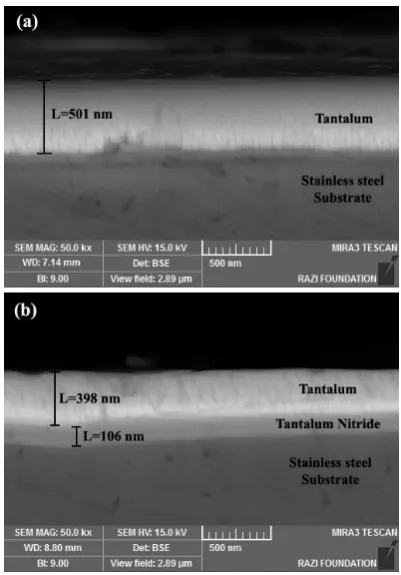
The depositions of different samples were carried out under different conditions. The thicknesses were measured according to the cross sectional FESEM images of tantalum films. The cross-sectional images of two specimens with and without TaN seed layer are shown in Figure 1:
As cross sectional images of all specimens are similar to these samples and have the same thickness, a typical cross section of Ta/TaNx thin film obtained from samples, is shown in Figure 1.
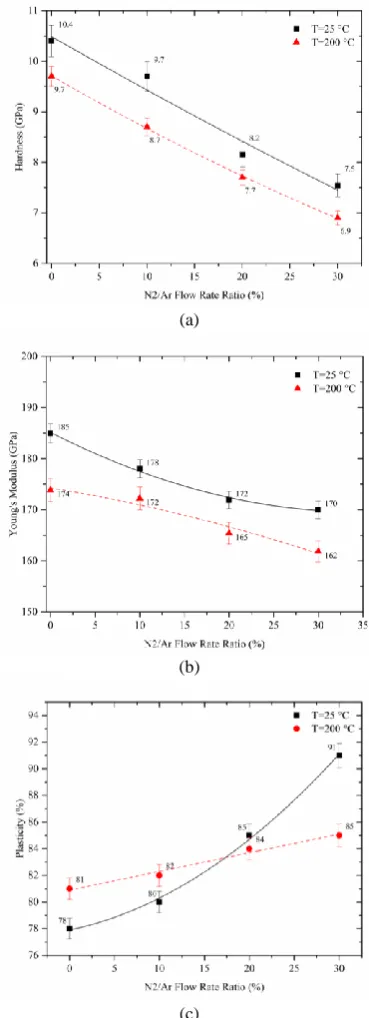
The thickness of tantalum thin films varied slightly due to differences between samples at less than ±20 nm. Therefore, the growth rate was calculated as 35 nm/min. Figure 2(a) and (b) show the hardness and Young’s modulus of tantalum thin films extracted from load-displacement curves of nano-indentation tests.
Figure 1. SEM images of the typical cross section of (a) Ta
As demonstrated in these figures, with increasing temperature up to 200°C, the hardness and Young’s modulus values of deposited films were decreased as the nitrogen content of interlayer increased.
Furthermore, the hardness of the tantalum thin films. Also, there is a slight decrease (about 8%) in the Young’s modulus of tantalum film deposited at both room temperature and 200°C, with increase in nitrogen content of interlayer.
The decrease in hardness and Young’s modulus due to arising temperature is related to grain growth during sputtering. The average grain size of specimens from AFM images [24], are demonstrated in Figure 4. Based on this figure, the grain size is clearly increased as temperature rises. This behavior is due to the increasing of surface diffusion (mobility) which results in coalescence of the grains which in turn produces larger grains [13, 25-28]. This result is in agreement with Thornton model [29]. The grain size increment with increasing temperature is 33, 33, 27 and 42% related to nitrogen flow rate ratio of 0, 10, 20 and 30% respectively.
Hardness levels are known to be related to grain
size, as demonstrated by the Hall-Petch equation [20]. It
demonstrates that grain growth caused by substrate heating during deposition, leads to decrease in hardness [30], due to increment of dislocation mean free path [31]. Infact, grain boundaries act as a barrier to dislocation motion [28]. Therefore, as demonstrated in Figure 2 (a), the hardness of the room temperature deposited tantalum films (RT-Ta) is greater than the high temperature deposited tantalum films (HT-Ta), which is agreement with the Hall-Petch phenomenon. Furthermore, Young’s modulus of the RT-Ta is greater than the HT-Ta. It can be concluded that as grain size increases, Young’s modulus rises. However, as described in Ref. [30] the Young's modulus values, do not exhibit any systematic variation with either growth texture or grain size, but the results show that the behavior of Young’s modulus is rather similar to that of hardness [28]. This conclusion may be related to increase of defects concentration due to temperature rise. Therefore, more defects concentration leads to lower Young’s modulus [22, 32].The AFM images of Ta films deposited on interlayer with different NFR from 0 to 30% at room temperature (a-d) and 200°C (e-h) are shown in Figure 3. Surprisingly, Figure 4 which demonstrates grain size values extracted from AFM analysis, shows that the average grain size is decreased with increasing interlayer nitrogen content. The grain size of Ta films deposited at room temperature and 200°C decreases from 80 nm to 53nm and from 106nm to 75nm respectively as NFR is increased from 10% to 30% which is expected to increase the hardness according to Hall-Petch phenomenon. However, as shown in Figure 2 (a, b), the results show a decrease in hardness and
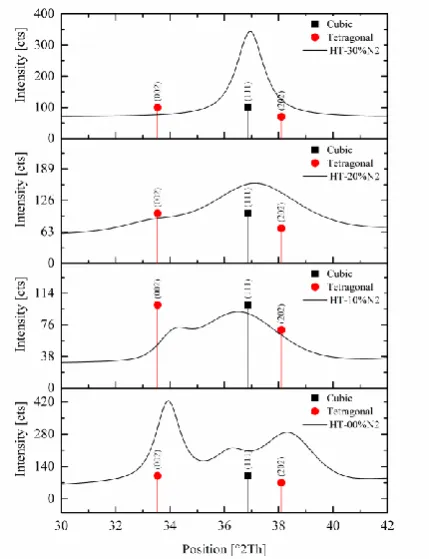
Young’s modulus with an increase in NFR. XRD pattern study of specimens show that using TaNx interlayer not only leads to grain refinement but also results in phase transformation in tantalum thin films. The XRD patterns of tantalum films grown on interlayer with different nitrogen content at room temperature and 200°C are shown in Figures 5 and 6, respectively.
(a)
(b)
(c)
Figure 2. Values of (a) the hardness, (b) the Young’s modulus
Figure 2. AFM images of Ta films on stainless steel substrate as a function of different parameters: (I) at room temperature using TaNx interlayer with (a) NFR=0%, (b) NFR=10%, (c)
NFR=20% and (d) NFR=30%; (II) at 200°C using TaNx
interlayer with (e) NFR=0%, (f) NFR=10%, (g) NFR=20% and (h) NFR=30%.
Figure 4. The average grain size at RT and 200°C deposited
Ta thin films as function of N2/Ar flow rate ratio
The comparison of the films deposited on stainless steel substrate and on tantalum nitride interlayer with NFR =10% at both room and high temperatures, show strong peak, at position 33.5° and 40.2° identified for the tetragonal crystalline structure of tantalum.
In the present work, by increasing the NFR, the intensity of the peaks corresponding to tetragonal tantalum is decreased with an increase in cubic tantalum peaks at 36.9° and 38.4°.𝐶𝑖𝑛𝑣 and𝐶𝑒𝑠𝑡 as fixed costs. In
Table 1, the fixed parameters are stated.
These variations indicate a phase transformation from tetragonal tantalum to cubic structure tantalum with lower hardness and superior plasticity.
Figure 3. XRD patterns of the Ta films deposited on
interlayer with different nitrogen content at room temperature (RT)
Figure 4. XRD patterns of the Ta films deposited on
Obviously, derived from the above results, lattice matching via modifying the atomic structure of the TaNx interlayer, is of great importance in governing the phase transformation of the subsequent tantalum thin film. These results are in good agreement with the reported work by Tsao et al. [17]. Eventually, hardness reduction due to phase transformation from β-tantalum to α-tantalum is in contrary to hardness enhancement due to grain refinement. So, in this case, the phase transformation is the dominant factor. The phase transformation from tetragonal tantalum to cubic structure tantalum is in association with plasticity enhancement as demonstrated in Figure 2(c). According to this figure, using TaNx interlayer with NFR of 30% leads to 91% plasticity due to simultaneous phase transformation and grain refinement without heating substrate.
However the increase in temperature caused in enhancement of plasticity due to grain enlargement (Figure 2(c)), but the XRD pattern of Ta thin film deposited at 200°C without applying interlayer (Figure 6), shows that increasing temperature to 200°C could not result in formation of single phase cubic tantalum thin film with lower hardness and superior plasticity compared with quasi static tetragonal tantalum.
4. CONCLUSION
In summary, the effects of temperature and TaNx interlayer on the mechanical properties and microstructure of magnetron sputtered tantalum thin film were investigated and the following results were obtained:
1-Increasing the plasticity of Ta thin films using TaNx interlayer is an effective method to develope these films as mechanically protecting coatings.
2-Using TaNx interlayer leads to increase in the plasticity of subsequent tantalum thin film up to 91% due to decrease in hardness and Young’s modulus.
3-Applying TaNx interlayer results in grain refinement of tantalum thin film.
4-Tantalum thin film with cubic structure was promoted by tantalum nitride interlayer.
5-The higher temperature leads to slight decrease in hardness and Young’s modulus due to grain growth.
5. REFERENCES
1. Alishahi, M., Mahboubi, F., Khoie, S.M., Aparicio, M., Hübner, R., Soldera, F. and Gago, R., "Electrochemical behavior of nanocrystalline Ta/TaN multilayer on 316l stainless steel: Novel bipolar plates for proton exchange membrane fuel-cells", Journal of Power Sources, Vol. 322, No. 4, (2016), 1-9. 2. Yu, H., Yang, L., Zhu, L., Jian, X., Wang, Z. and Jiang, L.,
"Anticorrosion properties of TA-coated 316l stainless steel as
bipolar plate material in proton exchange membrane fuel cells", Journal of Power Sources, Vol. 191, No. 2, (2009), 495-500.
3. Zhang, M., Zhang, Y., Rack, P., Miller, M.K. and Nieh, T.-G., "Nanocrystalline tetragonal tantalum thin films", Scripta Materialia, Vol. 57, No. 11, (2007), 1032-1035.
4. Pham, V.-H., Lee, S.-H., Li, Y., Kim, H.-E., Shin, K.-H. and Koh, Y.-H., "Utility of tantalum (Ta) coating to improve surface hardness in vitro bioactivity and biocompatibility of Co–Cr", Thin Solid Films, Vol. 536, No.2, (2013), 269-274.
5. Choe, C., Choi, H., Hong, W. and Lee, J.-J., "Tantalum nitride coated AISI 316l as bipolar plate for polymer electrolyte membrane fuel cell", international journal of hydrogen energy, Vol. 37, No. 1, (2012), 405-411.
6. A., Y., Characterization of alpha and beta phases of tantalum coatings. (2001): A New Jersey Institute of Technology. 7. Myers, S.W., Investigation of the beta to alpha phase transition
of thick tantalum coatings deposited bymodulated pulsed power magnetron sputtering. (2012): Colorado School of United States. 8. Zhou, Y., Xie, Z., Xiao, H., Hu, P. and He, J., "Effects of deposition parameters on tantalum films deposited by direct current magnetron sputtering in Ar–O2 mixture", Applied Surface Science, Vol. 258, No. 5, (2011), 1699-1703.
9. Hertl, C., Koll, L., Schmitz, T., Werner, E. and Gbureck, U., "Structural characterisation of oxygen diffusion hardened alpha-tantalum PVD-coatings on titanium", Materials Science and Engineering: C, Vol. 41, (2014), 28-35.
10. Huang, J.-Y., "An investigation into the fundamental phase and orientation properties of sputtered tungsten and tantalum thin films, Vol. 265, No. 3, (2003), 27-34.
11. Zhang, S. and Zhang, X., "Toughness evaluation of hard coatings and thin films", Thin Solid Films, Vol. 520, No. 7, (2012), 2375-2389.
12. Srinivas, K., Raja, M.M., Rao, D.S. and Kamat, S., "Effect of sputtering pressure and power on composition, surface roughness, microstructure and magnetic properties of AS-deposited CO2FeSi thin films", Thin Solid Films, Vol. 558, No.5, (2014), 349-355.
13. Anders, A., "A structure zone diagram including plasma-based deposition and ion etching", Thin Solid Films, Vol. 518, No. 15, (2010), 4087-4090.
14. Chang, L.-C., Chen, Y.-I. and Kao, H.-L., "Annealing of sputter-deposited nanocrystalline Cr–TA coatings in a low-oxygen-containing atmosphere", Thin Solid Films, Vol. 520, No. 23, (2012), 6929-6934.
15. Matson, D.W., McClanahan, E.D., Rice, J.P., Lee, S.L. and Windover, D., "Effect of sputtering parameters on TA coatings for gun bore applications", Surface and Coatings Technology, Vol. 133, No.6, (2000), 411-416.
16. Gladczuk, L., Patel, A., Demaree, J.D. and Sosnowski, M., "Sputter deposition of BCC tantalum films with TaN underlayers for protection of steel", Thin Solid Films, Vol. 476, No. 2, (2005), 295-302.
17. Tsao, J.-C., Liu, C.-P., Fang, H.-C. and Wang, Y.-L., "How tantalum proceeds phase change on tantalum nitride underlayer with sequential ar plasma treatment", Materials Chemistry and Physics, Vol. 137, No. 3, (2013), 689-693.
18. Chen, G., Chen, S., Huang, S. and Lee, H., "Growth mechanism of sputter deposited ta and Ta–N thin films induced by an underlying titanium layer and varying nitrogen flow rates", Applied Surface Science, Vol. 169, No.11, (2001), 353-357. 19. Bernoulli, D., Müller, U., Schwarzenberger, M., Hauert, R. and
20. Chen, Y.-T. and Wu, C.-W., "Effect of grain size on nano-indentation property of Co60Fe20B20 thin film", Journal of Alloys and Compounds, Vol. 551, No.7, (2013), 360-364.
21. Chen, Y.-T. and Wu, C.-W., "Effect of grain size on nanomechanical property Ni80Fe20 thin film", Intermetallics, Vol. 34, No.13, (2013), 89-93.
22. Braccini, M., Volpi, F., Devos, A., Raymond, G., Benoit, D. and Morin, P., "Elastic properties of tensile nitrogen-plasma-treated multilayer silicon nitride films", Thin Solid Films, Vol. 551, No.7, (2014), 120-126.
23. Cherneva, S., Iankov, R., Radic, N., Grbic, B. and Stoychev, D., "Nanoindentation investigation of mechanical properties of ZrO 2, ZrO2–Y2O3, Al2O3 and TiO2 thin films deposited on stainless steel OC 404 substrate by spray pyrolysis", Materials Science and Engineering: B, Vol. 183, No.9, (2014), 12-16.
24. Ţǎlu, Ş., Stach, S., Valedbagi, S., Elahi, S.M. and Bavadi, R., "Surface morphology of titanium nitride thin films synthesized by dc reactive magnetron sputtering", Materials Science-Poland, Vol. 33, No. 1, (2015), 137-143.
25. Muslim, N., Soon, Y.W., Lim, C.M. and Voo, N.Y., "Properties of nickel films growth by radio frequency magnetron sputtering at elevated substrate temperatures", Thin Solid Films, Vol. 612, No.9, (2016), 82-86.
26. Rafieerad, A., Bushroa, A., Nasiri-Tabrizi, B., Vadivelu, J., Baradaran, S., Mesbah, M. and Zavareh, M.A., "Mechanical properties, corrosion behavior and in-vitro bioactivity of nanostructured pd/pdo coating on Ti–6Al–7NB implant", Materials & Design, Vol. 103, No.4, (2016), 10-24.
27. Chen, X., Wang, Y.-W., Liu, X., Wang, X.-Y., Wang, X.-B., An, S.-D. and Zhao, Y.-Q., "Molecular dynamics study of the effect of titanium ion energy on surface structure during the amorphous TiO2 films deposition", Applied Surface Science, Vol. 345, No.11, (2015), 162-168.
28. Khojier, K., Savaloni, H., Ashkabusi, Z. and Dehnavi, N., "Structural, mechanical and tribological characterization of chromium oxide thin films prepared by post-annealing of Cr thin films", Applied Surface Science, Vol. 284, No.4, (2013), 489-496.
29. Cristea, D., Pătru, M., Crisan, A., Munteanu, D., Craciun, D., Barradas, N., Alves, E., Apreutesei, M., Moura, C. and Cunha, L., "Composition and structure variation for magnetron sputtered tantalum oxynitride thin films, as function of deposition parameters", Applied Surface Science, Vol. 358, No.4, (2015), 508-517.
30. Saha, R. and Barnard, J.A., "Effect of structure on the mechanical properties of ta and Ta (N) thin films prepared by reactive DC magnetron sputtering", Journal of crystal growth, Vol. 174, No. 1-4, (1997), 495-500.
31. Dubey, P., Arya, V., Srivastava, S., Singh, D. and Chandra, R., "Effect of nitrogen flow rate on structural and mechanical properties of zirconium tungsten nitride (Zr–W–N) coatings deposited by magnetron sputtering", Surface and Coatings Technology, Vol. 236, No.5, (2013), 182-187.
32. Mody, N., Hwang, R., Venka-Taraman, S., Angelo, J., Norwood, D. and Gerberich, W., "Adhesion and fracture of tantalum nitride films", Acta materialia, Vol. 46, No. 2, (1998), 585-597.
Mechanical Properties and Microstructural Evolution of Ta/TaN
xDouble Layer Thin
Films Deposited by Magnetron Sputtering
M. Nikravesha, G. H. Akbaria, A. Poladib
a Department of Material Science and Engineering, Shahid Bahonar University, Kerman, Iran. b Faculty of Materials Science and Engineering, Semnan University, Semnan, Iran.
P A P E R I N F O
Paper history: Received 04 January 2017
Received in revised form 09 January 2017 Accepted 22 January 2017
Keywords: Nano-indentation Tantalum Thin film Grain size
Phase characterization
ديكچ ه
دودح رد تماخض اب راتخاس ونان مولاتنات کزان ملیف 500
نزن گنز دلاوف یور رب رتمونان
AISI316L
دنیآرف طسوت
( امد ود رد یناشن هیلا ،مولاتنات ملیف یکیناکمونان صاوخ یسررب روظنم هب .دش یناشن هیلا یسیطانغم شاپودنک
°C
25 و
°C
200 ینایم هیلا یور رب )
TaNx
ات رفص زا نوگرآ هب نژورتین یولف تبسن اب 30
ونان نومزآ .دش ماجنا %
هب هدنورورف
ملیف یکیناکم صاوخ هب یبایتسد روظنم تماخض .دش ماجنا هیلاریز ریثات نودب هتیسیتسلاپ و گنای لودم ،یتخس لماش اه
هیلا رشن یشبور ینورتکلا پوکسورکیم کمک هب عطقم حطس ریوصت طسوت کزان یاه هزادنا ینادیم
روظنم هب .دش یریگ
( یمتا یورین پوکسورکیم طسوت بیترت هب ملیف یلاتسیرک یراتخاس و هناد هزادنا ،جیاتن یبایزرا
AFM
وترپ شارپ و )
( سکیا
XRD
ات یناشن هیلا یامد شیازفا هک تسا نآ زا یکاح جیاتن .دش ماجنا ) 200
هناد دشر لیلد هب دارگیتناس هجرد
تارییغت نودب هک یلاح رد .دیدرگ هتیسیتسلاپ رد یکدنا شیازفا و گنای لودم و یتخس رد یکدنا شهاک هب رجنم ،یزاف
( یدیرتین ینایم هیلا زا هدافتسا
TaNx
رد رتمک یتخس و رتشیب هتیسیتسلاپ اب مولاتنات یبعکم زاف لیکشت تیوقت هب رجنم ،)
یغت نیا .دیدرگ لانوگارتت رادیاپ هبش راتخاس اب هسیاقم یم ببس راتخاس ری
زا ظفاحم هیلا ناونع هب مولاتنات ملیف هک ددرگ
.دشاب هدافتسا لباق یکیناکم ظاحل