VOLUME NO. 1 (2011), ISSUE NO. 6 (NOVEMBER) ISSN2231-5756
I
I
I
N
N
N
T
T
T
E
E
E
R
R
R
N
N
N
A
A
A
T
T
T
I
I
I
O
O
O
N
N
N
A
A
A
L
L
L
J
J
J
O
O
O
U
U
U
R
R
R
N
N
N
A
A
A
L
L
L
O
O
O
F
F
F
R
R
R
E
E
E
S
S
S
E
E
E
A
A
A
R
R
R
C
C
C
H
H
H
I
I
I
N
N
N
C
C
C
O
O
O
M
M
M
M
M
M
E
E
E
R
R
R
C
C
C
E
E
E
,
,
,
I
I
I
T
T
T
A
A
A
N
N
N
D
D
D
M
M
M
A
A
A
N
N
N
A
A
A
G
G
G
E
E
E
M
M
M
E
E
E
N
N
N
T
T
T
A Monthly Double-Blind Peer Reviewed Refereed Open Access International e-Journal - Included in the International Serial Directories
Indexed & Listed at: Ulrich's Periodicals Directory ©, ProQuest, U.S.A., Index Copernicus Publishers Panel, Poland, Open J-Gage, India
C
C
C
CONTENTS
ONTENTS
ONTENTS
ONTENTS
Sr.
No.
TITLE & NAME OF THE AUTHOR (S)
Page No.
1
.
A POLICY FRAMEWORK FOR MANAGING DIVERSITY IN THE DEPARTMENT OF THE PREMIER OF THE WESTERN CAPE PROVINCIAL GOVERNMENTDESMOND VAN DER WESTHUIZEN, DR. SHAUN PEKEUR & MOHAMED SAYEED BAYAT
1
2
.
OPPORTUNITIES OF TOURISM SECTOR IN BANGLADESHMD. ZAHIR UDDIN ARIF, MD. NAZRUL ISLAM & MD. SHAFIQUL ISLAM
10
3
.
AN EMPIRICAL BIVARIATE CASE STUDY ON ASSOCIATIONS BETWEEN SELECT FACTORS CONCERNING POST GRADUATE STUDENTS AND THEIR ACADEMIC PERFORMANCENIRAJ MISHRA & PREETI SHRIVASTAVA
18
4
.
A STUDY ON THE RELATIONSHIP BETWEEN CORPORATE FINANCIAL PERFORMANCE AND CORPORATE SOCIAL RESPONSIBILITY (CSR)ALIYAR MOHAMED SHEHAM & DR. ATHAMBAWA JAHFER
25
5
.
FACTORS RELATED TO THE PERFORMANCE OF LOW COST ELECTRONIC PRODUCTS IN BANGLADESHMD. RIFAYAT ISLAM
32
6
.
EMPLOYEE SATISFACTION: A CASE STUDY OF A LEADING MULTINATIONAL TELECOMMUNICATION COMPANY IN BANGLADESHDR. TAIMUR SHARIF & SELINA AKTER
36
7
.
EFFECT OF FAMILY CONTROL AND INTERNAL AUDITOR ON ACCURAL ITEMS OF OPERATIONAL ACCOUNTING (GIULI AND HIN CCONSERVATIVE MODEL)MOHAMADREZA ABDOLI
45
8
.
THE EFFECT OF INTELLECTUAL CAPITAL ON THE ORGANIZATIONAL PERFORMANCEDR. AMIR HOSSEIN AMIRKHANI, SAYD MEHDI VEISEH, MEYSAM ERTEGHAEI & HAMIDEH SHEKARI
49
9
.
TEACHER STRESS: THE SOURCES OF TEACHER STRESS AND THEIR CONSEQUENCESRABIA MUSHTAQ
54
10
.
RETAILING IN INDIA: OPPORTUNITIES & CHALLENGESANIL KUMAR .S. HAGARGI & DR. RAJNALKAR LAXMAN
60
11
.
GROWTH AND SUSTAINABILITY OF INDIAN BANKING SECTORDR. M. L. GUPTA & DR. REKHA GARG
64
12
.
A STUDY ON LOCUS OF CONTROL OF EMPLOYEES IN TEXTILE COMPANIES AT SALEM DISTRICT, TAMILNADUM. GURUSAMY, A. VELSAMY & DR. N. RAJASEKAR
67
13
.
ORGANIZATIONAL EFFECTIVENESS AND SERVICE EFFICIENCY: A COMPARATIVE STUDY SELECT INDIAN BANKSDR. ASHOK AIMA & NAVEEDA SEHER
73
14
.
EMPLOYEE WELFARE ACTIVITIES WITH RESPECTIVE MEASURES IN INDUSTRIAL SECTOR - A STUDY ON INDUSTRIAL CLUSTER AT CHITTOR DISTRICTDR. P. VENUGOPAL, T. BHASKAR & P. USHA
78
15
.
MOTIVATORS AND INHIBITORS OF ONLINE SHOPPING IN HYDERABADMOHD LAYAQ AHAMAD & SHAIKH MOHD ZAFAR
84
16
.
A STUDY ABOUT HEALTH PROBLEMS OF EMPLOYEES WORKING IN IT AND ITES INDUSTRY IN THE ASPECTS OF ERGONOMICSDR. C. S. RAMANI GOPAL & DR. G. PALANIAPPAN
88
17
.
A STUDY ON THE USAGE OF KNOWLEDGE MANAGEMENT PRACTICE IN AVASARALA TECHNOLOGIES LIMITED (ATL)A. MANI MARAN, S. SUNDARAMURTHY REDDY & P. SELVA KUMAR
94
18
.
OUTSOURCING OF HR SERVICES AT ITC MAURYA SHERATON HOTEL & TOWERSRISHI DOGRA & COL K. S. MADAAN
101
19
.
ANALYTICAL STUDY OF ICT SERVICES AND SKILLS IN THE MODERN EDUCATION SYSTEMDHANANJAY MANDLIK, MADHUWANTI SATHE & DR. PARAG KALKAR
106
20
.
A COMPARATIVE STUDY OF ORGANISATIONAL CLIMATE: INDIAN MULTINATIONAL COMPANIES IT EXECUTIVES VS. FOREIGN MULTINATIONALS COMPANIES IT EXECUTIVESANURAG SINGH
110
21
.
FAMILY VS. WORK CONFLICT AMONG WORKING WOMEN IN INDIA WITH SPECIAL REFERENCE TO IT, EDUCATION AND BANKING SECTORA. VANITHA & DR. S. MEENAKUMARI
113
22
.
BANKING PROFESSIONALS AND ATTITUDINAL DIMENSION OF JOB SATISFACTION: A DESCRIPTIVE STUDYS.M. SHARIQ ABBAS
119
23
.
USE OF ICT IN LEARNING OF ENGLISH PRONUNCIATION, GRAMMAR AND VOCABULARY OF SECONDARY SCHOOL STUDENTSRANJIT SINGH
125
24
.
MANAGING CONFLICT THROUGH CONFRONTATION: AN OD INTERVENTIONDR. ARPITA SARANGI
131
25
.
SPONSORSHIP IN CULTURAL AFFAIRS: A NEW ARENATRINANKUR DEY
135
CHIEF PATRON
CHIEF PATRON
CHIEF PATRON
CHIEF PATRON
PROF. K. K. AGGARWAL
Chancellor, Lingaya’s University, Delhi
Founder Vice-Chancellor, Guru Gobind Singh Indraprastha University, Delhi
Ex. Pro Vice-Chancellor, Guru Jambheshwar University, Hisar
PATRON
PATRON
PATRON
PATRON
SH. RAM BHAJAN AGGARWAL
Ex. State Minister for Home & Tourism, Government of Haryana
Vice-President, Dadri Education Society, Charkhi Dadri
President, Chinar Syntex Ltd. (Textile Mills), Bhiwani
CO
CO
CO
CO----ORDINATOR
ORDINATOR
ORDINATOR
ORDINATOR
AMITA
Faculty, E.C.C., Safidon, Jind
ADVISORS
ADVISORS
ADVISORS
ADVISORS
PROF. M. S. SENAM RAJU
Director A. C. D., School of Management Studies, I.G.N.O.U., New Delhi
PROF. M. N. SHARMA
Chairman, M.B.A., Haryana College of Technology & Management, Kaithal
PROF. S. L. MAHANDRU
Principal (Retd.), Maharaja Agrasen College, Jagadhri
EDITOR
EDITOR
EDITOR
EDITOR
PROF. R. K. SHARMA
Dean (Academics), Tecnia Institute of Advanced Studies, Delhi
CO
CO
CO
CO----EDITOR
EDITOR
EDITOR
EDITOR
DR. BHAVET
Faculty, M. M. Institute of Management, Maharishi Markandeshwar University, Mullana, Ambala, Haryana
EDITORIAL ADVI
EDITORIAL ADVI
EDITORIAL ADVI
EDITORIAL ADVISORY BOARD
SORY BOARD
SORY BOARD
SORY BOARD
DR. AMBIKA ZUTSHI
Faculty, School of Management & Marketing, Deakin University, Australia
DR. VIVEK NATRAJAN
Faculty, Lomar University, U.S.A.
DR. RAJESH MODI
Faculty, Yanbu Industrial College, Kingdom of Saudi Arabia
PROF. SANJIV MITTAL
University School of Management Studies, Guru Gobind Singh I. P. University, Delhi
PROF. ANIL K. SAINI
Chairperson (CRC), Guru Gobind Singh I. P. University, Delhi
DR. KULBHUSHAN CHANDEL
Reader, Himachal Pradesh University, Shimla
DR. TEJINDER SHARMA
VOLUME NO. 1 (2011), ISSUE NO. 6 (NOVEMBER) ISSN2231-5756
DR. SAMBHAVNA
Faculty, I.I.T.M., Delhi
DR. MOHENDER KUMAR GUPTA
Associate Professor, P. J. L. N. Government College, Faridabad
DR. SHIVAKUMAR DEENE
Asst. Professor, Government F. G. College Chitguppa, Bidar, Karnataka
MOHITA
Faculty, Yamuna Institute of Engineering & Technology, Village Gadholi, P. O. Gadhola, Yamunanagar
ASSOCIATE EDITORS
ASSOCIATE EDITORS
ASSOCIATE EDITORS
ASSOCIATE EDITORS
PROF. NAWAB ALI KHAN
Department of Commerce, Aligarh Muslim University, Aligarh, U.P.
PROF. ABHAY BANSAL
Head, Department of Information Technology, Amity School of Engineering & Technology, Amity University, Noida
PROF. A. SURYANARAYANA
Department of Business Management, Osmania University, Hyderabad
DR. ASHOK KUMAR
Head, Department of Electronics, D. A. V. College (Lahore), Ambala City
DR. SAMBHAV GARG
Faculty, M. M. Institute of Management, Maharishi Markandeshwar University, Mullana, Ambala, Haryana
DR. V. SELVAM
Divisional Leader – Commerce SSL, VIT University, Vellore
DR. PARDEEP AHLAWAT
Reader, Institute of Management Studies & Research, Maharshi Dayanand University, Rohtak
S. TABASSUM SULTANA
Asst. Professor, Department of Business Management, Matrusri Institute of P.G. Studies, Hyderabad
SURJEET SINGH
Asst. Professor, Department of Computer Science, G. M. N. (P.G.) College, Ambala Cantt.
TECHNICAL ADVISOR
TECHNICAL ADVISOR
TECHNICAL ADVISOR
TECHNICAL ADVISOR
AMITA
Faculty, E.C.C., Safidon, Jind
MOHITA
Faculty, Yamuna Institute of Engineering & Technology, Village Gadholi, P. O. Gadhola, Yamunanagar
FINANCIAL ADVISORS
FINANCIAL ADVISORS
FINANCIAL ADVISORS
FINANCIAL ADVISORS
DICKIN GOYAL
Advocate & Tax Adviser, Panchkula
NEENA
Investment Consultant, Chambaghat, Solan, Himachal Pradesh
LEGAL ADVISORS
LEGAL ADVISORS
LEGAL ADVISORS
LEGAL ADVISORS
JITENDER S. CHAHAL
Advocate, Punjab & Haryana High Court, Chandigarh U.T.
CHANDER BHUSHAN SHARMA
Advocate & Consultant, District Courts, Yamunanagar at Jagadhri
SUPERINTENDENT
SUPERINTENDENT
SUPERINTENDENT
SUPERINTENDENT
CALL FOR MANUSCRIPTS
CALL FOR MANUSCRIPTS
CALL FOR MANUSCRIPTS
CALL FOR MANUSCRIPTS
We
invite unpublished novel, original, empirical and high quality research work pertaining to recent developments & practices in
the area of Computer, Business, Finance, Marketing, Human Resource Management, General Management, Banking, Insurance,
Corporate Governance and emerging paradigms in allied subjects like Accounting Education; Accounting Information Systems;
Accounting Theory & Practice; Auditing; Behavioral Accounting; Behavioral Economics; Corporate Finance; Cost Accounting;
Econometrics; Economic Development; Economic History; Financial Institutions & Markets; Financial Services; Fiscal Policy;
Government & Non Profit Accounting; Industrial Organization; International Economics & Trade; International Finance; Macro
Economics; Micro Economics; Monetary Policy; Portfolio & Security Analysis; Public Policy Economics; Real Estate; Regional
Economics; Tax Accounting; Advertising & Promotion Management; Business Education; Business Information Systems (MIS);
Business Law, Public Responsibility & Ethics; Communication; Direct Marketing; E-Commerce; Global Business; Health Care
Administration; Labor Relations & Human Resource Management; Marketing Research; Marketing Theory & Applications;
Non-Profit Organizations; Office Administration/Management; Operations Research/Statistics; Organizational Behavior & Theory;
Organizational Development; Production/Operations; Public Administration; Purchasing/Materials Management; Retailing;
Sales/Selling; Services; Small Business Entrepreneurship; Strategic Management Policy; Technology/Innovation; Tourism,
Hospitality & Leisure; Transportation/Physical Distribution; Algorithms; Artificial Intelligence; Compilers & Translation; Computer
Aided Design (CAD); Computer Aided Manufacturing; Computer Graphics; Computer Organization & Architecture; Database
Structures & Systems; Digital Logic; Discrete Structures; Internet; Management Information Systems; Modeling & Simulation;
Multimedia; Neural Systems/Neural Networks; Numerical Analysis/Scientific Computing; Object Oriented Programming;
Operating Systems; Programming Languages; Robotics; Symbolic & Formal Logic and Web Design. The above mentioned tracks
are only indicative, and not exhaustive.
Anybody can submit the soft copy of his/her manuscript
anytime
in M.S. Word format after preparing the same as per our
submission guidelines duly available on our website under the heading guidelines for submission, at the email addresses:
[email protected]
or
.
GUIDELINES FOR SUBMISSION OF MANUSCRIPT
GUIDELINES FOR SUBMISSION OF MANUSCRIPT
GUIDELINES FOR SUBMISSION OF MANUSCRIPT
GUIDELINES FOR SUBMISSION OF MANUSCRIPT
1. COVERING LETTER FOR SUBMISSION:
DATED: _____________
THE EDITOR
IJRCM
Subject:
SUBMISSION OF MANUSCRIPT IN THE AREA OF .
(e.g. Computer/IT/Finance/Marketing/HRM/General Management/other, please specify)
.
DEAR SIR/MADAM
Please find my submission of manuscript titled ‘___________________________________________’ for possible publication in your journal.
I hereby affirm that the contents of this manuscript are original. Furthermore, it has neither been published elsewhere in any language fully or partly, nor is it under review for publication anywhere.
I affirm that all author (s) have seen and agreed to the submitted version of the manuscript and their inclusion of name (s) as co-author (s).
Also, if our/my manuscript is accepted, I/We agree to comply with the formalities as given on the website of journal & you are free to publish our contribution to any of your journals.
NAME OF CORRESPONDING AUTHOR:
Designation:
VOLUME NO. 1 (2011), ISSUE NO. 6 (NOVEMBER) ISSN2231-5756
Residential address with Pin Code:
Mobile Number (s):
Landline Number (s):
E-mail Address:
Alternate E-mail Address:
2. INTRODUCTION: Manuscript must be in British English prepared on a standard A4 size paper setting. It must be prepared on a single space and single column with 1” margin set for top, bottom, left and right. It should be typed in 8 point Calibri Font with page numbers at the bottom and centre of the every page.
3. MANUSCRIPT TITLE: The title of the paper should be in a 12 point Calibri Font. It should be bold typed, centered and fully capitalised.
4. AUTHOR NAME(S) & AFFILIATIONS: The author (s) full name, designation, affiliation (s), address, mobile/landline numbers, and email/alternate email address should be in italic & 11-point Calibri Font. It must be centered underneath the title.
5. ABSTRACT: Abstract should be in fully italicized text, not exceeding 250 words. The abstract must be informative and explain the background, aims, methods, results & conclusion in a single para.
6. KEYWORDS: Abstract must be followed by list of keywords, subject to the maximum of five. These should be arranged in alphabetic order separated by commas and full stops at the end.
7. HEADINGS: All the headings should be in a 10 point Calibri Font. These must be bold-faced, aligned left and fully capitalised. Leave a blank line before each heading.
8. SUB-HEADINGS: All the sub-headings should be in a 8 point Calibri Font. These must be bold-faced, aligned left and fully capitalised.
9. MAIN TEXT: The main text should be in a 8 point Calibri Font, single spaced and justified.
10. FIGURES &TABLES: These should be simple, centered, separately numbered & self explained, and titles must be above the tables/figures. Sources of data should be mentioned below the table/figure. It should be ensured that the tables/figures are referred to from the main text.
11. EQUATIONS: These should be consecutively numbered in parentheses, horizontally centered with equation number placed at the right.
12. REFERENCES: The list of all references should be alphabetically arranged. It must be single spaced, and at the end of the manuscript. The author (s) should mention only the actually utilised references in the preparation of manuscript and they are supposed to follow Harvard Style of Referencing. The author (s) are supposed to follow the references as per following:
•
All works cited in the text (including sources for tables and figures) should be listed alphabetically.•
Use (ed.) for one editor, and (ed.s) for multiple editors.•
When listing two or more works by one author, use --- (20xx), such as after Kohl (1997), use --- (2001), etc, in chronologically ascending order.•
Indicate (opening and closing) page numbers for articles in journals and for chapters in books.•
The title of books and journals should be in italics. Double quotation marks are used for titles of journal articles, book chapters, dissertations, reports, working papers, unpublished material, etc.•
For titles in a language other than English, provide an English translation in parentheses.•
The location of endnotes within the text should be indicated by superscript numbers.PLEASE USE THE FOLLOWING FOR STYLE AND PUNCTUATION IN REFERENCES:
BOOKS
•
Bowersox, Donald J., Closs, David J., (1996), "Logistical Management." Tata McGraw, Hill, New Delhi.•
Hunker, H.L. and A.J. Wright (1963), "Factors of Industrial Location in Ohio," Ohio State University.CONTRIBUTIONS TO BOOKS
•
Sharma T., Kwatra, G. (2008) Effectiveness of Social Advertising: A Study of Selected Campaigns, Corporate Social Responsibility, Edited by David Crowther & Nicholas Capaldi, Ashgate Research Companion to Corporate Social Responsibility, Chapter 15, pp 287-303.JOURNAL AND OTHER ARTICLES
•
Schemenner, R.W., Huber, J.C. and Cook, R.L. (1987), "Geographic Differences and the Location of New Manufacturing Facilities," Journal of Urban Economics, Vol. 21, No. 1, pp. 83-104.CONFERENCE PAPERS
•
Garg Sambhav (2011): "Business Ethics" Paper presented at the Annual International Conference for the All India Management Association, New Delhi, India, 19–22 June.UNPUBLISHED DISSERTATIONS AND THESES
•
Kumar S. (2011): "Customer Value: A Comparative Study of Rural and Urban Customers," Thesis, Kurukshetra University, Kurukshetra.ONLINE RESOURCES
•
Always indicate the date that the source was accessed, as online resources are frequently updated or removed.WEBSITE
THE EFFECT OF INTELLECTUAL CAPITAL ON THE ORGANIZATIONAL PERFORMANCE
DR. AMIR HOSSEIN AMIRKHANI
FACULTY
DEPARTMENT OF MANAGEMENT
PAYAME NOOR UNIVERSITY
TEHRAN
IRAN
SAYD MEHDI VEISEH
RESEARCH SCHOLAR
PAYAME NOOR UNIVERSITY
TEHRAN
MEYSAM ERTEGHAEI
FACULTY
DEPARTMENT OF MANAGEMENT
PAYAME NOOR UNIVERSITY
SEMNAN
IRAN
HAMIDEH SHEKARI
FACULTY
DEPARTMENT OF MANAGEMENT
PAYAME NOOR UNIVERSITY
TAFT, YAZD
IRAN
ABSTRACT
Today, Experts believe that the organizations’ performance is not only evaluated by financial issues. They believe that there are other factors affecting on the financial and non-financial performance of the organizations. Researchers (including economists, accountant and organization s managers) believe that the performance of each organization is the total reflection of its intellectual capital (human capital, structural capital and customer capital). In fact, the improvement of each factor demonstrates the financial and non-financial performance of the organization. Therefore the first hypothesis is as follow: the desired condition of intellectual capitals cause to improve the effectiveness, the market place, customer satisfaction, competence and suitable operation of the organization. In this survey, data analysis was based on the descriptive and comprehensive methods and SPSS software and multiple regressions were used in order to test the hypotheses. The population included all managers and assistants of Tehran’s Sepah banks. In this regard, some procedures were presented in order to use intellectual capital and to improve it efficiently.
KEYWORDS
Intellectual capital, human capital, structural capital, client capital, organizational performance.
INTRODUCTION
n order to simplify the interpretation of intellectual capital, three main categories are presented as follow: Human capital , Structural capital , Client capital. These categories are increasingly emphasized by the authors. The first one includes the knowledge of an organization s member relative to the capabilities and viewpoints. The second is referred to the non human knowledge of an organization including the data bases, organizational charts, processes and strategies. These factors increase the organizational values. The third refers to the knowledge achieved from the marketing channels and the relationship between the client and the organization (Bontis et al, 2000). In reality, intellectual capital is mainly described as an art instead of a science, and it includes the mental factors, creativity and behavioral studies (Lim et al.2004). The use of intellectual capital makes the organization capable to compete with an external resource (Bontis, 1999) without regarding the definition of this factor, some authors manage and report intellectual capital in financial notes. Much of these researches have been done without regarding their exact meanings (Bontis, 2001; Chen et al, 2004). Intellectual capital is regarded as one of the key factors used in knowledge – based economy. Intellectual capital makes the intangible and mental assets valuable. Although in past periods some factors such as machines, buildings, earth, money and materials were considered as the factors affecting on the organizations’ permanence, in recent years organizations are mainly based on the creativity and innovation. It is hypothesized that knowledge – based organizations need a higher degree of innovation. Therefore, considering the performance of intellectual capital as the method of all organizational crises could be regarded as a reaction to dissatisfaction from financial prosperity rate.
LITERATURE REVIEW
DEFINITION OF INTELLECTUAL CAPITAL
In past, organizations could account the value of their production factors by use of accounting methods. But today the above mentioned methods are not used because in past the organizations had tangible assets and today, much of organizational assets are intangible (Sullivan et al, 2000).
VOLUME NO. 1 (2011), ISSUE NO. 6 (NOVEMBER) ISSN2231-5756
organizational culture as the main resources of their business. Economically, creativity and use of these intangible assets leads to create the organizational capability (Kannan et al, 2004). Intellectual capital is referred to the difference between the values of an organization (Seetharaman et al, 2002).
Intellectual capital includes some parts named intellectual capital, structural capital and client capital (Bontis, 2000). Intellectual capital provides a new resource by which an organization could compete with other organizations (Moshabaki, 2005). Stewart believes that intellectual capital includes knowledge, information, mental assets and experience which could be used in order to make money (Stewart, 1994b). Intellectual capital is simply referred to the difference between market value and clerical value of company’s assets (Seetharaman et al, 2002).
Due to another definition, intellectual capital is referred to all processes and assets which are not reflected in balance sheet (Edvinson, 1997; Bontis et al, 2000). Some terms relative to intellectual capital include: knowledge management, learning organization, intangible assets, intangible outcomes, organizational learning, and etc. intellectual capital could be regarded as an umbrella which covers all of these words (Zahedi& LotfiZadeh, 2007)
BACKGROUND OF THE PROBLEM
Today, knowledge is more important than production factors including land, capital and machines. Economically, knowledge is a production factor and is mentioned as the main comparative factor of the organizations (Seetharaman et al, 2002). Intellectual capital is the basic power of organizational performance by which the real value of an organization is reflected (Chaharbaghi&Cripps, 2006). It is a very important factor for the knowledge – based firms because their main resources are intangible assets
(KujanSivu&Lnnqvis, 2007). In past, organizations could account the value of their products by use of accounting methods, but today these methods are not used; because in past most of organizational assets were tangible (Shun et al,2006;Sulivan,2000).
Therefore, the main issue of this research is the effectiveness of intellectual capital in organizational performance. As mentioned above, in past authors believed that organizational performance is based on the financial and expense management. Today this procedure has missed its meaning and has proved that 80% of organizational performance is related to the correct management of intellectual capital. Some authors believe that organizations’ financial success is based on the success of intellectual capital. On the other hand, there is a kind of interaction between internal parts of intellectual capital which affect positively on each other. Therefore, this survey is aimed to answer following questions:
1. Is there any positive and meaningful relationship between the parts of intellectual capital? 2. Can these parts improve the organizational performance of Sepah banks?
RESEARCH NECESSITY AND IMPORTANCE
As mentioned before, intangible assets are regarded as the main part of organizational assets and they could not be measured by use of accounting methods (Sullivan, 2000). On the one hand, organizational success is based on the ability to manage these intangible assets. Mar (2003) believes that intellectual capitals are measured to:
1- Help the organizations regulate their strategies. 2. Evaluate the enforcement of strategies 3. Help the decision making
4. Use the results of intellectual capital measurement as a base for servicing. 5. Declare these assets to the organizations’ external beneficiaries
Evaluation of intellectual capital can determine the performance of the firms because knowledge is the main part of a company's value (kannan et al, 2004; Chen et al, 2004). Although we could not measure these assets, we could determine the importance of investing capital with regard to the quality of them and their effect on the organizational performance.
There are some questions mainly asked by the masters of the universities. In short, there is a little evidence relative to the measurement of real influences of intellectual capital of the firms. Therefore, the advantages of the evaluation of intellectual capital for the internal managers are as follows:
• The ability of the firm in order to achieve its goals
• The ability of the firm in order to planning and investing capital
• The opportunity to make decisions
• The evaluation of the firm's values in order to compare some factors
• The development of organizational recollection by key resources
Intellectual capital is mainly measured in order to recognize the intangible assets and develop their strategies to achieve organizational goals. The measurement of intellectual capital and knowledge management performance is the main advantage of organization. There are some advantages relative to the measurement of intellectual capital:
1. Recognition and planning of intangible assets 2. Recognition of inter organizational knowledge patterns 3. Giving the priority to the main issues of knowledge 4. Acceleration of inter organizational learning patterns
5. Recognition of the best performance of the company by use of the best business 6. Continual control of assets and finding some ways in order to increase the values 7. Understanding the way through which the knowledge makes interactive relationship 8. Understanding the social networks of the organization
9. Increasing the innovation and creativity
10. Developing cooperative activities in order to know the advantages of knowledge management 11. Self-understanding of the staffs
12. Creating performance-based culture
RESEARCH OBJECTIVES
The research is aimed to achieve the following goals:
1. Examining the relationship between the elements of intellectual capital
2. Determining the relationship between intellectual capital and the performance of Sepah bank 3. Understanding the condition of the elements of intellectual capital in sepah bank
4. Presenting various procedures in order to improve the level of intellectual capital in Sepah bank and other banks.
RESEARCH HYPOTHESES AND MEAINGFUL MODEL
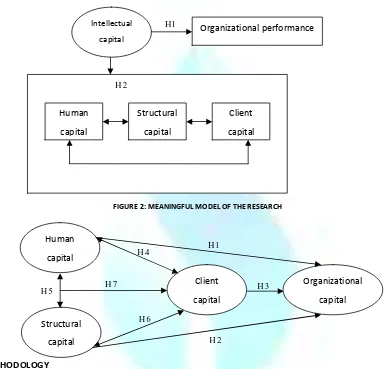
Due to the meaningful model of the research, the level of intellectual capital (including human capital, structural capital and client capital) improves the level of organizational performance.
Some authors believe that there is a meaningful relationship between the elements of human capital. Therefore, four other secondary hypotheses could be stated relative to the main hypothesis 2.
Main hypothesis 2: There is a meaningful and positive relationship between the elements (human, structural and client) of intellectual capital. Secondary hypothesis 4: There is a meaningful and positive relationship between human capital and client capital of Sepah banks.
Secondary hypothesis 5: There is a meaningful and positive relationship between human capital and structural capital of Sepah banks. Secondary hypothesis 6: There is a meaningful and positive relationship between structural capital and client capital of Sepah banks.
Secondary hypothesis 7: There is a meaningful and positive relationship between human capital, structural capital and client capital in Sepah bank.
FIGURE 1: MEANINGFUL MODEL OF THE RESEARCH
FIGURE 2: MEANINGFUL MODEL OF THE RESEARCH
RESEARCH METHODOLOGY
This survey is theoretical and descriptive-analytic which generalizes all of the findings to the population by use of a logic sample.
The tool used in this survey is a questionnaire designed by Nick Bontis in order to evaluate the individuals' attitude to ward the intellectual capital of the organizations.
The population includes all of the managers and assistants of the Sepah banks in Tehran. Cochran formula was used in order to calculate the sample volume (221).
In this survey, the banks were randomly selected because the sample's number was clear. In added, SPSS software and multiple regressions were used in order to test the hypotheses.
DATA ANALYSIS
It could be said that data analysis is referred to the determination of demographic variables' condition. In the survey, the following variables were used to analyze demography: age, gender, education, work experience and organizational post.
AGE
The first variable of this survey is age. Due to the results, 24, 36, 88 and 84 persons were selected between ages 25 to 30, 31 to 35, 36 to 40 and 41 to 45, respectively. Also, it could be said that the average of the age ranged between 36 to 45 years.
GENDER
The sample was composed of 205 men and 56 women. It is clear that the number of the men is four fold the number of the women.
EDUCATION
Educationally, they had diploma, associate of arts, B.A and M.A degrees. Respondents were asked to determine their education levels based on the above framework. 109, 47, 101 and 4 persons had diploma, associate of arts, B.A and M.A degrees, respectively. It was clean that most of them had diploma (about 41/8 percent of the respondents).
WORK EXPERIENCE
Due to this variable, respondents were asked to make clear their work experience. 10, 20 and 43 persons had between 3 to 6, 7 to 10 and 11 to 14 years of work experience, respectively. 14 other persons had more than five years of experience. Also, most of them had 11 to 14 years of work experience (49/4%).
ORGANIZATIONAL POSITION
The last variable of the survey is organizational position. The sample was composed of 135 governors and 126 assistants of the Sepah banks in Tehran. Intellectual
capital
1
H
Organizational performance
Client
capital
Structural
capital
Human
capital
2 H
Human
capital
Structural
capital
Client
capital
Organizational
capital
5
H H7
4
H H1
3 H
6 H
VOLUME NO. 1 (2011), ISSUE NO. 6 (NOVEMBER) ISSN2231-5756
DEDUCTIVE ANALYSIS OF ELEMENTS AND VARIABLES
As mentioned before, this survey is aimed to determine the relationship between the elements of intellectual capital and organizational performance of the Sepah banks in Tehran. Correlation test is a criterion used in order to determine the relationship between the two variables. Two main criterios used in the test are determination coefficient and correlation coefficient.
• Hypothesis 1: Based on the results Pearson's correlation coefficient is 0/502 (P<0.01) and it shows that there is a positive and relatively strong relationship between human capital and performance.
• Hypothesis 2: Based on the results, Pearson's correlation coefficient of the two variables is 0/691 (P<0.01) and it shows that there is a highly strong relationship between human capital and client capital.
• Hypothesis 3: Due to the results, the Pearson's correlation coefficient of the two variables is 0.720 (P<0.01) and it shows that there is a strong relationship between human capital and structural capital.
• Hypothesis 4: According to the results, the Pearson's correlation coefficient is 0.517 (P<0.01) and it shows that there is a strong relationship between structural capital and performance.
• Hypothesis 5: Due to the results, Pearson's correlation coefficient of the two variables is 0.718 (P<9.01) and it shows that there is a strong relationship between client capital and structural capital.
• Hypothesis 6: Results show that the Pearson's correlation coefficient of the two variables is 0.558 (P<0.01) and it shows that there is a highly strong relationship between client capital and performance.
• Hypothesis 7: Based on the results, the Pearson's correlation coefficient for the relationship between human capital and structural capital with the client capital is 0.759 (P<0.01). It shows that there is highly strong relationship between human capital, structural capital and client capital.
• Hypothesis 8: Results reveal that Pearson's correlation coefficient of the two variables is 0.588 (P<0.01) and there is a strong relationship between human capital and organizational performance in Sepah banks.
TABLES3: PEARSON'S CORRELATION COEFFICIENTS OF THE VARIABLES
1 2 3 4
Structural capital 1 Client capital 0.718 1 Human capital 0.720 0.691 1 Organizational 0.517 0.558 0.502 1 performance
CAUSALITY TEST OF MODEL
Because there are some independent variables in the survey (the elements of intellectual capital) whose effect on the dependent variable (performance of Sepah banks) should be examined, it is necessary to use multiple regresion technique.
HUMAN CAPITAL AND ORGANIZATIONAL PERFORMANCE OF SEPAH BANKS
The coefficient of human capital in the equation is 0.297. Therefore, it could be accepted that the variable human capital affects positively on the organizational performance of Sepah banks.
STRUCTURAL CAPITAL AND ORGANIZATIONAL PERFORMANCE OF SEPAH BANKS
The coefficient of human capital is 0.339. Therefore, it could be said that the variable structural capital affects positively on the organizational performance of Sepah banks.
CLIENT CAPITAL AND ORGANIZATIONAL PERFORMANCE OF SEPAH BANKS
The coefficient of client capital is 0.508.
Therefore, it could be accepted that the variable client capital affects positively on the organizational performance of Sepah banks.
CONCLUSION
Based on the above findings the followings are correct:
Secondary hypotheses 1: Due to the results of Pearson's test, the higher human capital, the more the organizational performance is increased and vise versa. If organizational capital improves the human capital will improve too. Regarding the human capital and organizational performance as the independent and dependent variable, respectively, the results show that about 15% of the changes related to the organizational performance of Sepah banks in Tehran are belonged to the human capital variable.
Secondary Hypothesis 2: Based on the results, there is a relatively strong relationship between the two variables. i.e. by increase of structural capital, the organizational performance will be increased. On the other hand, by improvement of organizational performance, structural capital will be improved. Regarding the structural capital as the independent variable and organizational performance as the dependent variable, it is clear that about 17 percent of organizational performance changes in Sepah banks are related to the structural capital.
Secondary hypothesis 3: Due to the results of the Pearson's test, there is a relatively strong relationship between the two variables. The higher level of client capital, the more degree of organizational performance is increased. On the other hand, the client capital will be improved by the improvement of organizational performance. Regarding the client capital and organization al performance as the independent and dependent variables, respectively, it is clear that about 17 percent of the changes are related to the client capital variable.
Secondary hypothesis 4: Based on the results, it is clear that there is a higher strong and positive relationship between human capital and client capital of Sepah banks.
Secondary hypothesis 5: Due to the results, there is a strong and positive relationship between human capital and structural capital of Sepah banks. Secondary hypothesis 6: Due to the results, there is a strong and positive relationship between structural capital and client capital of Sepah banks.
Secondary hypothesis 7: Results show that there is a strong and positive relationship between human capital, structural capital and client capital in Sepah banks.
Main hypothesis 1. The elements of intellectual capital affect positively and meaningfully on the performance of Sepah banks.
Based on the above mentioned, it is hypothesized that there is a positive and strong relationship between the intellectual capital and organizational performance. It could be said that the level of intellectual capital will be increased by the increase of organizational performance.
Meanwhile, among the mentioned elements, client capital has the highest effect. Therefore, it is hypothesized that the firm's intellectual capital is determined by the market.
Main hypothesis 2. There is a meaningful and positive relationship between the elements of intellectual capital. In added, the strongest relationship is related to the human capital and structural capital.
REFERENCES
Abdolmohammadi, M (2005): Intellectual capital disclosure and market capitalization, ournal of Intellectual Capital, Vol. 6 No. 3, 2005 pp. 397ـ416.
Bontis, N. (2001): Assessing knowledge assets: a review of the models used to measure intellectual capital, International Journal of Management Reviews, Vol. 3, No. 1, pp. 41ـ60.
Bontis, N; Keow, W and Richardson, S (2000): Intellectual capital and the nature of business in Malaysia, Journal of Intellectual Capital, Vol. 1, No. 1, pp. 85ـ100 Bontis,N.,Dargonetti,N,C., Jacobsen ,K.and Roos ,G.(1999), “ The knowledge toolbox: A review of the tools available to measure and manage intangible resource”, European ManagementJournal , Vol .17 No.4,pp.391-402.
Edvinsson, L. (2000): Some perspectives on intangibles and intellectual capital, Journal of Intellectual Capital, Vol. 1, No. 1, pp. 12ـ13 Edvinsson, L. (2000): Some perspectives on intangibles and intellectual capital, Journal of Intellectual Capital, Vol. 1, No. 1, pp. 12ـ13
Edvinsson, L. and Malone, M. (1997): Intellectual Capital: The Proven Way to Establish Your Company’s Real Value by Measuring its Hidden Brainpower, Biddles Ltd, Guildford, King’s Lynn and London.
Kannan, G, Aulbur, Wilfried, G ,(2004): Intellectual capital:Measurement effectiveness, Journal of Intellectual Capital, Vol. 5, No. 3, pp. 389ـ413 Kujansivu, P, Lo¨nnqvist, A (2007): Investigating the value andefficiency of intellectual capital, Journal of Intellectual Capital, Vol. 8, No. 2, pp. 272ـ287. Lim, l,l,k, Dallimore, p. (2004), “Intellectual capital : management attitudes in Service Industries”, Journal of Intellectual capital, Vol. 5, No.1, pp. 181-194. Marr, B., Gupta, O., Pike, S. and Roos, G. (2003), “Intellectual capital andknowledge management effectiveness”, Management Decision 41 / 3, 771– 781. Moshabaki, Azghr, (2005), Competitive Advantage: defining the role of intellectual capital and social capital (the case study of two Iranian manufacturing company, Journal of the Humanities Teacher, Volume 11, Number 3, PP.233-260
Seetharaman, A , (2004): Comparative justification on intellectual capital, Journal of Intellectual Capital, Vol. 5, No. 4, pp. 522ـ539.
Sullivan, P (2000): ValueـDriven Intellectual Capital ± How to Convert Intangible Corporate Assets into Market Value, John Wiley & Sons, New York, NY.
Seetharaman, A., Sooria, H,H,B,Z. , Saravanan, A, S. (2002),“Intellectual capital accounting and Reporting in the knowledge economy”,Journal of Intellectual capital, vol. 3 No. 2, pp . 128-148.
Stewart, T.A. (1994b): Your company’s most valuable asset: intellectual capital, Fortune, October 3, pp. 68ـ74. Stewart, T., "(1997). Intellectual Capital: The New Wealth of Nations,"Doubleday Dell Publishing Group, New York, NY.
Chaharbaghi, K., Cripps, S. (2006) «Intellectual Capital: Direction, not Blind Faith», Journal of Intellectual Capital; Vol. 7 No. 1, pp.29-42.
Shun hsing chen and et.al (2006): bsc in higher education, TQM magazine, vol.a8, no.2, pp 190ـ205.OECD (1996): the knowledgeـBased Economy, Paris.
VOLUME NO. 1 (2011), ISSUE NO. 6 (NOVEMBER) ISSN2231-5756
REQUEST FOR FEEDBACK
Dear Readers
At the very outset, International Journal of Research in Commerce, IT and Management (IJRCM)
acknowledges & appreciates your efforts in showing interest in our present issue under your kind perusal.
I would like to request you to supply your critical comments and suggestions about the material published
in this issue as well as on the journal as a whole, on our E-mails i.e.
or
for further improvements in the interest of research.
If you have any queries please feel free to contact us on our E-mail
.
I am sure that your feedback and deliberations would make future issues better – a result of our joint
effort.
Looking forward an appropriate consideration.
With sincere regards
Thanking you profoundly
Academically yours
Sd/-