
International Journal of Engineering
J o u r n a l H o m e p a g e : w w w . i j e . i rOptimal Design of Sandwich Panels using Multi-objective Genetic Algorithm and
Finite Element Method
A. Khalkhali*a, N. Nariman-zadehb, Sh. Khakshourniaa , S. Amirib
a School of Automotive Engineering, Iran University of Science & Technology, Tehran, Iran
b Department of Mechanical Engineering, Faculty of Engineering, The University of Guilan, Rasht, Iran
P A P E R I N F O
Paper history: Received 20 May 2013
Received in revised form 28 July 2013 Accepted 22 August 2013
Keywords:
Sandwich Panels with Corrugated Core Multi-objective Optimization The Finite Elements Method
A B S T R A C T
Low weight and high load capacity are remarkable advantages of sandwich panels with corrugated core, which make them more considerable by engineering structure designers. It is important to consider the limitations such as yielding and buckling as design constraints for optimal design of these panels. In this paper, multi-objective optimization of sandwich panels with corrugated core is carried out by minimizing two supposed objective functions, the structure’s weight and deflection. The finite element model of structure is created using the commercial software ANSYS, which is employed to calculate the deflection of panel in different problem conditions. A NSGA-II code prepared in MATLAB, is used to perform the optimization process in a gradual evolution trend, which leads to obtain the Pareto front consisting a set of design vectors and optimal objective function vectors. Two conventional methods are then used to select the trade-off optimal point among the Pareto non-dominant optimal set.
doi:10.5829/idosi.ije.2014.27.03c.06
1. INTRODUCTION1
Sandwich panels with open and continuous cells are modern and important structures that are widely used in the industry recently [1-3]. Having low weight with specific strength is an important property that makes these panels more useful in engineering [4]. Also, other properties of sandwich panels such as energy absorption, acoustic, thermal and cooling and durability lead to increase in their application [5].
There are some limitations which are necessary to be considered in engineering designing. In many cases, it is desired to reduce the product’s weight. It has different benefits related to the designing case. For example, reduction of the constitutive material and consuming fuel are some of these benefits. In this paper, it is desired to reduce the panel’s weight as an objective. Furthermore, the deflection of panel under a vertical loading case is desired to be reduced. Hence, the stiffness of the structure must be increased. Therefore,
1*Corresponding Author Email: [email protected] (A. Khalkhali)
to consider all of such criteria simultaneously, a complex multi-objective optimization problem (MOP) must be solved. Non-dominated Sorting Genetic Algorithm (NSGA-II) proposed by Srinivas and Deb [6], which is a Pareto based approach is one of the efficient algorithms for solving MOPs. It generates a set of non-dominated solutions (Pareto solutions) [7], where a non-dominated solution performs better on at least one criterion than the other solutions. Genetic algorithm is one of evolutionary algorithms and has a wide range of use in optimization problems. Also because of favorable application in unspecific search spaces and direct use of function values without any need to their derivatives, Genetic algorithm has experienced an impressing growth of usage in modeling and optimization problems and has a wide range of applications in single-objective and multi-objective problems [8-10].
Many researches have been done by scientists on sandwich panels in the recent years. For example, Wang et al. [11] performed a study to design a sandwich panel with a balance of acoustical and mechanical properties at minimal weight. Furthermore, Hou et al. [12]
performed a crashworthiness optimization of corrugated sandwich panels. They optimized the configuration of trapezoidal and triangular core cells to maximize the absorbed energy by the panel. Also, a single objective optimization of panel’s weight was performed by Valdevit et al. [4] by Genetic algorithm on sandwich panels with corrugated core. They found an optimum geometry of these panels which lead to the minimum possible weight under different loading cases, considering the panel as a cantilever beam. In this situation, the maximum deflection of this panel seems to be an important parameter for design. But the higher weight of the panel, the lower is the deflection of panel’s end. Hence, it requires a multi-objective optimization to find optimum design points which are suitable considering both weight and deflection.
In this paper the finite element method and modified NSGAII algorithm are used for multi-objective optimization of sandwich panels with corrugated core simultaneously. Weight and deflection of the panel, are considered as opposed objective functions, and panel’s geometrical specifications are considered as design variables. Indeed, it is desired to minimize both weight and deflection of the sandwich panel but the conflict between these two objectives, makes it impossible to minimize both of them simultaneously. Here is the usage of Genetic algorithm which finds a set of design variables which lead to corresponding sets of optimum deflections and weights. These obtained optimum sets will form the Pareto front as well. It is desired to select some trade-off optimum points among the Pareto points as suggested design points. Several methods are investigated in this study to find these compromising points. The break point method and the nearest to ideal point method are employed in this paper.
2. SANDWICH PANELS WITH CORRUGATED CORE
Figure 1 shows typical view of sandwich panels with corrugated core. Design variables are shown in Figure 2, including d as the face thickness, dc as the core member thickness and H as the distance between face sheets. All probable types of loading on such structures are shown in Figure 3. For the lateral loading case, the non-dimensional loading index which is based on the maximum values of shear force can be shown in the following equation [1]:
EM V =
P (1)
In this equation, V and M are maximum values of the shear force and moment, both per unit width. E is Young modulus of the constituent material. The structure’s weight per unit width “W” can be shown in non-dimensional form [1]:
2
l W
r
y = (2)
where r denotes the density of constituent material. Another characteristic, parameter “l” is defined as
V M
l= which has a direct relation with the loading
length. According to the length of loading and different boundary conditions, the values of l are shown in Figure 3 [1].
Figure 1. A sandwich panel with corrugated core
Figure 2. Geometrical variables of sandwich panels
When yielding or buckling occurs for the core or face sheets, the structure is failed. It is assumed that all bending will be tolerated by face sheets and all shear forces by the core. The normal stress in the face sheets and core are calculated using static equilibrium in related sections [13]:
) ( )
( d H d
Vl d
H d
M
f = - =
-s (3) c c d V q s sin 1 = (4)
where d,
d
c and H are geometrical design variables which are introduced in the first paragraph of the current part. The parameterq
is core sheet's angle as it is depicted in Figure 2.Critical buckling load in core face is obtained using
f
K correction factor that applied to Euler’s critical load relation, as like as the columns constrained with elastic supports in two ends [13]. Critical tensions in the structure are found as:
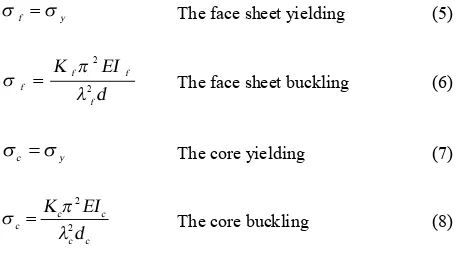
y f s
s = The face sheet yielding (5)
d EI K f f f f 2 2 l p
s = The face sheet buckling (6)
y c s
s = The core yielding (7)
c c c c c d EI K 2 2 l p
s = The core buckling (8)
where
I
f andI
care the area moment of inertia for face sheet and core sheet, respectively. Also,Kf andc
K are Euler’s equation correction factors andlf, lc
are length values related to the face sheets and the core sheets surfaces which will be calculated using the following equations [13]:
q l tan 2 n d H f -= (9) q l sin n d H c -= (10) 2 3 3 ) 1 ) / ( 2 . 1 1 ) / ( 4 . 2 ( + + = d d Cos d d Cos K c c f q q (11) 2 3 3 ) / ) / ( 6 . 0 6 . 1 / ) / ( 2 . 1 2 . 2 ( 375 . 1 q q Cos d d Cos d d K c c c + + = (12)
In non-dimensional form we can rewrite the Equations (5) to (8) using the Equations (3) and (4) in the following way:
) ( 2 l d l H l d E EM
V =sy - (13)
l d E EM
V qsy c
sin 2 = (14) 3 1 2 2 2 ) ( ) ( tan 48 l d l d l H k EM
V = fP q - - (15)
3 2 3 2 2 ) ( ) ( sin 12 l d l d l H k EM
V = cP q - - c (16)
3. SANDWICH PANELS’ FINITE ELEMENT MODEL
3D beam element (BEAM 189) is used in finite element modeling of the panel using commercial software ANSYS. Figure 4 shows the sandwich panel’s finite element model.
Constitutive material of panel is considered as Aluminum with elasticity modulus of E=70GPa and yielding tension of sy=490MPa [14].
To verify accuracy of the FE model, five different simulations are performed. A vertical load is applied to one end of the sandwich panel and deflection of this point is compared to corresponding values in reference [4].
The face sheets’ thickness, the core face’s thickness and the face sheets’ distance are considered 4.3 mm, 0.93 mm and 37 mm respectively. Root mean square error of such comparison is obtained equal to 0.0039, which shows acceptable accuracy of modeling and we can use this model to calculate the panel’s deflection in multi-objective process.
Figure 4. Sandwich panel’s finite element model
4. MULTI-OBJECTIVE OPTIMIZATION
In multi-objective optimization we are looking for the
design vector of T
n x x x
X { , *,..., *} 2 * 1
*= element Rn which
optimizes the objective functions
T k X f X f X f
F={1( ), 2( ),..., ( )} element k
R under m
unequal constraints: 0
) (X £
gt t=1, 2, …, m (17)
and p equal constraints 0
) (X =
hj j=1, 2, …, p (18)
Without reducing generality of the problem, we suppose that all objective vectors should be minimized. This multi-objective minimization problem that is categorized as Pareto problems is defined as follows.
4. 1. Pareto Dominance Vector U =[u1,u2,...,un] is dominated to vector V=[v1,v2,...,vn] where(UpV), if and only if:
j j i
i v j k u v
u k
iÎ £ Ù$ Î £
" {1,2,..., }, {1,2,..., }, (19)
4. 2. Pareto Optimality A point such as X*ÎW
( W is an acceptable design region which satisfies Equations (17) and (18)) is an optimum Pareto if and only ifF(X*) F(X)
p . Or in other words:
) ( ) ( } { },
,..., 2 , 1
{ 1
* 1
* f X f X
X X
k
iÎ " ÎW- £
"
) ( ) ( : } ,..., 2 , 1
{ k f X* f X
jÎ j £ j
$
Ù (20)
4. 3. Pareto Set In multi-objective optimization problem; a Pareto set (R*) contains all optimized Pareto vectors:
)} ( ) ( : |
{
*= XÎW $XÎW F X¢ pF X
R (21)
Evolutionary algorithms have been widely used for multi-objective optimization because of their natural properties suited for these types of problems. This is mostly because of their parallel or population-based search approach. Therefore, most of difficulties and deficiencies within the classical methods in solving multi-objective optimization problems are eliminated. For example, there is no need for either several runs to find all design vectors. In this way, the original non-dominated sorting procedure given by Goldberg [10] was the catalyst for several different versions of multi-objective optimization algorithms. However, it is very important that the evolutionary algorithm and distribution of optimized vectors to be preserved by population of sufficient diversity.
NSGA-II algorithm [6] which is a Pareto-based approach has a wide range usage in multi-objective problems. But density scale which is used in this algorithm for distribution of design vectors and
preventing population accumulation has deficiencies in solving multi-objective problems with more than two objective functions. In this paper, we used NSGA-II modified algorithm [15, 16] which is usable for the optimization problem with infinite objective functions.
5. METHODS TO FIND THE TRADE-OFF OPTIMUM POINT
The Pareto front obtained by modified NSGAII optimization algorithm, prepares a set of non-dominated design points. But all of these points are not appropriate to be chosen as the final design point. Now, it is necessary to employ some methods to choose the trade-off optimal design point through the Pareto front. Two methods are introduced in this section which is used in the present work.
5. 1. Break Point Method In a Pareto front which contains non-dominant optimum design points with two conflicting objective functions, some important data could be seen. The two ends of Pareto front represent the single-objective optimization results for each axis separately. But if we consider both objective functions, the end points of Pareto front are not suitable choices; because, in conflicting objective function cases, one objective function gives bad results near by the single-objective optimization point of the other single-objective function. Hence, the middle part of Pareto front is a better area to look for the trade-off design point. One of the attractive zones in Pareto front is the break point of the curve. This point usually contains interesting results comparing to the other points of Pareto.
5. 2. Nearest to Ideal Point Method (NIP) In this method, values of the objective functions, will be mapped to [0, 1] interval, in order to make these functions comparable. The ideal point which is not accessible in real is the point where projected objective functions have their most desirable values there. Then, the distance between all non-dominated points of the Pareto front to the ideal point is calculated separately. Finally, the trade-off optimum design point is simply the one with minimum distance to the ideal point. It should be noted that for the case of minimization of all objective functions, the ideal value for each mapped objective function is zero. For example, in the case of two objectives minimization, the ideal point is (0, 0).
6. RESULTS AND DISCUSSION
Pareto curve will be obtained. In this way, the finite element method and Genetic algorithm are used simultaneously for multi-objective optimization. In this method, MATLAB and ANSYS software have been coupled together during the run time. NSGA-II code has been written in MATLAB and the deflection calculator code has been written in ANSYS using APDL2 language. In each generation, design vectors are produced by NSGA-II code and are sent to ANSYS. Then after calculation of deflection for each design vector, the obtained values will be returned to MATLAB and the optimization process will be continued. Finally, the non-dominated optimum values of objective functions and the corresponding design vectors will be obtained.
In the present study, the sandwich panel with corrugated core is fully supported in one end and is loaded in the other end. The core sheets’ angle
q
is supposed to be =54.7o; while, the structure’s shear strength in this angle will be maximized [17]. Geometrical variables are, the face sheets’ thickness (d),the core sheets’ thickness (d )c and the face sheets’
distance (H) as introduced in section 2, paragraph 1. According to Figure 3, for the cantilever condition, variable l is equal to the panel’s length. In this paper, the sandwich panel’s length is supposed to be constant and equals to 1 m. The structure’s weight in none dimensional form will be calculated using the following equation: l d Cos l d l W c q r
y = 2 =2 + 1 (22)
The design constrains for yielding and buckling of the structure’s elements in a transverse loading case according to the Equations (15) to (18) will be found using the following relations:
Minimize = = ( , , )
(Calculated using ANSYS)
Minimize = = 2 +
Unequal constraints:
: ( )1 1
2
1 - £
-l d l H d l E EM V g y s
: 1 2 1
2 £ c y d l E EM V Sin g s
q (23)
( )( ) 1
tan 48
: 2 3
2 2
3 - £
d l l d l H E EM V K g y
fp q s
: 12 ( )2( )3 1
2
3 2
4 - £
c y c d l l d l H E EM V Sin K g s q p
Boundary of each design variable: 2 - ANSYS Parametric Design Language
003 . 0 0001 .
0 p p
l
dc , 0.001p p0.01
l
d ,0.01 0.1
p p
l H
Penalty function is used to apply the constraints in objective functions and the constraints with great weight factor will be added to related objective function and new objective functions will be introduced as follow:
) ( 10 ) ( 10 1
1 x f G x
F = + (24)
) ( 10 ) ( 10 2
2 x f G x
F = + (25)
where:
å
= 4 1 ) ( )(x g x
G wi i (26)
In the multi-objective optimization case, both the weight and deflection will be supposed as objective functions simultaneously. In this case, a group of points which all are optimal and apparent, no one has any advantage to the others will be found. Figure 5 shows Pareto front for the former condition derived by minimization of defined objective functions simultaneously. In this figure, the optimum points A, B
can be obtained by single-objective optimization. If the structure’s weight is considered as objective function in the single-objective optimization process, point B will be obtained and if the structure’s deflection is considered as objective function in the single-objective optimization, point A will be the answer.
It is now desired to find some trade-off optimum points to be used for designing. In this way, two special methods are explained. There can be found a break point shown by C in the figure. As it is clear in Figure 5, a small amount of reduction in weight of the structure relative to break point’s weight, will lead to a huge increment in deflection of the structure. The key point is here that increasing the weight of structure relative to the break point’s weight will not lead to a remarkable increment in deflection of the structure. Hence, it will be concluded that the trade-off Pareto point should be around the break point’s zone. Each method proposes a point around this area. The proposed point of this method is point C. Figures 6 to 8 show the variation of weight and deflection with the face sheets’ distance, the face sheets’ thickness and the core sheet’s thickness respectively. Figure 6 exposes the fact that increasing the face sheet distance will be useful while this distance is less than the value of h in the break point. Regarding to this figure, the mentioned point looks a desired designing point, because decreasing the face sheet distance from this value leads to a huge increase in deflection which is not acceptable and increasing the face sheet distance from this value will lead to growth in weight.
<gi(x)>=0, if the ith constraint is satisfied
Figure 5. Pareto front and trade-off design points for single and multi-objective optimization-A (minimum deflection), B (minimum weight), C (break point), D (nearest to ideal point) and [4] (Valdevit minimum weight point)
Figure 6. Relationship between weight and face sheets distance in optimal condition, according to Pareto front curve- A (deflection), B (weight), C & D (nearest to ideal point), E & F (break point)
Figure 7. Relationship between weight and face sheets thickness in optimal condition, according to Pareto front curve- A (deflection), B (weight), C & D (nearest to ideal point), E & F (break point)
Figure 8. Relationship between weight and core sheets thickness in optimal condition, according to Pareto front- A (deflection), B (weight), C & D (nearest to ideal point), E & F (break point)
Figure 9. Deformed shape of the sandwich panel in NIP best compromising design point
The impressing characteristic of this point as it is apparent in Table 1 is that the weight of panel from point A to point C is decreased about 63% of total variations in weight with an increment in panel’s deflection about 3% of total variations in deflection. Also, if we move from point B to point C, a remarkable reduction will appear in the panel’s deflection (about 96%) without any considerable increase in structure’s weight (about 37%).
The nearest to ideal point, shown in Figure 5 looks another good designing point, because both the weight and deflection of the panel are in a relative minimum value in this point. Figures 7 and 8 demonstrate the general direct relation between weight and the sheet thicknesses as we expected before. The conflict between weight and deflection of the structure is overt in these figures.
TABLE 1. Design variables and objective functions for points A, B, C and D
Optimum design point H (m) (m) (m) y =W rl2 Panel’s deflection(m)
A 0.1 0.0089 0.0029 0.0230 0.0089
B 0.0383 0.0043 0.001 0.0102 0.1283
C 0.0830 0.00585 0.0018 0.015 0.0132
D 0.0970 0.0055 0.0020 0.0144 0.0177
The characteristic of this point as apparent in Table 1 is that the weight of panel from point A to point D is decreased about 67% of total variations in weight with an increment in panel’s deflection about 7% of total variations in deflection. Also, if we move from point B
to point D, a remarkable reduction will appear in the panel’s deflection (about 93%) without any considerable increase in structure’s weight (about 33%).
7. CONCLUSION
The finite element method and modified NSGAII algorithm were used simultaneously for multi-objective optimization of sandwich panels with corrugated core, considering two objective functions, weight and deflection of the structure. Then in a gradual evolution, the Pareto front of the structure was obtained. The Pareto front, not only includes the single-objective optimization problem solutions, but also gives a set of optimum design points to designers, which designers select one of them according to their needs.
Using Pareto front makes it possible for us to study on the relation between objective functions, and select the suitable design point through all optimal points. A middle point of Pareto curve contains interesting information about both deflection and weight objective functions which are impossible to obtain using single-objective optimization. In order to find a trade-off middle point in Pareto curve, two different methods were investigated. Each one had special characteristics. The trade-off optimal set found by nearest to the ideal point method leads to a higher weight and a lower deflection in comparison with proposed point by the break point method. Designer will be able to choose appropriate design set among the trade-off optimal sets comparing the characteristics of each set.
8. REFERENCES
1. Wadley, H. N., Fleck, N. A. and Evans, A. G., "Fabrication and structural performance of periodic cellular metal sandwich structures", Composites Science and Technology, Vol. 63, No. 16, (2003), 2331-2343.
2. He, L., Cheng, Y.-S. and Liu, J., "Precise bending stress analysis of corrugated-core, honeycomb-core and x-core sandwich panels", Composite Structures, Vol. 94, No. 5, (2012), 1656-1668.
3. Wadley, H. N., Børvik, T., Olovsson, L., Wetzel, J. J., Dharmasena, K. P., Hopperstad, O. S., Deshpande, V., and Hutchinson, J. W., "Deformation and fracture of impulsively loaded sandwich panels", Journal of the Mechanics and
Physics of Solids, Vol. 61, No. 2, (2012) 674-699.
4. Valdevit, L., Hutchinson, J. and Evans, A., "Structurally optimized sandwich panels with prismatic cores", International Journal of Solids and Structures, Vol. 41, No. 18, (2004), 5105-5124.
5. Zok, F., Waltner, S., Wei, Z., Rathbun, H., McMeeking, R., and Evans, A., "A protocol for characterizing the structural performance of metallic sandwich panels: Application to pyramidal truss cores", International Journal of Solids and
Structures, Vol. 41, No. 22, (2004), 6249-6271.
6. Deb, K., Pratap, A., Agarwal, S. and Meyarivan, T., "A fast and elitist multiobjective genetic algorithm: Nsga-ii", Evolutionary Computation, IEEE Transactions on, Vol. 6, No. 2, (2002), 182-197.
7. Coello, C. A. C., "A comprehensive survey of evolutionary-based multiobjective optimization techniques", Knowledge and
Information Systems, Vol. 1, No. 3, (1999), 129-156.
8. Nariman-Zadeh, N., Darvizeh, A. and Ahmad-Zadeh, G., "Hybrid genetic design of gmdh-type neural networks using singular value decomposition for modelling and prediction of the explosive cutting process", Proceedings of the Institution of Mechanical Engineers, Part B: Journal of Engineering
Manufacture, Vol. 217, No. 6, (2003), 779-790.
9. Alitavoli, M., Nariman-zadeh, Khalkhali, A. and Mehran, M., "Modeling of abrasive fluid micro machining parameters by polynomial neural networks and genetic algorithms", in MESM Porto, Portugal. (2005).
10. Goldberg, D., "Genetic algorithms in optimization, search and machine learning", Addison Wesley, New York. Eiben AE, Smith, Vol. 905, (1989), 205-211.
11. Wang, T., Li, S. and Nutt, S. R., "Optimal design of acoustical sandwich panels with a genetic algorithm", Applied Acoustics, Vol. 70, No. 3, (2009), 416-425.
12. Hou, S., Zhao, S., Ren, L., Han, X. and Li, Q., "Crashworthiness optimization of corrugated sandwich panels", Materials &
Design, Vol. 51, (2013) 1071-1084.
13. Bazant, L. and Z.P.Cedolin, "Stability of structure", Oxford University Press, (1991).
14. Liu, T., Deng, Z. and Lu, T., "Design optimization of truss-cored sandwiches with homogenization", International Journal of
Solids and Structures, Vol. 43, No. 25, (2006), 7891-7918.
thermodynamically optimized turbojet engines using gmdh-type neural networks and evolutionary algorithms", Engineering
Optimization, Vol. 37, No. 5, (2005), 437-462.
16. Atashkari, K., Nariman-Zadeh, N., Pilechi, A., Jamali, A. and Yao, X., "Thermodynamic pareto optimization of turbojet engines using multi-objective genetic algorithms", International
Journal of Thermal Sciences, Vol. 44, No. 11, (2005), 1061-1071.
17. Lu, T., Hutchinson, J. and Evans, A., "Optimal design of a flexural actuator", Journal of the Mechanics and Physics of
Solids, Vol. 49, No. 9, (2001), 2071-2093.
Optimal Design of Sandwich Panels using Multi-objective Genetic Algorithm and
Finite Element Method
A. Khalkhalia, N. Nariman-zadehb, Sh. Khakshourniaa, S. Amirib
a School of Automotive Engineering, Iran University of Science & Technology, Tehran, Iran
b Department of Mechanical Engineering, Faculty of Engineering, The University of Guilan, Rasht, Iran
P A P E R I N F O
Paper history: Received 20 May 2013
Received in revised form 28 July 2013 Accepted 22 August 2013
Keywords:
Sandwich Panels with Corrugated Core Multi-objective Optimization The Finite Elements Method
هﺪﯿﮑﭼ
نزو ﻢﮐ و ﺖﯿﻓﺮﻇ رﺎﺑ يﺎﻫﺖﯾﺰﻣ زاﻻﺎﺑ ﻞﺑﺎﻗ
ﻪﺟﻮﺗ ﻞﻧﺎﭘ ﯽﭽﯾوﺪﻧﺎﺳيﺎﻫ ﺎﺑ
ﻪﺘﺴﻫ ﺪﻨﺘﺴﻫرادجﻮﻣ ﻪﺟﻮﺗﺐﺟﻮﻣﻪﮐ
ﻦﯿﺳﺪﻨﻬﻣ نﺎﺣاﺮﻃ هزﺎﺳ ﺪﻧﻮﺷﯽﻣ
.
رد ﺮﻈﻧ ﻦﺘﻓﺮﮔ ﺖﯾدوﺪﺤﻣ ﯽﯾﺎﻫ ﺪﻨﻧﺎﻣ هدزﺎﺑ و ﺶﻧﺎﻤﮐ ﻪﺑ ناﻮﻨﻋ ﺪﯿﻗ يﺎﻫ ﯽﺣاﺮﻃ ياﺮﺑ
ﯽﺣاﺮﻃ ﻦﯾاﻪﻨﯿﻬﺑ ﺖﺳاﺖﯿﻤﻫايارادﺎﻫﻞﻧﺎﭘ
.
رد ﻦﯾا ،ﻪﻟﺎﻘﻣ ﻪﻨﯿﻬﺑ ﻞﻧﺎﭘيزﺎﺳ ﯽﭽﯾوﺪﻧﺎﺳيﺎﻫ ﺎﺑ
ﻪﺘﺴﻫ رادجﻮﻣ ﺎﺑ ﻪﺑ ﻞﻗاﺪﺣ
نﺪﻧﺎﺳر ود ،ﻊﺑﺎﺗ ﻞﻣﺎﺷفﺪﻫ نزو
و فاﺮﺤﻧا رﺎﺘﺧﺎﺳ ﺖﺳا مﺎﺠﻧا هﺪﺷ ﺖﺳا
.
لﺪﻣ نﺎﻤﻟا دوﺪﺤﻣ ﺎﺑهزﺎﺳ هدﺎﻔﺘﺳا زا مﺮﻧ راﺰﻓا
يرﺎﺠﺗ
ANSYS
ﻪﮐهﺪﺷدﺎﺠﯾا ياﺮﺑ
ﻪﺒﺳﺎﺤﻣ فاﺮﺤﻧا ﻞﻧﺎﭘ رد ﻂﯾاﺮﺷ ﻒﻠﺘﺨﻣ دورﯽﻣرﺎﮐﻪﺑ
.
ﺪﮐزا
NSGA-II
ﻪﮐ رد
MATLAB
ياﺮﺑهﺪﺷﻪﯿﻬﺗ مﺎﺠﻧا
ﺪﻨﯾاﺮﻓ ﻪﻨﯿﻬﺑ يزﺎﺳ رد ﺪﻧور ﻞﻣﺎﮑﺗ ،ﯽﺠﯾرﺪﺗ ﻪﮐ ﺮﺠﻨﻣ ﻪﺑ ﻪﺑ ﺖﺳد ندروآ ﻪﻬﺒﺟ ﻮﺗرﺎﭘ
ﻞﻣﺎﺷ ﻪﻋﻮﻤﺠﻣ يا زا يﺎﻫرادﺮﺑ ﯽﺣاﺮﻃ و ﻪﻨﯿﻬﺑ ﻊﺑﺎﺗ ﺖﺳاهﺪﺷهدﺎﻔﺘﺳا،ﺖﺳافﺪﻫ
.
ردﺲﭙﺳ نﺎﯿﻣ ﻪﻋﻮﻤﺠﻣ ﻪﻨﯿﻬﺑ ﺮﯿﻏ ﺐﻟﺎﻏ
،ﻮﺗرﺎﭘ ود شور لواﺪﺘﻣ ياﺮﺑ بﺎﺨﺘﻧا ﻪﻄﻘﻧ ﻪﻨﯿﻬﺑ ﺖﻓﺮﮔراﺮﻗهدﺎﻔﺘﺳادرﻮﻣ
.
doi:10.5829/idosi.ije.2014.27.03c.06
![Figure 3. "l " value for different structures [1]](https://thumb-us.123doks.com/thumbv2/123dok_us/233640.2017983/2.595.319.541.528.733/figure-l-value-different-structures.webp)
![Figure 5. Pareto front and trade-off design points for single and multi-objective optimization-A (minimum deflection), B (minimum weight), C (break point), D (nearest to ideal point) and [4] (Valdevit minimum weight point)](https://thumb-us.123doks.com/thumbv2/123dok_us/233640.2017983/6.595.315.538.103.273/figure-objective-optimization-deflection-minimum-nearest-valdevit-minimum.webp)

