RESEARCH
Clinical evaluation of haploidentical
hematopoietic combined with human umbilical
cord-derived mesenchymal stem cells in severe
aplastic anemia
Lixin Xu
1†, Zhouyang Liu
1†, Yamei Wu
1, Xueliang Yang
1, Yongbin Cao
1, Xiaohong Li
1, Bei Yan
1, Songwei Li
1,
Wanming Da
2and Xiaoxiong Wu
1*Abstract
Background: This study not only evaluated the clinical effects of treatment using haploidentical hematopoietic stem cells (haplo-HSCs) combined with human umbilical cord mesenchymal stem cells (UC-MSCs) in patients with severe aplastic anemia (SAA), but also investigated the factors related to graft versus host disease (GVHD).
Methods: Cotransplantation of haplo-HSCs and UC-MSCs was performed in 24 SAA patients. The conditioning regi-mens consisted of rabbit anti-human T-lymphocyte immunoglobulin (ATG), cyclophosphamide, and fludarabine with or without busulfan. GVHD was prevented using cyclosporine A, ATG, anti-CD25 monoclonal antibody, and mycophe-nolate material.
Results: The incidence of acute GVHD was 50%. The incidence of severe acute GVHD was not related to gender, age, donor-recipient relations, and patient/donor pair, while patient/donor pair (r= 0.541, P= 0.022) was significantly cor-related with incidence of chronic GVHD. Upon follow-up for a median of 13 months, 5 of the 24 patients (20.8%) were dead. The survival rates at 3 and 6 months in all patients were 87.5% (21/24) and 83.3% (20/24), respectively.
Conclusion: Cotransplantation of haplo-HSCs combined with UC-MSCs was an effective and safe approach for the treatment of patients with SAA. The appropriate conditioning regimen and early treatment for infection also played a critical role in the success of HSCT.
Keywords: Severe aplastic anemia, Haploidentical hematopoietic stem cells transplantation, Umbilical cord-derived mesenchymal stem cells, Graft versus host disease
© The Author(s) 2018. This article is distributed under the terms of the Creative Commons Attribution 4.0 International License (http://creativecommons.org/licenses/by/4.0/), which permits unrestricted use, distribution, and reproduction in any medium, provided you give appropriate credit to the original author(s) and the source, provide a link to the Creative Commons license, and indicate if changes were made. The Creative Commons Public Domain Dedication waiver (http://creativecommons.org/ publicdomain/zero/1.0/) applies to the data made available in this article, unless otherwise stated.
Background
Severe aplastic anemia (SAA) is a life-threatening disease characterized by hypoplastic bone marrow and pancyto-penia [1]. Although allogeneic hematopoietic stem cell transplantation (HSCT) is the first choice for the treat-ment of SAA [2], it is difficult to search for the human leukocyte antigen (HLA)-compatible donors in China [3].
Recent studies have investigated the effect of haploidenti-cal HSCT (haplo-HSCT) in SAA patients, and it has been considered as an optional treatment [4–7]. Nevertheless, the high incidence of graft versus host disease (GVHD) limited the clinical application of haplo-HSCT in patients with SAA.
It has been demonstrated that mesenchymal stem cells (MSCs) can reduce the risks of both acute GVHD (aGVHD) and chronic GVHD (cGVHD) [8]. Notably, human umbilical cord-derived mesenchymal stem cells (UC-MSCs) have higher activities of proliferation and differentiation in comparison with the bone marrow MSCs [9]. Recent study has revealed that UC-MSCs can
Open Access
*Correspondence: [email protected]
†Lixin Xu and Zhouyang Liu are joint first authors
1 Department of Hematology, The First Affiliated Hospital of Chinese PLA
General Hospital, No. 51 Fucheng Road, Haidian District, Beijing 100048, China
not only reduce the risk of GVHD, but also increase the transplantation rate of allogeneic HSCs [10]. A previous study by Wu et al. [11] and another research by Zhang et al. [12] have preliminarily shown that the cotrans-plantation of haplo-HSCs and third-party donor-derived UC-MSCs achieved favorable outcomes for patients with aplastic anemia. However, several problems remain to be further resolved, such as the correlation factors affecting GVHD and lack of optimal sources of donors.
In this study, we reviewed 24 patients with SAA who received the cotransplantation of haplo-HSCs and UC-MSCs with modified conditioning, and evaluated the safety and efficacy of the cotransplantation of UC-MSCs and donor HSCs in SAA patients and investigated the factors related to GVHD.
Methods Patients
The whole protocol was approved by the Institu-tional Review Board of our hospital, and informed written consents were obtained from all patients. All donors were eligible for donating HSCs, and they also signed the informed consent forms for donation before transplantation.
This study recruited 24 patients with SAA (14 males and 10 females) who underwent cotransplantation of human UC-MSCs and HSCs from June 2010 to August 2013. The inclusion criteria were as follows: patients pre-senting with SAA or very severe aplastic anemia (VSAA) were defined according to the International Aplastic Anemia Study Group [13]; patients who underwent pre-vious therapy regimens, including cyclosporine A (CSA), stanozole/andriol, granulocyte colony stimulating factor (G-CSF), anti-human T-lymphocyte immunoglobulin (ATG), Erythropoietin (EPO), glucocorticoid—however, they failed to respond to this therapy regimen; patients who received multiple transfusions and whose transfu-sion dependence was confirmed when the transplanta-tion was performed; patients who agreed to participate in HSCT; and all donors who were relatives to the patients. Patients who had uncontrolled infections and severe liver, renal, lung, or heart diseases before transplantation were excluded in this study. The detailed information about patients and preparation of donors is listed in Additional file 1: Table S1.
Preparation of UC‑MSCs and HSCs
UC-MSCs were purchased from the National Engineer-ing Research Center of Cell Products. HSCs were isolated from peripheral blood of the donors who were injected subcutaneously with recombinant human G-CSF (rhG-CSF, 5 µg/kg day) for 5–6 consecutive days. In brief, peripheral blood (200–600 mL) was collected on day 5,
and red cells were removed to avoid the incompatibility of major cross-match. Then, HSCs were separated using Fenwal CS-3000 plus blood cell separator (Baxter Inter-national Inc., Deerfield, IL, USA) on days 6 and 7. Finally,
mononuclear cells [(4–6) × 108/kg] and CD34+ cells [(2–
4) × 108/kg] were obtained.
HSCs and UC‑MSCs transplantation
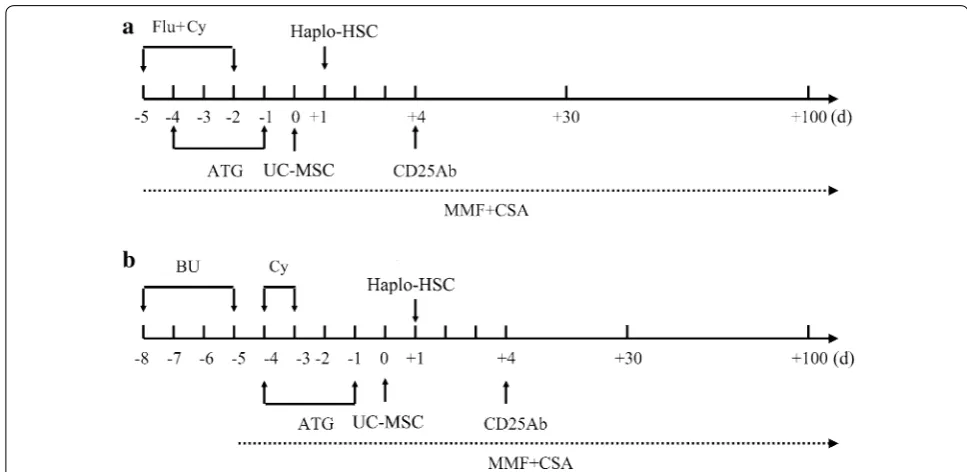
Anti-inflammatory, hepatoprotective and gastric mucosa-protecting treatments were performed on patients with sodium bicarbonate, dexamethasone and promethazine before transplantation. The conditioning regimens included rabbit ATG (Fresenius AG, Oberur-sel, Germany), cyclophosphamide (Cy), and fludarabine (Flu) treatment. For the patients with acute SAA
(SAA-I), intravenous administration of 30 mg/(m2 day) of Flu
and 500–800 mg/(m2 day) of Cy was performed from
days − 5 to − 2, and 5 μg/(kg day) of ATG was
adminis-tered from days − 4 to − 1 (Fig. 1a). For the patients with
chronic SAA (SAA-II), the same treatment of ATG and Cy was applied as above with the supplement of 0.6 mg/
(kg 6 h) of busulfan (BU) from days − 8 to − 5 prior to
transplantation (Fig. 1b) [3]. On day 0, HSCs were infused
intravenously. Then, a total of 5 × 10⁵/kg UC-MSCs was
transfused at 4 h before infusion with HSCs.
Management of GVHD
Prophylaxis of GVHD was carried out by the admin-istration of immunosuppressive agents, such as CSA, mycophenolate mofetil (MMF), and anti-CD25 antibody (CD25Ab; Basiliximab, Novartis Pharma Stein AG, Stein, Switzerland). To achieve a target trough with blood con-centration of 250–450 ng/mL at 12 months after HSCT, CSA (3 mg/kg) was conducted by intravenous injection
from day − 5 (Fig. 1); then, CSA concentration was
grad-ually decreased and withdrawn in the next 2–3 months. Oral MMF administration (20 mg/kg/day) was conducted
from days − 1 to day + 100, and intravenous injection of
CD25Ab monoclonal antibody (0.5 mg/kg/day) was
per-formed only on day + 4 after HSCT (Fig. 1).
Glucksberg-Seattle criteria (GSC) [14] were used for the diagnosis and grading of GVHD, and those with grade III-IV acute GVHD (aGVHD) were served as severe aGVHD.
Supportive care
Patients were housed in the laminar flow clean ward. They were asked to take a medicated bath, and treated with acyclovir, ornidazole, sulfamethoxazole trimethoprim, and sulfadiazine 1 or 2 days before conditioning. On day
+ 3 after HSCT, G-CSF and thrombopoietin (TPO) were
China) and compound Danshen (20 mg/day; Shanghai No. 1 Biochemical & Pharmaceutical Co., LTD,
Shang-hai, China) were administered from day − 5 to day + 14
as hepatic veno-occlusive disease (VOD) prophylaxis. Mesna injection (Baxter, Shanghai, China) was used to prevent the hemorrhagic cystitis (HC).
Engraftment
Neutrophil engraftment was defined as the first of three consecutive days with an absolute neutrophil count
(ANC) above 0.5 × 10⁹/L, and platelet engraftment
was defined as the first day of a week with the
plate-let count exceeding 20 × 109/L in the absence of
trans-fusion. Hematopoietic chimerism was assessed using peripheral blood samples of the donor and recipient via short-tandem repeated sequence-PCR (STR-PCR) DNA fingerprinting [15] for sex-matched pairs and karyotype analysis for sex-mismatched pairs. The bone marrow of the recipient was analyzed for hematopoietic chimerism every 30 days until 90 days after HSCT. For blood-type incompatible pairs, the measurement of blood-type titer was processed weekly after hematopoietic reconstitution.
Statistical analysis
Patients were followed up for 3–44 months. Kaplan– Meier analysis was calculated as survival in the absence of death. The relationships between the incidence of GVHD and gender, age, blood type, donor–recipient relations, and patient/donor pair were evaluated using Chi-square test. All statistical analyses were performed using the standard statistical package of SPSS 19.0 (IBM,
Armonk, New York, USA). A two-sided P value of 0.05 or
less was considered statistically significant.
Results
Engraftment and chimerism
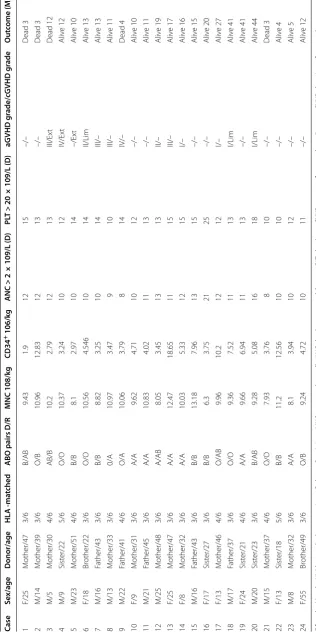
Clinical features of patients and their donors, and the
subsequent outcomes in 24 case are shown in Table 1.
The median scores of infusion numbers of MNCs and
CD34+ cells were 10.6 × 10⁸/kg and 4.55 × 10⁶/kg for all
the patients, respectively. The median times to achieve neutrophil and platelet engraftment were 11 and 13 days, respectively. All the patients achieved 70–100% donor chimerism within 1 month after haplo-HSCT.
Fig. 1 The schematic diagram of conditioning regimen and prophylaxis and management of GVHD. Conditioning included 1 of 2 regimens: for patients with SAA-I (a), intravenous administration of fludarabine (Flu) 30 mg/(m2 day) and cyclophosphamide (Cy) 500–800 mg/(m2 day) from day − 5 to − 2, anti-human T-lymphocyte immunoglobulin (ATG) 5 μg/(kg day) from day − 4 to − 1; or for SAA-II (b), the same treatment of ATG and Cy with busulfan (Bu) 0.6 mg/(kg 6 h) from day − 7 to − 6. Prophylaxis and management of GVHD included: intravenous administration of cyclosporine A (CSA) 3 mg/kg from day − 5, followed by gradual decrease in concentration after reaching a target trough blood concentration of 250–450 ng/mL and then withdrawal in the next 2–3 months, oral mycophenolate mofetil (MMF) administration (20 mg/kg/day) from day − 1 to
Table 1 Clinic al f ea tur es of pa tien ts and
their donors as
w ell as the out comes of 24 c ases F female , M male , HL A human leukoc yt e an tigen, D donor , R recipien t, MNC mononuclear c ells , ANC absolut e neutr ophil c oun t, PLT pla telets , aG VHD acut e g raf t-versus-host disease , cG VHD chr onic g raf t-versus-host disease , Ex t ex tensiv e, Lim limit ed , D da y, M mon ths C ase Se x/age Donor/age HL A ‑ma tched
ABO pairs D/R
MNC 108/k
g
CD34
+ 106/k
GVHD
The GVHD incidences of all patients after HSCT are
shown in Table 2. Of the 24 patients, 12 cases (50%)
developed aGVHD, including 4 (16.7%) with grade I, 2 (8.35%) with grade II, 4 (16.7%) with grade III, and 2 (8.35%) with grade IV. Meanwhile, 3 of the 24 (12.5%) patients developed extensive cGVHD, and 2 cases among them also experienced III–IV aGVHD. In addition, 3 of the 24 (12.5%) patients who experienced I–II aGVHD also developed limited cGVHD. The other 11 patients
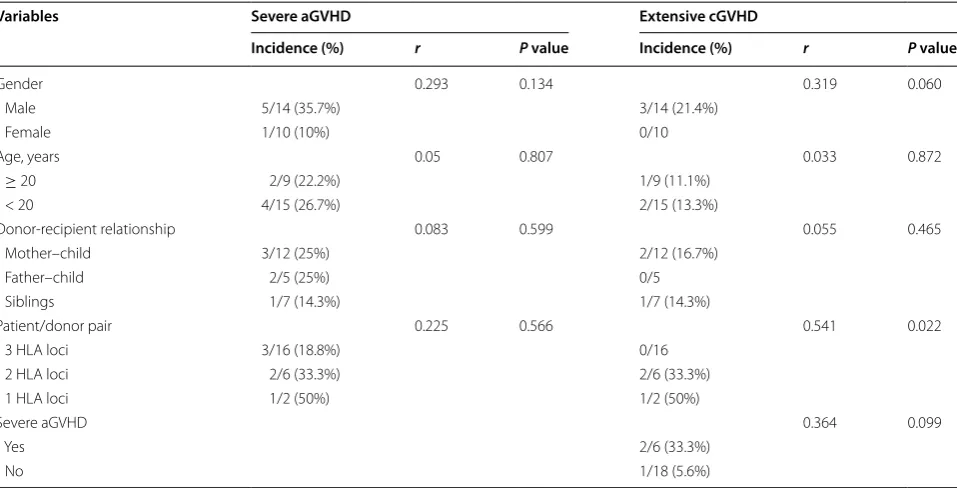
had no GVHD. As shown in Table 3, the incidence of
severe aGVHD was not related to gender, age, donor– recipient relations and patient/donor pair, while patient/ donor pair was significantly correlated with extensive
cGVHD (r = 0.541, P = 0.022). The postoperative
inci-dences of extensive cGVHD were 2/15 of patients with blood-type compatibility, 1/1 of major cross-match mis-match and 0 of minor cross-mis-match mismis-match. The rise in GVHD incidence paralleled the increase in HLA loci
(χ2 = 7.764, P = 0.022). Extensive cGVHD trended to
occur in male and patients who also suffered from severe
aGVHD (P = 0.060 and P = 0.099, respectively).
Other complications
During HSCT period, all patients suffered from nausea, vomiting, and various degrees of anepithymia, and then these symptoms regressed after symptomatic and sup-portive therapies. Nineteen patients (19/24, 79.2%) who developed stomatitis also showed improvement after mouth care and the topical application of epithelium growth factor. At the stage of bone marrow suppression, various degrees of fevers occurred in patients, and then fevers were controlled by the administrations of imi-penem, vancomycin, and antifungals. The incidence of pulmonary infection was 16.7% (4/24). Two cases with pulmonary infection developed into severe pneumonia, and one of them finally died. There were two patients with septicemia and two cases with engraftment syn-drome. Fifteen patients (15/24, 62.5%) had viral infec-tions, including Cytomegalovirus (CMV) or Epstein Barr Virus (EBV)-emia in eight cases, and two or more viruses infection in five cases. Three patients (3/24, 12.5%) devel-oped HC. Sixteen patients suffered from diarrhea, and Table 2 GVHD incidences in allogeneic HSCT recipients
HSCT hematopoietic stem cell transplantation, aGVHD acute graft-versus-host disease, cGVHD chronic graft-versus-host disease, Ext extensive, Lim limited
Parameters N= 24, (%)
Acute GVHD
I 4 (16.7%)
II 2 (8.35%)
III 4 (16.7%)
IV 2 (8.35%)
Chronic GVHD
Lim 3 (12.5%)
Ext 3 (12.5%)
Table 3 The correlation of variables with GVHD incidence in allogeneic HSCT recipients
HSCT hematopoietic stem cell transplantation, aGVHD acute graft-versus-host disease, cGVHD chronic graft-versus-host disease, HLA human leukocyte antigen
Variables Severe aGVHD Extensive cGVHD
Incidence (%) r P value Incidence (%) r P value
Gender 0.293 0.134 0.319 0.060
Male 5/14 (35.7%) 3/14 (21.4%)
Female 1/10 (10%) 0/10
Age, years 0.05 0.807 0.033 0.872
≥ 20 2/9 (22.2%) 1/9 (11.1%)
< 20 4/15 (26.7%) 2/15 (13.3%)
Donor-recipient relationship 0.083 0.599 0.055 0.465
Mother–child 3/12 (25%) 2/12 (16.7%)
Father–child 2/5 (25%) 0/5
Siblings 1/7 (14.3%) 1/7 (14.3%)
Patient/donor pair 0.225 0.566 0.541 0.022
3 HLA loci 3/16 (18.8%) 0/16
2 HLA loci 2/6 (33.3%) 2/6 (33.3%)
1 HLA loci 1/2 (50%) 1/2 (50%)
Severe aGVHD 0.364 0.099
Yes 2/6 (33.3%)
they all responded well to antidiarrheal treatment and regulation of intestinal microecology. The incidences of infectious diarrhea, fungal enteritis, and viral enteritis were 29.2% (7/24), 4.2% (1/24), 16.7% (6/24), respectively, and all of these cases developed into grade III-IV intes-tinal GVHD. Besides, three patients developed epilepsy. Among them, seizure was resolved in one patient since
day + 28 via the replacement of CSA by FK506, and this
patient was in stable condition in 2 years after being dis-charged. The second patient with refractory seizures
since day + 60 was diagnosed as positive EBV in his
cere-brospinal fluid, and then the patient’s condition improved after antiviral therapy. However, drop of blood cells and infection occurred in the third patient with seizures on
day + 90 of haplo-HSCT, and he refused further
treat-ment and finally died.
Follow‑up
Upon follow-up for a median of 13 months, 5 of the 24 patients (20.8%) were dead. The survival rates at 3 and 6 months in all patients were 87.5% (21/24) and 83.3%
(20/24), respectively (Fig. 2). Among the five dead
patients, two died as a result of early graft rejection; one died because of rejecting further treatment for reduced blood cell counts and pulmonary infection; the other two patients died due to the uncontrollable grade IV aGVHD, among whom one also suffered from serious pulmonary infection 1 year after haplo-HSCT.
Discussion
Recent studies suggested that immunosuppressants improved the efficacy of HSCT in patients with SAA [16, 17]. In HLA-matched transplantation for treatment of aplastic anemia, the conditioning regimen consisting of Cy, ATG, and Flu could remarkably decrease the
fail-ure rate of transplantation [18, 19]. Similarly, our study
also selected this conditioning regimen in patients with SAA-I; however, we adjusted Cy at the concentration of
500–800 mg/m2 day according to the demographic data
of the patients. For patients with SAA-II, reduced doses of BU was supplemented into the conditioning regimen to enhance immune ablation. Our results demonstrated that all patients with modified conditioning regimen achieved a high engraftment without serious toxic reac-tions or deaths.
GVHD, as a common complication following allogeneic HSCT, was the principal cause of morbidity and nonre-lapse mortality in long-term survivors [20, 21]. Our study showed that the incidence of aGVHD after haplo-HSCT was 50% (six cases of grade I–II aGVHD and six cases of grade III–IV aGVHD), which was consistent with Wu’s study showing 57.1% incidence of aGVHD [3]. However, previous studies showed the incidence ranged of 44–64% for II–IV aGVHD and 12–26% for extensive cGVHD [22, 23]. Therefore, it seemed that the infusion of third-party donor-derived UC-MSCs might play a considerable role in reducing the incidence of severe GVHD. Furthermore, our study found that gender, age, donor-recipient rela-tionship, and patient/donor pair were not associated with the incidence of the severe aGVHD, while the incidences of extensive cGVHD were increased in patients with major cross-match mismatch and less HLA loci. Besides, cGVHD incidences were also more likely to occur in males or patients who had developed aGVHD. All these results suggested that it might be an optional prevention route for cGVHD to effectively control severe aGVHD and avoid major cross-match mismatch.
This study showed that the mortality for the entire group of patients was 20.8%, suggesting that cotransplan-tation of haplo-HSCs and human UC-MSCs might be an effective treatment modality for patients with SAA. How-ever, despite infusions of human UC-MSC after alloge-neic HSCT, Si et al. [24] reported that the 3-year overall survival rate was 74.2%, which was lower than our results (87.5%). The differences in the survival rate might be attributable to the pediatric patients enrolled in Si et al.’s study. Besides, the deaths reported in five patients in this study all occurred due to different complications, such as early graft rejection, reduced blood cell counts, pulmo-nary infection, and aGVHD, which indicated that preop-erative prophylaxis and care also played essential role in a successful HSCT.
This study has some limitations. First, because cotrans-plantation of human UC-MSCs and HSCs is not a con-ventional treatment for patients with SAA, it was difficult to recruit the patients who underwent cotransplanta-tion of human UC-MSCs and HSCs for this study. Due to the small sample size of this study, a prospective study with larger sample size will be performed to confirm our results. Second, a thorough evaluation of the patients to determine the correlation factors affecting GVHD was still required to conduct the cotransplantation. Third, no control group to compare the efficacy and safety of cotransplantation of UC-MSCs and haplo-HSCs was available. Thus, a case–control group comparison of evaluations of treatments with HSCs or UC-MSCs alone is necessary to strengthen the integrity and statistical power of this study and to validate our present results in the future study. Despite these limitations, this study has preliminarily demonstrated the safety and effectiveness of cotransplantation of haplo-HSCs and UC-MSCs for the treatment of patients with SAA.
Conclusion
This study suggested that the combined application of UC-MSCs in HSCT was a safe and efficacious method for the treatment of SAA. The appropriate conditioning regi-men and early treatregi-ment for infections and other compli-cations also played a critical role in the success of HSCT.
Abbreviations
UC-MSCs: umbilical cord mesenchymal stem cells; SAA: severe aplastic anemia; GVHD: graft versus host disease; HSCT: hematopoietic stem cell transplantation; HLA: the human leukocyte antigen; aGVHD: acute GVHD; cGVHD: chronic GVHD; VSAA: very severe aplastic anemia; CSA: cyclosporine A; G-CSF: granulocyte colony stimulating factor; ATG: anti-human T-lymphocyte immunoglobulin; EPO: erythropoietin; Cy: cyclophosphamide; Flu: fludarabine; MMF: mycophenolate mofetil; TPO: thrombopoietin; PGE1: prostaglandin E1; VOD: veno-occlusive disease; ANC: absolute neutrophil count; STR-PCR: short-tandem repeated sequence-PCR; CMV: cytomegalovirus; EBV: Epstein Barr Virus.
Authors’ contributions
YW, XY, and YC participated in the design of this study. XL and BY performed the statistical analysis. LX carried out the study, together with ZL, and col-lected important background information. SL and WD helped to draft the manuscript. XW conceived of this study, and participated in the design, and helped to draft the manuscript. All the authors read and approved the final manuscript.
Author details
1 Department of Hematology, The First Affiliated Hospital of Chinese PLA
General Hospital, No. 51 Fucheng Road, Haidian District, Beijing 100048, China.
2 Department of Hematology, Chinese PLA General Hospital, Beijing 100853,
China.
Additional file
Additional file 1: Table S1. Pre-transplant characteristics of patients and their donors.
Acknowledgements
The authors thank everyone in the team for their support.
Competing interests
The authors declare that they have no competing interests.
Availability of data and materials
All data generated or analyzed during this study are included in this published article.
Consent for publication
Informed written consents were obtained from all patients.
Ethics approval and consent to participate
The whole protocol was approved by the Institutional Review Board of our hospital and the consents to participate were obtained from all patients.
Funding
This work was supported by The PLA general hospital clinical research support funds (2012FC-TSYS-4007).
Publisher’s Note
Springer Nature remains neutral with regard to jurisdictional claims in pub-lished maps and institutional affiliations.
Received: 28 February 2017 Accepted: 20 February 2018
References
1. Scheinberg P, Young NS. How I treat acquired aplastic anemia. Blood. 2012;120(6):1185–96. https://doi.org/10.1182/blood-2011-12-274019. 2. Wang H, Yan H, Wang Z, Zhu L, Liu J, Guo Z. Cotransplantation of
alloge-neic mesenchymal and hematopoietic stem cells in children with aplastic anemia. Pediatrics. 2012;129(6):e1612–5.
3. Wu Y, Cao Y, Li X, Xu L, Wang Z, Liu P, et al. Cotransplantation of haploi-dentical hematopoietic and umbilical cord mesenchymal stem cells for severe aplastic anemia: successful engraftment and mild GVHD. Stem Cell Res. 2014;12(1):132–8.
4. Martelli MF, Di Ianni M, Ruggeri L, Pierini A, Falzetti F, Carotti A, et al. “Designed” grafts for HLA-haploidentical stem cell transplantation. Blood. 2014;123(7):967–73.
5. Zhu H, Luo RM, Luan Z, Lee V, Zhu YP, Luo CJ, et al. Unmanipulated haploidentical haematopoietic stem cell transplantation for children with severe aplastic anaemia. Br J Haematol. 2016;174(5):799–805.
6. Jaiswal SR, Chatterjee S, Mukherjee S, Ray K, Chakrabarti S. Pre-transplant sirolimus might improve the outcome of haploidentical peripheral blood stem cell transplantation with post-transplant cyclophospha-mide for patients with severe aplastic anemia. Bone Marrow Transplant. 2015;50(6):873–5.
7. Gupta N, Choudhary D, Sharma SK, Khandelwal V, Dhamija M. Haploi-dentical hematopoietic SCT for acquired severe aplastic anemia using post-transplant high-dose CY. Bone Marrow Transplant. 2014;50(1):155–6. 8. Yanez R, Lamana ML, García-Castro J, Colmenero I, Ramirez M, Bueren JA. Adipose tissue-derived mesenchymal stem cells have in vivo immuno-suppressive properties applicable for the control of the graft-versus-host disease. Stem cells. 2006;24(11):2582–91.
9. Wang HS, Hung SC, Peng ST, Huang CC, Wei HM, Guo YJ, et al. Mesenchy-mal stem cells in the Wharton’s jelly of the human umbilical cord. Stem Cells. 2004;22(7):1330–7.
10. Wu KH, Chan CK, Tsai C, Chang YH, Sieber M, Chiu TH, et al. Effective treatment of severe steroid-resistant acute graft-versus-host disease with umbilical cord-derived mesenchymal stem cells. Transplantation. 2011;91(12):1412–6.
• We accept pre-submission inquiries
• Our selector tool helps you to find the most relevant journal
• We provide round the clock customer support
• Convenient online submission
• Thorough peer review
• Inclusion in PubMed and all major indexing services
• Maximum visibility for your research
Submit your manuscript at www.biomedcentral.com/submit
Submit your next manuscript to BioMed Central
and we will help you at every step:
12. Zhang X, Li JY, Cao K, Lu H, Hong M, Qian S, et al. Cotransplantation of HLA-identical mesenchymal stem cells and hematopoietic stem cells in Chinese patients with hematologic diseases. Int J Lab Hematol. 2010;32(2):256–64.
13. Camitta BM, Thomas ED, Nathan DG, Gale RP, Kopecky KJ, Rappeport JM, et al. A prospective study of androgens and bone marrow transplantation for treatment of severe aplastic anemia. Blood. 1979;53(3):504–14. 14. Glucksberg H, Storb R, Fefer A, Buckner C, Neiman P, Clift R, et al.
Clinical manifestations of graft-versus-host disease in human recipi-ents of marrow from Hl-A-matched sibling donor S. Transplantation. 1974;18(4):295–304.
15. Xu LX, Cao YB, Wang ZH, Liu ZY, Liu B, Zhao DD, et al. Efficacy of haploi-dentical allogeneic bone marrow hematopoietic stem cell transplanta-tion combined with umbilical cord blood derived mesenchymal stem cells for severe aplastic anemia. Zhongguo Shi Yan Xue Ye Xue Za Zhi. 2011;19(5):1241–5.
16. Shin SH, Yoon JH, Yahng SA, Lee SE, Cho BS, Eom KS, et al. The efficacy of rabbit antithymocyte globulin with cyclosporine in comparison to horse antithymocyte globulin as a first-line treatment in adult patients with severe aplastic anemia: a single-center retrospective study. Ann Hematol. 2013;92(6):817–24.
17. Maury S, Aljurf M. Management of adult patients older than 40 years refractory to at least one immunosuppressive course: HLA-identical sibling HSCT using fludarabine-based conditioning. Bone Marrow Trans-plant. 2013;48(2):196–7.
18. George B, Mathews V, Viswabandya A, Kavitha M, Srivastava A, Chandy M. Fludarabine and cyclophosphamide based reduced intensity condition-ing (RIC) regimens reduce rejection and improve outcome in Indian
patients undergoing allogeneic stem cell transplantation for severe aplastic anemia. Bone Marrow Transplant. 2007;40(1):13–8. 19. Maury S, Bacigalupo A, Anderlini P, Aljurf M, Marsh J, Socié G, et al.
Improved outcome of patients older than 30 years receiving HLA-identical sibling hematopoietic stem cell transplantation for severe acquired aplastic anemia using fludarabine-based conditioning: a comparison with conventional conditioning regimen. Haematologica. 2009;94(9):1312–5.
20. Hale G, Jacobs P, Wood L, Fibbe W, Barge R, Novitzky N, et al. CD52 antibodies for prevention of graft-versus-host disease and graft rejection following transplantation of allogeneic peripheral blood stem cells. Bone Marrow Transplant. 2000;26(1):69–76.
21. Okamoto M, Okano A, Akamatsu S, Ashihara E, Inaba T, Takenaka H, et al. Rituximab is effective for steroid-refractory sclerodermatous chronic graft-versus-host disease. Leukemia. 2005;20(1):172–3.
22. Bensinger WI, Martin PJ, Storer B, Clift R, Forman SJ, Negrin R, et al. Transplantation of bone marrow as compared with peripheral-blood cells from HLA-identical relatives in patients with hematologic cancers. N Engl J Med. 2001;344(3):175–81.
23. Couban S, Simpson DR, Barnett MJ, Bredeson C, Hubesch L, Howson-Jan K, et al. A randomized multicenter comparison of bone marrow and peripheral blood in recipients of matched sibling allogeneic transplants for myeloid malignancies. Blood. 2002;100(5):1525–31.