Online Deniability for Multiparty Protocols with Applications to
Externally Anonymous Authentication
Alonso Gonz´alez-Ulloa and Alejandro Hevia
Dept. of Computer Science, University of Chile Blanco Encalada 2120, 3er piso, Santiago, Chile
[email protected],[email protected]
Abstract. In the problem of anonymous authentication (Boneh et al. CCS 1999), a sender wishes to authenticate a message to a given recipient in a way that preserves anonymity: the recipient does not know the identity of the sender and only is assured that the sender belongs to some authorized set. Although solutions for the problem exist (for example, by using ring signatures, e.g. Naor, Crypto 2002), they provide no security when the anonymity set is a singleton. This work is motivated by the question of whether there is any type of anonymity possible in this scenario. It turns out that we can still protect the identity of all senders (authorized or not) if we shift our concern from preventing the identity information be revealed to the recipient to preventing it could be revealed to an external entity, other than the recipient. We define a natural functionality which provides such guarantees and we denote it byFeaa forexternally anonymous authenticated channel.
We argue that any realization ofFeaamust be deniable in the sense of Dodis et al. TCC 2009. To prove the deniability of similar primitives, previous work definedad hoc notions of deniability for each task, and then each notion was showed equivalent to realizing the primitive in the Generalized Universal Composability framework (GUC, Canetti et al. TCC 2007). Instead, we put forward the question of whether deniability can be defined independently from any particular task. We answer this question in the affirmative providing a natural extension of the definition of Dodis et al. for arbitrary multiparty protocols. Furthermore, we show that a protocol satisfies this definition if an only if it realizes the ideal functionalityFdenin the GUC framework. This result enables us to prove that most GUC functionalities we are aware of (and their realizations) are deniable.
We conclude by applying our results to the construction of a deniable protocol that realizesFeaa.
1 Introduction
Consider an online forum where users can post sensitive data on a server and may be concerned about being linked to their posts – a health forum, for example. In order to organize posts by rele-vance, the server may want to rank posts according to user reputation, which we assume is measured by some arbitrary number. Arguably, the forum’s owners would like to implement an anonymous authentication protocol [2], where users can be authenticated to a server while maintaining their anonymity.
In the typical solution to the anonymous authentication problem “the authentication protocol carried out between the user and the server does not identify the user” [2]. Instead, the server verifies that the user belongs to some authorized group, such as the group of users with the same reputation. But what if the reputation is sufficiently “fine grained”? On the worst case, if each user has a different reputation level then the authorized group is of size 1. In such a case, it is unavoidable that the server will learn the user’s identity. Even worse, any party may learn the user’s identity since the security notion does not rule out public verification of the authentication process. Clearly, anonymous authentication does not suffice for our goal.
Suppose we are no longer concerned about whether the server would identify the user but whether an eavesdropper – or any party other than the server – can be certain that a given user indeed participated. Moreover, we would like to preserve anonymity even in the case the server is malicious and may use any strategy to prove to the external party that the given user indeed participated in the protocol. We seek guarantees that no such server can succeed and call this goal externally anonymous authentication (EAA). More precisely, an EAA protocol should satisfy the following two requirements
Secure authentication: No user should be able to fool the server about its identity (except with very small probability).
External anonymity: Users can not be linked to their messages by parties other than the server, even when the server is malicious.
Yet, rigorously formalizing the above is tricky. In order to gain some intuition, it is helpful to ab-stract the desired properties using a “functionality” such as those used in secure function evaluation definitions [29]. A good starting point is the functionality for ideally authenticated channelsFauth[4], which allows a sender S to transmit an authenticated message to a receiver R. The functionality is essentiallyFauth(m) = (m, m), where the input is given byS, the first output is R’s output, and the second output is the adversary’s output. In our multiparty setting, with users P1, P2, . . . , Pn and serverS, it becomesFauth(m1, m2, . . . , mn) = ((m1, m2, . . . , mn),(m1, m2, . . . , mn)). Certainly,
Fauthprovides secure authentication but no anonymity. In order to provide anonymity, we must hide the parties identities. We do so by setting the adversary’s output to the lexicographically sorted listSort(m1, m2, . . . , mn). Consequently, the semantics of the EAA primitive can be captured by
Feaa(m1, m2, . . . , mn) def
= ((m1, . . . , mn),Sort(m1, . . . , mn)).
The fact that the server’s output contains a message min thei-th position is not a proof of the participation of the i-th user since the server’s output can be produced without the participation of i-th user.
This last property of Feaa is captured by the concept of deniability (originally put forward by Dwork et al. [16] and refined by Dodis et al. [11, 13]). Roughly speaking, a protocol is deniable if the server nor any other participant can prove that a particular party participated in the protocol. Can we realizeFeaa with some protocolπ while preserving deniability? Here the cryptographic framework where security is proven becomes crucial. Indeed, it has been shown that a proper framework needs to be used in order to preserve deniability [6, 11, 14, 22]. In fact, the Generalized Universal Composability (GUC) framework from Canetti et al. [6] was specifically proposed to preserve deniability, although this work does not formalize a “general” notion for this concept.
So far, it has been shown that the GUC framework captures deniability only for specific tasks, via the following approach: Given a task T, define a deniability experiment for T and then show that a protocol satisfies this experiment if and only it realizes the ideal functionality for T in the GUC framework. This approach have been successfully done for authentication and key exchange by Dodis et al. [11], and for zero-knowledge by Dodis et al. [13].
To gain some intuition on our definition, we recall (a simplified version of) the deniable zero-knowledge definition of Dodis et al. [13]. There, a prover P proves a true statementx to a verifier V in a setting where both of them are part of a network environment which includes some trusted parties or setup (for example, PKI). Now, let π be a protocol that implements a deniable zero-knowledge proof fromP toV. The protocol is required to be complete, sound, and zero-knowledge. According to Dodis et al. a protocolπ is an online deniable zero-knowledge protocol if, whenx∈L, it can be simulated only with access to the statementxand the public information of trusted parties, but without participation of P norV.
Interestingly, even if one abstracts out the properties which are specific to the zero-knowledge task (completeness, soundness, and zero-knowledge), we still get a meaningful security property. Namely: “A protocolπ is deniable if and only if it can be simulated given only its inputs and public information, but without participation of any honest party.”
Note that neither correctness norprivacy are required from a protocol with this property, and therefore, a protocol achieving it might be trivial to construct. But, in that case, the protocol will probably not realize any interesting task. Deniable protocols become interesting when they also realize some non-trivial functionality.
We formalize online deniability by proposing an experiment – similar to the one by Dodis et al. [11, 14] – which, contrarily to those works, does not require privacy nor correctness. We show that an arbitrary multiparty protocol satisfies our deniability definition if an only if it realizes a fixed ideal functionality Fden in the GUC framework. Since a functionality is a special case of a protocol, this result also enables us to prove that most GUC functionalities we are aware of (and their realizations) are deniable. Yet, not all the functionalities are deniable, as we discuss below.
We gain further confidence in our definition by noting that a similar characterization of Bi-deni-ability in the LUC framework [9] can be captured with the LUC equivalent ofFden. In the process, we take the opportunity to correct a small mistake in their notion, as we explain in next section.
The Non-Triviality of Our Definition of Deniability: It is easy to see that there are
protocols that cannot be deniable. Consider one that uses a UF-CMA public-key signature scheme [18] where a signature for an honest user and her verification key are public, cannot be deniable – any simulation from the inputs only will contradict the UF-CMA property. On the other hand, the protocols proposed in [11, 13] can be shown deniable under our definition. This provides some support to our characterization. If we consider functionalities, on the other hand, the landscape is not so clear. One functionality that appears to be not deniable is Fkeia [11]. Whether we can characterize the class of meaningful non-deniable functionalities is an interesting open problem.
1.1 Related Work
Deniability, Offline and Online: Deniable authentication was first defined by Dwork et al.
in their seminal work on Concurrent Zero-Knowledge [16]. Later, Dodis et al. refined the notion, introducing the concept ofonline deniability. They define and study the concept in the context of authentication, identification, and Key Exchange [11], and Zero Knowledge [14]. They showed that, for each of these tasks, deniability is equivalent to GUC-realizing the corresponding ideal function-alities. As consequence, their definition implies security under general concurrent composition.
Several protocols that achieve deniability exist for different tasks: deniable authentication and identification (e.g. [11, 15–17, 21, 23, 24]), deniable key exchange (e.g. [25, 28]), and deniable zero knowledge [14, 22]. All of them, however, fall in one of the two categories: (offline) deniable and online-deniable. Most of the protocols proposed before [11, 14] are offline deniable (with the sole exception of HMQV [24] as noted by Dodis et al. [11]). In our work, we focus on the strictly stronger requirement of online deniability.
Online Deniable Authentication: Dodis et al. presented an online-deniable authentication
with respect to static adversaries [11]. They also showed the impossibility of the same task with respect to adaptive adversaries. Our paper builds on these results, first by using a modified version of their protocol as the underlying authentication procedure in our anonymous authentication protocol, and second, by restricting our adversarial model to static adversaries.
Anonymous Authentication: Most work on the anonymous authentication literature relies on
ring signatures in order to make the user identify anonymously as member of an authorized group [2, 12, 20]. Unfortunately, ring signatures cannot provide meaningful anonymity guarantees when the ring size is one. Naor also proposed the notion of deniable ring signatures which combines deniability and ring signatures [21]. However, as noted by Dodis et al., Naor’s protocol cannot be online deniable as long as verifiers do not register public keys [11]. We also note that, in our setting, deniable ring signature do not necessarily provide anonymity among users of different rings (in our example users with different reputations).
Bi-Deniability and Deniable Encryption: Canetti and Vald [9, 10] introduced the notion of
Bi-Deniability with many similarities to the definition of deniability of Dodis et al. [11] as well as to the one of our work. Their definition is motivated by a different problem (capturing collusion-freeness and game-theoretic solution concepts) in a UC variant called Local Universal Composability (LUC). They showed that a two-party protocol is Bi-Deniable if and only if it LUC-realizesFauth, the LUC authentication functionality (defined in [9, 10]).
Unfortunately, there is a minor technical issue in their result that we discovered when comparing their notion with ours. Functionality Fauth requires a specific correctness property: if the sender providesm to the protocol, the receiver receives the samem. This is not the case in other deniable protocols (zero-knowledge for example) so the their proposed characterization is incorrect. We conclude that the right characterization is notFauth butFden, the LUC version of ourFden. A more detailed description of the problem and a way to patch this issue is discussed in the full version of this work.
Simplifying Constructions:Ishai et al. [19] introduced an anonymity functionalityAnon(which
provides sender and receiver anonymity) in order to construct secure channels from anonymous channels. Interestingly, our ideal functionality for anonymous authenticated channels Feaa can be used to significantly simplify their construction. Due to space restrictions, we defer this discussion to the full version of this work.
1.2 Our Contribution
In this work, we define the concept ofonline deniability independently of any specific task. We also provide an alternative characterization by showing that a protocol is online deniable if and only if it GUC realizes a given ideal functionalityFden. We note that this result also applies to Bi-deniability in the LUC framework [9, 10].
We extend the characterization of deniable protocols (and functionalities) by showing that most ideal functionalities are deniable. Our result implies all previous results on deniability we are aware of: deniability for secure Zero Knowledge protocols [13, Thm.8], deniability for GUC-secure authentication [11, Prop.1], and deniability of GUC-GUC-secure key exchange and identification from [11].
Finally, we apply our results on deniability to realize the functionality that motivated this work, which combines anonymous and authenticated channels. To prove the security of the protocol, we use the fact that the Multi-Decisional Diffie-Hellman (Multi-DDH) assumption follows from the Decisional Diffie-Hellman (DDH) assumption [3]. In the process, we give an improved bound on the
Multi-DDH vs. DDH relation: the tightness of our reduction is linear compared to quadratic from the best known result [3].
1.3 Organization
We briefly review UC and GUC frameworks in Section 2. We then define deniability, provide a characterization of deniable protocols on Section 3. Finally, in Section 4, we conclude by defining an ideal functionality for externally anonymous authenticated channel Feaa, designing a protocol for it, and formally proving it GUC realizes Feaa in the ¯Gkrk-hybrid model.
2 Preliminaries
Model:We define and prove the security guarantees of our protocol in the Generalized Universal
Composability (GUC) framework as described in [6]. We also use GUC to provide an alternative characterization of deniability. Since GUC is a generalization of the Universal Composability (UC) framework [5], we briefly and informally outline both of them here. A more detailed exposition can be found in [4, 5] for UC and [6, 26] for GUC.
The Universal Composability framework (UC): In the UC framework, the desired
adversary. The notion of “emulation” involves a distinguisherZ which not only provides the inputs to the parties and sees their outputs but also interacts with the adversary, with the goal of telling whether it is interacting with a real protocol and the real-life adversary, or with the functionality and the ideal-adversary. Good emulation means no such environment is successful. See details and proofs in [5]. We denoteEXECZ,A,π(k) the distribution of the output of environment Z when exe-cuted with adversaryA, protocolπ, and security parameter k. If the protocol assumes the presence of some functionalities F1, . . . ,Fm, the output of the environment is denoted by EXECF1,...,Fm
Z,A,π (k) or simply EXECF1,...,Fm
Z,A,π , when considering the associated family of distributions. Similarly, in the ideal world, the output ofZexecuted withS and the ideal protocol with functionalityF is denoted
EXECFZ,S,IDEALF.
The main advantage of UC security is that it composes, that is, the security of any protocol is maintained even when the protocol is being executed concurrently with other, possibly adversarially chosen, protocols. But there is a restriction, the protocol must be subroutine respecting. This means that the protocol itself and all its subroutines do not provide any input or output to any other protocol. In other words, the protocol and the subroutines called by the protocol are independent of all other protocols and cannot share state with other protocols.
The Generalized UC framework (GUC):A UC-secure protocol must besubroutine respecting,
otherwise the UC-theorem may not be true. Furthermore, a subroutine respecting protocol is unrealistic whensetup assumptionsare required (which is the case of more interesting functionalities [8]), as noted by Canetti et al. [6].
In the GUC framework [6], subroutine respecting protocols are extended so they can be ¯G -subroutine respecting: protocols can be -subroutine respecting except that are allowed to call the shared functionality G¯. The GUC framework models ¯G-subroutine respecting protocols by allowing the environment to impersonate dummy parties connected to the shared functionality. This small change lets the environment simulate protocols that share state with the analyzed protocol.
The definitions of execution and emulation in GUC are almost identical to those of UC but notation changes. From now on, we denote by EXEC both the UC-execution as well as the GUC-execution, and by UC-emulation we also refer to GUC-emulation. Analogously to UC, it is possible to prove a composition theorem for ¯G-subroutine respecting protocols.
3 Online Deniability
In this section, we generalize the notions of deniability for specific tasks available in the literature, namely online authentication deniability, online deniable key-exchange [11], and online deniable zero-knowledge [13], to any task. We call our definition simply online deniability. Our definition follows that in [11, 13] but it does not require correctness nor privacy.
The lack of correctness implies that, from a definitional standpoint, we do not commit to any specific correctness property. In contrast, in deniable authentication an honest receiver is required to output the same message sent by an honest sender. Similarly, in deniable zero-knowledge, both completeness and soundness are required. The lack of privacy implies that we do not guarantee any privacy property in a deniable protocol, in contrast to deniable zero-knowledge where the witness remains hidden to any other party than the prover.
The Players: We consider a judge J, an informant I, misinformant M, and a global setup
protocol π.1 All parties can communicate with a shared functionality ¯G (which may model, for example, availability of a PKI) or with I. The entitiesJ,I and Mhave also access to the public interface of ¯G, and also to the secret interface but only in the case of corrupted parties.
The Real World: In the real world, the first entity activated is the judge J. It then activates
I while providing I with the input of each party participating in π. Upon activation, party I
forwards (possibly different) inputs to the actual parties, witnesses (monitors) the execution of protocolπ, and interact withJ (possibly sending evidence that an execution ofπ is taking place). The informant I can adaptively corrupt parties if instructed by J. When it does so, the entire internal state of the corrupted party is revealed to I, who takes control of the corrupted party. Finally, at some point of the execution J is activated, outputs a single bit and halts. Given an integer k, the security parameter, we denote by RealDenGJ¯,I,π(k) the output of J executed in the real world with informant I, shared functionality ¯G, and protocol π.
The Simulated World: In thesimulated world,J is the first party activated. Then it activates
Mwith the inputs of each party. Contrarily to the real world, in the simulated world honest parties cannot be activated byM, and thus actual parties never executes the protocolπ. Nonetheless,M
is also able to adaptively corrupt parties. Corruption works exactly as in the real world. Finally, at some point of the execution J is activated, outputs a single bit and halts. Given an integer k, the security parameter, we denote bySimDenGJ¯,M(k) the output of a judgeJ executed in the simulated world with misinformantM, and setup functionality ¯G.
Definition 1. Let π be an arbitraryG¯-subroutine respecting multiparty protocol. We say that pro-tocol π is online deniable if for all judge J and all informant I there exists a misinformant M
such that RealDenGJ¯,I,π ≈SimDenGJ¯,M.
3.1 Online deniability in GUC
We now show that deniability in the real world can be seen as a syntactic transformation of the GUC real world experiment – any environment and adversary can be simulated with a judge and an informant, and vice versa. The proof is in Appendix A.1.
Lemma 1. For each judgeJ and for each informantI there exists an environmentZJ and an
ad-versaryAI such that for all protocolπexecuted in theG¯-hybrid modelRealDenG¯
J,I,π≡EXEC ¯ G ZJ,AI,π.
Conversely, for all environmentZand for all adversaryAthere exists a judgeJZ and an informant
IA such that EXECGZ¯,A,π ≡RealDenGJ¯Z,IA,π
The functionality Fden, defined in figure 1, provides all the necessary information to run a misinformant, and thus a simulator can perfectly simulate the misinformant. We now show a result equivalent to the one in [11].
Theorem 1. AG¯-subroutine respecting protocol π is online deniable if and only if it GUC-realizes the ideal functionality Fden in the G¯-hybrid model.
1
Also, we allow algorithm J to take an auxiliary input z ∈ {0,1}∗
The ideal functionalityFden running with parties ˜P1, . . . ,P˜nproceeds as follows:
1. Whenxiis received from party ˜Pi, send (Input,P˜i, x) to the adversaryS.
2. When (Output,P˜i, y) is received from the adversaryS, sendyto ˜Pi.
Fig. 1.The ideal functionalityFden
Proof. We first prove the first implication, namely: if π is online deniable then π GUC-emulates
Fden. LetZ be an environment and Abe an adversary. By lemma 1, there exists a judge JZ that simulatesZsuch thatRealDenGJ¯Z,IA,π ≡EXEC
¯ G
Z,A,π.By deniability ofπ, there exists a misinformant
Msuch that
Pr
h
RealDenGJ¯Z,IA,π= 1 i
− Pr
h
SimDenGJ¯Z,M = 1 i
=, where is negligible in the
security parameter.
The ideal adversarySM
with access to the ideal functionalityFdenproceeds as follows: 1. SimulateM.
2. When (Input,P˜i, x) is received fromFden, send ( ˜Pi, x) toM.
3. WhenMsends ( ˜Pi, y), send (Output,P˜i, y) toFden.
4. WhenMcorrupts partyPi, party ˜Pi is corrupted and the internal state of ˜Piis revealed toM.
5. Whenxis received fromZ, sendxtoM. 6. Whenxis received fromM, sendxtoZ.
Fig. 2.The ideal adversarySM
Consider now the ideal adversarySM, with (oracle) access toM, as defined in figure 2. Note that in both, SimDenGJ¯Z,M and EXEC
¯ G,Fden
Z,SM,IDEAL
Fden, Z is “hardwired” with M. The only difference is
that inEXECG¯,Fden
Z,SM,IDEAL
Fden the inputs are directly given byZto the parties, but inSimDen
¯ G
JZ,Mthe
inputs are forwarded fromJZ to the parties byM. In both cases the input given to each party is the same, and consequently the view ofZ is the same. ThereforeSimDenGJ¯Z,M≡EXEC
¯ G,Fden
Z,SM,IDEAL Fden,
which implies that
Pr
h
EXECGZ¯,A,π= 1
i
−Pr
h
EXECG¯,Fden
Z,SM = 1 i
= . Therefore, π GUC-emulates
Fden.
The other direction is similar. Suppose that π GUC-emulates Fden in the ¯G-hybrid model. Let
J be a judge andI be an informant, by lemma 1 there exists an environmentZJ and an adversary
AI such that RealDenGJ¯,I,π ≡EXECGZ¯J,AI.By hypothesis there exists a simulatorS such that the
advantage ofZJ distinguishing betweenπ andF
den is negligible. Similarly to the first implication, a misinformantMS can simulate S forJ. This is indistinguishable fromI to J, and thereforeπ is online deniable.
Corollary 1. Let π be a subroutine respecting protocol, thenπ is online deniable. Furthermore, if ρ is G¯-subroutine respecting but only have access to the public interface of G¯(that is the interface that is accessible by the adversary), then ρ is also online deniable.
Proof. The view of a subroutine respecting protocol is completely determined by its inputs and randomness, thus π can be perfectly simulated only with access to the inputs returned by Fden. Thus π GUC-emulates Fden and, by Theorem 1, π must be deniable. Clearly, this simulation can easily be extended to the case the protocol requires access to the shared functionality ¯G so the adversary only sees the public interface.
By the transitivity of the emulation relation, we remark that a proof that a protocol GUC-realizes some deniable ideal functionality also implies that the protocol is deniable.
4 Externally Anonymous Authenticated Channels
4.1 The Feaa ideal functionality
An “anonymous authenticated channel” should allow parties to send authenticated messages to any other party without revealing their identities to anyone except the receiver. Since the receiver knows the sender identity, we call this variantexternal anonymity. We formally define an externally-anonymous authenticated channel via an ideal functionality called Feaa (fig. 3) which requires the shared functionality ¯Gkrk (fig. 5). Note that the functionality Feaa reveals just the value of each sent message to the adversary but not the identities related to those messages. This holds while the receiver of the message is not corrupt – but even in that situation the information revealed by
Feaa is completely simulatable by any one. This holds because functionality Feaa is indeed online deniable, guaranteed by corollary 2.
Functionality Feaa parameterized by an integer κ, running with shared functionality ¯Gkrk, parties P1, . . . , Pn, and
adversaryS, proceeds as follows.
Initialization: Initialize multisetsMj← ∅for eachj∈ {1, . . . , n}andM← ∅.
Message reception: Suppose (Send, m, j) is received from ˜Pi, do:
1. If ˜Pior ˜Pjare not registered in ¯Gkrkori=j, then send⊥to ˜Pi.
2. Else, send (Sent,P˜i) toS and (Sent, m, j) to ˜Pi, and letMj←Mj] {(m, i)}andM ←M] {m}honest.
Message delivery: Once that|M|=κ, for eachj∈ {1, . . . , n}send (Messages, Mj) to ˜Pj, and send (Messages, M)
toS.
Fig. 3.The ideal functionalityFeaa
The integer κ statically fixes the number of exchanged messages per session. We include this parameter in order to define a condition that triggers the delivery of messages. In order to realize
Feaa, we will require that the underlying anonymity functionality also fixes the number of exchanged messages per session to κ.
Note that Feaa requires that senders and receivers have been registered on ¯Gkrk. This condition means that registration on ¯Gkrk is required but not provided by Feaa.
Proof. Note thatFeaais ¯Gkrk-subroutine respecting, but all information needed from ¯Gkrkis whether or not a party is registered. Certainly, this information is public and thus Feaa is online deniable as consequence of Corollary 1.
4.2 Primitives and setup assumptions
In order realize Feaa, we require an anonymous channel functionality Fanon and a global PKI modeled by the shared functionality ¯Gkrk.
Anonymous Channels: Anonymous channels allow users to exchange messages without revealing
their identities. We define an anonymous channel functionality Fanon in fig. 4. We note that Fanon
can be realized, for example, using the universal composable mixnet proposed by Wikstr¨om [27].
The Ideal functionalityFanon, parameterized by an integerκ, running partiesP1, . . . , Pn, and ideal adversaryS
1. Initialize a listL← ∅.
2. When (Send, m) is received fromPi, appendmto the listL. Then, hand (Pi,Sent) toS.
3. Once that|L|=κ, sort the listL lexicographically to form a listL0, and hand (Output, L0) toS and toPi, for i= 1 tok.
Fig. 4.The functionalityFanon.
The Key Registration with Knowledge Functionality: In this section, we recall the Φ-Key
Registration with Knowledge Functionality [11]. We require that honest parties retrieve secrets keys only using our protocolSIGMIX, defined in Sect. 4.4. In other words,Φ={SIGMIX}.
Parameterized by a security parameterλ, a protocol (or, more generally, a list of protocols)Φ, and a (deterministic) key generation functionGen, shared functionality ¯Gkrkproceeds as follows when running with partiesP1, . . . , Pn:
Registration: When receiving a message (Register) from an honest party Pi that has not previously registered,
sampler← {0R ,1}λ
then compute (P Ki, SKi)←Genλ(r) and record the tuple (Pi, P Ki, SKi).
Corrupt Registration: When receiving a message (Register, r) from a corrupt party Pi that has not previously
registered, compute (P Ki, SKi)←Genλ(r) and record the tuple (Pi, P Ki, SKi).
Public Key Retrieval: When receiving a message (Retrieve, Pi) from any partyPj (wherei=j is allowed), if
there is a previously recorded tuple of the form (Pi, P Ki, SKi), then return (Pi, P Ki) toPj . Otherwise return
(Pi,⊥) toPj.
Secret Key Retrieval: When receiving a message (RetrieveSecret, Pi) from a partyPi that is either corrupt or
honestly running the protocol code forΦ, if there is a previously recorded tuple of the form (Pi, P Ki, SKi) then
return (Pi, P Ki, SKi) toPi. In all other cases, return (Pi,⊥).
Fig. 5.TheΦ-Key Registration with Knowledge shared functionality [11].
4.3 Realizing Feaa
can be non interactively computed by Pi using Pj’s public key and Pi’s secret key (both keys registered in ¯Gkrk), and it can be also computed by Pj with Pi’s public key and Pj’s secret key. Note that a corrupted receiverPj may not convince a third party about the identity of the sender of (m, σ). Indeed, given that the keyki,j used to produce σ can also be produced byPj, (m, σ) can be obtained without participation ofPi when Pj is corrupted.
We will argue that this approach fails. First, note that nothing in the security definition of a MAC (UF-CMA) prevents the existence of an algorithm Check which, given two MACs values σ=MACk(m) and σ0 =MACk0(m0), returns 1 if and only ifk=k0.2
Fix an execution where party P1 sends 0||σ1 = MACk1,2(0) to P2 and then P2 sends 1||σ2 =
MACk1,2(1) toP1. By anonymity, the only information leaked to the adversary should be the set of
sent messages{0,1}and the fact thatP1sent a message and thenP2sent another message. The same information is leaked in a similar execution with the only exception thatP2sends1||σ2 =MACk1,3(1)
to another party P3. An adversary can distinguish these executions by executingCheck(σ1, σ2); in the first execution it should return 1 and in the second 0.
We fix this problem by attaching to the message m the evaluation of aVariable Input-Pseudo Random Function (VI-PRF) [1]Eki,j onm. Therefore, ifPi wants to anonymously send an authen-ticated message m to Pj,Pi simply anonymously sends m||σ where σ =Eki,j(m). Note that now the simulator is no longer concerned about the keys used to generateσ; it can generateσby simply picking a fresh random value. Unfortunately, this simulation procedure will be only successful ifthe same message is never sent twice to the same receiver. Indeed, if the same message is sent twice to the same receiver, the simulator can not decide whether to attach the same random value twice or two independently chosen random values.
We can easily get rid of this assumption requiring the senders to attach arandom nonceto each message, and requiring the receivers to never accept the same message from the same receiver. 3 Note that in a real implementation, this can be also achieved by attaching, for example, the current time to each message.
4.4 The SIGMIX protocol
The SIGMIX protocol runs in the Fanon,G¯krk-hybrid model and with static adversaries. We fix the key generation algorithmGenof ¯Gkrkwith an algorithm that, using randomnessr, sample a random element x from Zq and return the pair (gx, x), where g is the generator of a cyclic group Gq of order q. It is stressed that any other protocol using ¯Gkrk might share public keys withSIGMIX. We consider the functionalityFanonas a traditional UC ideal functionality, meaning that each instance of Fanon is local to each calling protocol.
The SIGMIX protocol is described in figure 6.
4.5 Proof of security
Before we prove the security of SIGMIX, we bound the relation between the hardness of theMulti Decisional Diffie-Hellmanassumption and the (standard)Decisional Diffie-Hellmanassumption [3].
2
Such a scheme can be easily constructed in the Random Oracle Model. Simply attach H(k) to the MAC, i.e.
MAC0k(m) =H(k)||MACk(m). The valueH(k) does not help a forger to breakMAC0 as long asH(k) is a random
value independent fromk. Given two MACsh||σ=H(k)||MACk(m) andh0||σ0=H(k0)||MACk0(m0), the algorithm Checkreturns 1 if and only ifh=h0.
3In the proof of security we make a stronger requirement to simplify the proof. However, using a random nonce also
The protocolSIGMIXκ, running with partiesP1, . . . , Pnin theFanon,Gkrk-hybrid model, proceeds as follows:¯
SenderPi:Each senderPiand proceeds as follows:
1. Wait for input (Send, m, j).
2. IfPiorPjare not registered on ¯Gkrk, ori=j, return⊥. Computeki,j ←yxji, and computeσ←Eki,j(m), where
xiisPi’s secret key andyjisPj’s public key.
3. Hand (Send, m||σ) toFanon and return (Sent, m, j).
ReceiverPj:Each receiverPjproceeds as follows:
1. Wait for an input (Output, L) fromFanon.
2. Retrievey1, . . . , yn, the public keys of all parties participating in the protocol, and retrievexj,Pj’s secret key,
from ¯Gkrk. For eachi∈ {1, . . . , n}, ifyi6=⊥andxj6=⊥compute the shared secretki,j←y xj
i , otherwiseki,j←⊥.
3. Let the multiset Mj ← ∅. For each i ∈ {1, . . . , n} and each (m||σ) ∈ L, ifki,j 6=⊥ and σ = Eki,j(m), then
Mj←Mj] {(m, i)}. Return (Messages, Mj).
Fig. 6.The protocolSIGMIX.
Proposition 1. Let Gq be a cyclic group where the DDH assumption holds, then the Multi-DDH
assumption also holds, that is:({gxi}n
i=1,{gxixj}ni=1,j>i) c
≈({gxi}n
i=1,{gri,j}ni=1,j>i), wherexi∈RGq, ri,j ∈R Gq for all i and j. Specifically, for each adversary D attacking Multi-DDH there exists an adversaryD0 attacking DDH such thatn·AdvDDHD0 (k)≥AdvMDDHD (k).
This linear bound on the advantages is tighter than the quadratic bound given in [3] which, to the best of our knowledge, is the best bound known forMulti-DDH. The proof is in Appendix A.2. The security ofSIGMIXis guaranteed by the following theorem which is proven in Appendix A.3.
Theorem 2. Suppose that E : {0,1}k × {0,1}∗ → {0,1}t is a VI-PRF and that DDH holds in Gq, then SIGMIX GUC-realizes the ideal functionality Feaa in the G¯krk-hybrid model with respect to environments and adversaries that do not play replay attacks. Concretely, let n be the number of participants andk the security parameter of an execution of SIGMIX. Then, for all environment Z
and for all adversary A there exist a simulatorS, a DDH distinguisherDDDH, and a distinguisher
DPRF such that for all k large enough
n·AdvDDHDDDH(k) + (κ+ 1)Adv
PRF
E,DPRF(k) +
κ 2t ≥
Pr h
EXECG¯krk,Fanon
Z,A,SIGMIX(k) = 1
i
−
PrhEXECG¯krk,Feaa
Z,S,IDEALFeaa(k) = 1
i References
1. M. Bellare, R. Canetti, and H. Krawczyk. Pseudorandom functions revisited: The cascade construction and its concrete security. InFOCS, pages 514–523. IEEE Computer Society, 1996.
2. D. Boneh and M. Franklin. Anonymous authentication with subset queries. In6th ACM Conference on Computer and Communications Security (CCS ’99), pages 113–119, New York, Nov. 1999. ACM Press.
3. E. Bresson, O. Chevassut, and D. Pointcheval. Dynamic group diffie-hellman key exchange under standard assumptions. InProceedings of the International Conference on the Theory and Applications of Cryptographic Techniques: Advances in Cryptology, EUROCRYPT ’02, pages 321–336, London, UK, UK, 2002. Springer-Verlag. 4. R. Canetti. Universally composable security: A new paradigm for cryptographic protocols. Cryptology ePrint
Archive, Report 2000/067, 2000.
6. R. Canetti, Y. Dodis, R. Pass, and S. Walfish. Universally composable security with global setup. In S. P. Vadhan, editor,TCC, volume 4392 ofLecture Notes in Computer Science, pages 61–85. Springer, 2007.
7. R. Canetti, C. Dwork, M. Naor, and R. Ostrovsky. Deniable encryption. In B. S. Kaliski Jr., editor,Advances in Cryptology—CRYPTO ’97, volume 1294 ofLecture Notes in Computer Science, pages 90–104. Springer-Verlag, 17–21 Aug. 1997.
8. R. Canetti, E. Kushilevitz, and Y. Lindell. On the limitations of universally composable two-party computation without set-up assumptions. In E. Biham, editor,EUROCRYPT, volume 2656 of Lecture Notes in Computer Science, pages 68–86. Springer, 2003.
9. R. Canetti and M. Vald. Universally composable security with local adversaries. In I. Visconti and R. D. Prisco, editors,SCN, volume 7485 ofLecture Notes in Computer Science, pages 281–301. Springer, 2012.
10. R. Canetti and M. Vald. Universally composable security with local adversaries. Cryptology ePrint Archive, Report 2012/117, 2012. http://eprint.iacr.org/.
11. Y. Dodis, J. Katz, A. Smith, and S. Walfish. Composability and on-line deniability of authentication. In O. Reingold, editor,Theory of Cryptography, 6th Theory of Cryptography Conference, TCC 2009, San Francisco, CA, USA, March 15-17, 2009. Proceedings, volume 5444 ofLecture Notes in Computer Science, pages 146–162. Springer, 2009.
12. Y. Dodis, A. Kiayias, A. Nicolosi, and V. Shoup. Anonymous identification in ad hoc groups. In C. Cachin and J. Camenisch, editors,EUROCRYPT, volume 3027 of Lecture Notes in Computer Science, pages 609–626. Springer, 2004.
13. Y. Dodis, V. Shoup, and S. Walfish. Efficient constructions of composable commitments and zero-knowledge proofs. 2008. http://www.shoup.net/papers/gucc.pdf.
14. Y. Dodis, V. Shoup, and S. Walfish. Efficient constructions of composable commitments and zero-knowledge proofs. In D. Wagner, editor, Advances in Cryptology - CRYPTO 2008, 28th Annual International Cryptol-ogy Conference, Santa Barbara, CA, USA, August 17-21, 2008. Proceedings, volume 5157 of Lecture Notes in Computer Science, pages 515–535. Springer, 2008.
15. C. Dwork, M. Naor, and A. Sahai. Concurrent zero knowledge. InProceedings of the 30th Annual ACM Symposium on Theory of Computing (STOC-98), pages 409–418, New York, May 23–26 1998. ACM Press.
16. C. Dwork and A. Sahai. Concurrent zero-knowledge: Reducing the need for timing constraints. In H. Krawczyk, editor,CRYPTO, volume 1462 ofLecture Notes in Computer Science, pages 442–457. Springer, 1998.
17. I. Goldberg, B. Ustaoglu, M. V. Gundy, and H. Chen. Multi-party off-the-record messaging. In E. Al-Shaer, S. Jha, and A. D. Keromytis, editors,ACM Conference on Computer and Communications Security, pages 358– 368. ACM, 2009.
18. S. Goldwasser, S. Micali, and R. L. Rivest. A digital signature scheme secure against adaptive chosen-message attacks. SIAM J. Comput., 17(2):281–308, 1988, April.
19. Y. Ishai, E. Kushilevitz, R. Ostrovsky, and A. Sahai. Cryptography from anonymity. InFOCS, pages 239–248. IEEE Computer Society, 2006.
20. J. Kilian and E. Petrank. Identity escrow. In H. Krawczyk, editor,CRYPTO, volume 1462 ofLecture Notes in Computer Science, pages 169–185. Springer, 1998.
21. M. Naor. Deniable ring authentication. In M. Yung, editor,CRYPTO, volume 2442 ofLecture Notes in Computer Science, pages 481–498. Springer, 2002.
22. R. Pass. On deniability in the common reference string and random oracle model. In D. Boneh, editor,CRYPTO, volume 2729 ofLecture Notes in Computer Science, pages 316–337. Springer, 2003.
23. M. D. Raimondo and R. Gennaro. New approaches for deniable authentication. In V. Atluri, C. Meadows, and A. Juels, editors,ACM Conference on Computer and Communications Security, pages 112–121. ACM, 2005. 24. M. D. Raimondo, R. Gennaro, and H. Krawczyk. Secure off-the-record messaging. In V. Atluri, S. D. C.
di Vimercati, and R. Dingledine, editors,WPES, pages 81–89. ACM, 2005.
25. M. D. Raimondo, R. Gennaro, and H. Krawczyk. Deniable authentication and key exchange. In A. Juels, R. N. Wright, and S. D. C. di Vimercati, editors,ACM Conference on Computer and Communications Security, pages 400–409. ACM, 2006.
26. S. Walfish.Enhanced security models for network protocols. PhD thesis, New York, NY, USA, 2008. AAI3310580. 27. D. Wikstr¨om. A universally composable mix-net. In M. Naor, editor, TCC, volume 2951 of Lecture Notes in
Computer Science, pages 317–335. Springer, 2004.
28. A. C. Yao and Y. Zhao. Deniable internet key exchange. InApplied Cryptography and Network Security, pages 329–348. Springer, 2010.
A Proofs
A.1 Proof of Lemma 1
Proof. Let J be a judge andI be an informant. Then we can define the environmentZJ and an adversaryAI, such that the output of ZJ is equal to the output ofJ.
The environment ZJ simulates J with a direct link to I. This is done by appending the prefix “Judge-Inform:” to each message sent by J to I, then the new message is sent to AI. Symmetrically, when “Inform-Judge:m” is received fromAI,m is forwarded toJ as coming from
I. When (Input, Pi, x) is received from AI, it activates party Pi with input x. When party Pi produces outputy,ZJ sends (Output, P
i, y) toAI.
The adversaryAI simulatesI with a direct link toJ symmetrically as it is made byZJ. When
I produces input x for party Pi,AI sends (Input, Pi, x) to ZJ. When (Output, Pi, y) is received from ZJ, I is informed that P
i outputs yi. When I corrupts party Pi, AI also corrupts Pi and reveals the internal state of Pi to I. Clearly, the simulation of J and I is perfect, and thus the output ofZJ follows the same distribution that follows the output of J.
The other direction is similar. LetZ be a judge andAbe an adversary. The judgeJZ redirects input that Z sends to the parties to the informant. The informant IA simulates the adversary A
and starts an execution of π following the instructions of JZ. The simulation of Z and A is also perfect, and thus the output ofJZ follows the same distribution that follows the output of Z.
A.2 Proof of Proposition 1
Proof. The proof is based on an hybrid argument, where in each hybrid χ` the shared keys of parties P1, . . . , P` are randomly chosen and other shared keys don’t. That is
χ` def
=
({gxi}ni=1),
{gri,j}`,`i=1,j=i,
{gxixj}n,ni=1,j=`+1
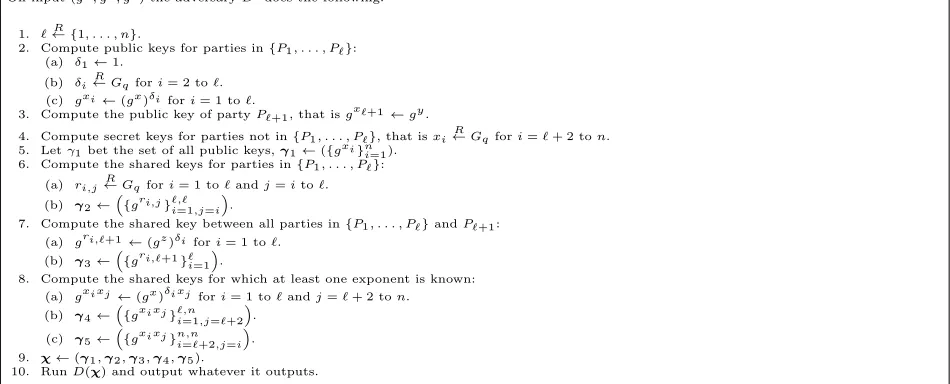
Wherexi ∈RGqandri,j ∈RGqfor alli, j∈1, . . . , n. LetDbe an adversary that attacksMulti-DDH. In figure 7 we describe an adversary that chooses a random ` ∈ {1, . . . , n} and, if D0 breaks
Multi-DDH, it distinguish between hybrids χ` and χ`+1. Clearly, if z = xy then γ3 = {gδixy}`i=1
and thus χ = χ`. Otherwise, if z ∈R Gq then
χ = χ`+1. Then, the advantage of D0 is given by n1AdvMDDHD (k). From the above, proving the indistinguishability betweenχ1 and χn is straightforward.
A.3 Proof of Theorem 2 (sketch)
Proof. The proof proceeds through the indistinguishability of 4 games: Gamereal, Gamerand keys,
Gamerand, and Gameideal.
Let Z be an environment and A an adversary. Gamereal consist of an execution of SIGMIX
with environment Z and adversary A in the real world. Gamerand keys is the same as Gamereal
except that instead of executingSIGMIX, the protocolSIGMIXrand keys is executed.SIGMIXrand keys
is almost equal toSIGMIX, except that for each pair of honest partiesPi andPj,i6=j, the shared keys ki,j and kj,i are replaced with a random ri,j ∈ Gq. Gamerand is the same as Gamerand keys
except that, instead ofSIGMIXrand keys, the protocolSIGMIXrand is executed. SIGMIXrand is almost
On input (gx, gy, gz) the adversaryD0does the following:
1. `← {R 1, . . . , n}.
2. Compute public keys for parties in{P1, . . . , P`}: (a) δ1←1.
(b) δi←RGqfori= 2 to`. (c) gxi←(gx)δi fori= 1 to`.
3. Compute the public key of partyP`+1, that isgx`+1←gy.
4. Compute secret keys for parties not in{P1, . . . , P`}, that isxi←RGqfori=`+ 2 ton. 5. Letγ1bet the set of all public keys,γ1←({gxi}ni=1).
6. Compute the shared keys for parties in{P1, . . . , P`}: (a) ri,j←RGqfori= 1 to`andj=ito`. (b) γ2←
{gri,j}`,`i=1,j=i.
7. Compute the shared key between all parties in{P1, . . . , P`}andP`+1:
(a) gri,`+1←(gz)δifori= 1 to`. (b) γ3←
{gri,`+1}`i=1.
8. Compute the shared keys for which at least one exponent is known: (a) gxixj←(gx)δixj fori= 1 to`andj=`+ 2 ton. (b) γ4←
{gxixj}`,ni=1,j=`+2. (c) γ5←{gxixj}n,n
i=`+2,j=i
.
9. χ←(γ1,γ2,γ3,γ4,γ5).
10. RunD(χ) and output whatever it outputs.
Fig. 7.AdversaryD0attackingDDH
honest, is replaced by a call to a completely random functionF.Gameideal consist of an execution ofFeaawith environment Z and the simulatorS (defined in figure 8) in the ideal world. We let the output of each game be the output of the environment.
Is not hard to see that indistinguishability betweenGamereal and Gamerand keys follows directly from the hardness of Multi-DDH. Also, by proposition 1, there exist an adversary DDDH such that n·AdvDDHD
DDH(k)≥
Pr[Gamereal]−Pr[Gamerand keys] .
The indistinguishability between Gamerand keys and Gamerand is based on an hybrid argument. For each i ∈ {0, . . . , κ}, we define the hybrid Gameirand such that the l-th shared key, l ≤ i, is replaced by a randomly chosen key. While the l-th shared key, l > i is chosen as in Gamerand keys.
By a standard hybrid argument we get that there exist a distinguisher DPRF such that (κ+ 1)· AdvPRFE,DPRF(k)≥
Pr
Gamerand keys= 1−Pr [Gamerand = 1].
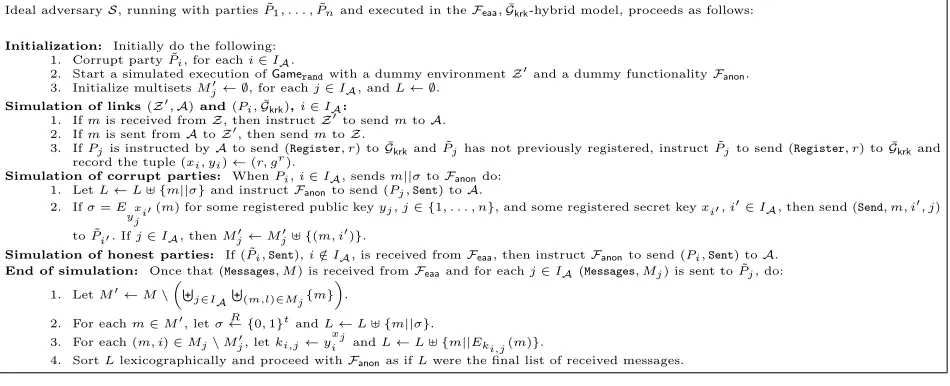
Let IA ⊆ {1, . . . , n} be the set indexes of parties corrupted by A. The ideal adversary SA is described in figure 8, and it simulates the execution of SIGMIXrand only with access toFeaa.
Since the values of messages sent by honest senders remains unknown toSA until all messages have been sent, when Feaa informs that a party ˜Pj (honest) sent some message, SA cheats the simulated A making Fanon tells A that some message have been sent by ˜Pj. When the set of messages M is revealed to SA, it silently instruct the simulated parties to send the messages to
Fanon. We will show that this seems indistinguishable from a real execution to A.
Note that the view ofAconsist of the lexicographically ordered listL, the responses fromFanon, and the responses from ¯Gkrk. Also note that the responses from Fanon and the responses from ¯Gkrk are the same and in the same order in bothGameideal and Gamerand. Therefore, the only possible difference might be inL.
LetLsimbe the list inGameidealandLrealbe the list inGamerand. We distinguish five type of
Ideal adversaryS, running with parties ˜P1, . . . ,P˜nand executed in theFeaa,G¯krk-hybrid model, proceeds as follows:
Initialization: Initially do the following: 1. Corrupt party ˜Pi, for eachi∈IA.
2. Start a simulated execution ofGamerandwith a dummy environmentZ0and a dummy functionalityF anon. 3. Initialize multisetsMj0← ∅, for eachj∈IA, andL← ∅.
Simulation of links(Z0,A)and(Pi,G¯krk),i∈IA:
1. Ifmis received fromZ, then instructZ0to sendmtoA. 2. Ifmis sent fromAtoZ0, then sendmtoZ.
3. IfPj is instructed byAto send (Register, r) to ¯Gkrk and ˜Pjhas not previously registered, instruct ˜Pj to send (Register, r) to ¯Gkrkand record the tuple (xi, yi)←(r, gr).
Simulation of corrupt parties: WhenPi,i∈IA, sendsm||σtoFanondo: 1. LetL←L] {m||σ}and instructFanonto send (Pj,Sent) toA. 2. Ifσ=E
yxi0 j
(m) for some registered public keyyj,j∈ {1, . . . , n}, and some registered secret keyxi0,i0∈IA, then send (Send, m, i0, j)
to ˜Pi0. Ifj∈IA, thenMj0←Mj0] {(m, i0)}.
Simulation of honest parties: If ( ˜Pi,Sent),i /∈IA, is received fromFeaa, then instructFanonto send (Pi,Sent) toA.
End of simulation: Once that (Messages, M) is received fromFeaaand for eachj∈IA(Messages, Mj) is sent to ˜Pj, do: 1. LetM0←M\
U
j∈IAU(m,l)∈Mj{m}
.
2. For eachm∈M0, letσ← {R 0,1}tandL←L] {m||σ}.
3. For each (m, i)∈Mj\Mj0, letki,j←yxji andL←L] {m||Eki,j(m)}.
4. SortLlexicographically and proceed withFanonas ifLwere the final list of received messages.
Fig. 8.The ideal adversaryS
are both inLsim andLreal, given that such elements only comes from corrupted parties. Therefore,
they must be added to Lsim in line 1 of the “Simulation of corrupt parties” stage. A message of
the type (honest,corrupt) is added to Lreal if an only if the corresponding message appears on
Mj\Mj0, for somej∈IA. Therefore, it must be added toLsim in line 3 of the “End of simulation”
stage. Note that, given that the sender is honest, the message is exactly the same message added inLreal. Finally a message of the type (honest,honest) is added toLreal if and only if the
corre-spondent message can be found in M0. Therefore, it must be added to Lsim in line 2 of the “End
of simulation” stage. Note that, given that both the sender and the receiver are honest, the subset of messages of type (honest,honest) in Lreal must be of the form {m1||F(m1), . . . , ms||F(ms)}, where s ∈ N and F is a completely random function. The assumption of environments that do not send the same message twice implies that, if i6=j, thenmi 6=mj and thusF(mi) and F(mj) are independent randomly chosen strings. Therefore, the messages added toLreal in line 2 follows
exactly the same distribution of correspondent messages in Lsim. We conclude that the view of A
inGamerand is exactly the same as inGameideal.
The only possible difference on the view of Z is due to a difference in the output of an honest party. Specifically, this difference is possible because, in the “Simulation of corrupted parties” stage, some messagesm||σ could not have been sent toFeaa in line 2 of the “Simulation of corrupt parties” stage. This set of dropped messages may contain forgery, i.e. messages created byA that are accepted by an honestPj as coming from an honest Pi.
Therefore, if A does not forges, then the the output of Z in Gamerand must be the same in Gameideal. Let “Aforges” be the event where an honest party accepts a message sent byAas coming
from another honest party. Then PrGamerand= 1|Aforges= PrGameideal= 1|Aforges. By the fundamental lemma of game playing we get that |Pr [Gamerand = 1]−Pr [Gameideal = 1]| ≤
Pr [Aforges].
m 6= m0 for all previously m0||σ0 seen by A, otherwise it must be that σ 6=σ0 = F(m0) = F(m), because m0||σ0 was honestly sent, and thusm||σ can not be accepted by an honest party.
Given thatm6=m0, for all previouslym||σseen byA, it must be thatAhave never seenF(m). Therefore, F(m) is randomly chosen independently from σ and thus Pr [F(m) =σ] = 1/2t. Given thatA can send a mostκ messages, it must hold that Pr [A forges]≤κ·2−t.