CrossMark
Published by DiscoverSys
1PhD in Biophysics, Associate Professor, Department of Medical Physics, Faculty of Medicine, Gonabad University of Medical Sciences, Gonabad, Iran.
2PhD in Educational Psychology, Associate Professor, Department of Basic Sciences, Faculty of Medicine, Gonabad University of Medical Sciences, Gonabad, Iran.
3BSc in Occupational Health, Student of Research Committee Gonabad University of Medical Sciences, Gonabad, Iran.
*Correspondence to: Jahanshir Tavakolizadeh, PhD in Educational Psychology, Associate Professor, Department of Basic Sciences, Faculty of Medicine, Gonabad University of Medical Sciences, Gonabad, Iran.
Received: 2017-1-3 Accepted: 2017-02-25 Published: 2017-2-28
INTRODUCTION
According to the World Health Organization’s (WHO) definition, health refers t full physical, mental and social welfare and not the absence of disease or infirmity.1 Therefore, mental health not only involves the absence of mental disorders, but also promotion of mental health. Indicators of mental health promotion and mental well-being have been widely evaluated.2
Ryff 2 presented a multidimensional definition of mental well-being and six key components of positive psychological performance including self-acceptance, positive relations with others, autonomy, environmental mastery, purpose in life and personal growth. In this context, control and mastery of emotions, particularly negative emotions such as depression, anxiety and aggression is very important. Psychologists believe that aggression includes behaviors which harm self or others physi-cally or verbally. Moreover, aggression is defined as a behavior which intends to harm another person or destroy property of others.3 Aggressive behav-iors have numerous reasons; they are sometimes in response to a situation of insecurity and they are sometimes rooted in the lack of opportunity to learn.4 In fact, there are different approaches used
to explain these behaviors. In psychological mobil-ity approach,aggression is instinctive in nature.
According to Freud, aggression corresponds to death instinct, that is, the innate human desire for destruction of self and others. This desire is internal and self-destructive; however, it becomes external soon and is manifested in the form of aggressive behaviors. Some theorists believe that human aggressive behavior is not guided by instinct and learning plays an important role particularly in observation of these behaviors. Biological factors undoubtedly contribute to aggression;however, its role is not clear properly.
Development of science, technology and utiliza-tion of multiple tools in producutiliza-tion process as well as exposure of workers to harmful factors lead to concern in occupational health as the main capital of industry. Sound is a mechanical wave. Noise is generally, defined as a sound or series of sounds unwanted. The general consensus is that noise is an audio hearing phenomenon with harmful effects on individuals. Effects of noise can be understood both physically and psychologically.
Noise is considered as the world’s most common work-related risk factor; almost 600 million workers ABSTRACT
Introduction: Aggression is a very complex concept which is both influenced by psychological factors and genetic, biological and environmental factors. Noise pollution is a major factor influencing human behavior.
Objective: Therefore, this study compared the effect of earmuffs and hocks on aggression of stone cutting factory workers.
Methods: In this quasi-experimental study, 60 healthy male workers of all stone cutting factories in Gonabad were selected by simple random sampling and assigned to two groups of 30 people who used earmuffs and hocks for a month. Aggressive behavior was measured by using Buss-Perry aggression questionnaire before and after intervention. Data was analyzed by using pairwise and independent t-test using statistical analysis software, SPSS, version 19 (p<0.05).
Results: No significant difference was found in demographic characteristics between the two groups of workers (p>0.05);however, the difference in pre-test and post-test mean scores of aggression and physical, verbal, anger and hostility between both groups showed that all these variables significantly decreased in the hock group compared to the earmuffs group (p<0.05).
Discussion: This study found that aggression regardless of the wide range of factors associated could be reduced in stone workers exposed to a relatively high noise by using hocks rather than earmuffs.
Conclusion: Hock reduces aggression and its components in stone workers more than earmuffs. Thus,hocks are recommended in factories which suffer from noise pollution.
Keywords: aggression, noise pollution, earmuff, hocks, stone workers
Cite This Article: Kianmehr M., Tavakolizadeh J., Tamaddon-Yalmeh T., Bahalgardi B. 2017. Comparison of the effect of earmuffs and hocks on aggression of stone workers. Bali Medical Journal 6(1): 164-168. DOI:10.15562/bmj.v6i1.388
Comparison of the effect of earmuffs and hocks on
aggression of stone workers
Mojtaba Kianmehr,1 Jahanshir Tavakolizadeh,2* Jalaloddin Tamaddon-Yalmeh,3
Bahareh Bahalgardi3
Volume No.: 6
Issue: 3
First page No.: 164
P-ISSN.2089-1180
E-ISSN.2302-2914
are exposed to occupational noise.5 Sound is one of the most important factors which can disrupt human physiological balance effectively in the workplace and threaten mental and physical health.
Stone cutting workshops are also exposed to a considerable noise. Iran with production of 9 million tons of stone and 1806 stone cutting busi-nesses is the world’s second industry in this field.6 When the noise level exceeds the limit, it can impose detrimental effects on different functions such as hearing and blood circulation, mental health and efficiency.5 Several studies have shown that noise as an environmental stressor, is a potential factor for physical and psychological injury.7 Not all individ-uals respond similarly to noise. Studies conducted in this field have demonstrated the role of brain,
hormones and heredity in this field.8 Although
many studies have been conducted on aggression; its many aspects are still unknown. Recent studies have focused on the role of endocrine and neuro-psychological factors as underlying mechanisms. In the past, it was believed that the steroidal hormone, testosterone, is an important activator of aggressive behavior and its incidence.
Noise can also cause emotions. Noise is associ-ated with jumping reaction, difficult falling asleep and it causes anxiety and aggression. For this reason, the noise-stress related responses include not only real sound level, but also all negative emotional relationship in memory of the affected person.9 To increase productivity and reduce effects of noise on the body, many countries have considerably noticed noise.5 Noise control at the source, noise control on the path and protection of auditory system are used to protect against noise.10
Earmuff is one of this personal protective equip-ment; however it has advantages and disadvantages. Its advantages are as follows: a bunch of earmuffs with a given size can cover a high percentage of individuals. At the start of a hearing protec-tion program,earmuffs are more acceptable than earplugs. Moreover,earmuffs are not as easily lost as earplugs. Their disadvantages are as follows: they are unpleasant in a hot environment, they are difficult to handle and maintain, they are more expensive, and they are not applicable in closed environments
which require movement of the head.10
There is a large number stone cutting factories in Gonabad; certainly, there are many workers in this industry who are exposed to very high and annoying intensity of noise. Given the significance of mental health of workers and the growing inci-dence of aggressive behaviors in social life focusing on adverse effect of these behaviors on public health as well as the lack of interventional studies in this field, this study evaluates following hypotheses to compare effect of earmuffs and sound blockers on
reduction of aggressive behavior and its components in workers of stone cutting factories in Gonabad.
1. Hocks have higher contribution in reducing aggression of workers than earmuffs.
2. Hocks have higher contribution in reducing components of aggression (physical aggres-sion, verbal aggresaggres-sion, anger and hostility) than earmuffs.
METHODS
This quasi-experimental study was conducted on 60 healthy male workers randomly recruited from stone cutting factories in Gonabad city in 2014.The studied samples were recruited from workers who had at least one year of experience in stone cutting and were willing to use hearing protectors, were healthy in terms of smoking, drug abuse, drug or food sensitivity, had no history of diseases such as congenital disabilities, mental retardation, thyroid disorders, metabolic disorders, diabetes, hyper-tension, hyperlipidemia, genetic diseases, mental disorders and hearing loss.
This study was approved by the Research Ethics Committee of Gonabad University of Medical Sciences. Providing their consent to participate in the study, the workers were randomly assigned to two groups of 30 and received intervention for one month. Buss-Perry aggression questionnaire was filled by both groups of workers before and after the intervention.
In this study, noise refers to the voice higher than national occupational exposure limit (85 dB).10 Personal hearing protective equipment refers to devices which can provide hearing protection limits.10 In this study, hearing protectors included earmuffs and hocks. Earmuff is a protective device placed on the ear and covers the auricle to prevent sound waves.
Hocks convert sound energy into heat energy. Hocks filter annoying sounds and allow sounds less than 80dB. Buss-Perry11 aggression question-naire was used to measure aggression of subjects. This 29-item questionnaire evaluates physical aggression (9 items), verbal aggression (5 items), anger (7 items) and hostility (8 items) by five points ranging from extremely uncharacteristic of me (1) to extremely characteristic of me (5). Buss and
Perry11 determined internal consistency of the
questionnaire to 0.89. Moreover, correlation of subscales with each other and with the whole scale varies from 0.25 to 0.45, indicating its good validity. Examining this questionnaire on Shiraz students,
Mohammadi12 determined its reliability by using
Moreover, validity of the questionnaire was determined by using convergent validity, concur-rent validity and factor analysis. Convergent validity was determined by calculating correlation coefficients of subscales with each other and with the whole questionnaire; these coefficients varied from 0.37 to 0.78 and were significant. Concurrent validity was calculated by using general psycho-pathology scale; the calculated coefficient of correlation (0.34) was significant (p<0.01). Factor analysis using principal components and varimax rotation showed that the questionnaire formed of
four factors (hostility, physical aggression, verbal aggression and anger) explain more than 46% of the total variance.12
The subjects assigned to 2 groups filled the Buss-Perry aggression questionnaire. Then, the subjects were instructed about how to use earmuffs and hocks. The workers were asked to use these hearing protectors for 1 month. Then, aggression of workers was determined by using the same questionnaire. In addition, demographic data and intensity of sound were determined in different parts of the factories at the beginning and end of the project. The CEL-450 Sound Level Meter, manufactured by CASELLA Co. UK, was used to determine sound intensity. A mercury sphygmomanometer, Erkameter 3000, Germany was used to determine blood pressure.
Data was analyzed by the statistical analysis software SPSS, version 19. Considering normal distribution of data in each group by Kolmogorov-Smirnov (K-S) test, analysis was done by using pairwise and independent-test (p<0.05).
RESULTS
The samples were all healthy male workers; their
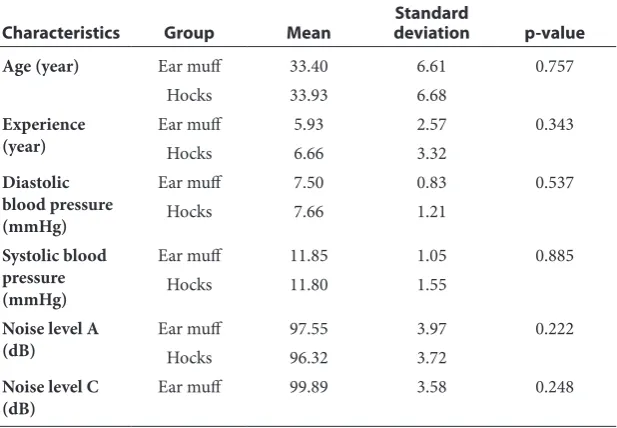
demographic data is listed in Table 1. According
to Table 1, independent t-test showed no signifi-cant difference in demographic data between the two groups using earmuffs and hocks (p>0.05). The Table 2 shows no significant difference between the two groups in terms of aggression before the inter-vention (p>0.05). However, reduction of aggression was higher after the intervention in the group using hocks than the group using earmuffs (p<0.05).
Moreover, there was no significant difference between two groups in terms of components of aggression including physical aggression, verbal aggression, anger and hostility before the interven-tion (p>0.05). However, reducinterven-tion of components was higher after the intervention in the group using hocks than the group using earmuffs (p<0.05).
According to Table 1, independent t-test showed no significant difference in demographic data between the two groups using earmuffs and hocks (p>0.05). The Table 2 shows no significant differ-ence between the two groups in terms of aggression before the intervention (p>0.05). However, reduc-tion of aggression was higher after the intervenreduc-tion in the group using hocks than the group using earmuffs (p<0.05). Moreover, there was no signif-icant difference between the two groups in terms of components of aggression including physical aggression, verbal aggression, anger and hostility before the intervention (p>0.05). However, reduc-tion of components was higher after the interven-tion in the group using hocks than the group using earmuffs (p<0.05).
Table 1 Mean and standard deviation of demographic data
Characteristics Group Mean deviationStandard p-value
Age (year) Ear muff 33.40 6.61 0.757
Hocks 33.93 6.68
Experience
(year) Ear muffHocks 5.936.66 2.573.32 0.343
Diastolic blood pressure (mmHg)
Ear muff 7.50 0.83 0.537
Hocks 7.66 1.21
Systolic blood pressure (mmHg)
Ear muff 11.85 1.05 0.885
Hocks 11.80 1.55
Noise level A
(dB) Ear muffHocks 97.5596.32 3.973.72 0.222 Noise level C
(dB) Ear muff 99.89 3.58 0.248
Table 2 Comparison of mean and standard deviation in aggression
and its factors between the two groups
Aggression Group InterventionBefore interventionAfter p-value Physical
aggression Ear muffHocks 19.86±2.0619.20±3.97 18.56±2.8615.56±1.83 <0.0010.010
p-value 0.363 <0.001
-Verbal
aggression Ear muffHocks 11.16±1.8010.76±1.79 10.60±1.949.06±1.99 <0.0010.140
p-value 0.392 0.004
-Anger Ear muff 18.03±3.33 17.33±2.12 0.159
Hocks 17.70±2.50 14.36±2.20 <0.001
p-value 0.663 <0.001
-Hostility Ear muff 18.46±2.48 17.50±2.71 0.041
Hocks 17.36±3.17 13.46±2.02 <0.001
p-value 0.141 <0.001
-General
aggression Ear muffHocks 67.53±4.8865.03±5.76 64.00±4.1952.46±5.06 <0.0010.002
-DISCUSSION
Findings support both hypotheses; results of statis-tical analysis are shown in Table 2. These results are partly consistent with studies in which stress caused by noise could influence emotions of people, partic-ularly aggression, and increase their aggression.13,14 However, no interventional studies were available on better performance of earmuffs in reducing aggression and its components among workers. However, the reduction in aggression scores of the group using hocks compared to the group using earmuffs can be attributed to the fact that hocks might outperform earmuffs in reducing noise stress-induced aggression. It seems that hearing system as an alarming member which, unlike eyes, cannot be closed responds to noise and increases stimulation against stress by increasing stress
hormones13 and consequently leads to aggression
and anger.
Noise is a phenomenon influencing everyone. During everyday life, people are constantly exposed to various noises such as transport, road traffic, railways, aircraft and helicopters, and noises inside buildings caused by mechanical devices, media and
musical tools and ventilation.14 This unpleasant
and generally unavoidable noises are produced and released abundantly in the industry.5 In parallel with development of industry and replacement of simple devices by complex mechanical devices, the number of sound sources with higher intensity, power and pressure has also increased; certainly, this inevitable industrial development has caused noise-related distresses.
In some studies showed human response to noise is similar to response to an imminent danger. These responses can include adrenaline hormone secretion, blood pressure and heart rate changes. Other problems related to noise can include bad
temper, violence and lack of concentration9 and
sleep disturbances.14 Damage to the hearing system, interfered conversation, effect on visual organs, effect on balance system, social disorders, neuro-logical effects, effect on electrolytes, side effects, psychological effects, general physiological effects and mental effects are caused by noise on human and his health.15
Biochemically, noise can change blood and urine parameters. Blood glucose, cholesterol, triglycerides, fibrinogen, leukocytes and stress hormones increase under prolonged exposure to noise.16 There is an extensive literature suggesting that noise can have a devastating effect on health, particularly mental health.17
Schreckenberg et al.18 showed that exposure to noise does not necessarily determine mental health effects; instead, sensitivity to noise is effective on
noise distress. Shepherd et al.19 found that noise level does not determine noise nuisance; instead, other factors, particularly noise sensitivity, play a role. Through a systematic review of the role of noise in clinical environments and its conse-quences focusing on mental health care, Brown,
Rutherford&Crawford7 showed that unwanted
noise could clearly be detrimental to health and prevent improvement. Some studies have shown that the risk of overcrowding in noisy workplace creates common workspaces which are associated with negative effects, such as high levels of stress and aggression.20
Studies have also found that vasopressin and dopamine play a key role in modulation of aggres-sion. In the meantime, there are other factors which can cause harmful effects. For example, some stud-ies have shown that unresolved conflicts in noisy workplaces can be harmful to people, because these conflicts can often lead to high levels of stress; more stressful events such as verbal aggression may also
lead to emotional exhaustion.20 Another study
showed that workplace noise and high noise could have negative consequences, such as high stress and aggression.20
In conclusion, emotions such as aggression in the workplace are influenced by different biological, psychological and social factors. Noise pollution is only one of the environmental factors effective on aggression. This study examined the role of hocks and earmuffs on aggression. Nevertheless, the fact is many biological factors such as endocrine factors, neurophysiological factors, hormones such as testosterone steroid hormone, vasopressin
and neurotransmitters such as dopamine4, various
psychological factors such as mobility and learn-ing16, cognitive factors such as sensitivity in percep-tion18, memory and negative emotional relations20 are involved in aggression. Therefore, noise can be associated with a set of these factors and increase aggression.
This study found that aggression regardless of the wide range of factors associated could be reduced in stone workers exposed to a relatively high noise by using hocks rather than earmuffs. However, resources used in this study were limited to self-evaluation instruments; the intervention was done within a month. Future studies can consider these limitations and provide solutions for them to present a more accurate judgment.
CONCLUSION
moreover, reduction of aggression is higher in workers using hocks than workers using earmuffs. Thus, it is recommended to use hocks in factories exposed to noise pollution.
ACKNOWLODGEMENT
The authors appreciate the workers participating in this study. There was no conflict of interest among the authors. This study is a summarized project approved by the Research Council of Gonabad University of Medical Sciences and sponsored by the Research Department of Gonabad University of Medical Sciences.
REFERENCES
1. WHO. Promoting mental health: concepts, emerging evi-dence, practice: report of the World Health Organization. 2005: 1-3.
2. Ryff CD. Happiness is everything, or is it? Explorations on the meaning of psychological well-being. Journal of Personality and Social Psychology. 1989; 57: 1069-81. 3. Anderson CA, Bushman BJ. Human aggression. Journal of
Annual Research Psychology. 2002; 53: 27-51.
4. Navabinejad S. Normal and abnormal behavior in children and predictive and treatment method. The publication of Parents and Teachers Association. Tehran, Iran. 2003. (Persian) 5. Tajic R, Ghadami A, Ghamari F. The effects of Noise
Pollution and Hearing of metal Workers in Arak. TabibeShargh. 2009; 10: 291-299. (Persian)
6. Halvani GhH, Zare M, Barkhordari A. Noise induced hearing loss among textile workers of Taban factories in Yazd. The Journal of Birjand University of Medical Sciences. 2009; 15: 69-75. (Persian)
7. Brown B, Rutherford P, Crawford P. The role of noise in clinical environments with particular reference to mental health care: A narrative review. International journal of nursing studies. 2015; 52: 1514-1524.
8. Aronson E. Social psychology. 4th Edition. 1990.
9. Smith A. A review of the non audiotory effects of noise on health. Work & Stress. 1991; 5:49-62.
10. Golmohamadi R, Mohamadfam I. Sound and vibration engi-neering: measurement, evaluation, health aspects and con-trol in industry and environment. hamedan: danes hju, 2014. 11. Buss AH, Perry MP. The aggression questionnaire. Journal
of Personality and Social Psychology. 1992; 63: 452-59. 12. Mohammadi N. [Pilot study of psychometric
characteris-tics of Buss and Perry’s aggression questionnaire]. Journal of Social and Human Sciences of Shiraz University. 2006; 25: 135-51. (Persian)
13. Evans G. Built environment and mental health. Journal of Urban Health: Bulletin of the New York Academy of Medicine. 2003; 80: 536e555.
14. Maschke C, Rupp T, Hecht K. The influence of stressors on biochemical reactions-a review of present scientific find-ings with noise. International journal of hygiene and envi-ronmental health. 2000; 203: 45-53.
15. Golmohamadi R, Ziad M, Atari G. evaluation of noise pol-lution and hearing loss caused by noise polpol-lution in stone workers of Malayer. Working health of Iran. 2006; 3:23-27. 16. Wallner B, Machatschke IH. Influence of nutrition on aggres-sion. CAB Reviews: Perspectives in Agriculture, Veterinary Science, Nutrition and Natural Resources. 2009; 4: 1-10 9 17. Muzet A. Environmental noise, sleep and health. Sleep
medicine reviews. 2007; 11: 135-142.
18. Schreckenberg D, Griefahn B, Meis M. The associations between noise sensitivity, reported physical and mental health, perceived environmental quality, and noise annoy-ance. Noise Health. 2010; 12: 7–16.
19. Shepherd D, Welch D, Dirks KN, Mathews R. Exploring the relationship between noise sensitivity, annoyance and health-related quality of life in a sample of adults exposed to environmental noise. Int. J. Environ. Res. Public Health. 2010; 7: 3579–3594.
20. Danielsson CB, Bodin L, Wulff C, Theorell T. The relation between office type and workplace conflict: A gender and noise perspective. Journal of Environmental Psychology. 2015; 42: 161-171.