Organized by C.O.E.T, Akola, ISTE, New Delhi & IWWA. Available Online at www.ijpret.com113
INTERNATIONAL JOURNAL OF PURE AND
APPLIED RESEARCH IN ENGINEERING AND
TECHNOLOGY
A PATH FOR HORIZING YOUR INNOVATIVE WORK
PROCESS UP-GRADATION OF AAC BLOCKS FOR LONG TERM DURABILITY
DR. DHARMENDRA CHANDRAPRAKASH KOTHARI
Amit Prakash Lonsane, Department of Chemical Engineering & Technology, COE&T, Akola, 444 104
Accepted Date: 07/09/2016; Published Date: 24/09/2016
Abstract: The objective of this paper is to provide research study on the long-term performance, degradation processes and ageing characteristics of AAC bricks with and without water repellants. Inspection carried out by physical and chemical analysis of samples artificially aged by short-term laboratory tests. Two approaches of coatings were employed; application of sealer cum primer and water based protective coatings to extend the service life and continuous moisture and temperature monitoring of exposed test samples are also included in the study. Attempt were been made to develop methods for long-term performance assessment of water repellants to be used in service life prediction. The combination of data obtained from the laboratory tests and analysis would meet practical needs of the end users. Aerated Autoclaved Concrete (AAC), unlike traditional concrete masonry units, is a solid material with integrated isolative and structural components contributes significantly to environment by preventing top soil deterioration and by fly ash consumption. Many failures of external walls made of porous AAC building materials are caused by excessive moisture content, particularly after driving rain and under long duration of moist, hot conditions. Lack of sufficient protection against exposure conditions is one of the reasons for external walls prematurely demonstrating failures. Protective coatings are expected to prolong the service life and improve the durability of wall components by preventing water access into the structure and thus delaying the deteriorating effects of the atmosphere. Yet various kinds of water repellants have been developed, only limited research has been carried out, particularly on the long-term field exposure testing. Existing work is mainly focused on the performance of surface treatments and the protection of AAC bricks based on short-term laboratory testing to enhance the bricks life and durability.
Keywords: Aerated Autoclaved Concrete (AAC), moisture content, protective coatings
. Corresponding Author: DR. DHARMENDRA CHANDRAPRAKASH KOTHARI
Co Author:
Access Online On:
www.ijpret.com
How to Cite This Article:
Dharmendra Chandraprakash Kothari, IJPRET, 2016; Volume 5 (2): 113-121
PAPER-QR CODE
SPECIAL ISSUE FOR
INTERNATIONAL CONFERENCE ON
“INNOVATIONS IN SCIENCE & TECHNOLOGY:
Organized by C.O.E.T, Akola, ISTE, New Delhi & IWWA. Available Online at www.ijpret.com114 INTRODUCTION
In India, nearly 90 metric tons of fly ash is generated per annum at present and is largely responsible for environmental pollution. In developed countries like Germany, 80% of the fly ash generated is being utilized, whereas in India only 3% is being consumed[1 & 2].
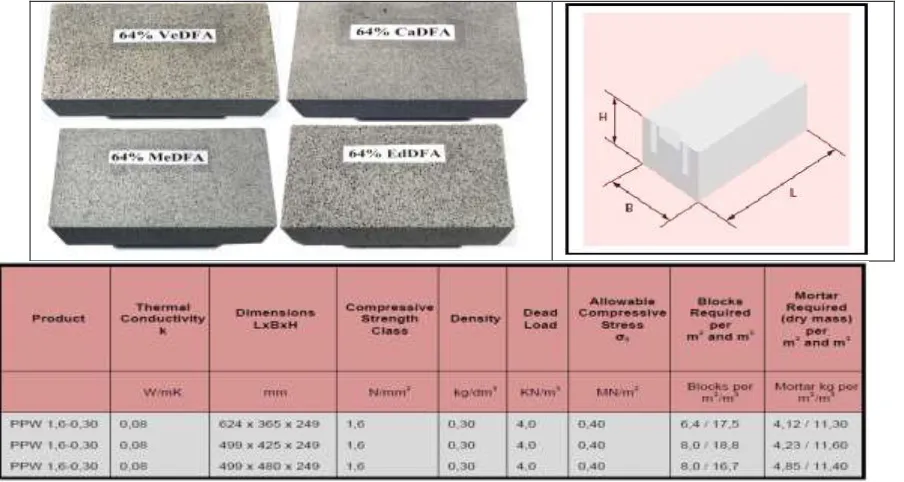
Aerated Autoclaved Concrete (AAC), as shown in Figure (1), unlike traditional concrete masonry units, is a unique building solid material system with integrated isolative and structural components. Also it is available in a variety of products that can be used in both load and non-load-bearing applications. Due to some versatile properties like large size, however light weight, high load bearing strength, high durability, best thermal insulation, unsurpassed fire-resistance, excellent sound absorption, hurricane and earthquake resistance, complete insusceptibility to termites etc makes it suitable over traditional constructional material and used for all kinds of building constructions[3 & 4].
Figure (1): AAC block and cross sectional view and dimensional properties.
In spite of these provisions, the major problems with the bricks which are in humid, hot, heavy rainy environment causes porous surface of concrete, trapping moisture already present that seeks to escape through the surface and setting the coating up for failure. Under tropical climate heat accumulation in modern building is the main problem for inhabitants. Thus residents are obliged to use mechanical devices to satisfy their comfort [5 & 6].
Organized by C.O.E.T, Akola, ISTE, New Delhi & IWWA. Available Online at www.ijpret.com115 Dry density
(kg/m3)
Compressive strength (MPa)
Static modulus of
elasticity (kN/mm2)
Thermal conductivity
(W/m°C)
400 1.3-2.8 0.18-1.17 0.07-0.11
500 2.0-4.4 1.24-1.84 0.08-0.13
600 2.8-6.3 1.76-2.64 0.11-0.17
700 3.9-8.5 2.42-3.58 0.13-0.21
AAC is in 'ready to build' material, requiring no onsite curing time. It has unparalleled workability because it can be sown, drilled, nailed, screwed and milled with common hand tools. Applying mineral additions as fly ash for the aggregate filler in aerated concrete has many ecological and economic benefits. AAC is recognized “Green Building” product contributing towards “Net zero Energy Building”, mold resistant inorganic, breathable, no toxic releases or off gassings and promotes healthy indoor air Quality. Generally, compressive strength increases linearly with density. Values of compressive strength for different densities and properties of AAC are listed in Table 1[7]. Several relations have been proposed to assess the compressive strength of aerated concrete. For m foamed concrete, the modified form of Feret’s equation relating the strength (S), water-cement (w/c) and air/cement (a/c) ratios, is given as;
S = K [1/(1+(w/c)+(a/c))]n
where, K and n are empirical constants. Strength to gel- space ratio relationship for foamed concrete made with proprietary foaming agents were developed by Durack and Weiqing[8, 9, &10].
Materials and Methods
Organized by C.O.E.T, Akola, ISTE, New Delhi & IWWA. Available Online at www.ijpret.com116
(a) Pore liner SiO
2. (b) Pore blocker Silicates. (c) Coating and Sealers, Acrylic & Stryrene. (d) Cementitious coating, Silicon additives.
Figure [2]: Types of surface treatments.
The use of surface treatments mainly aims to improve the weather resistance and in turn, the long-term performance of building materials, to provide a sufficiently dry wall by reducing water penetration while allowing vapour transmission and to control carbonation can be regarded as the primary performance requirements of surface treatments[13]. Surface treatments are classified in four main groups according to the mechanism by which the protection is achieved. In Figure (2), types of surface treatments are illustrated according to this classification. Surface treatments which are appropriate for application to AAC bricks are: surface impregnation with silicon-based water repellant as pore-liner Figure (2 a), acrylic-styrene paint as coating, Figure (2 c), rendering containing silicon additive Figure (2 d). The basic properties are given above.
The performance of the pore-liners largely depends on properties of the substrate, such as porosity and moisture content and on the amount of material applied in addition to the penetration depth. As the surface treatment is colorless, it makes very little change on the appearance of the facade. Silanes, siloxanes and silicon compounds are examples of this type, [14]. These treatments penetrate into the substrate and clog the pores. In this way water is
repelled along with any dissolved salts, acids and other aggressive agents. This treatment is also known as the crystal growth method. The crystalline reaction products bind to the water molecules and increase in volume. They have good weather resistance but the vapour transmission is greatly restricted by the blockage of the pores. Improper application can cause water uptake by capillary action [15].
Organized by C.O.E.T, Akola, ISTE, New Delhi & IWWA. Available Online at www.ijpret.com117 impart integral water repellency and improve the adhesion of the renderings to the substrate. These products are also vapour permeable allowing transmission of vapour. Cementitious coatings adhere well to the substrate, however, they do not function if cracking or substrate movement occurs [16].
The most important silicon-based water repellants are those made of silanes and siloxanes which are polymers containing three alkoxy groups, denoted OR’, linked to a silicon atom, and each silicon atom carrying an organic alkyl group, denoted R. The silicon functional alkoxy group (OR’) reacts with water and yields a reactive silanol group (hydrolysis stage). Further condensation by cross linking to the hydroxyl groups forms polysiloxane (silicon resin) as the active water-repellent product which is linked to the inorganic substrate by way of covalent siloxane bonds, & formation of crystallised tobermorite in AAC products as shown in Figure (3).
(a) R: Halogen or Alkoxy Group (b) Formation of crystallised tobermorite. Figure (3): (a) Reaction of alkylalkoxysilane, & (b) formation of crystallised tobermorite.
Organized by C.O.E.T, Akola, ISTE, New Delhi & IWWA. Available Online at www.ijpret.com118 Figure (4): The principle of water repellency.
The interaction between water and a surface may also be described from the first principles at the molecular level, leading to rather complex relationships.
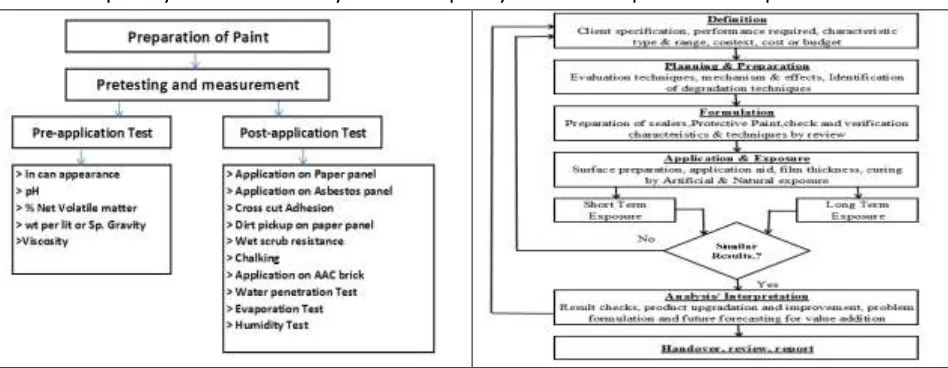
A short summary of exposure, measurement and testing programmes is given in Figure (5). All samples either exposed naturally or artificially, have been evaluated. By the end of continuous measurement after a week exposure period, the test blocks will be used for final laboratory testing and analysis. Studies on surface characteristics and chemical constituents are carried out subsequently to the laboratory tests of capillary water absorption and evaporation.
Figure [5]: Paint applications Methodology for Protective coating and Performance Testing.
RESULT AND DISCUSSION
Organized by C.O.E.T, Akola, ISTE, New Delhi & IWWA. Available Online at www.ijpret.com119 Figure (6): Capillary water Absorption results and Analysis.
A complete graphical presentation of the results to till date can be found in proposed work. It is important to note that test results of artificial weathering obtained at specific intervals belongs to the different samples. The capillary water absorption method of the surface coating describes the water absorption of a wall when a film of water occurs at the surface. In Figure (6), the capillary water absorption (at 24 hr interval) of treated samples during artificial weathering is graphically represented on the basis of observations from demonstrated linear increase during artificial weathering while being more stable after 48-hr artificial weathering.
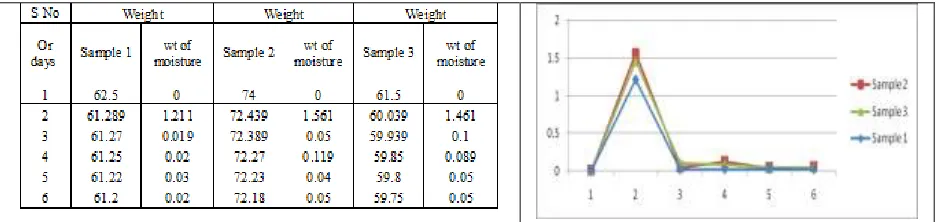
The drying rate is controlled by the diffusion of water vapour through the material. In addition to the pore size distribution, any surface treatment of the AAC has influence over drying property. The rate of drying after wetting is further dependent on the conditions like ambient temperature, relative humidity and wind velocity. However the laboratory testing data shows the actual artificially exposed sample data.
Figure (7) :- Water Evaporation Test Table & Analysis.
Organized by C.O.E.T, Akola, ISTE, New Delhi & IWWA. Available Online at www.ijpret.com120 properties and in turn improve its functionality, various coatings and/or treatments are applied making the surface more complicated.
CONCLUSION
Protective coatings are normally applied as a preventive measure in order to minimize deterioration of materials, and to extend their service life. The increased use of polyurethane and silicon based water repellants is therefore intended to provide a sufficiently dry wall by reducing rainwater penetration into the wall structure. It gives direct indication of real life effects of weathering and helps to understand actual in-service performance while artificial exposure under carefully controlled conditions. The work aimed at minimizing the degradation effects by water repellants on AAC walls based on the different testing procedures in accordance with the systematic methodology. The silicon-based water repellant impregnated sample 3 performs best so far. The rendering system with silicon additive is able to resist heavy driving rain.
REFERNCES
1. Belie, N, “When Green is not clean”, European Coatings Journal, (2010).
2. Dhadse, S. and Kumari, P., “Fly ash Characterization, utilization and Government initiatives in India- A review”, J. of Scientific & Ind Research, Vol. 67, pp.11-18, (2008).
3. Gadget Notification, Ministry of Road Transport & Highway’s, New Delhi, (2003).
4. Girrard, J. “Sealer Option for Concrete Countertops”, Concrete Countertops Inst., (2005). 5. Kus, H. “Long Term Performance of Water repellents on Rendered Autoclaved Aerated Concrete”, Doctoral Thesis in Engineering, Royal Institute of Tech., Stockholm, (2002).
6. Kus, H., “Silicon-Based Water Repellants: Long-term Performance Evaluation by Artificial Accelerated Ageing”, Add Coat 2001, Additives for Coatings, Inks and Additives, Orlando, Florida, USA, pp. 1-27, (2001).
7. Lonsane, A.P, “Aerated Autoclaved Concrete Blocks with Protective Coatings”, M.Tech., Thesis, Sanit Gadge Baba Amravati University, at COE&T, Akola, (2016).
8. Malshe, V.C. and Sikchi, M. “Basics of Paint Technology (Part-I)”, Sevak Printers, Mumbai, Third Edition, (2010).
9. Schnitzler, S., “Autoclaved Aerated Concrete as a Green Building Material”, Applied Research Paper, Sustainability and the Built Environment, UC Davis Extension, (2006).
10. Senapati, M. R., “Fly ash from thermal power plant- waste management and overview”, Current Science, Vol. 100, No 12, (2011), pp. 1791-1794.
Organized by C.O.E.T, Akola, ISTE, New Delhi & IWWA. Available Online at www.ijpret.com121
13. www.aschome.com/concretetechnologies/aac.htm.
14. www.currentscience.com/aacblock&brick.
15. www.safecrete.com/testimonials/taylor%20Trading%20Costco%Costco.htm.
![Figure [2]: Types of surface treatments.](https://thumb-us.123doks.com/thumbv2/123dok_us/8720474.1743680/4.612.86.528.83.228/figure-types-of-surface-treatments.webp)