Michalik Anna, Spratek Monika. Quality of life from the perspective of physical functioning in patients with rheumatoid arthritis -preliminary report. Journal of Education, Health and Sport. 2018;8(8):369-380. eISNN 2391-8306. DOI
http://dx.doi.org/10.5281/zenodo.1315185
http://ojs.ukw.edu.pl/index.php/johs/article/view/5679
The journal has had 7 points in Ministry of Science and Higher Education parametric evaluation. Part B item 1223 (26/01/2017). 1223 Journal of Education, Health and Sport eISSN 2391-8306 7
© The Authors 2018;
This article is published with open access at Licensee Open Journal Systems of Kazimierz Wielki University in Bydgoszcz, Poland
Open Access. This article is distributed under the terms of the Creative Commons Attribution Noncommercial License which permits any noncommercial use, distribution, and reproduction in any medium, provided the original author (s) and source are credited. This is an open access article licensed under the terms of the Creative Commons
Attribution Non commercial license Share alike.
(http://creativecommons.org/licenses/by-nc-sa/4.0/) which permits unrestricted, non commercial use, distribution and reproduction in any medium, provided the work is properly cited.
The authors declare that there is no conflict of interests regarding the publication of this paper. Received: 25.06.2018. Revised: 28.06.2018. Accepted: 16.07.2018.
QUALITY OF LIFE FROM THE PERSPECTIVE OF PHYSICAL FUNCTIONING IN PATIENTS WITH RHEUMATOID ARTHRITIS - PRELIMINARY REPORT
Anna Michalik1, Monika Spratek2
1 University of Bielsko-Biala, Faculty of Health Sciences, Willowa 2, 43-309 Bielsko-Biała
2 A graduate of the Faculty of Health Sciences at the University of Bielsko-Biala, Faculty
of Health Sciences, Willowa 2, 43-309 Bielsko-Biała Keywords: Rheumatoid arthritis, quality of life, HAQ, VAS
Abstract
Introduction: Rheumatoid arthritis is a chronic, inflammatory, progressive disease of connective tissue with an immunological basis. The quality of life of patients with RA is reduced due to progressive disability limiting the performance of basic everyday activities.
Materials and methods: The research was carried out by means of a diagnostic survey, using a survey technique. The research tools included the HAQ questionnaire, the VAS scale and the survey questionnaire of own design. The research was conducted among 50 RA patients meeting the ACR and ELUAR classification criteria and with a positive RF result.
Results: Patients suffering from rheumatoid arthritis encounter many limitations in everyday functioning. The higher level of HAQ was found in persons over 65, with primary and vocational education, living in towns/cities, with marital status: single, divorced, widowed.
Introduction: Rheumatoid arthritis (RA) is a chronic, systemic, inflammatory connective tissue disease with an immunological base, which is characterized by inflammatory symmetrical inflammation of the joints, degradation of joint cartilage and bones. Non-articular changes and systemic complications lead to premature death of the patient as a result of the involvement of internal organs [1-5]. RA is one of the most common inflammatory rheumatic diseases. In Poland, it affects approx. 400 thousand persons with the incidence of about 50 cases per 100,000 residents, and every year between 8-16 thousand new cases are observed [3]. Incidence peak falls on the 4th and 5th decade of life, and RA incidence increases with age [6-9].
A frequent and main symptom of RA is morning rigidity, the severity and duration of which depends on the stage of disease. In addition, there are other symptoms, such as joint swelling, weakness, fatigability, muscle pain, low-grade fever, deformations, muscle weakness or weight loss. Due to the fact that the disease is also of systemic nature, it leads to extra-articular symptoms, such as: pericarditis, myocarditis, lung fibrosis and changes in kidneys [1].
The quality of life of RA patients is determined mainly by the progressive disability, persistent and chronic pain, constant fatigue and depression. Everyday activities require great commitment [10]. Moreover, patients with RA have an increased risk of falls. This is due to many factors, including the involvement of lower limb joints, weakness in muscle strength, deterioration of vision due to steroid therapy, as well as cardiovascular disorders. The fear of falling is an inseparable part of the life of RA patients who are most often over 50 years of age [11]. Adapting to everyday life with a chronic disease of the musculoskeletal system is very difficult for patients and their families. It requires numerous sacrifices in the existential sphere.
Aim of this paper: The aim of this paper was to assess the quality of life of patients with rheumatoid arthritis in terms of their physical functioning. The detailed objective of the study was to obtain answers to the following questions:
1. does the severity of pain assessed on the VAS scale affect the quality of life assessed using the HAQ questionnaire?
2. do socio-demographic factors, such as age, education, marital status, place of residence, influence the value of HAQ?
3. does the length of the disease affect the value of HAQ and VAS in the examined group of patients?
previously assessed as impossible to perform, in which case 3 points were assigned [13]. The characteristic feature of the questionnaire is its high repeatability, regardless of the language version. It is a valuable method assessing the results of treatment of RA patients [14].
In addition, the visual and analog VAS scales were used in the research to assess the severity of pain [15]. The research also used a self-made questionnaire containing questions regarding: age of patients, education, place of residence, marital status, source of income, length of disease, living conditions and having children.
The obtained results were subjected to statistical analysis. In the research the relationship between the variables, the Spearman's rank correlation test and the Mann-Whitney U test were used to test a sample from one and different populations. In order to describe the correlation between ordinal variables, the Kandall tau coefficient was used. Statistical inference was carried out at the level of p = 0.05.
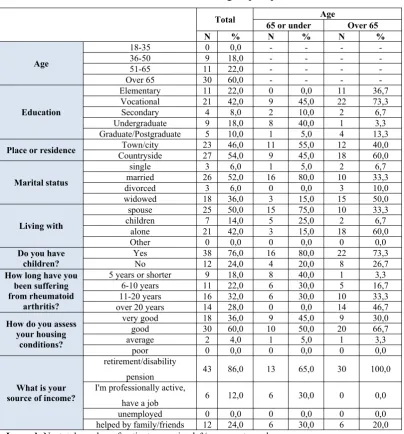
Table I. General characteristics of the studied group of patients
Total Age
65 or under Over 65
N % N % N %
Age
18-35 0 0,0 - - -
-36-50 9 18,0 - - -
-51-65 11 22,0 - - -
-Over 65 30 60,0 - - -
-Education
Elementary 11 22,0 0 0,0 11 36,7
Vocational 21 42,0 9 45,0 22 73,3
Secondary 4 8,0 2 10,0 2 6,7
Undergraduate 9 18,0 8 40,0 1 3,3
Graduate/Postgraduate 5 10,0 1 5,0 4 13,3
Place or residence CountrysideTown/city 2327 46,054,0 119 55,045,0 1218 40,060,0
Marital status
single 3 6,0 1 5,0 2 6,7
married 26 52,0 16 80,0 10 33,3
divorced 3 6,0 0 0,0 3 10,0
widowed 18 36,0 3 15,0 15 50,0
Living with
spouse 25 50,0 15 75,0 10 33,3
children 7 14,0 5 25,0 2 6,7
alone 21 42,0 3 15,0 18 60,0
Other 0 0,0 0 0,0 0 0,0
Do you have children?
Yes 38 76,0 16 80,0 22 73,3
No 12 24,0 4 20,0 8 26,7
How long have you been suffering from rheumatoid
arthritis?
5 years or shorter 9 18,0 8 40,0 1 3,3
6-10 years 11 22,0 6 30,0 5 16,7
11-20 years 16 32,0 6 30,0 10 33,3
over 20 years 14 28,0 0 0,0 14 46,7
How do you assess your housing
conditions?
very good 18 36,0 9 45,0 9 30,0
good 30 60,0 10 50,0 20 66,7
average 2 4,0 1 5,0 1 3,3
poor 0 0,0 0 0,0 0 0,0
What is your source of income?
retirement/disability
pension 43 86,0 13 65,0 30 100,0
I'm professionally active,
have a job 6 12,0 6 30,0 0 0,0
unemployed 0 0,0 0 0,0 0 0,0
helped by family/friends 12 24,0 6 30,0 6 20,0
Legend: N - total number of patients examined, % - percentage share
Source: own calculations
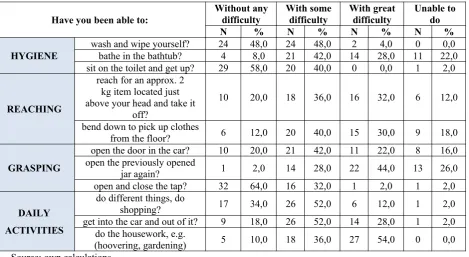
Table II. Characteristics of the studied group based on the HAQ questionnaire
Have you been able to:
Without any
difficulty With somedifficulty With greatdifficulty Unable todo
N % N % N % N %
HYGIENE
wash and wipe yourself? 24 48,0 24 48,0 2 4,0 0 0,0
bathe in the bathtub? 4 8,0 21 42,0 14 28,0 11 22,0
sit on the toilet and get up? 29 58,0 20 40,0 0 0,0 1 2,0
REACHING
reach for an approx. 2 kg item located just above your head and take it
off?
10 20,0 18 36,0 16 32,0 6 12,0
bend down to pick up clothes
from the floor? 6 12,0 20 40,0 15 30,0 9 18,0
GRASPING
open the door in the car? 10 20,0 21 42,0 11 22,0 8 16,0
open the previously opened
jar again? 1 2,0 14 28,0 22 44,0 13 26,0
open and close the tap? 32 64,0 16 32,0 1 2,0 1 2,0
DAILY ACTIVITIES
do different things, do
shopping? 17 34,0 26 52,0 6 12,0 1 2,0
get into the car and out of it? 9 18,0 26 52,0 14 28,0 1 2,0
do the housework, e.g.
(hoovering, gardening) 5 10,0 18 36,0 27 54,0 0 0,0
Source: own calculations
The mean of HAQ points was 2.74 points in the examined group (SD = 1.46), in the minimum range of 0.50 points and a maximum of 7.38 points. On the VAS scale, the mean was 60.52 points (SD = 17.62), in the range of 15.00 to 91.00 points (Table III). The statistical analysis using the Spearman rank test showed that the stronger the pain, the higher the degree of disability (R = 0.744, p<0.001). The results are shown in Figure 1.
Table III. The relationship between the HAQ coefficient and the VAS scale
M SD Min Max Q1 Me Q3
HAQ 2,74 1,46 0,50 7,38 1,50 2,56 3,88
VAS 60,52 17,62 15,00 91,00 47,00 61,50 75,00
Legend: M – mean; SD – standard deviation; Min –minimum value; Max – maximum value; Q1 –lower
[image:5.595.63.533.90.347.2]10 20 30 40 50 60 70 80 90 100 VAS
-1 0 1 2 3 4 5 6 7 8
H
A
[image:6.595.164.431.71.270.2]Q
Figure 1. Relations between HAQ and VAS in the studied group of patients
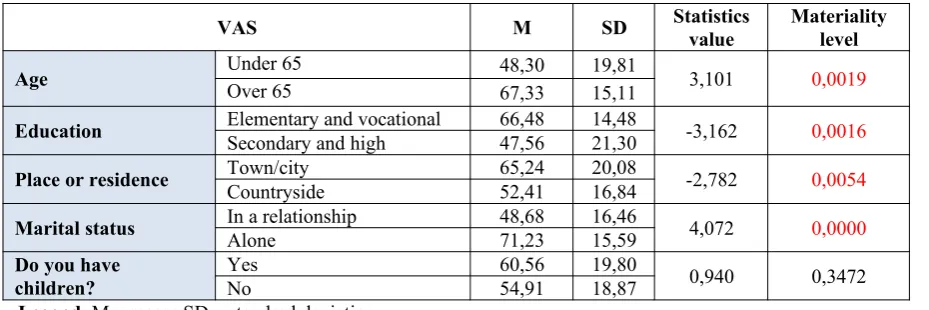
The Mann-Whitney U test was used to verify the hypothesis that there is no difference in the VAS ratio due to socio-demographic variables such as age, education, place of residence, marital status and children. Statistical analysis revealed statistically significant differences in the VAS scale due to age, education, place of residence, and marital status. A higher level of pain was declared by persons over 65 (mean 67.33), with primary and vocational education (mean 66.48), living in the town/city (mean 65.24), with marital status: single, divorced, widowed (mean 71.23). The results are shown in Figure IV.
Table IV. Differences in the VAS ratio and socio-demographic variables.
VAS M SD Statisticsvalue Materialitylevel
Age Under 65Over 65 48,30 19,81 3,101 0,0019
67,33 15,11
Education Elementary and vocationalSecondary and high 66,4847,56 14,4821,30 -3,162 0,0016
Place or residence Town/cityCountryside 65,2452,41 20,0816,84 -2,782 0,0054
Marital status In a relationshipAlone 48,6871,23 16,4615,59 4,072 0,0000
Do you have children?
Yes 60,56 19,80 0,940 0,3472
No 54,91 18,87
Legend: M – mean; SD – standard deviation
Source: own calculations
[image:6.595.62.527.458.613.2]Table V. The correlation between the VAS ratio and the period in which the patient suffers from rheumatoid arthritis and housing conditions
VAS Kendall's taucorrelation
coefficient Materiality level
How long have you been suffering from
rheumatoid arthritis? 0,514 0,0000
How do you assess your housing conditions? 0,153 0,1306
Source: own calculations
When proceeding to further analysis, it was examined whether age, education, place of residence, marital status and the number of children influenced the HAQ coefficient. The Mann-Whitney U test was used to verify the hypothesis that there is no difference in the HAQ coefficient due to age, education, place of residence, marital status and having children against the alternative hypothesis that such differences occur. Statistical analysis showed statistically significant differences in the HAQ coefficient due to age, education, place of residence, and marital status. A higher level of pain was declared by persons over 65 (mean 3.10), with primary and vocational education (mean 3.15), living in the town/city (mean 3.19), with marital status: single, divorced, widowed (mean 3.33) (Table VI).
Table VI. Socio-demographic factors affecting the HAQ
HAQ M SD Statisticsvalue Materialitylevel
Age Under 65 2,20 1,76 2,693 0,0071
Over 65 3,10 1,11
Education Elementary and vocationalSecondary and high 3,152,02 1,221,59 -3,224 0,0013
Place or residence Town/cityCountryside 3,192,22 1,171,61 -2,881 0,0040
Marital status In a relationshipAlone 2,203,33 1,181,51 2,437 0,0148
Do you have children?
Yes 2,95 1,51 1,874 0,0609
No 2,08 1,04
Legend: M – mean; SD – standard deviation
Source: own calculations
Table VII. The dependence of the HAQ coefficient and the period of suffering from RA and housing conditions
HAQ Kendall's taucorrelation
coefficient
Materiality level
How long have you been suffering from
rheumatoid arthritis? 0,483 0,0000
How do you assess your housing conditions? 0,178 0,0679
Source: own calculations
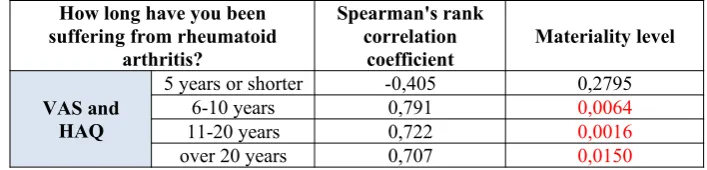
In the further part of the analysis, the relationship between the HAQ coefficient and the VAS scale in individual periods of the disease was examined. The statistical analysis showed a strong correlation between the HAQ coefficient and the VAS scale in the group of patients who have suffered for at least 6 years. In addition, it was noted that the stronger the pain, the higher the degree of disability was (Table VIII).
Table VIII. The relationship between the disease duration time and the HAQ coefficient and the VAS scale
How long have you been suffering from rheumatoid
arthritis?
Spearman's rank correlation
coefficient Materiality level
VAS and HAQ
5 years or shorter -0,405 0,2795
6-10 years 0,791 0,0064
11-20 years 0,722 0,0016
over 20 years 0,707 0,0150
Source: own calculations
Discussion: RA is a chronic, systemic, progressive connective tissue disease that inevitably leads to disability in the scope of physical functioning. This is related to the occurrence of progressive degeneration in the joints and accompanying pain significantly affecting the everyday functioning of patients [1]. To assess the outcomes of treatment of RA patients, different types of questionnaires are used more and more often which assess the quality of life and disability. The questionnaires are a great tool for both the patient and the physician as they help to understand and define the goals that are best to achieve during treatment. The studied group of patients was divided into 4 subgroups according to the duration of the disease. The duration of the disease ranged from under 5 years to over 20. The patients took part in a standard interview based on the questionnaire and the HAQ questionnaire was used to assess the quality of life of RA patients. In the research presented higher levels of pain were reported in persons over 65, with primary and vocational education, living in towns/cities, with marital status: single, divorced, widowed. The same criteria were met by persons showing a higher level of HAQ, which indicates a high correlation between the level of pain and HAQ, and age, education, place of residence, and marital status.
especially in terms of fitness level (2.20 mean in the HAQ scale), compared to patients from other age groups. Similar results were reported by Moćko and Zurzycka yet in their research group, the younger persons were persons under 50. [16]. Based on own research, it was also found that elderly persons over 65 had higher pain levels on the VAS scale and showed a higher level of HAQ, which was associated with more severe disability. Similar results were obtained by Moćko and Zurzycka [16].
The level of education also plays a significant role. It may point to the level of awareness of one's illness, the need for treatment, and health behaviours [16]. In own research patients with basic and vocational education obtained a higher HAQ level (the mean of 3.15) indicating poorer quality of life. Patients with secondary or higher education achieved lower HAQ (the mean of 2.02). Similar results were obtained by Moćko and Zurzycka [16]. The results of own research are also consistent with the studies of Corbacho et al., in which 53 patients took part and in which it was shown that more than a half had only primary education, including not always complete, which resulted in increased unemployment (66%) due to the necessity of resigning from work in the first year of the disease [17]. It can therefore be concluded that a higher level of education also affects the possibility of undertaking work other than manual, which allows one to keep their job despite continuous disease progression. Similar results, correlating with own research, were obtained by Jiang et al., where in the study population of RA patients receiving standard care in the country with a generally accessible public healthcare system, education did not affect neither the time of diagnosis nor the treatment itself. She showed that patients with a higher level of education declared less pain (assessed by the VAS scale) and less functional disability (HAQ) during the follow-up period, and were more likely to achieve remission of pain and improve functional impairment [18].
Own analysis also showed that lonely patients suffering from RA had worse quality of life than patients who were in a relationship. Different results were reported by Moćko and Zurzycka who showed that lonely persons perceived their quality of life better as measured with the HAQ scale [16]. Krause et al. who conducted a study among 100 persons meeting the ACR criteria, discussed the factors affecting the disability of patients with RA. They took into account the occurrence of depressive symptoms in patients that adversely affect the course of the disease [19]. It can therefore be concluded that lonely patients are more likely to experience depression due to the progressive disability and fear that they will not be able to cope with everyday activities, which further intensifies the impact of the disease on their functioning.
therapy. This is, therefore, evidence of major difficulties in the functioning of patients with RA. For example, the domain concerned with dressing was performed with great difficulty by 50% in own research and 52% in research conducted by Miedziak et al. Another domain, i.e. getting up, was performed with some difficulty by 54% of patients in own research, while in studies by Miedziak et al. 56% performed it with great difficulty. Reaching was accomplished with some difficulty by 36% of patients according to own research, while according to studies by Miedziak et al. 44% performed it with great difficulty. Everyday activities, such as hoovering or gardening were difficult to perform for 54% of patients in own research and in the research conducted by Miedziak et al. [21].
Also, the level of pain perceived by the VAS in both cases was quite high. In Miedziak et al. before biological treatment, the average pain value on the VAS scale was 73.70, while in own studies (the patients who were not undergoing biological treatment), the mean value was 60.52 [21].
In addition, own research showed that in the total of 43 patients, the source of income was a pension or disability pension, and only six were professionally active. This may be related to both the level of education and the progressive disability of RA patients. Bodur et al. examined 49 patients diagnosed with RA against the ACR criteria. In his research only 11 persons were employed and 38 subjects did not work. This indicates a high percentage of incapacity for work in RA patients. Based on the obtained results, he suggested implementing solutions that could improve the employment of patients by recognizing problems related to work at early stages of the disease by the doctors, implementing facilities at the workplace, gaining support of co-workers and employers. This would lead to the decrease in occupational disability, retention of paid work and an increase in the productivity of working patients [22]. In conclusion, disability prevention is a common goal for the patient and the attending physician. Reducing the degree of disability gives the patient greater opportunities both in terms of maintaining employment and coping with everyday activities. This has a huge impact on improving the quality of life of patients, both in terms of physical and mental functioning. Conclusions:
1. The severity of pain assessed by means of the VAS scale significantly affects the quality of life of patients with RA examined using the HAQ questionnaire.
2. Socio-demographic factors, such as age, education, place of residence, marital status, have a significant impact on the value of HAQ. Patients over 65, with primary and vocational education, living in towns/cities, with single marital status, showed a significantly higher level of HAQ.
3. There exists a correlation between the duration of the disease and the HAQ and VAS values. The stronger the pain experienced by patients, the higher the level of disability affecting the value of HAQ.
References
1. Filipowicz-Sosnowska A. Reumatoidalne zapalenie stawów – postępy w diagnostyce i leczeniu. [Rheumatoid arthritis – advances in diagnosis and treatment]. Nowa Klinika 2011; 18(2): 242-249 (in polish)
2. Głuszko P, Filipowicz-Sosnowska A, Tłustochowicz W. Reumatoidalne zapalenie stawów. [Rheumatoid arthritis]. Reumatologia 2012; 50(2): 83-90 (in polish)
3. Kontny E. Patogeneza reumatoidalnego zapalenie stawów. [Pathogenesis of rheumatoid arthritis]. Reumatologia 2011; 49(1): 40-46 (in polish)
5. Olewicz-Gawlik A, Hrycaj P. Jakość życia chorych na reumatoidalne zapalenie stawów – badania własne i przegląd literatury. [Health-related quality of life among patients with rheumatoid arthritis – original results and short literature review]. Reumatologia 2007; 45(6): 346-349 (in polish)
6. Kvien T. Epidemiology and burden of illness of rheumatoid arthritis. Pharmacoeconomics 2004; 22 (2): 1-12
7. Kucharz E. Reumatoidalne zapalenie stawów. [Rheumatoid arthritis]. [w] Wielka interna-reumatologia. Warszawa, Medical Tribune Polska, 2010, pp. 75-88.
8. Tłustochowicz W. Postępy w diagnostyce i terapii chorób reumatycznych. [Advances in diagnosis and treatment of rheumatic diseases]. Przewodnik Lekarski 2011; 1: 94-101 (in polish)
9. Szekanecz Z. Treatment strategies in rheumatoid arthritis. Reumatologia 2013; 51(4):239-248 (in polish)
10. Żuk B, Księżopolska-Orłowska K. Ochrona stawów w reumatoidalnym zapaleniu stawów. Czynności dnia codziennego. [Joint protection in rheumatoid arthritis. Daily living]. Reumatologia 2009; 47(4): 193-201 (in polish)
11. Tomaszewski K, Chmielowska K, Zarychta M, Głuszko P. Czynniki ryzyka upadków i złamań kości u pacjentów chorych na reumatoidalne zapalenie stawów. [Risk factors for falls and bone fractures in patients with rheumatoid arthritis]. Reumatologia 2010; 48(2): 98-103 (in polish)
12. Krawczyk-Wasielewska A, Gajewska E, Samborski W. Płeć jako jeden z czynników mogących determinować jakość życia w reumatoidalnym zapaleniu stawów. [Gender as one of the factors that may determine the quality of life in rheumatoid arthritis]. Nowiny Lekarskie 2012; 81(4): 347-353 (in polish)
13. Bruce B, Fries JF. The Stanford health assessment questionnaire (HAQ): a review of its history, issues, progress, and documentation. Jornal of Rheumatology 2003; 30(1): 167- 178
14. Prajs K. Jakość życia chorych na reumatoidalne zapalenie stawów w odniesieniu do sprawności fizycznej i stanu psychicznego. [The quality of life of patients who suffer from rheumatoid arthritis in reference to their physical fitness and mental state]. Annales Academiae Medicae Stetinensis 2007; 53(2): 72-82 (in polish)
15. Szwat B., Słupski W., Krzyżanowski D. Sposoby radzenia sobie z chorobą nowotworową a poczucie depresji i nasilenie bólu u chorych objętych opieką paliatywną. [Ways of coping with cancer and feeling of depression and pain intensity in patients receiving palliative care]. Nursing and Public Health 2011; 1 (1): 35-41 (in polish)
16. Moćko J, Zurzycka P. Jakość życia pacjentów z reumatoidalnym zapaleniem stawów-doniesienia wstępne. [Quality of life of the patients with rheumatoid arthritis – preliminary result]. Pielęgniarstwo XXI wieku 2013; 1(42): 15-19 (in polish)
17. Corbacho MI, Dapueto JJ. Assesing the functional status and quality of life of patients with rheumatoid arthritis. Brasilian Journal of Rheumatology 2010; 50(1): 31-43 18. Jiang X, Sandberg MEC, Saevarsdottir S, Klareskog L, Alfredsson L, Bengtsson C.
20. Sierakowska M, Sierakowski S, Sierakowska J, Krajewska-Kułak E. Comparative analysis of education needs of patients with rheumatic diseases selected based on the Polish version of the Educational Needs Assessment Tool (Pol- ENAT). Reumatologia 2016; 54(4): 153-160 (in polish)
21. Miedziak M, Bąk E, Krzeminska S. Wpływ leczenia biologicznego na codzienne funkcjonowanie chorych z reumatoidalnym zapaleniem stawów. [Effect of biological treatment on the daily functioning of patients with rheumatoid arthritis]. Journal of Education, Health and Sport 2017; 7(7): 614-628 (in polish)