www.ann-geophys.net/35/535/2017/ doi:10.5194/angeo-35-535-2017
© Author(s) 2017. CC Attribution 3.0 License.
Longitudinal variation of equatorial electrojet and the
occurrence of its counter electrojet
A. Babatunde Rabiu1, Olanike Olufunmilayo Folarin1,2, Teiji Uozumi3, Nurul Shazana Abdul Hamid4, and Akimasa Yoshikawa3
1Centre for Atmospheric Research, National Space Research and Development Agency, Anyigba, Nigeria
2Ionospheric and Space Physics Laboratory, Department of Physics, University of Lagos, Akoka, Lagos State, Nigeria 3International Center for Space Weather Science and Education ICSWSE, Kyushu University, 744, Motooka, Nishi-ku,
Fukuoka, 819-0395, Japan
4National University of Malaysia, Faculty of Science & Technology, Selangor, Malaysia
Correspondence to:A. Babatunde Rabiu ([email protected])
Received: 1 August 2016 – Revised: 28 February 2017 – Accepted: 7 March 2017 – Published: 7 April 2017
Abstract. We examined the longitudinal variability of the equatorial electrojet (EEJ) and the occurrence of its counter electrojet (CEJ) using the available records of the horizon-tal component H of the geomagnetic field simultaneously recorded in the year 2009 (mean annual sunspot number
Rz =3.1) along the magnetic equator in the South
Ameri-can, AfriAmeri-can, and Philippine sectors. Our results indicate that the EEJ undergoes variability from one longitudinal repre-sentative station to another, with the strongest EEJ of about 192.5 nT at the South American axis at Huancayo and a min-imum peak of 40.7 nT at Ilorin in western Africa. Obtained longitudinal inequality in the EEJ was explicable in terms of the effects of local winds, dynamics of migratory tides, propagating diurnal tide, and meridional winds. The African stations of Ilorin and Addis Ababa registered the greatest % of CEJ occurrence. Huancayo in South America, with the strongest electrojet strength, was found to have the least oc-currence of the CEJ. It is suggested that activities that sup-port strong EEJ inhibits the occurrence of the CEJ. Percent-age of occurrence of the CEJ varied with seasons across the longitudes. The order of seasonal variation of morning oc-currence does not tally with the evening ococ-currence order at any station. A semiannual equinoctial maximum in percent-age of morning occurrence of the CEJ was obtained at Huan-cayo and Addis Ababa. Only Addis Ababa recorded equal equinoctial maxima in percentage of evening occurrence of the CEJ. The seasonal distribution of the occurrences of the CEJ at different time regimes implies a seasonal variability
of causative mechanisms responsible for the occurrence of the CEJ.
Keywords. Atmospheric composition and structure (instru-ments and techniques)
1 Introduction
Space-based technology and applications have become an es-sential tool in many countries, especially developing ones, making the world a “global village”. Earth satellite commu-nication and other applications of satellite technology have made the study of space environment, including the iono-sphere, more popular in recent times. As a result, the study of the equatorial ionosphere and its current systems has contin-ued to gain much interest due to the complexities associated with the region (Rabiu et al., 2007).
polariza-tion field, which is primarily responsible for the enhanced eastward currents, can be set up (Onwumechili, 1997).
On occasion during quiet periods, at certain hours of the day particularly in the early morning and evening, the day-time EEJ strength is weakened and reverses direction for a short period, after which it later returns to its normal after-noon value before it disappears around sunset (Gouin, 1962; Gouin and Mayaud, 1967). The counter electrojet (CEJ) is the EEJ reversal during magnetically quiet periods (Gouin and Mayaud, 1967). This event was first observed during the study of the magnetic records at Addis Ababa, Ethiopia, in 1962 by Gouin (1962). It manifests in the magnetograms as a depression in plot ofH versus time. Hanuise et al. (1983) showed a consistent electrical connection between the CEJ and theSq current system, with two horizontal current
vor-tices of opposite directions that flow on each side of the noon sector, anticlockwise in the morning and clockwise in the af-ternoon. These current vortices produce a poleward current flow at low latitudes at noon (Gurubaran, 2002).
Since the discovery of the EEJ at Huancayo (Peru) as well as the CEJ at Addis Ababa (Ethiopia) near the dip equator, studies across various longitudinal sectors have shown that both phenomena display significant diurnal, seasonal, day-to-day, and solar cycle and longitudinal variabilities (Rich-mond, 1973; Kane, 1976; Mayaud, 1977; Forbes, 1981; Reddy, 1981, 1989; Stening, 1995; Rastogi, 1989; Amory-Mazaudier et al., 1993; Amory-Mazaudier et al., 2005; Doumouya et al., 1998; Doumouya and Cohen, 2004; Luhr et al., 2004; Rabiu et al., 2011; Yizengaw et al., 2014).
The strength of the EEJ and its width have been estab-lished to change with longitude (Onwumechili, 1997; Ras-togi, 1962). Jadhav et al. (2002) studied the EEJ strength along the Indian and American sectors and showed that the EEJ strength varies with longitude. Rabiu et al. (2011) clearly revealed that along the African sector, the EEJ at the west-ern sector appears weaker than the EEJ at the eastwest-ern sector. This west–east asymmetrical behaviour in EEJ strength in the African sector is further confirmed by Yizengaw et al. (2014) using data from an array of different magnetometers. In ad-dition, Yizengaw et al. (2014) reported higher values of EEJ andE×Bdrift distribution in the western American sector and decrement towards the eastern longitudes all the way to the eastern African sector.
Chandrasekhar et al. (2014) noticed that a few stud-ies have reported that there is large day-to-day variabil-ity of the CEJ phenomena over a 45◦longitude separation, which sometimes occurs over a large longitudinal difference (Onwumechili and Akasofu, 1972; Mayaud, 1977). Kane and Trivedi (1980) demonstrated the characteristics of CEJ events at two locations in the Brazilian region across the east and west coasts of the South American sector, separated by less than 30◦ longitude. Patil et al. (1990a, b) reported more CEJ occurrence during low solar activity periods than high solar activity periods in the Indian and American sec-tors. Rangarajan and Rastogi (1993) investigated the
after-noon CEJ events at equatorial stations Addis Ababa and Ko-daikanal and concluded that the afternoon CEJ is localized in longitude, and on some occasions, the events may not oc-cur on the same day, even at locations separated by a narrow longitude of 2 h.
Onwumechili (1997) concluded that the properties of
S(2,2),S(2,4) tidal modes suggest that they can contribute to the cause of the CEJ. However, the contributions of ver-tical winds and local east–west neutral winds with verver-tical shear are more obvious, whether or not they are of tidal ori-gins. He stated that the very high occurrence frequency of the CEJ near dawn and near dusk appears to be partly due to late morning reversal and early evening reversal of the vertical electric field.
Doumouya et al. (1998) reported CEJ occurrences along the western African longitudes and observed that morning as well as afternoon occurrences of the CEJ show seasonal variability. Alex and Mukherjee (2001) compared CEJ events along two equatorial stations, Trivandrum and Addis Ababa, which are 40◦apart in longitude, and showed that there are some differences in CEJ events when observed in different longitudinal sectors. Bolaji et al. (2014) reported more fre-quent occurrence of morning CEJ events at Ilorin in 2009 and attributed this to the late reversal of westward to eastward currents. Rabiu et al. (2017) investigated the simultaneity and asymmetry in the occurrence of the CEJ along African longi-tudes and most frequently found (about 77 %) simultaneous occurrence of CEJ in the morning at two equatorial stations, one in the west of the continent and the other in the east.
Stening et al. (1996) suggested an association of sudden stratospheric warming (SSW) with the occurrence of CEJ events during their study of the occurrence of the CEJ during the winter months. A distinctive pattern in the equatorial day-timeE×Bdrift during the SSW years was also reported by Chau et al. (2009). Balan et al. (2012) also showed that the low-latitude thermosphere and ionosphere record very clear effects of the SSW taking place in the polar stratosphere dur-ing an unusual solar minimum. The clear effects at the un-usual minimum are interpreted in terms of the 8 h tide during the warming events.
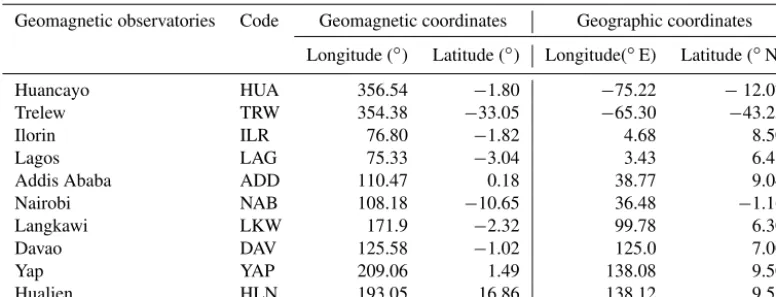
Table 1.Geomagnetic observatories and their corresponding coordinates.
Geomagnetic observatories Code Geomagnetic coordinates Geographic coordinates
Longitude (◦) Latitude (◦) Longitude(◦E) Latitude (◦N)
Huancayo HUA 356.54 −1.80 −75.22 −12.07
Trelew TRW 354.38 −33.05 −65.30 −43.25
Ilorin ILR 76.80 −1.82 4.68 8.50
Lagos LAG 75.33 −3.04 3.43 6.48
Addis Ababa ADD 110.47 0.18 38.77 9.04
Nairobi NAB 108.18 −10.65 36.48 −1.16
Langkawi LKW 171.9 −2.32 99.78 6.30
Davao DAV 125.58 −1.02 125.0 7.00
Yap YAP 209.06 1.49 138.08 9.50
Hualien HLN 193.05 16.86 138.12 9.53
2 Methods and analyses
Obtained from ground-based magnetometer observatories of the Magnetic Data Acquisition System (MAGDAS) of the International Centre for Space Weather Science and Educa-tion, Kyushu University Japan, as well as the INTERMAG-NET global network, were 1 year of data of the horizontal components (H) of the geomagnetic field for the year 2009 (mean annual sunspot numberRz=3.1). These observatories
are located along the South American, African, and Philip-pine longitudes within the magnetic equatorial zone. The de-tails of the geographic and geomagnetic coordinates of the selected stations and their distributions are shown in Table 1. The EEJ produces a strong enhancement in the H com-ponent magnetic field, measured by magnetometers located within ±3◦ of the magnetic equator; therefore, measuring this perturbation in equatorial magnetometers could provide a direct measure of the EEJ (Onwumechili, 1997; Yizengaw et al., 2014). Ilorin, Addis Ababa, Huancayo, Davao, Yap, and Langkawi are located within the equatorial electrojet belt, which lies around±3◦latitude of the magnetic equa-tor, while Lagos, Nairobi, Trelew, and Hualien are outside the electrojet belt.
Since EEJ can be accurately considered during quiet con-ditions, this research employed the data obtained on magnet-ically quiet days (Ap≤3). Table 2 present the dates of the quiet days engaged in this work with their corresponding Ap indices. The concept of local time was used throughout this analysis to ensure a measure of accuracy as the stations vary from one local time to another.
TheH components of geomagnetic field stations located within and outside of the EEJ region are compared and the difference of theH component within and outside the EEJ,
1H, was calculated. This difference is the only part of the
H component field that is related to the EEJ current contri-bution (Anderson et al., 2004). Thus, hourly equatorial elec-trojet strength at any EEJ station (EEJs) is given by the dif-ference between theH field at that location and another
sta-tion outside the EEJ zone (EEJo) but close in longitude to it. Therefore hourly EEJ at various EEJ stations are
EEJ at Huancayo: EEJt(HUA)=Ht(HUA)−Ht(TRW) EEJ at Ilorin: EEJt(ILR)=Ht(ILR)−Ht(LAG) EEJ at Addis Ababa: EEJt(ADD)=Ht(ADD)−Ht(NAB) EEJ at Langkawi: EEJt(LKW)=Ht(LKW)−Ht(HLN) EEJ at Davao: EEJt(DAV)=Ht(DAV)−Ht(HLN) EEJ at Yap: EEJt(YAP)=Ht(YAP)−Ht(HLN)
, (1)
whereHt(HUA),Ht(TRW),Ht(ILR),Ht(LAG),Ht(ADD),
Ht(NAB), Ht(LKW), Ht(HLN), Ht(DAV), and Ht(YAP)
are hourly values of horizontal geomagnetic field compo-nent at local time t hours at Huancayo, Trelew, Ilorin, Lagos, Addis Ababa, Nairobi, Langkawi, Hualien, Davao, and Yap respectively; EEJt(HUA), EEJt(ILR), EEJt(ADD),
EEJt(LKW), EEJt(DAV), and EEJt(YAP) are hourly EEJ
strength at local time t hours at Huancayo, Ilorin, Addis Ababa, Langkawi, Davao, and Yap respectively.
It is pertinent to mention that LAG station at−3.04◦ geo-magnetic latitude is 1.22◦ south of ILR, barely outside the EEJ strip and may still have some EEJ magnetic effects. However, we were constrained to stick to the choice of the LAG–ILR station pair as LAG is the farthest station we could get along the same longitude as ILR within the observational network that we engaged in this work. Therefore, our choice of the LAG–ILR station pair, may have consequences for the accuracy of our representation of the EEJ at ILR.
These hourly values were further corrected for non-cyclic variation following Price and Stone (1964) in a method well explained in Rabiu et al. (2007, 2011).
Furthermore, since the CEJ is the reversed EEJ current, Gouin (1962), CEJ in daytime at any timetis estimated when EEJ at that particular time is negative, that is
CEJt=(EEJt <0). (2)
T able 2. International quiet days eng aged in this w ork and their equi v alent Ap indices. Month Y ear Q 1 AP 1 Q 2 AP 2 Q 3 AP 3 Q 4 AP 4 Q 5 AP 5 Q 6 AP 6 Q 7 AP 7 Q 8 AP 8 Q 9 AP 9 Q 10 AP 10 Jan 2009 12 0 23 1 11 1 22 2 24 2 28 2 07 2 18 2 25 2 17 3 Feb 2009 08 0 02 1 17 1 19 1 06 1 10 2 13 2 09 2 07 2 26 3 Mar 2009 02 1 07 2 09 2 18 2 06 2 23 2 01 3 31 3 28 3 29 4 Apr 2009 04 1 23 2 02 2 30 2 03 2 28 2 14 2 07 3 26 3 29 3 May 2009 12 1 27 1 17 1 25 2 05 2 15 2 26 3 13 3 19 3 01 3 Jun 2009 12 1 01 2 17 2 09 2 22 2 19 2 02 2 11 3 08 3 26 3 Jul 2009 17 1 19 1 18 2 02 2 26 2 16 2 29 2 27 3 01 3 04 3 Aug 2009 15 1 16 2 24 2 29 2 17 2 25 2 28 2 14 2 18 3 11 3 Sep 2009 23 0 29 1 24 1 19 2 25 2 12 2 09 2 08 2 07 2 05 2 Oct 2009 20 0 14 1 10 1 17 1 03 1 18 1 21 1 02 2 12 2 06 2 No v 2009 06 0 23 0 29 0 03 0 04 0 11 0 16 0 05 1 30 1 10 1 Dec 2009 01 0 03 0 04 0 11 0 30 0 09 0 29 0 31 0 08 0 02 1
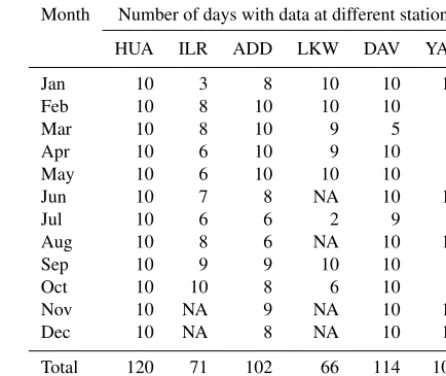
Table 3.Days of data availability (NA means “data not available”).
Month Number of days with data at different stations
HUA ILR ADD LKW DAV YAP
Jan 10 3 8 10 10 10
Feb 10 8 10 10 10 8
Mar 10 8 10 9 5 9
Apr 10 6 10 9 10 9
May 10 6 10 10 10 9
Jun 10 7 8 NA 10 10
Jul 10 6 6 2 9 9
Aug 10 8 6 NA 10 10
Sep 10 9 9 10 10 5
Oct 10 10 8 6 10 7
Nov 10 NA 9 NA 10 10
Dec 10 NA 8 NA 10 10
Total 120 71 102 66 114 106
station to another. Table 3 shows the monthly total number of days on which data were available for all the stations.
Percentage occurrence of CEJ in a particular batch was estimated as
% occurrence of CEJ (3)
= number of occurrence of CEJ
Total number of days for which data were available×100. Occurrence of morning CEJ (MCEJ) in % was considered for the duration between 06:00 and 11:00 LT, while % oc-currence of afternoon CEJ (ACEJ) was considered for the duration between 13:00 and 18:00 LT.
3 Results and discussion
3.1 EEJ characteristics at each station
The variability of EEJ across the stations between 06:00 and 18:00 LT is presented in Fig. 1. The contour plot evidently shows the diurnal distribution of EEJ at each of the stations.
[image:4.612.315.538.89.277.2]Figure 1.Variation of the equatorial electrojet (EEJ) among the stations.
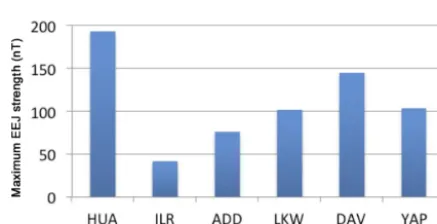
Figure 2.Variation of the maximum EEJ attained in any location with longitude.
1.22◦and LAG is just at the edge of the EEJ strip. However, lack of adequate station pairs in this longitude sector makes the LAG–ILR choice unavoidable in the present analysis. It is hoped that this would be corrected in future work. Further-more, Fig. 3 illustrates the variability of the amplitude of the maximum CEJ strength in the morning and afternoon from one station to another.
[image:5.612.57.276.294.406.2]Longitudinal inequality of EEJ, which is well displayed in Figs. 1 and 2, underscores the effects of local winds in driv-ing the EEJ accorddriv-ing to Stendriv-ing (1985, 1995). Doumouya et al. (1998, 2003), Jadhav et al. (2002), Rabiu et al. (2011), and Alken and Maus (2007), among others, had reported lon-gitudinal variation of EEJ using different data sources and discussed the longitudinal inequality in terms of dynamics of migratory tides, propagating diurnal tide, and meridional winds. Jadhav et al. (2002) attributed the longitudinal in-equality found in EEJ strength to non-migratory tides us-ing Ørsted satellite magnetic field data. Luhr et al. (2004) engaged CHAMP satellite data and deduced that the longi-tude dependence of the EEJ intensity can be explained by varying cross-sectional area of the Cowling channel. Lühr et al. (2008) discussed the influence of non-migrating tides on
Figure 3.Variation of the maximum CEJ strength attained at any location with longitude.
the longitudinal variation of the EEJ by using the climatolog-ical model of EEJ derived earlier from Ørsted, CHAMP, and SAC-C satellite measurements by Alken and Maus (2007). Firstly Rabiu et al. (2011) and later Yizengaw et al. (2014) showed that EEJ strength is higher in eastern Africa than western Africa, with about 30◦longitudinal difference. The longitudinal inequality in the maximum strength of the CEJ either in the morning or afternoon across the stations, as displayed in Fig. 3, is a reflection of the longitudinal de-pendence of the EEJ. South American stations at Huancayo recorded the maximum CEJ strength just as it is known for its strong EEJ. The longitudinal variability in the strength of the EEJ obtained from our ground-based results here confirmed the reproducibility of the satellite-based results from other sources.
3.2 Occurrence of CEJ
[image:5.612.309.546.297.425.2]dif-Figure 4.Percentage occurrence of morning CEJ.
Figure 5.Percentage occurrence of afternoon CEJ.
ferent longitudes. Figure 6 shows the annual % occurrence of MCEJ and ACEJ at all locations. Outstandingly clear in all the figures is the greater % of occurrence of the CEJ at the African stations of ILR and ADD than elsewhere. The great-est % occurrence of MCEJ was found at the eastern African station of ADD, while the greatest % occurrence of afternoon CEJ was found at the western African station of ILR. ADD recorded 100 % of days with MCEJ for almost all the days of availability of data, except in the months of June, November, and December. Meanwhile, ILR in western Africa registered 100 % occurrence of Afternoon CEJ in all the months of Jan-uary, April, July, August, October and November. Figure 4 supported the fact that CEJ occurrence is more predominant in the African sector than other sectors considered in this work. In the overall analysis, the station with the strongest electrojet strength was found to have the least occurrence of the CEJ. It has often been reported by Onwumechili (1997), and some other authors, that the CEJ rarely occur during pe-riods when the EEJ is strong. It may be right to assert that activities that support strong EEJ do inhibit occurrence of the CEJ.
The seasonal dependence of occurrence of the CEJ is pre-sented in Figs. 7 and 8, where it is clear that percentage of occurrence of the CEJ varies with seasons across the stations.
Figure 6.Yearly percentage of occurrence of the CEJ.
Figure 7.Seasonal variation of morning CEJ, MCEJ (D_solstice means December solstice, Equinox_m means March equinox, J_solstice means June solstice, Equinox_S means September equinox).
Figure 8.Seasonal variation of afternoon CEJ, ACEJ (D_solstice means December solstice, Equinox_m means March equinox, J_solstice means June solstice, Equinox_S means September equinox).
equinox. Minimum morning occurrence occurred at the De-cember and June solstices at Addis Ababa and Huancayo.
[image:7.612.306.548.67.162.2]Considering evening occurrence of the CEJ as shown in Fig. 8, only Addis Ababa recorded equal equinoctial max-ima at the two equinoxes. Langkawi and Yap have maximum evening occurrences at the September equinox, followed by the December solstice. Ilorin recorded a March equinoctial maximum, while Huancayo and Davao have December sol-stitial maxima. Minimum evening occurrence was found in Davao in September equinox.
Figures 9 and 10 display the seasonal variation of the strength of the morning and ACEJ respectively across the stations. It is obvious that the seasonal variation of the oc-currence of the CEJ really has no direct correlation with the seasonal variation of its strength. Seasonal variability exists in the strength of the CEJ at the two dispensations and any station and does not have uniform order of seasonal depen-dence, unlike EEJ, as reported in various literatures such as Onwumechili (1997) and the references therein.
Rabiu et al. (2017) noted that the seasonal distribution of the occurrences of the CEJ at different time regimes im-plies a seasonal variability of anyone or a combination of
[image:7.612.307.548.232.335.2]Figure 9. Seasonal variation of the strength of the morning CEJ across the stations. D_solstice means December solstice, Equinox_m means March equinox, J_solstice means June solstice, and Equinox_S means September equinox.
Figure 10. Seasonal variation of the strength of the afternoon CEJ across the stations. D_solstice means December solstice, Equinox_m means March equinox, J_solstice means June solstice, and Equinox_S means September equinox.
the following mechanisms responsible for the occurrence of the CEJ itself: height-varying local winds capable of causing the reversal in the current system (Richmond, 1973), gravity wave-associated vertical winds (Raghavarao and Anandarao, 1980), global-scale tidal winds with appropriate phase com-bination (Forbes and Lindzen, 1976; Marriott et al., 1979; Forbes, 1981; Singh and Cole, 1987; Stening, 1989; Somaya-julu et al., 1993), high-latitude stratospheric warming events (Stening et al., 1996; Vineeth et al., 2009), daytime vertically driven downward electric field (negativeEz) (Onwumechili,
1997), and semidiurnal tide (Gurubaran, 2002; Sridharan et al., 2002, 2009).
The variances in order of seasonal variation of percent-ages of occurrence of the CEJ at different longitudes could be related to local effects such as seasonal variability of local and neutral winds. In addition, Chandrasekhar et al. (2014) in their study of occurrence of the CEJ at two new remote elec-trojet sites in India separated by 15◦longitude presented evi-dence of the CEJ being caused by local perturbations in their results. They considered the following as possible factors of CEJ occurrence not being simultaneously universal: non-migrating eastward- and westward-propagating diurnal tides and local meteorological phenomena associated with upper mesospheric temperature, wind, and density variations.
[image:7.612.55.278.272.381.2]in the morning on the same day in eastern Africa instead of in the afternoon, a scenario they described as Asymmetry-2; they attributed this longitudinal variability in the local time of occurrence of the CEJ along these longitudes to the differences in meridional currents across different longi-tudes. Chandrasekhar et al. (2014) found non-simultaneous occurrence of the CEJ between two Indian stations sepa-rated by 15◦ longitude and thus threatened the CEJ longi-tudinal extent of 30◦earlier reported by Kane (1973), Kane and Trivedi (1980), and Rastogi (1974). Rastogi and Yu-moto (2006) reported that the direction of meridional current varies significantly with longitude and, possibly, with the lo-cal time and season. Rabiu et al. (2017) ascribed the variation in percentage of occurrence of the CEJ with months to the longitudinal variability of thermospheric winds that drive the ionospheric dynamo even on magnetic quiet days, as men-tioned by Vichare and Richmond (2005), which could be due to atmospheric solar tides that are not sun synchronous (Ha-gan and Forbes, 2002, 2003). Other factors that have been re-ported to be responsible for variation in percentage of occur-rence of the CEJ along different longitudes include eastward zonal winds (Ramkumar et al., 2002); gravity wave–tidal in-teractions and vertical coupling process in the mesosphere – lower thermosphere – ionosphere (MLTI), resulting in neu-tral winds (Vineeth et al., 2007; Liu and Watanabe, 2008) via DE3 tidal modulation of the E layer dynamo, changes in temperature, wind and density variation in the upper meso-spheric region due to the influence of tides, gravity, and plan-etary waves from the stratosphere and troposphere (Vineeth et al., 2012), which strongly influence ionospheric conduc-tivity over short spatial scales of approximately 1600 km; differences in local wind shears that modify jet fields (es-pecially during the noon hours) (Reddy and Devasia, 1981); and changes in neutral winds (Sridharan et al., 2002; Vineeth et al., 2007).
4 Conclusions
This work investigated the longitudinal variability of the equatorial electrojet (EEJ) and the occurrence of its counter equatorial electrojet (CEJ) along the geomagnetic equato-rial belt and made use of data from the following electro-jet stations whose longitudes are given in parentheses: Huan-cayo HUA (−75.22◦), Ilorin ILR (4.68◦), Addis Ababa ADD (38.77◦), Langkawi LKW (99.78◦), Davao DAV (125.0◦), and Yap YAP (138.08◦). The study compared the spatial and temporal morphology of EEJ and CEJ occurrence along var-ious equatorial sectors.
Our results indicated that the EEJ undergoes variability from one longitudinal representative station to another, with the strongest EEJ of about 192.5 nT in the South American axis at Huancayo and a minimum peak of 40.7 nT at Ilorin in western Africa. Obtained longitudinal inequality in the EEJ was explicable in terms of the effects of local winds
(Stening, 1985, 1995), dynamics of migratory tides, propa-gating diurnal tide, and meridional winds (Doumouya et al., 1998, 2003; Jadhav et al., 2002; Rabiu et al., 2011; Alken and Maus, 2007).
Of all the sectors considered, the African stations of ILR and ADD registered the greatest % of occurrence of the CEJ than elsewhere. The greatest % occurrence of MCEJ was found at Addis Ababa (eastern Africa), while the greatest % occurrence of afternoon CEJ was found at Ilorin (west-ern Africa). Thus, CEJ occurrence is more predominant in the African sector than other sectors considered in this work. Huancayo in South America, with the strongest electrojet strength, was found to have the least occurrence of the CEJ. It may be right to assert that activities that support strong EEJ do inhibit the occurrence of the CEJ.
We reported a variation of percentage of occurrence of the CEJ with seasons across the longitudes. The order of sea-sonal variation of morning occurrence does not tally with the evening occurrence order at any station. Semi-annual equinoctial maxima in percentage of morning occurrence of the CEJ were obtained at Huancayo and Addis Ababa. No other stations had these double equinoctial maxima. How-ever, Ilorin has March equinoctial maxima and recorded minimum morning occurrence of the CEJ at the September equinox. LKW, DAV, and YAP all recorded minimum morn-ing occurrence at the March equinox. Minimum mornmorn-ing occurrence occurred at the December and June solstices at Addis Ababa and Huancayo respectively. Only Addis Ababa recorded equal equinoctial maxima in percentage of evening occurrence of the CEJ. The seasonal distribution of the oc-currences of the CEJ at different time regimes implies a sea-sonal variability of causative mechanisms responsible for oc-currence of the CEJ.
Data availability. The data collected at Huancayo, Trelew, and Ad-dis Ababa can be obtained from www.intermagnet.org. While those of Lagos, Ilorin, Nairobi, Langkawi, Davao, Yap, and Hualien are obtainable at http://magdas.serc.kyushu-u.ac.jp/.
Competing interests. The authors declare that they have no conflict of interest.
data were engaged in this research are also acknowledged. Nu-rul Shazana Abdul Hamid was supported by grants GGPM-2015-020 and FRGS/1/2015/ST02/UKM/02/1. Akimasa Yoshikawa was supported in part by the JSPS Core-to-Core Program (B. Asia-Africa Science Platforms), Formation of Preliminary Center for Ca-pacity Building for Space Weather Research and JSPS KAKENHI grants 15H05815. The authors remain grateful to the anonymous reviewers for the positive criticism.
The topical editor, J. Makela, thanks the two anonymous refer-ees for help in evaluating this paper.
References
Alex, S. and Mukherjee, S.: Local time dependence of the equato-rial counter electrojet effect in a narrow longitudinal belt, Earth Planets Space, 53, 1151–1161, doi:10.1186/BF03352410, 2001. Alken, P. and Maus, S.: Spatio-temporal characterization of the equatorial electrojet from CHAMP, Ørsted, and SAC-C satel-lite magnetic measurements, J. Geophys. Res., 112, A09305, doi:10.1029/2007JA012524, 2007.
Amory-Mazaudier, C., Vila, P., Achache, J., Achy-Seka, A., Al-bouy, Y., Blanc, E., Boka, K., Bouvet, J., Cohen, Y., Dukhan, M., Doumouya, V., Fambitakoye, O., Gendrin, R., Goutelard, C., Hamoudi, M., Hanbaba, R., Hougninou, E., Huc, E. C., Kakou, K., Kobea-Toka, A., Lassudrie-Duchesne, P., Mbipom, E., Men-vielle, M., Ogunade, S. O., Onwumechili, C. A., Oyinloye, J. O., Rees, D., Richmond, A., Sambou, E., Schmuker, E., Tire-fort, J. L., and Vassal, J.: International equatorial electrojet year: the African sector, Revista Brasileira de Geofisica, 11, 303–317, 1993.
Anderson, D., Anghel, A., Chau, J. L., and Veliz, O.: Daytime
ver-ticalE×Bdrift velocities inferred from ground-based
magne-tometer observations at low latitudes, Space Weather, 2, S11001, doi:10.1029/2004SW000095, 2004.
Balan, N., Chen, C. Y., Liu, J. Y., and Bailey, G. J.: Behaviour of the low-latitude ionosphere-plasmasphere system at long deep solar minimum, Indian J. Radio Space, 41, 89–97, 2012.
Bolaji, O. S., Oyeyemi, E. O., Fagundes, P. R., deAbreu, A. J., de-Jesus, R., Rabiu, A. B., and Yoshikawa, A.: Counter Electrojet Events using Ilorin Observations during a Low Solar Activity Period, The African Review of Physics, 9, 361–376, 2014. Chandrasekhar, N. P., Arora, K., and Nagarajan, N.: Evidence
of short spatial variability of the equatorial electrojet at close longitudinal separation, Earth Planets Space, 66, 110, doi:10.1186/1880-5981-66-110, 2014.
Chapman, S.: The equatorial electrojet as detected from the abnor-mal electric current distribution above Huancayo, Peru and else-where, Arch. Meteor. Geophy. B., 4, 368–390, 1951.
Chau, J. L., Fejer, B. G., and Goncharenko, L. P.: Quiet variability
of equatorialE×Bdrifts during a sudden stratospheric warming
event, Geophys. Res. Lett., 36, 1–4, 2009.
Doumouya, V. and Cohen, Y.: Improving and testing the em-pirical equatorial electrojet model with CHAMP satellite data, Ann. Geophys., 22, 3323–3333, doi:10.5194/angeo-22-3323-2004, 2004.
Doumouya, V., Vassal, J., Cohen, Y., Fambitakoye, O., and Men-vielle, M.: Equatorial electrojet at African longitudes: first re-sults from magnetic measurements, Ann. Geophys., 16, 658– 666, doi:10.1007/s00585-998-0658-9, 1998.
Doumouya, V., Cohen, Y., Arora, B. R., and Yumoto, K.: Local time and longitude dependence of the equatorial electro-jet magnetic effects, J. Atmos. Sol.-Terr. Phy., 65, 1265–1282, 2003. Fambitakoye, O. and Mayaud, P. N.: Equatorial electrojet and
regu-lar daily variation SR – I. A determination of the equatorial elec-trojet parameters, J. Atmos. Terr. Phys., 38, 1–17, 1976a. Fambitakoye, O. and Mayaud, P. N.: Equatorial electrojet and
regu-lar daily variation SR – II. The center of the equatorial electrojet, J. Atmos. Terr. Phys., 38, 19-26, 1976b.
Forbes, J. M.: The equatorial electrojet, Rev. Geophys. Space Phys., 19, 469–504, 1981.
Forbes, J. M. and Lindzen, R. S.: Atmospheric solar tides and their electrodynamic effects – II. The equatorial electrojet, J. Atmos. Terr. Phys., 38, 911–920, 1976.
Gouin, P.: Reversal of the Magnetic Daily Variations at Addis Ababa, Nature, 139, 1145–1146, 1962.
Gouin, P. and Mayaud, P. N.: A propos de l’existence possible d’un “Contre Electrojet” aux latitudes, magnetiques equatoriales, Ann. Geophys., 23, 41–47, 1967.
Gurubaran, S.: The equatorial counter electrojet: Part of a worldwide current system?, Geophys. Res. Lett., 29, 1337, doi:10.1029/2001GL014519, 2002.
Hagan, M. E. and Forbes, J. M.: Migrating and non-migrating diurnal tides in the middle and upper atmosphere excited by tropospheric latent heat release, J. Geophys. Res., 107, 475, doi:10.1029/2001JD001236, 2002.
Hagan, M. E. and Forbes, J. M.: Migrating and non-migrating semi-diurnal tides in the upper atmosphere excited by tro-pospheric latent heat release, J. Geophys. Res., 108, 1062, doi:10.1029/2002JA009466, 2003.
Hanuise, C., Mazaudier, C., Vila, P., Blanc, M., and Crochet, M.: Global dynamo simulation of ionospheric currents and their con-nection with the equatorial electrojet and counter electrojet: A case study, J. Geophys. Res., 88, 253–270, 1983.
Jadhav, G., Rajaram, M., and Rajaram, R.: A detailed study of equa-torial electrojet phenomenon using oersted satellite observations, J. Geophys. Res., 107, 1175, doi:10.1029/2001JA000183, 2002. Kane, R. P.: Comparison of geomagnetic changes in India and the POGO data, J Atmos. Terr. Phys., 35, 1249–1252, doi:10.1016/0021-9169(73)90022-6, 1973.
Kane, R. P.: Geomagnetic field variations, Space Sci. Rev., 18, 413– 540, 1976.
Kane, R. P. and Trivedi, N. B.: Implication ofZvariations during a
near noon equatorial counter electrojet on March 6, 1967 in the Indian sector, J. Geophys. Res., 85, 4705–4710, 1980.
Liu, H. and Watanabe, S.: Seasonal variation of the longitu-dinal structure of the equatorial ionosphere: does it reflect tidal influences from below?, J. Geophys. Res., 113, A08315, doi:10.1029/2008JA013027, 2008.
of the equatorial electrojet, Geophys. Res. Lett., 113, A08313, doi:10.1029/2008JA013064, 2008.
Marriott, R. T., Richmond, A. D., and Venkateswaran, S. V.: The quiet time equatorial electrojet and counter-electrojet, J. Geo-magn. Geoelectr., 31, 311–340, 1979.
Mayaud, P. N.: The Equatorial Counter Electrojet: A review of its geomagnetic aspects, J. Atmos. Sol.-Terr. Phy., 39, 1055–1070, 1977.
Mazaudier, C. A., Kobea, A., Vila, P., Achy-Séka, A., Blanc, E., Boka, K., Bouvet, J., Cécile, F., Cohen, Y., Curto, J.-J., Dukhan, M., Doumouya, V., Fambitakoye, O., Farges, T., Goutelard, C., Guisso, E., Hanbaba, R., Houngninou, E., Kone, E., Lassudrie-Duchesne, P., Lathuillere, C., Leroux, Y., Men-vielle, M., Obrou, E., Petitdidier, M., Ogunade, S. O., On-wumechili, C. A., Rees, D., Sambou, E., Sow, M., and Vassal, J.: On equatorial geophysics studies: a review on the IGRGEA re-sults during the last decade, J. Atmos. Terr. Phys., 67, 301–313, doi:10.1016/j.jastp.2004.10.001, 2005.
Onwumechili, C. A.: The Equatorial Electrojet. Gordon and Breach Science Publishers, the Netherlands, 627 pp., 1997.
Onwumechili, C. A. and Akasofu, S. I.: On the abnormal
depres-sion ofSq(H) under the equatorial electrojet in the afternoon, J.
Geomagn. Geoelectr., 24,161–173, 1972.
Patil, A. R., Rao, D. R. K., and Rastogi, R. G.: Equatorial electrojet strength in the Indian and American sectors, Part I, during low solar activity, J. Geomagn. Geoelectr., 42, 801–811, 1990a. Patil, A. R., Rao, D. R. K., and Rastogi, R. G.: Equatorial electrojet
strength in the Indian and American sectors, Part II, during high solar activity, J. Geomagn. Geoelectr., 42, 813–823, 1990b. Price, A. T. and Stone, D. J.: The quiet day magnetic variation
dur-ing the IGY, Annals of the International Geophysical Year, IGY, 35, Part III, 64, Pergamon, Oxford, UK, 65–269, 1964.
Rabiu, A. B., Mamukuyomi, A. I., and Joshua, E. O.: Variability of equatorial ionosphere inferred from geomagnetic field measure-ments, B. Astron. Soc. India, 35, 607–618, 2007.
Rabiu, A. B., Yumoto, K., Falayi, E. O., Bello, O. R., and MAG-DAS/CPMN Group: Ionosphere over Africa: Results from geo-magnetic field measurement during international Heliophysical Year IHY, Journal of Sun and Geosphere, 6, 61–64, 2011. Rabiu, A. B., Onwumechili, C. A., Nagarajan, N., and Yumoto,
K.: Characteristics of equatorial electrojet over India determined from a thick current shell model, J. Atmos. Sol.-Terr. Phy., 92, 105–115, doi:10.1016/j.jastp.2012.10.014, 2013.
Rabiu, A. B., Folarin, O. O., Uozumi, T., and Yoshikawa, A.: Si-multaneity and asymmetry in the occurrence of counterequato-rial electrojet along African longitudes, in: Ionospheric Space Weather: Longitude and Hemispheric Dependences and Lower Atmosphere Forcing, Geophysical Monograph 220, 1st Edn., edited by: Fuller-Rowell, T., Yizengaw, E., Doherty, P. H., and Basu, S., American Geophysical Union, John Wiley & Sons, Inc., 21–31, 2017.
Raghavarao, R. and Anandarao, B. G.: Vertical winds as a plausible cause for equatorial counter electrojet, Geophys. Res. Lett., 7, 357–360, 1980.
Ramkumar, T. K., Gurubaran, S., and Rajaram, R.: Lower E-region MF radar spaced antenna measurements over magnetic equator, J. Atmos. Sol.-Terr. Phy., 64, 1445–1453, 2002.
Rangarajan, G. K. and Rastogi, R. G.: Longitudinal difference in magnetic field variations associated with quiet day counter elec-trojet, J. Geomagn. Geoelectr., 45, 649–656, 1993.
Rastogi, R. G.: Longitudinal variation in the equatorial electrojet, J. Atmos. Terr. Phys., 24, 1031–1040, 1962.
Rastogi, R. G.: Westward equatorial electrojet during
daytime hours, J. Geophys. Res., 79, 1503–1512,
doi:10.1029/JA079i010p01503, 1974.
Rastogi, R. G.: The equatorial electrojet: magnetic and ionospheric effects, Geomagnetism, edited by: Jacobs, J. A., Academic Press, London, Vol. 3, chap. 7, 461–525, 1989.
Rastogi, R. G. and Yumoto, K.: Equatorial electrojet in the East Brazil anomaly region, Earth Planets Space, 58, 103–106, 2006. Reddy, C. A.: The equatorial electrojet: a review of the ionospheric and geomagnetic aspects, J. Atmos. Terr. Phys., 43, 557–571, doi:10.1016/0021-9169(81)90118-5, 1981.
Reddy, C. A.: The equatorial electrojet, Pure Appl. Geophys., 131, 485–508, 1989.
Reddy, C. A. and Devasia, C. V.: Height and latitude structure of electric fields and currents due to local east–west winds in the equatorial electrojet, J. Geophys. Res., 86, 5751–5767, 1981. Richmond, A. D.: Equatorial Electrojet-I, Development of a Model
including Wind and Instabilities, J. Atmos. Terr. Phys., 35, 1083– 1103, 1973.
Singh, A. and Cole, K. D.: A numerical model of the ionospheric dynamo – III, Electric current at equatorial and low latitudes, J. Atmos. Terr. Phys., 49, 539–547, 1987.
Somayajulu, V. V., Cherian, L., Rajeev, K., Ramkumar, G., and Raghava Reddy, C.: Mean winds and tidal components during counter electrojet events, Geophys. Res. Lett., 20, 1443–1446, 1993.
Sridharan, S., Gurubaran, S., and Rajaram, R.: Structural changes in the tidal components in the mesospheric winds as observed by the MF radar during afternoon counter electrojet events, J Atmos. Sol.-Terr. Phys., 64, 1455–1463, doi:10.1016/S1364-6826(02)00109-8, 2002.
Sridharan, S., Sathishkumar, S., and Gurubaran, S.: Variabilities of mesospheric tides and equatorial electrojet strength during major stratospheric warming events, Ann. Geophys., 27, 4125–4130, doi:10.5194/angeo-27-4125-2009, 2009.
Stening, R. J.: Modeling the equatorial electrojet, J. Geophys. Res., 90, 1705–1719, doi:10.1029/JA090iA02p01705, 1985.
Stening, R. J.: A calculation of ionospheric currents due to semidi-urnal asymmetric tides, J. Geophys. Res., 94, 1525–1531, 1989. Stening, R. J.: What drives the equatorial electrojet?, J. Atmos. Terr.
Phys., 57, 1117–1128, 1995.
Stening, R. J., Meek, C. E., and Manson, A. H.: Upper atmosphere wind systems during reverse equatorial electrojet events, Geo-phys. Res. Lett., 23, 3243–3246, 1996.
Vichare, G. and Richmond, A. D.: Simulation study of the longitu-dinal variation of evening vertical ionospheric drifts at the mag-netic equator during equinox, J. Geophys. Res., 110, A05304, doi:10.1029/2004JA010720, 2005.
Vineeth, C., Pant, T. K., Devasia, C. V., and Sridharan, R.: Highly localized cooling in daytime mesopause temperature over the dip equator during counter electrojet events: first results, Geophys. Res. Lett., 34, L14101, doi:10.1029/2007GL030298, 2007. Vineeth, C., Kumar Pant, T., and Sridharan, R.: Equatorial counter
example of high latitude-low latitude coupling?, Ann. Geophys., 27, 3147–3153, doi:10.5194/angeo-27-3147-2009, 2009. Vineeth, C., Pant, T. K., and Hossain, M. M.: Enhanced gravity
wave activity over the equatorial MLT region during counter electrojet events, Indian J. Radio Space, 41, 258–263, 2012.