Ann. Geophys., 27, 2997–3005, 2009 www.ann-geophys.net/27/2997/2009/
© Author(s) 2009. This work is distributed under the Creative Commons Attribution 3.0 License.
Annales
Geophysicae
Magnetosheath excursion and the relevant transport process at the
magnetopause
C. L. Cai1,2,3, I. Dandouras1,2, H. R`eme1,2, J. B. Cao4,3, G. C. Zhou3, C. Shen3, G. K. Parks5, and D. Fontaine6 1University of Toulouse, UPS, CESR, 9 avenue colonel Roche, 31028 Toulouse cedex 4, France
2CNRS, UMR5187, 31028 Toulouse, France
3State Key Laboratory of Space Weather, Center for Space Science and Applied Research, 100080 Beijing, China 4School of Astronautics, Beijing University of Aeronautics and Astronautics, 100191 Beijing, China
5Space Sciences Laboratory, University of California, Berkeley, CA 94720, USA
6Centre d’Etudes des Environnements Terrestre et Plan´etaires, Centre National de la Recherche Scientifique, 78140 V´elizy, France
Received: 7 May 2009 – Accepted: 26 June 2009 – Published: 3 August 2009
Abstract. A large-amplitude excursion of the magnetosheath (MS) in quiet solar wind conditions on 17 March 2004 was recorded simultaneously by the Cluster and TC-1 spacecraft. During this period, the IMFBzwas entirely northward. The coherence between the bow shock motion and magnetopause (MP) motion is revealed and the excursion velocities of the bow shock motion are analyzed. In addition, the relevant plasma transport phenomenon in the form of flux fluctuations below the ion gyrofrequency at the MP is exposed and is in-terpreted as manifestation of the drift instability. Correlated observations on charge accumulation and electrostatic poten-tial perturbation are recorded by electron measurements in high energy regime, and also the eventual cross-field vortex motion in the nonlinear stage and the consequential mass ex-change are exhibited. The present investigation gives some new insight into the MS plasma transport mechanism across the subsolar MP region in quiet solar wind conditions during a period of northward IMF.
Keywords. Magnetospheric physics (Magnetosheath; Plasma waves and instabilities) – Space plasma physics (Transport processes)
1 Introduction
The shape and location of the bow shock and MP are very sensitive to the solar wind conditions, especially the solar wind kinetic pressure and the orientation of the interplanetary
Correspondence to: C. L. Cai
magnetic field (IMF). Observations have indicated that the MP and bow shock are almost always in motion, sometimes at large velocities, even during periods of low solar and geo-magnetic activity (Holzer et al., 1966; Anderson et al., 1968). The MP and the bow shock motions are usually found to be coherent over a large distance. Previous statistical studies on the speed of the MP motion showed that typical values were in the range 10–60 km/s (Anderson et al., 1968). Further in-vestigations based on energetic ion remote sensing technique found that the velocities are usually less than 20 km/s but for one case, the value was 156 km/s (Kaufmann and Konradi, 1969). Time lag measurements from ISEE 1 and 2 found the speeds were in the range 5–380 km/s, with 80% falling in the range 10–80 km/s (Berchem and Russell, 1982). Recent statistical study of the bow shock motion based on Cluster data shows that typical shock velocities are 35 km/s, and the fastest one was nearly 150 km/s (Horbury et al., 2002).
2998 C. L. Cai et al.: Magnetosheath excursion and the relevant transport process at the magnetopause
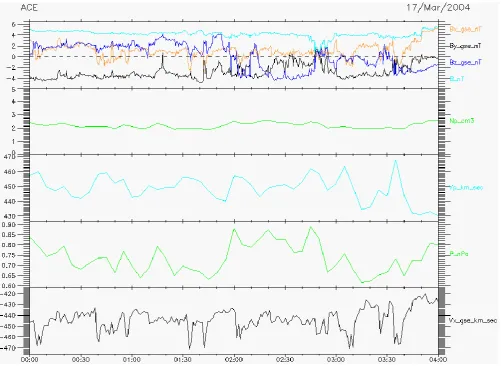
Fig. 1. Solar wind parameters from ACE.
into the magnetosphere by the formation of the mixed tran-sition layer at the MP (Lemaire, 1977; Lemaire and Roth, 1978).
In the present paper, we report a bulk excursion of the MS that was recorded simultaneously by the Cluster and TC-1 spacecraft in quiet solar wind conditions during a period of northward IMF on 17 March 2004. The relevant plasma transport phenomenon in the form of flux fluctuations below the ion gyrofrequency at the MP is shown and interpreted as manifestation of the drift instability.
2 Observations
Figure 1 shows the solar wind parameters from ACE. During the period 00:00–02:00 UT, the IMFBzwas entirely north-ward, and the total field amplitude was almost constant. The solar wind velocity had only some small fluctuations and the kinetic pressure manifested some modest perturbations. The solar wind condition in this time interval can be considered as moderately quiet. The propagation time for plasma from
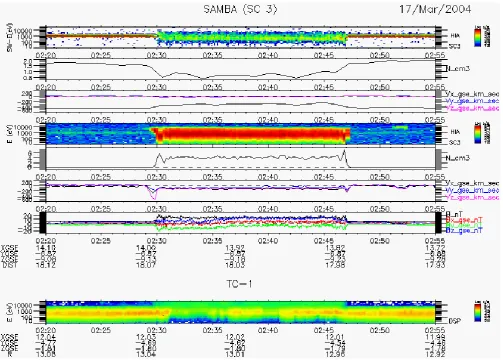
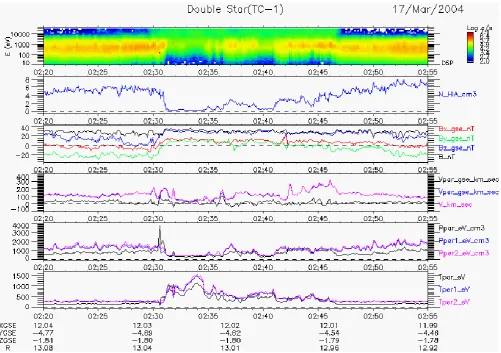
L1 to Earth, estimated by the advection shift, is about 55 min. Since the concerned time interval is 02:30–02:50 UT, hence ACE observations before 02:00 UT are relevant. On early 17 March 2004, all the Cluster and TC-1 spacecraft was in-bound. The geographical locations are schematically shown in Fig. 2. The four Cluster spacecraft were approximately at R=(14.00,−6.87,−9.13)GSERE, and the characteristic scale of the tetrahedron was only about 200 km at that time. The TC-1 spacecraft was at R=(12.03, −4.69, −1.80)GSERE. Figures 3 and 4 show magnetic field measurements and hot ion measurements recorded by Cluster and TC-1 satellites for 02:20–02:55 UT. The magnetic field measurements come from the FGM experiment (Balogh et al., 2001) and the hot ions from HIA sensor of the CIS instrument (R`eme et al., 2001). Almost identical HIA instrument is also on board TC-1 (R`eme et al., 2005). For the 4 Cluster spacecraft, only data from C3 are shown here(because of the very small size of the tetrahedron all Cluster showed very similar features).
C. L. Cai et al.: Magnetosheath excursion and the relevant transport process at the magnetopause 2999
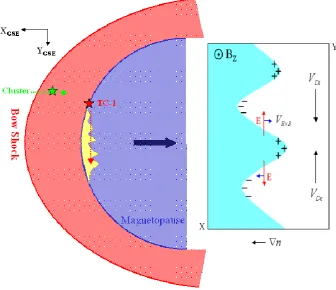
Fig. 2. A schematic of the geographical locations of the Cluster and TC-1 spacecraft projected to the ecliptic plane. The bow shock and
the magnetopause are shown by the red and blue bows respectively. The green and red stars and the dashed arrows denote the Cluster and TC-1 spacecraft and their orbits respectively. The ripples at the magnetopause describe the scenario of the drift instability. Meanwhile, its fundamental physical picture is illustrated at the right side. A sinusoidal electrostatic potential perturbation tight ties to a sinusoidal plasma density perturbation, and both them propagate with the plasma diamagnetic drift velocity. For more details see the text.
to detect the solar wind particles. The density and veloci-ties are shown in the second and third panels. The fourth panel shows the time-energy spectrogram of the high geo-metrical factor C3 HIA sensor, which is designed to detect the MS and magnetospheric particles. The density and ve-locities from this detector are shown in the fifth and sixth panels. Until 02:30 and after 02:47 UT, the energy spectrum shows almost monoenergetic ions, with velocities nearly in the x-direction (GSE). All these features indicate that the ob-servations were recorded inside the solar wind, while during the interval 02:30–02:47 UT, the observational characteris-tics indicate that the spacecraft entered into and stayed in the MS. Due to the deceleration and thermalization of the solar wind plasma behind the bow shock, the ion energy spectrum in the MS is spread, and the corresponding density rises to a much higher level. During this period, the bulk velocities also decreased and was deflected in comparison to the solar wind velocities. Likewise, TC-1 was inside the MS till 02:30 and after 02:47 UT as it can be easily identified from Fig. 4. During the interval 02:30–02:47 UT, it is clear that the obser-vations were recorded in the magnetosphere, where the ion energy spectrum is in a higher energy regime compared to
that of the MS. Here, the reason that the density recorded by the low geometrical factor HIA sensor decreases inside the MS is due to the fact that it is in the solar wind mode (instru-ment effect).
Combining the observations of the Cluster and TC-1 spacecraft, the present event reveals a large-amplitude bulk excursion of the MS. Initially, the Cluster spacecraft was in the solar wind and TC-1 in the MS. At 02:30 UT, a rapid bulk sunward motion of the MS took place Cluster entered the MS, and TC-1 encountered the MP. After about 17 min at 02:47 UT, a rapid earthward motion of the MS occurred. Thus Cluster reentered the solar wind, and TC-1 returned to the MS. An impressive feature of the present event is the good coherence between the bow shock and the MP motion. To expose this point, we added the time-energy spectrogram recorded at the same time by TC-1 satellite on the bottom panel of Fig. 3. It can be seen that the period of Cluster in the MS exactly coincides with the period of TC-1 at the MP. In the present event, the MS magnetic field has compo-nents with a positive Bz, a negative By and a nearly zero
3000 C. L. Cai et al.: Magnetosheath excursion and the relevant transport process at the magnetopause
Fig. 3. Magnetic field and hot ion parameters from Cluster C3 . From top, (a–c) time-energy spectrogram and density and velocities of solar
wind particles respectively, (d–f) time-energy spectrogram and density and velocities of magnetosheath particles respectively. g) components of magnetic field. However, the last panel is hot ion time-energy spectrogram from TC-1.
field is sheared to the terrestrial magnetic field with an angle about 45◦. Based on the temperature of MS ions and the total
magnetic field, we can estimate the proton gyroradius to be approximately 80 km and the gyroperiod about 2 s.
Another remarkable feature recorded by TC-1 at the MP is the mixture of the MS and magnetospheric ion composition: the high energy ions characteristics of magnetosphere ions, are mixed with variable magnetosheath ions. In the time in-terval 02:30 and 02:47 UT, the encountered mixtures is the well known low latitude boundary layer (LLBL) composi-tion, which has a fully mixed ion energy structure. Besides the LLBL, there are some irregular mixtures, where some sporadic MS composition is observed in a stable background of the magnetospheric ion composition. TC-1 was skimming over the ellipsoidal MP at that time, hence these flux fluctua-tions should be regarded as local spatial structures at the MP instead of temporal variations due to the radial vibration of the MP. Otherwise, the background of the MS and magneto-spheric ion composition should be alternately observed,
in-stead of a stable background of the magnetospheric ion com-position that was observed. Therefore, the fluctuated mix-tures actually represent a transport of the MS ions across the MP. A possible ripple structures at the MP is shown in the schematic of Fig. 2.
Note that the duration of each fluctuation structure is much longer than the ion gyroperiod (∼2 s). For example, during 02:35–02:36 UT, some wavy flux tubes were recorded, and each tube persisted for 20 s, and those fluctuations encoun-tered later have even longer durations.
C. L. Cai et al.: Magnetosheath excursion and the relevant transport process at the magnetopause 3001
Fig. 4. Magnetic field and hot ion parameters from TC-1. From top to bottom, (a) hot ion time-energy spectrogram, (b) hot ion density, (c) components of the magnetic field, (d) ion bulk velocities. (e) and (f) components of hot ion pressure, and temperature, respectively.
3 Discussion
3.1 Excursion velocity of the bow shock
The small size of the Cluster tetrahedron allows the nor-mal direction of the bow shock to be determined by a mag-netic field gradient method (Shen et al., 2007). Then the velocity in the normal direction of the shock front can be estimated by the shock mass flux conservation equation, that is, ρu(Vu−Vnn)·n=ρd(Vd−Vnn)·n, where ρu (ρd)andVu (Vd)are the plasma density and velocity up-stream (downup-stream) of the shock respectively, and Vn is the excursion velocity in the normal direction (Schwartz, 1998). From the above equation, Vn can be solved to be Vn=1(ρV)·n/1ρ. For the first bow shock en-counter at 02:30 UT, the normal direction is determined to be n=(0.740,−0.580,−0.340)GSE. The density and velocity upstream and downstream of the shock are ρu=1.60 cm−3,
Vu=(−453, 18,−4)GSEkm/s andρd=5.76 cm−3,Vd=(−92, −74, −112k)GSEkm/s respectively. Hence Vn is evalu-ated to be roughly 156 km/s. Similarly, for the second
bow shock encounter at 02:47 UT, the normal direction is n=(0.744, 0.141, −0.653)GSE. The density and velocity upstream and downstream of the shock are ρu=1.63 cm−3,
Vu=(−437, 13, 20)GSEkm/s andρd=7.16 cm−3,Vd=(−102, −31,−83)GSEkm/s, henceVnis approximately 65 km/s.
3002 C. L. Cai et al.: Magnetosheath excursion and the relevant transport process at the magnetopause
TC1/2Spin/PA 0-15deg
10-6 10-5 10-4
ergs/cm**2-s-str-eV
dEF
TC1/2Spin/PA 165-180deg
10-6 10-5 10-4
ergs/cm**2-s-str-eV
dEF
TC1/2Spin/PA 75-90deg
10-6 10-5 10-4
ergs/cm**2-s-str-eV
dEF
2004/077
101
102 103 104
Center Energy
eV
02:20 02:25 02:30 02:35 02:40 02:45 02:50 02:55
2004/07710
1
102
103
104
Center Energy
eV
02:20 02:25 02:30 02:35 02:40 02:45 02:50 02:55
2004/07710
1
102
103 104
Center Energy
eV
[image:6.595.70.523.63.398.2]02:20 02:25 02:30 02:35 02:40 02:45 02:50 02:55
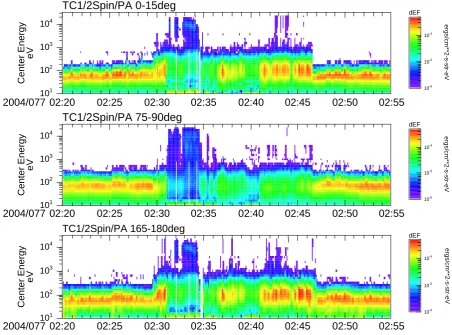
Fig. 5. Time-energy spectrogram of low energy electrons from TC-1. From top to bottom, are electron energy fluxes in the pitch angle range
of 0–15◦, 75–90◦and 165–189◦, respectively.
driving mechanism of the motion of bow shock and magne-topause is left for future investigation.
3.2 Drift instability
During the period TC-1 stayed at the MP, there were no ap-parent magnetic perturbation, hence an electrostatic type in-stability is responsible for the generation of the ripple struc-tures (Fig. 2). Moreover, since there were prominent density gradient and the corresponding plasma pressure gradient at the MP, thus they can act as free energy to excite drift in-stability, whose fundamental physical picture is illustrated on the right side of Fig. 2. Here, a sinusoidal density per-turbation is assumed. In the scenario of drift wave, the dy-namics of electrons parallel to the magnetic field is adiabatic. Therefore, a plasma density perturbation directly connects to a plasma potential perturbation via the electron Boltzmann distribution in the parallel direction and an electric field in the plane perpendicular to the magnetic field builds up. Conse-quently, theE×Bdrift leads to propagation of the perturba-tion in the plasma diamagnetic drift direcperturba-tion, where the ion diamagnetic drift direction is eastward and opposite to that of
electrons. In the MP environment, the electron perpendicular temperature is much lower than the ion perpendicular tem-perature (Phan et al., 2005). Thus, the electron diamagnetic drift velocity can be neglected and the drift wave propagates in the positive y direction with the ion diamagnetic drift ve-locity.
C. L. Cai et al.: Magnetosheath excursion and the relevant transport process at the magnetopause 3003
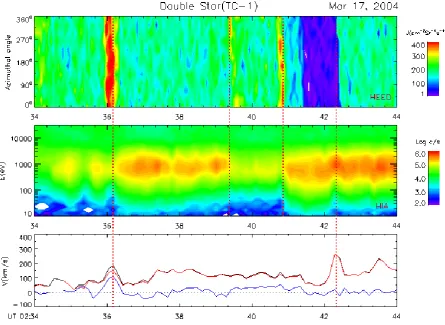
Fig. 6. (a) Time-energy spectrogram of electrons in the energy range of 0.2–0.4 MeV recorded by the HEED experiment onboard the TC-1
spacecraft. The vertical axis is the azimuthal angle, which is defined in the plane perpendicular to the satellite spin axis. (b) HIA time-energy spectrogram. (c) Ion bulk velocities: the black curve represents the total velocity, and the blue and red represent parallel and perpendicular velocities, respectively.
is HIA time-energy spectrogram and the third panel shows the ion bulk velocities deduced from HIA measurements: the black curve represents the total velocity, and the blue and red represent parallel and perpendicular velocities respectively. In the interval 02:35:58–02:36:12 UT, a filament of electron flux up to 400 cm−2sr−1s−1 was observed, which implies that a region of negative charge accumulation and accord-ingly a potential minimum is encountered. While during the period of 02:41:26–02:42:25 UT, a flux tube with ion flux below ten cm−2sr−1s−1was recorded, which implies that a region of positive charge accumulation and accordingly a po-tential maximum. Also, as shown by two short dashed lines, during the period of 02:39:22–02:40:51 UT, a minor poten-tial minimum is exhibited, which is bounded by two minor regions of negative charge accumulation. Why the whole re-gion of this potential perturbation did not display apparent variations of electron flux but only at the edges? Since elec-trons satisfy approximately the Boltzmann distribution and also the potential perturbation at that time is small, hence the electron perturbation is proportional to the ambient plasma density and inversely proportional to the plasma
tempera-ture. Therefore, the electron perturbation and correspond-ing charge accumulation in the magnetospheric ambience are much smaller than that in the MS ambience and accordingly no apparent variations of electron flux are observed.
[image:7.595.75.521.63.388.2]3004 C. L. Cai et al.: Magnetosheath excursion and the relevant transport process at the magnetopause potential minimum and the fully enhanced potential
maxi-mum encountered later during 02:41:26–02:42:25 UT make up spatially a complete sinusoid-like perturbation propagat-ing in the positive y direction on one hand, while they also record temporally the history of potential growth on the other hand.
As shown by two long dashed lines at 02:36:10 and 02:42:20 UT, respectively, in Fig. 6, at the end of the record of both two major potential perturbations, a pulse of the per-pendicular velocity is observed. These pulses are due to the EcrossBmotion in the nonlinear regime. In the linear stage of drift instability, although the potential perturbation grows up slowly, however both the potential and density perturba-tions are harmonically oscillated and no net mass transport across the boundary takes place. When the potential per-turbation is high enough, theE×Bmotion will give rise to convective instability, causing mass interchange between the high density region and the low density region. Consequen-tially, the exchanged MS ion fluxes are observed in the in-terval 02:36:20–02:37:40 UT and after 02:42:20 UT, respec-tively. It is worthy to point out that associated with the first perpendicular velocity pulse, there is also a parallel veloc-ity pulse, which implies that at this stage, the ion parallel motion is relevant, or in other words, the ion acoustic wave plays a role in the system evolution. For the second per-pendicular velocity pulse, no parallel velocity pulse occurs. However, an apparent corresponding magnetic perturbation can be found from the third panel in Fig. 4. It indicates that at that stage, the instability is not merely electrostastic but electromagnetic, namely the shear Alfv´en wave involves in the whole dynamics.
In contrast to the measurements of high energy electrons that reveal some evidence on charge accumulation and po-tential perturbation, the observations of low energy electrons as shown in Fig. 5 display no similar indication. The reason is thought that high energy electrons show non-adiabaticity in the parallel motion due to their larger effective viscosity and are responsible for the charge accumulation. Another is-sue is the stabilization of magnetic shear effect on the drift instability, since in the present event the MS magnetic field is sheared to the terrestrial magnetic field with an angle about 45◦. The answer is that due to the bulk excursion of MS, a localized region with a small magnetic shear or without shear developed. It can be found out from the third panel in Fig. 4. After 02:47 till 02:51 UT, the plasma measurements clearly indicate that the satellite was already drifting away from the MP and entered into the MS, while the magnetic field records were still similar to that of the terrestrial magnetic field.
Finally, the perpendicular wavelength can be estimated by the product of each duration time of the filament structure and the ion diamagnetic drift velocity. The ion diamagnetic drift velocity isvit h·ρiLn, wherevit his the ion thermal ve-locity,ρi is the ion gyroradius andL−n1= −dn
ndx is the
scale length of the density gradient. Usually, at the MP the
scale length of density gradient is typically a few ion gyro-radii (Winske, 1996). Here, we assume that the ratio of the characteristic length to the ion gyroradius is about five, so the ion diamagnetic drift velocity is one-fifth of the ion thermal velocity and is about 30 km/s. Then, the perpendicular wave-length of drift waves can be estimated to be roughly from 1200 km to 5400 km. Since a drift wave has a much larger parallel wavelength than its perpendicular wavelength, the volume of each flux tube is large and hence eventual particle transport by exchange of flux tubes is actually considerable. Based on this interpretation, it is interesting to point out that in contrast to the most investigated drift instability at the MP in the low hybrid regime and the assumed stationary turbu-lent diffusion, the observations presented here reveal the drift instability frequency is much less the ion gyrofrequency and consequently large-scale convective interchange seems to be a more efficient transport mechanism at the MP during peri-ods of northward IMF.
4 Conclusion
In summary, a large-amplitude excursion of the MS in quiet solar wind conditions during period of northward IMF is re-ported, which was observed simultaneously by the Cluster and TC-1 spacecraft. The good coherence between the bow shock motion and the MP motion is revealed and the excur-sion velocity of the bow shock motion is analyzed by a multi-satellite data analysis technique. Furthermore, the relevant plasma transport phenomenon in the form of flux fluctua-tions below the ion gyrofrequency at the MP is shown and interpreted as a manifestation of the drift instability. It is indicated that even in the case of IMF having a large shear to the terrestrial magnetic fields, a localized region at the MP without shear can develop due to the bulk motion of the MS and hence this stabilization factor in the drift instabil-ity is absent. In addition, evidence of charge accumulation and electrostatic potential perturbation related the evolution of drift instability are exhibited from the measurements of high energy electrons. All these potential perturbations show a good correlation to the ion density perturbations. More-over, the relevant rapidE×Bmotion in the nonlinear stage and the corresponding mass exchange are recorded. Finally, based on rough estimation of the scale of drift wave lengths, it is pointed out that in contrast to the most investigated drift instability at the MP in the low hybrid regime and the as-sumed stationary turbulent diffusion, the observations pre-sented here reveal the drift instability to be much less than the ion gyrofrequency and consequently large-scale convec-tive interchange seems to be a more efficient transport mech-anism at the MP during a period of northward IMF.
C. L. Cai et al.: Magnetosheath excursion and the relevant transport process at the magnetopause 3005
Laboratories and the French National Space Agency (CNES). C.L.C acknowledges the French Embassy in China for his government scholarship.
Topical Editor I. A. Daglis thanks P. J. Kellogg and another anonymous referee for their help in evaluating this paper.
The publication of this article is financed by CNRS-INSU.
References
Anderson, K. A., Binsack, J. H., and Fairfield, D. H.: Evidence for hydromagnetic waves of 3- to 15-minute period on the magne-topause and their relation to bow shock spikes, J. Geophys. Res., 73, 2371–2386, 1968.
Balogh, A., Carr, C. M., Acu˜na, M. H., Dunlop, M. W., Beek, T. J., Brown, P., Fornacon, H., Georgescu, E., Glassmeier, K.-H., Harris, J., Musmann, G., Oddy, T., and Schwingenschuh, K.: The Cluster Magnetic Field Investigation: overview of in-flight performance and initial results, Ann. Geophys., 19, 1207–1217, 2001, http://www.ann-geophys.net/19/1207/2001/.
Berchem, J. and Russell, C. T.: The thickness of the magnetopause current layer, J. Geophys. Res., 87, 2108–2114, 1982.
Cao, J. B., Liu, Z. X., Yan, C. X., Cai, C. L., Li, Z. Y., Zhu, G. W., Wang, S. R., Zhao, H., Liang, J. B., Ren, Q. Y., Zai, Y. Y., R`eme, H., Dandouras, I., Aoustin, C., Escoubet, P., Fazakerley, A., McKenna-Lawlor, S., and Dunlop, M.: First results of Chi-nese particle instruments in the Double Star Program, Ann. Geo-phys., 23, 2775–2784, 2005,
http://www.ann-geophys.net/23/2775/2005/.
Gary, S. P. and Eastman, T. E.: The lower hybrid drift instability at the magnetopause, J. Geophys. Res., 84, 7378–7381, 1979. Holzer, R. F., McLeod, M. G., and Smith, E. J.: Preliminary results
from the OGO 1 search coil magnetometer: Boundary positions and magnetic noise spectra, J. Geophys. Res., 71, 1481–1486, 1966.
Horbury, T. S., Cargill, P. J., Lucek, E. A., Eastwood, J., Balogh, A., Dunlop, M. W., Fornacon, K.-H., and Georgescu, E.: Four spacecraft measurements of the quasiperpendicular terrestrial bow shock: Orientation and motion, J. Geophys. Res., 107, 1208, doi:10.1029/2001JA000273, 2002.
LaBelle, J. and Treumann, R. A.: Plasma waves at the dayside mag-netopause, Space Sci. Rev., 47, 175–202, 1988.
Lemaire, J.: Impulsive penetration of filamentary plasma elements into the magnetospheres of the Earth and Jupiter, Planet. Space Sci., 26, 887–890, 1977.
Lemaire, J. and Roth, M.: Penetration of solar wind plasma ele-ments into the magnetopause, J. Atrnos. Terr. Phgs., 40, 331– 335, 1978.
Kaufmann, R. L. and Konradi, A.: Explorer 12 magnetopause ob-servations: Large-scale non-uniform motion, J. Geophys. Res., 74, 3609–3627, 1969.
Phan, T. D., Escoubet, C. P., Rezeau, L., Treumann, R. A., Vaivads, A., Paschmann, G., Fuselier, S. A., Attie, D., Rogers, B., and Sonnerup, B. U. O.: Magnetopause process, Space Sci. Rev., 118, 367–424, 2005.
R`eme, H., Aoustin, C., Bosqued, J. M., et al.: First multispacecraft ion measurements in and near the Earths magnetosphere with the identical Cluster ion spectrometry (CIS) experiment, Ann. Geo-phys., 19, 1303–1354, 2001,
http://www.ann-geophys.net/19/1303/2001/.
R`eme, H., Dandouras, I., Aoustin, C., Bosqued, J. M., Sauvaud, J. A., Vallat, C., Escoubet, P., Cao, J. B., Shi, J., Bavassano-Cattaneo, M. B., Parks, G. K., Carlson, C. W., Pu, Z., Klecker, B., Moebius, E., Kistler, L., Korth, A., Lundin, R., and the HIA team: The HIA instrument on board the Tan Ce 1 Double Star near-equatorial spacecraft and its first results, Ann. Geophys., 23, 2757–2774, 2005,
http://www.ann-geophys.net/23/2757/2005/.
Schwartz, S. J.: Shock and Discontinuity Normals, Mach Num-bers, and Related Parameters, in: Analysis Methods for Multi-Spacecraft Data, edited by: Paschmann, G. and Daly, P., 1998. Shen, C., Dunlop, M., Li, X., Liu, Z. X., Balogh, A., Zhang, T.
L., Carr, C. M., Shi, Q. Q., and Chen, Z. Q.: New approach for determining the normal of the bow shock based on Cluster four-point magnetic field measurements, J. Geophys. Res., 112, A03201, doi:10.1029/2006JA011699, 2007.
Smit, G. R.: Oscillatory Motion of the Nose Region of the Magne-topause, J. Geophys. Res., 73, 4990–4993, 1968.
Treumann, R. A., LaBelle, J., and Pottelette, R.: Plasma diffusion at the magnetopause: The case of lower hybrid drift waves, J. Geophys. Res., 96, 16009–16013, 1991.