R E S E A R C H
Open Access
Evolutionary fitness as a function of pubertal age
in 22 subsistence-based traditional societies
Ze
’
ev Hochberg
1*, Aneta Gawlik
1,2and Robert S Walker
3Abstract
Context:The age of puberty has fallen over the past 130 years in industrialized, western countries, and this fall is widely referred to as the secular trend for earlier puberty. The current study was undertaken to test two
evolutionary theories: (a) the reproductive system maximizes the number of offspring in response to positive environmental cues in terms of energy balance, and (b) early puberty is a trade-off response for high mortality rate and reduced resource availability.
Methods:Using a sample of 22 natural-fertility societies of mostly tropical foragers, horticulturalists, and pastoralists from Africa, South America, Australia, and Southeastern Asia, this study compares indices of adolescence growth and menarche with those of fertility fitness in these non-industrial, traditional societies.
Results:The average age at menarche correlated with the first reproduction, but did not correlate with the total fertility rate TFR or reproductive fitness. The age at menarche correlated negatively with their average adult body mass, and the average adult body weight positively correlated with reproductive fitness. Survivorship did not correlate with the age at menarche or age indices of the adolescent growth spurt. The population density correlated positively with the age at first reproduction, but not with menarche age, TFR, or reproductive fitness. Conclusions:Based on our analyses, we reject the working hypotheses that reproductive fitness is enhanced in societies with early puberty or that early menarche is an adaptive response to greater mortality risk. Whereas body mass is a measure of resources is tightly associated with fitness, the age of menarche is not.
Introduction
The age of puberty has fallen over the past 130 years in industrialized, western countries, where menarche age has receded from 16.5 years in 1880 to the current 12.5 years in western societies; this decline has occurred con-comitantly with an improvement in child health [1]. The progressively declining age of thelarche and menarche may have multiple explanations. Primates’studies sug-gest a role for prenatal androgens and social factors (like the social rank) [2,3]. In the last decade, a popular notion among investigators is that early puberty may result from environmental exposure to endocrine dis-rupting chemicals (EDC), thus accelerating hypothalamic maturation [4]. Whereas EDC may have a bearing on the earlier age of thelarche, evolutionary forces may add
a new angel to explain the secular trend in the age of menarche over the last 130 years. Even though the age at menarche is strongly linked to genetic variations [5], the time course of the secular trend suggests strong environmental influence.
This secular trend for early onset of puberty is a topic of much research interest. This trend was recently examined from a life-history evolutionary perspective, and we pre-viously suggested that transition from juvenility to adoles-cence is a period of adaptive plasticity [6,7]. Two models have been proposed to explain this adaptation. Gluckman and Hanson suggested that life-history strategies for greater reproductive fitness (a product of the fertility rate and survivorship) could account for the current early onset of puberty [8]. The declining age of pubertal devel-opment have both been proposed as an adaptive response to positive environmental cues in terms of energy balance [7]. The assumption is that the reproductive system maxi-mizes the number of offspring by balancing the benefit of more births against the costs of maternal mortality. With * Correspondence: [email protected]
1Division of Pediatric Endocrinology, Meyer Children’s Hospital, Rambam Medical Center, and Rappaport Faculty of Medicine and Research Institute, Technion-Israel Institute of Technology, Haifa, Israel
Full list of author information is available at the end of the article
respect to puberty, women face a trade-off between spend-ing a long time accumulatspend-ing resources through childhood growth and weight gain in order to improve the likelihood for successful pregnancy, against an early-age reproduction in order to increase the number of reproductive cycles. Indeed, heavy women in pre-industrial societies are more fertile, and both increased body weight and fertility are correlated with high birth rates [9]. This trade-off model has been used to predict that 18 years is the optimal age for first birth, which is near the observed average 17.5 years in such societies [10].
A different evolutionary trade-off was suggested by Migliano et al [11]. Based on analysis of the stature, growth, and reproductive fitness for the Aeta and the Batak pygmy from the Philippines, they argued that that the small body size of pygmy populations is an adapta-tion that evolved as the result of a life history tradeoff between the fertility benefits of a large body size against the costs of late growth cessation, under the circum-stances of significant young and adult mortality. They showed that the small pygmy body size evolved through the early onset age of juvenility and adolescence [12], and suggested early cessation of growth is a trade-off for high mortality rate and reduced resource availability. Thus, short life expectancy may be initially a determi-nant of early puberty but subsequently, early puberty as
an adaptive response may determine longer lifespan due to reduced adult size and resource need.
The present study was designed to explore these two hypotheses. To this end, it takes an inter-population approach that compares indices of adolescence (menarche, and the growth spurt) with those of fertility fitness in non-industrial, traditional societies. Using a sample of 22 nat-ural-fertility societies of mostly tropical foragers, horticul-turalists, and pastoralists from Africa, South America, Australia, and Southeastern Asia, we hypothesized that (a) early adolescence would be associated with greater repro-ductive fitness or (b) with mortality risk, and predicted that the age at menarche and indices of pubertal growth will (a) negatively correlate with fertility rate or (b) posi-tively correlate with survivorship. Although the reproduc-tive and life history strategies of males and females are quite distinct in these societies, similar considerations might apply to the males, for which we included indices of adolescent growth spurt in our study.
Methods
Natural-fertility human societies
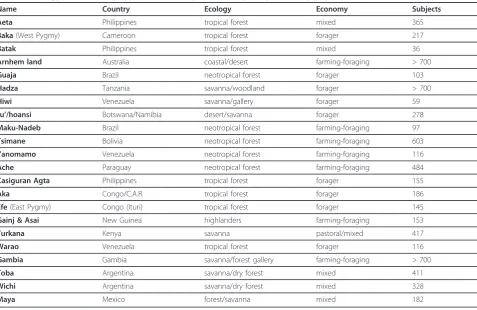
The sample used here is 22 subsistence-based societies and the demographic characteristics of each society, col-lected at different times during 1967-1988; these have been previously described [13] (Table 1). Information on
Table 1 Ecology and economy type of the twenty tribes comprising the study populations
Name Country Ecology Economy Subjects
Aeta Philippines tropical forest mixed 365
Baka(West Pygmy) Cameroon tropical forest forager 217
Batak Philippines tropical forest mixed 36
Arnhem land Australia coastal/desert farming-foraging > 700
Guaja Brazil neotropical forest forager 103
Hadza Tanzania savanna/woodland forager > 700
Hiwi Venezuela savanna/gallery forager 59
Ju’/hoansi Botswana/Namibia desert/savanna forager 278
Maku-Nadeb Brazil neotropical forest farming-foraging 97
Tsimane Bolivia neotropical forest farming-foraging 603
Yanomamo Venezuela neotropical forest farming-foraging 116
Ache Paraguay neotropical forest farming-foraging 484
Casiguran Agta Philippines tropical forest forager 155
Aka Congo/C.A.R. tropical forest forager 186
Efe(East Pygmy) Congo (Ituri) tropical forest forager 145
Gainj & Asai New Guinea highlanders farming-foraging 153
Turkana Kenya savanna pastoral/mixed 417
Warao Venezuela tropical forest forager 116
Gambia Gambia savanna/forest gallery farming-foraging > 700
Toba Argentina savanna/dry forest mixed 411
Wichi Argentina savanna/dry forest mixed 328
the life history and population density of these societies and their average height, body weight, and BMI is avail-able at http://anthropology.missouri.edu/people/walker. html as compiled by one of us (RSW) from previous reports [14-16] and sources therein. In these societies, the age of menarche ranged from 12.6-18.4, and the age at growth spurt takeoff ranged from 10-13.5 years.
The stages of puberty were determined in girls of each society by the mean age of menarche, by the adolescent takeoff height velocity, peak height velocity, and for the end of puberty - the return to weight and height takeoff velocities. Indices of fertility in each society were deter-mined from the average age at first reproduction, the interbirth interval (IBI, by self report), and total fertility rate (TFR). Reproductive fitness was calculated per society from the population average survivorship to age 15 (L15, range 0.33-0.80) and the TFR (range 2.6-9.0), TFR*L15, as previously suggested [17]. Mortality risk was determined from the survivorship to age 15 and life expectancy at birth (range 24.3-47.5) and age 15 (range 29.6-47.0).
At the time of data collection, ethical approval was considered not required, and the authors had no access to individuals’data.
Statistical analyses
Linear regression analyses with 95% confidence intervals of outcome as a function of IBI were performed using
Sta-tistica 6.0. For these analyses, the average of each study parameter for each society was a single point in the regres-sion analysis. One-way analysis of variance (ANOVA) was used to determine whether statistical differences exist between the study parameters in the 22 studied societies. Statistical significance was set at p < 0.05.
Results
Adolescent age and reproductive fitness
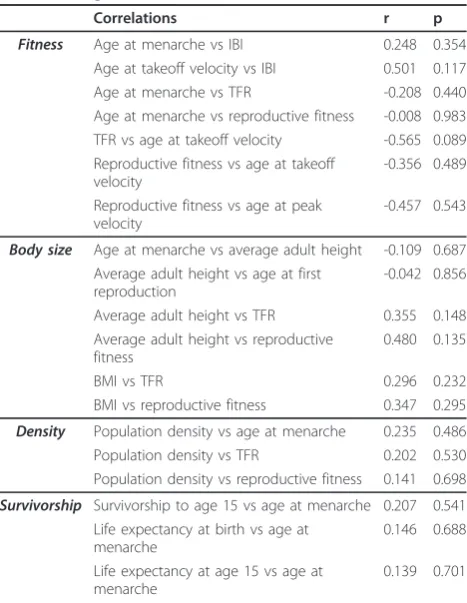
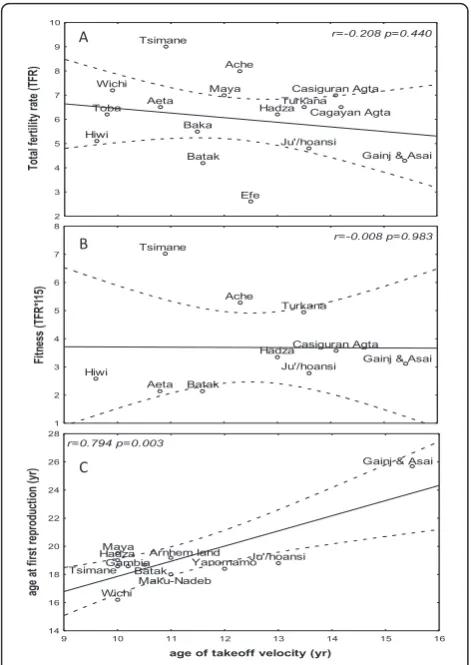
The age at menarche correlated positively with the age at first reproduction (r = 0.762, p < 0.001), and the aver-age duration between the two events was four years (Figure 1). When we tested the hypothesis that early adolescence is associated with increased reproductive fit-ness, the age at menarche and the growth indices (age at takeoff, peak velocity, and the return to weight and height takeoff velocity) did not correlate with the IBI (Table 2). The age at menarche did not correlate with TFR or reproductive fitness (NS: r = -0.208, p = 0.440; r = -0.008, p = 0.983, respectively), whereas the age at first reproduction correlated positively with the age at height spurt takeoff (r = 0.794, p = 0.003; Figure 2), peak height velocity (r = 0.791, p = 0.011), and return to takeoff height velocity (r = 0.765, p = 0.027), but TFR and reproductive fitness did not correlate with any of these variables (Table 2).
Body size
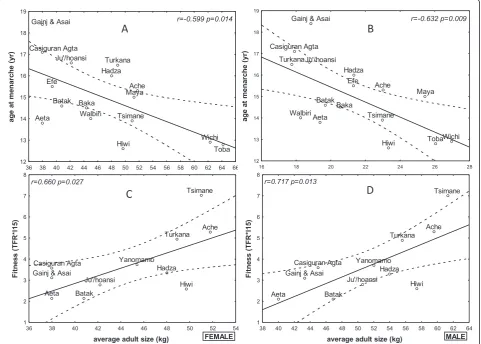
The average age at menarche correlated negatively with the average adult body weight (kg) (r = -0.599, p = 0.014; Figure 3) and body mass index (BMI) (r = -0.632, p = 0.009; Figure 3), but not with the average adult height
Aeta Batak Hadza
Hiwi
Walbiri
Casiguran Agta Turkana
Toba
Wichi
12 13 14 15 16 17 18 19
age at menarche (yr)
14 16 18 20 22 24 26 28
age at
f
ir
st
r
epr
oduct
ion (
yr
)
Tsimane Baka Efe
Maya Ache
Ju'/hoansi Cagayan Agta
Gainj & Asai r=0.762 p<0.001
Figure 1 Age of menarche and the first reproduction. A regression line and 95% confidence limits for the age of the first reproduction as a function of the menarche age in traditional societies. The dashed line connects identical ages on the X and Y axes, demonstrating the constant age gap between the menarche age and first reproduction age.
Table 2 Insignificant correlations
Correlations r p
Fitness Age at menarche vs IBI 0.248 0.354
Age at takeoff velocity vs IBI 0.501 0.117
Age at menarche vs TFR -0.208 0.440
Age at menarche vs reproductive fitness -0.008 0.983 TFR vs age at takeoff velocity -0.565 0.089 Reproductive fitness vs age at takeoff
velocity
-0.356 0.489
Reproductive fitness vs age at peak velocity
-0.457 0.543
Body size Age at menarche vs average adult height -0.109 0.687 Average adult height vs age at first
reproduction
-0.042 0.856
Average adult height vs TFR 0.355 0.148
Average adult height vs reproductive fitness
0.480 0.135
BMI vs TFR 0.296 0.232
BMI vs reproductive fitness 0.347 0.295
Density Population density vs age at menarche 0.235 0.486
Population density vs TFR 0.202 0.530
Population density vs reproductive fitness 0.141 0.698
Survivorship Survivorship to age 15 vs age at menarche 0.207 0.541 Life expectancy at birth vs age at
menarche
0.146 0.688
Life expectancy at age 15 vs age at menarche
0.139 0.701
(Table 2). The average adult body weight (kg) correlated negatively with the age at first reproduction (r = -0.450, p = 0.041), and the average adult body weight (kg) positively correlated with the respective society’s reproductive fitness (r = 0.660, p = 0.027; r = 0.717, p = 0.013, respectively; Fig-ure 3). The average adult heights did not correlate with the age at first reproduction, TFR, or reproductive fitness (Table 2). The BMI correlated with the age at first repro-duction (r = -0.466, p = 0.033), but not with the TFR or reproductive fitness.
Adolescent age and the physical environment
The average age at menarche and parameters of the growth spurt for each society did not correlate with their respective population density. The population den-sity correlated positively with the women’s age at first reproduction (r = 0.680, p < 0.005), but not with menarche age, TFR, or reproductive fitness (Table 2).
Adolescent age and survivorship expectancy
When we tested the hypothesis that early adolescence and small body size is a trade-off for high mortality risk,
we found that the survivorship to age 15 and life expec-tancy at birth or age 15 did not correlate with the age at menarche or age indices of the adolescent growth spurt (Table 2). Adding survivorship to a multivariate analysis for age at menarche or age at first reproduction as a function of BMI and population density added no statis-tical significance.
Ecological and economic correlates
When the societies were categorizing societies by their ecology, dwellers of the tropical forest, the neotropical forest, and the savanna had comparable ages at menarche and reproductive fitness. Of the studied socie-ties, the TFR was highest among dwellers of neotropical forests (8.3 ± 0.6), as compared to those in the savanna (6.5 ± 0.7) and the tropical forests (5.4 ± 1.7, p = 0.015; Table 3). When the societies were categorized by their economy type, the age at menarche, TFR, and reproduc-tive fitness were not significantly different between the farmers-foragers, the foragers, and the mixed-economy groups (results not shown).
Discussion
In considering human adolescence in the context of evolutionary fitness, we considered key traits that were available from data collected in 1967-1988. These include the age of menarche, the pattern and timing of the adolescent growth spurt, the body size, and the determinants of reproductive fitness, namely the age of the first reproduction, the IBI, the number of progeny, and mortality risk [18]. The database contains no infor-mation on birth size, which may influence the age at menarche. Extended growth and large body size in humans prompt fertility gains and reduced offspring mortality [19]. Consequently there is a pressure for delayed reproductive onset, whereas early reproduction minimizes the likelihood of death before reproduction.
Several limitations of this approach require considera-tion. i. By nature of this approach, comparing population level averages and attributing differences to ecological differences may not be straightforward. It assumes that the relationships observed would be the same if exam-ined at an individual level [20]. In their report, Greenland and Robin construct several epidemiological examples that show that data at the ecologic level can be misinter-preted if nonlinear effects at the individual level, and other confounds, are not accounted for. Such data for the individual level were not available to us. ii. Comparative studies across societies may also suffer from problems of phylogenetic non-independence. This was addressed for these data previously by adjusting for geographical loca-tion (Africa, South America, Australia and Southeast Asia), but the effect was very weak and not significant in any of the multiple regressions [13].
Aeta
Baka
Batak
Hadza
Hiwi
Ju'/hoansi Tsimane
Ache
Casiguran Agta
Efe Turkana Toba
Wichi Maya
12 13 14 15 16 17 18 19
age at menarche (yr) 2
3 4 5 6 7 8 9 10
To
ta
l fe
rti
lity
ra
te
(T
FR
)
Cagayan Agta
Gainj & Asai
r=-0.208 p=0.440
Aeta Batak
Hadza
Hiwi Ju'/hoansi
Tsimane
Ache
Casiguran Agta Turkana
12 13 14 15 16 17 18 19
age at menarche (yr) 1
2 3 4 5 6 7 8
Fi
tn
ess (
TFR
*l15)
Gainj & Asai
r=-0.008 p=0.983
Hadza YanomamoJu'/hoansi
Wichi Maya
9 10 11 12 13 14 15 16
age of takeoff velocity (yr) 14
16 18 20 22 24 26 28
age at
fi
rs
t r
epr
oduct
ion (
yr
)
Maku-Nadeb Tsimane Batak
Gainj & Asai
GambiaArnhem land
r=0.794 p=0.003 A
B
C
Pubertal timing is not a univocal parameter; secular changes may occur differently for some pubertal events. Whereas the age of thelarche has reduced in the last decades, changes in menarche have been more subtle and mental maturation - deferred. Also, it is not clear that menarche is a good proxy for fecundity. The age at first reproduction in the present study strongly corre-lated with menarche, but the potential role of anovula-tory menstrual cycles after menarche and potential non-linearity of this trend remain options. For example, it is
possible that girls who differ on age at menarche may be similar with regard to age of fecundity; earlier menarche may relate to a greater number of anovulatory cycles [21], and indeed, regular (ovulatory) cycling was shown to follow a secular trend towards delay as opposed to early menarche [22].
The data show that at natural fertility, early adoles-cence in girls, as assessed by the age of menarche and the growth pattern, corresponds to a young age with the first reproduction occurring about four years later, as
Aeta Baka Batak Hadza Hiwi Ju'/hoansi Tsimane Walbiri Ache Efe Turkana Wichi Maya
36 38 40 42 44 46 48 50 52 54 56 58 60 62 64 66
average adult size (kg)
12 13 14 15 16 17 18 19 age at m enar che ( yr ) Toba Gainj & Asai
Casiguran Agta r=-0.599 p=0.014 Aeta Batak Hadza Hiwi Tsimane Walbiri Ache Casiguran Agta Efe Gainj & Asai
Turkana
TobaWichi Maya
16 18 20 22 24 26 28
BMI (kg/m2)
12 13 14 15 16 17 18 19 age at m enar che ( yr ) Ju'/hoansi Baka r=-0.632 p=0.009 Aeta Batak Hadza Hiwi Ju'/hoansi Tsimane Yanomamo Ache
Gainj & Asai
Turkana
36 38 40 42 44 46 48 50 52 54
average adult size (kg)
1 2 3 4 5 6 7 8 Fi tn ess ( TFR *l 15) Casiguran Agta r=0.660 p=0.027 FEMALE Aeta Batak Hadza Hiwi Ju'/hoansi Tsimane Yanomamo Ache Casiguran Agta Gainj & Asai
Turkana
38 40 42 44 46 48 50 52 54 56 58 60 62 64
average adult size (kg)
1 2 3 4 5 6 7 8 Fi tn ess ( TFR *l 15) r=0.717 p=0.013 MALE
A
B
C
D
Figure 3Puberty and body weight.Upper panels: A regression and 95% confidence limits for the age at menarche as a function of the average adult body weight (left panel) and BMI (right panel).Lower panels: A regression and 95% confidence limits for reproductive fitness as a function of the body weight in both females (left panel) and males (right panel).
Table 3 Ecology type of the societies comprising the study populations
VARIABLES Tropical forest Neotropical forest Savanna/other p Value
Age at menarche (n) (n = 6)
15.5 ± 1.4
(n = 2) 14.6 ± 1.0
(n = 6) 14.3 ± 1.8
0.45
TFR (n) (n = 6)
5.4 ± 1.7
(n = 3) 8.3 ± 0.6
(n = 7) 6.5 ± 0.7
0.015
Reproductive fitness (n) (n = 3)
2.6 ± 0.9
(n = 3) 5.3 ± 1.7
(n = 4) 3.9 ± 1.2
0.09
previously suggested [23]. However, based on our ana-lyses, we reject the two working hypotheses: reproduc-tive fitness is enhanced in societies with early puberty [8] and early menarche is an adaptive response to greater mortality risk [11].
We focus here on subsistence-based societies because most resources are invested as somatic capital in terms of growth, body size and fertility (reproductive fitness), as opposed to stored and inherited wealth [15]. The relative contribution of biological and behavioral factors in determining natural fertility change with the environ-ment. Environmental factors to consider in an inter-population study include the physical environment (e.g., population density), the biological environment (e.g., food availability, disease, and other mortality risks) and social behaviors (e.g., age at marriage) [15]. We defined reproductive fitness as a function of TFR and L15, as previously suggested [17]; these two variables were selected among other because information on these two parameters was available for almost all of the societies in the database. The age at menarche did not correlate with TFR or reproductive fitness. Whereas reproduction starts early in societies in which puberty occurs early, in the context of high population density [19], their repro-ductive fitness does not increase. The dwellers of the neotropical forests have a high TFR, but given their mortality risk, they have comparable reproductive fitness to the other ecology groups.
We confirm a previous assertion for greater reproduc-tive fitness among heavier, better-nourished traditional societies [9,24]. When considered as a whole, we found that the average adult body weight, but not height, corre-lated negatively with age at menarche and the age at first reproduction, and positively with reproductive fitness. The BMI may not work as well in the extremes of size; in very small or very tall populations the BMI is not as accurate as it is in average size populations. Even though, these findings provide indirect support to the hypothesis that early puberty among girls who live in affluent and developed countries is a response to a positive energy balance. Indeed, among contemporary girls in developing countries, the age at menarche among the prosperous is earlier than that of the underpriviledged [1].
Based on the high mortality rates of the Philippine pygmy, Migliano et al suggested that early fertility is part of the “fast” extreme of life history strategies to which the pygmy adapt [25], with both longevity and resource availability as limiting factors [11]. Indeed, early life stress is associated with premature juvenility and adolescence [1,12,26]. The results of the present study do not confirm the fast life history theory; we found no correlation between adult height and the age of menarche with survivorship. Yet, population density correlated with the age of first reproduction, in addition
to our previous assertion that body size in a traditional society was dependent upon the population density [19]. We have previously suggested that population density acts through two pathways - nutritional constraints and juvenile mortality - at varying intensities, and can con-tribute to a nearly twofold range in body size across human societies [19]. The sample of the present study includes two African pygmy groups - the Baka (West pygmy) and the Efe (East pygmy), both of whom are not consistent with the Migliano risk/early fertility model. The average age of menarche and age at first reproduc-tion in these two societies, 14.5 and 15.5, respectively 18.5 and 19, respectively, were close to those of all of the other studied societies [13].
The secular trend for an early age of menarche has been rapid over the past 130 years in developed coun-tries [27]. This trend is rightly interpreted as a reflection of improved nutrition and health in childhood [18]. Life history theory postulates tradeoffs of current versus future reproduction and fertility versus mortality risk. Life-history modeling predicted that a reduction in juve-nile mortality reduces the age of menarche [8] or that low survivorship accelerates the life history [11]. Given the close interaction between resource availability and reproduction, we anticipated that those environmental factors that determine late metabolic homeostasis, attainment of adult size and cessation of growth would interface with those influencing the timing of sexual maturation. The data do not support these predictions. Whereas body mass as a measure of resources is tightly associated with fitness in these traditional societies, the age of menarche is not. Thus, it may be that women’s physiology tracks its own condition in such a way as to maximize their individual fitness.
Abbreviations
BMI: Body mass index; IBI: Interbirth interval; EDC: endocrine disrupting chemicals; L15: survivorship to age 15; TFR: Total fertility rate
Author details
1Division of Pediatric Endocrinology, Meyer Children’s Hospital, Rambam Medical Center, and Rappaport Faculty of Medicine and Research Institute, Technion-Israel Institute of Technology, Haifa, Israel.2Department of Pediatric Endocrinology and Diabetes, Medical University of Silesia, Katowice, Poland. 3Department of Anthropology, University of Missouri, Columbia MO 65211,
USA.
Authors’contributions
ZH contributed to the concept and design, analysis and interpretation of data, writing the article. AC contributed to the design, analysis and interpretation of data. RSW contributed to the concept and design, acquisition and interpretation of data. All authors read and approved the final manuscript.
Competing interests
The authors declare that they have no competing interests.
References
1. Parent AS,et al:The timing of normal puberty and the age limits of sexual precocity: variations around the world, secular trends, and changes after migration.Endocr Rev2003,24(5):668-93.
2. Zehr JL, Van Meter PE, Wallen K:Factors regulating the timing of puberty onset in female rhesus monkeys (Macaca mulatta): role of prenatal androgens, social rank, and adolescent body weight.Biol Reprod2005,
72(5):1087-94.
3. Wilson ME,et al:Timing of sexual maturity in female rhesus monkeys (Macaca mulatta) housed outdoors.J Reprod Fertil1984,70(2):625-33. 4. Toppari J, Juul A:Trends in puberty timing in humans and
environmental modifiers.Mol Cell Endocrinol2010,324(1-2):39-44. 5. Ong KK,et al:Associations between the Pubertal Timing-Related Variant
in LIN28B and BMI Vary Across the Life Course.J Clin Endocrinol Metab 2010.
6. Hochberg Z:Juvenility in the context of life history theory.Arch Dis Child 2008,93(6):534-9.
7. Hochberg Z:Evo-devo of child growth II: human life history and transition between its phases.Eur J Endocrinol2009,160(2):135-41. 8. Gluckman PD, Hanson MA:Evolution, development and timing of
puberty.Trends Endocrinol Metab2006,17(1):7-12.
9. Pawlowski B:Prevalence of menstrual pain in relation to the reproductive life history of women from the Mayan rural community.
Ann Hum Biol2004,31(1):1-8.
10. Simondon KB, Simondon F:Mothers prolong breastfeeding of undernourished children in rural Senegal.Int J Epidemiol1998,
27(3):490-4.
11. Migliano AB, Vinicius L, Lahr MM:Life history trade-offs explain the evolution of human pygmies.Proc Natl Acad Sci USA2007,
104(51):20216-9.
12. Hochberg Z:Evo-Devo of child growth III: premature juvenility as an evolutionary trade-off.Horm Res Paediatr2010,73(6):430-7.
13. Walker RS,et al:The trade-off between number and size of offspring in humans and other primates.Proc Biol Sci2008,275(1636):827-33. 14. Binford L:Constructing frames of reference: An analytical method for
archaeological theory building using ethnographic and environmental data sets.Berkeley: University of California Press; 2001.
15. Walker R,et al:Growth rates and life histories in twenty-two small-scale societies.Am J Hum Biol2006,18(3):295-311.
16. Hill KR,et al:Co-residence patterns in hunter-gatherer societies show unique human social structure.Science2011,331(6022):1286-9. 17. Gurven M, Kaplan H:Longevity among hunter-gatherers: a cross-cultural
examination.Population Develop Rev2007, ,33:321-365.
18. Hochberg Z, Albertsson-Wikland K:Evo-devo of infantile and childhood growth.Pediatr Res2008,64(1):2-7.
19. Walker R, Hamilton MJ:Life-history consequences of density dependence and the evolution of human body size.Curr Anthropol2008,49:115-122. 20. Greenland S, Robins J:Invited commentary: ecologic studies–biases,
misconceptions, and counterexamples.Am J Epidemiol1994,
139(8):747-60.
21. Apter D, Vihko R:Early menarche, a risk factor for breast cancer, indicates early onset of ovulatory cycles.J Clin Endocrinol Metab1983,57(1):82-6. 22. Clavel-Chapelon F:Evolution of age at menarche and at onset of regular
cycling in a large cohort of French women.Hum Reprod2002,
17(1):228-32.
23. Kramer KL:Early sexual maturity among Pume foragers of Venezuela: fitness implications of teen motherhood.Am J Phys Anthropol2008,
136(3):338-50.
24. Ellison PT:Morbidity, morality, and menarche.Hum Biol1981,53(4):635-43. 25. Harvey P, Clutton-Brock T:Life history variation in primates.Evolution
1985,39:559-581.
26. Cizza G,et al:Circulating plasma leptin and IGF-1 levels in girls with premature adrenarche: potential implications of a preliminary study.
Horm Metab Res2001,33(3):138-43.
27. Garn SM:The secular trend in size and maturational timing and its implications for nutritional assessment.J Nutr1987,117(5):817-23.
doi:10.1186/1687-9856-2011-2
Cite this article as:Hochberget al.:Evolutionary fitness as a function of pubertal age in 22 subsistence-based traditional societies.International Journal of Pediatric Endocrinology20112011:2.
Submit your next manuscript to BioMed Central and take full advantage of:
• Convenient online submission
• Thorough peer review
• No space constraints or color figure charges
• Immediate publication on acceptance
• Inclusion in PubMed, CAS, Scopus and Google Scholar
• Research which is freely available for redistribution