Paraboea dolomitica
(Gesneriaceae), a new species
from Guizhou, China
Zhiyou Guo1, Zhaowen Wu2, Weibin Xu3, Zhenyu Li4, Xiaoguo Xiang2
1 Qiannan Normal College for Nationalities, College of Biological Sciences and Agriculture, Duyun, 558000, China 2 Jiangxi Province Key Laboratory of Watershed Ecosystem Change and Biodiversity, Institute of Life Science and School of Life Sciences, Nanchang University, Nanchang 330031, China 3 Guangxi Key Laboratory of Plant Conservation and Restoration Ecology in Karst Terrain, Guangxi Institute of Botany, Guangxi Zhuang Autonomous Region and the Chinese Academy of Sciences, Guilin 541006, China 4 State Key Laboratory of Systematic and Evolutionary Botany, Institute of Botany, Chinese Academy of Sciences, Beijing 100093, China
Corresponding author: Xiaoguo Xiang ([email protected])
Academic editor: Alan Paton | Received 8 February 2020 | Accepted 27 May 2020 | Published 16 July 2020 Citation: Guo Z, Wu Z, Xu W, Li Z, Xiang X (2020) Paraboea dolomitica (Gesneriaceae), a new species from Guizhou, China. PhytoKeys 153: 37–48. https://doi.org/10.3897/phytokeys.153.50933
Abstract
Here we describe Paraboea dolomitica Z.Y. Li, X.G. Xiang & Z.Y. Guo, a new species of Gesneriaceae from Guizhou, China. Based on recent extensive observations, this new species is morphologically similar to Paraboea filipes (Hance) Burtt, in having obovate leaf blades, 1–4-flowered cymes and purplish corolla, but differs from that species by the combination of denticulate leathery leaves, sparsely brown haired pe-duncles, two woolly bracts, reniform anthers and two glabrous staminodes. Additionally, molecular data support this new species as a member of a clade that includes P. crassifolia, P. tetrabracteata, P. peltifolia, P. vetutina, P. dushanensis, P. dictyoneura, P xiangguiensis and P. guilinensis, but it is distinct from them in leaf position, inflorescence, penduncle, bract and capsule. The conservation status of this species is considered to be “Vulnerable” (VU) according to the IUCN Red List Categories and Criteria.
Keywords
Gesneriaceae, limestone flora, new species, Paraboea http://phytokeys.pensoft.net
Copyright Zhiyou Guo et al. This is an open access article distributed under the terms of the Creative Commons Attribution License (CC BY 4.0), which permits unrestricted use, distribution, and reproduction in any medium, provided the original author and source are credited.
Paraboea was published by Clarke (1883) as a section of the Didymocarpus Wall. and subsequently treated as a distinct genus by Ridley (1905). Burtt (1984) recircum-scribed Paraboea based on the indumentum instead of fruit morphology, and many species were transferred to Paraboea from the genus Boea Comm. ex Lam. Xu et al. (2008) revised this genus and recognised 89 species and five varieties. Using ITS and
trnL-F, a recent molecular phylogenetic study indicated that Trisepalum C.B. Clarke and Phylloboea Benth. were nested in Paraboea, and consequently 15 new combina-tions in Paraboea were made (Puglisi et al. 2011). Further, Puglisi et al. (2016) estab-lished a new genus Middletonia segregated from Paraboea.
To date, Paraboea (C.B.Clarke) Ridley contains approximately 142 species and is distributed in southern China, northeastern India, the eastern Himalayas, Burma, Thailand, Cambodia, Laos, Vietnam, Malaysia, Philippines and Indonesia east to Sulawesi, occurring mostly in limestone regions (Xu and Burtt 1991; Xu 1994; Li and Wang 2004; Xu et al. 2008; Chen et al. 2008; Puglisi et al. 2011; Xu et al. 2012; Wen et al. 2013; Xu et al. 2017a; Puglisi and Phutthai 2018). Xu et al. (2017b) summarised that there are ca. 28 species in China, mainly in limestone areas of south and southwest China. Since then, one new species and one new record have been discovered in China (He et al. 2018; Lu et al. 2019). During our expeditions to Wuyang River, Zhenyuan County and Yuntai Mountain, Shibing County, Guizhou, China in 2016 and 2017, an unidentified species of Paraboea was collected. Based on morphological and mo-lecular data, we concluded that it is a significant new species, which we describe here.
Materials and methods
Morphological observations
Morphological observations and measurements of the new species were carried out, based on living plants in the field and dry specimens in herbarium (PE and QNUN, herbarium acronyms according to Index Herbariorum; Thiers 2020). The photographs were taken in the field. All morphological characters were studied under dissecting microscopes and are described using the terminology presented by Wang et al. (1998).
Taxon sampling and DNA sequencing
outgroups. No material of P. filipes (Hance) Burtt, the most morphologically-similar species, was available for analysis.
Total genomic DNA was extracted from leaves dried in silica gel using the Plant Genomic DNA Kit (CW Biotech, Beijing, China). The nuclear internal trancribed spacer (ITS) and chloroplast trnLUAA-FGAA (including intron and spacer) were used in
this study. The primers for ITS were ITS-5P (5’-GGA AGG AGA AGT CGT AAC AAG G-3’) and ITS-8P (5’-CAC GCT TCT CCA GAC TAC-3’) (Möller and Cronk 1997) and primers for trnL-F were c (5’-CGA AAT CGG TAG ACG CTA CG-3’) and f (5’-ATT TGA ACT GGT GAC ACG AG-3’) (Taberlet et al. 1991). The select-ed DNA regions were amplifiselect-ed with standard polymerase chain reaction (PCR) and products were analysed by MajorBio company (Beijing, China). Voucher information and GenBank accession numbers are listed in Appendix 1. Except for sequences of the new species that were generated in this study, others are from GenBank.
Alignment and Phylogenetic analysis
Sequences were aligned using the default parameters in CLUSTAL X v1.83 (Thompson et al. 1997) and manually adjusted with BIOEDIT v5.0.9 (Hall 1999). Phylogenetic analyses were carried out using Maximum Parsimony (MP) and Bayesian Inference (BI) methods in PAUP v4.0b10 (Swofford 2003) and MrBayes v3.2.0 (Ronquist and Huelsenbeck 2003), respectively. For MP analyses, heuristic searches were performed with 1000 random sequence addition replicates, tree-bisection-reconnection (TBR) branch swapping, MulTrees in effect and steepest descent off. Gaps were treated as missing data, characters were equally weighted and their states were unordered. In-ternal branch support was estimated by using 1000 bootstrap replicates (Felsenstein 1985), as described above. For BI analyses, the nucleotide substitution model was de-termined by the Akaike Information Criterion (AIC) in Modeltest v3.06 (Posada and Crandall 1998). Four chains of the Markov Chain Monte Carlo (MCMC) were run over 3 million generations, sampling one tree every 1000 generations, starting with a random tree. Majority rule (> 50%) consensus tree was constructed after removing the burn-in period samples (the first 25% of the sampled trees).
results
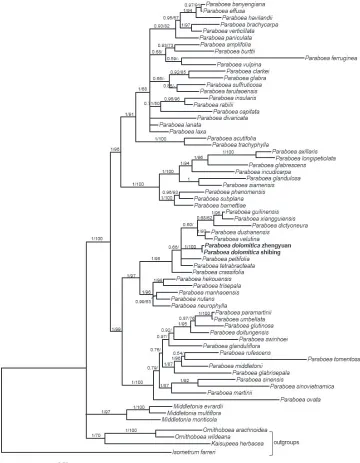
Figure 1. The majority consensus tree of the Bayesian Inference method based on ITS and trnL-F re-gions. Bayesian posterior probabilities and bootstrap support values (> 50%) are shown above the branch. The new species is highlighted in bold.
value (BS) = 100%). The new species forms a monophyletic clade with P. crassifolia, P. tetrabracteata, P. peltifolia, P. vetutina, P. dushanensis, P. dictyoneura, P xiangguiensis and
Taxonomic treatment
Paraboea dolomitica Z.Y. Li, X.G. Xiang & Z.Y. Guo, sp. nov.
urn:lsid:ipni.org:names:77210596-1 Figs 2, 3
Diagnosis.Paraboea dolomitica is morphologically similar to P. filipes. Both of them have obovate leaf blades, 1–4-flowered cymes and a purplish corolla, but P. dolomitica
differs from P. filipes by its leathery leaves with denticulate margins (vs. papery leaves with subentire margins in P. filipes), peduncles sparsely covered with brown hairs (vs. sparsely sericeous-lanate when young and glabrate when mature), two woolly bracts (vs. two glabrous bracts), reniform anthers (vs. oblong anthers), two staminodes 0.3 cm long (vs. 1 staminodes 0.02 cm long), and flowering during April and May (vs. flowering during September and October) (Table 1).
Phylogenetic analysis suggested that P. dolomitica was nested in a clade including P. crassifolia (Hemsl.) Burtt, P. tetrabracteata F. Wen, Xin Hong & Y. G. Wei, P. peltifolia D. Fang et Z. Zeng, P. vetutina (W. T. Wang et C. Z. Gao) Burtt, P. dushanensis W. B. Xu & M. Q. Han, P. dictyoneura (Hance) Burtt, P xiangguiensis W. B. Xu & B. Pan and P. guilin-ensis L. Xu et Y. G. Wei, but P. dolomitica can be easily differentiated from them in leaf position, inflorescence, penduncle, bract and capsule. The detailed morphological com-parison of the species most morphologically similar to P. dolomitica is listed in Table 1.
Type. China. Guizhou: Shibing County, Yuntai Mountain, 27°06'80.7"N, 108°07'00.0"E, elevation 885 m, on rock faces of a karst dolomite cave, 2 May 2017, Z.Y. Guo 20170047 (holotype: PE!; isotypes: PE!, QNUN!).
tab
le 1.
M
orphological comparisons betw
een
Par
aboea dolomitica
and its r
elativ
es its r
elativ
es based on morphological obser
vation and phylogenetic analyses.
Characters P. dolomitica P. filipes P. dicty oneur a P. cr assifolia P. dushanensis P. peltifolia Rhiz ome
1.5–6.0 cm long, ca. 0.3–0.5 cm diam.
up to 2.5 cm long, ca. 0.3
cm diam.
1.5–2.5 cm long, 0.7–
0.8 cm diam.
0.5–1.5 cm long, 0.5–0.9
cm diam.
4–10 cm long, 0.2–0.6 cm
diam.
2–7 cm long, 0.5–1 cm
diam.
Stem
pr
esent
absent
absent or up to 10 cm
absent or up to 15 cm
absent pr esent Leaf position cr ow
ded near the stem apex, opposite
basal, r
osette
basal or cr
ow
ded near the
stem apex, r
osette
basal or cr
ow
ded near the
stem apex
congested at the apex of
rhiz
ome
spiral at the stem apex
Leaf blade
leather
y, obo
vate to
elliptic, 2.5–4.5 × 1.0–1.5 cm, margin
denticulate paper y, obo vate to obo vate-oblong, (1~)
2–5 × (0.3~) 0.7–2.2 cm, margin shallo
wly cr enate or subentir e thick paper y, oblanceolate,
7–19 × 1.2–4.5 cm,
margin serrate to dentate
or subentir e thick paper y, obo vate or ov
ate, 3–16 × 1.5–7 cm,
margin cr
enate to denate
or subentir
e
leather
y, cuneate to
attenuate, 4–8 × 0.7–
1.5 cm, margin cr
enate to shallo wly r epand paper y, obo vate to
oblanceolate, spatulate or subspatulate, 6–33.5 × 3–14.3 cm, margin
cr enate-serrate C ymes 1–4-flo w er ed 1–4-flo w er ed 5–20-flo w er ed 4–12-flo w er ed 1–5-flo w er ed 2–15-flo w er ed Peduncle
3–5 cm long, sparsely
lanate with glandular hairs
3–7 cm long, glabr
escent
8–21 cm long, pannose to
sparsely pannose
3–12 cm long, woolly to
pannose
3–5 cm long, ferr
uginous
matted indumentum
4–6 cm long, woolly
Bract
2, linear
, 0.3–0.4 cm long
2, narr
owly oblong-o
vate,
ca. 0.1 cm long
2 or 3, lanceolate to narrowly oblong, 0.5– 1.3 cm long 2, linear to subulate, 0.2–0.5 cm long 2, linear-lanceolate, 0.3–0.5 cm long 2, lanceolate-triangular 0.2–0.3 (~0.4) cm long
Calyx 5-par ted 5-par ted 5-par ted 5-par ted 5-par ted 2-lipped Cor olla purplish purplish purplish purplish purple-blue white Anther reniform narr owly oblong oblong oblong elliptic reniform Staminodes
2, 0.3 cm long
1, ca. 0.02 cm long
3, 0.2–0.45 cm long
2, 0.2–0.25 cm long
3, 0.25–0.3 cm long
2, 0.2 cm long
Capsule
1.5–1.8 cm long, slightly
twisted
0.5–1.1 cm long, not
twisted
1.5–6 cm long, spirally twisted to nearly straight
2–4.5 cm long, spirally
twisted
1.2–3.1 cm long, not
twisted
1–3.6 cm long, not
twisted
Flo
w
ering
April and M
ay
September and O
ctober
April and M
ay
June and J
uly
M
ay and J
une
M
ar
ch and A
pril
N
ote: The morphological characters of
P. filipes , P. dicty oneur a , P. cr assifolia and P. peltifolia ar e fr
om Li and
W
ang (2004) and the characters of
P. dushanensis
ar
e fr
om X
Figure 2.Paraboea dolomitica. A Habitat B flowering habit C flower face view D opened corolla showing stamens, staminodes and pistil e bracts F pistil with calyx G adaxial leaf blade; and h abaxial leaf blade.
Distribution. Paraboea dolomitica is known from Yuntai Mountain, Shibing County and Wuyang River, Zhenyuan County, Guizhou, China.
Etymology. The specific epithet refers to the habitat of this new species, the dolo-mite karst area.
Habitat and ecology.Paraboea dolomitica grows on rock faces of dolomite karst area, at an elevation of ca. 650–855 m. Accompanying plants in the habitat are sparse and include trees, such as Platycarya strobilacea Sieb. et Zucc., Cotinus coggygria Scop., and herbs such as Selaginella moellendorfii Hieron., Paphiopedilum micranthum T. Tang et F. T. Wang, Viola diffusa Ging., Galium aparine Linn. var. echinospermum (Wallr.) Cuf. and Carex sp.
Additional collections. China. Guizhou: Zhenyuan County, Wuyang River, 27°06'80.7"N, 108°07'00.0"E, elevation 650 m, on rock faces, 3 August 2016, Guo ZY, GZY1608721 (PE and QNUN), GZY1608723 (PE and QNUN), GZY1608724 (PE and QNUN).
Proposed IUCN conservation status
The new species has only been found in Shibing County and Zhenyuan County, Guizhou, China. The populations and habitats are vulnerable to human activities such as road construction and deforestation for crops. According to field observations, it has several known populations of less than 300 mature individuals according to field observations. The species is considered to be “Vulnerable” (VUD1) according to the IUCN Red List Criteria (IUCN 2017), based on Criterion D1 and population size, estimated to be fewer than 1000 mature individuals.
Acknowledgements
This study was supported by the National Natural Science Foundation of China (Grant nos. 31370227, 31670212, 31400183), Special Funds for Traditional Chinese Medicine Industry (201407003), Fourth National Survey of Chinese Materia Medica ([2018]132, [2019]186).
references
Burtt BL (1984) Studies in the Gesneriaceae of the Old World: XLVII. Revised generic concepts
for Boea and its allies. Notes from the Royal Botanic Garden Edinburgh 41: 401–452.
Chen WH, Möller M, Shui YM, Zhang MD (2008) A new species of Paraboea (Gesneriaceae)
from a karst cave in Guangxi, China, and observations on variations in flower and
inflores-cence architecture. Botanical Journal of the Linnean Society 158(4): 681–688. https://doi.
org/10.1111/j.1095-8339.2008.00873.x
lution 39(4): 783–791. https://doi.org/10.1111/j.1558-5646.1985.tb00420.x
Hall TA (1999) BioEdit: a user-friendly biological sequence alignment editor and analysis pro-gram for Windows 95/98/NT. Nuclear Acids Symposia Series 41(41): 95–98.
He DM, Feng YF, Pan FZ, Hong X, Wen F (2018) Paraboea wenshanensis, a new species of
Gesneriaceae from Yunnan, China. PhytoKeys 95: 83–91.
https://doi.org/10.3897/phy-tokeys.95.21586
IUCN (2017) Guidelines for using the IUCN Red List Categories and Criteria. Version 13.
IUCN Standards and Petitions Subcommittee. http://www.iucnredlist.org/documents/
RedListGuidelines.pdf
Li ZY, Wang YZ (2004) Plants of Gesneriaceae in China. Henan Sciences & Technology Pub-lishing House, Zhengzhou. [In Chinese]
Lu ZC, Liu ED, Han MQ, Zhu XX, Nguyen KS, Xu WB (2019) Discovery of Paraboea
minutiflora (Gesneriaceae) from southeastern Yunnan, China with supplementary descrip-tion. Guihaia (online).
Möller M, Cronk QC (1997) Phylogeny and disjunct distribution: evolution of Saintpaulia
(Gesneriaceae). Proceedings of the Royal Society London: Biological Sciences 264(3689):
1827–1836. https://doi.org/10.1098/rspb.1997.0252
Posada D, Crandall KA (1998) Modeltest: Testing the model of DNA substitution.
Bioinformat-ics (Oxford, England) 14(9): 817–818. https://doi.org/10.1093/bioinformatics/14.9.817
Puglisi C, Phutthai T (2018) A new species of Paraboea (Gesneriaceae) from Thailand.
Ed-inburgh Journal of Botany 75(1): 51–54. https://doi.org/10.1017/S0960428617000324
Puglisi C, Middleton DJ, Triboun P, Möller M (2011) New insights into the relationships
between Paraboea, Trisepalum and Phylloboea (Gesneriaceae) and their taxonomic
conse-quences. Taxon 60(6): 1693–1702. https://doi.org/10.1002/tax.606014
Puglisi C, Yao TL, Milne R, Moller M, Middleton DJ (2016) Generic recircumscription in the Loxocarpinae (Gesneriaceae), as inferred by phylogenetic and morphological data. Taxon
65(2): 277–292. https://doi.org/10.12705/652.5
Ridley HN (1905) The Gesneriaceae of the Malay Peninsula. Journal of the Straits Branch of the Royal Asiatic Society 44(1): 1–92.
Roalson EH, Roberts WR (2016) Distinct processes drive diversification in different clades of
Gesneriaceae. Systematic Biology 65(4): 662–684. https://doi.org/10.1093/sysbio/syw012
Ronquist F, Huelsenbeck JP (2003) MrBayes 3: Bayesian phylogenetic inference under mixed
models. Bioinformatics (Oxford, England) 19(12): 1572–1574. https://doi.org/10.1093/
bioinformatics/btg180
Swofford DL (2003) PAUP*. Phylogenetic analysis using parsimony (* and other methods), ver. 4.0b10. Sinauer Assocites.
Taberlet P, Gielly L, Pautou G, Bouvet J (1991) Universal primers for amplification of three
non-coding regions of chloroplast DNA. Plant Molecular Biology 17(5): 1105–1109. https://
doi.org/10.1007/BF00037152
Thiers B (2020) Index Herbariorum: a global directory of public herbaria and associated staff.
New York Botanical Garden’s Virtual Herbarium. http://sweetgum.nybg.org/science/ih.
Thompson JD, Gibson TJ, Plewniak F, Jeanmougin F, Higgins DG (1997) The CLUSTAL_X windows interface: flexible strategies for multiple sequence alignment aided by
qual-ity analysis tools. Nucleic Acids Research 25(24): 4876–4882. https://doi.org/10.1093/
nar/25.24.4876
Wang WT, Pan KY, Li ZY, Weitzman AL, Skog LE (1998) Gesneriaceae. In: Wu ZY, Raven PH (Eds) Flora of China, Vol. 18. Science Press and Missouri Botanical Garden Press, Beijing and St. Louis, 362–367.
Wen F, Hong X, Chen LY, Zhou SB, Wei YG (2013) A new species of Paraboea (Gesneriaceae)
from a karst limestone hill in southwestern Guangdong, China. Phytotaxa 131(1): 1–8.
https://doi.org/10.11646/phytotaxa.131.1.1
Xu ZR (1994) A new species of Paraboea Ridley from Thailand. Zhiwu Fenlei Xuebao 32(4):
359–361. http://www.jse.ac.cn/EN/Y1994/V32/I4/359
Xu ZR, Burtt BL (1991) Towards a revision of Paraboea (Gesneriaceae): I. Edinburgh Journal
of Botany 48(1): 1–18. https://doi.org/10.1017/S0960428600003541
Xu ZR, Burtt BL, Skog LE, Middleton DJ (2008) A revision of Paraboea (Gesneriaceae).
Edin-burgh Journal of Botany 65(2): 161–347. https://doi.org/10.1017/S0960428608005106
Xu WB, Huang YS, Wei GF, Tan WN, Liu Y (2012) Paraboea angustifolia (Gesneriaceae): A
new species from limestone areas in northern Guangxi, China. Phytotaxa 62(1): 39–43.
https://doi.org/10.11646/phytotaxa.62.1.8
Xu WB, Guo J, Pan B, Han MQ, Liu Y, Chung KF (2017a) Three new species of Paraboea
(Gesne-riaceae) from limestone karsts of China based on morphological and molecular evidence.
Bo-tanical Studies (Taipei, Taiwan) 58(1): 56. https://doi.org/10.1186/s40529-017-0207-5
Xu WB, Guo J, Pan B, Zhang Q, Liu Y (2017b) Diversity and distribution of Gesneriaceae in China. Guihaia 37(10): 1219–1226.
Appendix 1
GenBank accession numbers (species: voucher, trnL-F, ITS). The dash indicated that there is no data
Ingroups:Paraboea acutifolia, JN934711, FJ501314; Paraboea amplifolia, JN934712, JN934754; Paraboea axillaris, KU203943, KU203848; Paraboea banyengiana, JN934713, JN934755; Paraboea barnettiae, AJ492306, KU203847; Paraboea birmanica, HQ632866, HQ632958; Paraboea brachycarpa, FJ501465, KU203870;
Paraboea burttii, JN934714, JN934756; Paraboea capitata, AJ492298, FJ501315;
Paraboea clarkei, JN934715, JN934757; Paraboea crassifolia, FJ501472, FJ501318;
Paraboea dictyoneura, FJ501463, KJ475415; Paraboea divaricata, JN934717, JN934759; Paraboea doitungensis, KU203941, KU203846; Paraboea dolomitica, Z.Y. Guo 20170047, MT379849, MT379851; Paraboea dolomitica, GZY 1608721, MT379850, MT379852; Paraboea dushanensis, MF358716, MF358698;
Paraboea effusa, JN934718, JN934760; Paraboea ferruginea, FJ501471, KU203862;
JN934763; Paraboea glandulosa, HQ632867, JN934784; Paraboea glutinosa, JN934722, JN934764; Paraboea guilinensis, MF358717, MF358701; Paraboea havilandii, JN934724, JN934766; Paraboea hekouensis, KU203938, KU203843;
Paraboea incudicarpa, JN934725, JN934767; Paraboea insularis, KU203952, KU203857; Paraboea lanata, FJ501467, –; Paraboea laxa, FJ501466, –; Paraboea longipetiolata, KU203946, KU203851; Paraboea martinii, MF358718, MF358702;
Parabora manhaoensis, KU203937, KU203842; Paraboea middletonii, KU203940, KU203845; Paraboea neurophylla, JN934727, JN934769; Paraboea nutans, MF358719, MF358703; Paraboea paniculata, JN934728, JN934770; Paraboea paramartinii, JN934729, JN934771; Paraboea peltifolia, MF358720, –; Paraboea phanomensis, KU203950, KU203855; Paraboea rabilii, KU203951, KU203856; Paraboea rufescens, JN934730, JN934772; Paraboea siamensis, KU203948, KU203853; Paraboea sinensis, JN934731, JN934773; Paraboea sinovietnamica, MF358722, MF358706; Paraboea subplana, JN934744, JN934786; Paraboea suffruticosa, JN934732, JN934774;
Paraboea swinhoei, FJ501475, JN934775; Paraboea tarutaoensis, JN934734, JN934776; Paraboea tetrabracteata, MF358723, MF358707; Paraboea tomentosa, KU204043, KU203971; Paraboea trachyphylla, JN934735, JN934777; Paraboea trisepala, JN934736, JN934778; Paraboea umbellata, JN934737, FJ501317; Paraboea velutina, JN934738, JN934780; Paraboea verticillata, JN934739, JN934781; Paraboea vulpina, JN934740, JN934782; Paraboea xiangguiensis, MF358728, MF358711.