Smart Irrigaton Control Using IoT for Farmers
1
Dr.S.Diwakaran,2K.Durga,3S.R.Indiradevi Nachiyar,4M.Kaleeswari
Abstract-As modern automation has been brought in and used in advanced world, there must be an advancement made in agricultural field. The indispensable source for agricultural is water. An automatic irrigation practice was advanced to enhance sufficient water supply to improve agricultural yield. The structure comprises of sensor grid for temperature sensor, soil moisture sensor, humidity sensor and water level sensor that are located at the root region of the cultural crops. The arduino of the unit is utilized to set the threshold codes of the soil moisture and temperature. The controller system controls the motor to restrict the excess flow of water. Using internet of things, real time data can be monitored and performance will be traced. This system is predominantly concentrated to improve the agricultural yield with efficient water source.
Keywords—IoT, Arduino, sensors, GPRS module.
I.INTRODUCTION
Maximum percentage of resource is used by the farmers worldwide. Due to the growing population and larger demand of food supply, the yield of crops must be increased accordingly farmers grows verify of crops on wider farms of different area. It is impossible of single person to be capable of farm all the time. Due to the inappropriate supervisor some region of the farm may receive excess flow of water or the region may receive no water at all and leading to drought of the soil. Either of the two cases might damage the crop and diminish the yield. The solution for this dispute can be encountered by proposing. This project is absolutely helpful in which the consumer can observe and regulate water inventory even from isolated region. So the network is associated to the web with the help of a wifi sector. IoT incorporate sensor automation, web mechanics perceptive computing automation, and transmission networks to attain stable inventive refining the signals of the control unit are transmitted by using the arduino UNO and it associated to the appetite website. The moisture constituents of the loam are being observed by the circuit by using the moisture sensor and moisture level is restored on the website. The present moisture level and the amount of water supplied can be observed by the consumer even from an isolated region.
II.LITERATURE SURVEY
In[1] the photovoltaic (pv) array analytics and control have become necessary for remote solar farms and for intelligent fault detection and power optimization. Here SMDs include radio and relays which allow modifying solar array connection topologies. Solar panels in a PV array behave essentially as nodes in an internet of things(IoT) type of topology their main air is to provide mobile analytics, enable solar farm control, detect and remedy faults, optimize power under different shading conditions and reduce
Threshold Level
No
Yes Microcontroller
GSM Module
Motor on Relay Relay driver Soil
moisture
Temperature
Water level
Analog values of sensors
process in a factory. They set commands to the machine by IoT database. The setup commands will help to control the start and stop of working of the machine. Thus by IoT they are capable of achieving their setup goal. In[11] the mainly used smart irrigation system to achieve the goal their of main objective is to irrigate the water where the irrigation of water is required. there are microcontrollers, sensor, water pumping used in this project sensing the changes of the weather or soil moisture, they will act according to the changes the water will irrigate to where it requires and will not irrigate at damped soil. In[12] the main object is to reduce the water level is under or over the crop field. By using latest technology MATLAB program to develop the code and they set certain values to the sensor to detect the richness of the crop. It mainly checks the nutrients like magnesium and nitrogen. In[13] an automated irrigation system using sensors, GSM, Bluetooth and cloud technology. With involvement of both embedded technology and IoT. This project develops of cloud storage in mobile. Thus the collected information from sensors will be send to the farmer. Thus they develop the water level in the crop field. In[14] the internet of things in agriculture for sustainable rural development. This project is mainly to specify the crop farming and management of the food chain mainly by using IoT technology. Thus by the specification they can contribute the poverty in rural agriculture farm. In[15] the usage of water utilized for farming is focused. They made use of arduino UNO, moisture sensor, sprinklers, internet. They developed an application in the mobile. The sensor will detect the moisture value in the water tank and send the signals to the arduino and to mobile app via internet. Then the user will respond to the signal to whether, ON or OFF the sprinklers through the arduino. Thus they basically developed IoT based irrigation system in the farm.
III.PROPOSED WORK
ADC conversion
10-bit 0-1023 bits resolution
SAR successive approximation
GPIO Modules
Communication Protocol
Fig.3.1. Block diagram for IoT based smart irrigation
This system of smart farm monitoring is based on internet of things. There is a possibility to determine the dryness of soil. The required level of water to be delivered will be established at the right time. The performance of every sensors are observed regularly by using a cloud server. The GSM module used here performance on 12v power supply. The temperature sensor illustrates the temperature by 0.01v/⁰c. The scope varies from 55⁰c to +150⁰c. An arduino UNO is located in which the temperature sensor is confluence with analog transmit in A0,in which it is converted using analog to digital conversion located within the controller unit. Likewise, the water level sensor is interfaced to the analog transmit in which the status of the water is determined using sensors that receives the datas from the microcontroller. As well as the soil moisture is associated along the analog transmit of microcontroller. The analog signals are modified into digital signal by the mechanism of 10-bit Analog to Digital Conversion resolution consecutive approximation register. Temperature is high, moisture level is low and water level is low the motor switches from its current state. These specifications are observed over wireless by utilizing the GSM and the IOT module. The GSM pursues the sequential pattern of communication which comes under the RS-232 Universal Addressable Receiver and Transmitter (UART) obligation which is discussed by AT commands. The IoT input communication is achieved by using peer–to-peer obligation utilized by ESP8266-01E component performs on 3.3v that is further discussed by AT commands. The cloud website utilized on deck is the Thing speak that is assisted by Math works.
IV.COMPONENTS
A.Arduino UNO
The Arduino UNO relies on AT Mega 328. Arduino is the microcontroller panel which consist of 14 i/o pins. It consists of several ways to communicate alongside the PC, and different microcontrollers. The ATMega 328 affords sequential transmission that is feasible on receiver and transmitter pins. The receiver and transmitter LEDs will flash while the datas are transmitted. The flash memory of the arduino UNO is 32KB. The arduino comprises of every elements to assist microcontroller.
Fig.4.1.Arduino UNO
B.LCD (Liquid Crystal Display)
A liquid crystal display (LCD) is a fragile horizontal display device built of several figure of stain or unbroken picture element aligned in front of a light source or reflector. Every picture element comprises of a queue of fluid crystal particles ceased among two translucent cathodes, and two separating channels, the hinges of IOT Module
Send SMS Dataset output
extremity of which are opposite to each other. The fluid crystals between them, beam crossing over one would be arrested by the alternative. The fluid crystal twists the diffraction of luminous penetrating one medium to enable it to enter over the alternative. A procedure must related along the external world using data and earn appliances that transmit straightly with a human. One of the foremost popular gadgets merged to a schemer is an LCD array any of the much popular LCDs associated to the schemer are 16X1, 16x2 and 20x2 array .
Fig.4.2. Liquid Crystal Display
C.LM35 Sensor
The LM35-sequential devices are definiteness micro circuit temperature sensors, along gain voltage precisely reciprocal to Centigrade temperature. The LM35 appliance has a benefit over precise temperature sensors measured in Kelvin, while the consumer is no more needed to deduct a enormous stable potential from the gain to attain acceptable Centigrade measuring. The LM35 appliance does not need several exterior evaluation or trimming to contribute regular measures of ± ¼ °C at room temperature and ± ¾. Diminished expenditure is guaranteed by trimming and evaluation at water status. The nominal gain impedance, precise gain, and linear fundamental evaluation of LM35 equipment generates assimilation to restraint circuits. The design is utilized along individual potential supplies, or with. The LM35 design picks only 60 μA from the supply and so has certainly nominal self-boiling lesser than 0.1°C. The LM35 design is graded to work by a −55°C to 150°C temperature stretch, where as the LM35C design is graded for a −40°C to 110°C stretch.
Fig.4.3. LM35 Sensor
D.High Sensitivity Moisture Sensor
The Moisture sensor is utilized to estimate the aqua constituents (moisture) of the loam. While the loam is undergoing water deficit, module gain is at immense level. The sensor warns the consumer to irrigate their crops and further observes moisture constituents of the loam. The Soil Moisture Sensor utilizes capacitance to estimate dielectric permittivity of the neighboring channel. In loam,
dielectric permittivity is an action of the aqua constituents. This sensor generates a potential reciprocal to the dielectric permittivity. This sensor equates the aqua constituents over the unified dimension of the sensor. There is a 2 cm region of consequence corresponding to the low surface of the sensor, although it has limited or no acuteness appearing in the intense corner. This Sensor is utilized to calibrate the deficit of humidity beyond time over dehydration and crop return, calculate maximum loam humidity constituents for discrete class of crop, observe loam humidity constituents to restraint watering in greenhouses and enlarge soldier biology operations.
Fig.4.4 Moisture Sensor
E.High Sensitivity Water Sensor
The water sensor is devised to detect the level of the water. That is primarily used to check the leakage of water and to control the flow of water. To estimate the level of the water, the water sensor must be interfaced with the arduino. This sensor performs at voltage level of 5V. It determines the data at the temperature range from 10℃ to 30℃. This device consumes extremely low power. This sensor calculates the values transmitted and controls the excess flow of water or provides the water supply to the soil when it becomes drought.
Fig.4.5 Water Level Sensor
F.GSM Sim 900A
V FUTURE WORK
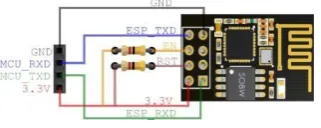
G.Wifi MODULE
Fig 4.6 GSM
There by, the above methods are the methodology we used in this project. we concluded that the above methodology can be modified and altered to next level of the future project work. the loam moisture constituents, the temperature of the region at which the farm is located, the status of the water in the tank could be estimated by using arduino microcontroller as well as the IoT module. To evade the dehydration of the soil and excess discharge of water, the natural specifications are anticipated by designing this The ESP8266 is the sign of a micro controller devised by
Espressif Systems. It is an independent WiFi system result contributing like a platform from extant micro controller to WiFi also it is able of functioning self-reliant operations.
Fig.4.7 Wifi Module
H.Relay
A relay consist of an electromagnet as well as a connect system. Relay is defined as simulating the connect system with the help of electromagnetic gravitation, that is generated when voltaic current outstrip. The stated value flows to the electromagnet. The potential and input signal enforced to the coil discloses or shutters the connection. Relays are applied as intermediary amidst control circuits and load circuits, for beacon amplification, for segregation of undeviating current and fluctuating current circuitry, for coupling data.
Fig.4.8 Relay
I.DC Motors
The DC, perpetual magnet, flick electrical turbine is the captive of minor, energized automated structures. Turbines transform electrical intensity into mechanical intensity and so the things can be moved in the environment. They are based on the electrical principle of induction. When you put electric current through a wire, it generates a magnetic field around the wire. The direction of the magnetic field is related to the direction of the electrical current.
Fig.4.9 DC Motor
automation. These parameters could cause destruction of agricultural land and diminish the crop yield. The cloud looks over these specifications. The consumer controls performance of the motor with the help of GSM module.
VI. REFERENCES
[1] Chieochan, Oran, Anukit Saokaew, and Ekkarat Boonchieng.
"Internet of things (IOT) for smart solar energy: A case study of the smart farm at Maejo University."International Conference on Control, Automation and Information Sciences (ICCAIS). IEEE, 2017.
[2] Liu, Shubo, et al. "Internet of Things Monitoring System of
Modern Eco-Agriculture Based on Cloud Computing." IEEE Access 7 (2019): 37050-37058.
[3] Elijah, Olakunle, et al. "An overview of Internet of Things
(IoT) and data analytics in agriculture: Benefits and challenges." IEEE Internet of Things Journal 5.5 (2018): 3758-3773.
[4] Dan, L. I. U., et al. "Intelligent agriculture greenhouse
environment monitoring system based on IOT technology." 2015 International Conference on Intelligent Transportation, Big Data and Smart City. IEEE, 2015.
[5] Math, Anushree, Layak Ali, and U. Pruthviraj. "Development
of Smart Drip Irrigation System Using IoT." 2018 IEEE Distributed Computing, VLSI, Electrical Circuits and Robotics (DISCOVER). IEEE, 2018.
[6] Reddy, S. R. N. "Design of remote monitoring and control
system with automatic irrigation system using GSM- bluetooth." International Journal of Computer Applications 47.12 (2012).
[7] Dr.N.Suma,SandraRheaSamson,S.Saranya,G.Shanmugapriya,
R.Subhashri. "IOT based smart agriculture monitoring system." International Journal on Recent and Innovation Trends in computing and communication 5.2 (2017): 177-181.
[8] Ray, Partha Pratim. "Internet of things for smart agriculture:
Technologies, practices and future direction." Journal of Ambient Intelligence and Smart Environments 9.4 (2017): 395-420.
[9] D. Mishra, A. Khan, R. Tiwari and S. Upadhay, “Automated
IrrigationSystem-IoT Based Approach”2018 3rd International Conference On Internet of Things: Smart Innovation and Usages (IoT-SIU), 2018.
[10] Ammour, Kamel. "Factory automation and irrigation control
in an IoT environment." 2018 15th Learning and Technology Conference (L&T). IEEE, 2018.
[11] Masaba, Kizito, Amini Ntakirutimana, and Taha Selim
Ustun. "Design and implementation of a smart irrigation system for improved water-energy efficiency." (2016): 100-5.
[12] A. Rau, J. Sankar, A. Mohan, D. Das Krishna and J. Mathew,
“IoT based smart irrigation system and nutrient detection with disease analysis", 2017 IEEE Region 10 Symposium (TENSYMP), 2017.
[13] M. Monica, B. Yeshika, G. Abhishek, H. Sanjay and S.
[14] Dlodlo, Nomusa, and Josephat Kalezhi. "The internet of things in agriculture for sustainable rural development." 2015 international conference on emerging trends in networks and computer communications (ETNCC). IEEE, 2015.
[15] Sukriti, Sanyam Gupta, and K. Indumathy. "IoT based Smart
Irrigation and Tank Monitoring System." International Journal of Innovative Research in Computer and Communication Engineering 4.9 (2016): 15717-15722.
First Author Dr.S.Diwakaran
Electronic And Communication Engineering, Kalasalingam
Academy of Research and Education
Madurai, India [email protected]
Second Author K.Durga Electronic And Communication
Engineering, Kalasalingam Academy of Research and Education,
Madurai, India
Third Author S.R.Indiradevi Nachiyar
Electronic And Communication Engineering, Kalasalingam
Academy of Research and Education ,
Madurai, India
Fourth Author M.Kaleeswari
Electronic And Communication Engineering, Kalasalingam
Academy of Research and Education
Madurai, India