The Historical Development of
Engineering Higher Education
and Implications on Future
Teaching and Learning - Bridging
the Skills Gap’
Candice Downie received a BEng (Hons) in Mechanical Engineering (1st Class) from
the University of Bolton in 1994 and an MPhil in Engineering (composite materials)
from the University of Manchester in 1999. She was a senior lecturer in Engineering
at the University of Bolton and is currently a Curriculum Manager of HE Engineering
at Blackpool and the Fylde College. Her research interests involve investigating the
educational application of HE within FE, engineering teaching & learning and impact
of transition from FE to HE. She is also actively involved in the Curriculum Design
and delivery of undergraduate Degree Apprenticeship programmes.
The introduction of science, technology, engineering and mathematics (STEM)
education in the UK was protracted, initially driven by scientific developments
but ultimately shaped and enhanced by industrial demand. The current focus
of widening participation, engaging students from less conventional academic
backgrounds is further compounded by the need to satisfy the STEM, (particularly
engineering) shortfall in the UK, hence alternative approaches to encourage young
people into such areas is being supported via more expansive routes into higher
education. This has opened some particularly educationally profound avenues
such as University Technical Colleges, and also via HE in FE: supporting Higher
Apprenticeship Schemes and delivering Foundation Degrees.
The teaching and learning styles employed in undergraduate engineering, although
highly researched still display some evidence of historical methods and traditional
didactic teaching styles. These approaches have the potential to both impose
additional pressure on and de-motivate students from less traditional vocationally
orientated backgrounds.
Keywords: HE in FE, engineering education, engineering history, teaching / learning
methods, vocational engineering, widening participation.
Survey of note-taking behaviour
Policy and Practice in Education
As part of a doctoral research programme of study into the investigation of the transition from further into higher education for engineering students, it was deemed pertinent to initially evaluate how historical trends and legacy teaching approaches have shaped current pedagogical practice and access to Higher Education (HE) engineering. This background will allow informed exploration of the key challenges that students
face whilst transitioning into higher education in an engineering discipline, henceforth providing opportunities to enhance their learning experiences and ultimately expand employment prospects. This investigation initially explores the policies, trends and legacies that have
shaped the development of engineering education, defining how it was delivered historically and whom it was accessible to. Further
examination of existing research available around the changing methods of teaching, learning and assessment of engineering students directs consideration to the impact on students from less traditional academic backgrounds, which will lead to the focus of the doctoral research investigation.
There is evidence of teaching in Oxford as early as 1096, albeit the University of Oxford was not actually officially founded until 1167. Subjects taught were predominantly focused around the Church and areas such as Law, the Arts and Medicine. According to University of Cambridge archives, the earliest records of study date back to 1209, when, due to hostility from the Oxford locals many scholars moved to Cambridge. Again Arts and associated subjects prevailed, later followed by a broader spectrum of arithmetic, music, geometry and astronomy, hence there is no evidence that engineering, technology, science or even
core mathematics (beyond arithmetic) were part of the initial higher education (HE) agenda.
Typifying the educational style of the era, particularly at Cambridge:
‘Teaching was conducted by masters who had themselves passed through the course and who had been approved or licensed by the whole body of their colleagues (the Universitas or University). The teaching took the form of reading and explaining texts; the examinations were oral disputations in which the candidates advanced a series of questions or theses which they disputed or argued with opponents a little senior to themselves, and finally
with the masters who had taught them.’ (University of Cambridge, 2014 online). Further evidence typifying the learning and teaching styles of the Middle-Ages identified that ‘writers like Aristotle were regarded as the final authority, lecturing was a matter of explaining what they meant’. Until the introduction of the printing press in 1476, students tended to learn via tutors and lectures only as ‘books were rare luxuries’. (Local Histories, 2014 online). Mathematical and scientific developments in education were not overtly evident until the seventeenth century, through which, ensued
a rapid development of
chemistry and astronomy, resulting in mathematics dominating studies towards the end of the century. This period known as the ‘Scientific Revolution’ was transforming the views of nature and society, with further innovations such as Galileo’s observational astronomy and physics feeding the dialogues: ‘Two New Sciences’ (Galileo, 1638) and Hooke’s principles of science, including the pertinent
‘Hooke’s Law’ (1660). During this period, Isaac Newton was a Professor at Cambridge University. In 1687, Newton composed the prominent ‘Principia Mathematica’ - establishing fundamental principles of physics that still informs teaching in contemporary classrooms today. Newton himself argued that during his studies he was ‘self-taught’, learning from books and supplementing his stifled ‘Aristotle oriented education’ by reading
works written by the (then) modern philosophers
such as Galileo and Kepler. (For contextualisation, Einstein’s theory of relativity followed in 1905 and many further significant scientific developments, albeit these were only introduced in limited form to university education at the time). A series of ‘Dissenting’ Academies emerged in the latter end of the Seventeenth Century, in existence
between 1662 to 1820, they were eventually ‘open to all comers’ and during fourteen hour days, delivered a wide range of subjects preparing students for life in general (Parker, 1990, p125). There is some evidence of science and mathematical topic areas such as algebra, metaphysics, trigonometry and celestial mechanics (astronomy), being embedded within the curriculum. (Parker, 1990, p.127). Albeit a wide and varied experience in terms of quality and consistency, ‘a new definition of the content of a general education was worked out and put into practice’ (Williams, 1961, p.134). This inevitably had an impact upon the development in educational topics during the Industrial Revolution as the State began to implement a form of nationalised education programme. Hence, the Industrial Revolution and an increasing population (not less influenced with significant developments such as James Watt’s steam engine in 1769), resulted in a migration from an agriculturally focused country to mass production factories and new industrial development. Guilds were still embedded within medieval towns during this period which increasingly forced the economic propulsion for specific, high, consistent standards to be met,
particularly in craft trades. (Guild 2016 online).
The required skills to support these changes incorporated the need for ‘mechanics’ (the non-contemporary definition of which represents those who were actually undertaking technical roles such as operating and maintaining machinery) to support the growth in local industry. Universities of this period were not configured to teach the relevant subject areas to accommodate such a technical education, or the working classes.
Hence the technical education for working professionals was undertaken by the introduction of ‘Mechanics’ Institutes’ initially established as libraries and facilities to provide access to education in science and technology for the working class – (the first of which was set up in Edinburgh in 1821 founded by George Birkbeck). Further Mechanics’ Institutes evolved in rapid succession - there were believed to be over seven hundred by the mid nineteenth century across the UK and overseas. The Mechanics Institute motion, ‘matured within an environment of attention by a considerable dimension of the populace in methodical interests disclosed in the common speeches of well-known experts in science such like Faraday’. (Jefferson, 1969, p.21).
upon existing intellectual traditions (demonstrating didactic teaching approaches similar to that of most universities of the time), yet training a specific class of society and initiating the onset of technical vocational training. The initial teaching methodology applied was via a series of lectures in physical mechanics, which (due to the alleged inquisitive nature of the students in such topics) further developed to include ‘mechanics’ classes’, laboratories and reading libraries. The Mechanics’ Institutes could be categorised as inherently providing training of a specific class, where ‘the new sciences were radical elements in the society as a whole’. (Williams, 1961, p.143, cited by Gillard, 2011).
Although many of the Mechanics Institutes were ultimately disbanded when industrial demand waned, some migrated into colleges and universities or were further developed into public libraries during the latter end of the twentieth century, evidence that their influence is still significant to the educational development of Engineering, Science and Technology today. The
importance of the Mechanics’ Institute movement has been much understated, arguably, ‘it laid the foundations of our modern technical education and in no small degree of our public library system.’ (Kelly,
1952, p.17).
Further developments in university engineering and mathematics education were slow until after the Royal Commission of 1850 (with the establishment of the first World Trade Fair) they subsequently advanced considerably, a result of the aforementioned acting as a catalyst for expansion and development of Britain’s industrial image and also as a result of the increasing strength of university
education in mathematics in England particularly, (gradually introducing natural and
mechanical science studies and ensuing experimental physics and engineering).
A provocative opinion of universities during this era was that of Newman who highlighted in his ‘Discourses to the Church’ that the focus of a university was as a ‘place of teaching universal knowledge’, with the implications that ‘…its object is intellectual rather than moral and the diffusion and extension of knowledge rather than the advancement’. Most controversial in the context of this study is the further statement that he did not appreciate ‘how it can be the seat of literature and science’. Newman (1852). Hence claiming that universities were not advancing research and development nor were they encouraging forward thinking
or engaging students in new ideas or concepts.
Subsequently, contradicting Newman’s arguments, education in experimental physics moved forward rapidly at universities such as Cambridge, particularly towards the late 1800’s resulting in major scientific breakthroughs such as the discovery of the electron, later leading to the (initial) splitting of the atom in 1932. Further significant engineering and scientific progress: significantly jet engine development, digital computer technology and the identification of the structure of DNA all ensued over the following two decades, predominantly as a result of research expansion within the more prominent universities of the time.
The opening of new colleges and particularly the six initial ‘Redbrick’ Universities (in major UK industrial driven Victorian and Edwardian cities: Birmingham, Bristol, Leeds, Liverpool, Manchester, Sheffield) in the late nineteenth and early twentieth century, initiated changes at Oxford and
and Midlands in response to rising population … and the need for scientific and technical manpower for the industries of those areas’ (Sanderson, 2002, p3). The new organizations admitted male learners without prejudice against religion or class to study, (until the ‘University Statute’ of 1920 admitting women to full university membership, women were not allowed to matriculate or graduate at some universities), - the focus being predominantly civic science and/or engineering related skills, to serve their industrial locations. (Egiins, 2010, p12). Hence local demand from the developing manufacturing industry was again driving the development of technical education at a higher academic level within
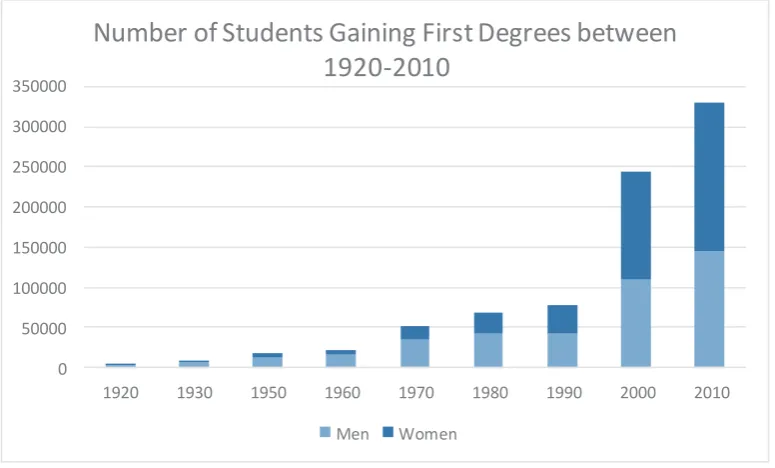
universities. Statistics from this period show a significant increase in the number of students gaining first or second degrees (aligned with the increase in available institutions within the UK), this remained relatively steady until the significant downturn during World War II.
The Second World War had a momentous effect upon the financial status of HEI’s and also on the development of teaching in that it ‘influenced certain academic concepts, the aims of education, the introduction of new programmes and curricula …. the nature of teaching’. (Cardozier, 1993, p212). As demonstrated in Figure 1, the number of students studying and gaining first degrees in the late 1940’s rose as ‘numbers were boosted by government
schemes to support those who had served in the armed forces’ (Bolton, 2012, p13). Growth remained a prevalent theme into the early 1990’s, where the 1992 Act
expanded opportunities for polytechnics and institutes to be raised to university status: ‘if the educational institution is within the HE sector… so as to include the word ‘university’ in the name of the institution’. (Further and Higher Education Act, 1992). This allowed them to validate their own undergraduate and post graduate programmes, hence a significant
development for HE,
reflecting recommendations made within the ‘Robbins Report’ (1963) almost thirty years earlier.
0 50000 100000 150000 200000 250000 300000 350000
1920 1930 1950 1960 1970 1980 1990 2000 2010
Number of Students Gaining First Degrees between 1920-2010
Men Women
The traditional polytechnics predominantly focussed on engineering, applied sciences and technology with more emphasis on teaching than research. Although often deemed lower in status than traditional universities they provided opportunities to those who may not have otherwise accessed higher education: with often lower admission criteria and a more informal approach to teaching in contrast to the lecturing style utilised by most university professors of the day. Prior to the 1992 act, academic degrees in polytechnics and institutes were validated by the Council for National Academic
Awards (CNAA) and many undergraduate courses by the Business and Technology Education Council (BTEC). It was argued by many of these transitioning organisations that ‘a CNAA degree was superior to many university degrees especially in engineering, due to the external independent validation process employed by the CNAA, the engineering institutions, and innovations such as sandwich degrees.’ Brosan (1972). Subtle intimation of forthcoming vocationalism) that a
polytechnic education is more adaptable for professional roles within industry. Vocational education
became a topic of particular interest towards the new century. National Vocational
Qualifications (NVQ’s) had already been in existence for almost a decade, however they only hinted of the later more focused integration of academia and industry. These early NVQ’s were subject to much controversy due to the considerable paperwork required to apply the criteria for assessing skills and competence. The NVQ has progressed and developed over a period of time, still today allowing many individuals to gain formal qualifications within their vocational trades and professions. It also introduced a new style of education that provided an alternative approach to learning and assessment and also satisfied the needs of many employers as their staff could study on a part time / more flexible basis. Contrastingly, the NVQ framework was also likened to a ‘prescriptive straightjacket’ and it was realised by the government that ‘employer ownership needed to be strengthened’ (Raggatt & Williams (2004, p100). Interestingly employer ownership and collaboration is the cornerstone of the new Degree Apprenticeship schemes initiated in 2015. During the early part of the millennium, the focus of attention was shifted from compulsory education to the educational welfare of 16-19 year olds. Following the publication of the ‘Learning
and Skills Act (2000)’ and the establishment of the Learning and Skills Council, concentration on the ‘14-19 agenda’ became of prevailing Government interest, and the drive for acquisition of skills led to a dramatic change in traditional approaches to teaching and learning, particularly in practically oriented subject areas. Noteworthy consultation papers were written by Estelle Morris in 2002 and a year later by Charles Clarke, both identifying proposals for the 14-19 curriculum, these were entitled: ‘14-19 extending opportunities, raising standards’ and ‘14-19: opportunity and excellence’ respectively, ultimately resulting in the ‘Increased Flexibility Programme’ (IFP). This programme was structured to provide alternative routes for students with a more practical,
colleges and providers work in partnership to offer greater flexibility to students…’
(Golden 2004). Contrasting arguments however can be found aligning with the highly debated - ‘free schools’, being disputed to be ‘largely ideologically informed’ and to …’increase segregation’ (Kitchener, 2013, p411), identifying patterns of class and educational selectivity resulting in limitations to career direction.
Influenced by the Tomlinson Report (2004), five new diplomas were introduced in 2008, from foundation through to higher levels, with the aim of broadening vocational opportunity for those students, where again, the current curriculum did not suit. Two of these being ‘construction’ and ‘engineering’ focussed, with a bias towards acquisition of practical skills. The 14-19 engineering
diplomas in particular received ‘exceptional employer and professional engineering community engagement and was recognised as providing an authentic engineering experience for pupils
taught in real world settings, stimulating their motivation to learn’. (Kirby, 2013, p.19). Despite significant investment and focus, the diploma was disbanded by the Department for Education in 2013 although such was the commitment to the programme (at the time of
writing), a committee of key participants still convene to promote engineering education.
EngineeringUK launched a report in 2014 highlighting the necessity to double the number of annual recruits into engineering to meet expected demand (Kumar, 2014, p.xi). Engineering companies are projected to have over two million job openings from 2010 – 2020, almost 70% of these will need essential engineering skills and knowledge via degree (including foundation, undergraduate and
postgraduate) qualifications. Currently the UK produces only 46,000 engineering
graduates each year. There will also be demand for around 69,000 people qualified at advanced apprenticeship or equivalent level each year. Despite the demand, only around 27,000 UK apprentices a year are currently qualifying at the required level. (Kumar, 2014, p.xiii).
The growing concern about the limited availability of people studying STEM subjects into further and higher education requires a less traditional, more radical approach, by widening participation and attracting students from different backgrounds, providing more varied and flexible routes into engineering. Identifying that those from disadvantaged areas and/or backgrounds
are ‘ten times more likely to take a vocational pathway and study less academically challenging subjects that their more affluent counterparts’, (Kirby, 2014, p.19), there is an increasing recognition that the image of vocational routes need to be uplifted to eliminate negative perceptions and make access routes into HE more achievable yet
desirable. University Technical Colleges (UTC’s) are one example of a new initiative offering an alternative route from school into engineering or technical education with progression routes into apprenticeships or higher education.
Another alternative mechanism is via further education (FE) providers. Studies show that in 2011, FE colleges provided 38% of higher education entrants (Summers, 2011, online). Interestingly two thirds of HE students studying in a FE college are doing so on a part time basis and are generally more likely to be older than their university counterparts, hence the FE setting provides an alternative and debatably more flexible route into HE. In 2011, two FE colleges were the first to be given Foundation Degree Awarding Powers (FDAP), (Summers, 2011, online), this has
Summary
Summary
It is evident that science,
engineering, technology and to a lesser extend mathematics were not deemed essential subject areas in their own right during historical development of university education. Key drivers for introducing such topics being via scientific developments, but even then the teaching was reported to be
unidirectional and based upon individual professors’ research interests. Ultimately industrial demand shaped the need to enhance the curriculum, with the introduction of Mechanic’s Institutes, wider range of additional universities and more frequently polytechnics and university technical colleges.
Official figures from 2013 identified that almost half of young people in the UK experienced a university education of some form, in contrast to 4% of the young
population fifty years previous. Such a significant increase in figures since the 1960s could be partially attributed to the wider variety of post compulsory educational opportunities that have become increasingly more readily available yet there is a significant and real shortfall in those embarking on a STEM career.
The current need to satisfy the identified STEM (and particularly engineering) shortfall has resulted in the need to reconsider the curriculum provision and identify creative approaches, widening opportunities and encouraging students from non-traditional, less academic educational backgrounds. This however has implications on the teaching, learning and assessment in contemporary classrooms, in order to retain the interest of vocationally orientated students, whilst
also retaining the academic rigour.
This poses significant challenges to engineering students during and beyond their transition into higher education whilst also providing a different set of challenges to the tutors in engage students from various educational starting points and with differing levels of drive and determination.
Nevertheless, widening participation opportunities via entry into HE
Engineering via UTC and FE Colleges, combined with traditional degree routes, the newly defined Degree Apprenticeship agenda, and the increasingly popular offering of the more practically orientated Foundation Degree can only assist in driving the reduction in the UK engineering
skills gap anticipated in the forthcoming decade.
References
Bandura, A. (1994) Self-efficacy. V. S. Ramachaudran (Ed.), Encyclopedia of Human Behavior (Vol. 4, pp. 71-81). New York: Academic Press. http://www.uky.edu/~eushe2/Bandura/Bandura1994EHB.pdf
Barr, N. (2013) Shaping Higher Education: 50 Years after Robbins. http://www.lse.ac.uk/economics/research/ publications/50YearsAfterRobbins.pdf.
Benn, C. and Chitty, C. (1996) Thirty years on: is comprehensive education alive and well or struggling to survive? London: David Fulton Publishers.
Bolton, P. (2012). Education, Historical Statistics – Standard Note: SN/SG/4252. http://researchbriefings.files. parliament.uk/documents/SN04252/SN04252.pdf [Accessed: 21/02/16].
Brosan. (1972) The Development of Polytechnics in the UK, Paedagogica Europaea, Vol. 7.
Brown, Lord J. (2010) Securing a Sustainable Future for Higher Education. https://www.gov.uk/government/ uploads/system/uploads/attachment_data/file/31999/10-1208-securing-sustainable-higher-education-browne-report.pdf. [Accessed: 21/02/16].
Brown, R. and Carasso, H. (2013) Everything for Sale? The Marketisation of UK Higher Education. (ebook). Routledge/Society for Research into Higher Education. [Accessed: 16/12/14].
Cardozier, V. (1993) Colleges and Universities in WWII. London. Praeger Publishers.
Cranston, G & Lock, G. (2012) Techniques to encourage interactive student learning in a laboratory setting Engineering Education. Vol. 7. (1).
DfES (2002) http://dera.ioe.ac.uk/4705/1/DfES-0744-2002Main.pdf
Egiins, H. (2010) Access and Equity, Comparative Perspectives. Rotterdam, Netherlands: Sense.
Felder, R. (1996) Matters of Style ASEE Prism, Vol. 6 (4).
Felder, R. and Silverman, L. (1988) Learning and Teaching Styles In Engineering Education. Engineering Education, Vol.78 (7).
Freeman, S. et al. (2014) Active learning increases student performance in science, engineering, and mathematics. PNAS. Vol. 111, (23).
Further & Higher Education Act (1992). http://www.legislation.gov.uk/ukpga/1992/13/section/7 [Accessed: 16/12/14].
Gibney, E. (2013) Robbins: 50 Years Later. Times Higher Education http://www.timeshighereducation.co.uk/ features/robbins-50-years-later/2008287.article [Accessed: 16/12/14].
Gillard, D. (2011) Education in England – the History of Our Schools. http://www.educationengland.org.uk/ history [Accessed: 16/12/14].
Gov.uk.. (1825) Universities Act. http://www.legislation.gov.uk/ukpga/Geo4/6/97/introduction [Accessed: 16/12/14].
Guild. (2016) Encyclopedia Britannica Online. Retreived 19 January 2016, from http://www.brittanica.con/topic/ guild-trade-association
HEFCE. (2014) Higher Education in England 2013-14 – Key Facts. http://www.hefce.ac.uk/media/hefce/content/ heinengland/2014report/HEinEngland_2014_Key_Facts.pdf [Accessed: 25/01/15].
Higher Education Statistics Agency (2013). https://www.hesa.ac.uk/pis/noncon [Accessed: 25/01/15].
Jefferson, G. (1969) Libraries and Society. Cambridge London, Great Britain: James Clark CO. LTD. (p.21).
Keep, C. (2005) Technology, Industrial Conflict and the Development of Technical Education in 19th-Century England. Victorian Studies, 47(2), (p.299-301,321).
Kelly, T. (1952) Origin of Mechanics’ Institutes. British Journal of Educational Studies. Vol. 1, (1), (p.17-27).
Kirby, C (2013) Aspiration & Opportunity – Fair Access to the Engineering Profession. Education For
Engineering. http://www.educationforengineering.org.uk/news/pdf/Aspiration_and_Opportunity.pdf. [Accessed: 16/12/14].
Kitchener, D.A. (2013). What Price Free Schools ? The Continued Insiduous Privatisation of UK State Education. Forum. Vol. 55 (3), (p.407-414).
Kumar, A (2013) Engineering UK 2013: The State of Engineering. http://www.engineeringuk.com/_resources/ documents/Engineering%20UK%202013%20Interactive1.pdf
Local Histories. http://www.localhistories.org/oxuni.html [Accessed: 16/12/14].
McIntosh, S. (2004) The Impact of Vocational Qualifications on the Labour Market Outcomes of Low-Achieving School-Leavers CEP Discussion Paper No 621.
Morris, E. (2002) http://dera.ioe.ac.uk/4502/1/14-19-extending-opportunities-raising-standards.pdf [Accessed: 16/12/14].
Murphy, C (2010) Attitudes of Children and Parents to Key Stage 2 Science Testing and Assessment Final report to the Wellcome Trust. http://www.wellcome.ac.uk/stellent/groups/corporatesite/@msh_peda/documents/web_ document/wtx062721.pdf [Accessed: 16/12/14].
Nath, C. (2013) STEM Education for 14-19 year olds. Houses of Parliament. Postnote. 430. www.parliament.uk/ briefing-papers/POST-PN-430.pdf [Accessed: 16/12/14].
Newman, J.H. (1852) The Idea of a University Defined and Illustrated In Nine Discourses Delivered to the Catholics of Dublin. Anon.
NFER (2013) Vocational Education: The Wolf Review. National Foundation for Educational Research http:// www.nfer.ac.uk/publications/99924/99924.pdf
Parker, I. (1990) Dissenting Academies in England. New York. Cambridge University Press.
Parsons, S. et al. (2011) Engineering students’ confidence in mathematics mapped onto Bandura’s self-efficacy. Engineering Education. Vol. 6. (1).
learning styles. Engineering Education. Vol. 6 (1).
Raggat, P. and Williams, S. (2004). Government, Markets and Vocational Qualifications: An Anatomy of Policy. London: Taylor and Francis.
Robbins, L. (1963) http://filestore.nationalarchives.gov.uk/pdfs/small/cab-129-114-c-173.pdf [Accessed: 16/12/14].
Rugarcia, A. et al. (2000) The Future of Engineering Education 1. A Vision for a New Century. Chemical Engineering Education, Vol. 34 (1), (p.16–25).
Sanderson, M. (2002) The History of the University of East Anglia, Norwich London.
Savage, N. (2011) Motivation of Engineering Students in Higher Education. Engineering Education. Vol. 6 (2).
Summers, N (2011) FE Week. http://feweek.co.uk/2011/08/02/foundation-degree-awarding-powers-granted-to-fe-colleges-for-the-first-time/ [Accessed 21/01/15].
Teaching & Higher Education Act (1998) http://www.legislation.gov.uk/ukpga/1998/30/part/I/chapter/I/ crossheading/the-general-teaching-council-for-england [Accessed 19/12/14].
Thompson, J and Bekhradnia, B. (2014) Higher Education: Students at the Heart of the System’ – an Analysis of the Higher Education White Paper 1.http://www.hepi.ac.uk/wp-content/uploads/2014/02/HEPI-Report-54-Summary-Report.pdf [Accessed: 16/12/14].
Tomlinson, M. (2005) Tomlinson Report. http://dera.ioe.ac.uk/11961/7/15_02_05_tomlinson.pdf [Accessed: 16/12/14].
The Guardian (2007) Higher Education Tuition Fees. http://www.theguardian.com/education/2007/jul/24/ highereducation.tuitionfees [Accessed: 17/12/14]
University of Cambridge – History: http://www.cam.ac.uk/about-the-university/history [Accessed: 16/12/14]. Williams, R. (1961) The Long Revolution. London: Chatto and Windus.
Vygotsky, L. (1978) Mind in society: The Development of Higher Mental Processes. Cambridge, MA, Harvard University Press.