The Thirty-Third AAAI Conference on Artificial Intelligence (AAAI-19)
Generating Multiple Diverse Responses for Short-Text Conversation
Jun Gao,
1∗Wei Bi,
2†Xiaojiang Liu,
2Junhui Li,
1Shuming Shi
2 1School of Computer Science and Technology, Soochow University, Suzhou, China[email protected], [email protected] 2Tencent AI Lab, Shenzhen, China {victoriabi, kieranliu, shumingshi}@tencent.com
Abstract
Neural generative models have become popular and achieved promising performance on short-text conversation tasks. They are generally trained to build a 1-to-1 mapping from the input post to its output response. However, a given post is often associated with multiple replies simultaneously in real applications. Previous research on this task mainly focuses on improving the relevance and informativeness of the top one generated response for each post. Very few works study gen-erating multiple accurate and diverse responses for the same post. In this paper, we propose a novel response generation model, which considers a set of responses jointly and gener-ates multiple diverse responses simultaneously. A reinforce-ment learning algorithm is designed to solve our model. Ex-periments on two short-text conversation tasks validate that the multiple responses generated by our model obtain higher quality and larger diversity compared with various state-of-the-art generative models.
Introduction
Endowing the machine with the ability to converse with humans using natural language is one of the fundamental challenges in artificial intelligence (Turing 1950). In partic-ular, conversation models in open domains have received increasing attention due to its wide applications including chatbots, virtual personal assistants and etc. With the vast amount of conversation data available on web services, gen-erative models have shown their great potential. Especially, the Sequence-to-sequence (Seq2seq) framework (Vinyals and Le 2015; Sordoni et al. 2015), which learns the map-ping from the input to its corresponding output directly, has achieved promising performance. Following the most con-ventional setting for generative short-text conversation mod-els (Shang, Lu, and Li 2015; Li, Monroe, and Jurafsky 2016; Mo et al. 2016; Shen et al. 2017), we consider the single round chi-chat conversation with no context information, i.e. an input post from a user and the output response given by the machine.
Despite the popularity of the Seq2seq models, various problems occur when they are applied for short-text
conver-∗
Work done when Jun Gao was interning at Tencent AI Lab.
†
Corresponding author
Copyright c2019, Association for the Advancement of Artificial Intelligence (www.aaai.org). All rights reserved.
sation. One important issue is that they try to model the input post and the output response as a 1-to-1 mapping. Whereas, a post is often associated with multiple responses simulta-neously in real applications, which is a 1-to-n mapping. For example, for a user’s tweet on Twitter, there are often multi-ple replies obtained from the other users.
In order to handle a set of replies, a simple method is to pair each of them with the input as multiple training instances and then train the Seq2seq models. Previous sults show that this method tends to generate generic re-sponses (Li et al. 2016a; 2016b). Moreover, only one target response can be generated in this method. To obtain multi-ple responses as in the real applications, many approaches resort to beam search or enhanced beam search for diverse answers (Li, Monroe, and Jurafsky 2016; Shao et al. 2017). Recently, Zhouet al. (2017; 2018) introduced multiple la-tent embeddings as language responding mechanisms into the Seq2seq framework. By choosing different responding mechanisms, multiple output responses can be generated.
Zhaoet al. (2017) adopted the conditional variational
auto-encoder (CVAE) and generated multiple responses by draw-ing samples from the prior distribution. Yet, these methods still decomposed multiple responses into independent ones, and did not model the fact of multiple responses.
In this paper, we propose a novel response generation model for short-text conversation, which considers multi-ple responses jointly. We introduce a latent variable distri-bution for each post and sample different values from the learned latent distribution to generate multiple diverse re-sponses. Our novelty lies in two aspects. First, we model the post with its various responses as a bag of instances and in-fer the distribution of the latent variable by considering mul-tiple responses jointly. Second, unlike in CVAE, we adopt interpretable latent variables, of which different samplings should be capable to capture the divergence between dif-ferent responses. Here, we set the latent variable as a word in the vocabulary. Each sampling of the latent variable is then to select a specific word, which drives the generated response to be more meaningful around this word.
standard back-propagation training procedure. We propose to treat each latent word as an action, and use a reinforce-ment learning(RL) algorithm to solve the large latent space issue. We first use the latent word inference network to esti-mate the distribution over all words for an input post. Based on this probability distribution, we sample multiple latent words, which are then combined as parts of inputs in the generation network. The generation network will return the reward of each sampled latent words by considering all gen-erated responses jointly. Specifically, we design a sampling scheme to select multiple diverse latent words for our RL algorithm to converge effectively.
To summarize, our contributions are threefold:
1. We propose a response generation model which directly considers an input post with its multiple responses jointly. Our model could automatically generate multiple diverse re-sponses for a single post.
2. We consider latent words as actions and propose to use a reinforcement learning algorithm to solve our model.
3. Experimental results show that our model outperforms existing state-of-the art generative methods in generating multiple high-quality and diverse responses. All our code and datasets are available are https://ai.tencent.com/ailab/ nlp/dialogue.html.
Related Work
The Seq2seq framework has been widely used for conver-sational response generation (Vinyals and Le 2015; Sordoni et al. 2015; Shang, Lu, and Li 2015). Such models learn the mapping from an inputxto one outputyby maximizing the pairwise probability ofp(y|x). During testing, these mod-els only target for one response. In order to obtain multiple responses, beam search can be used. However, the resulting multiple sequences are often very similar. Many approaches have been proposed to re-rank diverse meaningful answers into higher positions. For example, Liet al. (2016) proposed a simple fast decoding algorithm to directly encourage re-sponse diversity in the scoring function used in beam search.
Shaoet al.(2017) heuristically re-ranked the responses
seg-ment by segseg-ment to inject diversity earlier in the decoding process. These methods only modified the decoding steps and still often generated responses using different words but with similar semantics.
A few works have explored different factors that decide the generation of diverse responses. For task-oriented dia-logue systems, Wenet al.(2017) proposed to model a latent space to represent intentions. Zhao et al. (2017) adopted the CVAE for learning discourse-level diversity for dialog models. They further incorporated a distribution over poten-tial dialogue acts for better discourse-level diversity. Unlike them, our work targets for the single round open-domain conversation task, which assumes no discourse level infor-mation. Also, it is observed that in CVAE with a fixed Gaus-sian prior, the learned conditional posteriors tend to collapse to a single mode, yielding little diversity in the generated re-sults (Wang, Schwing, and Lazebnik 2017). In our model, if we choose two latent words with far different meanings, the generated responses should be different.
The most relevant work to ours is from Zhouet al.(2017; 2018). They introduced latent embeddings as the language responding mechanisms into the Seq2seq model. By choos-ing different respondchoos-ing mechanisms, multiple responses can be generated. However, their model decomposed the joint probability of multiple responses into a product of in-dividual probabilities:p({y}|x) =Q
yp(y|x). Despite that the latent embedding has no interpretable meaning, they have to set a very small number of mechanisms in order to optimize the fully factorized probabilities over the latent em-beddings in a standard back-propagation training procedure. Our model assumes a much larger latent space with interpret ability. Thus, it is impractical to compute the exact gradient, which we will show in later section. We then propose a rein-forcement learning algorithm to train our model.
We notice that Yao et al. (2017) proposed to generate an informative reply based on a cue word. In our model, we utilize a latent word to guide the response generation, which shares certain similarities. Their results also validates our model assumption that it should be effective to integrate auxiliary word-level information for generating high-quality responses. However, they simply computed the cue word for each post using the point-wise mutual information (PMI) from the word concurrence statistics, and focused on design-ing a better decoddesign-ing cell to deal with the cue word. Our work considers another problem, which is to infer multiple diverse latent words from a parametric model to generate multiple responses with satisfying quality and diversity.
Most of the related methods mentioned above will be compared in our experiments and our results show that our proposed method outperforms them in terms of generating multiple relevant and diverse responses.
Models
Problem Formulation and Model Overview
We are given training samples{(x,{y})}, withxdenoting the input post and {y}its set of output responses. We as-sume an unobserved latent variablezfor each inputx. Be-fore introducing our model, we first discuss how to construct a proper latent spaceZin short-text conversation tasks:
• For anyz ∈ Z, it should be interpretable, which can show its relevance to the input xas well as the responses {y}. Thus, we are easy to identify whether a good unob-servablezis assigned for a sample(x,{y}).
• Eachz∈Zshould be capable of capturing the sentence-level discrepancy such that given distinct x’s, the inferred
z’s can be different and given distinctz’s, the generated re-sponses can be different.
To meet these two criteria, we set the latent spaceZas the vocabulary used in each task and eachzcorresponds to one of its words. In terms of the first criterion, we can directly check the relevance from the plain text ofz,xand{y}. For the second one, the vocabulary defines a large enough latent space for a givenxto select out multiple distinct and diverse
z’s to generate multiple responses.
“I feel boring in the weekends. How do you spend your time?”, it has two responses “I play guitar sometimes” and “My favorite is camping and you can join me next time.”. Both “guitar” and “camping” are valid latent words of the query, but each of them is relevant to only one of the re-sponses. Thus, we get inspired from multi-instance learn-ing (Zhou 2004), in which a positive bag of instances con-tains at least one positive instance. Here, a query with its multiple responses is considered as a bag of instances. That is, if a givenxis assigned with a latent wordz, its bag of instances contains at least one responseyrelevant to thisz. In turn, if multiple responses are relevant to differentz’s, multiplez’s can be inferred with relatively large probabil-ities simultaneously for a single x. Our training objective is to minimize the average risk of generating the bag of re-sponses{y}over the probability distribution ofz givenx, which is defined as:
J(Θ) =L({y}|x) =Ep(z|x)[L({y}|x, z)], (1)
wherep(z|x)is the probability of a latent z givenx, and L({y}|x, z)is the loss of generating the bag of responses {y} given bothx andz. In our model, we use deep neu-ral networks to parameterizep(z|x)andL({y}|x, z), de-noted asWandGrespectively.Θ={W,G}contains all model parameters. Note that unlike previous works (Zhou et al. 2017; 2018), we do not decompose{y}into individual
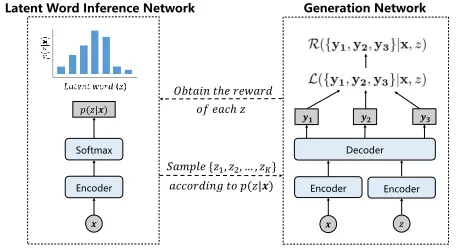
y’s and infer the latentzfor each of them separately. The overall framework of our model is shown in Fig. 1. It consists of two key components: a latent word inference network forp(z|x), from which multiple words can be sam-pled out to drive the generation of diverse responses; a re-sponse generation network forL({y}|x, z), which generates the given multiple responses according to the input xand sampled words. We iteratively update the two networks in that: the latent word inference network starts with an initial policy, i.e.p(z|x), revise its strategy based on the reward and improve the accuracy of the inferred latent words; the gener-ation network receives more accurate latent words as inputs to facilitate generating the given responses, and output the reward for each sampledzfor updating the latent word in-ference network. In the following subsections, we describe these two networks, the RL algorithm for their joint training and prediction in detail.
Latent Word Inference Network
This network estimates the probability distributionp(z|x). We first encode the inputxwith a bidirectional GRU to ob-tain an input representationhxand then compute the proba-bility of each latent word as follows:
p(z|x) =softmax(W2·tanh(W1hx+b1) +b2), (2)
where parameters in the bidirectional GRU,W1,b1,W2
andb2are jointly trained in our model.
Generation Network
We assume thatL({y}|x, z)can be estimated from individ-ual loss`(y|x, z)’s fory∈ {y}through a simple parameter-free and differentiable functionf(·):
L({y}|x, z) =fy∈{y}(`(y|x, z)). (3)
𝑆𝑎𝑚𝑝𝑙𝑒 {𝑧1, 𝑧2, … , 𝑧𝐾} 𝑎𝑐𝑐𝑜𝑟𝑑𝑖𝑛𝑔 𝑡𝑜 𝑝(𝑧|𝒙) 𝑂𝑏𝑡𝑎𝑖𝑛 𝑡ℎ𝑒 𝑟𝑒𝑤𝑎𝑟𝑑 Latent Word Inference Network
𝑝(𝑧|𝒙)
Encoder Encoder
𝒚𝟏 𝒚𝟐 𝒚𝟑
Softmax
𝒙
Generation Network
𝑜𝑓 𝑒𝑎𝑐ℎ 𝑧
𝒙
Encoder
𝑧 Decoder
Figure 1: An overview of the proposed model. The givenx
is associated with three output responses{y1,y2,y3}. Each
latentzis a word in the vocabulary.
We first introduce the detailed network structure to estimate
`(y|x, z), and then discuss proper choices off(·).
With a sampledz, we first encodexthrough another bidi-rectional GRU for an input representationhgx. At the same time, we obtain the representationhg
zofzusing an
embed-ding layer followed by a fully connected layer. Both repre-sentations are then leveraged to decode the output sequence
y. Here, our decoding function is constructed as follows. We compute the attention betweenhg
z andxand construct the
context vectorcz:
aj =
exp(hg
z Thg
x(j))
P
texp(h
g z T
hgx(t))
, cz=
X
t
athgx(t), (4)
where{hg
x(t)}is the series of hidden vectors obtained in the encoder for each word inx. Intuitively,czis a weighted sum
of the input representations, which captures the information ofxrelevant to the selectedz.
We use GRU as the decoding cell with{hy(t)}denoting its series of hidden vectors. In each decoding step, we cal-culate the attention and the context vectorcy(t)forhy(t), which can be obtained by replacinghg
zwithhy(t)in Eq. 4. Then, we concatenatehy(t),czandcy(t)together and for-ward this vector into a fully connected layer followed by a softmax output layer. `(y|x, z)is set as the negative log likelihood ofp(y|x, z). Comparing with the decoding step in traditional Seq2seq models (Bahdanau, Cho, and Bengio 2015), we integrate more information from the input repre-sentations relevant to the selected wordzto help predict the current output wordy(t).
Next, we discuss how to design a proper function f(·)
with`(y|x,z)’s estimated from the above network structure. Typically,f(·)is set to be the average function:
Lavg({y}|x, z) = 1
|{y}|
X
y∈{y}
`(y|x, z), (5)
where|{y}|is the cardinality of{y}. HoweverLavg may
not be proper in our setting. As discussed in Section , not all responses may relate to a singlez. Thus, the loss terms
the remaining will be large. The overall lossLavg({y}|x, z)
could still be large. Hence, we propose to use the minimum function as thef(·)function:
Lmin({y}|x, z) = min
y∈{y}`(y|x, z). (6)
If the sampledz paired withxcan generate one of its re-sponses very well, its overall loss value now will be small.
Joint Training with Reinforcement Learning
To update the networks, we generally compute the gradient ofJ(Θ)in Eq. 1 with respect toΘ:
∇ΘJ(Θ)
=∇Θ
X
z∈Z
p(z|x)L({y}|x, z)
= X
z∈Z
[L({y}|x, z)∇Wp(z|x) +p(z|x)∇GL({y}|x, z)]
=Ep(z|x;W)[L({y}|x, z)∇Wlogp(z|x)+∇GL({y}|x, z)].
A major difficulty faced by our model is the intractability in calculating the above gradient since the expectation involves a huge number of terms for a large latent spaceZ. To address this problem, we propose to use reinforcement learning for optimization, which is shown in Algorithm 1.
In Step 1, we use existing keyword extraction tools to ex-tract keywords for each post as the latent words to pre-train the latent word inference network. Then we use the top one inferred word from the latent word inference network as the inputzto pre-train the generation network with the standard loss function Eq. 5 used in Seq2seq models. During train-ing, the REINFORCE algorithm (Williams 1992) is used to train the latent word inference network, and standard back-propagation is adopted for updating the generation network. Two key issues remains when we perform the joint train-ing. First, when we performKtrials to sample multiplez’s, it may be difficult and time-consuming for the algorithm to explore the large latent space, if we directly use the sampling distribution in Eq. 2. Second, the loss function in Eq. 5/Eq. 6 is not bounded and thus will introduce a large variance in policy gradients, which affects the stability of the algorithm. To address the first issue, we design a two-step sampling scheme, which can effectively limit the word sampling in a much smaller latent space. For the second issue, we propose to replaceL({y}|x,z)in the policy gradient with a bounded rewardR({y}|z,x).
Sampling multiple diverse latent wordsFirstly, we notice
that each input post xis often relevant to only a few z’s, since the information provided by a short text should be very limited. Thus, we maintain a small candidate setZxfor each
x, and only sample the latentzinZxusing theirp(z|x;W). In our experiment, the candidate setZxis constructed using outputs from existing keyword extraction methods on the in-putxand its output sequences{y}.1
Second, it is desirable thatKdiversez’s can be selected out for eachx. Thus we perform clustering on the candidate setZx using their context vectorcz’s in Eq. 4. Forz’s in
1
We have tried using all words inZasZxand the performance
is much worse.
Algorithm 1:RL Training Algorithm
Input: (x,{y}),Z
Output: Θ
1: Θ←Pre-trained from baseline methods. 2: foreach(x,{y}) do
3: fork= 1, . . . , Kdo
4: Sample a wordzaccording to the proposed sampling scheme.
5: Obtain the generated sentence
ˆ
y=argminy∗`(y∗|x, z).
6: Compute the reward according toR({y}|x, z). 7: Update the latent word inference network via the
policy gradientR({y}|x, z)∇Wlogp(z|x). 8: Update the generation network via the gradient
∇GL({y}|x, z).
9: end for
10: end for
different clusters, they tend to have different attentions on the input post. For each trial of sampling, we only select latent words from clusters, from which no words has been selected before.
Reward function design A few recent works have been
proposed to learn a discriminator for a data-driven reward function (Li et al. 2017; 2018). However, these methods in-volve more model modules and complex parameter tuning. To keep our model simple, we make use of the generated sentence ˆy from the generation network (Step 5 in Algo-rithm 1), and compute the reward with respect to a singley
using the parameter-free F1 score betweenyandyˆ which measures the average overlap by treating the two sequences as bags of tokens:
R(y|z,x) =
F1(y,y)ˆ , y∩yˆ6=∅,
−1, else.
The reward with respect to{y}is computed as:
R({y}|x, z) =
1 |{y}|
P
yR(y|x, z), Eq. 5 is used,
maxyR(y|x, z), Eq. 6 is used.
Experimental results show that our model with the use of this simple reward function works very well.
Generating Multiple Responses
With a trained model, we discuss how to generateKdiverse responses for a testing inputx. We set the top 1000z’s of
p(z|x)from the latent word inference network as the can-didate set. Next, we perform clustering on the cancan-didate set similarly as in training and select out the centroidz’s of the largestK clusters. Finally, each of the selectedz’s is com-binedxto generate the response.
Experiments
performance of the various compared methods. We further show some analyses to validate the effectiveness of our RL training algorithm.
Datasets
We perform experiments on two short-text conversation tasks in which each input post is generally associated with multiple output sequences. Weibo: We used the bench-mark dataset (Shang, Lu, and Li 2015) and pre-processed it for high-quality data pairs. In total, we have above 4 mil-lion training pairs.Twitter:We crawled post-response pairs using the Twitter API. With several data cleaning steps, we have around 750 thousand training pairs. Both datasets have the vocabulary size 50,000. Details of the data pre-processing and statistics are in Appendix.
Compared Methods
Beam Search(BS): We use the vanilla Seq2seq model with
attention employed in decoding (Bahdanau, Cho, and Ben-gio 2015). Standard beam search is applied in testing.
Diverse Beam Search(DBS) (Li, Monroe, and Jurafsky
2016): We use the same Seq2seq model for training. In test-ing, a modified ranking score is used in beam search to en-courage diverse results. We set a fixed diversity rate as 0.5.
Maximum Mutual Information(MMI) (Li, Monroe, and
Jurafsky 2016): We generate the N-best list using the same Seq2Seq model, and then rerank the results by this method.
Multiple-Mechanism(MultiMech)(Zhou et al. 2017) : It
introduced latent embeddings for diverse response genera-tion. Following their setting, we use 4 latent mechanisms. Then we select top 3 mechanisms and perform beam search to obtain one response for each top mechanism.
CVAE(Zhao, Zhao, and Eskenazi 2017): As stated in Sec-tion , it adopted CVAE for diverse response generaSec-tion. We replace the dialogue acts used in their original model as the keyword used in our pre-trained step.
HGFU(Yao et al. 2017): This model used the PMI to ex-tract a cue word for a post and then incorporate it for gener-ating a more informative response. However, we find calcu-lating the PMI is very time-consuming for a testing sample, which involvesO(the sequence length×vocabulary size× the number of the training data)operations. Thus we change to apply the keyword used in our pre-trained step.
Ours: We explore our model using the pre-trained networks only (Ours(Pretrain)) and two variants utilizing the two loss functions in Eq. 5 and 6 in the generation network, de-noted asOurs(Avg)andOurs(Min).
Evaluation
Top 3 results of each method are collected for evaluation. For automatic evaluations, we report:
BLEU(Papineni et al. 2002): A widely used metric to mea-sure the response relevance;
Distinct-1/2: Number of distinct unigrams/bigrams in the
generated multiple responses scaled by the total number of generated unigrams/bigrams for each post, which can be considered an automatic metric for evaluating the diversity among the multiple responses generated for a single post.
Since automatic metrics for open-domain generative mod-els may not be consistent with human perceptions (Liu et al. 2016), we also do human annotations to further evaluate the generated results. We randomly select 200 testing posts for each dataset and recruit 3 annotators from a professional la-beling company to label the following two aspects for results of all compared methods:
Quality: Each post-response pair is evaluated with: bad
(un-grammatical or irrelevant), normal (basically (un-grammatical and relevant) or good (grammatical and highly relevant with specific meaning and information); responses on normal and good levels are treated as “acceptable”;
Diversity: Number of fundamentally distinct responses
among the output responses of each method; thus the largest diversity score of a post is 3 in our setting.
Results on Weibo
Overall PerformanceResults of automatic evaluations and
human annotations are shown in Table 1 and 2 respec-tively. In terms of BLEU, HGFU performs the best, while Ours(Min) achieves the second best on BLEU-2/3/4. How-ever, BLEU only evaluates how much overlapped words the generated responses have towards the given references. In open-domain conversations, responses not close to the refer-ences may not necessarily be poor. Thus, the quality scores from the human annotations are more reliable. As shown, Ours(Min) obtains the highest acceptable ratio. More im-portantly, our model achieves a much higher good ratio, with approximately 195% improvement over HGFU. This indicates that our method can output more high-quality re-sponses. In terms of distinct-1/2 and diversity, Ours(Min) performs the best. Especially from the human evaluation re-sults, Ours(Min) obtains about 110% improvement over the Seq2seq baselines (BS, DBS and MMI), as well as 70% over the enhanced methods (MultiMech and HGFU). This val-idates that our method can output more diverse responses while maintaining each of them to be relevant to the post.
Comparing with Ours(Pretrain), Ours(Avg) cannot obtain consistent improvement on both quality and diversity. This shows that the loss in Eq. 6 is more suitable for our problem setting as discussed in Section 3.
We notice that the re-ranking methods (DBS and MMI) do not outperform BS considering both quality and diver-sity. As stated in introduction, these methods may have lim-ited effectiveness by only encouraging responses with differ-ent words to be ranked into higher positions during testing. Also, the diversity of CVAE is much worse than the other methods. This is consistent with our discussion in Section that directly sampling from a fixed Gaussian prior tends to cause mode collapse and yields little response diversity.
Analysis and Case studyWe first evaluate the overall
com-Method BLEU-1 BLEU-2 BLEU-3 BLEU-4 distinct-1 distinct-2 BS 24.784 18.923 13.362 7.866 44.316 53.250
DBS 24.187 18.437 13.016 7.674 44.962 54.114
MMI 25.683 19.597 13.845 8.187 43.369 52.265
CVAE 26.575 18.290 12.302 6.510 38.158 47.272
MultiMech 24.436 18.952 13.644 8.403 41.321 49.592
HGFU 43.530 32.356 22.826 14.043 36.262 42.323
Ours(Pretrain) 31.135∗ 23.361 16.889 10.594 58.534∗ 76.023∗ Ours(Avg) 30.435 23.187 16.511 10.086 43.618 51.769
Ours(Min) 31.067 23.523∗ 16.893∗ 10.945∗ 62.407 76.767
Table 1: Automatic evaluation results on Weibo. The best/second best results are bold/starred.
Figure 2: Examples showing the generated responses on Weibo. Words in the brackets are the selected latent words.
Method Quality Diversity
%Acceptable %Good
BS 44.611 4.333 0.678
DBS 44.667 4.389 0.683
MMI 44.611 4.056 0.680
CVAE 29.833 1.888 0.380
MultiMech 60.388 5.000 0.806
HGFU 60.833 7.111 0.846
Ours(Pretrain) 46.722 9.611 1.148
Ours(Avg) 49.278 8.556 0.843
Ours(Min) 63.000 20.944 1.436
Table 2: Human evaluation results on Weibo.
pute the cosine similarity between the latent word and the sentence embedding, and normalize the score into [0,1]. Re-sults are shown in Fig. 3(a). As can be seen, both Ours(Avg) and Ours(Min) can select out latent words that are more rel-evant to both the posts and responses than Ours(Pretrain). Meanwhile, the improvement of Ours(Min) is much larger than that of Ours(Avg).
Fig. 2 illustrates two example posts with their gener-ated responses.2 As can be seen, the responses with dif-ferent mechanisms can be identical. The reason may be that the number of mechanisms is very small and each mecha-nism can only capture high-level responding characteristics shared by many input data. A given post may not be sen-sitive to different responding mechanisms so that the same
2
Full results of all methods are shown in Appendix.
Query Response
0.0 0.1 0.2 0.3 0.4 0.5 0.6 0.7 0.8 0.9
0.22 0.28 0.33 0.22 0.24
0.37
Ours(Pretrain) Ours(Avg) Ours(Min)
(a)
V! 1HZ<HDUVSDUW\
LVDERXWWR EHJLQ VWLOO
VWRSZRUG!ZRQGHULQJ JLYH HYHU\ERG\
ZKDW VXUSULVH
DK VXUSULVH
1HZ<HDUVSDUW\ DSSUHFLDWH
V! PRQWK GD\ RFORFN7LDQMLQ
PDJQLWXGHHDUWKTXDNHVWRSZRUG!HSLFHQWHUSLFWXUH
HDUWKTXDNH 7LDQMLQ ILQLVK
(b)
Figure 3: (a) Cosine similarity between the latent word and the query/response. (b) Visualization of the attention paid to the relevant parts of the input post in Fig. 2 for each of the selected words; a large version of this figure is shown in Appendix for better readability.
response will be generated. Whereas, the responses by our methods are driven by different latent words, which contain more specific data-dependent information. If the selected words have far different meanings, the generated responses are highly probable to be different.
Method BLEU-1 BLEU-2 BLEU-3 BLEU-4 distinct-1 distinct-2 BS 39.595 34.331 27.727 22.857 51.867 63.951
DBS 37.004 32.075 25.836 21.198 53.703 66.226
MMI 44.306 38.727 31.760 26.661 48.678 60.135
CVAE 35.071 29.487 22.509 17.380 52.451 64.876
MultiMech 75.164 50.679 30.897 19.434 42.717 48.153
HGFU 28.145 18.214 12.963 9.488 5.786 6.609
Ours(Pretrain) 82.751 64.902 47.177 34.282 52.281 66.642
Ours(Avg) 82.886∗ 66.586∗ 48.288∗ 34.891∗ 55.371 67.210∗
Ours(Min) 86.682 74.356 60.294 49.965 53.904∗ 67.301
Table 3: Automatic evaluation results on Twitter. The best/second best results are bold/starred.
Figure 4: Examples showing the generated responses on Twitter. Words in the brackets are the selected latent words.
Method Quality Diversity
%Acceptable %Good
BS 28.055 3.778 0.657
DBS 29.000 3.722 0.697
MMI 31.667 4.667 0.678
CVAE 20.666 3.055 0.475
MultiMech 21.166 3.500 0.536
HGFU 14.000 2.722 0.245
Ours(Pretrain) 27.389 4.333 0.585
Ours(Avg) 30.667 4.444 0.570
Ours(Min) 42.000 7.944 0.713
Table 4: Human evaluation results on Twitter.
word. If the word is aligned with multiple words as the third one for both posts, the generated response is relevant to the these attended words but not the latent word itself. Over-all, since we select words from different clusters, which are computed using the context vectorcz, our method tends to
select words attended on different parts of the post and the generated responses are generally with diverse meanings.
Results on Twitter
Table 3 shows the automatic evaluation annotation results on Twitter. On all metrics, our proposed models outperform the other compared methods. The human evaluation results are provided in Table 4, and our method is still the best among all compared methods. Especially on the the Good ratio, Ours(Min) has an increase of 70% over MMI (the best re-ranking method) and 126% over MultiMech (the best diversity-promoting method). Generated responses of two posts are provided in Fig. 4. Full results of all methods are again provided in Appendix.
Analysis of RL Training
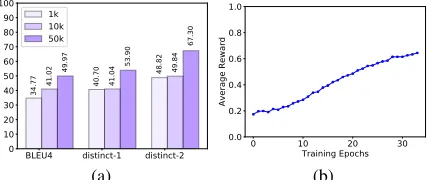
We vary the size of the latent space on Twitter to test if a large latent space is needed in our model. In Fig. 5(a), we
show the results of Ours(min) with the latent space using the top 1k, 10k and all words in the vocabulary. We find out that all metric scores decrease drastically with the use of a smaller latent space. Thus, it is critical to use a large latent space for our model to perform well.
In Fig. 5(b), we plot the average training reward of Ours(Min) obtained by each epoch on Twitter. The reward increases as the training algorithm iterates. It indicates our designed RL training algorithm is capable of revising its pol-icy to obtain more accurate latent variable distributions to generate better responses.
BLEU4 distinct-1 distinct-2 0
10 20 30 40 50 60 70 80 90 100
34.77 40.70
48.82
41.02 49.97 41.04 49.84
53.90
67.30
1k 10k 50k
(a)
0 10 20 30
Training Epochs 0.0
0.2 0.4 0.6 0.8 1.0
Average Reward
(b)
Figure 5: (a) BLEU and distinct-1/2 with the size of latent space as 1k, 10k and 50k. (b) Training rewards with different epochs.
Conclusion
Weibo and Twitter. Results show that, our method can effec-tively increase both the quality and diversity of the multiple generated responses compared with existing baselines and several state-of-the-art generative methods.
Acknowledgements
This work was supported by National Natural Science Foun-dation of China (Grant No. 61876120).
References
Adi, Y.; Kermany, E.; Belinkov, Y.; Lavi, O.; and Goldberg, Y. 2016. Fine-grained analysis of sentence embeddings using aux-iliary prediction tasks.arXiv preprint arXiv:1608.04207.
Bahdanau, D.; Cho, K.; and Bengio, Y. 2015. Neural machine translation by jointly learning to align and translate. Proceed-ings of the 2015 International Conference on Learning Represen-tations(ICLR).
Li, J.; Galley, M.; Brockett, C.; Gao, J.; and Dolan, B. 2016a. A diversity-promoting objective function for neural conversation models. InProceedings of the 2016 Conference of the North Ameri-can Chapter of the Association for Computational Linguistics: Hu-man Language Technologies(NAACL-HLT), 110–119.
Li, J.; Monroe, W.; Ritter, A.; Jurafsky, D.; Galley, M.; and Gao, J. 2016b. Deep reinforcement learning for dialogue generation. InProceedings of the 2016 Conference on Empirical Methods in Natural Language Processing(EMNLP), 1192–1202.
Li, J.; Monroe, W.; Shi, T.; Jean, S.; Ritter, A.; and Jurafsky, D. 2017. Adversarial learning for neural dialogue generation. In Pro-ceedings of the 2017 Conference on Empirical Methods in Natural Language Processing, 2157–2169.
Li, Z.; Jiang, X.; Shang, L.; and Li, H. 2018. Paraphrase generation with deep reinforcement learning. InProceedings of the 2018 Con-ference on Empirical Methods in Natural Language Processing. Li, J.; Monroe, W.; and Jurafsky, D. 2016. A simple, fast di-verse decoding algorithm for neural generation. arXiv preprint arXiv:1611.08562.
Liu, C.-W.; Lowe, R.; Serban, I.; Noseworthy, M.; Charlin, L.; and Pineau, J. 2016. How not to evaluate your dialogue system: An empirical study of unsupervised evaluation metrics for dialogue response generation. InProceedings of the 2016 Conference on Empirical Methods in Natural Language Processing, 2122–2132. Mikolov, T.; Chen, K.; Corrado, G.; and Dean, J. 2013. Efficient estimation of word representations in vector space. arXiv preprint arXiv:1301.3781.
Mo, K.; Li, S.; Zhang, Y.; Li, J.; and Yang, Q. 2016. Personaliz-ing a dialogue system with transfer reinforcement learnPersonaliz-ing. arXiv preprint arXiv:1610.02891.
Papineni, K.; Roukos, S.; Ward, T.; and Zhu, W.-J. 2002. Bleu: a method for automatic evaluation of machine translation. In Pro-ceedings of the 40th Annual Meeting of the Association for Com-putational Linguistics(ACL), 311–318. Association for Computa-tional Linguistics.
Shang, L.; Lu, Z.; and Li, H. 2015. Neural responding machine for short-text conversation.Proceedings of the 53rd Annual Meeting of the Association for Computational Linguistics(ACL)1577–1586. Shao, L.; Gouws, S.; Britz, D.; Goldie, A.; Strope, B.; and Kurzweil, R. 2017. Generating long and diverse responses with neural conversation models.arXiv preprint arXiv:1701.03185. Shen, X.; Su, H.; Li, Y.; Li, W.; Niu, S.; Zhao, Y.; Aizawa, A.; and Long, G. 2017. A conditional variational framework for dialog
generation.Proceedings of the 55th Annual Meeting of the Associ-ation for ComputAssoci-ational Linguistics(ACL).
Sordoni, A.; Galley, M.; Auli, M.; Brockett, C.; Ji, Y.; Mitchell, M.; Nie, J.-Y.; Gao, J.; and Dolan, B. 2015. A neural network approach to context-sensitive generation of conversational responses. In Pro-ceedings of the 2015 Conference of the North American Chapter of the Association for Computational Linguistics: Human Language Technologies(NAACL-HLT), 196–205.
Turing, A. 1950. Computing machinery and intelligence.Mind. Vinyals, O., and Le, Q. 2015. A neural conversational model.arXiv preprint arXiv:1506.05869.
Wang, L.; Schwing, A.; and Lazebnik, S. 2017. Diverse and ac-curate image description using a variational auto-encoder with an additive gaussian encoding space. InAdvances in Neural Informa-tion Processing Systems, 5756–5766.
Wen, T.-H.; Miao, Y.; Blunsom, P.; and Young, S. 2017. Latent in-tention dialogue models. InInternational Conference on Machine Learning, 3732–3741.
Williams, R. J. 1992. Simple statistical gradient-following algo-rithms for connectionist reinforcement learning.Machine Learning 8(3-4):229–256.
Yao, L.; Zhang, Y.; Feng, Y.; Zhao, D.; and Yan, R. 2017. To-wards implicit content-introducing for generative short-text con-versation systems. InProceedings of the 2017 Conference on Em-pirical Methods in Natural Language Processing, 2190–2199. Zhao, T.; Lee, K.; and Eskenazi, M. 2018. Unsupervised dis-crete sentence representation learning for interpretable neural di-alog generation. InProceedings of the 55th Annual Meeting of the Association for Computational Linguistics (ACL).
Zhao, T.; Zhao, R.; and Eskenazi, M. 2017. Learning discourse-level diversity for neural dialog models using conditional varia-tional autoencoders. InProceedings of the 55th Annual Meeting of the Association for Computational Linguistics (ACL), 654–664. Zhou, G.; Luo, P.; Cao, R.; Lin, F.; Chen, B.; and He, Q. 2017. Mechanism-aware neural machine for dialogue response genera-tion. InProceedings of AAAI Conference on Artificial Intelligence (AAAI), 3400–3407.
Zhou, G.; Luo, P.; Xiao, Y.; Lin, F.; Chen, B.; and He, Q. 2018. Elastic responding machine for dialog generation with dynamically mechanism selecting. InProceedings of AAAI Conference on Arti-ficial Intelligence (AAAI).