The Thirty-Third AAAI Conference on Artificial Intelligence (AAAI-19)
Unsupervised Feature Selection by Pareto Optimization
∗Chao Feng,
1Chao Qian,
1Ke Tang
21Anhui Province Key Lab of Big Data Analysis and Application, School of Computer Science and Technology,
University of Science and Technology of China, Hefei 230027, China
2Shenzhen Key Lab of Computational Intelligence, Department of Computer Science and Engineering,
Southern University of Science and Technology, Shenzhen 518055, China [email protected], [email protected], [email protected]
Abstract
Dimensionality reduction is often employed to deal with the data with a huge number of features, which can be gener-ally divided into two categories: feature transformation and feature selection. Due to the interpretability, the efficiency during inference and the abundance of unlabeled data, un-supervised feature selection has attracted much attention. In this paper, we consider its natural formulation, column sub-set selection (CSS), which is to minimize the reconstruction error of a data matrix by selecting a subset of features. We propose an anytime randomized iterative approach POCSS, which minimizes the reconstruction error and the number of selected features simultaneously. Its approximation guarantee is well bounded. Empirical results exhibit the superior perfor-mance of POCSS over the state-of-the-art algorithms.
Introduction
In machine learning and data mining applications, we of-ten encounter the input data with very high dimensionality, bringing certain challenges. Many feature transformation techniques have been proposed for dimensionality reduc-tion, e.g., principal component analysis (Jolliffe 2011), sin-gular value decomposition (SVD) (Golub and Reinsch 1971) and autoencoders (Hinton and Salakhutdinov 2006), to name a few. By combining existing features, these methods trans-form the data into a low dimensional subspace, which can capture the cardinal information of the original data. How-ever, the new feature representation is difficult to interpret, and projecting the input features into the reduced space often requires matrix multiplication, which reduces the inference efficiency. When keeping the semantic meaning of the fea-tures is important, feature selection, which selects a subset of features instead of transforming them, is more appealing. Since unlabeled data is often very abundant, much attention has been drawn to the unsupervised case.
Unsupervised feature selection can be explored from dif-ferent perspectives. In this paper, we focus on a natural for-mulation, column subset selection (CSS), which is to min-imize the reconstruction error of a data matrix based on
∗
This work was supported by the National Key Research and Development Program of China (2017YFC0804002), the NSFC (61603367, 61672478) and the YESS (2016QNRC001).
Copyright c2019, Association for the Advancement of Artificial Intelligence (www.aaai.org). All rights reserved.
the subset of selected features. Formally, given a matrix
A ∈ Rm×n (wheremis the number of instances andnis
the number of features) and a positive integerk, the goal is to select at mostkcolumns ofA(forming a matrixS) minimiz-ingf(S) =kA−SS+Ak2
F, whereS
+is the Moore-Penrose
inverse matrix ofS. That is, it is to find at mostkcolumns of
Athat captures as much ofAas possible w.r.t. the Frobenius norm. Note thatSS+denotes the projection matrix onto the span of the setSof columns. This problem is known to be UG-Hard (C¸ ivril 2014), and its NP-completeness has been proved only recently (Shitov 2017). Many algorithms with bounded approximation guarantees have been proposed, as briefly reviewed in the following.
Related Work
The CSS problem was first studied within the numeri-cal linear algebra community. Many algorithms based on rank-revealing QR (RRQR) factorization (Chan and Hansen 1992) were proposed, e.g., (Gu and Eisenstat 1996; Pan and Tang 1999; Hoog and Mattheij 2007). It has been proved that any algorithm for computing RRQR factorization of a matrix A can provide solutions of the CSS problem with approximation guarantees. Let Ak denote the best rank-k approximation toAobtained via SVD, and letSoptdenote an optimal solution of the CSS problem. Note that the ap-proximation guarantee obtained by this kind of algorithms is w.r.t.kA−AkkF, which is obviously a lower bound on the truly optimal function value, i.e.,kA−SoptS+optAkF.
Several randomized sampling algorithms were also pro-posed for solving the CSS problem, including subspace sam-pling (Drineas, Mahoney, and Muthukrishnan 2008), vol-ume sampling (Guruswami and Sinop 2012) and leverage sampling (Cohen et al. 2015). Their idea is to randomly se-lect columns with probability proportional to some statistic. The theoretical results on these algorithms mainly showed a trade-off between the number of columns chosen, the ap-proximation bound w.r.t.kA−AkkFand the success prob-ability of the algorithm.
In (Boutsidis, Mahoney, and Drineas 2009), the authors proposed a two-stage algorithm by combining the above two techniques. In the randomized stage, the algorithm selects
selectedO(klogk)columns by applying the deterministic column selection algorithm based on RRQR factorization. This two-stage algorithm can achieve an approximation ra-tio ofO(k√logk)w.r.t.kA−AkkFwith a high probability. In (Civril and Magdon-Ismail 2012), a deterministic algo-rithm based on the sparse approximation of the SVD ofA
was proposed. It first computes the topkleft singular vec-tors ofA, and then selects columns fromAto approximate the space spanned by these vectors, scaled by the singular values. It has been shown that this algorithm can achieve an approximation ratio of(1 +)w.r.t.kA−AkkF after se-lectingO(klogk/2)columns.
The standard greedy algorithm was later used to solve the CSS problem (Farahat, Ghodsi, and Kamel 2011). It it-eratively selects one column, whose inclusion can reduce the objective f(S)the most. To investigate its theoretical performance, Bhaskara et al. (2016) studied the equivalent problem that maximizeskSS+Ak2
F, and proved an approx-imation ratio of (1 −) w.r.t. the optimal function value kSoptS+optAk
2
Fafter selectingO(k/)columns.
Recently, Ordozgoiti et al. (2016) proposed a simple lo-cal search algorithm, which starts fromkrandomly selected columns, and iteratively replaces one selected column with the best amongn−kunselected columns, until no improve-ment can be yielded. This algorithm has been shown em-pirically to outperform other state-of-the-art methods, and an approximation bound w.r.t.kSoptS+optAk2F has also been provided (Ordozgoiti, Canaval, and Mozo 2018).
All the above algorithms are approximation algorithms. In (Arai, Maung, and Schweitzer 2015), an approach us-ing the A∗ heuristic search algorithm is guaranteed to find the optimum. However, due to the NP-hardness of the prob-lem, it can effectively select only a small number of columns from small data sets. A similar approach using the weighted A∗ algorithm thus has been proposed (Arai et al. 2016), which can run faster, but without the optimal guarantee.
Our Contribution
In this paper, we propose a new method based on Pareto optimization (Qian, Yu, and Zhou 2015) for the CSS prob-lem, briefly called POCSS. The idea of POCSS is to first reformulate the original CSS problem as a bi-objective min-imization problem that minimizes the given objectivef(S)
and the number of columns ofSsimultaneously, then em-ploy a randomized iterative procedure to solve it, and finally select the best solution with at mostkcolumns from the pro-duced set of solutions. In each iteration of POCSS, it needs to evaluate the objective value of a newly generated solu-tion, which is time-consuming. We derive the recursive re-lation between the objective values by adding one column into a matrix or deleting one column, based on which the algorithm is computationally feasible.
Theoretically, we prove that POCSS using polynomial time can find a solutionSbwith at mostkcolumns such that
kSbSb+Ak2F ≥ (1−e−γ)· kSoptS+optAk2F, where γis the submodularity ratio (Das and Kempe 2011) characterizing how close the function kSS+Ak2
F is to submodular. Fur-thermore, we prove that using slightly more thankcolumns,
i.e.,16k/(σ), POCSS can achieve an approximation ratio of(1−)w.r.t.kSoptS+optAk2F, where > 0is a constant andσdenotes the smallest squared singular value of the nor-malized Sopt, i.e., each column ofSoptis scaled to a unit vector.
The experimental results on 10 real-world data sets clearly show the superiority of POCSS over the state-of-the-art al-gorithms, including Two-stage (Boutsidis, Mahoney, and Drineas 2009), AprxSVD (Civril and Magdon-Ismail 2012), Greedy (Farahat, Ghodsi, and Kamel 2011), IterFS (Ordoz-goiti, Canaval, and Mozo 2016) and WA∗(Arai et al. 2016). The rest of the paper first introduces the studied problem, and then presents the proposed method, its theoretical anal-ysis and empirical study. Finally we conclude this paper.
Unsupervised Feature Selection
We first give some notations that will be used in the paper. • [n]: set{1,2,· · · , n}.• 0: all-zeros vector. • k · k2:`2-norm of a vector.
• 0m,n: zero matrix of sizem×n. • In: identity matrix of sizen.
• Cij: entry of thei-th row andj-th column of matrixC. • Ci::i-th row of matrixC.
• C:i:i-th column of matrixC.
• CT: transpose of matrixC.
• C+: Moore-Penrose inverse of matrixC.
• tr(·): trace of a square matrix. • k · kF: Frobenius norm of a matrix. • | · |: number of columns of a matrix.
Unsupervised feature selection can be naturally charac-terized by the CSS problem in Definition 1. It is to select at most k columns from all the ncolumns of a matrix A
to best approximateA. The goodness of approximation is measured by the sum of squared errors between the original matrix A and the approximationSS+A based on the
se-lected columns ofS. Note thatSS+denotes the projection matrix onto the space spanned by the columns ofS.
Definition 1(Column Subset Selection (CSS)). Given a ma-trixA ∈ Rm×n and a positive integerk < n, it is to find a submatrixSofAwith at mostkcolumns that minimizes
kA−SS+Ak2
F, that is,
arg minS: a submatrix ofA kA−SS+Ak2
F s.t. |S| ≤k. For the ease of theoretical treatment, this minimization problem is often equivalently transformed into a maximiza-tion problem:
arg maxS: a submatrix ofA kSS+Ak2F s.t. |S| ≤k.
The equivalency can be verified by kA−SS+Ak2
F =tr((A−SS
+A)T(A−SS+A))
=tr(ATA−ATSS+A) =tr(ATA)−tr(ATSS+A)
=tr(ATA)−tr(AT(SS+)TSS+A)
=tr(ATA)− kSS+Ak2
where the second and the fourth equalities are derived by the properties ofS+, i.e.,(SS+)T =SS+andS+SS+ =S+.
Note thattr(ATA)is a constant. In our theoretical analysis, we will consider maximization.
The Proposed Approach
In this section, we propose a Pareto optimization based ap-proach for the CSS problem, POCSS. Note that Pareto timization is a general framework that uses bi-objective op-timization as an intermediate step to solve single-objective optimization problems. It has been successfully applied to solve the general subset selection problem (Friedrich and Neumann 2015; Qian, Yu, and Zhou 2015; Qian et al. 2017a; 2017b) as well as the problems of multiset selection (Qian et al. 2018b),k-subsets selection (Qian et al. 2018a) and se-quence selection (Qian, Feng, and Tang 2018).
We use a binary vectors∈ {0,1}nto denote a submatrix
SofA. Each element ofscorresponds to one column ofA. For1≤i≤n, thei-th bitsi= 1means that thei-th column ofAis included intoS; otherwise, thei-th column ofAis not selected. Note that the columns ofSare in the order of their appearance inA. We will not distinguishs∈ {0,1}n and its corresponding submatrixSfor notational simplicity. POCSS reformulates the original problem, i.e., Defini-tion 1, as a bi-objective minimizaDefini-tion problem
arg mins∈{0,1}n f(s), |s|
wheref(s) =kA−ss+Ak2
F. That is, POCSS minimizes the original objective function and the number of selected columns simultaneously.
In the bi-objective setting, both the two objective values have to be considered for comparing two solutionssands0.
sweakly dominatess0 (i.e.,sisbetterthans0, denoted as
s s0) iff(s)≤f(s0)∧ |s| ≤ |s0|;sdominatess0 (i.e.,
sisstrictly better, denoted ass≺s0) ifs s0 and either
f(s)< f(s0)or|s|<|s0|. But if neithersis better thans0
nors0is better thans, they areincomparable.
The procedure of POCSS is described in Algorithm 1. In the optimization process, we use the archiveP to maintain the non-dominated solutions produced so-far, andf(P) =
{f(s)|s∈P}is the set of objective values of the solutions inP. The algorithm starts from the all-zeros solution0 rep-resenting the empty matrix (line 1), and then iteratively tries to improve the quality of the solutions inP (lines 4-15). In each iteration, a solutionsrandomly selected from the cur-rentP is used to generate a new solutionyby flipping each bit ofswith probability1/n(lines 5-6);yis then evaluated (line 7); ifyis not dominated by any previously archived so-lution (line 8), it will be added intoP, and meanwhile those solutions weakly dominated byywill be removed (lines 9-11). Note that the domination-based comparison makesP
always contain incomparable solutions.
POCSS repeats forT iterations. The value ofT could in-fluence the quality of the produced solution. Their relation-ship will be made clear in the theoretical analysis, and we will use the theoretically derivedTvalue in the experiments. After runningT iterations, the best solution (i.e., having the smallestf value) satisfying the size constraint inP is se-lected as the final solution (line 16).
Algorithm 1POCSS Algorithm
Input: matrixA∈Rm×n, cardinality constraintk∈[n] Parameter: the numberT of iterations
Output: a matrixscomprised by at mostkcolumns ofA
Process: 1: Lets=0.
2: LetP ={s},f(P) ={f(s)},P+={s+}.
3: Lett= 0. 4: while t < T do
5: SelectsfromP uniformly at random. 6: y:=flip each bit ofswith probability1/n. 7: (f(y),y+) =Evaluate(s, f(s),s+,y).
8: if@z∈Psuch thatz≺ythen
9: Q={z|z∈P,yz}. 10: P= (P\Q)∪ {y}.
11: f(P) = (f(P)\ {f(z)|z∈Q})∪ {f(y)}.
12: P+= (P+\ {z+|z∈Q})∪ {y+}.
13: end if
14: t=t+ 1. 15: end while
16: returnarg mins∈P,|s|≤kf(s)
Acceleration
Note that in each iteration of POCSS, we need to evaluate the objective value of a newly generated solution y, i.e., computing f(y) = kA−yy+Ak2
F, which is very time-consuming. For a matrixS∈Rm×k, the time of computing
S+isO(k2m); then computingSS+Arequires2kmntime;
finally we need to computek · k2
F, the time of which ismn. Thus, computing f(S)directly costs timeO(kmn), which is expensive.
To accelerate this evaluation process, we build the recur-sive relation between the objective values by deleting one column from a matrix or inserting one column into a matrix, as shown in Lemmas 1-2. Thus,f(y)can be computed from
f(s)by recursively deleting columns{A:j |sj= 1∧yj=
0}and then inserting columns{A:j | sj = 0∧yj = 1}. From Lemmas 1-2, we can see that the recursive relation on
f relies on the Moore-Penrose inverse of the current matrix. Thus, we also need to update the Moore-Penrose inverse ma-trix accordingly, as shown in Lemmas 3-4. During the run-ning process of POCSS, we use a set P+ to maintain the
Moore-Penrose inverse matrix for each solution inP, i.e.,
P+ = {s+ | s ∈ P}. P+ will be updated accordingly in line 12 of Algorithm 1. Note that for the empty matrix
s=0,s+is also an empty matrix andf(s) =kAk2
F. In the following lemmas, we assume thatSis a full col-umn rank matrix, i.e.,rank(S) =|S|. Their proofs are pro-vided in the Appendix.
Lemma 1. bSis the matrix generated by deleting thei-th
column ofS. Letρ= ((S+)i:)T andβ=ATρ. Then,
f(bS) =f(S) +kρk−22βTβ.
Lemma 2. bSis the matrix generated by inserting thej-th
Algorithm 2Evaluation Subprocedure
Input:S,f(S),S+andY Output:f(Y)andY+ Process:
1: fcur=f(S),S+cur=S+.
2: Xdelete={A:j|A:j∈S,A:j ∈/ Y}. 3: Xinsert={A:j|A:j∈Y,A:j∈/S}. 4: foreach columnA:jinXdeletedo
5: ρ= ((S+cur)i:)T (whereA:jis thei-th column ofS). 6: β=ATρ.
7: S←delete thei-th columnA:jfromS. 8: fcur←fcur+kρk−22β
Tβ.
9: S+
cur←delete thei-th row ofS+cur−kρk
−2
2 S+curρρT. 10: end for
11: foreach columnA:jinXinsertdo
12: E:j=A:j−SS+curA:jandδ=ATE:j. 13: S←insertA:jintoSas thei-th column. 14: fcur←fcur−δTδ/δj.
15: S+
cur ← insert ((E:j)TE:j)−1(E:j)T into (S+cur −
((E:j)TE:j)−1Scur+ A:j(E:j)T)as thei-th row. 16: end for
17: f(Y) =fcur,Y+=S+cur. 18: returnf(Y)andY+
SS+A:j (i.e., the residual column vector of A:j w.r.t.S),
E=A−SS+Aandδ=ATE
:j. Then,
f(bS) =f(S)−δTδ/δj, whereδjdenotes thej-th entry of the vectorδ.
Lemma 3. Sb is the matrix generated by deleting thei-th
column ofS. Letρ= ((S+)
i:)T. Then,Sb+is the matrix by
deleting thei-th row of(S+− kρk−2
2 S+ρρT).
Lemma 4. bS is the matrix generated by
insert-ing the j-th column of A into S as the i-th col-umn. Let E:j = A:j − SS+A:j. Then, Sb+ is the
matrix by inserting ((E:j)TE:j)−1(E:j)T into (S+ −
((E:j)TE:j)−1S+A:j(E:j)T)as thei-th row.
Algorithm 2 describes the procedure of computingf(Y)
andY+ of a new matrixY based on the knownf(S)and
S+of an old matrixS. To generateYfromS,X
deleteand
Xinsert record the columns that need to be deleted and in-serted, respectively. According to Lemmas 1 and 3, lines 4-10 of Algorithm 2 updates the current objective valuefcur and the current Moore-Penrose inverse matrixS+
curby delet-ing columns in Xdelete. According to Lemmas 2 and 4, lines 11-16 updatesfcur andS+cur by inserting columns in
Xinsert. After line 16, the current matrixSis just the matrix
Y. The algorithm returnsfcurandS+curasf(Y)andY+. We then show how the evaluation is accelerated. For delet-ing one column (lines 5-9), the time is determined by com-putingβandS+
curρρT, whose time ismnand2km, respec-tively. For inserting one column (lines 12-15), the time is determined by computingSS+
curA:j,δandS+curA:j(E:j)T, whose time is2km,mnand2km, respectively. Thus, both
their time is in the order ofO(mn). Note that in line 6 of Algorithm 1, it will flip one bit in expectation, that is, it will delete or insert one column in expectation. This implies that the evaluation by Algorithm 2 costs timeO(mn)in expec-tation, which is much smaller than the timeO(kmn)of di-rectly computingf(Y).
Theoretical Analysis
In this section, we investigate the theoretical performance of POCSS. For the CSS problem, we consider the equivalent maximization formulation:
arg maxS: a submatrix ofA g(S) =kSS+Ak2
F s.t. |S| ≤k. LetSoptdenote an optimal submatrix.
The objective function g(S) can actually be seen as a set function by treating S as a set of columns. Then, it can be verified that g(S) is monotone and non-submodular. The submodularity ratio γU,l(g) =
minL⊆U,S:|S|≤l,S∩L=∅
P
v∈S(g(L∪{v})−g(L))
g(L∪S)−g(L) (Das and
Kempe 2011) can be used to measure the close-ness of the function g to submodular. Note that
∀U⊆A, l≥1 : 0≤γU,l(g)≤1.
In (Qian et al. 2016), it has been proved that the Pareto optimization method using at most2ek2nexpected number
of iterations can achieve an approximation ratio of(1−e−γ) for maximizing a general monotone set function. By using the similar proof, we can prove the approximation bound of POCSS for maximizing the functiongas in Theorem 1, whereE[T]denotes the expected number of iterations. The only difference is the size of the archivePduring optimiza-tion. By the procedure of POCSS, we know that the solutions maintained inPmust be incomparable. Thus, each value of one objective can correspond to at most one solution inP. Since|S| ∈ {0,1, . . . , n},|P| ≤ n+ 1. Note that for the proof in (Qian et al. 2016),|P| ≤2k. Thus, the upper bound onE[T]changes from2ek2ntoekn(n+ 1)accordingly. Theorem 1. For the CSS problem, POCSS with E[T] ≤
ekn(n+ 1)finds a submatrixSofAwith|S| ≤kand
g(S)≥(1−e−γmin)·g(S
opt), whereγmin= minU:|U|=k−1γU,k(g).
Then, we further analyze the approximation guarantee of POCSS by allowing more than k columns. Our analysis needs Lemma 5, i.e., Lemma 1 of (Bhaskara et al. 2016), which shows that for any submatrixT, there always exists one column from a better submatrix, whose insertion intoT
can bring an improvement proportional to their current
dis-tance. Letσmin(S) = infkαk2=1
kSnormαk22 kαk2
2
, whereSnorm denotes the matrix by normalizing each column of Sto a unit vector. That is,σmin(S)is the smallest squared singular
value ofSnorm. It can be verified thatσmin(S)≤1, because
σmin(S) = inf kαk2=1
kX|S|
i=1αi(Snorm):ik 2 2
≤ inf
kαk2=1 |S|
X
i=1
kαi(Snorm):ik22= inf kαk2=1
|S|
X
i=1
Lemma 5. (Bhaskara et al. 2016) LetS,Tbe two subma-trices ofAwithg(S) ≥ g(T). There exists one column of S, inserting which intoTcan produce a matrixT0such that
g(T0)−g(T)≥σmin(S)
(g(S)−g(T))2
4|S|g(S) .
By Lemma 5, we prove that taking slightly more thank
columns, POCSS can obtain a constant approximation ratio of (1−). The proof is inspired from the analysis of the greedy algorithm, i.e., Theorem 1 in (Bhaskara et al. 2016).
Theorem 2. Let be any positive constant. For the CSS problem, POCSS withE[T] ≤ σmin16(eSopt)kn(n+ 1) finds
a submatrixSofAwith|S| ≤ 16k σmin(Sopt)and
g(S)≥(1−)·g(Sopt).
Proof. We useσto denoteσmin(Sopt)for convenience. Let
Jmaxdenote the maximum integer value ofjsuch that in the
archiveP, there exists a solutionswith|s| ≤ 8k σ
Pj−1
i=02
i
andg(s)≥g(sopt)−g(sopt)/2j. Note that the vectorsopt corresponds to the optimal submatrixSopt. That is,
Jmax= max{j∈N≥0| ∃s∈P,
|s| ≤ 8k
σ
Xj−1
i=02
i∧g(s)≥g(s
opt)−g(sopt)/2j}.
LetNbe the minimum integer value ofisuch that1/2i≤, i.e., 1/2N−1 > and 1/2N ≤ . We then only need to analyze the expected number of iterations untilJmax =N,
sinceJmax =N implies that there exists one solutionsin
Psatisfying that
|s| ≤ 8k
σ
XN−1
i=0 2
i= 8k
σ(2
N−1)≤16k
σ 2
N−1≤16k
σ
and g(s)≥g(sopt)−g(sopt)/2N ≥(1−)·g(sopt). The initial value ofJmax is 0, since POCSS starts from
the empty matrix0, which has|0| = 0andg(0) = 0. As-sume that currentlyJmax =j < N. Letsbe a
correspond-ing solution with the valuej, i.e., |s| ≤ 8k σ
Pj−1
i=02
i and
g(s) ≥ g(sopt)−g(sopt)/2j. It is easy to see that Jmax
cannot decrease because deletingsfromP (lines 9 and 10 of Algorithm 1) implies that the newly generated solution
ys, which must satisfy that|y| ≤ |s|andg(y)≥g(s). Then, we show thatJmax can increase by at least 1 after
at most 8eknσ(n+1)2jiterations in expectation. By Lemma 5,
g(s) < g(sopt)and|sopt| ≤ k, we know that flipping one specific 0 bit ofs(i.e., inserting one specific column) can generate a new solutiony, which satisfies that
g(y)−g(s)≥σ(g(sopt)−g(s))
2
4kg(sopt)
> σ(g(sopt)/2
j+1)2
4kg(sopt)
.
The last inequality is derived by g(s) < g(sopt) −
g(sopt)/2j+1, i.e.,g(sopt)−g(s)> g(sopt)/2j+1, because otherwise, it implies thatJmax ≥j+ 1, contradicting with
our assumptionJmax=j. This process happens in one
iter-ation with probability at least|P1|·1
n(1−
1
n)
n−1≥ 1
en(n+1),
where1/|P|is a lower bound on the probability of selecting
sin line 5 of Algorithm 1 and 1n(1− 1
n)
n−1is the
proba-bility of flipping a specific bit ofswhile keeping other bits unchanged in line 6. Note that |P| ≤ n+ 1. Thus, after at mosten(n+ 1)iterations in expectation, there must ex-ist one solutions1 inP satisfying that |s1| ≤ |s|+ 1 ≤
8k σ
Pj−1
i=02
i + 1 andg(s1) ≥ g(s) +σ(g(sopt)/2j+1)2
4kg(sopt) ≥
g(sopt)−g(sopt)/2j+σ
(g(sopt)/2j+1)2
4kg(sopt) . We then consider
such a process ons1, which can make the archivePcontain a solutions2 with|s2| ≤ |s1|+ 1≤ 8σkP
j−1
i=02
i+ 2and
g(s2)≥g(s1) +σ(g(sopt)/2j+1)2
4kg(sopt) ≥g(sopt)−g(sopt)/2
j+
2σ(g(sopt)/2j+1)2
4kg(sopt) . By repeating this processl =
8k σ2
j times
(we pessimistically assume thatJmaxdoes not increase, thus
it holds thatg(si)< g(sopt)−g(sopt)/2j+1for anyi < l),
P will contain a solutionslsatisfying that
|sl| ≤
8k
σ
Xj−1
i=02
i+l= 8k
σ
Xj
i=02
i and
g(sl)≥g(sopt)−
g(sopt)
2j +lσ
(g(sopt)/2j+1)2
4kg(sopt)
=g(sopt)−g(sopt)/2j+1.
This implies thatJmax≥j+1. Thus, after at mostl·en(n+
1) = 8eknσ(n+1)2j expected number of iterations,J
maxcan
increase by at least 1.
Thus, the expected number of iterations for increasing
Jmaxfrom0toN is at most
N−1
X
j=0
8ekn(n+1)
σ 2
j≤16ekn(n+1)
σ 2
N−1≤16e
σ kn(n+1),
which is just the expected number of iterations E[T] for
achieving an approximation ratio of(1−).
Experiments
In this section, we empirically evaluate the effective-ness of POCSS on 10 real-world data sets1. Five state-of-the-art algorithms for the CSS problem are com-pared, including Two-stage (Boutsidis, Mahoney, and Drineas 2009),AprxSVD(Civril and Magdon-Ismail 2012),
Greedy(Farahat, Ghodsi, and Kamel 2011; Bhaskara et al. 2016),IterFS (Ordozgoiti, Canaval, and Mozo 2016) and
WA∗ (Arai et al. 2016). The detailed introduction of these algorithms can be seen in the related work. For Two-stage,
2kcolumns are selected in the randomized stage. For WA∗, we implement its best version WA∗-b and set the parameter
= 0.5. For POCSS, the number of iterations isekn(n+ 1)
as suggested by Theorem 1. To improve its efficiency, sub-matrices with at least2kcolumns are excluded in the run-ning process, thus the number of iterations is set to2ek2n.
To evaluate an output submatrixS, we measure the ratio of its reconstruction errorf(S)w.r.t. the smallest rank-k ap-proximation error obtained by SVD, i.e.,
error ratio=kA−SS+Ak2
F/kA−Akk2F.
1
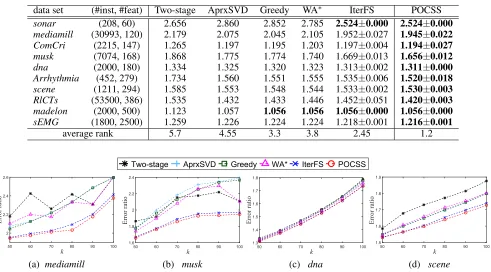
Table 1: The error ratio (the smaller the better) of the compared methods on 10 data sets fork= 50. The mean±std is reported for randomized algorithms. In each data set, the smallest values are bolded.
data set (#inst, #feat) Two-stage AprxSVD Greedy WA∗ IterFS POCSS sonar (208, 60) 2.656 2.860 2.852 2.785 2.524±0.000 2.524±0.000
mediamill (30993, 120) 2.179 2.075 2.045 2.105 1.952±0.027 1.945±0.022
ComCri (2215, 147) 1.265 1.197 1.195 1.203 1.197±0.004 1.194±0.027
musk (7074, 168) 1.868 1.775 1.774 1.740 1.669±0.013 1.656±0.012
dna (2000, 180) 1.334 1.325 1.320 1.323 1.313±0.002 1.311±0.000
Arrhythmia (452, 279) 1.734 1.560 1.551 1.555 1.535±0.006 1.520±0.018
scene (1211, 294) 1.585 1.553 1.548 1.544 1.533±0.002 1.530±0.003
RlCTs (53500, 386) 1.535 1.432 1.433 1.446 1.452±0.051 1.420±0.003
madelon (2000, 500) 1.123 1.057 1.056 1.056 1.056±0.000 1.056±0.000
sEMG (1800, 2500) 1.259 1.226 1.224 1.224 1.218±0.001 1.216±0.001
average rank 5.7 4.55 3.3 3.8 2.45 1.2
50 60 70 80 90 100
1.6 1.8 2 2.2 2.4
Error ratio
Two-stage AprxSVD Greedy WA* IterFS POCSS
50 60 70 80 90 100
k
2 2.2 2.4 2.6
Error ratio
50 60 70 80 90 100
k 1.6
1.8 2 2.2 2.4
Error ratio
50 60 70 80 90 100
k 1.3
1.4 1.5 1.6 1.7 1.8
Error ratio
50 60 70 80 90 100
k
1.5 1.6 1.7 1.8 1.9
Error ratio
(a) mediamill (b) musk (c) dna (d) scene
Figure 1: The comparison for cardinality constraintsk∈ {50,60, . . . ,100}(error ratio: the smaller the better).
The error ratio is obviously always larger than 1. The smaller it is, the better. For POCSS, Two-stage and IterFS, which are randomized algorithms, we repeat the run 10 times indepen-dently and report the average results.
The results fork = 50 are shown in Table 1. POCSS achieves the smallest error ratio on all the data sets. Note that we do not report the standard deviations of Two-stage, because they are always 0, as observed in (Ordozgoiti, Canaval, and Mozo 2016). We compute the rank of each method on each data set as in (Demˇsar 2006), which are av-eraged in the last row of Table 1. We can observe the order “POCSS<IterFS<Greedy<WA∗ <AprxSVD< Two-stage”, which are consistent with “IterFS<Greedy< Two-stage” in (Ordozgoiti, Canaval, and Mozo 2016) as well as “WA∗<Two-stage” in (Arai et al. 2016). Note that although IterFS is overall the second best, its performance is not very stable. For example, on theRlCTsdata set, IterFS is worse than AprxSVD, Greedy and WA∗. Figure 1 examines the in-fluence of the cardinality constraintk. We can observe that POCSS is consistently better than other methods.
Considering the running time, measured by the number of objective function evaluations, POCSS is set to use the theoretical upper bound2ek2n, i.e., the worst-case time. We
also empirically examine how effective POCSS is in prac-tice. For the two data setsRlCTsandsEMGwithk = 50, we plot the curve of the error ratio over the running time for POCSS and select Greedy and IterFS as the baselines. We
50 100 150 200 250 Running time in kn 1.41
1.42 1.43 1.44 1.45 1.46 1.47 1.48 1.49
Error ratio
Greedy IterFS POCSS
4kn
26kn
50 100 150 200 250
Running time in kn 1.215
1.22 1.225 1.23 1.235 1.24
Error ratio
Greedy IterFS POCSS
7kn 31kn
(a) RlCTs (b) sEMG
Figure 2: Performance v.s. running time of POCSS.
can observe from Figure 2 that the time of POCSS to obtain a better performance is much less than the worst-case time
2ek2n ≈ 271kn, implying that POCSS can be efficient in practice.
Conclusion
Appendix
To prove Lemma 1, which shows the recursive relation on
f(S)by deleting one column fromS, we first analyze the recursive relation onE=A−SS+A.
Lemma 6. Sb is the matrix generated by deleting thei-th
column ofS. Letρ= ((S+)
i:)T. Then,
b
E=A−SbSb+A=E+kρk−
2 2 SS
+ρρTA.
Proof. According to Lemma 3,bS+ is the matrix generated
by deleting thei-th row of(S+− kρk−2
2 S+ρρT). Thus,
b
SSb
+
=S(S+−kρk−22S+ρρT)−S:i(S+−kρk−22S
+ ρρT)i:
=S(S+− kρk−2
2 S +ρρT),
where the last equality is by(S+−kρk−22S+ρρT)i:=ρT−
kρk−2
2 ρTρρT =ρT −ρT =0. Then, we have
b
E=A−SbSb+A=A−(SS+− kρk−22SS+ρρT)A
=E+kρk−2
2 SS
+ρρTA.
Based on Lemma 6 andf(S) =kEk2
F, we can update the objectivef when deleting one column from a matrix.
Proof of Lemma 1.
f(bS) =kEbk
2
F =tr(bE T
b
E)
=tr((ET+kρk−22ATρρTSS+)(E+kρk−22SS+ρρTA))
=tr(ETE) + 2kρk−2
2 tr(A
TρρTSS+E)
+kρk−4
2 ·tr(A
TρρTSS+SS+ρρTA),
where the third equality is by Lemma 6 and (SS+)T =
SS+. SinceSis assumed to have full column rank,S+S=
I|S|. Then, we have
ATρρTSS+E=ATρρTSS+(A−SS+A)
=ATρρTSS+A−ATρρTSS+A=0n,n.
SinceρTSS+= (S+)i:SS+= (S+S)i:S+= (I|S|)i:S+=
(S+)
i: =ρT, we have
ATρρTSS+SS+ρρTA=ATρρTSS+ρρTA
=ATρρTρρTA=kρk2
2A
TρρTA=kρk2 2ββ
T.
Applying the above two equations tof(bS), we getf(bS) =
tr(ETE)+kρk−2
2 tr(ββT) =f(S)+kρk −2
2 βTβ.
To prove Lemma 2, which shows the recursive relation on
f(S)by inserting one column intoS, we use the recursive relation onETE, which has already been derived in Corol-lary 3 of (Farahat, Ghodsi, and Kamel 2011).
Proof of Lemma 2. LetEb = A−bSSb+A. According to
Corollary 3 in (Farahat, Ghodsi, and Kamel 2011), we get
b
ETEb =ETE−ETE:j(ETE:j)T/ (ET)j:E:j
.
We then show thatETE:jis justδ. By(SS+)T =SS+and
S+S=I
|S|, we get
δ=ATE:j = (ET+ATSS+)E:j=ETE:j+ATSS+E:j
=ETE:j+ATSS+(A:j−SS+A:j)
=ETE:j+ATSS+A:j−ATSS+SS+A:j =ETE:j.
It is also clear that(ET)j:E:j =δj. Thus, we have
f(bS) =kEbkF2 =tr(EbTEb) =tr(ETE)−tr(δδT)/δj
=f(S)−δTδ/δj.
LetSeandbSdenote the matrix by zeroing-out and deleting
thei-th column ofS, respectively. Lemma 7, i.e., Proposi-tion 1 in (Ordozgoiti, Canaval, and Mozo 2016), gives the Moore-Penrose inverse ofeS. By further investigating the
re-lation between the Moore-Penrose inverse of eSandSb, we
can prove Lemma 3, which shows the recursive relation on
S+by deleting one column from a matrix.
Lemma 7. (Ordozgoiti, Canaval, and Mozo 2016) Se is
the matrix resulting from zeroing-out thei-th column ofS, i.e., the i-th column of eS is comprised by all zeros. Let
ρ= ((S+)
i:)T. Then,eS+=S+− kρk−22S+ρρT.
Proof of Lemma 3. Since the columns of eSandbSspan
the same space, their projection matrices are the same. That is,SeeS+ = SbSb+. LetB denote the matrix by deleting the
i-th row of Se+. Then,SeeS+ = SBb , since thei-th column
of Se contains all zeros. Thus, SBb = bSSb+, implying that
B = bS+SbbS+ = Sb+. According to Lemma 7, bS+ is the
matrix by deleting the i-th row of(S+− kρk−2
2 S+ρρT).
Thus, the lemma holds. Lemma 4 shows the recursive relation onS+by inserting one column into a matrix. Our proof idea is to first analyze the Moore-Penrose inverse of the resulting matrix when the inserting position is the last column, and then analyze the influence on the Moore-Penrose inverse by switching two columns of a matrix.
Proof of Lemma 4. We first insert thej-th column ofA
into Sas its last column, and compute the Moore-Penrose inverse of the resulting matrix[S A:j]. For notational sim-plicity, letv=A:jandB=STS.
[S v]+=
ST
vT
[S v]
−1
ST
vT
=
B STv
vTS vTv
−1
ST
vT
=
B−1+τB−1STvvTSB−1 −τB−1STv
−τvTSB−1 τ
ST
vT
=
B−1ST+τB−1STvvTSB−1ST−τB−1STvvT −τvTSB−1ST+τvT
=
S++τS+vvTSS+−τS+vvT −τvTSS++τvT
,
where the first equality is by the definition of the Moore-Penrose inverse of a full column rank matrix, the third equal-ity is by block matrix inversion and
τ = (vTv−vTSB−1STv)−1
= ((v−SS+v)T(v−SS+v))−1= ((E:j)TE:j)−1,
and the fourth equality is by block matrix multiplication. SincevTSS+= (SS+v)T =vT−(E
:j)T, we have
[S v]+=
S+−((E
:j)TE:j)−1S+v(E:j)T
((E:j)TE:j)−1(E:j)T
Then, we show that ifCeis the matrix generated by
switch-ing thei-th andj-th columns of a matrixC,Ce+is the matrix
that swaps thei-th row andj-th row inC+. LetTdenote the
elementary matrix obtained by swapping thei-th row andj -th row of -the identity matrixI|C|. Then,Ce =CT.
Accord-ing to Corollary 2.3 in (Cline and Greville 1970), we get
e
C+= (CT)+= (C+CT)+(CTT+)+
= (I|C|T)+(CI|C|)+=T+C+=TC+.
Since TC+ is just swapping the i-th row andj-th row in
C+, our claim holds.
Note that the matrixSbwe are to analyze is generated by
inserting thej-th column ofA into Sas thei-th column. Thus, by combining Eq. (1) (wherev=A:j) with the above
claim, the lemma holds.
References
Arai, H.; Maung, C.; Xu, K.; and Schweitzer, H. 2016. Un-supervised feature selection by heuristic search with prov-able bounds on suboptimality. InAAAI, 666–672.
Arai, H.; Maung, C.; and Schweitzer, H. 2015. Optimal column subset selection by A-star search. InAAAI, 1079– 1085.
Bhaskara, A.; Rostamizadeh, A.; Altschuler, J.; Zadi-moghaddam, M.; Fu, T.; and Mirrokni, V. 2016. Greedy column subset selection: New bounds and distributed algo-rithms. InICML, 2539–2548.
Boutsidis, C.; Mahoney, M. W.; and Drineas, P. 2009. An improved approximation algorithm for the column subset se-lection problem. InSODA, 968–977.
C¸ ivril, A. 2014. Column subset selection problem is UG-hard. Journal of Computer and System Sciences80(4):849– 859.
Chan, T. F., and Hansen, P. C. 1992. Some applications of the rank revealing QR factorization. SIAM Journal on Scientific and Statistical Computing13(3):727–741.
Civril, A., and Magdon-Ismail, M. 2012. Column subset se-lection via sparse approximation of SVD.Theoretical Com-puter Science421:1–14.
Cline, R. E., and Greville, T. N. E. 1970. An extension of the generalized inverse of a matrix. SIAM Journal on Applied Mathematics19(4):682–688.
Cohen, M. B.; Elder, S.; Musco, C.; Musco, C.; and Persu, M. 2015. Dimensionality reduction fork-means clustering and low rank approximation. InSTOC, 163–172.
Das, A., and Kempe, D. 2011. Submodular meets spectral: Greedy algorithms for subset selection, sparse approxima-tion and dicapproxima-tionary selecapproxima-tion. InICML, 1057–1064.
Demˇsar, J. 2006. Statistical comparisons of classifiers over multiple data sets. Journal of Machine Learning Research 7:1–30.
Drineas, P.; Mahoney, M.; and Muthukrishnan, S. 2008. Relative-error CUR matrix decompositions. SIAM Journal on Matrix Analysis and Applications30(2):844–881.
Farahat, A. K.; Ghodsi, A.; and Kamel, M. S. 2011. An efficient greedy method for unsupervised feature selection. InICDM, 161–170.
Friedrich, T., and Neumann, F. 2015. Maximizing submod-ular functions under matroid constraints by evolutionary al-gorithms. Evolutionary Computation23(4):543–558. Golub, G. H., and Reinsch, C. 1971. Singular value de-composition and least squares solutions. InLinear Algebra. 134–151.
Gu, M., and Eisenstat, S. C. 1996. Efficient algorithms for computing a strong rank-revealing QR factorization. SIAM Journal on Scientific Computing17(4):848–869.
Guruswami, V., and Sinop, A. K. 2012. Optimal column-based low-rank matrix reconstruction. In SODA, 1207– 1214.
Hinton, G. E., and Salakhutdinov, R. R. 2006. Reducing the dimensionality of data with neural networks. Science 313(5786):504–507.
Hoog, F. D., and Mattheij, R. 2007. Subset selection for matrices. Linear Algebra and its Applications422(2):349 – 359.
Jolliffe, I. 2011. Principal component analysis. In Interna-tional Encyclopedia of Statistical Science. 1094–1096. Ordozgoiti, B.; Canaval, S. G.; and Mozo, A. 2016. A fast iterative algorithm for improved unsupervised feature selec-tion. InICDM, 390–399.
Ordozgoiti, B.; Canaval, S. G.; and Mozo, A. 2018. Iter-ative column subset selection. Knowledge and Information Systems54(1):65–94.
Pan, C.-T., and Tang, P. T. P. 1999. Bounds on singular values revealed by QR factorizations. BIT Numerical Math-ematics39(4):740–756.
Qian, C.; Shi, J.-C.; Yu, Y.; Tang, K.; and Zhou, Z.-H. 2016. Parallel Pareto optimization for subset selection. InIJCAI, 1939–1945.
Qian, C.; Shi, J.-C.; Yu, Y.; Tang, K.; and Zhou, Z.-H. 2017a. Subset selection under noise. InNIPS, 3562–3572.
Qian, C.; Shi, J.-C.; Yu, Y.; and Tang, K. 2017b. On sub-set selection with general cost constraints. InIJCAI, 2613– 2619.
Qian, C.; Shi, J.-C.; Tang, K.; and Zhou, Z.-H. 2018a. Con-strained monotonek-submodular function maximization us-ing multi-objective evolutionary algorithms with theoretical guarantee.IEEE Transactions on Evolutionary Computation 22(4):595–608.
Qian, C.; Zhang, Y.; Tang, K.; and Yao, X. 2018b. On mul-tiset selection with size constraints. InAAAI, 1395–1402. Qian, C.; Feng, C.; and Tang, K. 2018. Sequence selection by Pareto optimization. InIJCAI, 1485–1491.
Qian, C.; Yu, Y.; and Zhou, Z.-H. 2015. Subset selection by Pareto optimization. InNIPS, 1774–1782.