R E S E A R C H
Open Access
Fixed points of a new type of contractive
mappings in complete metric spaces
Dariusz Wardowski
Correspondence: [email protected]. lodz.pl
Department of Nonlinear Analysis, Faculty of Mathematics and Computer Science, University of Łódź, Banacha 22, 90-238Łódź, Poland
Abstract
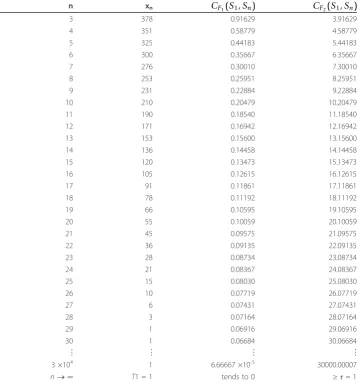
In the article, we introduce a new concept of contraction and prove a fixed point theorem which generalizes Banach contraction principle in a different way than in the known results from the literature. The article includes an example which shows the validity of our results, additionally there is delivered numerical data which illustrates the provided example.
MSC:47H10; 54E50
Keywords:F-contraction, contractive mapping, fixed point, complete metric space
1 Introduction
Throughout the article denoted byℝis the set of all real numbers, byℝ+is the set of all positive real numbers and by N is the set of all natural numbers. (X, d), (X for short), is a metric space with a metricd.
In the literature, there are plenty of extensions of the famous Banach contraction principle [1], which states that every self-mapping T defined on a complete metric space (X,d) satisfying
∀x,y∈Xd(Tx,Ty)≤λd(x,y), whereλ∈(0, 1), (1) has a unique fixed point and for everyx0 ÎX a sequence {Tnx0}nÎNis convergent to
the fixed point. Some of the extensions weaken right side of inequality in the condition (1) by replacinglwith a mapping, see e.g. [2,3]. In other results, the underlying space is more general, see e.g [4-7]. The Nadler’s paper [8] started the invatigations concern-ing fixed point theory for set-valued contractions, see e.g. [9-20]. There are many theo-rems regarding asymptotic contractions, see e.g. [21-23], contractions of Meir-Keeler type [24], see e.g [19,23,25] and weak contractions, see e.g. [26-28]. There are also lots of different types of fixed point theorems not mentioned above extending the Banach’s result.
In the present article, using a mappingF:ℝ+ ®ℝwe introduce a new type of con-traction called F-contraction and prove a new fixed point theorem concerningF -con-traction. For the concrete mappingsF, we obtain the contractions of the type known from the literature, Banach contraction as well. The article includes the examples ofF -contractions and an example showing that the obtained extension is significant. Theo-retical considerations that we support by computational data illustrate the nature ofF -contractions.
2 The result
Definition 2.1LetF:ℝ+®ℝbe a mapping satisfying:
(F1) Fis strictly increasing, i.e. for all a,bÎℝ+such thata<b,F(a)< F (b); (F2) For each sequence {an}nÎN of positive numbers limn®∞an= 0 if and only if limn®∞F(an) = -∞;
(F3) There existskÎ(0, 1) such that lima®0+akF(a) = 0.
A mapping T:X® Xis said to be anF-contraction if there existsτ>0 such that
∀x,y∈X(d(Tx,Ty)>0⇒τ+F(d(Tx,Ty))≤F(d(x,y))). (2) When we consider in (2) the different types of the mapping F then we obtain the variety of contractions, some of them are of a type known in the literature. See the fol-lowing examples:
Example 2.1 LetF:ℝ+ ®ℝbe given by the formulaF(a) = lna. It is clear thatF satisfies (F1)-(F3) ((F3) for any kÎ (0, 1)). Each mappingT: X®X satisfying (2) is an
F-contraction such that
d(Tx,Ty)≤e−τd(x,y), for allx,y∈X, Tx=Ty. (3)
It is clear that for x,y Î X such that Tx=Tythe inequality d(Tx, Ty)≤ e-τd(x, y) also holds, i.e. Tis a Banach contraction [1].
Example2.2 IfF(a) = lna+a,a>0 thenFsatisfies (F1)-(F3) and the condition (2) is of the form
d(Tx,Ty) d(x,y) e
d(Tx,Ty)−d(x,y)≤e−τ, for allx,y∈X, Tx=Ty. (4)
Example 2.3ConsiderF(α) =−1/√α, a > 0.Fsatisfies (F1)-(F3) ((F3) for any kÎ
(1/2, 1)). In this case, each F-contractionTsatisfies
d(Tx,Ty)≤ 1 (1 +τd(x,y))2
d(x,y), for allx,y∈X, Tx=Ty.
Here, we obtained a special case of nonlinear contraction of the type d(Tx,Ty)≤a(d (x,y))d(x,y). For details see [2,3].
Example 2.4Let F(a) = ln(a2 +a),a >0. ObviouslyFsatisfies (F1)-(F3) and forF -contractionT, the following condition holds:
d(Tx,Ty)(d(Tx,Ty) + 1) d(x,y)(d(x,y) + 1) ≤e
−τ, for allx,y∈X, Tx=Ty.
Let us observe that in Examples 2.1-2.4 the contractive conditions are satisfied forx,
y ÎX, such thatTx=Ty.
Remark 2.1 From (F1) and (2) it is easy to conclude that everyF-contraction Tis a contractive mapping, i.e.
d(Tx,Ty)<d(x,y), for allx,y∈X,Tx=Ty.
Thus everyF-contraction is a continuous mapping.
Remark 2.2Let F1,F2 be the mappings satisfying (F1)-(F3). IfF1(a)≤F2(a) for alla
Indeed, from Remark 2.1 we haveG(d(Tx,Ty)) ≤G(d(x,y)) for allx,y ÎX,Tx≠Ty. Thus, for allx,yÎ X,Tx≠Tywe obtain
τ+F2(d(Tx,Ty)) =τ+F1(d(Tx,Ty)) +G(d(Tx,Ty))
≤F1(d(x,y)) +G(d(x,y)) =F2(d(x,y)).
Now we state the main result of the article.
Theorem 2.1 Let(X, d)be a complete metric space and let T: X® X be an F-con-traction. Then T has a unique fixed point x* Î X and for every x0 Î X a sequence {Tnx0}nÎN is convergent to x*.
Proof. First, let us observe thatT has at most one fixed point. Indeed, if x∗1, x∗2∈X, Tx∗1=x∗1=x∗2=Tx∗2, then we get
τ ≤F(d(x∗1,x∗2))−F(d(Tx∗1,Tx∗2)) = 0,
which is a contradiction.
In order to show that T has a fixed point let x0 Î X be arbitrary and fixed. We define a sequence {xn}nÎN⊂X,xn+1=Txn,n= 0, 1, .... Denotegn= d(xn+1,xn),n= 0, 1, ....
If there existsn0Î Nfor whichxn0+1=xn0, thenTxn0=xn0and the proof is finished.
Suppose now that xn+1 ≠xn, for everynÎ N. Thengn>0 for allnÎ Nand, using (2), the following holds for everynÎN:
F(γn)≤F(γn−1)−τ ≤F(γn−2)−2τ ≤. . .≤F(γ0)−nτ. (5)
From (5), we obtain limn®∞F(gn) = -∞that together with (F2) gives
lim
n→∞γn= 0. (6)
From (F3) there existskÎ(0, 1) such that
lim n→∞γn
kF(γ
n) = 0. (7)
By (5), the following holds for all nÎ N:
γnkF(γn)−γnkF(γ0)≤γnk(F(γ0)−nτ)−γnkF(γ0) =−γnknτ ≤0. (8) Lettingn®∞in (8), and using (6) and (7), we obtain
lim n→∞nγn
k= 0.
(9)
Now, let us observe that from (9) there existsn1 Î Nsuch thatnγnk≤1for alln≥ n1. Consequently we have
γn≤ 1
n1/k, for alln≥n1. (10)
In order to show that {xn}nÎN is a Cauchy sequence considerm, nÎN such thatm
> n ≥ n1. From the definition of the metric and from (10) we
getd(xm,xn)≤γm−1+γm−2+· · ·+γn< ∞
i=n
γi≤ ∞
i=n 1
i1/k.
From the above and from the convergence of the series∞ i=11/i
1
k we receive that
From the completeness of X there exists x* Î Xsuch that limn®∞xn =x*. Finally, the continuity ofTyields
d(Tx∗,x∗) = lim
n→∞d(Txn,xn) = limn→∞d(xn+1,xn) = 0,
which completes the proof.□
Note that for the mappingsF1(a) = ln(a),a>0,F2(a) = ln(a) +a,a>0,F1< F2and a mapping F2 - F1 is strictly increasing. Hence, by Remark 2.2, we obtain that every Banach contraction (3) satisfies the contraction condition (4). On the other side in Example 2.5, we present a metric space and a mapping Twhich is notF1-contraction (Banach contraction), but still is anF2-contraction. Consequently, Theorem 2.1 gives the family of contractions which in general are not equivalent.
Example2.5Consider the sequence {Sn}nÎNas follows:
S1= 1,
S2= 1 + 2,
. . .
Sn= 1 + 2 +· · ·+n=
n(n+ 1) 2 ,n∈N, . . .
Let X= {Sn:nÎN} and d(x,y) = |x-y|,x,yÎ X. Then (X,d) is a complete metric space. Define the mapping T:X® Xby the formulae:
T(Sn) =Sn−1 forn>1,
T(S1) =S1.
First, let us consider the mapping F1defined in Example 2.1. The mappingT is not the F1-contraction in this case (which actually means thatTis not the Banach contrac-tion). Indeed, we get
lim n→∞
d(T(Sn),T(S1))
d(Sn,S1)
= lim n→∞
Sn−1−1
Sn−1 = 1.
On the other side taking F2 as in Example 2.2, we obtain that T isF2-contraction withτ= 1. To see this, let us consider the following calculations:
First, observe that
∀m,n∈N[T(Sm)=T(Sn)⇔((m>2∧n= 1)∨(m>n>1))]. For every mÎN,m >2 we have
d(T(Sm),T(S1))
d(Sm,S1)
ed(T(Sm),T(S1))−d(Sm,S1)= Sm−1−1
Sm−1
eSm−1−Sm
= m
2−m−2
m2+m−2e−
m<e−m<e−1.
For every m,nÎN,m > n >1 the following holds
d(T(Sm),T(Sn)) d(Sm,Sn)
ed(T(Sm),T(Sn))−d(Sm,Sn)= Sm−1−Sn−1 Sm−Sn
eSn−Sn−1+Sm−1−Sm
= m+n−1
m+n+ 1e
Clearly S1 is a fixed point ofT. To see the computational data confirming the above calculations the reader is referred to Table 1.
Acknowledgements
The author is very grateful to the reviewers for their insightful reading the manuscript and valuable comments. This article was financially supported by University ofŁódźas a part of donation for the research activities aimed in the development of young scientists.
Competing interests
The author declares that he has no competing interests.
Received: 20 April 2012 Accepted: 7 June 2012 Published: 7 June 2012
References
1. Banach, S: Sur les opérations dans les ensembles abstraits et leur applications aux équations intégrales. Fund Math.3, 133–181 (1922)
2. Boyd, DW, Wong, JSW: On nonlinear contractions. Proc Am Math Soc.20, 458–464 (1969). doi:10.1090/S0002-9939-1969-0239559-9
3. Rakotch, E: A note on contractive mappings. Proc Am Math Soc.13, 459–465 (1962). doi:10.1090/S0002-9939-1962-0148046-1
4. Arandjelović, I, Kadelburg, Z, Radenović, S: Boyd-Wong-type common fixed point results in cone metric spaces. Appl Math Comput.217, 7167–7171 (2011). doi:10.1016/j.amc.2011.01.113
Table 1 The comparison of Banach contraction condition with F-contraction condition
n xn CF1(S1,Sn) CF2(S1,Sn)
3 378 0.91629 3.91629
4 351 0.58779 4.58779
5 325 0.44183 5.44183
6 300 0.35667 6.35667
7 276 0.30010 7.30010
8 253 0.25951 8.25951
9 231 0.22884 9.22884
10 210 0.20479 10.20479
11 190 0.18540 11.18540
12 171 0.16942 12.16942
13 153 0.15600 13.15600
14 136 0.14458 14.14458
15 120 0.13473 15.13473
16 105 0.12615 16.12615
17 91 0.11861 17.11861
18 78 0.11192 18.11192
19 66 0.10595 19.10595
20 55 0.10059 20.10059
21 45 0.09575 21.09575
22 36 0.09135 22.09135
23 28 0.08734 23.08734
24 21 0.08367 24.08367
25 15 0.08030 25.08030
26 10 0.07719 26.07719
27 6 0.07431 27.07431
28 3 0.07164 28.07164
29 1 0.06916 29.06916
30 1 0.06684 30.06684
⋮ ⋮ ⋮ ⋮
3 ×10⁴ 1 6.66667 ×10⁻⁵ 30000.00007
n®∞ T1 = 1 tends to 0 ≥τ= 1
5. Huang, LG, Zhang, X: Cone metric spaces and fixed point theorems of contractive maps. J Math Anal Appl.332, 1467–1475 (2007)
6. Kadelburg, Z, Radenović, S, Rakočević, V: Remarks on“Quasi-contraction on a cone metric space. Appl Math Lett.22, 1674–1679 (2009). doi:10.1016/j.aml.2009.06.003
7. Tarafdar, E: An approach to fixed-point theorems on uniform spaces. Trans Am Math Soc.191, 209–225 (1974) 8. Nadler, SB Jr: Multi-valued contraction mappings. Pac J Math.30, 475–488 (1969)
9. Ćirić, L: Multi-valued nonlinear contraction mappings. Nonlinear Anal.71, 2716–2723 (2009). doi:10.1016/j.na.2009.01.116 10. Feng, Y, Liu, S: Fixed point theorems for multi-valued contractive mappings and multi-valued Caristi type mappings. J
Math Anal Appl.317, 103–112 (2006). doi:10.1016/j.jmaa.2005.12.004
11. Klim, D, Wardowski, D: Fixed point theorems for set-valued contractions in complete metric spaces. J Math Anal Appl. 334, 132–139 (2007). doi:10.1016/j.jmaa.2006.12.012
12. Mizoguchi, N, Takahashi, W: Fixed point theorems for multivalued mappings on complete metric spaces. J Math Anal Appl.141, 177–188 (1989). doi:10.1016/0022-247X(89)90214-X
13. Reich, S: Fixed points of contractive functions. Boll Unione Mat Ital.5, 26–42 (1972)
14. Reich, S: Approximate selections, best approximations, fixed points, and invariant sets. J Math Anal Appl.62, 104–113 (1978). doi:10.1016/0022-247X(78)90222-6
15. Türkoglu, D: Fisher B: Fixed point of multivalued mapping in uniform spaces. Proc Indian Acad Sci (Math Sci).113, 183–187 (2003). doi:10.1007/BF02829768
16. Wardowski, D: Endpoints and fixed points of set-valued contractions in cone metric spaces. Nonlinear Anal.71, 512–516 (2009). doi:10.1016/j.na.2008.10.089
17. Wardowski, D: On set-valued contractions of Nadler type in cone metric spaces. Appl Math Lett.24, 275–278 (2011). doi:10.1016/j.aml.2010.10.003
18. Włodarczyk, K, Obczyński, C, Wardowski, D: Set-valued dynamic systems and random iterations of set-valued weaker contractions in uniform spaces. J Math Anal Appl.318, 772–780 (2006). doi:10.1016/j.jmaa.2005.05.047
19. Włodarczyk, K, Plebaniak, R, Obczyński, C: The uniqueness of endpoints for set-valued dynamical systems of contractions of Meir-Keeler type in uniform spaces. Nonlinear Anal.67, 3373–3383 (2007). doi:10.1016/j.na.2006.10.019
20. Zhong, CK, Zhu, J, Zhao, PH: An extension of multi-valued contraction mappings and fixed points. Proc Am Math Soc. 128, 2439–2444 (1999)
21. Jachymski, J, Jóźwik, I: On Kirk’s asymptotic contractions. J Math Anal Appl.300, 147–159 (2004). doi:10.1016/j. jmaa.2004.06.037
22. Kirk, WA: Fixed points of asymptotic contractions. J Math Anal Appl.277, 645–650 (2003). doi:10.1016/S0022-247X(02) 00612-1
23. Suzuki, T: Fixed-point theorem for asymptotic contractions of Meir-Keeler type in complete metric spaces. Non-linear Anal.64, 971–978 (2006)
24. Meir, A, Keeler, E: A theorem on contraction mappings. J Math Anal Appl.28, 326–329 (1969). doi:10.1016/0022-247X (69)90031-6
25. Agarwal, RP, O’Regan, D, Shahzad, N: Fixed point theory for generalized contractive maps of Meir-Keeler type. Math Nachr.276, 3–22 (2004). doi:10.1002/mana.200310208
26. Abdeljawad, T: Fixed points for generalized weakly contractive mappings in partial metric spaces. Math Comput Modelling.54, 2923–2927 (2011). doi:10.1016/j.mcm.2011.07.013
27. Abdeljawad, T, Karapinar, E, Taş, K: Existence and uniqueness of a common fixed point on partial metric spaces. Appl Math Lett.24, 1900–1904 (2011). doi:10.1016/j.aml.2011.05.014
28. Choudhury, Binayak, S, Konar, P, Rhoades, BE, Metiya, N: Fixed point theorems for generalized weakly contractive mappings. Nonlinear Anal.74, 2116–2126 (2011). doi:10.1016/j.na.2010.11.017
doi:10.1186/1687-1812-2012-94
Cite this article as:Wardowski:Fixed points of a new type of contractive mappings in complete metric spaces. Fixed Point Theory and Applications20122012:94.
Submit your manuscript to a
journal and benefi t from:
7 Convenient online submission
7 Rigorous peer review
7 Immediate publication on acceptance
7 Open access: articles freely available online
7 High visibility within the fi eld
7 Retaining the copyright to your article