The Thirty-Third AAAI Conference on Artificial Intelligence (AAAI-19)
DRr-Net: Dynamic Re-Read Network for Sentence Semantic Matching
Kun Zhang,
1Guangyi Lv,
1Linyuan Wang,
1Le Wu,
2Enhong Chen,
1,*Fangzhao Wu,
3Xing Xie
3 1Anhui Province Key Laboratory of Big Data Analysis and Application, School of Computer Science and Technology,University of Science and Technology of China {zhkun, gylv, wly757}@mail.ustc.edu.cn, [email protected]
2Hefei University of Technology, China, [email protected]
3Microsoft Research Asia, China, [email protected], [email protected]
Abstract
Sentence semantic matching requires an agent to determine the semantic relation between two sentences, which is widely used in various natural language tasks such as Natural Lan-guage Inference (NLI) and Paraphrase Identification (PI). Among all matching methods, attention mechanism plays an important role in capturing the semantic relations and prop-erly aligning the elements of two sentences. Previous meth-ods utilized attention mechanism to select important parts of sentences at one time. However, the important parts of the sentence during semantic matching are dynamically changing with the degree of sentence understanding. Selecting the im-portant parts at one time may be insufficient for semantic un-derstanding. To this end, we propose aDynamic Re-read Net-work (DRr-Net) approach for sentence semantic matching, which is able to pay close attention to a small region of sen-tences at each step and re-read the important words for bet-ter sentence semantic understanding. To be specific, we first employ Attention Stack-GRU (ASG) unit to model the origi-nal sentence repeatedly and preserve all the information from bottom-most word embedding input to up-most recurrent out-put. Second, we utilize Dynamic Re-read (DRr) unit to pay close attention to one important word at one time with the consideration of learned information and re-read the impor-tant words for better sentence semantic understanding. Ex-tensive experiments on three sentence matching benchmark datasets demonstrate thatDRr-Nethas the ability to model sentence semantic more precisely and significantly improve the performance of sentence semantic matching. In addition, it is very interesting that some of finding in our experiments are consistent with the findings of psychological research.
1
Introduction
Sentence semantic matching, a fundamental technology in natural language processing, requires an agent to predict the semantic relation between two sentences. For exam-ple, in Natural Language Inference (NLI), sentence seman-tic matching is utilized to determine whether a hypothesis sentence can reasonably be inferred from a given premise sentence (Kim et al. 2018). In Paraphrase Identification (PI), it is utilized to identify whether two sentences express the same meaning or not (Dolan and Brockett 2005).
Copyright c2019, Association for the Advancement of Artificial Intelligence (www.aaai.org). All rights reserved.
As a fundamental technology, sentence semantic match-ing has broad applications, e.g. information retrieval (Clark et al. 2016), question answering (Wang et al. 2017; Liu et al. 2018), and dialog system (Serban et al. 2016). With the large annotated datasets (Bowman et al. 2015; Iyer, Dan-dekar, and Csernai 2017) and advancement of representa-tion learning techniques (Cheng, Dong, and Lapata 2016; Vaswani et al. 2017), rapid development on sentence mantic matching has been enabled. Among the core se-mantic matching techniques, attention mechanism plays an important role, which is known for its alignment between representations and modeling the dependency regardless of sequence length. For example, self-attention (Vaswani et al. 2017) can generate better representations by relating elements at different positions in a single sentence. Co-attention (Kim et al. 2018) is capable of modeling sentence interaction in a detailed perspective. They together have be-come essential for tackling numerous complicated tasks.
However, most of the existing methods select all the im-portant parts of sentences at one time. In fact, the imim-portant parts of sentences during semantic matching are dynami-cally changing with the progress of sentence understanding and should be repeatedly read and processed. For example, when judging the relation between “a person with a purple shirt is painting an image of a woman on a white wall” and “a woman paints a portrait of her best friend”, the impor-tant words will change from “person, purple, shirt, paint-ing, image, woman” to “person, image, woman” in the first sentence, and from “woman, paints, portrait, best friend” to “woman, portrait, best friend”in the second sentence. As the Chinese proverb says: “The gist of an article will come to you after reading it over 100 times”. The important words should be repeatedly read and thought for the final decision. Moreover, psychological researches have shown that hu-mans only pay attention to a small region of information at one time, i.e., people only focus on1.5words each time when intensively reading a piece of text (Wang et al. 1999). Koch and Tsuchiya (2007) have demonstrated that people might focus on less than7different objects at the same time. All of the studies indicate that the important words in sen-tences should be dynamic re-read and re-thought for better semantic understanding and matching.
better sentence semantic matching. To be specific, we uti-lize Attention Stack-GRU (ASG) unit to model the sentence semantic comprehensively and preserve all the information from bottom-most word embedding input to up-most recur-rent output. Then, we use Dynamic Re-read (DRr) unit to pay close attention to one important word at each step and repeatedly read the important words for better sentence se-mantic understanding. In this way,DRr-Net can select the most important word to process with the consideration of learned information, which is in favor of tackling sentence semantic matching task. Extensive evaluations on three sen-tence matching datasets demonstrate the effectiveness of DRr-Netin sentence semantic matching and its advantages over state-of-the-art sentence encoding-based baselines.
2
Related Work
In this section, we will introduce the related works on sen-tence semantic matching and human attention.
2.1
Sentence Semantic Matching
Sentence semantic matching has achieved a big progress with the development of large annotated data, such as SNLI (Bowman et al. 2015), and Quora Question Pair (Iyer, Dandekar, and Csernai 2017), and various neural network architectures, such as LSTM (Cheng, Dong, and Lapata 2016), GRU (Chung et al. 2014) and attention mecha-nism (Vaswani et al. 2017; Kun et al. 2018). Among all these methods, attention mechanism plays an important role, which helps models capture the semantic relations and prop-erly align the elements of two sentences. For example, Liu et al. (2016) proposed inner-attention to imitate the human behaviour that concerned more about the important words when reading. Then, they utilized mean pooling to generate the sentence vectors for sentence semantic matching. Shen et al. (2017) developed a directional and multidimensional attention without RNN/CNN structure. They calculated the attention on each dimension of word representations. Then, they utilized a multi-dimensional attention to compress the sequence into a vector, followed by a classification model to compute the final prediction. Kim et al. (2018) utilized densely-connected co-attention network to retain as many features as possible for better sentence understanding. Im and Cho (2017) adopted the masked multi-head attention with distance to explore the sentence semantic. Then, they utilized densely-connected operation to preserve all the in-formation for better sentence semantic matching. However, most of these methods selected all the important parts of sentences at one time. In fact, the important words of tences are dynamically changing with the progress of sen-tence understanding. Their methods may be insufficient for better sentence semantic matching.
2.2
Human Attention
Attention mechanism has been widely applied to both nat-ural language process and computer vision domains (Gong, Luo, and Zhang 2017). It allows the model to focus on dis-tinct aspects of the input and thus improve its ability to ex-tract the most relevant parts for outputs (Cho, Courville, and
Bengio 2015). Though attention mechanism is helpful for better performance, there is still much to learn in the form of human attention. Psychologists have done plenty of research on this domain. By building an eye tracker, O’Shea (1908) found that some words in a sentence were not fixated when people were reading. Yarbus (1967) described human atten-tion “is dependent on not only what is shown on the picture, but also the problem facing the observer and the informa-tion that he hopes to gain”. Moreover, Wang et al. (1999) found that people may focus on1.5words each time when intensively reading a piece of text. Further research (Koch and Tsuchiya 2007; Tononi 2008) demonstrated that people might focus on less than7different object at the same time, which meant that human only focused on a small part of in-formation at one time and repeatedly processed important parts for better understanding.
These psychological studies inspired us to utilize the at-tention mechanism to focus the model on the most important part at each time and repeatedly select the important word with the consideration of learned information for better sen-tence semantic matching.
3
Problem Statement and Model Structure
In this section, we formulate the sentence semantic matching task as a supervised classification problem and introduce the structure and technical details ofDynamic Re-read Network (DRr-Net)for sentence semantic matching.
3.1
Problem Statement
First, we define our task in a formal way. Given two sentence
sa = {wa1,wa2, ...,wlaa} ands
b ={wb
1,wb2, ...,wblb}. Our
goal is to learn a classifierξwhich is able to precisely predict the relationy=ξ(sa,sb)betweensaandsb. Here,wa
i and
wb
jare one-hot vectors which represent theithandjthword
in the sentences, andla andlb indicate the total number of
words insaandsb.
In order to understand sentence semantic more precisely and do better semantic matching, the following important challenge should be considered:
• With the degree of sentence understanding, the important words in the sentence that should be concerned are dy-namically changing at each step. How to ensure which word should be paid more attention to at each step with the consideration of learned information?
To this end, we propose a Dynamic Re-read Network (DRr-Net)approach for sentence semantic matching.
3.2
Overall Architecture of
DRr-Net
(B) Two-layer ASG Unit without attention (C) DRr Unit
GRU GRU GRU
Attention Unit
Attention Unit
Attention Unit initial
guide
1 , 2 {a}
a a a
i
h h h
(A) The Architecture of Dynamic Re-read Network (DRr-Net)
1
a
a
2a
l
a
GRU ...
1 1
x
GRU
1 2
x
GRU
1
a
l
x
b h
a h
1, 2,..., a
a a a
l
h h h
a
v
GRU ...
2 1
x
GRU
2 2
x
GRU
2
a
l
x
b v b
j h
Matching
Matching
ASG Unit DRr Unit
a
s
b
ASG Unit DRr Unit
b s
Input Embedding Dynamic Re-read Mechanism Label Prediction
a
h
a i
h
av
b
h
h
p
v
p
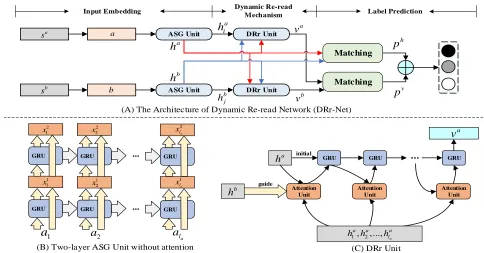
aFigure 1: Architecture ofDynamic Re-read Network (DRr-Net).
Input Embedding. This component consists of two parts: word embedding and Attention Stack-GRU (ASG) unit.
1) Word Embedding: The inputs of DRr-Net are one-hot representations sa = {w1a,w2a, ...,wal
a} and s
b =
{wb1,wb2, ...,wblb}for sentenceaandb. For a more
compre-hensive access to the semantic of each word in sentences, we utilize the concatenation of pre-trained word embed-ding (Pennington, Socher, and Manning 2014), character features (Gong, Luo, and Zhang 2017), and syntactical fea-tures (Chen et al. 2017a; Gururangan et al. 2018) to rep-resent each word in sentences. The character features are obtained by applying a convolutional neural network with a max pooling layer to the learned character embeddings, which can represent words in a finer-granularity and help to avoid the Out-Of-Vocabulary (OOV) problem that pre-trained word vectors suffer from. The syntactical features consist of the embedding of part-of-speech tagging feature, binary exact match feature, and binary antonym feature, which have been proved useful for sentence semantic under-standing (Chen et al. 2017a; Gururangan et al. 2018). Next, we pass these representations through a two-layer highway network (Srivastava, Greff, and Schmidhuber 2015) and get the extravagant representations {ai|i = 1,2, ..., la} and
{bj|j= 1,2, ..., lb}for the words in sentencesaandb.
2) Attention Stack-GRU (ASG) Unit. It is beneficial re-peatedly reading a sentence multiple times for sentence se-mantic understanding. In order to model sentence sese-mantic more comprehensively in this way, we employ the stacked Recurrent Neural Network (stack-RNN) (Nie and Bansal 2017), which are composed of multiple RNN layers on the top of each other, to process the sentences. Note that we
uti-lize Gated Recurrent Unit (GRU) as the base unit in DRr-Net. To be specific, letHlbe thelthGRU layer. At the time
stept, an ordinary stacked RNN is expressed as follows:
hlt=Hl(xlt, h l
t−1), x
l
t=h
l−1
t , (1)
wherexl
tis the input of thetth step in thelthGRU layer.
While this architecture enables us to build up deeper rep-resentations, it cannot preserve all the learned information. Even worse this architecture might cause the exploding or vanishing gradient problems. Motivated by (Kim et al. 2018), we concatenate the inputsx(l−1)and the statesh(l−1)
of the(l−1)thGRU layer as the inputs of thelthGRU layer.
In other words, Eq. (1) will be modified as follows:
hlt=Hl(xlt, h l
t−1), x
l
t= [h
l−1
t ;x
l−1
t ]. (2)
Note that[.;.]denotes the concatenation operation. The outputs {ha
i|i = 1,2, ..., la} and {hbj|j = 1,2, ..., lb} of
stack-GRU are the concatenation of outputs of all GRU lay-ers and the inputs of Attention Stack-GRU unit for sentence
a and b, which can preserve all the information, as well as the previous feature work in word embedding part. Fig-ure 1 (B) shows the detailed structFig-ure.
and Bengio 2015). Therefore, it is natural to utilize attention mechanism to integrate the outputs of Stack-GRU:
Aa = [ha1,ha2, ...,hala],
αa =ωTtanh(W Aa+b),
ha =
la
X
i=1
exp(αa
i)
Pla
k=1exp(α
a
k)
hai, i= 1,2, ..., la,
(3)
whereha is original representation of sentencea, which is actually a weight summation of the final outputs of stack-GRU.ω,W, andbare trainable parameters. The same oper-ation will be done on sentencebto get the original represen-tationhb. By utilizing this operation,DRr-Netcan gather all
the important information, which is critical for the sentence semantic, to generate the original sentence representation.
Dynamic Re-read Mechanism. Psychological researches have shown that people usually cannot pay close attention to too many things at the same time (Wang et al. 1999). In fact, humans could focus on less than 7 different object at the same time. When reading a piece of text intensively, peo-ple focus on only1.5words each time (Wang et al. 1999). Moreover, with an in-depth understanding of the sentence, the important words that should be concerned are dynam-ically changing, even the words that did not get attention before. In order to pay close attention to the most important word at each step with the consideration of learned informa-tion, we develop the Dynamic Re-read (DRr) Mechanism, as shown in the Figure 1 (C), the DRr unit selects the most im-portant word at each step with the consideration of original representations, and the selections in previous steps.
To be specific, the inputs of Dynamic Re-read unit are the final outputs{hai|i = 1,2, ..., la} and{hbi|i = 1,2, ..., lb}
of ASG unit. In each step, we adopt attention mechanism to choose the word for current input from the whole input sequence. Then, we utilize GRU to encode the chosen words and dynamic context around it:
¯
at= F([ha1,h
a
2, ...,h
a
la],
¯
hat−1,hb),
¯
hat = GRU(¯at,h¯ta−1), t= 1,2, ..., T,
va= ¯haT,
(4)
wherehb is the original representation of sentenceb.T is
the dynamic re-read length.va denotes the dynamic
repre-sentation of sentencea. In order to better understand sen-tence semantic, we also employ the original representation
ha as the initial state of GRU for sentencea. The function Fis the choosing function at each step, and we utilize at-tention mechanism to achieve this function, which can be formulated as follows:
¯
Aa = [ha1,ha2, ...,hala],
¯
ma =ωTdtanh(WdA¯a+ (Udh¯at−1+Mdhb)⊗ela),
¯
αa =
la
X
i=1
exp( ¯mai)
Pla
k=1exp( ¯m
a
k)
,
¯
at=haj, (j= Index(max( ¯αa))),
(5)
whereIndex(max( ¯αa))denotes getting the corresponding
index of the maximum value in the attention vector α¯a.
ωd,Wd,UdandMdare trainable parameters.ela∈R
lais a
row vector of1. The outer product(Ud¯hat−1+Mdhb)⊗ela
means repeating(Udh¯at−1+Mdhb)latimes.
To be specific, we treat the whole outputs of sentencea
in ASG unit[ha
1,ha2, ...,hala], original representationh
b of
sentence b, and previous hidden states ¯hat−1as the inputs of attention unit. As mentioned before, attention mechanism can help the model focus on the most relevant parts. Since our goal is to model the relation between two sentences, we choose the original representation hb of sentenceb as one
of the inputs of attention mechanism for sentencea. Along this line, the most important word at thetthtime step will be
selected with the consideration of the previous information and the information of sentenceb. However,Index(max(.)) operation has no derivative, which means its gradient could not be calculated. Fortunately, our goal is to select the most important word, which requires one word at one step. In-spired bysoftmaxfunction, we modify Eq.(5) as follows:
¯
Aa = [ha1,ha2, ...,hala],
¯
ma =ωTdtanh(WdA¯a+ (Udh¯at−1+Mdhb)⊗ela),
¯
at=
la
X
i=1
exp(βm¯a
i)
Pla
k=1exp(βm¯
a
k)
hai,
(6)
whereβ is an arbitrarily big value. With this operation, the weight of the most important word will be very close to1, and other weights will be very close to0.
Label Prediction. This component consists of three oper-ations: matching, fusion and classification. In order to deter-mine the overall relation between two sentences, we lever-age heuristic matching (Chen et al. 2017c) between original representationsha,hband dynamic representationsva,vb.
Specifically, we use the element-wise product, their differ-ence and concatenation. Then, we send them to multi-layer perceptron (MLP) to calculate the relation probability be-tween the sentences pair. The MLP has two hidden layers withReLuactivation and asoftmaxoutput layer.
h= (ha, hb, hbha, hb−ha),
v= (va, vb, vbva, vb−va), ph= MLP1(h),
pv= MLP1(v),
(7)
wherephandpvdenote the probability distribution of
dif-ferent classes with original sentence representations and dy-namic sentence representations separately.
In matching operation, concatenation can retain all the in-formation (Zhang et al. 2017). The element-wise product is a certain measure of “similarity” of two sentences (Mou et al. 2016). Their difference can capture the degree of distri-butional inclusion in each dimension (Weeds et al. 2014).
Table 1: Performance (accuracy) of models on different SNLI test sets and SICK test set.
Model #Paras Full test Hard test Lexical test SICK test
(1) CENN (Zhang et al. 2017) ≈800k 82.1% 60.4% 51.9% 81.8% (2) BiLSTM with Inner-Attention (Liu et al. 2016) 2.8m 84.5% 62.7% 58.6% 85.2% (3) Gated-Att BiLSTM (Chen et al. 2017b) 12m 85.5% 65.5% 65.6% 85.7% (4) CAFE (Tay, Tuan, and Hui 2017) 3.7m 85.9% 66.1% 65.5% 86.1% (5) Gumbel TreeLSTM (Choi, Yoo, and Lee 2018) 2.9m 86.0% 66.7% 67.3% 85.8% (6) Distance-based SAN (Im and Cho 2017) 4.7m 86.3% 67.4% 68.5% 86.7% (7) DRCN (Kim et al. 2018) 5.6m 86.5% 68.3% 69.4% 87.4%
(8)DRr-Net 3.5m 87.7% 71.4% 76.5% 88.3%
Table 2: Performance (accuracy) on Quora Question Pair.
Model Accuracy
(1) CENN (Zhang et al. 2017) 80.72% (2) MP-LSTM (Wang, Hamza, and Florian 2017) 83.21% (3) L.D.C (Wang, Mi, and Ittycheriah 2016) 85.55% (4) BiMPM (Wang, Hamza, and Florian 2017) 88.17% (5) pt-DecAttachar.c (Tomar et al. 2017) 88.40% (6) DIIN (Gong, Luo, and Zhang 2017) 89.06%
(7)DRr-Net 89.75%
more robust performance. Thus, we utilize a fusion gate and a multi-layer perceptron (MLP) to integrate them and make the final classification, which can be formulated as follows:
αh=σ(whTp h
+bh),
αv=σ(wvTp
v+b
v),
P(y|(sa,sb)) = MLP2(αhph+αvpv).
(8)
3.3
Model Learning
In this subsection, we will introduce the details about the model learning, which can be classified into two parts: 1) Loss Function; 2) Model Initialization.
Loss Function:We employ thecross-entropyas the loss function since the goal is to make the correct classification. The following is the loss function for the output of last layer:
Lc=−1
N
N
X
i=1
yilogP(yi|(sai,s b
i)), (9)
whereyi is the one-hot representation for the true class of
the ith instance, andN represents the number of training
instances. In order to makeph,pvalso calculate the correct probability distribution, we applycross-entropyfunction to both of them. Considering the model complexity, we also add l2-norm of all trainable parameters of DRr-Netto the final loss function, which is formulated as follows:
L=Lh+Lv+Lc+kθk2, (10)
whereθdenotes all training parameters in the model.
Model Initialization: In order to get the best perfor-mance, we have tuned the hyper-parameters on the valida-tion set. Their values are illustrated as follows:
We obtained the word embedding from a pre-trained word vectors (840B GloVe) (Pennington, Socher, and Manning 2014), which the dimension is set as 300. Character-level
Table 3: Ablation Performance (accuracy) ofDRr-Net.
Model SNLI test SICK test
(1)DRr-Net(w/o initial operation) 85.3% 85.7%
(2)DRr-Net(w/o guide operation) 85.1% 86.1%
(3)DRr-Net(w/o matching operation) 83.2% 82.6%
(4)DRr-Net(w/o origin result) 81.2% 80.5%
(5)DRr-Net(w/o re-read result) 85.6% 86.4 %
(6)DRr-Net 87.7% 88.3%
word embedding is set as 100. The number of stack lay-ers in ASG unit is set as3 and the re-read length in DRr unit is set as 6. The hidden state size of GRUs in these two units is set as 256. To initialize the model, we ran-domly set the all weights, such asW, following the uniform distribution in the range between−p
6/(nin+nout)and
p
6/(nin+nout)as suggested by (Orr and M¨uller 2003). All biases such asbare set as zeros. We use Adam optimizer with learning rate10−4. During implementation, we utilize Photinia1to build our entire model.
4
Experiment
In this section, we first evaluate the model performance on three benchmark datasets for two challenging sentence semantic matching tasks: 1) SNLI and SICK for natural language inference; 2) Quora Question Pair for paraphrase identification. Then, we give a detailed analysis of the model and experiment results.
4.1
Data Description
We evaluate our model on three well-studied datasets: the Stanford Natural Language Inference (SNLI), the Sentence Involving Compositional Knowledge (SICK), and Quora du-plicate questions (Quora).
SNLI.The SNLI (Bowman et al. 2015) contains570,152 human annotated sentence pairs. Each sentence pair is la-beled with one of the following relations:Entailment, Con-tradiction, orNeutral.
SICK. The SICK (Marelli et al. 2014) contains10,000 sentence pairs. The labels are the same as SNLI dataset.
Quora. The Quora Question Pair (Iyer, Dandekar, and Csernai 2017) dataset consists of over 400,000 potential question duplicate pairs. Each pair has a binary value that indicates whether the line truly contains a duplicate pair.
1
2 4 6 8 10
Accura
cy(%)
0.82 0.84 0.86 0.88
Full Test
Accura
cy(%)
2 4 6 8 10 0.67
0.69 0.71
0.73 Hard Test
Accura
cy(%)
2 4 6 8 10 0.80
0.75
0.70
0.65
0.60
Lexical Test
2 4 6 8 10 0.76
0.80 0.84
0.88 SICK Test
Accura
cy(%)
(A) The Re-read Length in Dynamic Re-read (DRr) Unit
1 2 3 4
0.84 0.86 0.88
Accura
cy(%)
1 2 3 4
0.702 0.710 0.718
Accura
cy(%)
1 2 3 4
0.62 0.70 0.78
Accura
cy(%)
1 2 3 4
0.85 0.87 0.89
Accura
cy(%)
Full Test Hard Test Lexical Test SICK Test
(B) The Number of Stack Layers in Attention Stack-GRU (ASG) Uint
0.82 0.83
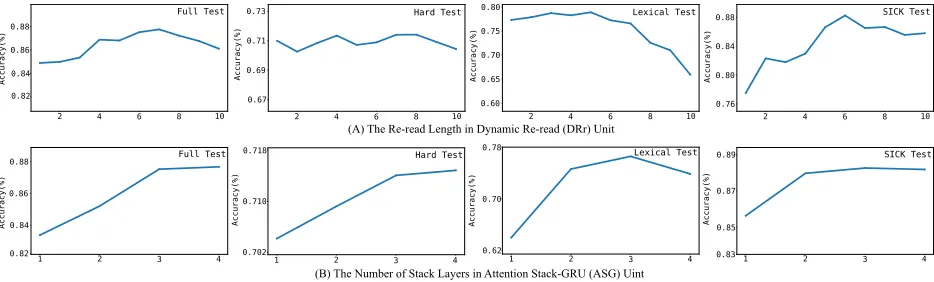
Figure 2: Performance (accuracy) ofDRr-Netwith different reading lengths (1-10) or the number stack layers (1-4).
4.2
Experiment Results
We evaluate models on the NLI task over SNLI and SICK datasets. In order to reduce the impact of annotate artifacts and better evaluate their ability of sentence understanding, we also select the challenging hard subset from (Gururan-gan et al. 2018), in which the premise-oblivious model can-not classify accurately, and lexical subset from (Glockner, Shwartz, and Goldberg 2018), which requires lexical and world knowledge, as our SNLI test sets.
Table 1 shows the results of our model compared with other published sentence encoding-based models. We utilize the accuracy on test sets to evaluate their performances.
From Table 1, we can figure out thatDRr-Net achieves the best performance on all test sets. As described in Sec-tion 3,DRr-Netutilizes ASG unit to model sentence seman-tic comprehensively by repeatedly reading the sentence and preserving all the information from bottom-most word em-bedding input to up-most recurrent output. Therefore, the sentence semantic can be fully explored. Moreover, DRr unit is employed to pay close attention to one important word at each step and repeatedly reads the important words for better sentence semantic understanding. Thus, DRr-Net achieves the best performance on all the test sets, even the challeng-ing hard test and lexical test sets.
Among these sentence encoding-based baselines, DRCN and Distance-based SAN are the current state-of-the-art models. Distance-based SAN utilizes the masked multi-head attention with distance to model the sentence seman-tic, which can effectively explore the sentence semantic from multiple aspects. DRCN adopts densely-connected co-attentive network to generate sentence representations. It can preserve the original and co-attentive feature information among the entire architecture. However, each attention oper-ation in these two methods considers too much informoper-ation at one time, which leads the models unable to focus on the most relevant part precisely asDRr-Netdid.
Gururangan et al. (2018) suspects that annotation arti-facts inflate model performance. Thus, they propose a chal-lenging hard subset of SNLI to better evaluate the mod-els’ ability on sentence semantic. Since the examples that premise-oblivious model classified accurately are removed, this test set can focus the model on sentence semantic
rather than the annotate artifacts and better evaluate their performances. From the results in Table 1, we can con-clude thatDRr-Netoutperforms all baselines by a large mar-gin, e.g. Distance-based DRCN (+3.1%), Distance-based SAN (+4.0%) and CAFE (+5.3%). We can find the same phenomenon on the challenging lexical test set. All of these indicate that our proposed model had better adaptability.
Table 2 shows performances of all models on the Quora dataset. BiMPM using the multi-perspective matching tech-nique between two sentences reports baseline performance of a L.D.C. network and basic multi-perspective models. We obtain accuracy of 89.75% on this dataset, surpassing the previous state-of-the-art model of DIIN.
4.3
Ablation Performance
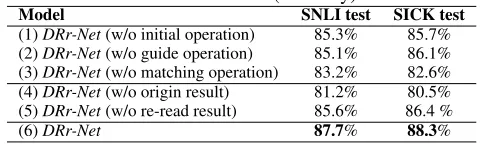
We conduct an ablation study on DRr-Net to examine the effectiveness of each component. The results are illustrated in Table 3. As mentioned before, we utilize the original rep-resentationha as the initial value of GRU in its DRr unit,
and the original representation hb as one of the inputs of
attention unit in its DRr unit. These operations make DRr-Nethave a comprehensive understanding of sentenceaand search the most relevant part with the consideration of sen-tenceband learned information at each step. As shown in Table 3 (1)-(2), the performance of DRr-Net significantly decreased when removing them separately, which means the initial operation and guide operation are critical for deciding which part should be concerned more at each step.
Table 4: Some examples of re-read sequence and the classification.
Sentence Re-read sequence Gold Predicted
sa: a couple walk hand in hand down a street. walk walk couple couple street street
Contradiction Contradiction
sb: a couple is sitting on a bench. couple sitting sitting bench bench bench
sa: a person in a red shirt and black pants hunched over. red shirt red shirt red shirt
Entailment Entailment
sb: a person wears a red shirt. wears red shirt red shirt red
sa: a person with a purple shirt is painting an image of a
woman on a white wall.
person painting painting woman woman
woman Neutral Neutral
sb: a woman paints a portrait of her best friend. woman paints paints best best best
sa: the man in the black t-shirt is trying to throw something. black t-shirt is trying throw throw
Entailment Neutral
sb: the man is in a black shirt. black black shirt shirt shirt shirt
sa: a person with a purple shirt is painting an image of a
woman on a white wall.
person painting painting woman woman
woman Neutral Entailment
sb: a woman paints a portrait of a person. paints portrait portrait portrait portrait person
4.4
Sensitivity of Parameters
As mentioned in Section 3, there are two parameters in DRr-Net should be determined: the number of stack layers in ASG unit and the re-read length in DRr unit. To be spe-cific, we evaluate the performances ofDRr-Neton SNLI and SICK datasets with different number of stack layers and re-read length separately. The results are shown in Figure 2
Figure 2 (A) shows the results on different test sets with different re-read length. The performance of DRr-Netfirst becomes better with the increasing of re-read length. When the re-read length is between 5 to 7, DRr-Net achieves the best performance. This phenomenon is consistent with the psychological findings that human attention focuses on nearly 7 words (Tononi 2008). When the length is bigger than 7, the accuracy of DRr-Net decreases to varying de-grees, in which the accuracy on lexical test set dropped most. Recalling the data collection, the sentence pair in lexical test set has high overlap. Only one word is different in each sen-tence pair. Therefore, when the re-read length becomes too long, the model may lose the focus on the different words, which leads a wrong classification.
Figure 2 (B) illustrates the results with different number of stack layers in ASG Unit. We can conclude that the per-formance becomes better with the increasing of the number of stack layers from the result. However, as illustrated in Fig-ure 1 (B), the inputs of thetthlayer are the concatenation of
the inputs and outputs of the(t−1)thlayer, which means
the scale of parameters will grow rapidly with the increasing of the number of stack layer. However, the increasing rate of accuracy will slow down with the increasing of the number of stack layer in Figure 2 (B). Moreover, a large number of parameters may cause the model hard to optimized, and even worse the gradient might be exploded or vanished. Thus, we select3layers in the ASG unit.
4.5
Case Study and Error Analysis
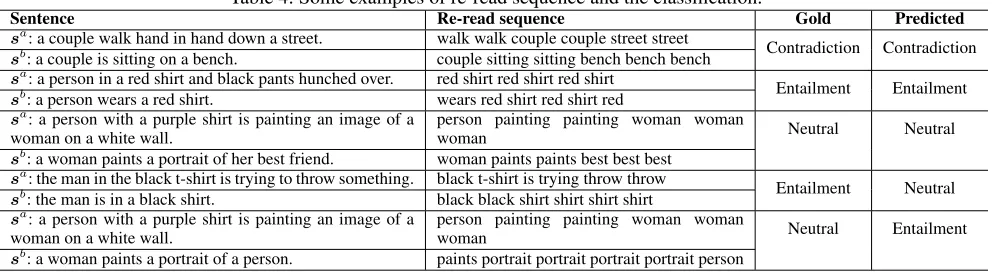
We also show some examples from SNLI dataset to demon-strate the ability of DRr-Net of dynamic re-reading the whole sequence. Table 4 shows the important word that the model chose at each step. For the first example, DRr-Netpays attention to words “walk, couple, street” in premise and “couple, sitting, bench” in hypothesis. Then, DRr-Netrepeatedly processes these important words for final
de-cision. From these words, we can conclude that the rela-tion of this sentence pair was contradicrela-tion easily. More-over, when checking the entailment relation in the second example,DRr-Net processes the same important words re-peatedly, i.e., reading “red shirt” multiple times. In a word, DRr-Netdoes really choose the important region and re-read these important parts multiple time for the final decision.
In order to better verify the ability ofDRr-Net, we make error analysis on the misclassification examples. In the forth example, when sentenceacontains more information than sentenceb,DRr-Netmay consider the unseen information in sentencebmore and make a wrong classification. Moreover, when the sentence pair has very complex semantic relation, e.g., the last example in Table 4, the model may be confused about their semantic and suffer from one of the important words, which leads to a wrong classification result.
Since sentence semantic suffers from the issues such as polysemy, ambiguity, as well as fuzziness. The model may need more information to distinguish these relations and make the correct decision.
5
Conclusion and Future Work
6
Acknowledgements
This research was partially supported by grants from the Na-tional Key Research and Development Program of China (No.2016YFB1000904, 2017YFB0803301), and the Na-tional Natural Science Foundation of China (Grants No. 61727809, U1605251, 61602147).
References
Bowman, S. R.; Angeli, G.; Potts, C.; and Manning, C. D. 2015. A large annotated corpus for learning natural language inference. In EMNLP, 632–642.
Chen, D.; Fisch, A.; Weston, J.; and Bordes, A. 2017a. Reading wikipedia to answer open-domain questions. InACL, 1870–1879. Chen, Q.; Zhu, X.-D.; Ling, Z.-H.; Wei, S.; Jiang, H.; and Inkpen, D. 2017b. Recurrent neural network-based sentence encoder with gated attention for natural language inference. In RepE-val@EMNLP, 36–40.
Chen, Q.; Zhu, X.; Ling, Z.; Wei, S.; Jiang, H.; and Inkpen, D. 2017c. Enhanced lstm for natural language inference. InACL. Cheng, J.; Dong, L.; and Lapata, M. 2016. Long short-term memory-networks for machine reading. InEMNLP.
Cho, K.; Courville, A. C.; and Bengio, Y. 2015. Describing mul-timedia content using attention-based encoder-decoder networks. IEEE Trans. Multimedia17:1875–1886.
Choi, J.; Yoo, K. M.; and Lee, S.-g. 2018. Learning to compose task-specific tree structures. InAAAI.
Chung, J.; Gulcehre, C.; Cho, K.; and Bengio, Y. 2014. Empirical evaluation of gated recurrent neural networks on sequence model-ing.CoRRabs/1412.3555.
Clark, P.; Etzioni, O.; Khot, T.; Sabharwal, A.; Tafjord, O.; Turney, P. D.; and Khashabi, D. 2016. Combining retrieval, statistics, and inference to answer elementary science questions. InAAAI. Dolan, W. B., and Brockett, C. 2005. Automatically constructing a corpus of sentential paraphrases. InIWP.
Glockner, M.; Shwartz, V.; and Goldberg, Y. 2018. Breaking nli systems with sentences that require simple lexical inferences. In ACL, 650–655.
Gong, Y.; Luo, H.; and Zhang, J. 2017. Natural language inference over interaction space.CoRRabs/1709.04348.
Gururangan, S.; Swayamdipta, S.; Levy, O.; Schwartz, R.; Bow-man, S. R.; and Smith, N. A. 2018. Annotation artifacts in natural language inference data. InNAACL-HLT, 107–112.
Im, J., and Cho, S. 2017. Distance-based self-attention network for natural language inference.CoRRabs/1712.02047.
Iyer, S.; Dandekar, N.; and Csernai, K. 2017. First quora dataset release: Question pairs.
Kim, S.; Hong, J.-H.; Kang, I.; and Kwak, N. 2018. Semantic sen-tence matching with densely-connected recurrent and co-attentive information.CoRRabs/1805.11360.
Koch, C., and Tsuchiya, N. 2007. Attention and consciousness: two distinct brain processes.Trends in cognitive sciences11(1):16–22. Kun, Z.; Guangyi, L.; Le, W.; Enhong, C.; Qi, L.; and Han, W. 2018. Image-enhanced multi-level sentence representation net for natural language inference. InICDM.
Liu, Y.; Sun, C.; Lin, L.; and Wang, X. 2016. Learning natural lan-guage inference using bidirectional lstm model and inner-attention. CoRRabs/1605.09090.
Liu, Q.; Huang, Z.; Huang, Z.; Liu, C.; Chen, E.; Su, Y.; and Hu, G. 2018. Finding similar exercises in online education systems. In SIGKDD, 1821–1830. ACM.
Luuk, E., and Luuk, H. 2011. The redundancy of recursion and infinity for natural language.Cognitive Processing12(1):1–11. Marelli, M.; Bentivogli, L.; Baroni, M.; Bernardi, R.; Menini, S.; and Zamparelli, R. 2014. Semeval-2014 task 1: Evaluation of com-positional distributional semantic models on full sentences through semantic relatedness and textual entailment. InSemEval, 1–8. Mou, L.; Men, R.; Li, G.; Xu, Y.; Zhang, L.; Yan, R.; and Jin, Z. 2016. Natural language inference by tree-based convolution and heuristic matching. InACL, volume 2, 130–136.
Nie, Y., and Bansal, M. 2017. Shortcut-stacked sentence encoders for multi-domain inference. InRepEval@EMNLP.
Orr, G. B., and M¨uller, K.-R. 2003.Neural networks: tricks of the trade. Springer.
O’Shea, M. 1908. The psychology and pedagogy of reading. The Journal of Philosophy, Psychology and Scientific Methods 5(18):500–502.
Pennington, J.; Socher, R.; and Manning, C. 2014. Glove: Global vectors for word representation. InEMNLP, 1532–1543.
Serban, I. V.; Sordoni, A.; Bengio, Y.; Courville, A. C.; and Pineau, J. 2016. Building end-to-end dialogue systems using generative hierarchical neural network models. InAAAI, volume 16. Shen, T.; Zhou, T.; Long, G.; Jiang, J.; Pan, S.; and Zhang, C. 2017. Disan: Directional self-attention network for rnn/cnn-free language understanding.CoRRabs/1709.04696.
Srivastava, R. K.; Greff, K.; and Schmidhuber, J. 2015. Highway networks.CoRRabs/1505.00387.
Tay, Y.; Tuan, L. A.; and Hui, S. C. 2017. A compare-propagate architecture with alignment factorization for natural language in-ference.CoRRabs/1801.00102.
Tomar, G. S.; Duque, T.; T¨ackstr¨om, O.; Uszkoreit, J.; and Das, D. 2017. Neural paraphrase identification of questions with noisy pretraining. InSWCN@EMNLP.
Tononi, G. 2008. Consciousness as integrated information: a pro-visional manifesto.The Biological Bulletin215(3):216–242. Vaswani, A.; Shazeer, N.; Parmar, N.; Uszkoreit, J.; Jones, L.; Gomez, A. N.; Kaiser, Ł.; and Polosukhin, I. 2017. Attention is all you need. InNIPS, 5998–6008.
Wang, J.; Chen, H.-C.; Radach, R.; and Inhoff, A. 1999. Reading Chinese script: A cognitive analysis. Psychology Press.
Wang, P.; Wu, Q.; Shen, C.; and van den Hengel, A. 2017. The vqa-machine: Learning how to use existing vision algorithms to answer new questions. InCVPR, volume 4.
Wang, Z.; Hamza, W.; and Florian, R. 2017. Bilateral multi-perspective matching for natural language sentences. CoRR abs/1702.03814.