The Thirty-Third AAAI Conference on Artificial Intelligence (AAAI-19)
DeepCCFV: Camera Constraint-Free Multi-View
Convolutional Neural Network for 3D Object Retrieval
Zhengyue Huang,
1Zhehui Zhao,
1Hengguang Zhou,
2Xibin Zhao,
1∗Yue Gao
1∗1BNRist, KLISS, School of Software, Tsinghua University, China. 2Department of Computer Science, University of Toronto.
{hzy18, zhao-zh16}@mails.tsinghua.edu.cn, [email protected],{zxb, gaoyue}@tsinghua.edu.cn
Abstract
3D object retrieval has a compelling demand in the field of computer vision with the rapid development of 3D vision technology and increasing applications of 3D objects. 3D ob-jects can be described in different ways such as voxel, point cloud, and multi-view. Among them, multi-view based ap-proaches proposed in recent years show promising results. Most of them require a fixed predefined camera position set-ting which provides a complete and uniform sampling of views for objects in the training stage. However, this causes heavy over-fitting problems which make the models failed to generalize well in free camera setting applications, particu-larly when insufficient views are provided. Experiments show the performance drastically drops when the number of views reduces, hindering these methods from practical applications. In this paper, we investigate the over-fitting issue and re-move the constraint of the camera setting. First, two basic fea-ture augmentation strategiesDropoutandDropvieware intro-duced to solve the over-fitting issue, and a more precise and more efficient method namedDropMaxis proposed after ana-lyzing the drawback of the basic ones. Then, by reducing the over-fitting issue, a camera constraint-free multi-view con-volutional neural network namedDeepCCFVis constructed. Extensive experiments on both single-modal and cross-modal cases demonstrate the effectiveness of the proposed method in free camera settings comparing with existing state-of-the-art 3D object retrieval methods.
Introduction
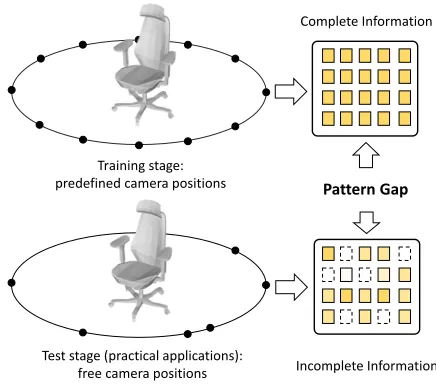
3D object retrieval received growing attention in the field of computer vision since the rapid development of 3D applica-tions in recent years. Various methods based on different 3D object representations, such as voxel, point cloud, and multi-view, have been investigated (Maturana and Scherer 2015; Qi et al. 2017a; Su et al. 2015). In multi-view based ap-proaches, views can be easily captured by cameras or ren-dered from 3D object models, and these approaches showed promising results. We noticed that most of the approaches require a fixed predefined camera position setting which pro-vides a full and uniform sampling of views for objects in the training stage. However, in practical applications, cam-era positions are randomly selected, the information patterns
∗
Corresponding authors
Copyright c2019, Association for the Advancement of Artificial Intelligence (www.aaai.org). All rights reserved.
Training stage: predefined camera positions
Test stage (practical applications): free camera positions
Pattern Gap
Incomplete Information Complete Information
Figure 1: The pattern gap between training and test stage.
are different in the training stage and real applications, and it brings the pattern gap as illustrated in Fig.1. This might cause heavy over-fitting problems.
experi-ments of GVCNN (Feng et al. 2018). It is reasonable that the performance drops since the input information is partially missed. However, an experiment in MVCNN revealed that training plain 2D image CNN for all captured views without features fusion achieves much better performance compar-ing to the original MVCNN when testcompar-ing with scompar-ingle input view. This suggests that deep learning method itself have the potential to handle the single-view case, and this motivates us to make further studies on this issue.
We noticed these works following MVCNN require a pre-defined camera setting, which is convenient at the training stage to gather a full and uniform sampling from views of objects. However, this may cause heavy over-fitting prob-lems since (1) Views provided in real applications may be different on camera position in training data (2) Num-ber of views provided in real applications may be insuffi-cient. Since the predefined camera positions usually sam-ple densely enough to cover all positions, we focus on the second over-fitting problem in this paper. In (Gao et al. 2012), a camera constraint-free view-based 3D object re-trieval method (CCFV) has been introduced to handle this situation using a probabilistic approach. With the develop-ment of deep learning methods in the field of 3D object retrieval and recognition, existing methods meet new chal-lenges.
As discussed before, the number of views provided in actual applications may be insufficient which leads to the pattern gap between test stage and training stage. Therefore training on fixed camera setting data may lead to over-fitting problems and fail to adapt to the gap. In the training stage, the complete set of information results in the domination of some strong features in the network. To tackle this problem, we first introduceDropout, a widely used feature augmen-tation method to reduce the domination of some strong fea-tures. On the other hand,Dropview (Nitish et al. 2014) is introduced which randomly drops the input views and tries to minimize the pattern gap between training and test stage. Both of the methods are proved useful by experiments with decent results. Moreover, We further proposeDeepCCFV, which is a camera constraint-free multi-view convolutional neural network assembled withDropMaxblock which drops the highest stimulates of a network’s layer output and forces the network to learn the relativelyweakfeatures. Thus the problem of domination of the strong features is more pre-cisely located than Dropout andDropview. Extensive ex-periments with different CNN backbones i.e. VGG11 (Si-monyan and Zisserman 2014) with batch normalization and ResNet50 (He et al. 2016) showed thatDeepCCFVhas sta-ble and superior performance than other methods in 3D ob-ject retrieval tasks. Finally, a trial on cross-modal retrieval is conducted using a common cross-modal pipeline to prove further thatDeepCCFVcan generate robust feature descrip-tors for 3D objects in multi-view representation. More de-tails are provided in Section Experiments.
In summary, the main contributions of this paper are listed as follows:
• We propose a Deep camera constraint-free multi-view neural network (DeepCCFV) for 3D object retrieval with a feature augmentation method calledDropMax, dropping
high stimulates of the output to force the model to pay more attention on less stimulative features, which tackles the over-fitting issue and brings notable improvement of retrieval performance.
• We conduct cross-modal 3D object retrieval trial between point cloud and multi-view modalities using the proposed
DeepCCFVmodel.
The rest of this paper is organized as follows. Firstly, we introduce the related work on 3D object recognition, and then we provide a detailed explanation of our proposed method. After the explanation, experiments are presented.
Related Work
3D object retrieval and recognition tasks based on different data representations, such as voxel, point cloud, and multi-view, have been investigated in recent years. In this work, the proposed DeepCCFV is based on multi-view. Also, in the cross-modal retrieval trail, we adopt the point cloud rep-resentation as another modality input. Hence, we will briefly review the methods based on multi-view and point cloud in this section.
Multi-view Based Methods
Previous multi-view based methods studied and described 3D objects with a group of projected views from different angles of the object. One of the pioneer view-based methods is (Chen et al. 2003), which composed a group of ten views captured from the vertices of a dodecahedron over a hemi-sphere. In (Papadakis et al. 2009), a set of panoramic views are generated to represent the 3D objects. (Gao et al. 2012) proposed a general framework based on Gaussian models, which enabled eliminating fixed predefined camera setting using a probabilistic approach.
With the recent proliferation of deep learning, view-based models came into the spotlight. An instance used deep learn-ing method, MVCNN (Su et al. 2015), extracted features with 2D CNN and then aggregated them through a pooling structure. Furthermore, Mahalanobis metric was employed to improve its performance on retrieval task. Input shapes are assumed to be upright oriented along a consistent axis, 12 rendered views are uniformly sampled around the object every 30 degrees. In (Xie et al. 2015), a deep auto-encoder structure was implemented to generate features of 3D ob-jects. Based on MVCNN, GVCNN (Feng et al. 2018) di-vided extracted features into groups with different weights, followed by a weighted-average pooling. A deep embed-ding network was proposed to solve the complex intra-class and inter-class variation in (Guo et al. 2016), in which the deep neural network was jointly supervised by classification loss and triplet loss. RotationNet (Kanezaki, Matsushita, and Nishida 2018) treated viewpoints as latent variables; basis axes was determined with unsupervised learning on view-points estimation. Instead of preprocessing of normalizing object dataset, RotationNet learned pose alignment.
GVCNN (Feng et al. 2018), the performances of MVCNN-like methods significantly decrease when the number of views drops. Due to the complex condition in a real-world environment, missing of views is common in applications, which limits the applications of view-based models in the real world. In this paper, we will propose methods to re-duce the performance drop with insufficient views and ac-complish camera-constraint-free in the next section.
Point Cloud Based Methods
Point cloud is regarded as an unordered set of 3-dimension vectors which denote the spatial positions of the captured object points. Recently, interest in point cloud gradually increases since the rapid development of sensors like Li-DAR, which was widely adopted in auto-driving cars. While 3D recognition tasks based on point cloud is getting more and more attention, the cross-modal retrieval task between point cloud and multi-view is more or less neglected by the community, we made an initial trial on this topic using the proposed DeepCCFV as the feature extractor of multi-view modality, along with DGCNN for the point cloud modality.
For point cloud based methods, PointNet(Qi et al. 2017a) is one of the pioneer deep learning work which employed a spatial transform network to maintain the invariance of learned representation under transformation. In PointNet, a structure that aggregates local and global features was used to describe point-to-point correlation. The extracted features are processed through symmetric pooling layer to address the unorderedness of input. PointNet has achieved outstanding performance in both classification and segmen-tation tasks, yet the model learned local geometric fea-tures poorly. Hence, PointNet++ (Qi et al. 2017b) was in-troduced to address this flaw. PointNet++ built a hierarchi-cal network structure with PointNet network as its basic building block. In (Klokov and Lempitsky 2017), the point cloud data was subdivided by Kd-tree, then features were extracted and aggregated by Kd-Network. By aggregating point and its neighbor features and perform edge convolu-tion alternatively on extracted edge feature in the network, DGCNN(Wang et al. 2018) utilized both local features and global features. At the same time, the graph on each layer was dynamic which enabled observation over the semanti-cally similar structure in the deeper layer of feature space. Among these methods, DGCNN was reported to reach the state-of-the-art performance in 3D object recognition. With DGCNN as the basic structure, PVNet (You et al. 2018) proposed an embedding attention fusion scheme, which in-tegrated and utilized the high-level features of point cloud data and multi-view data to augment each other in 3D shape recognition. In the cross-modal retrieval trial, we adopted DGCNN as the point cloud feature extractor.
Proposed Method
3D object retrieval aroused a great deal of interest in the last few years. However, most of the previous view-based methods require a fixed setting of camera positions, which limits the application of these methods. Therefore, we
pro-pose DeepCCFV to address this issue. Extensive
experi-ments have been conducted to prove its superior and stable
performance in both intra-modal and cross-modal cases. In the cross-modal retrieval experiment, the widely used point cloud is adopted as the supplemental modality.
The Problem of Predefined Camera Setting
Most of the recent works based on multi-view representa-tion of 3D objects are trained with rendered views captured in a predefined camera setting, which is convenient in the training stage to gather a full and uniform sampling of views for objects. However, in such cases the embedding space of the retrieval network is optimized by a complete set of fea-tures of 3D objects, somestrongfeatures will dominate the training process andweakfeatures will not be learned. This will cause the over-fitting problems since the presentation
of strongfeatures in test stage is not guaranteed with free
camera settings.
Tackle the Over-fitting Issue
Basic Feature Augmentation Methods We first
intro-duce two basic feature augmentation methods Dropout(Ni-tish et al. 2014) and Dropview to overcome the over-fitting issue.Dropoutis a widely used feature augmentation method which can reduce the domination of some strong features, but it drops weak features equally. Dropview is a simple data augmentation strategy introduced in this pa-per which can also reduce the domination of some strong features through randomly dropping the input views, but weaker features in dropped view are lost and cannot be fur-ther enhanced in the training process.
DropMax Considered the drawback of these methods, we
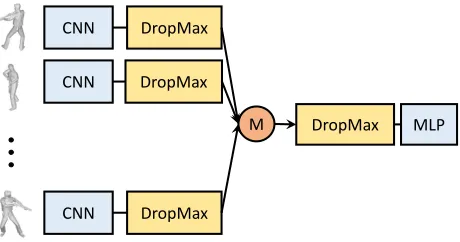
proposeDropMaxwhich drops thetopk highest stimulates of the output layer of the network, and it forces the network to learn relatively weakfeatures. For the MVCNN-like ar-chitecture, we add a DropMax block before and after the aggregation operation as illustrated in Fig.2. In our perspec-tive, high stimulates correspond tostrongfeatures processes in a network sincestrongfeatures contribute the most in both forward and backward processes which may dominate the training process. Thus dropping strongfeatures instead of dropping randomly locates the issue ofstrongfeatures dom-ination more precisely.
Formally,DropMax, which drops the top-k highest stimu-lates at the probability ofp, is added after a fully-connected layer of deep neural network after activation function. In the forward process, the dropped stimulates are set to zero and therefore zero gradient is passed through these dropped neu-rons in the backward process. This formula is illustrated as follows:
m(l)=T opkM ask(k, p) (1)
˜
CNN
CNN
CNN
DropMax
DropMax
DropMax
M DropMax MLP
Figure 2:DeepCCFVarchitecture, DropMax block is added before and after the aggregation operation (denoted as M is this figure), which is the maxpooling layer in MVCNN.
DeepCCFV By reducing the over-fitting issue, which is
the main problem that limits the generalization of current methods to free camera setting, a camera constraint-free multi-view convolutional neural network namedDeepCCFV assembled withDropMaxblock is constructed.
DeepCCFV for Single-modal Retrieval
In single-modal retrieval task, we calculate the cross-entropy loss on the basic DeepCCFV network to obtain discrimi-native embedding features. To reach greater robustness in retrieval, we adopt a commonl2-normalization strategy ap-plied on the raw features generated by the network (Wang et al. 2017; Song et al. 2016; Parkhi, Vedaldi, and Zisserman 2015; Schroff, Kalenichenko, and Philbin 2015). We con-duct extensive comparison experiments to prove the effec-tiveness ofDeepCCFV with other augmentation methods. Details are shown in the Experiment Section.
DeepCCFV for Cross-modal Retrieval
To further test the robustness of the proposedDeepCCFV, we provide an initial trial of cross-modal experiment be-tween multi-view and point cloud modalities of 3D objects. For simplicity, we adopt a common pipeline for cross-modal retrieval tasks which is illustrated in Fig.3. The inputs of the retrieval network are the data of two modalities, point cloud, and multi-view. The point cloud is a set of unordered points densely sampled from the 3D objects’ faces. The data of multi-view are rendered images of 3D shapes captured in predefined camera positions following the (Su et al. 2015) while the number of views is variable in this experiment.
Taking two modalities’ input at the same time, the feature extractor networks first extract features of two models si-multaneously, then pass the output features to the following embedding network that aims to learn a deep metric trans-formation for mapping the features of different modalities to the same embedding space. Finally, Triplet-Center-Loss (He et al. 2018) is adopted as the retrieval loss calculation on the embedded features in each mini-batch. Besides, for better performance, we consider different places to calculate the cross-entropy loss for each modality; placing it aftermlp1 layer in our embedding network leads to the most excellent performance. The whole pipeline is illustrated in Fig.3.
Experiments
In this section, we provide experiments on 3D object re-trieval in both single-modal and cross-modal cases which demonstrated the better and more stable performance com-paring with other methods particularly when the number of views is limited. At last, an additional experiment on the classification task is conducted which also showed the supe-rior performance of the proposed methodDeepCCFV.
Dataset
To validate the performance of the proposedDeepCCFV, we conduct experiments on Princeton ModelNet dataset (Chang et al. 2015), which contains 127,915 3D CAD models from 662 categories in total. We applied ModelNet40, a com-monly used subset of ModelNet that contains 12,311 shapes from 40 common categories in our experiments. We follow the same training/test split of ModelNet40 as in MVCNN (Su et al. 2015).
Single-modal Retrieval
As discussed before, the over-fitting problem comes from two aspects: (1) camera positions of the query views are dif-ferent from training data (2) number of query views vided is insufficient in the test stage. To validate if the pro-posed method helps the second dilemma and diminish the over-fitting problem we took the position of the cameras as the control variable and the quantity and selection of views as independent variables. Furthermore, to evaluate the per-formance of our proposedDeepCCFV network in the real-world situation, in which given queries are randomly cap-tured in unfixed camera positions, we conduct the same experiment with views rendered in random angle around the 3D object. To give a fair comparison with the original MVCNN, the first camera setting in MVCNN, i.e., 12 pre-defined camera positions are adopted in the training stage.
To evaluate DropMax’s effectiveness, we compare the proposedDeepCCFV assembled withDropMaxblock with (1) Original MVCNN (2) MVCNN with Dropout (3) MVCNN with DropView. For details,Dropout is added at the same place as Dropview with the same drop strength.
DropView is implemented by randomly dropping the input
views and it is insensitive to the drop strength so we set it to 0.5 in the experiments.
Implementation In the predefined camera position
set-ting, the views are rendered around the 3D models in every 30 degrees, 12 views for each object. While in the random camera position setting, the views are rendered around the 3D models in random angles, and the total number of views for each object is also 12.
Triplet
-Ce
n
ter
-Los
s
Modality Agonistic Features Mix
Point Cloud
Multi-View
Point Cloud Feature
Extractor MLP1
Embedding Network A
MLP2
Cross Entropy Loss
Norm
Early Feature
Multi-View Feature
Extractor MLP1
Embedding Network B
MLP2
Cross Entropy Loss
Norm
Early Feature
Figure 3: The architecture of our cross-modal retrieval network. The input multi-view data and point cloud data is first passed through the feature extractors. Then the extracted features are passed to the embedding networks to generate two features for each modality. These features are employed in both single-modal and cross-modal retrieval.
The result showed that using a stronger CNN backbone in MVCNN leads to better performance.
For the following experiments, the retrieval database con-tains the features of 3D objects in the test set split of Model-Net40 which are generated by the network with all 12 views from predefined positions provided. As for the queries, we use the number of randomly selected views of 3D objects ranges from 1 to 12. All these features are extracted from the output off c7 layer which is defined in MVCNN, right before the classifier.
We rank the similarity of the features of queries and the features in the database by measuring the Euclidean distance between them, and the top 1000 results with the closest dis-tance are selected as the retrieval output. Mean average pre-cision (mAP) is then calculated on this output. For a fair comparison, mAP is calculated following the previous work (Chang et al. 2015; Su et al. 2015). Furthermore, since our query views are randomly selected, we carry out each exper-iment for ten times and calculate the average value of them.
Parameter Influences There are two hyperparameters in
theDropmaxblock, i.e.,pandk. We evaluate the influences
of parameters and select the parameters based on the exper-imental analysis.
In our evaluation, experiments demonstrated that the per-formance of our model is insensitive with regards to the value ofp. It has stable performance whenpranges from 0.1 to 0.8. Hence, we empirically setpto 0.4 in both of the
DropMaxblocks.
To evaluate the parameterk, we denotek1 for the first
DropMaxblock andk2for the second. First, we fixk2to 50
and varyk1from 100 to 2000. We observed that our method could achieve stable results whenk1varies in a large range from 300 to 600. Thus, we setk1to 500 in all experiments. To evaluate the parameterk2 for the secondDropMax, we fixk1 to 500 and varyk2 from 0 to 400. We observed that our method has stable performance whenk2varies in a large
range from 0 to 400, especially when k2 varies from 0 to 100. We then setk2as 50 in all experiments. All these ex-periments demonstrated that the proposed method is insensi-tive to the value of the parameterskandp. Moreover, should be noticed that we only select the stable parameters in these experiments, the optimal parameters setting can be further studied in the future work.
Over-fitting Problem Diminution In this experiment, the
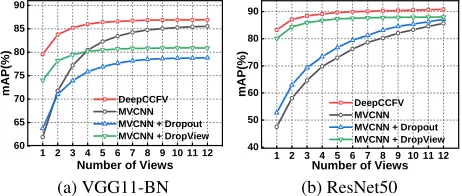
query views are captured in predefined camera positions. This experiment evaluates the ability of DeepCCFV to di-minish the over-fitting problem and improve retrieval perfor-mance in quantity-limited views situation. The experiment results and comparison among different methods are demon-strated in Fig.4(a) and Fig.4(b).
1 2 3 4 5 6 7 8 9 1 0 1 1 1 2 6 0
6 5 7 0 7 5 8 0 8 5 9 0
m
A
P
(%
)
N u m b e r o f V i e w s
D e e p C C F V M V C N N M V C N N + D r o p o u t M V C N N + D r o p V i e w
(a) VGG11-BN
1 2 3 4 5 6 7 8 9 1 0 1 1 1 2 4 0
5 0 6 0 7 0 8 0 9 0
D e e p C C F V M V C N N M V C N N + D r o p o u t M V C N N + D r o p V i e w
m
A
P
(%
)
N u m b e r o f V i e w s (b) ResNet50
In the experiment using VGG11-BN as the backbone as illustrated in Fig.4(a), the result of MVCNN demonstrated relatively decent result with 1.4% lower than DeepCCFV in the full-view setting. However, the difference between the result of MVCNN in a single-view setting and a full-view setting reached 23.61%, which is extreme. Similar to MVCNN, MVCNN withDropoutwas also sensitive to the number of views, with 15.07% difference between the worst and the best cases. In contrast, MVCNN with Dropview
andDeepCCFVwere comparatively stable, with 6.89% and
7.35% difference between the worst and the best cases. A similar pattern can be observed when using Resnet50 as the backbone illustrated in Fig.4(b). Curves of MVCNN and MVCNN withDropoutwere lower than other methods, and their difference between the highest and lowest points were 38.14% and 34.47%, while curves ofDeepCCFVand MVCNN withDropview had the difference of 7.57% and 7.92%. This result implies that MVCNN withDropviewand
DeepCCFV withDropMax as its core is more powerful in
overcoming the over-fitting issue.
In both of the figures, we can see that the performance curve of MVCNN decreased sharply by dropping the num-ber of views, while the performance curve ofDeepCCFVis not entirely affected; the fewer views given in queries, the more significant difference is observed. Plain MVCNN suf-fered more from over-fitting in full-view training, resulting in a greater reduction in mAP because of incomplete fea-ture sets under single-view setting. On the other hand, our purposedDeepCCFVoutperformed other methods in every setting. All these experiments demonstrated the proposed method DeepCCFV could reduce the over-fitting problem effectively and generate more robust and more comprehen-sive features of multi-view representations of 3D objects.
Besides, we noticed an interesting phenomenon that plain MVCNN performs better than MVCNN withDropoutand MVCNN with Dropview when using VGG11-BN as the backbone, while MVCNN withDropoutand MVCNN with
Dropviewperforms better when using ResNet50 as the
back-bone. As far as we concerned, this is because VGG11-BN model already employsDropoutlayers, when extraDropout layers are added orDropviewis added to drop the input of views, too much information is dropped, and it becomes a hinder for the model to learn discriminative features for 3D objects.
Free Camera Setting In this experiment, the query views
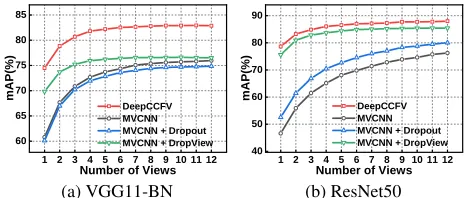
are captured in random camera positions around the object. This experiment evaluates the performance ofDeepCCFVin a real-world situation. The experiment results and compar-ison among different methods are demonstrated in Fig.5(a) and Fig.5(b).
In Fig.5(a), MVCNN, MVCNN with Dropout and MVCNN withDropview achieved closed highest result of 75.96%, 74.86%, and 76.52%, while the proposed DeepC-CFVreached outstanding highest result of 82.87%.
Just like results in Fig.4(b), in Fig.5(b), MVCNN and MVCNN withDropout had similar results of 76.23% and 80.03% under full-view setting and difference of extremes of 29.62% and 27.49%. Difference between the two groups
1 2 3 4 5 6 7 8 9 1 0 1 1 1 2 6 0
6 5 7 0 7 5 8 0 8 5
m
A
P
(%
)
N u m b e r o f V i e w s
D e e p C C F V M V C N N M V C N N + D r o p o u t M V C N N + D r o p V i e w
(a) VGG11-BN
1 2 3 4 5 6 7 8 9 1 0 1 1 1 2 4 0
5 0 6 0 7 0 8 0 9 0
m
A
P
(%
)
N u m b e r o f V i e w s
D e e p C C F V M V C N N M V C N N + D r o p o u t M V C N N + D r o p V i e w
(b) ResNet50
Figure 5: The retrieval mAP of comparing approaches using VGG11-BN and ResNet50 as the CNN backbone in random camera positions. The proposed DeepCCFV had the best performance among the methods listed in the figure. The retrieval mAP of DeepCCFV using single view achieved 74.49% and 78.63%, which were 13.69% and 32.02% higher than MVCNN. The retrieval mAP of the proposed DeepC-CFV using 12 views achieved 82.87% and 87.98% ,which were 6.91% and 11.75% higher than MVCNN.
is even more obvious. DeepCCFV and MVCNN with
Dropviewoutperformed other two methods with 89.98% and
85.43% result under full-view setting, and they were above the other group all the time.
In this situation, the query views are rendered in arbitrary angle around the 3D object; therefore, it is even harder for MVCNN to generate those strong features which are neces-sary for retrieval with the given query. Our proposed Deep-CCFV tackles this issue and provides best retrieval perfor-mance compared with other methods listed in the figures. Even if only one or two views are provided in a query, the retrieval performance is adequate compared to the retrieval performance when 12 views are provided.
Cross-modal Retrieval
To further evaluate the effectiveness of our proposed method, we employ point cloud and view based model into a common pipeline for cross-modal retrieval, i.e., the retrieval between 3D objects represented by a single view, 12-views and point cloud. This experiment provides evidence of the robustness ofDeepCCFVin a complex model; at the same time, it demonstrates the possibility ofDeepCCFVas a more general model for 3D object representation.
Within the cross-modal pipeline, we first compare the original single-modal retrieval performance of the pro-posed method DeepCCFV with multi-view based methods MVCNN, GVCNN and point cloud based method DGCNN (Wang et al. 2018). There is no retrieval performance of DGCNN provided. Thus we measure the retrieval mAP of DGCNN by ourselves. Meanwhile, we compare the cross-modal retrieval performance of MVCNN, and the proposed
DeepCCFVusing VGG11-BN as the backbone.
Implementation In our retrieval network, we employ
Method Query
point
cloud 12views 1view 1view
point
cloud 12views 1view Database cloudpoint 12views 1view 12views 12views cloudpoint cloudpoint
MVCNN (Su et al. 2015) - 70.10% 61.70% - - -
-MVCNN,metric (Su et al. 2015) - 80.20% - - - -
-GVCNN (Feng et al. 2018) - 81.30% - - - -
-MVCNN1 - 85.52% - 61.91% - -
-DeepCCFV1 - 86.92% - 79.57% - -
-DGCNN 81.60% - - -
-MVCNN1+ DGCNN 88.65% 88.17% 61.69% 36.06% 88.48% 83.74% 36.88%
DeepCCFV1+ DGCNN 89.33% 91.35% 80.46% 76.62% 90.24% 88.51% 75.20%
1Using VGG11-BN as CNN backbone.
All view-based models are trained with all 12 views of 3D objects.
Table 1: The results of cross-modal retrieval experiment in terms of mAP. Above the middle line, results show the original single-modal retrieval results for different methods. Below the middle line, results show the cross-modal retrieval result. For all cases, the method with DeepCCFV performs the best.
f c7layer as the input of the following embedding network. For point cloud data, we employ Dynamic Graph CNN (Wang et al. 2018), a point-cloud-based model for 3D object representation, as the feature extractor. The output ofmlp1 layer of DGCNN is extracted to be the input of the following embedding network. All of these models are pre-trained on the ModelNet40 dataset.
To narrow down the gap between two modalities and map features from both modalities into one clustered embed-ding space for cross-modal retrieval, we implement Triplet-Center Loss (He et al. 2018) as retrieval loss in our network, which is calculated in a cross-modal way.
We evaluate the performance of our purposed cross-modal retrieval model in both single-modal way and cross-modal way. The retrieval mAPs of the retrieval between 3D objects represented by point cloud, 12-views and single-view are measured in our experiments. We use the Euclidean distance to measure the similarity of 3D objects. For each query, we select top 1000 results to be our retrieval results.
Results The experimental results of comparisons between
different methods and different input regarding mAP are demonstrated in Table 1. Compared with the model that uses MVCNN as the feature extractor of multi-view data, our pro-posedDeepCCFVpresent superior performance in all seven tasks, especially when the queries are single view data.
Classification Performance
We also conduct 3D object classification experiments as a supplementary experiment. Both VGG11-BN and ResNet50 backbones are evaluated. The results are denoted in Table 2. We can see that reducing the number of views has a signifi-cant influence on the original MVCNN model, while it has a weaker influence onDeepCCFV. This phenomenon implies
thatDeepCCFVworks well on the classification task since
it is the same over-fitting issue in retrieval task that hinders the performance of classification.
Backbone Number of views Accuracy
MVCNN DeepCCFV
VGG11-BN
1 64.28% 82.11%
2 76.91% 87.84%
4 86.96% 90.72%
8 91.68% 92.15%
12 92.75% 92.30%
ResNet50
1 48.11% 70.39%
2 62.24% 79.69%
4 76.44% 86.09%
8 87.58% 90.74%
12 91.98% 92.46%
Table 2: The comparison of classification accuracy with dif-ferent numbers of views between MVCNN andDeepCCFV.
Conclusion
In this paper, we propose a camera constraint-free multi-view CNN, i.e.,DeepCCFV, for 3D object retrieval. A fea-ture augmentation method, named Dropmax, has been in-troduced to overcome the over-fitting issue in multi-view based 3D object representation methods coming from the fixed camera settings. To evaluate its performance, we have conducted extensive experiments comparing with traditional multi-view based methods. At the same time, we also con-duct a cross-modal retrieval experiment, which evaluates the performance of the proposed method in a complex model. Both of the results demonstrate the proposed method can achieve stable performance in camera constraint-free envi-ronments, particularly when the number of views varies sig-nificantly.
DeepCCFV, to more tasks and more databases. Also, cross-modal retrieval for point cloud and multi-view cross-modalities is a poorly investigated aspect that can be further studied.
Acknowledgements
This work was supported by National Key R&D Program of China (Grant No. 2017YFC0113000).
References
Chang, A. X.; Funkhouser, T.; Guibas, L.; Hanrahan, P.; Huang, Q.; Li, Z.; Savarese, S.; Savva, M.; Song, S.; Su, H.; et al. 2015. ShapeNet: An Information-Rich 3D Model Repository. arXiv preprint arXiv:1512.03012.
Chen, D.-Y.; Tian, X.-P.; Shen, Y.-T.; and Ouhyoung, M. 2003. On Visual Similarity Based 3D Model Retrieval. In Computer Graphics Forum, volume 22, 223–232. Wiley On-line Library.
Deng, J.; Dong, W.; Socher, R.; Li, L.; Li, K.; and Li, F.-F. 2009. ImageNet: A Large-Scale Hierarchical Image Database. In 2009 IEEE Conference on Computer Vision and Pattern Recognition (CVPR), 248–255.
Feng, Y.; Zhang, Z.; Xibin, Z.; Ji, R.; and Gao, Y. 2018. GVCNN: Group-View Convolutional Neural Networks for 3D Shape Recognition. InProceedings of the IEEE Confer-ence on Computer Vision and Pattern Recognition, 264–272. Gao, Y.; Tang, J.; Hong, R.; Yan, S.; Dai, Q.; Naiyao, Z.; and Chua, T.-S. 2012. Camera Constraint-Free View-Based 3-D Object Retrieval. IEEE Transactions on Image Processing 21:2269–2281.
Guo, H.; Wang, J.; Gao, Y.; Li, J.; and Lu, H. 2016. Multi-View 3D Object Retrieval With Deep Embedding Network.
IEEE Transactions on Image Processing25(12):5526–5537.
He, K.; Zhang, X.; Ren, S.; and Sun, J. 2016. Deep Residual Learning for Image Recognition. In2016 IEEE Conference on Computer Vision and Pattern Recognition (CVPR), 770– 778.
He, X.; Zhou, Y.; Zhou, Z.; Bai, S.; and Bai, X. 2018. Triplet-Center Loss for Multi-View 3D Object Retrieval. 2018 IEEE Conference on Computer Vision and Pattern Recognition (CVPR).
Ioffe, S., and Szegedy, C. 2015. Batch Normalization: Ac-celerating Deep Network Training by Reducing Internal Co-variate Shift. InProceedings of the 32nd International Con-ference on Machine Learning.
Kanezaki, A.; Matsushita, Y.; and Nishida, Y. 2018. Ro-tationNet: Joint Object Categorization and Pose Estimation Using Multiviews from Unsupervised Viewpoints. In2018 IEEE Conference on Computer Vision and Pattern Recogni-tion (CVPR).
Klokov, R., and Lempitsky, V. S. 2017. Escape from Cells: Deep Kd-Networks for the Recognition of 3D Point Cloud Models.2017 IEEE International Conference on Computer
Vision (ICCV)863–872.
Maturana, D., and Scherer, S. 2015. VoxNet: A 3D Convo-lutional Neural Network for Real-Time Object Recognition.
In 2015 IEEE/RSJ International Conference on Intelligent
Robots and Systems (IROS), 922–928.
Nitish, S.; Geoffrey, H.; Alex, K.; Ilya, S.; and Ruslan, S. 2014. Dropout: A Simple Way to Prevent Neural Networks from Overfitting. The Journal of Machine Learning
Re-search15(1):1929–1958.
Papadakis, P.; Pratikakis, I.; Theoharis, T.; and Perantonis, S. J. 2009. PANORAMA: A 3D Shape Descriptor Based on Panoramic Views for Unsupervised 3D Object Retrieval.
International Journal of Computer Vision89:177–192.
Parkhi, O. M.; Vedaldi, A.; and Zisserman, A. 2015. Deep Face Recognition. InProceedings of the British Machine Vision Conference (BMVC), volume 1, 6.
Qi, C. R.; Su, H.; Mo, K.; and Guibas, L. J. 2017a. Point-Net: Deep Learning on Point Sets for 3D Classification and Segmentation. 2017 IEEE Conference on Computer Vision
and Pattern Recognition (CVPR)77–85.
Qi, C. R.; Yi, L.; Su, H.; and Guibas, L. J. 2017b. Point-Net++: Deep Hierarchical Feature Learning on Point Sets in a Metric Space. InAdvances in Neural Information Process-ing Systems, 5105–5114.
Schroff, F.; Kalenichenko, D.; and Philbin, J. 2015. FaceNet: A Unified Embedding for Face Recognition and Clustering. In2015 IEEE Conference on Computer Vision and Pattern Recognition (CVPR), 815–823.
Simonyan, K., and Zisserman, A. 2014. Very Deep Convolu-tional Networks for Large-Scale Image Recognition. arXiv preprint arXiv:1409.1556.
Song, H. O.; Xiang, Y.; Jegelka, S.; and Savarese, S. 2016. Deep Metric Learning via Lifted Structured Feature Embed-ding. In 2016 IEEE Conference on Computer Vision and Pattern Recognition (CVPR), 4004–4012.
Su, H.; Maji, S.; Kalogerakis, E.; and Learned-Miller, E. G. 2015. Multi-view Convolutional Neural Networks for 3D Shape Recognition. In2015 IEEE International Conference on Computer Vision (ICCV).
Wang, F.; Xiang, X.; Cheng, J.; and Yuille, A. L. 2017. NormFace: L2 Hypersphere Embedding for Face Verifica-tion. InProceedings of the 25th ACM International Confer-ence on Multimedia, 1041–1049. ACM.
Wang, Y.; Sun, Y.; Liu, Z.; Sarma, S. E.; Bronstein, M. M.; and Solomon, J. M. 2018. Dynamic Graph CNN for Learn-ing on Point Clouds. arXiv preprint arXiv:1801.07829. Xie, J.; Fang, Y.; Zhu, F.; and Wong, E. K. 2015. DeepShape: Deep Learned Shape Descriptor for 3D Shape Matching and Retrieval. 2015 IEEE Conference on
Com-puter Vision and Pattern Recognition (CVPR)1275–1283.