Volume 7
Issue 1 Winter 2019 Article 11
January 2019
Collaborative Care Best Practices Model (CCBPM) Development
Collaborative Care Best Practices Model (CCBPM) Development
for Nursing and Occupational Therapy Assistant Interprofessional
for Nursing and Occupational Therapy Assistant Interprofessional
Simulation
Simulation
Carrie M. O'Reilly
Trinity Washington University - USA, [email protected]
Lisa P. Simmons
Trinity Washington University - USA, [email protected]
Mary L. Romanello
Trinity Washington University - USA, [email protected]
Follow this and additional works at: https://scholarworks.wmich.edu/ojot
Part of the Occupational Therapy Commons, and the Other Nursing Commons
Recommended Citation Recommended Citation
O'Reilly, C. M., Simmons, L. P., & Romanello, M. L. (2019). Collaborative Care Best Practices Model
(CCBPM) Development for Nursing and Occupational Therapy Assistant Interprofessional Simulation. The Open Journal of Occupational Therapy, 7(1). https://doi.org/10.15453/2168-6408.1502
This document has been accepted for inclusion in The Open Journal of Occupational Therapy by the editors. Free, open access is provided by ScholarWorks at WMU. For more information, please contact
Abstract Abstract
The use of simulation as a teaching and learning stratagem is well supported in the professional
literature. The development of a collaborative care best practices model (CCBPM) was undertaken to help the creation and implementation of an interprofessional education (IPE) learning strategy between occupational therapy assistant (OTA) and pre-licensure nursing students at a private liberal arts college. The project goals and outcomes involved faculty development, CCBPM development, and OTA and nursing novice student competency acquisition in their respective professions. Twenty-three students (10 OTA and 13 nursing) completed the IPE learning simulation exercise. A mixed-method approach to data analysis was used to evaluate aggregate data for simulation fidelity, student feelings of support, and identification of simulation experience themes. For both scenario and overall fidelity, the aggregate rating of strongly agree and agree equaled 90.9%. The aggregate rating of strongly agree and agree equaled 95.45% for equipment fidelity. The number of participants who rated their feeling of being supported by selecting strongly agree or agree was 72.72%. The participants worked in teams to complete the simulation and the debriefing process. Using grounded theory, safety, communication, and teamwork were the three primary themes identified from the transcribed team debriefing worksheets.
Comments
The project was funded by a faculty grant provided by the administration of Trinity Washington University.
Keywords Keywords
simulation, IPE, collaborative care best practices model, pre-licensure nursing students, occupational therapy assistant students
Credentials Display
Carrie M. O’Reilly, PhD, MSN, RN; Lisa P. Simmons, MS, OTR/L; Mary L. Romanello, PhD, PT
Copyright transfer agreements are not obtained by The Open Journal of Occupational Therapy (OJOT). Reprint permission for this Topics in Education should be obtained from the
corresponding author(s). Click here to view our open access statement regarding user rights and distribution of this Topics in Education.
DOI: 10.15453/2168-6408.1502
A large body of evidence supports the use of simulation as a teaching and learning strategy in the health professions (Owen, 2016). The National League for Nursing’s A Vision for Teaching with
Simulation statement proposes that faculty “purposefully integrate simulation into the curriculum with clear connections toward achievement of student learning outcomes” (National League for Nursing [NLN] Board of Governors, 2015, p. 6). In 2001, the Institute of Medicine (IOM) outlined a vision for addressing a quality chasm in health care, and subsequently developed a new vision for education in the health professions, stating “all health professionals should be educated to deliver patient-centered care as members of an interdisciplinary team, emphasizing evidence-based practice, quality improvement approaches, and informatics” (IOM, 2013, p. 3). However, most health care professionals are trained in programs without the benefit of interprofessional educational opportunities outside of the clinical
practice setting (Brown & Watts, 2016; Gilbert, 2005). Brown and Watts (2016) state that “simulation is essential in educating future healthcare team members to function effectively as a team” (p. 241).
Rossler and Kimball (2016) found that didactic approaches alone were insufficient to instruct interprofessional collaboration. Focusing on interprofessional collaboration during training in the simulation setting requires academic institutions to address barriers, including differences in administrative approaches between programs (Hood et al., 2013), logistical challenges in planning training between divergent curricular trajectories, and student and faculty attitudes associated with interprofessional learning approaches in the health care professions (Rose et al., 2009; Williams et al., 2012). Both the professions of nursing and occupational therapy follow profession-specific requirements for competencies that require practitioners to address quality and safety, communication, collaborative practice, and patient-centered care (American Association of Colleges of Nursing [AACN], 2008; Accreditation Council for Occupational Therapy Education [ACOTE], 2013). The World Health
Organization (WHO, 2010) asserts that “collaborative practice strengthens health systems and improves health outcomes” (p. 7).
The aims of this project were to develop a collaborative care best practices model (CCBPM) for interprofessional education, to provide an interprofessional simulation education experience, and to evaluate the learning outcomes based on the model guidelines. Selection of the CCBPM followed an evaluation process designed to identify steps to implementation of an interprofessional education simulation experience between the undergraduate nursing and occupational therapy assistant (OTA) programs. Dow, Blue, Konrad, Earnest, and Reeves (2013) point out that “bridging education and practice seems to have the most promise for graduating practitioners ready to practice and thrive in a new clinical environment” (p. 354). Evaluation of academic models that extend to professional practice became an early focus. An evaluation of resources provided by the National Center for Interprofessional Practice and Education, housed at the University of Minnesota (Regents of the University of Minnesota, 2017), helped to identify possible models that provided specific guidance for the development of an interprofessional education experience using simulation. We also evaluated the work of the University of Virginia’s Center for Academic Strategic Partnerships for Interprofessional Research and Education (ASPIRE). The CCBPM developed at ASPIRE provides a step-by-step approach to beginning and implementing an interprofessional education project in the academic setting with a focus on impacting practice patterns for students following completion of their primary education programs (University of Virginia School of Nursing, 2017). We selected the CCBPM framework for the project for this reason.
The project focused on the development of a CCBPM and the implementation of the
faculty development, CCBPM development, and OTA and nursing novice student competency
acquisition in their respective professions. The domains of chronic care management and rehabilitative care are care domains identified as needing urgent model development (Retchin, 2008). These domains are foundational to nursing and OTA practice. Faculty development focused on building students’ interprofessional core competencies in four areas:
Values and ethics for interprofessional practice Roles and responsibilities
Interprofessional communication Teams and teamwork
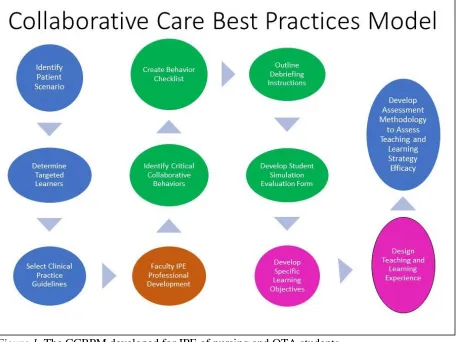
Figure 1. The CCBPM developed for IPE of nursing and OTA students.
The faculty sought to demonstrate novice nursing and OTA student competency acquisition relevant to their respective professions by having students demonstrate an awareness of complex health
the interprofessional team” (AACN, 2008, p. 14). The ACOTE standards (2018) state that the OTA’s role is to develop “occupation-based intervention plans and strategies (including goals and methods to achieve them) on the basis of the stated needs of the client as well as data gathering during the
evaluation process in collaboration with the client and others” (p. 23). The OTA faculty emphasized the role of and the expectations for occupational therapist and OTA collaboration in the students’ data collection, evaluation, and application, all of which inform decision-making in developing and implementing the patient’s plan of care. The faculty reviewed patient cases for ways in which the students demonstrated the skills of an occupational therapist and OTA collaboration, such as aspects of assessment, data collection, collaboration, communication, and evaluation within the appropriate scope of practice. Each role was emphasized in the courses for each profession. Activities included the OTA students communicating identified client needs to the occupational therapist.
Method
Following approval of the grant proposal, the faculty members met on multiple occasions to develop the CCBPM for the project. This process consists of five steps based on the University of Virginia interprofessional education approach (Brashers & Owen, n.d.).
Step 1 involved identifying the patient scenario, determining the targeted learners, and selecting the clinical practice guidelines as outlined by the respective professional bodies that aligned with the students’ professions. We generated the clinical practice guidelines from ACOTE for the OTA students and the Commission on Collegiate Nursing Education (CCNE) for the nursing students.
The faculty participated in professional development to increase their knowledge of IPE and collaborative team facilitation in Step 2 of the project. The primary faculty members completed IPE training using the University of Washington Center for Health Sciences Interprofessional Education, Research and Practice online education modules (University of Washington, 2017).
In Step 3, the faculty members identified a list of critical collaborative behaviors from the respective standards for practice in the professions. For nursing, these standards were from the AACN (2008). For OTA, these standards were from the ACOTE (2013). The faculty members created
behavioral checklists to address these behaviors. They outlined debriefing instructions using the International Nursing Association for Clinical Simulation and Learning (INACSL) Standards of Best Practice: Simulation. The faculty members developed the Student Simulation Evaluation Form to collect individual learner feedback and the Simulation Debriefing Worksheet to compile group learned
feedback following the simulation experience. During Step 3 all student learners and three faculty members were provided access to and training materials for the electronic medical record technology used by the university for health care professions training.
In Step 4, the faculty members developed specific learning objectives for the targeted learners and designed teaching and learning experiences that reflected the learning objectives. Step 5 was the final step in building the IPE collaborative model. In this step, the faculty members developed an assessment methodology to assess teaching and learning strategy efficacy.
The development of the CCBPM involved evaluation of the teaching and learning strategies used in both the OTA and nursing curricula that supported the primary concepts of interest. These included patient-centered care, quality and safety, teamwork (collaboration), informatics, and communication. In preparation for the developed scenario, the faculty members in both programs provided learning
collaborative health care practice, communication in an interprofessional team environment, and use of the electronic health record system.
Following the development of the CCBPM, we scheduled and conducted the simulation
experience with 13 nursing students and 10 OTA students participating. The students were divided into five groups, with two OTA students in each group; the remaining group members were nursing students. Preparatory work for the participants included a review of the job descriptions and skills associated with health care team members of other disciplines prior to the day of the simulation (INACSL Standards Committee, 2016). This included the OTA students reviewing the occupational therapist and OTA collaboration and scope of practice, and the nursing students reviewing the professional nursing scope of practice. A pre-briefing was conducted with each group to provide an overview of the scenario, outline expectations, provide instructions, and answer any questions the participants had prior to beginning the simulation experience (INACSL Standards Committee, 2016). Each group took approximately 15 min to complete the simulation scenario. During the simulation experience, the faculty used behavioral
checklists to evaluate learner performance based on their roles (OTA or nursing).
Once a group completed their simulation experience they were instructed to move to the
classroom designated for debriefing. Each group exited the simulation lab using a different path than the next group entering to prevent students from sharing the details of the scenario with those learners waiting their turn in the simulation lab setting. A faculty member assisted as the principle facilitator for the debriefing session. Instructions for this process were developed and implemented following the INACSL standards for simulation (Decker et al., 2013).
The first step in debriefing involved asking each student learner to complete an individual evaluation that included a self-reflection question. Once this was completed by each learner, each team was asked to complete a group reflection exercise and to record their responses on a debriefing
worksheet. After completing the worksheets, each group was asked to develop a concept map outlining the primary issues identified while completing the worksheet. These concept maps were photographed for archiving and for analysis for themes.
The final step of debriefing was to allow the students to discuss as a large group their experiences during the simulation and to receive general feedback about overall performance of the group as an aggregate. All learners were given opportunities to voice concerns, lessons learned, and feeling about their experiences with the simulation.
The project evaluation used a mixed-methods approach. Project performance measures focused on student learner outcomes using developed tools to quantitatively and qualitatively assess the students’ experiences and performance, faculty knowledge and qualification attainment, student learner and faculty experiences with the project’s teaching and learning strategies (theme identification from student focused feedback and concept mapping exercises), and evaluation of the CCBPM pilot through faculty reflection (lessons learned).
Results
scenario and overall fidelity, the aggregate rating of strongly agree and agree equaled 90.9%. The aggregate rating of strongly agree and agree equaled 95.45% for equipment fidelity.
Support for the learner throughout the simulation process can significantly affect the quality of what is learned through the simulation experience (Vardi, 2008). Variations in learning styles,
educational backgrounds, and prior experiences will impact the degree and substance of the learner support required during a simulation participation experience (Vardi, 2008). All students in the simulation experience were first semester students in their respective programs. The number of participants who rated their feelings of being supported by selecting strongly agree or agree was 72.72%.
The respective faculty for these programs developed the OTA and nursing student IPE Behavioral Checklists based on required clinical practice competencies associated with the scenario template developed for the CCBPM and by using the relevant disciplinary standards. The OTA program uses the ACOTE standards for OTAs (2018). The nursing program uses the AACN standards for
baccalaureate level nursing education (2008). The IPE Behavioral Checklists were then provided to expert faculty members in both programs for review to evaluate for content validity.
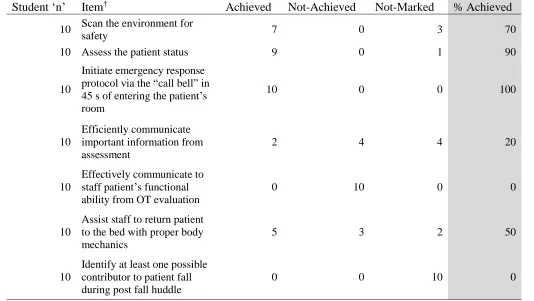
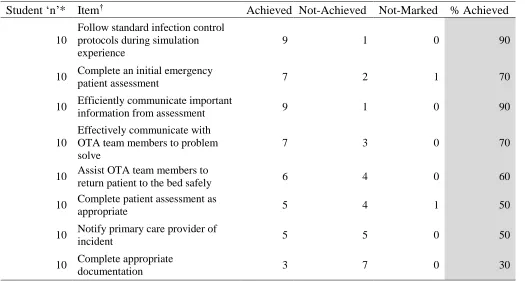
Tables 1 and 2 provide the data overview of achievement of behaviors by the participants based on their simulation performances. The percent achieved for each behavior is identified from all
observations. The checklists were completed for each student by the faculty of his or her profession to maintain rigor and rater reliability.
Table 1
OTA IPE Behavioral Checklist Outcomes
Student ‘n’ Item† Achieved Not-Achieved Not-Marked % Achieved
10 Scan the environment for
safety 7 0 3 70
10 Assess the patient status 9 0 1 90
10
Initiate emergency response protocol via the “call bell” in 45 s of entering the patient’s room
10 0 0 100
10
Efficiently communicate important information from assessment
2 4 4 20
10
Effectively communicate to staff patient’s functional ability from OT evaluation
0 10 0 0
10
Assist staff to return patient to the bed with proper body mechanics
5 3 2 50
10
Identify at least one possible contributor to patient fall during post fall huddle
0 0 10 0
The OTA students did not participate in a “post fall huddle” as anticipated, so this item on the OTA IPE Behavioral Checklist was not marked for any participant experience. All of the OTA
participants followed emergency response protocols. Ninety percent of the OTA participants completed an assessment of patient status following practice standards.
The OTA students performed well in assessing the patients’ status and initiating the response protocols. We identified efficient and effective communication and assistance with the nursing staff to return the fallen patient to the bed following proper body mechanics as areas for the OTA students to improve. These issues were addressed in the debriefing session to highlight the need to focus attention on these vital aspects of clinical practice.
Table 2
Nursing IPE Behavioral Checklist Outcomes
Student ‘n’* Item† Achieved Not-Achieved Not-Marked % Achieved
10
Follow standard infection control protocols during simulation experience
9 1 0 90
10 Complete an initial emergency
patient assessment 7 2 1 70
10 Efficiently communicate important
information from assessment 9 1 0 90
10
Effectively communicate with OTA team members to problem solve
7 3 0 70
10 Assist OTA team members to
return patient to the bed safely 6 4 0 60
10 Complete patient assessment as
appropriate 5 4 1 50
10 Notify primary care provider of
incident 5 5 0 50
10 Complete appropriate
documentation 3 7 0 30
† Behaviors derived from AACN, 2008.
*Three students participated in the simulation as scripted players portraying the daughter of the patient found fallen on the floor. The behavioral checklist was not applied to their performances.
The INACSL standards of best practice for simulation facilitation call for the simulation to include delivery of “cues to help participants interpret or clarify the simulated reality or help redirect participants toward the expected outcomes” (INACSL Standards Committee, 2016, p. s18). To facilitate reality in the simulation experience, three of the 13 nursing student participants role-played the scripted part of the patient’s daughter during the simulation but did not function in the simulation experience in the role of the nurse.
The nursing student participants performed well in two areas of basic nursing practice based on the simulation observation: following infection control protocols and communicating important
student participants included collaboration with occupational therapy staff to assist the patient back to bed safely, completion of a patient assessment following the return to bed, notification of primary care providers of the patient fall, and documentation of the event. These items were addressed during the debriefing session to focus the participants’ attention on the vital nature of these behaviors in clinical nursing practice.
All student participants were participating in their first clinical simulation experiences. None of the students had been to a clinical practice setting prior to this simulation experience. Identification of behavior gaps may be vital in assessing knowledge deficits to address prior to clinical placements.
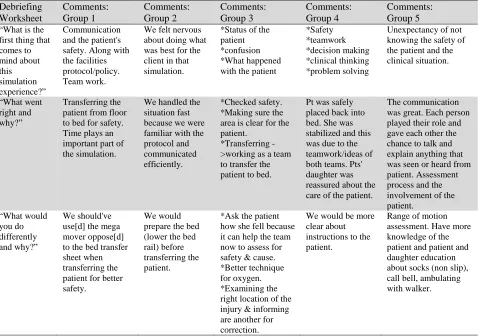
Qualitative analysis was done to evaluate the participants’ perceptions of focus for clinical practice in their professions following the simulation experience. Using the exploratory function of grounded theory methodology, the transcribed data from the team Simulation Debriefing Worksheet were analyzed to identify themes (see Table 3 for examples). Three primary themes were identified from the transcribed team debriefing worksheets. These were:
Safety
Communication
Teamwork
Table 3
IPE Simulation Team Responses: Debriefing Worksheet*
*All comments and responses were transcribed directly from the group debriefing worksheets as provided by the participants.
Debriefing Worksheet Comments: Group 1 Comments: Group 2 Comments: Group 3 Comments: Group 4 Comments: Group 5
“What is the first thing that comes to mind about this simulation experience?” Communication and the patient's safety. Along with the facilities protocol/policy. Team work.
We felt nervous about doing what was best for the client in that simulation.
*Status of the patient
*confusion *What happened
with the patient
*Safety *teamwork *decision making *clinical thinking *problem solving
Unexpectancy of not knowing the safety of the patient and the clinical situation.
“What went right and why?”
Transferring the patient from floor to bed for safety. Time plays an important part of the simulation.
We handled the situation fast because we were familiar with the protocol and communicated efficiently.
*Checked safety. *Making sure the area is clear for the patient.
*Transferring ->working as a team to transfer the patient to bed.
Pt was safely placed back into bed. She was stabilized and this was due to the teamwork/ideas of both teams. Pts' daughter was reassured about the care of the patient.
The communication was great. Each person played their role and gave each other the chance to talk and explain anything that was seen or heard from patient. Assessment process and the involvement of the patient. “What would you do differently and why?” We should've use[d] the mega mover oppose[d] to the bed transfer sheet when transferring the patient for better safety.
We would prepare the bed (lower the bed rail) before transferring the patient.
*Ask the patient how she fell because it can help the team now to assess for safety & cause. *Better technique for oxygen. *Examining the right location of the injury & informing are another for correction.
We would be more clear about instructions to the patient.
Triangulation of these themes with the major concepts produced by the teams in their team concept maps validated that these themes seem to be the most important for the participants immediately following the simulation.
The three themes address three of the five competencies identified as goal outcomes for the simulation project as outlined in Step 4 of the CCBPM. The competencies identified were:
Awareness of complex health care organizational systems and the promotion of safety and quality outcomes for diverse populations.
Collaboration in the collection, documentation, and application of patient care data to facilitate clinical decision-making.
Appropriate use of interprofessional communication and collaborative skills to deliver evidence-based, patient-centered care.
The remaining two competencies that were not identified by the student participants as most important for clinical practice represent additional educational opportunities for focus and alternative teaching and learning strategies moving forward. The remaining two competencies are:
Appropriate use of patient care technologies, information systems, and communication devices to support safety in all health care settings.
Evaluation of data from all relevant sources, including technology, to inform multidisciplinary delivery of patient-centered care.
Discussion
The faculty reported that their IPE training was valuable in helping to prepare other faculty new to the simulation experience for the expectations, standards, and best practices for using simulation as a teaching and learning stratagem. New accreditation standards in OTA and occupational therapy
education will require the use of simulation in the curriculum. A greater emphasis on intra- and interprofessional education, scheduling simulation for learning activities, assessment, and evaluation will be necessary components of curriculum development. The faculty IPE preparation will provide training to core and adjunct faculty across all health care programs, as programs expect interprofessional educational experiences to be integrated as part of course delivery. To allow for maximum effectiveness in use of simulation, information must be provided in a timely manner to all involved parties, thus allowing for appropriate curriculum alignment, individual course simulation scheduling, and faculty and student training. The student and faculty feedback identified the value of simulation and expressed a desire to implement this tool as a planned aspect of clinical education for both the OTA and the nursing students in the future.
students’ understanding of how to perform in simulation experiences, their knowledge of specific health care role delineation and scope of practice, and their confidence in clinical communication. This would be of significant benefit to both programs as they prepare for and continue to participate in community clinical experiences.
The development of the CCBPM provided significant guidance in the creation and
implementation of the interprofessional simulation educational experience for both the nursing and the OTA students. Continued use of simulation with an expansion of multidisciplinary focus should be a goal of the university. Gilbert (2005) states that “structural changes need to be made within universities such that interprofessional education for patient-centered [sic] collaborative practice becomes a
responsibility that crosses faculty jurisdictions and is accepted as the responsibility of all associated health and human service programs” (p. 87). Closing the quality chasm (IOM, 2001) is possible only if educational settings in both academic and clinical organizations devote energy in the use of data-driven teaching and learning strategies to address patient safety and delivery of best practices in both education and clinical practice for all professional program students as an expected student learning outcome.
Carrie M. O’Reilly, PhD, MSN, RN, earned her Bachelor of Nursing Science at Oral Roberts University, her Master of Nursing Science at the University of Phoenix, and her Doctor of Philosophy in health sciences from Touro University International, a branch campus of Touro College, New York. Dr. O’Reilly’s research interests are focused on educational outcomes research and on nursing theory development. Dr. O’Reilly has been a practicing nurse working in acute care, nursing leadership, and nursing education. Dr. O’Reilly is currently an assistant professor of nursing and health professions at Trinity Washington University in Washington, DC.
Lisa P. Simmons, MS, OTR/L, is currently the director of the occupational therapy assistant program at Trinity Washington University. Mrs. Simmons completed her Bachelor of Science in occupational therapy at Tuskegee University and her Master of Science in management at the University of Maryland, University College. She has been an occupational therapist for over 15 years working in various practice settings across the country, including acute care, mental and behavioral health, acute rehab, home health, outpatient, and skilled nursing facilities. She has been an occupational therapy educator for just over 4 years. Mrs. Simmons is a military spouse, mother of two, and volunteers with Girl Scouts and church organizations. Mary L. Romanello, PhD, PT, earned her Bachelor of Science in education at the University of Cincinnati, her Master of Science in physical therapy at Indiana Central University, and her Doctor of Philosophy in education at Miami University, Oxford, Ohio. Dr. Romanello’s scholarship focused on curriculum integration and student learning across health care disciplines. Dr. Romanello has taught in high school and college, served as athletic training and physical therapy program directors and advanced into higher levels academic leadership. Dr. Romanello currently is the dean of the School of Nursing and Health Professions at Trinity Washington University in Washington, DC.
References
Accreditation Council for Occupational Therapy Education. (2013). Accreditation manual. Bethesda, MD: Author. Retrieved from
https://www.aota.org/~/media/Corporate/Files/E ducationCareers/Accredit/Policies/ACOTE%20 Manual%20Complete.pdf
Accreditation Council for Occupational Therapy Education. (2018). 2011 Accreditation Council for Occupational Therapy Education (ACOTE) standards and interpretive guide. Retrieved from
https://www.aota.org/-/media/corporate/files/educationcareers/accredit/ standards/2011-standards-and-interpretive-guide.pdf
American Association of Colleges of Nursing. (2008).
The essentials of baccalaureate education for professional nursing practice. Washington, DC:
Author. Retrieved from
https://nursing.lsuhsc.edu/Docs/Quality/AACN% 20Essentials%20of%20Baccalaureate%20Educat ion%20for%20Professional%20Nsg%20Practice %20(2008).pdf
Brashers, T., & Owen, J. (n.d.). Brief primer on IPE evaluation for Univ. of Washington. Retrieved from
http://depts.washington.edu/uwhsa/wordpress/wp -content/uploads/2013/02/Brief-Primer-on-IPE-Evaluation-for-UW-2.pdf
Brown, M. R., & Watts, P. (2016). Primer on interprofessional simulation for clinical
laboratory science programs: A practical guide to structure and terminology. Clinical Laboratory Science, 29(4), 241-246. Retrieved from
Commission on Collegiate Nursing Education. (2013).
Standards for accreditation of baccalaureate and graduate nursing programs (Amended). Washington, D.C.: Author. Retrieved from
https://www.aacnnursing.org/Portals/42/CCNE/P DF/Standards-Amended-2013.pdf
Decker, S., Fey, M., Sideras, S., Cabellero, S., Rockstraw, L., Boese, T., … Borum, J. C. (2013). Standards of best practice: Simulation standard IV: The debriefing process. Clinical Simulation in Nursing, 9(6), S26-S29.
http://dx.doi.org/10.1016/j.ecns.2013.04.008 Dow, A., Blue, A., Konrad, S. C., Earnest, M., & Reeves,
S. (2013). The moving target: Outcomes of interprofessional education. Journal of Interprofessional Care, 27(5), 353-355.
http://dx.doi.org/10.3109/13561820.2013.80644 9
Gallo, K., & Smith, L. G., (Eds.). (2015). Building a culture of patient safety through simulation: An interprofessional learning model. New York, NY: Springer Publishing Company, LLC. Gilbert, J. H. V. (2005). Interprofessional learning and
higher education structural barriers. Journal of Interprofessional Care, 19(Suppl. 1), 87-106.
http://dx.doi.org/10.1080/13561820500067132
INACSL Standards Committee. (2016). INACSL standards of best practice: Simulation facilitation. Clinical Simulation in Nursing,
12(Suppl.), S16-S20.
http://dx.doi.org/10.1016/j.ecns.2016.09.007
Institute of Medicine. (2001). Crossing the quality chasm:
A new health system for the 21st century. Washington, DC: National Academy Press. Institute of Medicine. (2003). Health professions
education: A bridge to quality. Washington, D.C.: National Academy Press.
https://doi.org/10.17226/10681
National League for Nursing Board of Governors. (2015).
NLN vision series: A vision for teaching with simulation. Retrieved from
http://www.nln.org/docs/default- source/about/nln-vision-series-(position- statements)/vision-statement-a-vision-for-teaching-with-simulation.pdf?sfvrsn=2
Owen, H. (2016). Simulation in healthcare education: An extensive history. Cham, Switzerland: Springer International.
Regents of the University of Minnesota. (2017). Resource center. Retrieved February 27, 2017 from
https://nexusipe.org/informing/resource-center
Retchin, S. M. (2008). A conceptual framework for interprofessional and co-managed care.
Academic Medicine, 83(10), 929-933.
http://dx.doi.org/10.1097/ACM.0b013e3181850b 4b
Rose, M. A., Smith, K., Veloski, J. J., Lyons, K. J., Umland, E., & Arenson, C. A. (2009). Attitudes of students in medicine, nursing, occupational therapy, and physical therapy toward
interprofessional education. Journal of Allied Health, 38(4), 196-200.
Rossler, K. L., & Kimble, L. P. (2016). Capturing readiness to learn and collaboration as explored with an interprofessional simulation scenario: A mixed-methods research study. Nursing Education Today, 36, 348-353.
http://dx.doi.org/10.1016/j.nedt.2015.08.018
University of Virginia School of Nursing. (2017). Start your IPE project. Retrieved from
https://ipe.virginia.edu/foreducators/startyouripe project/
University of Washington. (2017). Center for health sciences interprofessional education, research, and practice.
Vardi, I. (2008). Teaching and learning through the simulated environment. In R. H. Riley (Ed.),
Manual of simulation in healthcare, pp. 99-114. Oxford, England: Oxford University Press. Williams, B., McCook, F., Brown, T., Palmero, C.,
McKenna, L., Boyle, M., … McCall, L. (2012). Are undergraduate health care students ‘ready’ for interprofessional learning? A cross-sectional attitudinal study. Internet Journal of Allied Health Sciences and Practice, 10(3). Retrieved from
http://nsuworks.nova.edu/ijahsp/vol10/iss3/4/ World Health Organization. (2010). Framework for
action on interprofessional education & collaborative practice. Retrieved from