573
Copyright © 2011-15. Vandana Publications. All Rights Reserved.
Volume-5, Issue-2, April-2015
International Journal of Engineering and Management Research
Page Number: 573-582
Behaviour of Concrete Infilled Duplex Stainless Steel Circular Columns
and Beams
SunusiAminu Yunusa1, Dr. S Senthil Selven2 1
M. Tech Student, Department of Structural Engineering, SRM University, Chennai,INDIA 2
Professor, Department ofCivil Engineering, SRM University, Kattankullathur, Chennai, INDIA
ABSRACT
This paper presents an experimental, theoretical and numerical investigation on the behaviour of concrete in filled duplex stainless steel circular columns and beams. Thebehaviour of columns was investigated using different size of columns calculated based on slenderness ratio varies from 50,60 to 70 and diameter of 50mm. A series of test was carried out to investigate the mechanical properties of the materials used for this research, concrete cubes, cylinders and beams of grade M20 was casted and tested with conventional concrete and concrete reinforced with steel fibre as part of preliminary test. The parametric study for this research are slenderness ratio, deflection, axial shortening, ultimate load, strain and effect of conventional concrete and concrete reinforced with steel fibre as in filled.Three hollow and six composite duplex stainless steel columns was casted and tested with conventional concrete and concrete reinforced with steel fibre. Finite element analysis was carried out for both hollow and composite duplex stainless steel column using commercial software package ANSYS 12 (ANSYS Mechanical APDL).The material properties obtained from experimental investigation were used to model both duplex stainless steel and concrete. The test strength was compared with the design strength calculated using international standards such as American code(ACI 319-1999), AISC-2005 and BS 5400.The resultsindicate that the use of fibre reinforced concrete as infill material in duplex stainless steel ( DSS) columns has a considerable effect on the strength and behaviour of slender composite columns.
Keywords--- Duplex stainless steel, Effect of
Slenderness ratio, Ultimate load, Axial shortening, Effect of conventional concrete and Steel fibre reinforced concrete in filled in duplex stainless steel (DSS) columns and beams.
I. INTRODUCTION
In the present era, creations and development of infrastructural facilities are the important factor that contribute to the development of any country. Concrete filled steel tubes (CFST) is a composite material which
574
Copyright © 2011-15. Vandana Publications. All Rights Reserved.
columns eliminate permanent formwork which reduces the time of construction. They are considered as an advantageous system for carrying large axial load benefitting from interaction between the concrete and the steel section. The steel tube reinforces the concrete to resist any bending moment, tensile and shear forces. The concrete in a composite column improves the buckling behaviour of the steel section in addition to resisting compressive loading. In the light construction of high rise buildings concrete filled steel tubes is one of an innovative new building material which can sustain worst combination of loads, with high stiffness, facilitating speed of construction and maintaining economy. In recent years, stainless steel tubes members have become popular due to the high corrosion resistance, ease of construction and maintenance as well as aesthetic appearance.Duplex stainless steel is an extremely corrosion resistant, work hardenable alloys, their microstructure consist of a mixture of austenite and ferrite phases, as a result, duplex stainless steels display the properties characteristics of both austenitic and ferrite stainless steels. This combination of properties can near some compromise when compared with pure austenitic and pure ferrite grades. On the other side, the duplex stainless steels offer higher strength than austenitics along with a great majority of carbon steels with similar or higher corrosion resistance. Accordingly, duplex grades have great potential for expanding future structural design possibilities, enabling a reduction in
section sizes and leading to lighter structures. However, duplex stainless steel grades are commonly grouped in to different groups, depending on their alloy contents and corrosion resistances as the duplex grade being one of them. The duplex contains low nickel content (around 1.5%), such as grade EN 1.4162 or ASTM-S32101 from international steel numbers. EN 1.4162 is a low alloyed, general purpose duplex stainless steel. Its high mechanical strength is similar to that of other duplex grades and its good corrosion resistance is on par with that of most standard stainless steel grades. Combined, these properties can be utilised to arrive at a design optimised with respect to strength, maintenance, durability and long-term cost efficiency for the construction sector. The mechanical properties of duplex stainless steel EN1.4162 are, it has high mechanical strength due its duplex microstructure and high nitrogen content.The characteristics properties are it has a high strength, excellent stress ratio, good fatique resistance, good corrosion resistance, high resistance to stress corrosion cracking, high energy absorption, very good machinability, very good weldability, and stable pricing in a volatile alloy market. Its main application includes nuclear, coastal defence, other marine (mainly energy drive), highways structures affected by salts, concrete repair and precast. The example of the structural application of duplex stainless steel grade EN 1.4162 include the likholefossen bridge in Norway and the siena foot bridge in Italy.
II.
METHODOLOGY
This research investigate the behaviour duplex stainless steel columns using different size of columns calculated based on slenderness ratio varies from 50,60 to 70 and diameter of 50mm. A series of test was carried out to investigate the mechanical properties of the materials used for this research, concrete cubes, cylinders and beams of grade M20 was casted and tested with conventional concrete and concrete reinforced with steel fibre as part of preliminary. Axial compressive
strength test was carried out on three hollow duplex stainless steel column and six duplex stainless steel column was casted and tested three with plain concrete and three with concrete reinforced with steel fibre. The experimental results was verified with theoretical values calculated from international standards and numerical modelling were carried out using commercial software package ANSYS 12 (ANSYS Mechanical APDL). And conclusion was made from the research based on the findings.
III.
PRIOR APPROACH
In the previous research,Theofanous.M et al (2010),[4] assess the effect of key parameters such as cross section aspect ratio, cross section slenderness and moment gradient on the strength and deformation capacity of lean duplex stainless steel beams. The outcome of this studies based on the experimental and numerical results, the overall lean duplex stainless steel is showed to offer superior structural performance than the familiar austenitics (grades at a lower cost, making lean duplex stainless steel an attractive choice
575
Copyright © 2011-15. Vandana Publications. All Rights Reserved.
and Australian/ New Zealand design specifications for cold formed stainless steel structures. The outcome has showed that the code predictions are mostly conservative for stainless steel beam-columns with rooms for improvement in the current guidance.Hassanein.MF et al (2013),[5] investigate the effects of compressive strength and diameter-to-thickness (D/t) ratio on the behaviour of CFSST columns. The outcome showed that the ultimate axial strength of circular CFSST columns increase with increasing the concrete compressive strength but decrease with an increase in the D/t ratio. Circular CFSST columns with difference D/t ratios exhibit the same initial stiffness. The lean duplex stainless steel tubes cannot provide good confinement on the concrete when D/t ratio is large. Theofanous.M et al (2009),[6]” assess the local and global geometric imperfection of Stub columns and long columns test on lean duplex stainless steel square (SHS) and rectangular hollow sections (RHS).parametric studies were performed to generate results over a wider range of cross sectional and member slenderness such as flexural buckling. The outcome showed that the comparisons between the structural performance of lean duplex stainless steel and that of other most commonly used stainless steel grade, showing lean duplex stainless steel to be an attractive choice for structural applications.
Hassanein.MF (2010),[3] showed that increasing the strength of the concrete core for the same stainless steel tube, leads generally to a linear increase in the strength of in filled concrete, the sharper the axial shortening behaviour and the design rules specified in the ASCE are highly conservative for square and rectangular concrete filled lean duplex slender stainless steel stub columns while they are conservative in the case of European specification. Hassanein.MF et al (2013),[1]
investigate the effect of concrete compressive strength, carbon steel yield stress and cross section geometry on the behaviour of CFSCT columns. The outcome of showed that the concrete compressive strength significantly increases the ultimate axial strength of circular CFSCT columns, while the initial stiffness remains approximately the same, CFSCT columns
behave in a favourable ductile manner irrespective of the compressive strength value even when the high strength concrete is used and the proposed design model provides excellent predictions of the ultimate axial strengths of circular CFSCT columns over a wide range of diameter-to-thickness ratios of the stainless steel tubes. Bradford et al (2002),[10] investigated the local and post-local buckling of circular steel tubes filled by mean of a rigid medium with emphasis being on the strength of CFST sections. They proposed a cross section slenderness limit that delineates between a fully cross section and a slender cross section. This cross section slenderness is given by 125/(fy/250); where fyis the steel yield strength.Ding et al (2011), reported that the confinement effect, ultimate capacity and ductility of CFST columns were found to improve with the increase in steel ratio and yield stress. On the other hand, increasing the concrete compressive strength increases the ultimate load capacity of the column but decreases the ductility of CFST columns.Liang and Faragomeni (2009), found that the existing confining pressure model, which were developed based on normal strength materials, generally overestimate lateral confining pressures in high strength circular CFST columns. Therefore a more accurate constitutive model for confined concrete in both normal and high strength circular CFST columns was proposed. The constitutive relationships for confined concrete can be used in numerical techniques for modelling the non linear behaviuor of circular CFST columns. This proposed for design formula can be used by practicing structural engineers to design high strength circular CFST columns, which are not covered by current design codes. Their study demonstrates that increasing the tube diameter-to- thickness (D/t) ratio reduces the ultimate strengths of CFST columns in addition to their section and axial ductility performance.O’shea and Bridge (2000),found that the strength and ductility decrease with increasing diameter to thickness (D/t) ratio and confirmed from the test that the load and the bond conditions significantly influenced the axial load behaviourof circular concrete filled steel tube columns.
IV.
OUR APPROACH
The previous research has focus attention some parameters such as the effect of diameter to thickness ratio (D/t), initial imperfection of steel tube, cross
section aspect ratio and effect of local buckling on the steel tube in relation to providing confinement to the concrete.
In this research attention were given to effect of slenderness ratio, axial shortening, deflection, strain, and the effect of compressive strength of conventional
576
Copyright © 2011-15. Vandana Publications. All Rights Reserved.
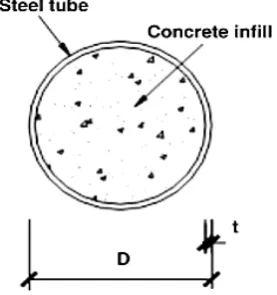
Fig. 1 Circular concrete in filled Duplex stainless steel sectionA. THEORETICAL ANALYSIS
The theoretical value of hollow duplex stainless steel was calculated using the formular given in
IS 800:2007, section 7, clause:7.1 the theoretical capacity value of hollow steel columns is calculated using the following formula:
Design axial compressive strength Pd P<Pd ,
Pd = AC × fcd
Where , AC = effective sectional area
fcd = design compressive stress, obtain from table 9(a) clause 7.1.2.1, for column buckling class (a) based on yield strength of steel.
P= applied load
The capacity concrete in filled column calculated using the following international standards as follows:
1. AISC-2005: American institute of steel construction-Load and Resistance Factor design specification for structural steel Buildings. The plastic stress distribution method is adopted by the AISC code to determine the nominal strength of composite sections but suitable reduction factors are applied to account for slenderness ratio of course, local buckling should be considered for filled composite member when using this method. For axially loaded CFST columns, the design compressive strength can be calculated for the flexural buckling limit state based on member slenderness ratio as follows: The design compressive strength Pdas per clause I; 2.2b is calculated from the following equation.
Pd= 0.75Pn
Pn= Po [0.658Po/Pe] if Pe≥0.44P P
o n= 0.877Pe if Pe< 0.44Po
Po = AS fy+ C2 Ac fc Pe= π2EIeff/(KL)2
Effective stiffness: EIeff =ES IS + C3ECIC C3 = 0.6 + 2AS /(AC + AS) ≤ 0.9
Where C2 = 0.85 for rectangular and 0.95 for circular sections.
2. ACI 318-1999:American concrete Institute-Building requirements for structural concrete: A composite column can be define as a concrete column reinforced with a structural steel shape or tubing in addition to reinforcement bars. Slenderness effects are included by considering equivalent radius of gyration and flexural stiffness. The limiting values of D/t ratio beyond which the local buckling may be avoided is also specified for concrete under sustained loads are considered. The ultimate load PU is given as: NACI,AIJ,AS= (AS×fy) +0.85(Ac × fc).
3. BS 5400 Method, the theoretical value formula for calculating the capacity of composite columns is given as : NBS5400= (AS×fy) +0.675(Ac × fc)
where N= load
AC= Area of concrete infill fy= yield strength of steel tube
AS= Area of steel tube fc
The theoretical results calculated for concrete in filled duplex stainless columns based on AIC 318-1999 and BS 5400 it can be easily understood that the axial load carrying capacity of CFST sections is only increase with an increased in D/t ratio.
B.NUMERICAL ANALYSIS
= compressive strength of concrete infill
The finite element analysis was carried out using commercial package ANSYS 12 (ANSYS Mechanical APDL), the element used for this analysis are SHELL 181 and SOLID 65 available in ANSYS library. SHELL 181 was used to model the steel tube. It is suitable for analysing thin or moderately- thick shell structures and it
has a four- node element with six degrees of freedom at each node. SOLID65: The element CONCRETE65 was
577
Copyright © 2011-15. Vandana Publications. All Rights Reserved.
the SOLID65(3-D Structural Solid) element with the addition of with special cracking and crushing capabilities.Non-linear static analysis was carried out for
these models, the models are generated withtotal load of -10KN. An incremental load magnitude along Y- direction is applied using NEWTONRAPHSON method available in ANSYS library.Each increment of step in the analysis a small amount of the load is applied until the total magnitude of applied load is reached. The total of number nine modelling were developed, three for hollows and three for composite columns using different
length of the columns based on slenderness ratio.The materials properties of duplex stainless steel and concrete obtained from laboratory tests where used to model both stainless steel column and concrete core the properties are as follows: STEEL: Material is duplex stainless steel grade EN 1.4162, with modules of elasticity of 200Gpa, poisons ratio of 0.3 and density of 7800 kg/m3. CONCRETE: the properties of concrete use for these models are concrete grade M20 with young modulus of 22,360.68Mpa, poisons ratio 0.2 and density of2400kg/m3
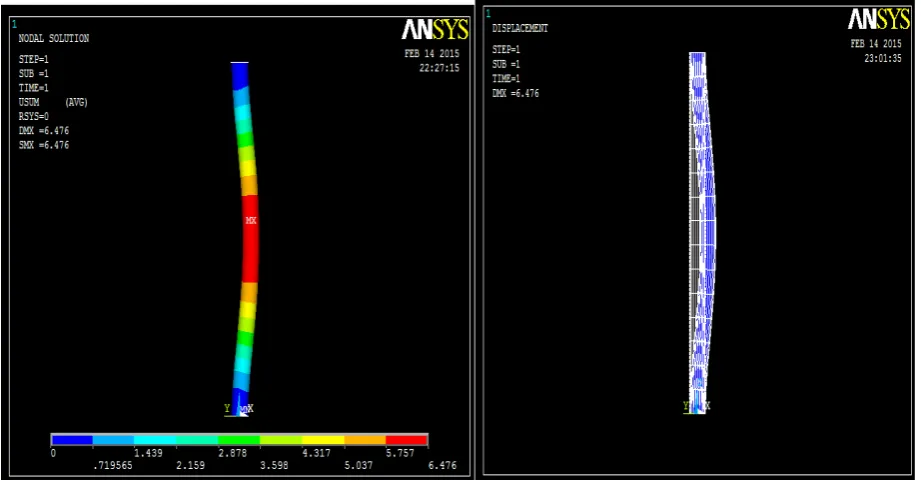
Fig.2 Composite column after meshing Fig.3 Boundary conditions of the column
were used for this models.
Stainless steel column Concrete in filled
578
Copyright © 2011-15. Vandana Publications. All Rights Reserved.
Fig.5 Stress on composite column Fig.6 Deformed and un-deformed579
Copyright © 2011-15. Vandana Publications. All Rights Reserved.
Fig.8 Deformed shape of the hollow columnsFig.9 Global buckling on hollow columnC. EXPERIMENTAL INVESTIGATION
The duplex stainless steel was cut to the required sizes and the size was calculated based on the slenderness ratio of 50, 60 and 70 respectively.
There are total number of nine duplex stainless steel columns specimens having the diameter of 50mm and length of 860mm, 1030mm and 1200mm (3 pieces each). The specimen identification number are as follows:A1,A2,A3 and B1,B2,B3 and C1,C2,C3 respectively: where A1- stand for hollow column, A2- stand for column with conventional concrete in filled
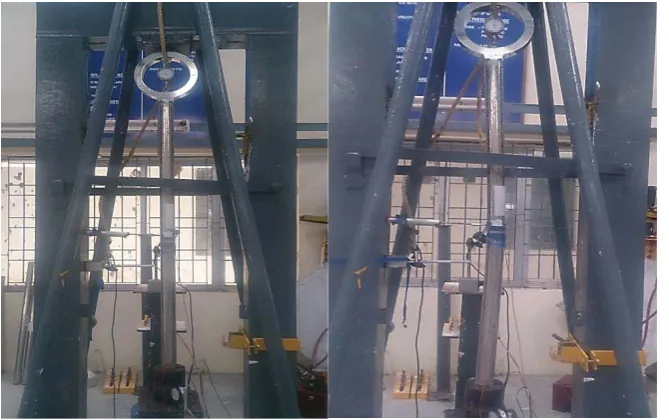
and A3-stand for column with concrete and steel fibre in filled respectively. Preliminary test was carried out on the materials used for this experiment in order to find the mechanical properties of both steel and concrete used. The test was carried out on nine duplex stainless steel columns in which three are hollow columns and six are concrete in filled columns. The experimental set-up showing the columns before and after testing are shown below in fig. 1 and fig .2
Fig. 5.1 Experimental set-up before testing Fig.5.2 Composite DSS column after testing
D. RESULTS AND DISCUSSIONS
The theoretical results calculated for concrete in filled duplex stainless columns based on AIC 318-1999 and BS 5400, it can be easily understood that the axial load carrying capacity of CFST sections is only increase with an increased in D/t ratio.
From the experiment conducted it was observed that the axial shortening increases with an increase in slenderness ratio.
580
Copyright © 2011-15. Vandana Publications. All Rights Reserved.
The strain was increasing with slight variations till the ultimate load was reached in all the columns.
The buckling is less in columns with 50 slenderness ratio compared to columns with 60 and 70 slenderness ratio respectively. This is because the buckling failure occurs when tall slender columns experiences loads that cause them to buckle or shift outward to relief stress.
The column with slenderness not exceeding 50 can be regarded as short column therefore it is carrying more load. The experimental results are shown in Table .1 below for both hollow duplex stainless steel and concrete in filled columns respectively. The comparison of experimental and theoretical results for hollow columns are shown in Table.2 and that of concrete in filled in Table.3.
Table.1 Experimental Results for hollow and concrete in filled duplex stainless steel columns. S/No. Specimen no. Slenderness
Ratio
Length (mm)
Diameter (mm)
Thickness (mm)
Axial shortening (mm)
Ultimate Load PU (KN)
1 A1 50 860 50 1.6 0.57 78.45
2 B1 60 1030 50 1.6 3.41 56.39
3 C1 70 1200 50 1.6 7.2 53.94
4 A2 50 860 50 1.6 4.4 132.38
5 B2 60 1030 50 1.6 5.5 95.61
6 C2 70 1200 50 1.6 6.9 88.26
7 A3 50 860 50 1.6 4.5 134.84
8 B3 60 1030 50 1.6 5.3 98.07
9 C3 70 1200 50 1.6 6.4 93.16
Table.2 Comparison of Experimental and Theoretical Results for hollow DSS columns S/No. Specimen
Identification Number.
Slenderness Ratio
Length (mm) Experimental ultimate Load PU
Theoretical Ultimate Load P (KN)
U
Finite Element Analysis Ultimate Load P (KN)
U(KN)
1 A1 50 860 78.45 56.92 65
2 B1 60 1030 56.39 53.52 55
3 C1 70 1200 53.94 49.14 50
0
20
40
60
80
100
A1
B1
C1
LO
AD
(K
N
)
DUPLEX STAINLESS STEEL COLUMNS
Comparison of ultimate Load for Hollow
DSS columns
581
Copyright © 2011-15. Vandana Publications. All Rights Reserved.
CHART.1 Comparison of Ultimate Load For Hollow DSS ColumnsTable.3 Comparison of Experimental and Theoretical Results for concrete in filled columns S/No. Specimen
Identification Number.
Slenderness Ratio
Length (mm)
Experimental ultimate Load PU
Finite Element Analysis Ultimate Load P (KN)
U
AISC- 2005 P
(KN)
U
ACI 318-1999 (KN)
(KN)
BS 5400 P
U (KN)
1 A2 50 860 132.38 120 129 104.58 97.58
2 B2 60 1030 95.61 95 90
3 C2 70 1200 88.26 85 77.53
4 A3 50 860 134.84 120 129
5 B3 60 1030 98.07 95 90
6 C3 70 1200 93.16 90 77.53
CHART.2 Comparison of Ultimate Load For concrete in filled DSS Columns.
V.
CONCLUSIONS
From the results of the current study, the following conclusions can be drawn:
1. The strength of the column decrease as the slenderness ratio of the column increases. 2. The use of fibre reinforced concrete as in filled
material in duplex stainless steel columns results in an increase in load bearing capacity compared with that of Plain concrete in filled
and hollow duplex stainless steel columns and it reduces the lateral deflection.
3. The axial shortening increase as the slenderness ratio of the column increases.
4. The interpretation of results indicate that the use of fibre reinforced concrete as infill material in duplex stainless steelcolumns has a considerable effect on the strength and behaviour of slender composite duplex stainless steel columns.
5. Therefore duplex stainless steel is showed to offer superior structural performance and
0
20
40
60
80
100
120
140
160
A2 B2 C2 A3 B3 C3
LO
AD
(K
N
)
DUPLEX STAINLESS STEEL COLUMNS
Comparison of Ultimate Load for Concrete in filled DSS
columns
EXP.
FEM.
AISC- 2005
BS 5400
582
Copyright © 2011-15. Vandana Publications. All Rights Reserved.
showing to be an attractive choice for structural applications.
REFERENCES
[1] Hassanien M.F, kharoob O.F, Liang Q.Q.,(2013) “Behaviour of circular concrete filled lean duplex stainless steel- carbon steel tubular short columns”, journal of Engineering structures vol. 56, May, pg. 83-94.
[2] Lui Wing-Man, Ashraf Mahmud, Young Ben,(2014)”Test of cold-formed duplex stainless steel SHS beam-columns”, Journal of Engineering structures. Vol. 74, June, pg. 111-121.
[3] Hassanein M.F, (2010) “Numerical modeling of concrete-filled lean duplex slender stainless steel tubular stub columns”, Journal of constructional steel research.Vol. 66, March, pg.1057-1068.
[4] Theofanous M, Gardner L, (2010)“Experimental and numerical studies of lean duplex stainless steel beams”, Journal of constructional steel research vol.66, January, pg.816-825.
[5] Hassanien M.F, kharoob O.F, Liang Q.Q., (2013) “Behaviour of circular concrete filled lean duplex stainless steel tubular short columns,” journal of Engineering structures. Vol.68,April, pg.113-123.
[6] Theofanous M, Gardner L,(2009) “Testing and numerical modelling of lean duplex stainless steel hollow section columns,” Journal of Engineering structures.vol.31,August,pg.3047-3058.
[7] Young.B, Ellobody E,(2006) “Experimental investigation of concrete-filled cold-formed high strength stainless steel tube columns”, Journal of constructional steel research,vol.65,pg.484-492.
[8] Dabaon M.A, El-boghdadi MH, Hassanien MF,(2009) “Experimental investigation on concrete-filled stainless steel stiffened tubular stub columns”,Journal of Engineering structures, vol.31, pg.300-307.
[9] Young.B, Ellobody. E,(2006) “Design and behaviour of concrete-filled cold formed stainless steel tube columns, Journal of Engineering structures, vol.28, pg.716-728.
[10] Brad ford MA, Loh. HY, Uy. B,(2002),”Slenderness limits for filled circular steel tubes”. Journal of constructional steel Research, Vol.58: pg.243-52.
[11] Liang .QQ Fragomenis.(2009),”Nonlinear analysis of circular concrete filled steel tubular short columns under axial loading”. Journal of constructional steel Research, vol.62:pg.706-15.
[12] Ding F-X, Yuz-W, Bai Y, Gong Y-Z, (2011)”Elasto-plastic analysis of circular concrete- filled steel tube stub columns”.Journal of constructional Reaserch, vol.65(12):pg.2186-96.
[13] IS 456:2000, “Plain and reinforced concrete-code of practice” (fourth revision), Bureau of Indian standards, New Delhi.
[14] IS 516:1959, “Method of test for strength of concrete”, Bureau of Indian standards, New Delhi. [15] IS 10262:2009, “Concrete mix proportioning”, guidelines (first revision), Bureau of Indian standards, New Delhi.
[16] IS 800:2007, “General construction in steel”, code of practice (third revision), Bureau of Indian standards, New Delhi.
[17] O’shea MD, Bridge RQ, (2000)”Design of circular thin walled concrete filled steel tubes” Journal of structural Engineering, ASCE 2000, Vol.126(11), pg.295-303
[18] ACI 318:1999, “Building code requirements for structural concrete and complementary”. American concrete institute, Farmington hills (MI), Detriot (U.S.A).