23
Effect of drying techniques on the physicochemical and
bioactive components of selected medicinal herbs
Vinita Puranik*, D.K. Chauhan**,Vandana Mishra* and G.K. Rai*
*Centre of Food Technology, University of Allahabad, Allahabad - 211006, U.P., India **Department of Botany, University of Allahabad, Allahabad - 211006, U.P., India
Received for publication September 7, 2012; accepted November 10, 2012
Abstract
Many countries are registering their standardized herbal drugs with proven clinical
post-harvest preservation and management methods are numerous, but many are not economically feasible. Perhaps one of the most widely used herb preservation methods is dehydration. Care must be taken to set drying parameters such that the herbs are not exposed to excessively high temperatures, causing major losses of their medicinal, culinary, visual and nutraceutical properties, negatively affecting the product value. The leaves of Boerhaavia diffusa L. and Andrographis paniculata (Burm.f.) Wall. ex Nees are used for the treatment of many diseases but there was no report about the effects of different drying methods on physicochemical quality and bioactive compounds in leaves of A.paniculata and B.diffusa. Therefore, different drying methods were applied to leaves, and the influence of these methods to physicochemical quality, the total phenols and percentage radical scavenging activity was investigated, with the aim to pick out the practical drying method. From the results, it was found that freeze drying produced the best quality leaf powders in terms of ascorbic acid, polyphenolic content and antioxidant activity, though it was quite hygroscopic in nature. It can be inferred that A.paniculata and B.diffusa leaf powders are good source of natural antioxidants which can be an alternative to synthetic antioxidants. The obtained results for leaf powder gave justifications for further investigations on its applicability as a functional food.
Key words:Bioactive compounds, Drying, Polyphenols, Antioxidants, Radical scavenging activity
Author for correspondence: Dr. Vinita Puranik
Scientist, Centre of Food Technology, University of Allahabad, Allahabad - 211006, U.P., India
E-mail: [email protected]
Tel.: +91-0532-2503864, Cell : +91-09450615549
PHYTOMEDICINE
An International Journal Annals of Phytomedicine 1(2): 23-29, 2012
Introduction
Medicinal plants are of great importance to the health of individuals and communities. The beneficial medicinal effects of plant materials typically results from the combinations of secondary metabolites such as alkaloids, steroids, tannins, phenolic compounds, flavonoids, resins, fatty acids and gums. The medicinal herbs selected for the study were Boerhaavia diffusa L. and Andrographis paniculata (Burm.f.) Wall. ex Nees.
Andrographis paniculata belonging to the family, Acanthaceae. Andrographis paniculata or Kalmegh is one of the most widely used plants in Ayurvedic formulations (Hooker, 1885). Leaves of Andrograhis paniculata were recommended in Charaka Samhita dating to 175 B.C. for treatment of Jaundice along with other plants in multiplant preparations (Sharma, 1983). It has also been used traditionally for sluggish liver as antidote in case of colic dysentery and dyspepsia (Handa and Sharma, 1990). It is used as bitter tonic, antispasmodic, antiperistaltic, stomachic and also an antihelmintic. It has been employed with benefit in case of general debility in convalescence after fevers, disorders of liver and advanced stages of dysentery (Dastur, 1959). The juice of fresh leaves is a domestic remedy in the treatment of colic pain, loss of appetite, irregular stools and diarrhea (Saxena et al., 1998).The leaves were to be rich in andrographolide, the most medicinally active phytochemical in the plant, while the seeds contain the lowest (Sastry, 2008).
Post-harvest preservation and management methods are numerous, but many are not economically feasible. Perhaps one of the most widely used herb preservation methods is dehydration. This method involves the use of a heat source to increase the air temperature in the vicinity of the herbs to be dried. Care must be taken to set drying parameters such that the herbs are not exposed to excessively high temperatures, causing major losses of their medicinal, culinary, visual, and nutraceutical properties, negatively affecting the product value. Under the right conditions, drying can produce a sufficiently shelf stable product without major losses in herb value (Jambor and Czosnowska, 2002).
During drying, enzymatic processes in fresh plant tissues may lead to significant changes in the composition of bioactive constituents of herbs. Especially phenolic compounds, ascorbic acid and pigments are highly susceptible to degradation during processing, resulting in colour changes of the material. Therefore, the aim of this study was to determine the effect of three different drying techniques on physicochemical quality, the content of total phenols and percentage radical scavenging activity in two medicinal plants, in order to provide an insight in the physicochemical quality and in the levels of polyphenolic antioxidants that are assured by the intake of these plants (Diplock et al., 1998 and Szeto, 2002).
Until now, there was no report about the effects of different drying methods on physicochemical quality and bioactive compounds in leaves of A.paniculata and B.diffusa. Therefore, different drying methods were applied to leaves, and the influence of these methods to physicochemical quality, the total phenols and percentage radical scavenging activity was investigated, with the aim to pick out the practical drying method.
Materials and Methods
Materials
Present study was conducted in the year 2011 at Centre of Food Technology, University of Allahabad, Allahabad, U.P., India. Fresh leaves of herbs, B. diffusa and A.paniculata were collected from a herbal garden of Botany Department, University of Allahabad, from the plant stalk and were cleaned by water. For freeze drying, 400 g of each leaves was subjected to freezing at -35°C for 3 h, followed by freeze dehydration in a freeze dryer (Model Alpha 1-4, Martin Christ, Germany) at 60°C for 1080 min. Sun dried powder was prepared from leaves, dried under sun followed by grinding in a mixer grinder and filtration, using muslin cloth. The powder was also prepared by drying the leaves in a vacuum oven (KC Instruments,
Lucknow, India) at 60°C and in a hot air oven at 50°C, followed by grinding and filtration as described earlier.
Analytical methods
Bulk density
Bulk density of powder was obtained by measuring the volume of a determined weight of the powder in a 100 ml graduated glass cylinder.
Colour value
Tristimulus colour in terms of Hunter L*, a*, b* values was measured, using X-Rite spectrophotometer (U.S.A), using
D-65 illuminant and 10oC 38 observer. ‘L’ value represents lightness, ‘a’ value shows redness-greenness and ‘b’ value indicates blueness-yellowness of the samples.
Ascorbic acid estimation
Vitamin C was estimated by 2, 6 dichloroindophenol titration method. Sample solution equivalent to 0.2 mg ascorbic acid/ ml was prepared in water containing 3% (w/v) metaphosphoric acid. It was titrated against standard 2, 6 dichlorophenol indophenol (2, 6 DCIP) solution of 0.5 mg/ml concentration
until the pink colour developed completely. The operation was repeated with a blank (Indian Pharmacopoeia, 1996).
Mineral estimation
Mineral estimation of only freeze dried powder of each herbal leaves was done by Atomic Absorption Spectophotometer as it was found best in all terms. Freeze dried leaf powder was weighed (1 g) and sulphuric acid (2 mL), was added to it. This was evaporated to dryness then ashing was done, After this, further concentrated nitric acid was added and heated until the ash becomes white, now it was then cooled at room temperature and transferred to a 25 ml volumetric flask, washing with nitric acid and filled up with distilled water. Suitable dilutions were subsequently made. Concentrations of calcium (Ca), magnesium (Mg), zinc (Zn) and iron (Fe) were
Total phenolic content
Total polyphenols were estimated as per procedure described by Jayprakash et al. (2001) where 250 mg sample was taken in 10 ml of acetone and water (70:30 v/v) solution in a graduated test tube and heated on water bath at 70oC for 10 min. The sample was brought to room temperature, centrifuged at 3500 rpm for 10 min. The supernatant (0.2 ml) was made up to 10 ml with distilled water. This solution was diluted 10 fold. Sample solution (5 ml) was mixed with saturated sodium carbonate (0.5 ml) and Folin-Ciocalteaue reagent (0.2 ml) and made up to 10 ml with distilled water. The absorbance was read at 765 nm after 60 min by UV visible double beam spectrophotometer (Model Evolution 600, Thermo Electron, US).
Determination of antioxidant activity
Free radical scavenging activity of extracts was measured by the slightly modified method of Alothman et al. (2009). The antioxidant capacity of the fruit extracts was studied through the evaluation of the free radical-scavenging effect on the 1, 1-diphenyl-2-picrylhydrazyl (DPPH) radical. An aliquot (100 µl) of fruit extract was mixed with 3.9 ml of 0.1 mM DPPH
methanolic solution. The mixture was thoroughly vortex-mixed and kept in the dark for 30 min. The absorbance was measured later at 515 nm, against a blank of methanol without DPPH. Results were expressed as percentage of inhibition of the
DPPH radical.
Results and Discussion
Bulk density, colour value and drying time
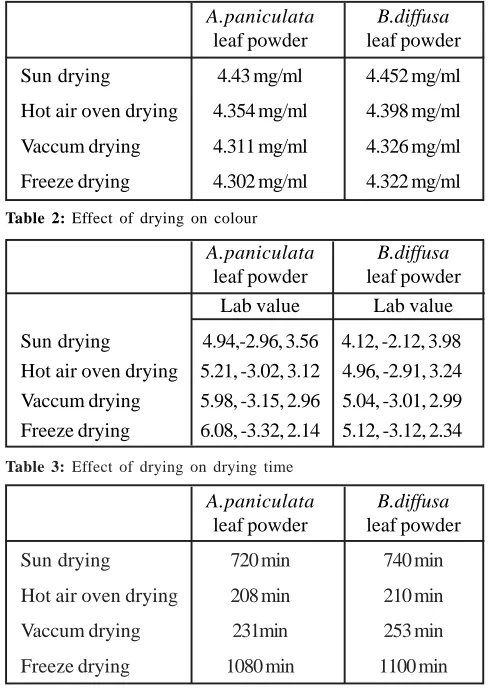
Bulk density of freeze dried powder was found to be minimum and in sun dried powder maximum. In case of bulk density of guava powder, similar results were reported by (Coralia et al., 2011) in samples of freeze dried and oven dried guava powder, which shows that the powder prepared by freeze drying technique was found lighter as compared to sun dried (Table 1). Freeze dried sample was found brightest (whiteness) in colour as compared to other powdered samples, while the sun dried sample was found to be darkest in colour, that can be observed by higher L value in freeze dried (6.08 and 5.12) and lower L* value in sun dried (4.94 & 4.12) in A.panniculata and B.diffusa leaf powder samples, respectively. Higher redness was observed in sun dried sample, followed by hot air, vacuum, and freeze dried samples. Whereas, b value was maximum in sun dried sample and minimum in freeze dried sample (Table 2). On the basis of L*, a*, b* colour values, the freeze dried sample was considered better in terms of retention of colour values (Mahendran, 2010). The time required for drying both the herbal leaves, were found to be minimum for the hot air drying method while maximum for freeze drying which adds cost to the drying of leaves by freeze drying method (Table 3).
Table 1: Effect of drying on bulk density
A.paniculata B.diffusa leaf powder leaf powder
Sun drying 4.43 mg/ml 4.452 mg/ml
Hot air oven drying 4.354 mg/ml 4.398 mg/ml
Vaccum drying 4.311 mg/ml 4.326 mg/ml
Freeze drying 4.302 mg/ml 4.322 mg/ml
Table 2: Effect of drying on colour
A.paniculata B.diffusa leaf powder leaf powder
Lab value Lab value
Sun drying 4.94,-2.96, 3.56 4.12, -2.12, 3.98 Hot air oven drying 5.21, -3.02, 3.12 4.96, -2.91, 3.24 Vaccum drying 5.98, -3.15, 2.96 5.04, -3.01, 2.99 Freeze drying 6.08, -3.32, 2.14 5.12, -3.12, 2.34
Table 3: Effect of drying on drying time
A.paniculata B.diffusa leaf powder leaf powder
Sun drying 720 min 740 min
Hot air oven drying 208 min 210 min
Vaccum drying 231min 253 min
Freeze drying 1080 min 1100 min
Ascorbic acid content
The total ascorbic acid content ranged from 7.4 to 36.42 mg/ 100 g and 5.67 to 32.44 mg/100 g in A.paniculata and B.diffusa leaf powder samples, respectively (Table 4). The freeze dried powder had the highest ascorbic acid content followed by vacuum dried powder. The lowest concentration of ascorbic acid was found in sun dried powder. When leaves were dried, the oxidation process already took place and this may be the reason of low ascorbic acid content in sun dried powder (Poonam Mishra et al., 2009). The rate of oxidation was high during sun drying, hence the sun dried sample showed lowest amount of ascorbic acid than other samples.
Table 4: Effect of drying on vitamin c
A.paniculata B.diffusa leaf powder leaf powder
Sun drying 7.4 mg/100 g 5.67 mg/100 g
Hot air oven drying 15.21 mg/100 g 12.53 mg/100 g
Vaccum drying 29.66 mg/100 g 27.51 mg/100 g
Table 5: Effect of drying on total phenol content and % RSA
A. paniculata leaf powder B. diffusa leaf powder
TPC (%) %RSA TPC (%) %RSA
Sun drying 2.33 24.11 2.12 25.14
Hot air oven drying 7.14 59.14 7.76 61.24
Vaccum drying 13.67 68.66 13.78 70.12
Freeze drying 18.31 74.33 19.62 76.12
Table 6: Effect of drying on mineral content in B.diffusa leaf powder
Fresh Sun drying Hot air Vaccum Freeze
oven drying drying drying
P mg/100g 151.005 150.89 151.76 151.45 151.896
Na mg/100g 160.2 160.04 160.22 160.21 160.26
Ca mg/100g 218.24 218.2 218.14 218.11 218.74
Mg mg/100g 8.93 8.478 8.785 8.56 8.83
Fe mg/100g 0.034 0.035 0.033 0.034 0.039
Table 7: Effect of drying on mineral content in A.paniculata leaf powder
Fresh Sun drying Hot air Vaccum Freeze
oven drying drying drying
P mg/100g 250.13 250.23 250.21 250.45 250.526
Na mg/100g 152.50 152.640 151.87 151.83 152.39
Ca mg/100g 318.62 317.97 317.62 317.67 317.97
Mg mg/100g 9.68 9.67 9.61 9.66 9.67
Zn mg/100g 0.44 0.434 0.433 0.45 0.46
Fe mg/100g 0.012 0.0115 0.012 0.0121 0.0124
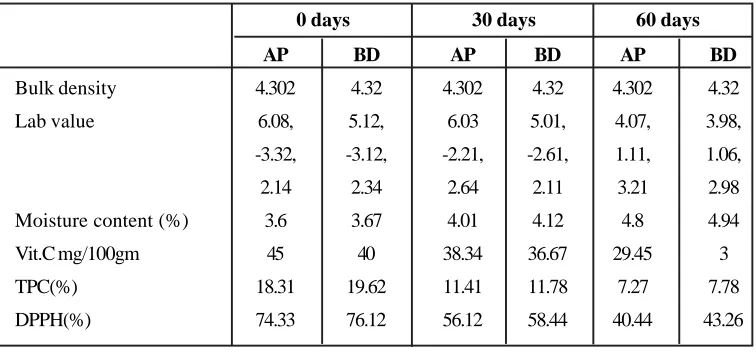
Table 8: Effect of storage on properties of powders stored at refrigerated temperature
0 days 30 days 60 days
AP BD AP BD AP BD
Bulk density 4.302 4.32 4.302 4.32 4.302 4.32
Lab value 6.08, 5.12, 6.03 5.01, 4.07, 3.98,
-3.32, -3.12, -2.21, -2.61, 1.11, 1.06,
2.14 2.34 2.64 2.11 3.21 2.98
Moisture content (%) 3.6 3.67 4.01 4.12 4.8 4.94
Vit.C mg/100gm 45 40 38.34 36.67 29.45 3
TPC(%) 18.31 19.62 11.41 11.78 7.27 7.78
Mineral content
Concentrations of minerals were presented in Tables 6 and 7. Macrominerals (P, Mg, Na and Ca) and microminerals (Zn, Fe),
both were analyzed. Freeze dried powder was found rich in all minerals. Calcium is the most abundant mineral, found in both the leaf powders.
Total phenolics and antioxidant activity
It was found that the total phenolic content of the acetone extract was expressed as gallic acid equivalent. The results obtained from the assay were presented in Table 5. Highest total phenolic content was observed in freeze dried powders (18.31 mg/100g and 19.62 mg/100g), followed by vacuum dried one (13.67 mg/100g and 13.78 mg/100g) in A.paniculata and B.diffusa leaf powder samples, respectively. It is well correlated with the results reported by Machiex et al. (1990) that at cellular level, the phenolic compounds are located in the vacuoles and are separated from oxidative enzymes in an intact fruit. This structure collapses during dehydration or drying process leading to a release of more phenolic compounds, together with the oxidative and hydrolytic enzymes that may degrade the phenolic compounds (Toor and Savage, 2006). Dehydration of part through drying process may contribute to the successive extraction of the phenolic compounds. The antioxidant activity of extracts was determined using DPPH assay. The results were expressed in
terms of percent free radical scavenging activity. The results revealed that the freeze dried powders has 74.33% and 76.12% free radical scavenging activity, while the other dehydration techniques has the results in the range of 24.11 and 25.14 to
68.66 and 70.12 % only in A.paniculata and B.diffusa leaf powder samples, respectively. Similiar trend of antioxidant activity was found as in the case of total phenolics. There was a positive correlation between the total phenolics and free radical scavenging activity. Thaipong et al. (2006) also suggested the highest correlation between total phenolic content and FRAP activity as compared to other antioxidant assays.
Storage study of freeze dried leaf powders
A.paniculata and B.diffusa freeze dried leaf powder samples, were stored at refrigeration temperature for a period of two months and analysis were carried out regularly at 0, 30 and 60 days (Mishra et al., 2010). Powders were analysed for their bulk density, L, a, b values, moisture content, vitamin C, total phenols and percentage radical scavenging activity at definite intervals (Table 8). Freeze dried samples were found lighter in colour as compared to other samples with the lowest L value in sun dried sample. With the increase of the storage time, the degradation of ascorbic acid increased, this being attributed to the increase in moisture content as well as oxygen and presence of trace metals (Dennison and Kirk, 1982 and Eison-Perchonok and Down, 1982). It was found that the moisture content of powders varied from 3.65 % to 4.8 % (dry weight basis). There was an initial increase in the moisture content of both the powders and the reason behind this may be the hygroscopic nature of freeze dried powder. These changes can be attributed to the environmental changes, which will bring changes in the relative humidity outside the packaging system (Hymavathi, 2005 and Taoukis, 1988 ).
The low temperature outside the packaging system increased the relative humidity, hence, outside water vapour moved inside the pouch, which resulted in the initial gain of moisture by the powder. The relation between moisture content and ascorbic acid showed negative correlation. The increase in the loss of ascorbic acid with the increase in moisture is not entirely due to the dilution of the ascorbic acid but partly to the effect of moisture itself. In the model system of dehydrated food, the destruction of ascorbic acid was dependent upon water activity, moisture content and oxygen (Kirk et al., 1977). Lee and Labuza (1975) reported that there was an increase in the rate of ascorbic acid degradation with the increase in the water activity from the dry state. There was significant difference (p<0.05) found in L, a, b values, total phenolics and percentage radical scavenging activity in 0, 30 and 60 days stored samples of each herb. With the increase of the storage time, the total phenolic as well as percentage radical scavenging activity decreases, this being attributed to the decrease in ascorbic acid content which contributes to radical scavenging activity (Figure 1).
Conclusion
Freeze drying produced the best quality leaf powders in terms of ascorbic acid, polyphenolic content and antioxidant activity, though it was quite hygroscopic in nature. It can be inferred that A.paniculata and B.diffusa leaf powders are good source of natural antioxidants which can be an alternative to synthetic antioxidants. Freeze dried powder showed the best retention of the natural colour of leaves, as evident from L*, a*, b* values. From the above study, it can be concluded that freeze dried powder can be utilized as an ingredient for the development of value added food product as it contains high total phenolic content with other nutrients. It was also found high in the mineral content also, even though this technology is too costly but it has the potential in the area of drying sensitive material and due to better stability of nutrient content. The obtained results for leaf powder gave justifications for further investigations on its applicability as a functional food.
Acknowledgement
The author is grateful to Centre of Food Technology, University of Allahabad, Allahabad for providing facilities for the research work.
References
Adesina, S.K. (1979). Anticonvulsant properties of the roots of
Boerhaavia diffusa. Quarterly Journal of Crude Drug Research, 17:
84-86.
Agarwal, R.R. and Dutt,S.S. (1936). Chemical examination of Punarnava or Boerhavia diffusa Linn.II. Isolation of an alkaloid Punarnavine. Chemical Abstract, 30: 44-54.
Alothman, M.; Bhat, R. and Karim, A.A. (2009). Antioxidant capacity and phenolic content of selected tropical fruits from Malaysia, extracted with different solvents. Food Chem., 115:785-788.
Bhalla, T.N.; Gupta, M.B. and Bhargava, K.P. (1971). Anti-inflamma-tory activity of Boerhaavia diffusa. Journal of Research in Indian Medicine, 6:11-15.
Bhalla, T.N.; Gupta, M.B; Sheth, P.K. and Bhargava, K.P. (1968). Anti-inflammatory activity of Boerhaavia diffusa. Indian Journal of Physiology and Pharmacology, 12:37.
Chandan, B.K.; Sharma, A.K. and Anand, K.K. (1991). Boerhaavia
diffusa: A study of its hepatoprotective activity. Journal of
Ethnopharmacology, 31 (3):299-307.
Chopra, R.N.; Nayar, S.L. and Chopra, I.C. (1965). Glossary of Indian Medicinal Plants. Council of Scientific and Industrial Research (CSIR), New Delhi, India. 39.
Coralia, O.; Jose. G. and Carriazaro (2011). Thermal and structural study of guava powders obtained by two dehydration methods. Quim. Nova., 34(4): 636-640.
Dastur, J. F. (1959). “Medicinal plants of India and Pakistan”, Meyer Books.
Dennison, D.K. and Kirk, J.R. (1982). Effect of trace metal fortification on the storage stability of ascorbic acid in a dehydrated model food system. Journal of Food Science, 47:1199.
Diplock, T.A.; Charleux, J.L.; Crozier-Willi, G.; Kok, F.J.; Rice-Evans, C.; Roberfroid, M.; Stahl, W. and Viòa-Ribes, J. (1998). Functional food science and defence against reactive oxidative species. British Journal of Nutrition, 80 : 77-112.
Eison-Perchonok, M.H. and Down, T.W. (1982). Kinetics of ascorbic acid oxidation as a function of dissolved oxygen and temperature. Journal of Food Science, 47:765.
Gaitonde. B.B.; Kulkarni, H.J. and Nabar, S.D. (1974). Diuretic activity of punarnava (Boerhaavia diffusa). Bulletins of the Haffkine Institute (Bombay, India), 2:24
Handa, S.S. and Sharma, A. (1990). Hepatoprotective activity of andrographolide from Andrographis paniculata against carbon tetrachloride. Indian Journal of Medical Research, 92: 276-283.
Hooker, J. D. (1885). “Flora of British India”, Vol: IV, L. Reeve & CO. LTD, Ashford, Kent.
Hymavathi, T.V. (2005). Carotene, ascorbic acid and sugar content of vacuum dehydrated ripe mango powders stored in flexible packaging material. Journal of Food Composition and Analysis, 18:181-192.
Indian Pharmacopoeia (1996). Ministry of Health and Family Welfare. Vol 2, Govt of India, Controller of Publications, New Delhi, pp: 100-111.
Jain, G.K. and Khanna, N.M. (1989). Punarnavoside: A new antifibrinolytic agent from Boerhaavia diffusa L. Indian Journal of Chemistry, 28b:163-166.
Jambor, J. and Czosnowska, E. (2002). Herbal medicines from fresh plants. Postêpy Fitoterapii, 8(1-2): 2-5.
Jayprakash, G.K.; Singh, R.P. and Sakariah, K.K. (2001). Antioxidant activity of grape seed extracts on peroxidation models. Food Chem.,
73: 285-290.
Kirk, J.; Dennison, D.; Kokoczka, P. and Heldman, D. (1977). Degradation of ascorbic acid in a dehydrated food system. Journal of Food Science, 42 (5):1274-1279.
Lee, S. and Labuza, T.P. (1975). Destruction of ascorbic acid as a
function of water activity. Journal of Food Science, 40:370-373.
Macheix. J.J.; Fleuriet, A. and Billot, J. (1990). Fruits Phenolics. CRC Press, Florida.
method and maltodextrin concentration. Tropical Agricultural Research and Extension, 13(2):48-54.
Mishra, J.P. (1980). Studies on the effect of indigenous drug
Boerhaavia diffusa Rom. on kidney regeneration. Indian Journal of
Pharmacy, 12:59.
Mishra, V.; Mishra, P. and Rai, G.K. (2010). Process and product standardization for the development of amla. Beverage Food World,
37: 58-60.
Nadkarni, A.K. (1976). Indian Materia Medica. Popular Prakashan Pvt. Ltd., Bombay, Maharashtra, India, pp : 203-205.
Olukoya, D.K.; Tdika, N. and Odugbemi, T. (1993). Antibacterial activity of some medicinal plants from Nigeria. Journal of Ethnopharmacology, 39:69-72.
Poonam Mishra; Vijeyta Srivastava; Deepmala Verma, Chauhan, O.P. and Rai, G. K. (2009). Physico-chemical properties of Chakiya variety of Amla (Emblica officinalis) and effect of different dehydrationmethods on quality of powder, African Journal of Food Science, 3(10): 303-306.
Ranganna, S. (2005). Handbook of Analysis and Quality Control for Fruit and Vegetable Products. 2nd Eds., New Delhi, India: Tata McGraw-Hill Publishers.
Rawat, A.K.S.; Mehrotra, S.; Tripathi, S.K. and Shama, U. (1997). Hepatoprotective activity in punarnava- a popular Indian ethnomedicine. Journal of Ethnopharmacology, 56 (1):61-68.
Sastry, J.L.N. (2008). Compendium on “Herbs for everyone”, Medicinal Plant Board, Chandigarh.
Saxena, S.; Jain, D.C.; Bhakuni, R.S. and Sharma, R.P. (1998). Chemistry and pharmacology of Andrographis species. Indian Drugs,
35: 458-467.
Sharma, P. V. (1983). “Charka Samhita”, Ed. Chankhambhia Orientalia, Vol.II, Varanasi.
Szeto, Y.T.; Tomlinson, B. and Benzie, I.F. (2002). Total antioxidant and Ascorbic Acid Content of Fresh Fruits and Vegetables: Implications for Dietary Planning and Food Preservation. British Journal of Nutrition, 87: 55–59.
Taoukis, P.S. (1988). Moisture transfer and shelf life of packaged foods. In:ACS Symposium Series (Vol. 365). American Chemical Society: Washington, DC., pp:243-261.
Thaipong, K.; Boonprakob, U.; Crosby, K.; Cisneros-Zevallos, L. and Byrne, D.H. (2006). Comparison of ABTS, DPPH, FRAP and ORAC assays for estimating antioxidant activity from guava fruit extracts. Journal of Food Composition and Analysis, 19:669-675.