Research Article
Vascular
Endothelial
Growth
Factor
C
Serum
and
Endostatin
Serum
as
Predictors
of
Lympho
Vascular
Invasion
in
Early
Stage
Cervical
Cancer
Hubungan
Kadar
Serum
Vaskular
Endothelial
Growth
Factor
C
(Serum
VEGF
C)
dan
Serum
Endostatin
dengan
Invasi
Limfo
Vaskuler
pada
Pasien
Kanker
Serviks
Uteri
Stadium
Awal
Andhinna Rusmardiani, Syahrul Rauf, Efendi Lukas Department of Obstetrics and Gynecology Faculty of Medicine Universitas Hasanuddin/
Dr. Wahidin Sudirohusodo Hospital Makassar
INTRODUCTION
Cervical cancer is the second type of cancer in women in the world and most cancers occur in women in developing countries. Lymph node metastasis in pelvic, size of tumor, depth invasion of the stroma, the invasion of parametrial and emboli limfo vascular will affect the recurrence and distant metastasis as well as a prognostic factor in early stage cervical cancer.1,2
Radical hysterectomy with pelvic lymphadenec-tomy was performed for cervical cancer stage IB and IIA. 5-years cure rate in patients without lymph node metastasis is 70-90% and is decreased to 40-60% in patients with lymph node metastasis. There was a reported in early-stage cervical cancer patients who undergo radical histerectomy and bilateral pelvic lymphadenectomy is detected as many as 83% of the total invasion limfo vascular, 77% are stage IB and from that stage, there are
Abstract
Objective: To determine the relationship of Vascular Endothelial Growth Factors-C (VEGF-C), endostatin and the ratio of VEGF-C/ endostatin with limfo vascular invasion in patient with early stage cervical cancer.
Methods: This study used a cross sectional method. Samples were all patients with early stage cervical cancer who came to the several teaching hospitals of Obstetrics and Gynecology Department Universitas Hasanuddin Medical Faculty that meet the criteria, then we measured the levels of VEGF-C and endostatin.
Results: We get 30 women with cervical carcinoma. The results showed that the serum levels of VEGF-C was higher in limfo vascular invasion positive (p = 0.017); the ratio of VEGF-C/ endostatin higher in limfo vascular invasion positive (p = 0.004); whereas serum levels of endostatin did not differ significantly in limfo vascular invasion positive or negative (p = 0.522).
Conclusion: The level of VEGF-C and VEGF-C/ endostatin ratio was higher in patients with early stage cervical cancer with positive LVSI than negative LVSI.
[Indones J Obstet Gynecol 2017; 5-2: 105-109]
Keywords: cervix uteri cancer, endostatin, limfo vascular invasion, VEGF-C
Abstrak
Tujuan: Untuk mengetahui hubungan Vaskular Endothelial Growth Factors-C (VEGF-C) dan Endostatin serta rasio VEGF-C/ endostatin dengan invasi limfo vaskuler pada pasien kanker serviks uteri stadium awal.
Metode: Penelitian ini menggunakan metode cross sectional. Sampel penelitian adalah semua penderita kanker serviks uteri stadium awal yang datang ke Bagian Obstetrik dan Ginekologi Rumah Sakit Umum Pendidikan Universitas Hasanuddin dan jejaringnya yang memenuhi kriteria inklus yang kemudian dilakukan pengukuran kadar VEGF-C dan Endostatin.
Hasil: Kami mendapatkan 30 perempuan penderita karsinoma serviks. Hasil penelitian menunjukkan bahwa kadar serum VEGF-C lebih tinggi pada invasi limfo-vaskuler positif (p = 0,017); rasio VEGF-C/ Endostatin lebih tinggi pada invasi limfo-vaskuler positif (p = 0,004); sedangkan kadar serum endostatin tidak berbeda secara bermakna pada invasi limfo-vaskuler positif ataupun negatif (p = 0,522).
Kesimpulan: Kadar VEGF-C dan rasio VEGF-C/Endostatin lebih tinggi pada pasien kanker serviks uteri stadium awal dengan LVSI positif dibandingkan dengan LVSI negatif.
[Maj Obstet Ginekol Indones 2017; 5-2: 105-109]
Kata kunci: endostatin, invasi limfo-vaskuler, kanker serviks uteri, VEGF-C
21% got lymph node metastasis. Women with positive pelvic lymph nodes have recurrence risk and should be treated aggressively.1,3
Tumor growth, neovascularization and metas-tasis depend on the ability of cancer cells to invade the tissue that consist extracellular matrix degradation and basal membrane structure. Tumor invasion and metastasis are also crucial step in determining the aggressiveness of the cancer and the cause of death due to cancer. Molecular under-standing that leads to metastasis as well as the complex interaction between the host cell metas-tasis, important in deciding more effective cancer therapy. Family Vascular endothelial growth factor (VEGF) VEGF-A, B, C, D, E is particularly important because it causes angiogenesis and limfangioge-nesis which will further lead to tumor growth and metastasis of cancer.4-6
Several studies have been carried out by com-paring the VEGF with endostatin in several human cancers, Shaarawy et al (2001) conducted a study of postmenopausal women: 72 endometrial cancers, 27 endometrial hyperplasia and 30 healthy female controls and compare their levels of VEGF and endostatin at each in each case. It was found that the serum levels of VEGF in endometrial hyperplasia (142 18 ng/ml) and endometrial cancer stage I (291 22 ng/ml), II (623 68 ng/ml) and stage III- IV (1527 119 ng/ml) was significantly higher than the average of the controls (12 1.6 ng/ml). Serum levels of endostatin on endometrial hyperplasia (149 19 ng/ml), endo-metrial cancer stage I (320 41 ng/ml), II (644
86 ng/ml) and stage III-IV (1253 114 ng/ml) also significantly higher than the average of the controls (13 2.4 ng/ml). Elevated VEGF values above the normal levels achieved in nonmalignant state by 7% (stage I), 37% (stage II) and 100% (stage III-IV) of endometrial cancer. While endostatin was respectively 37%, 59% and 100%.7-9
These results suggested that both of the bio-marker levels in the circulation were associated with staging of the tumor. Serum levels of VEGF and endostatin were significantly decreased after treatment, but will rise again if there is a relapse. The ratio of VEGF - endostatin was higher in advanced stage compared with early stage endo-metrial cancer. This shows that the balance between angiogenic stimulators with angiogenic inhibitor can affect metastasis and tumor pro-gression.7,10
The objective of this study is to determine the relationship of VEGF-C, endostatin, ratio VEGF- C/ endostatin with limfo vascular invasion in patients with early-stage cervical cancer.
METHODS
The study method was cross sectional. This study was conducted in several teaching hospitals of Obstetrics and Gynecology department Universitas Hasanuddin Faculty of Medicine in Makassar from February 2014 until February 2015. The population were women with early stage of cervical uteri cancer who examined in several teaching hospitals of Obstetrics and Gynecology department Universitas Hasanuddin Medical Faculty in Makassar. Samples who met the criteria and approved the informed consent. Data processing with SPSS. Data analysis use T independent test and Mann Whitney test. Hypothesis testing determined significant if
<0.05.
RESULTS
There were 30 samples who met inclusion criteria. In this study, the results of distribution charac-teristics shown in Table 1.
Table 1. Characteristics Comparison Distribution of the Study Sample
Characteristic Sample(n=30) Percentage(%=100)
Age
< 45 years old 13 43.33
45-55 years old 14 46.67
> 55 years old 3 10.00
Education
Elementary school 7 23.33
Middle school 11 36.67
High school 10 33.33
University 2 6.67
Occupation
Housewife 28 93.33
Enterpreneur 2 6.67
Age when first married
16 years old 27 90
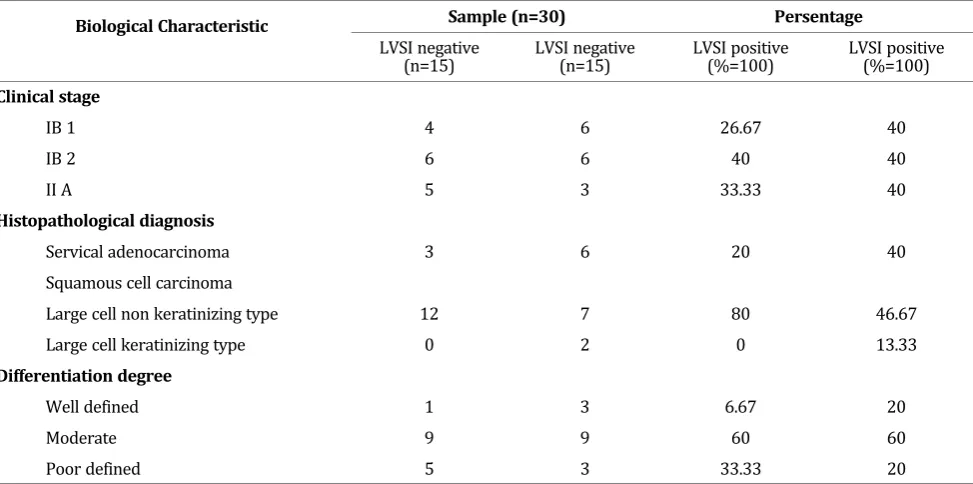
Table 2 shows the characteristics of biological distribution and we obtained sample highest LVSI positives and negatives in stage IB 2 each 6 cases (40%), from that sample the most histopathologic type are invasive squamous cell carcinoma 12 cases (80%) and 7 cases (46.67%), respectively. Middle differentiation was the most in LVSI posi-tive or negaposi-tive.
Table 3 demonstrates the comparison level of VEGF-C, endostatin and ratio VEGF-C/ endostatin. VEGF-C Serum higher in LVSI positive with mean 12720.40 2593.13 that LVSI negative. Serum levels of endostatin higher in LVSI positive with mean value 178.20 33.99, and ratio VEGF-C/ endostatin higher in LVSI positive that LVSI negative with a mean value 71.39 6.16 and P = 0.04.
Characteristic Sample(n=30) Percentage(%=100)
Parity
Primipara 2 6.67
Multipara 28 93.33
Frequence of married
Once 28 93.33
Twice 2 6.67
Contraception use
DMPA 7 23.33
IUD 1 3.33
Pill 2 6.67
Pill & DMPA 3 10.00
None 17 56.67
Table 2. Characteristics of Biological Distribution Study Sample
Biological Characteristic Sample (n=30) Persentage
LVSI negative
(n=15) LVSI negative(n=15) LVSI positive(%=100) LVSI positive(%=100)
Clinical stage
IB 1 4 6 26.67 40
IB 2 6 6 40 40
II A 5 3 33.33 40
Histopathological diagnosis
Servical adenocarcinoma 3 6 20 40
Squamous cell carcinoma
Large cell non keratinizing type 12 7 80 46.67
Large cell keratinizing type 0 2 0 13.33
Differentiation degree
Well defined 1 3 6.67 20
Moderate 9 9 60 60
Poor defined 5 3 33.33 20
Table 3. Comparison Level of VEGF-C, Endostatin, and Ratio VEGF-C/ Endostatin
Variable LVSI p value
Positive (mean SD) Negative (mean SD)
DISCUSSION
In some other studies showed similar results that cervical cancer frequently found at the age of 45-55 years old, studies by Turah, Hasan and Perfitri. In the United States, the mean age about 52.2 years. Based on study by Aziz MF with gynecologic cancer data in Indonesia on 2009, the peak age of cervical cancer incidence is found in the age range 45-54 years old.
The results showed the sample is usually first married at age 16 years old. One risk factor for cervical carcinoma is sexual intercourse at an early age. The result similar with study by MF Aziz that suggested that the first sexual intercourse at age < 20 years old had higher risk of developing cervical cancer than doing first sexual intercourse at the age of > 20 years old.
Samples were generally educated middle and high school as well as the daily activities as house-wife. While the sample who graduated from college were only two people. This result is accordance with a study conducted by MF Aziz that showed that were less educated had higher risk those who were well educated and those who compared to did not work have higher risk of developing cer-vical cancer compared to those who work.
In terms of parity, frequency of marriage and contraception usage showed that almost the entire sample were multiparas and frequency of marriage was once and samples generally did not use con-traception. This is according to study by Aziz MF which showed that multiparous women with the number of children 6 have higher risk than primiparous. In addition, it also concluded that who were not taking birth control pills have higher risk than those taking birth control pills.
In this study, the most histopathological type samples were squamous cell carcinoma, large cell non keratinize type. Based on study conducted by AP Vizcaino, around two thirds of cervical cancer types were squamous cell carcinoma and approxi-mately 15% were adenocarcinoma.
The study showed that the level of VEGF-C serum was higher in the LVSI positive (12720.40
2593.13) than LVSI negative (10704.46
1609.86) with p = 0.17. VEGF-C works well on blood vessels and lymphatic vessels and play an important role in the process of angiogenesis, and metastasis limfangiogenesis. Study conducted by
Tjandra on 47 patients with early stage cervical cancer found that stage results, the size of lesions > 40 mm, degree of differentiation, limits of the vaginal incision, limfo vascular invasion, levels of VEGF-C > 10066.90 were lymph node metastasis risk factor and they could be used as predictors. Lesions size of > 40 mm, differentiation, para-metrial invasion, levels of VEGF-C > 10066.90 were limfovascular invasion risk factor. VEGF-C levels > 10066.90 is likely have 80 times risk get lymphnode metastasis com-pared to VEGF-C 10066.90 (p < 0.001) and 12.5 times get limfo vascular invasion (p = 0.022).
Mitsuhashi A in his study concluded that the levels of VEGF-C serum were signs of biomolecular potential for cervical cancer squamous cell type. Yu H did study in 2007-2009 in Qi Lu Hospital, Shandong University on 97 patients with cervical cancer stage Ia-IIa, which 30 of them had positive lymphnode metastasis with the result of VEGF-C, VEGF-D, FLT-4 relating to limfangio-genesis. Similarly, in study by Wang et al on 89 patients (22 cervicitis chronic, 24 CIN, 43 squamous cell carcinomas) with a result higher expression of VEGF-C in tissue, the higher levels in serum (p = 0.024), VEGF-C in serum and tissues associated with clinical stage, tumor size, lymphnode metastasis and not related to the degree of differentiation.
We could see that the levels of endostatin on the LVSI positive (178.20 33.99) was higher than LVSI negative (170.46 31.24), but this result was not significant because the p-value was 0.552. Tjandra found that endostatin levels 184.5 ng/ml was a protection factor of the invasion limfo vascular but in statistics are also not significant (p = 0.562). Endostatin is an angiogenesis inhibitor. It is produced by our body as a reaction of the malignant tumor through the degradation of the basement membrane. There were elevated levels of endostatin in circulation (with over gene expression in endothelial) less than 2 times can suppress tumor growth by 2- 3 fold. It would require further research on the relationship endostatin with limfo vascular invasion with a larger number of samples.
CONCLUSIONS AND SUGGESTIONS
with LVSI positive than negative. Further research on angiogenesis inhibitor and endostatin in cervical cancer with a larger number of samples is required.
REFFERENCES
1. Chandacham, Monaghan JM, Davies BR, et al. Extent of lym-phovascular space invasion and risk of pelvic lymph node metastases in stage 1b1 cervical cancer. J Med Assoc Thai. 2010; 88: S31-S36.
2. Yan M, Yoneda J, Kuniyasu H, et al. Influence of lymph vascular space invasion on prognosis of patients with early stage cervical squamous cell carcinoma. Chinese J Cancer. 2010; 29: 425-30.
3. Schoppmann S, Bardelli A, Buckhaults P, et al. VEGF-C expressing tumor-associated machrophages in lymph node positive breast cancer: impact on lymphangiogenesis and survival. Sur. 2011; 139: 839-46.
4. Su J, Darcy KM, Hutson A, et al. The role of the VEGF-C/VEGFR-3 axis in cancer progression. Bri J Cancer. 2011; 96: 541-5.
5. Afonso J, Wong AS, Choi KC, et al. Angiogenesis, Lymph-angiogenesis and Lymphovascular Invasion: Prognostic Impact for Bladder Cancer Patients. 2011; 22: 255-88. 6. Behtash N, Qiu D, Pallen CJ, et al. Preoperative prognostic
factors and effect of adjuvant therapy on outcomes of early stage cervical cancer in iran. Asian Pacific J Cancer Prev. 2011; 10: 613-8.
7. Shaarawy M, Andrade L, Martinez, et al. Biomarkers of intrinsik angiogenic and anti-angiogenic acivity in patients with endometrial hyperplasia and endometrial cancer. Acta Onco. 2011; 40: 513-8.
8. Tjandra O, Calin G, Russo A, et al. Clinicopathologic factor, endostatin serum level, and vascular endothelial growth factor-C (VEGF-C) serum level as predictors of lymph nodes metastasis in early stage cervical cancer patients. Indones J Obstet Gynecol. 2011; 35(4): 225-9.
9. Kajiyama H, Seo Y, Kasuga M, et al. Expression of twist enhances risk of poor oncologic outcome in patients with stage Ib to II cervical carcinoma with lymphovascular space involvement. Hum Pathol. 2013; 44: 181-8.