Issue 1 Latino Children
2010
Explaining Scholarship Addressing Hispanic Children’s Issues
Explaining Scholarship Addressing Hispanic Children’s Issues
Adolfo G. Santos
University of Houston - Downtown, [email protected]
Follow this and additional works at: https://digitalcommons.library.tmc.edu/childrenatrisk
Recommended Citation Recommended Citation
Santos, Adolfo G. (2010) "Explaining Scholarship Addressing Hispanic Children’s Issues," Journal of Applied Research on Children: Informing Policy for Children at Risk: Vol. 1 : Iss. 1 , Article 6.
Available at: https://digitalcommons.library.tmc.edu/childrenatrisk/vol1/iss1/6
The Journal of Applied Research on Children is brought
to you for free and open access by CHILDREN AT RISK at
Introduction
The impact of the growing Latino population on the United States is only now being studied closely.* While the growth of the Latino population will help the U.S. remain competitive globally, the Latino population is not without its deficits. Nowhere is that more apparent than among Latino children.
The educational, health, economic and social dynamics affecting Latino children are finally being studied. Certain issues, such as a high dropout rate, language barriers, drug use, poverty rates, obesity and juvenile diabetes disproportionately affect the Latino community and will have long-term detrimental effects on the Latino population, and on the United States.
There is a dearth of scholarship addressing issues unique to Latino children. The existing literature has been written by Hispanic scholars and the federal government to analyze issues facing the Hispanic community. As more Hispanics have become professors, their research has become more sophisticated. As the Hispanic population has grown, the issues it faces have begun to be recognized by the federal government. The government, in response, has increased spending on research, and created institutions to improve the lives of the Hispanic population.
Simply put, the lack of research regarding Hispanic children is a function of interest in Hispanic children. This paper begins with a brief definition of interest, as that term is used in the article. The article then describes the research design and identifies the hypotheses to be tested. The findings section will describe how the growing number of Hispanic scholars affects the number of articles published on Hispanic children’s issues and will discuss the various investments that the federal government has made on behalf of Hispanic children.
“Interest” Defined
This paper addresses the question of why there is so little scholarship on Hispanic and Latino children in the United States. As the data will show, although there has been an increase in the amount of scholarship about this population, the vast majority of research is new. Given the complexity of the issues facing Hispanics, and the implications of these challenges on the United States, much more research is required.
From 1970 to the present, 1,640 articles have been published addressing Latino and Hispanic children. During that same time period, there were 8,552 articles that mentioned “black children,” 2,470 that
*
mentioned “African American children,” 1,343 articles that mentioned “Jewish children,” 4,499 articles that mentioned “poor children,” and 2,195 articles that mentioned “immigrant children.” The relatively small number of articles on Hispanic children indicates a lack of interest.
There are two types of “interest” defined by Suzanne Hidi that are applicable in this context. “Individual interest” develops slowly over time and tends to have long-lasting effects on a person’s knowledge and values. “Situational interest,” on the other hand, tends to be evoked more suddenly by something in the environment and may have only a short-term effect, marginally influencing an individual’s knowledge and values. While the focus of individual interest is the person and the focus of situational interest is the environment, person/environment interactions are a crucial aspect of both.1
In either case, the environment has an impact on an individual’s interest in the subject matter at hand. For the purpose of this study, we assume that both types of interest are motivating factors driving researchers.
Research Design
This study tests several hypotheses to explain the amount of scholarship on Latino children. Individual interest is affective; it comes from the intrinsic affinity that one has for a group to which one belongs. Given that scholarship is produced by academics, an increase in the number of Latino scholars will lead to an increase in the amount of scholarship with a focus on Latino issues.
Situational interest is a function of cognitive deliberation; it is temporal and stimulated by one’s environment. Individuals develop interest in a topic either because the issue is sufficiently salient, or because some other type of stimulant stirs interest in the scholar. Interest in Latino children may be a function of the size of the Latino population – a sufficiently salient stimulus. As the Latino population grows, the population has its own set of issues to address. Interest in Latino children may also be a function of pecuniary benefits.
As the federal government has created Hispanic Serving Institutions, and funded programs to understand the Latino population, scholars have developed an interest in understanding Latino children. Now that there is financial gain from graduating Latino college students, it becomes important to scholars to understand Latino children before they arrive to university.
“Hispanic children”. These articles were then coded for the year they were published, the subject of the article, the subject of the journal, the ethnicity of the authors, the number of authors, and the state where the authors resided. Ethnicity of the authors was determined by surname. Spanish surname has been used as a proxy measure for Hispanic/Latino ethnicity in numerous other studies when self-report or other measures of ethnicity are not available.2, 3 While using surname as a measure of ethnicity is not without its limitations, in particular due to exogamy,2 it was determined to be an adequate measure for the present inquiry.
The journal data is then tracked over time to show the amount of scholarship being produced with the terms “Hispanic children” and “Latino children” in the text of the article.† These are then compared to other data points that gauge the size of the Latino population, the percentage of scholars who are Latinos, and the percentage of Latinos with advanced degrees. These data points are also compared to the increase in federal spending and the creation of Hispanic Serving Institutions.
In gathering the data, 502 articles addressing “Latino children” were found from 1974 to the present. For purposes of this analysis, the last year included is 2007. This is because not all articles have been archived with the search engine jstor.org within the last three to five years. There were many more articles that used the more common “Hispanic children” in the articles. A total of 1,138 articles on “Hispanic children” were found between 1972 and the present. As with the term “Latino children” the period studied excludes the years 2008 through the present.
Findings
The analysis is presented in three parts: 1) a description of the amount of scholarship using the terms “Latino children” and “Hispanic children,” 2) the effect of “individual interest” i.e. whether scholarship about Hispanic children is produced by Hispanic scholars 3) the effect of situational interest” i.e. whether pecuniary stimuli contributed to the creation of interest in studying Hispanic children.
The data shows that the number of published articles addressing “Latino children” (Figure 1) or “Hispanic children” (Figure 2) has steadily increased since the 1970s. From 1974 until the late 1980s there were
†
virtually no such articles. Please note that the trend is flat until 1980 which is the first time that Census respondents could choose “Hispanic” to designate their ethnicity. After that time, demographers and other researchers had a major national source of data through which children of Hispanic descent could be counted and analyzed. At the end of the 1980s the data shows an increase in articles addressing “Latino children” (Figure 1).
Figure 1: Number of scholarly articles addressing “Latino children” (1974-2007)
Figure 2: Number of scholarly articles addressing “Hispanic children” (1972-2007)
Given that the terms Latino and Hispanic can be used interchangeably, they have been combined in the figure below. When the terms are combined the data shows there has been a more steady increase in the scholarship addressing Hispanic and Latino children (Figure 3).
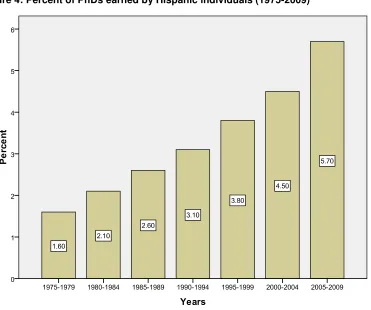
Latinos experienced an increase of 0.7 percentage points in the share of doctorates awarded. That share increased even more from 2000-2004 to 2005-2009, rising by 1.2 percentage points. As more and more Latinos have earned doctorates, there has been an increase in the number of scholarly articles that address Latino issues.
Figure 4: Percent of PhDs earned by Hispanic individuals (1975-2009)
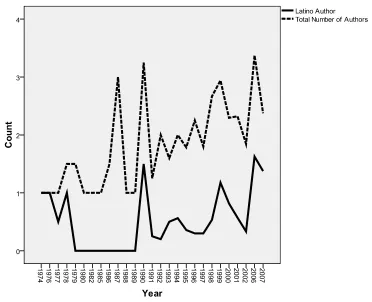
The figure below (Figure 5) shows the average percentage of Latinos authoring or co-authoring articles addressing “Latino” children’s issues.‡ During the 1970s there were very few articles written on the subject and most were single-authored. By the late 1980s Latino scholars began publishing articles addressing issues facing Latino children. Hispanic scholars are beginning to co-author pieces with other academics as more Hispanic scholars join the field. By the 1990s and into the present decade, the average percentage of Hispanics authoring or co-authoring scholarship was on the rise.
‡
Figure 5: Number of Latino author/co-authors compared to the total number of authors/co-authors over time (1974-2007)
responsibility in helping to resolve the problems and challenges facing Latino children.
Figure 6: Average number of authors who are Hispanic compared to the average of all authors (1974-2007)
Articles analyzing issues affecting Hispanic children can be broken down into the following topics: 40 percent address education, 10 percent focus on health, 5 percent are written about family issues and another five percent discuss race.
Hispanic population contributed to a 66 percent increase in the amount of scholarship produced from 1980 to 1990. By 2000, Hispanics accounted for 12.5 percent of the total U.S. population and 43 percent of the scholarship measured for this study; the data for this decade is still incomplete.
The data reveals that the Hispanic population will continue to grow. As a result, more research will be required. The Latino and Hispanic community is a relatively young population. The challenges unique to Hispanic and Latino children will become national challenges and must be addressed in order to maintain the economic, social and political viability of the United States.
Figure 7: Percentage of Hispanic population and percentage of all scholarship produced during decade addressing Hispanic and Latino children (1974-2007)
Education: Challenges, Research, and Policies,”6 are examples of articles published to attract federal attention to the problem, and make a case for increased funding for research to address it. As a result, the federal government took a more active role in the elementary and secondary education of Hispanics.
Figure 8 shows the amount of federal spending in 2008. The federal government increased spending on research at educational institutions. By the 1990s, the scholarship was broadening its scope, looking for factors affecting Hispanics’ behavior,7 parenting,8 socialization,9 and health,10 to name a few. As a result of the increasing sophistication of the research, the federal government enacted the No Child Left Behind Act in 2001, and created the Institute of Education Sciences in 2002.
The federal government is able to focus the attention of researchers on specific issues by offering research money to academics to address the nation’s concerns. In addition, Congress provided incentives by creating Hispanic Serving Institutions – universities with a Hispanic enrollment of 25 percent or more, whose researchers apply for federal grants. There are approximately 260 Hispanic Serving Institutions11 and they are eligible for millions of dollars.§ By creating Hispanic Serving Institutions, the federal government has successfully created laboratories where scholars are rewarded for learning more about Hispanic students.** Of the scholars producing research specific to Hispanic children’s issues, 28 percent come from California. California, with the largest Hispanic population, claims 52 of the 260 Hispanic Serving Institutions.11
Conclusion
This article explains why so little scholarship has been produced addressing Hispanic and Latino children’s issues. For some, research on Hispanic children is driven by their personal connection to the population. Much of the literature on Hispanic children is created by Hispanic scholars. While Hispanic academics account for a small fraction of total
§
In 2009, Hispanic Serving Institutions were provided more than 16 million dollars as part of the Title V, Developing Hispanic Serving Institutions Program accessed May 31, 2010 http://www2.ed.gov/programs/idueshsi/awards.html.
**
Figure 8: Federal on-budget funds for elementary and secondary education and for research at educational institutions.
Source: National Center for Education Statistics: Digest of Education Statistics: 2008. Figure 18. Accessed May 31, 2010
http://nces.ed.gov/programs/digest/d08/figures/fig_18.asp?referrer=list
academics, they produce a third of the scholarship. Another strong motivation for scholars is monetary. As research dollars are aimed at addressing the issues facing Hispanic children, scholars’ research is becoming more sophisticated. The increase in federal spending to remedy the problems facing education, combined with the creation of Hispanic Serving Institutions has successfully led to
scholarship. Further diversifying faculties with Hispanic faculty will lead to a deeper understanding of the issues facing Hispanic children and how to craft remedies for them. Continued growth in the population, combined with further federal investments in research, will add the much needed stimulus to encourage others to study this population.
budget funds for elementary and secondary education and for research at educational institutions.
Source: National Center for Education Statistics: Digest of Education Statistics: 2008. Figure 18. Accessed May 31, 2010
http://nces.ed.gov/programs/digest/d08/figures/fig_18.asp?referrer=list.
academics, they produce a third of the scholarship. Another strong motivation for scholars is monetary. As research dollars are aimed at addressing the issues facing Hispanic children, scholars’ research is becoming more sophisticated. The increase in federal spending to remedy the problems facing education, combined with the creation of Hispanic Serving Institutions has successfully led to the increase in research and scholarship. Further diversifying faculties with Hispanic faculty will lead to a deeper understanding of the issues facing Hispanic children and how to craft remedies for them. Continued growth in the population, combined further federal investments in research, will add the much needed stimulus to encourage others to study this population.
budget funds for elementary and secondary education and for
Source: National Center for Education Statistics: Digest of Education Statistics: 2008.
References
1. Hidi S. Interest, reading, and learning: theoretical and practical considerations. Educational Psychology Review. 1990;13(3):191-209.
2. Forbes D, Frisbie W. Spanish Surname and Anglo Infant Mortality: Differentials Over a Half-Century. Demography. 1991(28):639-660.
3. Morgan R, Wei I, Virnig B. Improving Identification of Hispanic Males in Medicare: Use of Surname Matching. Medical Care. 2004(42):810-816.
4. U.S. Department of Education, National Center for Education Statistics. Digest of Education Statistics, 2008 (NCES 2009-020), Table 246. Available at
http://nces.ed.gov/fastfacts/display.asp?id=61. Accessed May 30, 2010 .
5. Olivas M. Federal higher education policy: the case of hispanics.
Educational Evaluation and Policy Analysi., 1982l4:3 (301-310). 6. Orfield G. Hispanic Education: Challenges, Research, and Policies.
American Journal of Education. 1986;95:1 (1-25).
7. Johnson EM, Delgado JL. Reaching Hispanics with Messages to Prevent Alcohol and Other Drug Abuse. Public Health Reports. 1989;104: 6 (588-594).
8. Wojtkiewicz RA, Donato KM, Hispanic Educational Attainment: The Effects of Family Background and Nativity Social Forces. 1995;74:2 (559-574).
9. Epps EG. Race, Class, and Educational Opportunity: Trends in the Sociology of Education, Sociological Forum. 1995;10:4 (593-608). 10. Novello AC, DeGraw C, Kleinman DV. Healthy children ready to
learn: an essential collaboration between health and education.
Public Health Reports. 1992;107:1, (3-15).
11. Moltz D. The Emerging Hispanic-Serving Institution Inside Higher Ed, 5, February 2010, accessed