Vol. 8, No. 2, 2014, 37-42
ISSN: 2279-087X (P), 2279-0888(online) Published on 17 December 2014
www.researchmathsci.org
37
Branch and Bound Technique in Flow Shop Scheduling
Using Fuzzy Processing Times
G.Ambika1 and G.Uthra2 1
Department of Mathematics, SKR Engineering College, Chennai, India. Email: [email protected]
2
PG & Research Department of Mathematics, Pachaiyappa’s College Chennai, India. Email: [email protected]
Received 8 September 2014; accepted 21 November 2014
Abstract. This paper presents a branch and bound technique in flow shop scheduling problem with imprecise processing times, being the objective to minimize the total elapsed time .The processing times are described by triangular membership functions. Job sequences are constructed with respect to branch and bound technique by fuzzy processing time. A numerical example is explained through 3 stage flow shop scheduling.
Keywords: Flow shop Scheduling, Average High Ranking, Branch and Bound Technique, Optimal Sequence, Total Elapsed time
AMS Mathematics Subject Classification (2010): 90B36 1. Introduction
Scheduling problems are common in our day to day life e.g., manufacturing plant, programs are to be run in a sequence at computer, Management, etc. Scheduling is a decision making process for optimally allocating resources. Efficient scheduling has become essential for manufacturing firms to survive in today’s intensely competitive business environment.
The study of scheduling problem has attracted researchers from various fields. Permutation flow shop sequencing problems (PFSPs) have long been a topic of interest for the researchers & Practitioners in this field. Recently the objective of minimizing total flow time, total completion time if all jobs are available for processing at the beginning, has attracted more attention form researchers. In flow shop scheduling, the objective is to obtain a sequence of jobs which when processed in a fixed order of machines, will optimize some well-defined criteria.
38
Scheduling problems can be modeled as fuzzy systems. Branch and Bound is an exact method usually used in scheduling problems to find optimal solutions. This method requires three components a lower bound, an upper bound and a branching strategy.
2. Literature review
Johnson [1] has proposed a basic algorithm for n jobs, two machine scheduling problem with minimizing makespan. Lomnicki [3] introduced the concept of flow shop scheduling with the help of branch and bound method. Further the work was developed by Ignall and Schrage [2], Brown [4] in the branch and bound technique to the machine scheduling problem by introducing different parameters.
Ishibuchi and Lee (1996) discussed the fuzzy flowshop scheduling problem by taking the average high ranking concept. Singh and Gupta [6] made an attempt to study the optimal two stage production schedule in which processing time and set up time both were associated with probabilities including job block criteria.
In our work, we confine ourselves to the flow shop problem with fuzzy processing time of jobs. The fuzzy processing times are described by triangular membership functions. The objective is to minimize the elapsed time using branch and bound technique. Because of the fuzziness of processing times, the obtained elapsed time is also a fuzzy number.
Triangular membership functions are used to represent fuzzy processing times of jobs on the machines.
Definition 1. A fuzzy number ã on R is said to be a triangular fuzzy number or linear fuzzy number if its membership function ã: R has the following characteristics:
,
( ) ,
0, x a
for a x b b c
c x
a x for b x c
c b
elsewhere −
≤ ≤
−
−
= ≤ ≤
−
ɶ
The above relation shows the triangular membership functions of a fuzzy number P<a,b,c> which represents processing time of a job on a machine.
To deal with the same problem with fuzzy job processing times we rank the fuzzy processing times using their corresponding AHR (Average high ranking method) and then apply a branch and bound technique to find the optimal job sequence.
Average high ranking. To find the optimal sequence, the expected processing time of the jobs are calculated by using Yager’s (1981) average high ranking formula (AHR) =
h(A)= 3 3b+c−a
39 Fuzzy arithmetic operations
The following are the four operations that can be performed on triangular fuzzy numbers: Let A=(a1,a2,a3) and B= (b1,b2,b3) then
Addition: A+B= (a1+b1, a2+b2, a3+b3) Subtraction: A-B= (a1-b1, a2-b2, a3-b3)
Multiplication: A X B= (Min (a1b1,a1b3,a3b1,a3b3), Max (a1b1,a1b3,a3b1,a3b3)) Division: A/B = =(Min (a1/b1,a1/b3,a3/b1,a3/b3) , Max(a1/b1,a1/b3,a3/b1,a3/b3)
Notations
S : Sequence of jobs 1,2,3…n
Sk : Sequence obtained by branch and bound technique Mj: Machine j j=1,2,3
M : Minimum makespan aij : Fuzzy processing time of i
th
on Machine Mj. Aij : AHR of processing time of i
th
on Machine Mj. Jr : Partial schedule of r scheduled jobs
Jr’ : The set of remaining (n-r) free jobs
Assumptions:
o All the jobs are available for processing at time zero. o Each job must be completed when started.
o To make job on a second machine, it must be completed on the first machine. o Machines may be idle
o Setup times are known and are included in processing times
3. Mathematical development
Consider n jobs say i= 1,2,3….n are processed on three machines A, B & C in the order ABC. A job (i=1,2,3…n) has fuzzy processing time by triangular fuzzy members ai , bi & ci
Jobs Machine M1
Machine M2
Machine M3
1 A11 A12 A13
2 A21 A22 A23
3 A31 A32 A33
- - - -
- - - -
n An1 An2 An3
40 Algorithm:
Step 1: For triangular fuzzy numbers using average high ranking formula find expected processing times for machines A, B and C
Step 2: Calculate a lower bound for the 3 machine makespan problem
i. L1 = t(Jr,1) +
min(
)
'
i i j
i
i
B
C
A
r
+
+
∑
∈
ii. L2=t(Jr,2) +
∑
∈jr' i
i
B + min(Ci)
iii. L3=t(Jr,3) +
∑
∈jr' i
i C
where Ai, Bi,Ci are the processing times of the i th
job on machines A, B and C
Step 3: Calculate L= {L1,L2,L3} We evaluate L first for the n classes of permutations, i.e. for these starting with 1,2,3… n respectively having labelled the appropriate vertices of the scheduling tree by these values.
Step 4: Now explore the vertex with lowest label. Evaluate L for the (n-1) subclasses starting with this vertex and again concentrate on the lowest label vertex. Continuing this way, until we reach at the end of the tree represented by two single permutations, for which we evaluate the total work duration. Thus we get the optimal schedule of the jobs.
Step 5: Prepare in-out table for the optimal sequence obtained in step 3 and get the minimum total elapsed time.
4. Numerical illustration
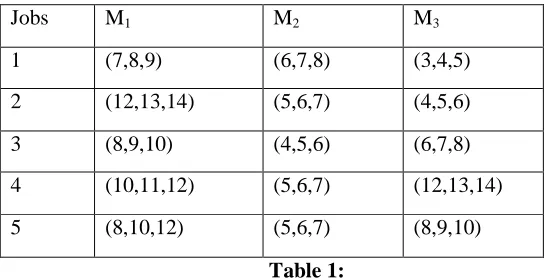
Consider 5 jobs 3 machine flow shop problem where processing time of the jobs described by triangular fuzzy numbers as given in table 1. Our objective is to obtain an optimal schedule using branch and bound technique and finding the total elapsed time.
Jobs M1 M2 M3
1 (7,8,9) (6,7,8) (3,4,5)
2 (12,13,14) (5,6,7) (4,5,6)
3 (8,9,10) (4,5,6) (6,7,8)
4 (10,11,12) (5,6,7) (12,13,14)
5 (8,10,12) (5,6,7) (8,9,10)
41
As per step 1 by the Average high ranking formula finding the expected processing time of each job in fuzzy environment(a,b,c) using .
Jobs M1 M2 M3
1 26/3 23/3 10/3
2 28/3 14/3 12/3
3 20/3 12/3 23/3
4 24/3 14/3 28/3
5 24/3 14/3 20/3
Table 2:
Step 2:
i. L1 = t(Jr,1) +
min(
)
'
i i j
i
i
B
C
A
r
+
+
∑
∈
ii. L2=t(Jr,2) +
∑
∈jr' i
i
B + min(Ci)
iii. L3=t(Jr,3) +
∑
∈jr' i
i C
Calculate lower bounds using above formula LB(Jr) For J1=(1) then J’1(1)= {2,3,4,5}
L1 =49.3 L2=38.3, L3 =47.3 LB(J1) = Max (L1 , L2 , L3 ) = 49.3 Similarly, we have LB(J2)=51.7, LB(J3)= 49.3…
Proceeding in this way, we obtain lower bound values as shown in table below : Jr Lb(Jr)
1 49.3
2 51.7
3 49.3
4 49
5 49.3
41 60
42 57.6
43 54.3
45 56.3
435 67 431 70.7 432 68.3 4352 81 4351 83.3
42 Thus the optimal sequence is Sk : 4-3-5-2-1.
As per Step 5: In out table for the optimal sequence is as follows:
Hence the total elapsed time: (54,62,70)
5. Conclusion
Scheduling problems results can be improved by using Branch and Bound techniques and fuzzy processing time. This work can be extended with more parameters like transportation job, breakdown, setup time etc., especially in fuzzy environment.
REFERENCES
1. S.M.Johnson, Optimal two and three stage production schedules with setup times include, Naval Research Logistics Quarterly, 1(1) (1954) 61-68.
2. E.Ignall and L.Schrage, Application of the branch and bound technique to some flowshop scheduling problem, Operations Research, 13(3) (1965) 400-412.
3. A.P.G.Brown and Z.A.Lominicki, Some applications of the branch and bound algorithm to the machine scheduling problem, Operational Research Quarterly, 17 (1966) 173-182.
4. K.Chander Shekaran and D.Rajendra Chanderi, An efficient heuristic approach to the scheduling of jobs in a flow shop, European Journal Of Operational Research, (1992) 318-325.
5. T.Izzettin and S.Erol, Fuzzy branch and bound algorithm for flow shop scheduling, Journal of Intelligent Manufacturing, 15 (2004) 449-454.
6. D.Gupta, Application of branch and bound technique for n x 3 flow shop scheduling in which processing time associated with their respective probabilities, Mathematical Modeling and Theory, 2(1)(2011) 31-36.
Jobs M1 M2 M3
In Out In Out In Out