Rabbit welfare: determining priority
welfare issues for pet rabbits using a
modified Delphi method
Fiona Rioja- Lang,1 Heather Bacon,1 Melanie Connor,1 Cathy Mary Dwyer 1,2
1Jeanne Marchig International
Centre for Animal Welfare Education, The University of Edinburgh Royal Dick School of Veterinary Studies, Edinburgh, UK
2Animal Behaviour and Welfare,
Scotland's Rural College, Edinburgh, UK
Correspondence to Dr Cathy Mary Dwyer; cathy. dwyer@ ed. ac. uk
To cite: Rioja- Lang F, Bacon H, Connor M, et al. Rabbit welfare: determining priority welfare issues for pet rabbits using a modified Delphi method. Veterinary Record Open 2019;6:e000363. doi:10.1136/ vetreco-2019-000363
Received 26 June 2019 Revised 21 October 2019 Accepted 23 October 2019
© British Veterinary Association 2019. Re- use permitted under CC BY- NC. No commercial re- use. Published by BMJ.
AbstrAct
Background Rabbits are the third most popular pet in the UK, but little research into their welfare needs has been conducted.
Methods A modified Delphi method was used to generate expert consensus on the most important welfare issues for rabbits in the UK. The study involved 11 experts, recruited from a range of disciplines. The experts generated an initial broad list of welfare issues via an online discussion board. Two rounds of online surveys were conducted to prioritise these issues. The final round was a workshop with a subsection of experts. The experts decided that welfare issues should be ranked considering: (1) severity, (2) duration, and (3) prevalence.
Results Experts considered that rabbits were often kept in inadequate housing, were not handled or socialised properly, were fed inappropriate diets and owners failed to vaccinate their rabbits against preventable diseases. Rabbits were thought to experience a reduced life expectancy. Lack of owner knowledge of rabbit husbandry and behaviour and, in some cases, also lack of veterinary knowledge, contributed to poor rabbit welfare.
Conclusions The Delphi process resulted in consensus on the most significant welfare challenges faced by rabbits and can help guide future research and education priority decisions.
IntRoduCtIon
Rabbits are the third most popular mamma-lian pet in the UK (after dogs and cats), with an estimated 1–2 million pet rabbits in the UK.1 2 However, despite their prevalence, relatively little research has been conducted into the management, feeding and welfare of pet rabbits. Rabbits are unusual, in addition to their role as companion animals, as they are also used as laboratory animals, farmed for meat and exist as wildlife populations, which can be perceived as pests and may be subject to human management. There is some limited evidence in the literature for the welfare of rabbits in all these roles, which can be relevant to pet rabbits. Additionally, a number of survey studies have been carried out to assess owner or breeder knowledge, attitudes, housing and management of pet rabbits. These studies suggest that 45 per cent
of pet rabbits are kept alone,3 4 and 51.5 per cent of breeders house rabbits singly.5 This practice is associated with abnormal behav-iour in singly housed laboratory rabbits.6 Similarly, studies indicate that pet rabbits are often housed in cages that are below the minimum space requirements for farmed or laboratory rabbits.7 About a quarter of rabbits in a Dutch survey were strongly resistant to handling4 and 60 per cent of rabbits are reported to struggle when handled and show fear- related aggression.8 Dental disease is also common in pet rabbits,3 although may not be recognised by owners, and can be a conse-quence of inappropriate feeding.9 Further-more, the PDSA PAW Report1 suggests that only 66 per cent of pet rabbits are registered with a vet and only 51 per cent of rabbits have received a primary course of vaccinations against myxomatosis and rabbit (viral) haem-orrhagic disease. These studies suggest that there may be significant welfare issues with pet rabbits, despite the rather low amount of research in this area.
In a study investigating the knowledge and attitudes of UK pet rabbit owners at the point of sale10 respondents were found to have a limited knowledge of the welfare needs of rabbits, particularly with respect to dietary and social needs. In addition, studies of veterinary practitioners suggest that many veterinarians felt they had an inadequate knowledge of the treatment of rabbits for pain.11 These data suggest that, although more research may be required, improved methods of communica-tion and knowledge transfer may be required both to veterinarians, and from vets to owners, particularly future owners of rabbits. Rooney et al suggest that further research should include the prioritisation of the range of welfare issues highlighted in surveys.12
The aim of this study was to solicit the opinions of animal welfare experts on the welfare issues facing pet rabbits in the UK, and achieve a consensus on priority welfare issues. A popular method for assessing expert
copyright.
on September 10, 2020 by guest. Protected by
opinion on a topic is a Delphi method, which relies on an expert panel that complete multiple rounds of surveys in an attempt to reach consensus on an important issue. The main premise of the Delphi method is based on the assumption that group opinion is more valid than individual opinion.13 The classical Delphi method is anonymous, which provides each panel member with the opportunity to present and react to ideas—unbi-ased and unintimidated by other participants. However, due to the relatively small literature on rabbit welfare issues, this study also incorporated a ‘conference Delphi’ method with an online discussion board, to determine all possible welfare issues for pet rabbits, and a ‘modi-fied Delphi’ method with an expert panel workshop. Including a workshop in the procedure has been shown to have a higher probability of reaching agreement than anonymised classical Delphi approaches.14 The aim was to understand the most important welfare issues for pet rabbits, to guide education or research activities.
Methods
The study formed part of a larger study to identify and prioritise welfare issues for a range of different species.
Recruitment of experts
The aim was to recruit between 12 and 20 rabbit welfare experts, and to recruit a broad range of stakeholders: a combination of practising veterinarians, academics, charity sector employees, industry representatives and policy officials. An expert was defined as someone who had worked in their field of expertise for more than three years and were based in the UK.
The recruitment process began with building a list of contacts of well- known experts in their field and contacting them via email and describing the study, the aims and the Delphi procedure. We also created a Delphi information page on the Jeanne Marchig International Centre for Animal Welfare Education website (Univer-sity of Edinburgh) where potential participants could read more about the study. Additionally, we employed a ‘snowball- sampling method’ whereby these initial contacts were also asked to refer us to other experts in their field who would be a good addition to the study. When an expert agreed via email to participate in the study, they were then sent a consent form to sign in accor-dance with the Human Ethics Review Committee guide-lines. The consent form also contained a more detailed description of the study objectives, protocol and expected timeline. It was also explained to each expert that partic-ipation was anonymous (except for the workshop) and voluntary, and they could choose to leave the process at any time.
Rabbit welfare issues
It was considered that there was insufficient peer- reviewed literature available in order to construct comprehensive lists of potential rabbit welfare concerns. Therefore, a ‘Delphi Conference’ was used whereby experts could post,
and respond, to comments on an online discussion board anonymously. The discussion board contained an initial list of potential welfare issues for each species (derived from a list generated by the British Veterinary Associa-tion), and the experts discussed, amended and added to the list to generate a comprehensive list of welfare issues for each species group. The discussion board was open for a period of two weeks, and experts were sent an email reminder mid- way through, and two days before closing. The discussion board host was able to monitor how many experts had logged into the system, and to answer any queries from experts. All comments and discussions from the discussion board were collated, and a detailed thematic analysis was performed using NVivo V.11 Pro. Using an emergent coding process each comment from the discussion board was categorised into themes (eg, housing, management, nutrition, and so on), reaching saturation at 19 themes, which was reduced to seven by combining related areas. Any duplicate welfare issues were deleted, resulting in a comprehensive and concise list of welfare issues. These final lists were reviewed by two independent assessors before the first online survey was generated. At this stage, the lists were relatively long and unranked, but that ensured, as far as possible, that all potential rabbit welfare outcomes and risk factors had been captured.
Questionnaire design
Two rounds of surveys were conducted online using the Online Survey tool (formerly Bristol Online Survey) and were completed anonymously. In both rounds of online surveys, demographic data were also collected from the participants. This included: year of birth, gender, profes-sion, highest level of education and number of years since graduating highest level of education.
The experts were asked via email for the criteria they considered important to rank/score welfare issues. Experts were unable to achieve a consensus on the rela-tive importance of the different criteria and thus we used three factors: (1) severity (defined as the likely maximum severity associated with the welfare issue in the experts’ opinion), (2) duration (defined as the likely propor-tion of the animals’ life which would be affected by the welfare issue in the experts’ opinion), and (3) prevalence (defined as the experts’ perceived proportion of the population affected by the welfare issue) to account for the scale of welfare issues at the individual animal level (severity and duration) and at the population level (prev-alence). For the first survey, participants were asked to score each of the potential welfare issues derived from the thematic analysis for each factor on a 6- point Likert scale, where 1=never/none, and 6=always/high. An even numbered scale was chosen as this forced the experts to make a choice (prioritised or not).
The results of the first survey were reviewed and only the welfare issues that received a median response score of 3.0 or greater for any of severity, duration or preva-lence were included in the second survey. The remaining
copyright.
on September 10, 2020 by guest. Protected by
welfare issues were then arranged according to their ranking from round 1, with the highest ranking issues (score 6) at the top of the list, and the lowest ranked issues (score 3) at the bottom. Experts were presented with the reduced, ranked, lists and asked whether they: (1) agree with the ranking position of the welfare issue, (2) disagree with the ranking position of the welfare issue, it should be higher, or (3) disagree with the ranking position of the welfare issue, it should be lower. Again, this was done by experts individually considering prevalence, severity and duration separately. Agreement between experts was determined by calculating Fleiss’ kappa statistics.
Workshop
The final stage of the process was a workshop which was held at Edinburgh University in September 2018. Twen-ty- one welfare experts participated in the workshop, including two rabbit specialists, all workshop participants had already been involved in the online components of the Delphi for rabbits or other species. In addition, 10 of the other experts in attendance were companion animal experts, and all participants had expertise in animal welfare in general, therefore were able to competently give an expert opinion on rabbit welfare issues during the group discussions. Over the two days there was a series of small group (species specific) and large group (to identify cross- cutting issues) exercises and discus-sions in order to finalise the priority welfare lists for each species group and to rank them. Workshop participants were given the issues, ranks and agreements that were derived from the previous rounds to take into account in determining the overall priority placings of issues. Due to the discussion element that took place in the Work-shop a consensus was considered to have been reached when workshop participants agreed on overall ranking of welfare issues for rabbits.
Results
demographic information
Eleven experts were recruited to the rabbit study. Experts were a mean of 49 years (SD=14.30), and were predom-inantly female (eight female, three male). Experts were predominantly veterinarians (n=3) or academic researchers (n=3), but also included charity or non- governmental organisation workers (n=2), and three others who worked in the pet trade, as a behaviourist or classified themselves as ‘other’. Five participants had a postgraduate qualification (three PhD, two MSc), four had a graduate degree and two experts held other quali-fications. Response rate for round 1 was 81 per cent and for round 2 was 63 per cent.
Rabbit welfare issues
The rabbit experts generated a very comprehensive list of welfare concerns through the discussion board (around 5500 words). From the thematic analysis of the discussion board content we were able to reduce these comments to
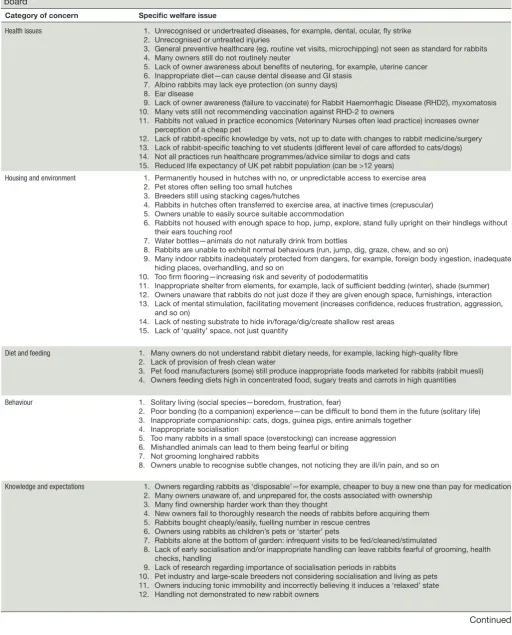
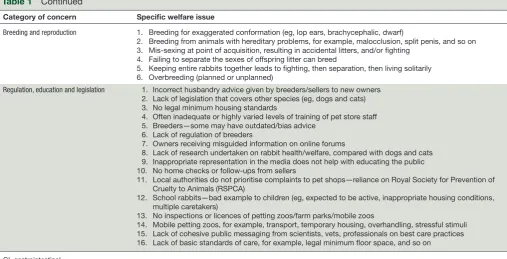
a concise list of 76 specific welfare issues, covering seven themes, in preparation for the first survey (table 1).
Round 1: online survey
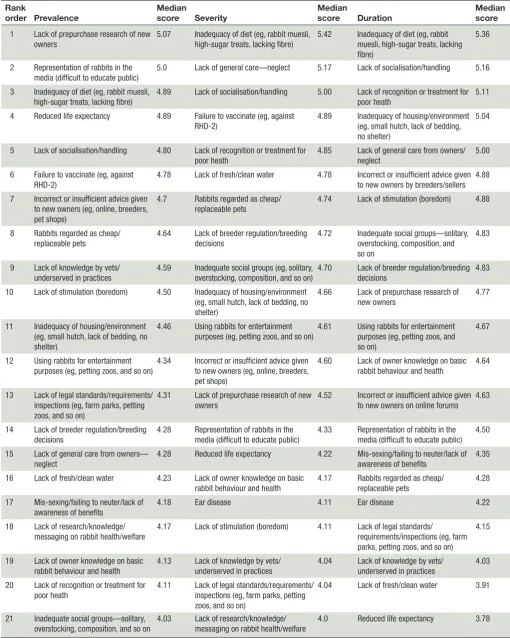
The outcome of the ranking process conducted by experts is shown in table 2. Of the 76 issues shown in
table 1, 22, 21 and 23 issues (for prevalence, severity and duration, respectively) scored above a median of 3, and so were judged by the experts to be at least somewhat important for the welfare of pet rabbits.
Round 2: online survey
Rabbit experts agreed about the placing of the highest ranking issue for prevalence (100 per cent agree-ment), severity (83 per cent) and duration (100 per cent) of welfare concerns. However, overall agreement was moderate for prevalence and duration rankings (ĸ=0.473 and ĸ=0.424, respectively), and fair for severity (ĸ=0.400). In general, experts felt that the rankings for prevalence of lack of socialisation, insufficient or incor-rect advice, inadequate housing, lack of care or knowl-edge and inadequate social groupings should have been placed higher, and media representations, using rabbits in entertainment and lack of legal requirements should have been placed lower. Experts considered that inad-equate social groups and housing, reduced life expec-tancy and lack of owner knowledge had a more signifi-cant impact on the severity of welfare issues for rabbits than suggested by the median response scores in table 2. They also felt that failure to vaccinate, and perceptions of rabbits by owners or the media had a lesser impact on the severity of rabbit welfare. Finally, experts suggested that rankings of inadequate housing, lack of owner knowledge and failure to vaccinate should have been higher for the duration of the welfare issue, and that lack of regulation and representations of rabbits in the media should have been ranked lower.
Workshop
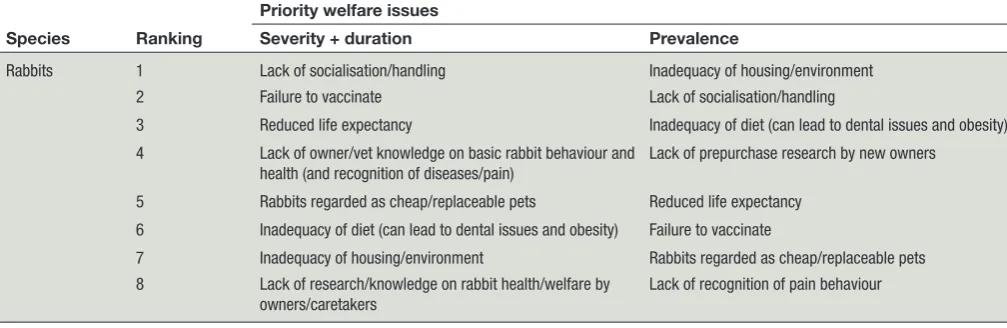
The final priority lists for rabbits that were generated during the workshop is shown in table 3. The severity and duration of welfare issues were considered together (considering the welfare of individual rabbits), and prev-alence of a welfare issue was considered alone (consid-ering the welfare of the population of pet rabbits in the UK).
dIsCussIon
This study generated a comprehensive list of rabbit welfare issues, and generated a prioritisation of what experts currently considered to be the areas of greatest concern. In both the online and workshop rankings the greatest concerns for the welfare of pet rabbits in the UK were inadequacy of diets and environments, lack of handling and socialisation, and a number of concerns that generally cluster in the area of inadequate knowl-edge by owners of the housing, nutritional and behav-ioural needs of rabbits in their care. There were very
copyright.
on September 10, 2020 by guest. Protected by
Table 1 Welfare issues for pet rabbits (unranked) derived through thematic analysis of the anonymous online discussion board
Category of concern Specific welfare issue
Health issues 1. Unrecognised or undertreated diseases, for example, dental, ocular, fly strike 2. Unrecognised or untreated injuries
3. General preventive healthcare (eg, routine vet visits, microchipping) not seen as standard for rabbits 4. Many owners still do not routinely neuter
5. Lack of owner awareness about benefits of neutering, for example, uterine cancer 6. Inappropriate diet—can cause dental disease and GI stasis
7. Albino rabbits may lack eye protection (on sunny days) 8. Ear disease
9. Lack of owner awareness (failure to vaccinate) for Rabbit Haemorrhagic Disease (RHD2), myxomatosis 10. Many vets still not recommending vaccination against RHD-2 to owners
11. Rabbits not valued in practice economics (Veterinary Nurses often lead practice) increases owner perception of a cheap pet
12. Lack of rabbit- specific knowledge by vets, not up to date with changes to rabbit medicine/surgery 13. Lack of rabbit- specific teaching to vet students (different level of care afforded to cats/dogs) 14. Not all practices run healthcare programmes/advice similar to dogs and cats
15. Reduced life expectancy of UK pet rabbit population (can be >12 years)
Housing and environment 1. Permanently housed in hutches with no, or unpredictable access to exercise area 2. Pet stores often selling too small hutches
3. Breeders still using stacking cages/hutches
4. Rabbits in hutches often transferred to exercise area, at inactive times (crepuscular) 5. Owners unable to easily source suitable accommodation
6. Rabbits not housed with enough space to hop, jump, explore, stand fully upright on their hindlegs without their ears touching roof
7. Water bottles—animals do not naturally drink from bottles
8. Rabbits are unable to exhibit normal behaviours (run, jump, dig, graze, chew, and so on)
9. Many indoor rabbits inadequately protected from dangers, for example, foreign body ingestion, inadequate hiding places, overhandling, and so on
10. Too firm flooring—increasing risk and severity of pododermatitis
11. Inappropriate shelter from elements, for example, lack of sufficient bedding (winter), shade (summer) 12. Owners unaware that rabbits do not just doze if they are given enough space, furnishings, interaction 13. Lack of mental stimulation, facilitating movement (increases confidence, reduces frustration, aggression,
and so on)
14. Lack of nesting substrate to hide in/forage/dig/create shallow rest areas 15. Lack of ‘quality’ space, not just quantity
Diet and feeding 1. Many owners do not understand rabbit dietary needs, for example, lacking high- quality fibre 2. Lack of provision of fresh clean water
3. Pet food manufacturers (some) still produce inappropriate foods marketed for rabbits (rabbit muesli) 4. Owners feeding diets high in concentrated food, sugary treats and carrots in high quantities
Behaviour 1. Solitary living (social species—boredom, frustration, fear)
2. Poor bonding (to a companion) experience—can be difficult to bond them in the future (solitary life) 3. Inappropriate companionship: cats, dogs, guinea pigs, entire animals together
4. Inappropriate socialisation
5. Too many rabbits in a small space (overstocking) can increase aggression 6. Mishandled animals can lead to them being fearful or biting
7. Not grooming longhaired rabbits
8. Owners unable to recognise subtle changes, not noticing they are ill/in pain, and so on
Knowledge and expectations 1. Owners regarding rabbits as ‘disposable’—for example, cheaper to buy a new one than pay for medication 2. Many owners unaware of, and unprepared for, the costs associated with ownership
3. Many find ownership harder work than they thought
4. New owners fail to thoroughly research the needs of rabbits before acquiring them 5. Rabbits bought cheaply/easily, fuelling number in rescue centres
6. Owners using rabbits as children’s pets or ‘starter’ pets
7. Rabbits alone at the bottom of garden: infrequent visits to be fed/cleaned/stimulated
8. Lack of early socialisation and/or inappropriate handling can leave rabbits fearful of grooming, health checks, handling
9. Lack of research regarding importance of socialisation periods in rabbits
10. Pet industry and large- scale breeders not considering socialisation and living as pets 11. Owners inducing tonic immobility and incorrectly believing it induces a ‘relaxed’ state 12. Handling not demonstrated to new rabbit owners
Continued
copyright.
on September 10, 2020 by guest. Protected by
Category of concern Specific welfare issue
Breeding and reproduction 1. Breeding for exaggerated conformation (eg, lop ears, brachycephalic, dwarf)
2. Breeding from animals with hereditary problems, for example, malocclusion, split penis, and so on 3. Mis- sexing at point of acquisition, resulting in accidental litters, and/or fighting
4. Failing to separate the sexes of offspring litter can breed
5. Keeping entire rabbits together leads to fighting, then separation, then living solitarily 6. Overbreeding (planned or unplanned)
Regulation, education and legislation 1. Incorrect husbandry advice given by breeders/sellers to new owners 2. Lack of legislation that covers other species (eg, dogs and cats) 3. No legal minimum housing standards
4. Often inadequate or highly varied levels of training of pet store staff 5. Breeders—some may have outdated/bias advice
6. Lack of regulation of breeders
7. Owners receiving misguided information on online forums
8. Lack of research undertaken on rabbit health/welfare, compared with dogs and cats 9. Inappropriate representation in the media does not help with educating the public 10. No home checks or follow- ups from sellers
11. Local authorities do not prioritise complaints to pet shops—reliance on Royal Society for Prevention of Cruelty to Animals (RSPCA)
12. School rabbits—bad example to children (eg, expected to be active, inappropriate housing conditions, multiple caretakers)
13. No inspections or licences of petting zoos/farm parks/mobile zoos
14. Mobile petting zoos, for example, transport, temporary housing, overhandling, stressful stimuli 15. Lack of cohesive public messaging from scientists, vets, professionals on best care practices 16. Lack of basic standards of care, for example, legal minimum floor space, and so on
GI, gastrointestinal.
Table 1 Continued
few disease issues that were considered important rabbit welfare issues, although failure to vaccinate rabbits was highlighted, perhaps as a consequence of lack of knowledge, or because rabbits were regarded as cheap and disposable. These factors may all contribute to the reduced life expectancy of pet rabbits that was a signifi-cant welfare concern for the experts involved in the work.
Rabbit housing and environment
In an owner survey of 46 owners with 102 rabbits, Mullan and Main3 reported that the mean size of hutches was 1.16 x 0.58 x 0.59 m (length, width and height, respec-tively) with hutch heights ranging from 0.3 to 1.8 m, and an average floor area of 0.79 m2 (ranging from 0.2 to
1.24 m2). A survey in the Netherlands4 suggested at most pet rabbits are housed in hutches that are less than 0.5 m2.
Further 51 per cent of rabbit breeders housed animals at lower space allowances than recommended.5 Current regulations for singly housed rabbits in laboratories stip-ulate that rabbits less than 3 kg, and between 3 and 5 kg bodyweight, should be provided with accommodation with a minimum height of 45 cm.15 Therefore, it is reason-able to assume that some UK pet rabbits are currently housed in hutches that are smaller than regulations for laboratory rabbits. Restricted space allowances increase the amount of inactivity in rabbits, and prevented rabbits from performing some behaviours such as hopping and rearing.7 Rabbits also showed a rebound in behaviours when placed in a large pen after being housed in small pens (0.88 m2), suggesting they were motivated to move
but were prevented from doing so by the size of the pen. In addition to space, rabbits need something to do in the space—studies in laboratory rabbits demonstrate that rabbits interact with forms of enrichment, particularly
chewable enrichment, and that this can reduce stress and stereotypic behaviour.16 17
Social interaction can also be a source of enrichment. In survey studies, around half of pet rabbits were kept without a companion,1 3 despite recommendations from veterinary and animal organisations for pair housing. Rabbit breeders were also likely to house rabbits, espe-cially males, in single housing. Solitary housing is thought to contribute to reduced lifespan in rabbits,4 and is asso-ciated with increased stereotypic behaviour in laboratory rabbits6 and fearfulness in pet rabbits.4
Inadequate diet
In the wild, rabbits have adapted to eat an herbaceous diet that is high in fibre, and low in fat and starchy carbo-hydrates. However, 20 per cent of pet rabbits are still fed low- fibre, high- carbohydrate rabbit muesli as their main diet.1 The consequences of these diets include dental disease, gastrointestinal disease, obesity and behavioural problems.9 18 Feeding ad libitum hay increases feeding behaviour and reduces stereotypy in pet rabbits.18 Feeding a traditional rabbit mix has also been associated with selective feeding, with rabbits not eating the pelleted part of the ration resulting in a lack of calcium and vitamin D.3 Pet food manufacturers have developed homogeneous, high- fibre pellets for pet rabbits.3 However, the Rabbits Welfare Association and Fund19 recommend that only 5 per cent of pet rabbit diet should consist of pelleted feed, 10 per cent should be a variety of leafy greens, vegeta-bles and herbs and 85 per cent should be from unlimited grass or hay (long fibre). Pet rabbits are prone to obesity particularly when high- fat diets and ad lib feeding of concentrates are offered.20 Rabbit obesity has been anec-dotally associated with several health disorders of rabbits
copyright.
on September 10, 2020 by guest. Protected by
Table 2 Median scores of welfare issues from first online survey completed by rabbit experts for those issues given a score of 3 or above for prevalence, severity of duration of the welfare issue. Issues are presented in descending order for each measure of welfare impact based on median scores
Rank
order Prevalence Median score Severity Median score Duration Median score
1 Lack of prepurchase research of new
owners 5.07 Inadequacy of diet (eg, rabbit muesli, high- sugar treats, lacking fibre) 5.42 Inadequacy of diet (eg, rabbit muesli, high- sugar treats, lacking fibre)
5.36
2 Representation of rabbits in the
media (difficult to educate public) 5.0 Lack of general care—neglect 5.17 Lack of socialisation/handling 5.16 3 Inadequacy of diet (eg, rabbit muesli,
high- sugar treats, lacking fibre)
4.89 Lack of socialisation/handling 5.00 Lack of recognition or treatment for poor heath
5.11
4 Reduced life expectancy 4.89 Failure to vaccinate (eg, against
RHD-2) 4.89 Inadequacy of housing/environment (eg, small hutch, lack of bedding, no shelter)
5.04
5 Lack of socialisation/handling 4.80 Lack of recognition or treatment for poor heath
4.85 Lack of general care from owners/ neglect
5.00
6 Failure to vaccinate (eg, against
RHD-2) 4.78 Lack of fresh/clean water 4.78 Incorrect or insufficient advice given to new owners by breeders/sellers 4.88 7 Incorrect or insufficient advice given
to new owners (eg, online, breeders, pet shops)
4.7 Rabbits regarded as cheap/
replaceable pets 4.74 Lack of stimulation (boredom) 4.88
8 Rabbits regarded as cheap/
replaceable pets 4.64 Lack of breeder regulation/breeding decisions 4.72 Inadequate social groups—solitary, overstocking, composition, and so on
4.83
9 Lack of knowledge by vets/
underserved in practices 4.59 Inadequate social groups (eg, solitary, overstocking, composition, and so on) 4.70 Lack of breeder regulation/breeding decisions 4.83 10 Lack of stimulation (boredom) 4.50 Inadequacy of housing/environment
(eg, small hutch, lack of bedding, no shelter)
4.66 Lack of prepurchase research of
new owners 4.77
11 Inadequacy of housing/environment (eg, small hutch, lack of bedding, no shelter)
4.46 Using rabbits for entertainment
purposes (eg, petting zoos, and so on) 4.61 Using rabbits for entertainment purposes (eg, petting zoos, and so on)
4.67
12 Using rabbits for entertainment purposes (eg, petting zoos, and so on)
4.34 Incorrect or insufficient advice given to new owners (eg, online, breeders, pet shops)
4.60 Lack of owner knowledge on basic rabbit behaviour and health
4.64
13 Lack of legal standards/requirements/ inspections (eg, farm parks, petting zoos, and so on)
4.31 Lack of prepurchase research of new
owners 4.52 Incorrect or insufficient advice given to new owners on online forums 4.63
14 Lack of breeder regulation/breeding
decisions 4.28 Representation of rabbits in the media (difficult to educate public) 4.33 Representation of rabbits in the media (difficult to educate public) 4.50 15 Lack of general care from owners—
neglect 4.28 Reduced life expectancy 4.22 Mis- sexing/failing to neuter/lack of awareness of benefits 4.35 16 Lack of fresh/clean water 4.23 Lack of owner knowledge on basic
rabbit behaviour and health 4.17 Rabbits regarded as cheap/replaceable pets 4.28 17 Mis- sexing/failing to neuter/lack of
awareness of benefits 4.18 Ear disease 4.11 Ear disease 4.22
18 Lack of research/knowledge/ messaging on rabbit health/welfare
4.17 Lack of stimulation (boredom) 4.11 Lack of legal standards/
requirements/inspections (eg, farm parks, petting zoos, and so on)
4.15
19 Lack of owner knowledge on basic
rabbit behaviour and health 4.13 Lack of knowledge by vets/underserved in practices 4.04 Lack of knowledge by vets/underserved in practices 4.03 20 Lack of recognition or treatment for
poor heath
4.11 Lack of legal standards/requirements/ inspections (eg, farm parks, petting zoos, and so on)
4.04 Lack of fresh/clean water 3.91
21 Inadequate social groups—solitary,
overstocking, composition, and so on 4.03 Lack of research/knowledge/messaging on rabbit health/welfare 4.0 Reduced life expectancy 3.78
Continued
copyright.
on September 10, 2020 by guest. Protected by
Rank
order Prevalence Median score Severity Median score Duration Median score
22 Ear disease 3.56 Lack of research/knowledge/
messaging on rabbit health/welfare 3.77
23 Failure to vaccinate (eg, against
RHD-2) 3.75
RHD, Rabbit Haemorrhagic Disease. Table 2 Continued
Table 3 Ranked welfare priority issues of companion animals for individual rabbits (severity and duration) and for the pet rabbit population (prevalence), as derived from the Workshop
Species Ranking
Priority welfare issues
Severity + duration Prevalence
Rabbits 1 Lack of socialisation/handling Inadequacy of housing/environment
2 Failure to vaccinate Lack of socialisation/handling
3 Reduced life expectancy Inadequacy of diet (can lead to dental issues and obesity)
4 Lack of owner/vet knowledge on basic rabbit behaviour and
health (and recognition of diseases/pain) Lack of prepurchase research by new owners 5 Rabbits regarded as cheap/replaceable pets Reduced life expectancy
6 Inadequacy of diet (can lead to dental issues and obesity) Failure to vaccinate
7 Inadequacy of housing/environment Rabbits regarded as cheap/replaceable pets 8 Lack of research/knowledge on rabbit health/welfare by
owners/caretakers
Lack of recognition of pain behaviour such as myiasis, pododermatitis, pregnancy toxaemia,
gastrointestinal stasis and ileus.21
In our data, from the comments made on the discus-sion board, inappropriate feeding of rabbits was linked to education and misrepresentations in media:
Inappropriate representation in the media does not help with educating the public. For example, when giving talks to infant school children and asking them at the start what do rabbits eat, they all shout ‘carrots’. Cartoon rabbits are often seen eating carrots, so this myth is ingrained in peo-ple from an early age and even with all the organisations promoting the correct messages, these beliefs are difficult to overcome.
socialisation/handling
In a survey of rabbit owners,12 most pet rabbits report-edly did not respond calmly when handled either by their owner (61 per cent) or other adults (75 per cent) and 27 per cent of the owners surveyed described them-selves as being ‘not very confident’ when handling their rabbit. This may be related to the finding that only 63 per cent of rabbit owners interacted with their pet on a daily basis.22 Many rabbits show fear behaviours when lifted from the ground, and 25 per cent of rabbits display strong resistance to being lifted,4 which can constitute a significant behavioural and welfare problem.8 In their review of appropriate handling of pet rabbits, Bradbury and Dickens8 report the importance of early exposure to both human scent and to lifting, which will assist rabbits in coping with being lifted or carried in the future.
Although there is limited evidence to provide guidance on when to socialise rabbits with humans, evidence from commercial rabbits suggests that early handling in the first week of life can reduce fear of humans.23 24 Rooney
et al12 suggest that it is important to start the exposure to humans and handling during the immediate postnatal period, meaning the onus for adequate socialisation is placed on rabbit breeders.
lack of prepurchase research/lack of knowledge
Lack of knowledge by owners (eg, dietary requirements, housing and social needs) and a lack of prepurchase research were important rabbit welfare concerns. A survey of owners at point of sale suggested that 81 per cent of owners had done some research prior to buying a rabbit,10 with leaflets, pet shop staff and books the most used resources, although veterinary surgeons, book and the internet were preferred sources. Owners did, however, reveal limited knowledge of rabbit welfare needs in their responses to questions about diet and need for a social companion. More recently, 17 per cent of rabbit owners reported not doing any prepurchase research before acquiring a rabbit, 32 per cent said they looked on the internet, 33 per cent had previous experience of rabbit ownership and 21 per cent took advice from a pet shop.1 A similar study found that owner knowledge of rabbit husbandry and welfare needs was associated with greater attachment to their pet, a higher probability of taking their rabbit for regular check- ups and a greater likelihood that the pet would be neutered.25 Owners
copyright.
on September 10, 2020 by guest. Protected by
were also most likely to purchase rabbit breeds, such as dwarf lops,5 10 which have been bred for flat faces and are known to be brachycephalic. Lack of knowledge or unre-alistic expectations about the amount of care rabbits may need has also been implicated in the reasons why rabbits might be relinquished to animal shelters.26
Concerns by experts in the study about lack of knowl-edge of rabbit welfare was also extended to veterinary surgeons. A review of pain recognition and use of anal-gesia suggested that pain management for rabbits was inadequate, despite advances in rabbit medicine, and best practice in analgesia provision was not widely used by veterinarians for rabbits.27 In addition, veterinarians felt their knowledge of pain recognition, anaesthesia and analgesia in rabbits was inadequate.11 According to statements made on the expert discussion board in the current study some welfare issues, for example, failure to vaccinate, can be due to owner’s unwillingness, but also due to veterinarians not advising it:
Many vet practices still do not recommend vaccination against RHD-2. It is important that vets are provided with up- to- date information to be able to advice owners.
Attitudes to rabbits
Concerns were raised about possible owner attitudes towards rabbits as pets—rabbits regarded as cheap and replaceable may be less likely to be provided with appro-priate veterinary care (such as vaccinations), may be left to children as the main person responsible for animal care10 and contributes to both relinquishment to shelters and reduced life expectancy.
Pet rabbits are considered to live for five to eight years,28 with the potential to be upward of 12 years. However, surveys in England and the Netherlands suggest a mean age at death of 4.2–5.6 years4 12 in pet rabbits. The inad-equacies in housing, diet and social companionship already described will contribute to the reduced life expectancy of pet rabbits. Failure to vaccinate pet rabbits remains an ongoing welfare issue, with almost half (49 per cent) of rabbits not vaccinated with a primary course of vaccinations when young, and a further 58 per cent not having regular booster vaccinations.1 Only 16.7 per cent of rabbits sold online through breeders were vacci-nated.5 Nearly three- quarters of rabbit owners (73.9 per cent) do not have pet insurance for their rabbits29 and 78.3 per cent do not have their rabbit microchipped.
limitations of the approach
Although Delphi studies are popular and can address problems that would otherwise be contentious or intractable, it is important to acknowledge their limita-tions. The number of experts in this study was relatively small (this was close to the numbers recommended in some papers (eg, ref 14) but lower than others (eg, ref 30)) and ideally the reliability of the study would be tested with other groups of experts. There is no statistical test for reliability in Delphi studies. However, the outcomes
of this study met with the suggested criteria for credi-bility30 as participants were interested and knowledge-able about the field, reasoned discussion and debate was part of the process in the Workshop and supporting data from the literature have been presented here, supporting the validity of the outcomes. As this was the first study of its type, we took a broad approach to welfare issues and included both risk factors (such as housing or owner knowledge) as well as welfare outcomes (such as ear disease or reduced life expectancy), which arose from the expert discussions which proceeded the ranking. In prac-tice, this sometimes was problematic for the experts and did require them to consider the importance of issues that were not necessarily on the same scale. In future work separation of these issues may be beneficial.
ConClusIon
This study is the first to rank and prioritise UK rabbit welfare issues using expert consensus. Most of the welfare issues identified as a priority in this study (lack of prepur-chase research by new owners, inadequate diet, lack of basic general care, lack of socialising and handling, inad-equate housing, and so on) rely on increasing owner knowledge, improving attitudes towards rabbits and encouraging human behaviour change. Therefore, the study suggests that education actions to improve owner knowledge will be beneficial in improving rabbit welfare. The most successful route for this is most likely to be via veterinarians and pet shop employees as they have the greatest contact with new and existing rabbit owners, and veterinarians in particular are seen as an important source of information. However, there was also concern that rabbits are not often taken to the vets, and vets may have insufficient knowledge about rabbit welfare. Therefore, additional Continuing Professional Develop-ment in rabbit behaviour and welfare may be useful for veterinarians, and/or increased training in rabbit behav-iour, welfare and health issues for veterinary students. In addition, campaigns targeting future rabbit owners and emphasising the need to consult a veterinarian for this species would also be useful. Some of the identified lack of knowledge stems from infrequent research data on the environmental, social and behavioural needs of rabbits that could require further study. For example, the timing of socialisation of rabbits to human contact has received considerably less attention compared with dogs and cats, and the behavioural and environmental needs of rabbits are not well understood. These findings suggest that rabbit research priorities could focus on an improved understanding of the behaviour of pet rabbits, particularly human–rabbit interactions, and on the envi-ronmental needs of rabbits in a domestic pet setting.
Acknowledgements The authors thank the 11 rabbit welfare experts, and the
additional 19 animal welfare experts who participated in the workshop.
Funding This study was funded by the Animal Welfare Foundation (AWF). AWF
is a fund- raising and grant- giving charity (charity number 287118) directed by veterinary professions, which uses veterinary knowledge to improve the welfare of
copyright.
on September 10, 2020 by guest. Protected by
animals through science, education and debate. More information can be found at www. anim alwe lfar efou ndation. org. uk.
ethics approval All research generated from this study was approved by the
University of Edinburgh’s Human Ethics Review Committee (HERC).
Provenance and peer review Not commissioned; externally peer reviewed.
data availability statement Data are available upon reasonable request.
open access This is an open access article distributed in accordance with the
Creative Commons Attribution Non Commercial (CC BY- NC 4.0) license, which permits others to distribute, remix, adapt, build upon this work non- commercially, and license their derivative works on different terms, provided the original work is properly cited, an indication of whether changes were made, and the use is non- commercial. See: http:// creativecommons. org/ licenses/ by- nc/ 4. 0/.
oRCId id
Cathy Mary Dwyer http:// orcid. org/ 0000- 0001- 7511- 2056
RefeRences
1 PDSA. Paw report, 2018. Available: www. pdsa. org. uk [Accessed Nov 2018].
2 Sayers I. Approach to preventive health care and welfare in rabbits.
In Pract 2010;32:190–8.
3 Mullan SM, Main DCJ. Survey of the husbandry, health and welfare of 102 PET rabbits. Vet Rec 2006;159:103–9.
4 Schepers F, Koene P, Beerda B. Welfare assessment in PET rabbits. Animal welfare 2009;18:477–85.
5 Gosling EM, Vázquez- Diosdado JA, Harvey ND. The status of PET rabbit breeding and online sales in the UK: a glimpse into an otherwise elusive industry. Animals 2018;8. doi:10.3390/ani8110199. [Epub ahead of print: 06 Nov 2018].
6 Chu L- ru, Garner JP, Mench JA. A behavioral comparison of new Zealand white rabbits (Oryctolagus cuniculus) housed individually or in pairs in conventional laboratory cages. Appl Anim Behav Sci
2004;85:121–39.
7 Dixon LM, Hardiman JR, Cooper JJ. The effects of spatial restriction on the behavior of rabbits (Oryctolagus cuniculus). J Vet Behav
2010;5:302–8.
8 Bradbury AG, Dickens GJE. Appropriate handling of PET rabbits: a literature review. J Small Anim Pract 2016;57:503–9.
9 Meredith AL, Prebble JL, Shaw DJ. Impact of diet on incisor growth and attrition and the development of dental disease in PET rabbits. J Small Anim Pract 2015;56:377–82.
10 Edgar JL, Mullan SM. Knowledge and attitudes of 52 UK PET rabbit owners at the point of sale. Vet Rec 2011;168:353–9.
11 Keown AJ, Farnworth MJ, Adams NJ. Attitudes towards perception and management of pain in rabbits and guinea pigs by a sample of veterinarians in New Zealand. N Z Vet J 2011;59:305–10.
12 Rooney NJ, Blackwell EJ, Mullan SM, et al. The current state of welfare, housing and husbandry of the English PET rabbit population. BMC Res Notes 2014;7:942–55.
13 Keeney S, Hasson F, McKenna H. The Delphi technique in nursing and health research. New Jersey: Wiley- Blackwell, 2011. 14 Boulkedid R, Abdoul H, Loustau M, et al. Using and reporting
the Delphi method for selecting healthcare quality indicators: a systematic review. PLoS One 2011;6:e20476.
15 Council of Europe. Appendix A of the European convention for the protection of vertebrate animals used for experimental and other scientific purposes (Ets No. 123), guidelines for accommodation and care of animals. Section 4.3 enclosures – dimensions and flooring. Strasbourg, France: Council of Europe, 2006: 25.
16 Poggiagliolmi S, Crowell- Davis SL, Alworth LC, et al. Environmental enrichment of new Zealand white rabbits living in laboratory cages. J Vet Behav 2011;6:343–50.
17 Buijs S, Keeling LJ, Tuyttens FAM. Behaviour and use of space in fattening rabbits as influenced by cage size and enrichment. Appl Anim Behav Sci 2011;134:229–38.
18 Prebble JL, Langford FM, Shaw DJ, et al. The effect of four different feeding regimes on rabbit behaviour. Appl Anim Behav Sci
2015;169:86–92.
19 Rabbit Welfare Association and Fund (RWAF). Available: https:// rabbitwelfare. co. uk/ rabbit- diet/ greens- veg- herbs/ [Accessed Feb 2019].
20 Meredith A. The British rabbit Council guide to the importance of diet in rabbits. Available: https:// theb riti shra bbit council. org/ importanceofdiet. pdf [Accessed Apr 2018].
21 Harcourt- Brown F. Textbook of rabbit medicine. Butterworth- Heinemann: Oxford, 2002.
22 Howell TJ, Mornement K, Bennett PC. Companion rabbit and companion bird management practices among a representative sample of guardians in Victoria, Australia. J Appl Anim Welf Sci
2015;18:287–302.
23 Csatádi K, Kustos K, Eiben C, et al. Even minimal human contact linked to nursing reduces fear responses toward humans in rabbits.
Appl Anim Behav Sci 2005;95:123–8.
24 Zucca D, Redaelli V, Marelli SP, et al. Effect of handling in pre- weaning rabbits. World Rabbit Sci. 2012;20:97–101.
25 Welch T, Coe JB, Niel L, et al. A survey exploring factors associated with 2890 companion- rabbit owners' knowledge of rabbit care and the neuter status of their companion rabbit. Prev Vet Med
2017;137:13–23.
26 Neville V, Hinde K, Line E, et al. Rabbit relinquishment through online classified advertisements in the United Kingdom: when, why, and how many? J Appl Anim Welf Sci 2019;22:105–15.
27 Benato L, Rooney NJ, Murrell JC. Pain and analgesia in PET rabbits within the veterinary environment: a review. Vet Anaesth Analg
2019;46:151–62.
28 Meredith A. General biology and husbandry. In: Flecknell P, ed. Manual of rabbit medicine and surgery. Quedgeley: BSAVA, 2000: 13–23.
29 Oxley JA, Previti A, Alibrandi A, et al. A preliminary internet survey of pet rabbit owners’ characteristics. World Rabbit Sci.
2015;23:289–93.
30 Hasson F, Keeney S, McKenna H. Research guidelines for the Delphi survey technique. J Adv Nurs 2000;32:1008–15.
copyright.
on September 10, 2020 by guest. Protected by