San Diego Law Review
Volume 31 | Issue 1 Article 7
2-1-1994
Market Affirmative Action
Robert CooterFollow this and additional works at:https://digital.sandiego.edu/sdlr
Part of theLaw Commons, and theLegal Theory Commons
This Article is brought to you for free and open access by the Law School Journals at Digital USD. It has been accepted for inclusion inSan Diego Law Reviewby an authorized editor of Digital USD. For more information, please [email protected].
Recommended Citation
Market Affirmative Action
ROBERT COOTER*
This paper applies the economic theory of regulation to laws for-bidding discrimination or requiring affirmative action. Perfect competition causes discriminators to pay for segregation. Market failures can shift the cost of discrimination to its victims. The most efficient remedies are the ones already developed by econo-mists for other problems. Discriminatory cartels can be prohibited or undermined. Discriminatory signals can be overcome by
supple-menting market information. External effects of prejudice can be internalized by tax-subsidies. In general, any target for diversity can be achieved more efficiently by transferable rights than by quotas.
I was much cheered, on my arrival [at prison], by the warder at the gate, who had to take particulars about me. He asked my religion and I replied "agnostic." He asked how to spell it, and remarked with a sigh: "Well, there are many religions, but I suppose they all worship the same God."
Bertrand Russell'
In response to a report on affirmative action, President David Gardner of the University of California quipped, "If you think you know the solution, you don't understand the problem."2 People with a solution are like Bertrand Russell's warder - they underestimate the depth of the disagreement. Intellectuals cannot resolve disputes that are deeper than ideas, but economists can improve the debate
* Professor of Law, Boalt Hall, School of Law, University of California at Berke-ley since 1980. Oxford Ph.D. 1975, Harvard; B.A. 1967, Swarthmore.
1. 2 BERTRAND RUSSELL, THE AUTOBIOGRAPHY OF BERTRAND RUSSELL 1914-1944, at 30 (1968). The passage occurs when Russell is beginning his brief confinement in prison for opposing World War I.
by identifying the most efficient means for pursuing any particular policy.
The laws that forbid discrimination and promote affirmative action regulate product and labor markets. Economics has developed an ex-tensive critique of regulation. According to this critique, market-like instruments should replace bureaucratic rules wherever possible. Substituting the former for the latter promotes efficiency and liberty by lowering the cost and coercion of achieving policy goals. This Ar-ticle applies the economic critique of regulation to antidiscrimination law and explores the possibility of substituting market affirmative action for bureaucratic rules. The Article concludes that substitution would increase efficiency and liberty, and also dilute the law's sym-bolic condemnation of discrimination. Unfortunately, economic anal-ysis has no theory of the symbolic and education function of law.
I. ECONOMIC CRITIQUE OF REGULATION
A policy science predicts the effect of alternative policies on shared values.3 For example, applied economics predicts how
alter-native policies affect efficiency and distribution. Most political dis-agreements are buttressed by false beliefs about how policies impinge upon values. By correcting such errors, science improves the quality of policy debate or even imposes a framework upon it.
Economists reached a consensus in the 1970s concerning the framework for analyzing government regulations. According to this framework, a prima facie case for regulation requires demonstrating a market failure and a policy to correct it. Tests for market failure are developed in general equilibrium theory; corrective policies are evaluated by cost-benefit techniques. A conclusive case for regulation requires a further demonstration that the proposed remedy would succeed politically, rather than being subverted by interest groups. Tests for political failure are developed in collective choice theory.4
This consensus over the framework of debate obviously did not end disagreements among economists over regulation. Left-liberal economists stress market failures, and conservative economists stress political failures. However, the arguments between the two sides join because they proceed within the same general framework. The join-ing of the arguments focuses research on questions that both sides consider decisive.
3. See Robert Cooter, The Best Right Laws: Value Foundations of the Economic Analysis of Law, 64 NOTRE DAME L. REV. 817 (1989).
4. This framework for evaluating regulation is reflected in many books and
[VOL 31: 133. 1994] Market Affirmative Action
SAN DIEGO LAW REVIEW
Two examples, which are especially relevant to this article, illus-trate the effect of economics on the debate about regulation. First, George Stigler published an article in 1964 purporting to show that federal securities laws do not increase the value of stocks.' He con-cluded by advocating repeal of the federal securities laws and aboli-tion of the Securities and Exchange Commission. Although his recommendations were not adopted, his paper helped to shift the de-bate about securities laws, which is now conducted in academic cir-cles in terms of the "efficient market hypothesis."6
As a second example, Charles Schultze proposed to replace "com-mand and control" regulations with "market-like instruments.", To illustrate the distinction, the state can reduce air pollution by impos-ing quantitative restrictions on polluters ("commands backed by sanctions") or by creating a limited number of transferrable emis-sion rights ("markets in emisemis-sions"). The environmental lobby ini-tially defended quantitative restrictions and opposed markets, using arguments that relied upon moral intuition. ("Why should you pay someone to stop dumping garbage in your back yard?") More re-cently, however, environmental organizations like the Sierra Club and the Environmental Defense Fund have come to appreciate that voters will "buy" cleaner air if it costs less. The search by environ-mentalists for cheaper solutions to pollution encompasses innovative proposals like markets in emission rights, which were given a statu-tory foundation in the 1990 amendments to the Clean Air Act.'
As these examples suggest, most economists agreed in the 1970s and 1980s that government officials were retarding the economy with
5. George J. Stigler, Public Regulation of the Securities Market, 37 J. Bus. GRADUATE SCH. Bus. U. CHI. 117 (1964), reprinted in STIGLER, supra note 4, at 78.
6. See, e.g., Jeffrey N. Gordon & Lewis A. Kornhauser, Efficient Markets, Costly Information, and Securities Research, 60 N.Y.U. L. REV. 761 (1985); Ronald J. Gilson
& Renier H. Kraakman, The Mechanisms of Market Efficiency, 70 VA. L. REV. 549 (1984).
7. SCHULTZE, supra note 4.
8. The law has actually evolved from set-offs within a single existing plant, to the broader and more systematic trading envisioned in the Clean Air Act Amendments of 1990. 42 U.S.C.A. §§ 7401-7671q (West Supp. 1994); see RICHARD A. LIROFF, AIR POLLUTION OFFSETS: TRADING, SELLING, AND BANKING (1980); RICHARD A. LIROFF, REFORMING AIR POLLUTION REGULATION: THE TOIL AND TROUBLE OF EPA's BUBBLE
(1986); THOMAS H. TIETENBERG, EMISSIONS TRADING: AN EXERCISE IN REFORMING POLLUTION POLICY (1985); John P. Dwyer, California's Tradable Emissions Policy and
Greenhouse Gas Control, 118 J. ENERGY ENGINEERING 59 (1992); Robert W. Hahn & Robert N. Stavins, Incentive-Based Environmental Regulation" A New Era From an Old
heavy-handed regulations. While agreeing about the necessity of re-form, economists disagreed over its direction and scope. Thus, George Stigler wanted to repeal most regulations and Charles Schultze wanted to improve them.9 The diversity of views among economists provided intellectual sanction for reforming politicians who repealed some regulations and reformed others. However, few economists found anything good to say about "command and con-trol" regulations.
Contrary to these trends, legislatures, courts, and administrators have imposed new "command and control" regulations since 1964 for the stated purpose of eliminating current discrimination or undo-ing its past effects upon various social groups, includundo-ing racial mi-norities, women, the elderly, and handicapped people.10 These
regulations apply to hiring and promoting ("employment discrimina-tion"), and the sale of goods and services ("refusal to deal"). Al-though complex and uncertain in application, the effect of the laws are far-reaching. New rights have been created for employees, job applicants, and consumers. Many organizations have adopted targets for the social mix of employees and implemented procedures to han-dle disputes and complaints.
Various scholars have applied the economic theory of regulation to these laws and policies, but none has achieved the comprehensiveness of Richard Epstein's Forbidden Grounds." This technical yet pas-sionate book calls for legislatures to repeal all statutes suppressing discrimination in economic transactions and abandon the field to common law. Thus, Epstein's prescription for antidiscrimination laws parallels Stigler's prescription for securities laws. Against Epstein, John Donohue has argued that Title VII probably increased eco-nomic efficiency on the whole.2
As good as Epstein's book is - and it is very good - its policy prescription is more prophetic than practical, because it cannot suc-ceed in the U.S. without an unforeseeable change in the distribution of political sentiment and power. Furthermore, Epstein's book poses the risk of identifying the economic theory of regulation exclusively with abolition, in which case the defenders of antidiscrimination laws
9. See SCHULTZE, supra note 4; STIGLER, supra note 4.
10. Richard Epstein's book is the most thorough treatment of the legislation.
RICHARD A. EPSTEIN, FORBIDDEN GROUNDS: THE CASE AGAINST EMPLOYMENT DISCRIM-INATION LAWS (1992) [hereinafter FORBIDDEN GROUNDS].
11. Id.
12. The efficiency of Title VII is debated by Richard Posner and John Donohue.
E.g., John J. Donohue III, Further Thoughts on Employment Discrimination Legisla-tion: A Reply to Judge Posner, 136 U. PA. L. REV. 523 (1987) [hereinafter Further Thoughts]; John J. Donohue III, Is Title VII Efficient?, 134 U. PA. L. REV. 1411 (1986) [hereinafter Is Title VII Efficient?]; Richard A. Posner, The Efficiency and Efficacy of
[VOL. 31: 133. 1994] Market Affirmative Action
SAN DIEGO LAW REVIEW
and affirmative action policies will feel compelled to oppose econom-ics. This would be unfortunate in my view because economics has much to offer both sides in the policy debate over discrimination. To become more widely accepted in this debate, economics must be viewed as a flexible engine of analysis that can serve various political tendencies.
This Article contributes to this goal in two ways. First, I develop the simple, pure economic theory of regulation as applied to discrim-ination in economic transactions. Second, I develop the general lines of the case for reform, which involves replacing command and con-trol regulations with market-like instruments to overcome discrimi-nation and pursue affirmative action targets. (Hence the phrase
"market affirmative action.")
II. DISCRIMINATION As INEFFICIENCY
To discriminate among wines by taste, smell, and color displays refinement, but to discriminate against people by race, sex, religion, ethnicity, age, or disability may violate morality and law.13 In the
United States and other countries, law restricts the criteria that can be used when employers fill jobs, universities award scholarships, or
retailers sell commodities. Fairness in competition requires that the criteria for sorting winners from losers measure performance on dimensions relevant to the activity in question, such as speed, accu-racy, comprehension, endurance, and originality.'4 Performance is
not measured by traits of persons such as race, gender, ethnicity, or age. Antidiscrimination laws prohibit the unfairness of sorting win-ners from losers by traits rather than performance. The absence of discrimination gives everyone an equal opportunity to compete for offices, jobs, commodities, privileges, and honors, regardless of their personal traits.
Performance in economic life is usually measured by productivity. Consequently, discrimination in economic life usually consists in sorting people according to traits rather than productivity. When
13. For an illuminating discussion of when and why discrimination is morally wrong, see Larry Alexander, What Makes Wrongful Discrimination Wrong? Biases,
Preferences, Stereotypes, and Proxies, 141 U. PA. L. REV. 149 (1992). For an
interna-tional collection of essays on discrimination and the law, see DISCRIMINATION: THE Lim-ITS OF LAW (Bob Hepple & Erika M. Szyszczak eds., 1992).
people are sorted by traits rather than productivity, industrial effi-ciency diminishes. Consequently, discrimination as defined here nec-essarily reduces efficiency in production. Conversely, non-discrimination maximizes the productivity of organizations.
"Discrimination" is a term of opprobrium in ordinary speech. Most practices that satisfy the efficiency definition of discrimination are widely condemned. To illustrate, "ceiling quotas" on Jews, which lowered the productivity of universities, are widely condemned. How-ever, the efficiency definition of discrimination admits the possibility that some practices falling within its scope may be widely condoned. To illustrate, the exclusion of non-Indians from jobs in tribal govern-ment on Indian reservations is widely condoned.
Organizations mix people by traits in various ratios, with some organizations being relatively homogeneous and others being rela-tively heterogeneous. As defined above, discrimination occurs when mixing in an organization does not go far enough to maximize pro-duction. People who are willing to sacrifice productivity and lose in-come in order to reduce mixing have "a taste for separation." Economists often take the satisfaction of preferences as the appropri-ate goal of public policy. However, there is much dispute about whether satisfying the taste of people for separation is an appropri-ate policy goal.
Equal opportunity to compete in economic transactions conflicts with freedom of contract. Complete freedom of contract implies the right to deal or not to deal with anyone for whatever reason, includ-ing their personal traits. In contrast, antidiscrimination laws attempt to prohibit certain motives from affecting economic transactions. An-tidiscrimination laws necessarily interfere with freedom of con-tract.15 In general, liberty rights conflict with equality rights, because the former create a sphere of individual autonomy and the latter intrude into it.16
15. Their enactment, however, does not necessarily logically imply a much wider infringement demanded by some proponents. Equal opportunity to compete does not im-ply an equal probability of winning, since the probability of winning a fair competition increases with the contestant's skill. Equal opportunity does not imply equal outcomes, since some win and others lose in any competition. Equal opportunity does not imply distributive justice, since a fair competition may not distribute outcomes ideally. Equal opportunity does not imply that the most deserving person wins, since natural abilities and luck affect performance on any occasion.
16. There is a large philosophical literature on "negative liberty" and "positive liberty." See, e.g., JEREMY WALDRON, Liberal Rights: Two Sides of the Coin, in
[VOL, 31: 133. 1994] Market Affirmative Action
SAN DIEGO LAW REVIEW
III. SEPARATION AND MIXING IN PERFECT COMPETITION
In this section I review how competition in markets with free con-tracts undermines discrimination and determines the extent of sepa-ration, segregation, and diversity. I begin by reviewing how competition undermines discrimination.17 In general, people who have a particular preference bear the cost of satisfying it in a per-fectly competitive economy. Consequently, competition causes people who prefer segregation to bear any additional cost that discrimina-tion imposes on goods, services, or employment.
To see why, first consider labor markets. Discriminatory employ-ers constrain themselves by refusing to hire or promote people with disfavored traits. The constraint imposes higher costs to obtain the same quality of labor. In perfect competition, lower cost producers eliminate higher cost producers. Thus, perfect competition eliminates discrimination by employers.
To illustrate, a professional football team, which will go unnamed, recruited the best available white players in the 1950s, but refused to recruit blacks. This discriminatory team competed against other teams that recruited the best available players regardless of race. Over time, the discriminatory team's popularity and profits plum-meted as it lost more and more of its games, so it eventually aban-doned discriminatory recruitment.
Now consider how competition affects discriminatory employees, as opposed to discriminatory employers. Imagine a world whose peo-ple are blue or green, in which some blues refuse to work with greens, but otherwise people are nondiscriminatory. Workers of dif-ferent color substitute perfectly for each other on the job, except that organizations employing discriminatory blues must pay the extra cost of segregating them from greens. Thus, the value of a discrimi-natory worker to an employer equals the value of any nondiscrimina-tory worker minus the incremental cost of segregation. Competition in the labor market aligns each worker's wages with his value to employers. The perfectly competitive wage of discriminatory workers thus equals the wage of equivalent workers minus the incremental cost of segregation. In general, perfect labor market competition im-poses the cost of segregation upon workers who demand it.
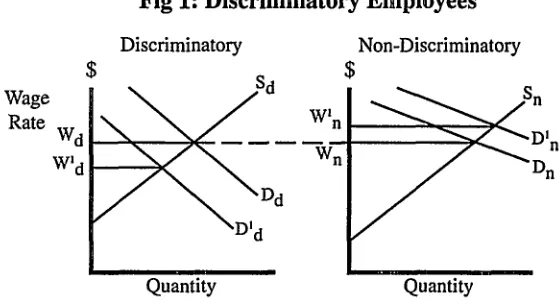
These facts are depicted in Figure 1. The horizontal axis indicates the quantity of labor and the vertical axis indicates the wage rate. Workers are distinguished into those who discriminate, indicated by
a subscript, d, and those who do not discriminate, indicated by a subscript, n. The curves Sd and Sn indicate the quantity of labor each group will supply as a function of the wage. The demand curves
Dd and Dn indicate the value of the two kinds of labor to employers. Initially, assume that the cost of segregation is nil, so both kinds of labor are equally valuable to employers and they receive the same wage, Wd=wn.Now assume that segregating the workplace becomes costly. As the cost of segregation increases, the demand curve for discriminatory labor shifts down from Dd to D'd as shown, and the discriminatory wage falls from wd to w'd. The reduction in use of discriminatory labor causes an increase in demand for nondiscrimi-natory labor, as indicated by the upward shift in demand from Dn to D'n. Consequently, a gap opens in the wage of the two groups, with
discriminatory labor receiving the lower wage w'd and nondiscrimi-natory labor receiving the higher wage w'n.
Fig 1: Discriminatory Employees
Discriminatory Non-Discriminatory
$ $
Wage $Sfl1
Rate Wd n
Wd Wnn
Dd
Quantity Quantity
I have explained why perfect competition causes discriminatory workers to pay for segregation. In general, perfect labor markets im-pose an increase in the cost of production upon anyone whose de-mand for special working conditions causes it. Consequently, perfect labor markets would also impose the cost of additional integration upon workers who demand more of it than would maximize the firm's productivity.
[VOL. 31: 133, 1994] Market Affirmative Action
SAN DIEGO LAW REVIEW
with some buyers, the discriminatory sellers may experience addi-tional costs. In perfect competition, all goods sell at cost, so discrimi-natory sellers will charge more than nondiscrimidiscrimi-natory sellers for the same good. Nondiscriminatory buyers will purchase from the sellers with the lowest prices. Thus, perfect competition eliminates discrimi-natory sellers, just as it eliminates discrimidiscrimi-natory employers. For ex-ample, a restauranteur who insisted on segregated dining facilities might have higher costs, which nondiscriminatory patrons would re-fuse to bear.
Now consider the case of discriminatory buyers. Once again, prod-uct markets strictly parallel labor markets. Specifically, consumers who prefer discriminatory sellers will pay a surcharge for the prod-ucts they buy relative to nondiscriminatory consumers. The surcharge will equal the additional cost of segregating buyers. For example, diners who discriminate will pay the extra cost of segregat-ing their facilities.18
I have explained that people who demand segregation pay the cost of it in competitive markets. In turn, demand for segregation conveys differential advantage to various groups in the labor market. To il-lustrate, airlines apparently believe that a significant group of their customers prefer to be served by pretty, young stewardesses. An air-line that caters to this taste may dismiss stewardesses as they reach middle age, thus incurring higher labor turnover and training costs. These higher costs will be paid by passengers in the form of higher ticket prices. However, discriminatory demand will also bid up the wage for pretty, young stewardesses, who will thus benefit from pas-senger discrimination.19
IV. DIVERSITY AMONG ORGANIZATIONS AND IN ORGANIZATIONS
So far I have discussed discrimination in markets for labor, goods, and services. Exchange occurs in markets, and production occurs in
18. A related question is whether the satisfaction of discriminatory preferences should ever count as a social benefit. Some economists, who are true to the tradition of Bentham, count all preference satisfaction as equally valuable, regardless of whether the preferences are immoral; but others disagree. For discussion and citations, see Jeff L. Lewin & William N. Trumbull, The Social Value of Crimes, 10 INT. REV. L. ECON. 271
(1990).
organizations. Now I consider the extent to which people from di-verse social groups will obtain advantages from mixing together in
organizations.
Economic organizations join people together in a structure of roles and personal relationships to produce goods and services. Performing the necessary roles requires cooperation, and motivating the individ-uals who fill them requires competition.2 0 When combining coopera-tion and competicoopera-tion, disputes often arise over distribucoopera-tional issues like advancement and wages. When people in the organization share the same outlook, disputes are easier to avoid or resolve, and, as a result, the costs of decision making are lower.21 Furthermore, clus-tering people together who have the same tastes increases efficiency in the supply of public goods. To illustrate, achieving a consensus on interior decorating in the workplace is easier and cheaper to imple-ment if all the workers like bright colors and clean edges.2 Thus, efficient governance and the supply of public goods to the workplace argue for clustering workers into homogeneous groups.
However, combining people with different outlooks in the same or-ganization also has advantages. The division of labor causes people to view the production process from different perspectives. People with different perspectives tend to notice things that would be missed by people with the same perspective. Greater perceptiveness in-creases an organization's flexibility and adaptability. Thus, heteroge-neity, which increases the cost of decision making, may improve its quality.23
The competition between homogeneous and diverse firms is exem-plified by the competition between American and Japanese corpora-tions. Large American corporations often have an ethnically diverse board of directors, which gives Americans an advantage in interna-tional business networks. In contrast, large Japanese corporations have homogeneous boards of directors, which lowers the transaction costs of governance. International competition is now testing which
20. This insight is fundamental to the "new industrial organization," which con-ceives of the firm as a principal-agent problem. See, e.g., JEAN TIROLE. THE THEORY OF
INDUSTRIAL ORGANIZATION (1988).
21. Henry Hansmann found that cooperatives tend to succeed when their members are homogeneous so that decision costs remain low. See Henry Hansmann, When Does Worker Ownership Work? ESOPs, Law Firms, Codetermination, and Economic Democ-racy, 99 YALE L.J. 1749 (1990).
22. In a famous article, Charles Tiebout argued that mobility would naturally cause people to separate into local jurisdictions in which the residents have similar tastes with respect to public goods, thus increasing efficiency in the supply of public goods. In effect, I am arguing that this conclusion also applies to the workplace. See Charles M. Tiebout, A Pure Theory of Local Expenditures, 64 J. POL. ECON. 416 (1956); see also WALLACE E. OATES, FISCAL FEDERALISM (1972).
[VOL. 31: 133. 1994] Market Affirmative Action
SAN DIEGO LAW REVIEW
kind of corporation is more efficient.
I have described a few of the advantages and disadvantages of homogeneity and heterogeneity in organizations. The reader can probably think of many more. Organizations that compete in the marketplace try to combine persons and practices in the most profit-able way, and the resulting mix defines the firm's "culture." In com-petition, firms with successful corporate cultures multiply and unsuccessful ones disappear.
It is conceivable that one type of corporate culture would be so successful as to eliminate all the others in a fair competition, thus leaving all firms with the same mix of persons and practices. How-ever, this outcome seems as unlikely in economic competition as in biological evolution. At any point in time, we expect competing firms to vary significantly from each other in corporate culture, including the way they mix social groups. In other words, we expect diversity among organizations with respect to diversity within organizations.
Most citizens of a large country like the United States feel the need for institutions and identities that occupy an intermediate posi-tion between the state and the individual. Important parochial at-tachments include community, region, race, ethnicity, and religion. Intermediate organizations such as residential communities, churches, and private clubs are seldom representative of the nation as a whole with respect to measures of diversity applied in discrimi-nation cases. In the case of Indian reservations, restricting residence and employment to tribal members increases ethnic homogeneity.24
Few people would advocate the enforcement of centrally determined targets for diversity upon these intermediate institutions.
Diversity among organizations can arise from separation or segre-gation. Indeed, distinguishing one from the other is difficult philo-sophically and practically.25 When perfect competition imposes the
24. To illustrate, the Vice Chairman of the Pasqua Yaqui tribe told me in the summer of 1991 that his greatest concern was to get Yaqui children out of integrated classrooms.
25. For an intelligent discussion of this problem by an economic historian, see JEN-NIFER A. ROBACK, PLURAL BUT EQUAL: GROUP IDENTITY AND VOLUNTARY INTEGRA-TION .8 Soc. PHIL. & POL'Y, Spring 1991, at 60. Roback writes:
How integrated should society be? To answer this question, two prior questions must be addressed. First, what function do ethnic groups perform for their members? This question focuses on the benefits of ethnic identity: distinctive-ness and separatedistinctive-ness. Second, why do we want ethnic integration? This ques-tion focuses on the benefits of ethnic interacques-tion: mixing and transformaques-tion.
cost of separation or segregation upon the parties who demand it, the case for interference by the state is weak. The strong case for state regulation arises when market failures enable the people who de-mand segregation or separation to transfer their cost to others. Before turning to market failures, however, I consider the possibility that the state might want to alter the level of mixing under perfect competition. If the state intervenes, it should pursue its policy goal efficiently, which leads to the next topic.
V. PROMOTING MIXING By TARGETS, TAXES AND TRANSFERABLE
RIGHTS
Many markets are "workably competitive," which means that they function much like the ideal type of a perfectly competitive market. Suppose that politicians and policy makers wish to achieve more mixing than workable competition yields, or to achieve it very quickly." One way to pursue such a goal is by imposing "targets" or "quotas" on organizations. "Quotas" are apparently unconstitutional in U.S. law and "targets" are apparently constitutional,27 although
the difference between them is elusive. 8 Fortunately, this difficult
distinction is unimportant for the purposes of this paper. Instead of contrasting targets and quotas, I will contrast non-transferable targets and transferable targets."9
What happens under workable competition if government imposes targets upon all organizations in order to achieve uniform mixing? For example, what happens if government requires fifty percent of the workers in each organization to be male and fifty percent to be female? Like any quota system, employment targets are insensitive to underlying differences in costs, which causes inefficiencies.
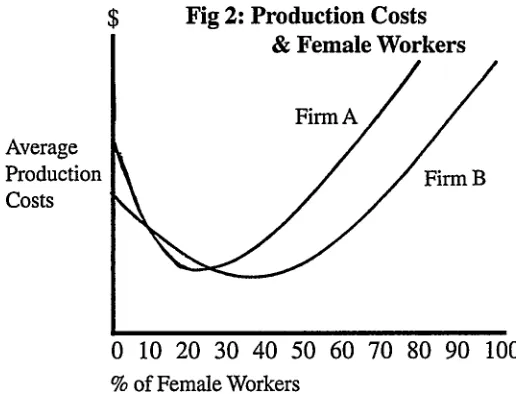
To depict this fact, Figure 2 shows average production costs on the vertical axis and the proportion of female workers on the horizontal
axis for two hypothetical firms in different industries. According to the figure, production costs are minimized in Firm A when thirty percent of its workers are female, and production costs are mini-mized in Firm B when forty percent of its workers are female. Thus,
cannot possibly get this trade-off right. So, government should remain neutral towards race. Id. at 61, 78-80.
26. John Donohue argues that perfect competition might take too long to eliminate discriminatory practices. See Further Thoughts, supra note 12; Is Title VII Efficient?,
supra note 12.
27. In the Bakke case, Justice Powell held that racial or ethnic targets to achieve diversity are permitted in an educational institution, but quotas are unconstitutional. See Regents of the Univ. of Cal. v. Bakke, 438 U.S. 265 (1978).
28. See Fullilove v. Klutznick, 448 U.S. 448 (1980).
29. On market affirmative action, see generally Harold Demsetz, Minorities in the
Market Place, 43 N.C. L. REv. 271 (1965); Jerry L. Mashaw, Implementing Quotas, 79
[VOL. 31: 133. 1994] Market Affirmative Action
SAN DIEGO LAW REVIEW
in perfect competition without regulation, the proportion of female workers in Firms A and B will equal thirty and forty percent, respec-tively. To be concrete, the proportion of women graduating from American law schools is higher than Ph.D. programs in economics, so Firm B might be a law firm, which can attract female lawyers easily, and Firm A might be an economic forecasting firm, which has difficulty attracting female economists.
$ Fig 2: Production Costs
& Female Workers
Firm A
Average
Production Firm B
Costs
0 10 20 30 40 50 60 70 80 90 100
% of Female Workers
Now suppose that government wants to increase female employ-ment in the two firms to fifty percent. One way to do so is by impos-ing a fifty percent target on both firms. However, replacimpos-ing male with female workers may cost one firm more than the other. Alterna-tively, the policy goal could be fifty percent female employment on average over the two firms. Implementing this goal at least cost might require one firm to have more than fifty percent female work-ers and the other to have less.
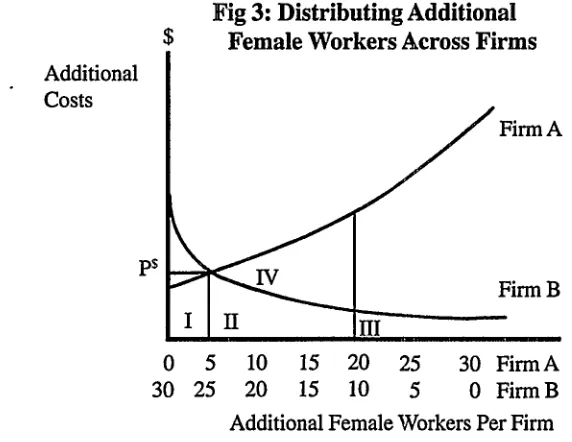
increase in female employment in Firm A from left to right, and the increase in Firm B is measured from right to left. At the extreme left, Firm A replaces zero males with females and Firm B replaces thirty males with females. At the extreme right, the opposite applies - Firm A adds thirty females and Firm B adds zero females. Con-sequently, each point on the horizontal axis represents a different way of distributing an increase of thirty in total female employment between the two firms.
Fig 3: Distributing Additional $ Female Workers Across Firms
Additional Costs
PS Firm B
0 5 10 15 20 25 30 FirmA
30 25 20 15 10 5 0 FirmB Additional Female Workers Per Firm
Figure 3 permits a direct comparison between uniform and cost-minimizing targets. According to the figure, the cost-cost-minimizing way to distribute the increase of thirty female workers between the two firms is indicated by the intersection of the two cost curves, which is the point where the marginal cost of adding an additional female worker is the same for both firms. At the cost minimizing point, Firm A replaces five male workers with females, and Firm B re-places twenty-five male workers with females. Thus, the minimal cost of adding thirty additional female workers is indicated by the
areas I+II+III in Figure 3.
[VOL. 31: 133. 1994] Market Affirmative Action
SAN DIEGO LAW REVIEW
achieve the goal of adding thirty female workers at extra cost corre-sponding to area IV.
Ideally, government administrators would respond to differences in labor markets by adjusting the targets to take account of the pool of qualified workers and other labor market conditions.30 For example, the female target for Firm B would be higher than for Firm A to reflect the greater number of women in law as opposed to economics. However, the economic critique of regulation builds upon the insight that the best regulations for society are seldom best for the tors, and even officials who have incentives to impose the best regula-tions seldom have enough information. To illustrate, officials might impose fifty percent targets on each firm because doing so maximizes the need for regulators, or because the officials lack the necessary information to adjust the targets in response to conditions in local labor markets.
In contrast, "market-like instruments" of regulation economize on the amount of information that officials require to enforce them. In terms of Figure 3, market-like regulation will induce Firm A to add five female workers and Firm B to add twenty-five. The mechanisms that can achieve this goal include targets supported by tax-subsidies or transferable employment rights. I will explain both of them, with-out discussing the formidable practical obstacles to their adoption.
The tax-subsidy solution requires each firm to pay a tax on "ex-cess" workers of the disfavored type and receive a subsidy for "sur-plus" workers of the favored type. To illustrate by our previous example, assume that policy makers adopt the. target of fifty percent female workers in the combined professions of law and economics. Each firm would receive a target of fifty percent females in its work force in these professions. A firm that fell short of the target would be charged a tax on its excess male workers, and a firm that ex-ceeded the target would receive a subsidy for its surplus female workers. For example, if Firm A is an economic forecasting com-pany that employs one hundred economists and thirty of them are female, then it must pay a tax on its twenty "excess" male econo-mists. If the tax is high enough, Firm A will respond by replacing male economists with females. In general, the higher the tax-subsidy, the more male employees will be replaced with females. It is not
hard to see that a tax-subsidy rate exists, and can be identified eas-ily, which achieves any target for increased female employment at the least cost to society.
To illustrate, return to the example in which the goal is adding thirty female workers in Firms A and B, and each firm is assigned a target of fifty percent female employees in professional jobs. The tax must be paid on shortfalls relative to the target, and the subsidy will be received for surpluses relative to the target. Initially the tax-sub-sidy is set at a low level and gradually raised until the goal of thirty additional female workers is achieved. Figure 3 indicates that this goal will be achieved by setting the tax-subsidy at p*.
To see why, consider the response of Firm A and Firm B when the tax-subsidy equals p*. If the tax is set at p*, Firm A will prefer to add up to five female workers to avoid paying the tax. However, af-ter it adds five female workers, it is cheaper to pay the tax than to add more females. Consequently, after adding five females, Firm A will pay a tax on the remaining fifteen "excess" male employees, for total tax payments of 15p*. Similarly, Firm B will add ten additional females to achieve its target and avoid paying the tax. However, Firm B will then take advantage of the subsidy by hiring additional females out to the point where the additional cost equals the subsidy, which occurs when Firm B adds a total of twenty-five females. Thus, Firm B will receive a subsidy of p* on its fifteen "surplus" female employees, for a total subsidy of 15p*. Notice that in equilibrium the total taxes paid by Firm A equal the total subsidies enjoyed by Firm B.
An alternative policy that achieves the same results in principle is to create a transferable right to employ disfavored workers.31 Firms would be required by law to own as many legal rights as they employ workers of the disfavored type. To illustrate by our previous exam-ple, assume that policy makers adopt the target of fifty percent fe-male workers in the combined professions of law and economics. Thus, the regulators must create a total number of rights to employ male lawyers or economists equal to fifty percent of the current workers in those jobs. These rights must be allocated initially, say by gift or auction. It matters little from an efficiency perspective how they are initially allocated. Once allocated, firms would buy and sell the rights.
31. In a bitter satire, Derrick Bell imagines the effects of a government bill author-izing whites to purchase permits allowing them to discriminate against blacks in busi-ness. The purpose served by the imagined permits is to allow for the satisfaction of discriminatory preferences at a price. See DERRICK BELL, FACES AT THE BOTTOM OF THE
WELL: THE PERMANENCE OF RACISM 47-64 (1992). Jerry Mashaw contemplates a mar-ket to discriminate, analogous to a marmar-ket to pollute. See Jerry L. Mashaw, Against
[VOL. 31: 133. 1994] Market Affirmative Action
SAN DIEGO LAW REVIEW
To illustrate concretely, suppose that regulators initially give Firm
A and Firm B male employment rights equal to fifty percent of their
workers. Thus, each firm receives the right to employ fifty males, for a total of one hundred males. However, the two firms initially em-ploy 130 males combined. To comply with the law, the two firms must now replace thirty male workers with females. The firms will bargain with each other to try to accomplish this goal in the cheap-est way. If bargaining replicates a competitive market, Firm A will offer to pay p* to Firm B for each male employment right. Firm B will respond by selling the right to employ fifteen males to Firm A. So in equilibrium, Firm A will increase its female workers by five and purchase fifteen male employment rights from Firm B, whereas Firm B will increase its female workers by twenty-five and sell fif-teen male employment rights to Firm A.
Notice that tax-subsidies and transferable employment rights achieve the identical outcome. Specifically, Firm A increases female employment by five, Firm B increases female employment by twenty-five, and Firm A pays 15p* to Firm B."2
Apparently, a tax-subsidy scheme is in place in Germany with re-spect to employment of the handicapped. Employers are assigned a target for hiring disabled workers based upon the proportion of handicapped in the working population. Employers who fail to hire their target of the handicapped make payments to the government which passes the funds along to employers who hire more than their share.33 New Jersey has experimented with a similar approach to low income housing located in middle class communities.3 4
VI. DISCRIMINATORY POWER
I have discussed discrimination in markets with perfect competi-tion and the achievement of affirmative accompeti-tion targets in perfectly competitive labor markets. Although the perfectly competitive model
32. The difference between tax-subsidies and marketable rights is the difference in transactions costs and whether the officials adjust prices or quantities to converge to the equilibrium. See Robert Cooter, The Cost of Coase, 11 J. LEG. STUD. 1 (1982).
33. See Mashaw, supra note 31, at 236 (citing BERND FRICK, INTERNE ARBEIT-SMARKTE UND BETREIBLICHE SCHWERBEHINDERTERBHAFTIGUNG: THEORETISCHE
ANALYSEN UND EMPIRISCHE BEFUNDE (1992)); Martin Pfaff & Walter Huber, Disability
Policy in the Federal Republic of Germany, in PUBLIC POLICY TOWARD DISABLED WORKERS: CROSS-NATIONAL ANALYSES OF ECONOMIC IMPACTS 193 (Robert H. Have-man et al. eds., 1984).
describes powerful forces at work in the economy, part of the histori-cal differences in wages between blacks and whites, or between women and men, are usually attributed to discrimination. Rather than confirming the prediction that discriminators paid for it, empir-ical studies suggest that the targets of discrimination in the United States historically received lower wages than others with equivalent skills, and that civil rights laws helped raise the income of blacks.36 Given the evidence, discriminatory practices in this country cannot be explained fully by the model of perfect competition.3
In subsequent sections of this Article, I will consider several mar-ket failures that might explain how discriminators shift the burden of segregation to its victims. First I develop a model of discrimina-tion based upon power, not competidiscrimina-tion. Just as producers collude to fix prices and obtain monopoly profits, so social groups sometimes collude to obtain the advantages of monopoly control over markets. To enjoy the advantages of monopoly, a social group must reduce competition from others by excluding them from markets. In this way, the more powerful social group can shift the cost of segregation to its victims, and more costs besides, so that the victims of discrimi-nation are worse off and the discriminators are better off.
To illustrate, recall the hypothetical example in which some blues discriminate against greens, and perfect competition causes the dis-criminatory blue workers to bear the cost of segregation. Now sup-pose that discriminatory blue workers organize themselves and acquire enough power to disrupt the workplace. The blues could use this power to threaten employers who failed to discriminate against greens. Faced with the power of the blues, employers might find that they could maximize their profits by avoiding disruption, even at the cost of segregating workers and confining greens to lower level jobs. This example describes circumstances in which segregation reduces productivity and its victims bear the cost.
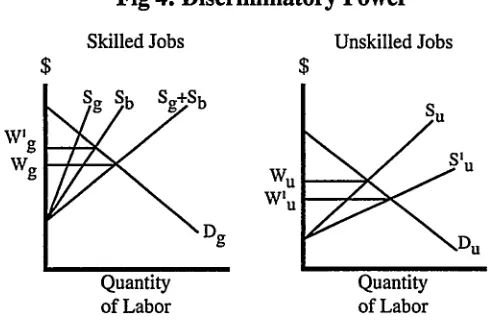
The consequences of discriminatory power ih the market for skilled and unskilled labor are depicted in Figure 4. The demand for skilled labor is indicated by the curve labelled Ds, and the supply of skilled labor by greens, blues, and the sum of greens and blues, is
35. The empirical evidence is reviewed in FORBIDDEN GROUNDS, supra note 10, at 242-66. In the usual approach, "human capital" variables explain part of the wage-gap between sexes or races, and the unexplained residual is attributed to discrimination. Gil-lian Hadfield has suggested that the "human capital" variables should be viewed as re-sults of discrimination in non-market institutions such as families and schools. See Gillian K. Hadfield, Households at Work: Beyond Labor Market Policies to Remedy the
Gender Gap, 82 GEo. L.J. 89 (1993).
36. Martin Katz argues that past discrimination could produce wage-disparities between the races that are relatively permanent, in spite of high levels of competition. These conclusions depend upon special assumptions such as barriers to entry. See Martin J. Katz, The Economics of Discrimination. The Three Fallacies of Croson, 100 YALE
[VOL. 31: 133. 1994] Market Affirmative Action
SAN DIEGO LAW REVIEW
indicated by the curves S , S
b, and S g+Sb, respectively. In the ab-sence of discrimination, t e wage for all skilled workers equals ws. The demand for unskilled labor is indicated by the curve labelled Du,
and the supply of unskilled labor (blue and green) is indicated by the curve Su. In the absence of discrimination, the wage for unskilled
workers is wu .
Now consider how discrimination changes wages. If skilled blues exclude skilled greens from the market for skilled labor, the supply falls from Sg +Sb to Sb, and the skilled wage rises to w's. Discrimina-tion forces greens to work as unskilled labor. The addiDiscrimina-tional greens entering the unskilled labor market swell the supply from Su to S'u, which causes wages to fall from wu to w'u. Thus, discrimination in-creases wages for skilled blue workers, and lowers wages for un-skilled blues and all greens.
Fig 4: Discriminatory Power
Skilled Jobs Unskilled Jobs
, $
Sg Sb Sg+Sb Su
W'g / S
Wg Wu
w1 u
Quantity Quantity
of Labor of Labor
demand is higher for "blue work" than for "green work", then segre-gating tasks will cause the wage of unskilled blue workers to rise above the wage of unskilled green workers.
This market analysis can be applied to Title VII of the Civil Rights Act of 196437 and the Age Discrimination in Employment Act (ADEA)."8 These laws prohibit employment discrimination based on race, color, religion, sex, national origin, or age. In prac-tice, most workers fall within its protection except for young white males. Complaints of discrimination must be filed with the Equal Employment Opportunity Commission which investigates them. Thus, for example, a company that wrongfully denied a job to some-one two years ago might be ordered to hire the person and pay com-pensation equal to the difference between his current wage and the higher wage in the better job for two years. In terms of Figure 4, a skilled green worker who was forced to accept unskilled employment could sue for the difference between ws and wu. The fact that the law limited damages to back-pay discouraged lawyers from taking small cases on a contingency fee, but their reluctance may be overcome by revisions in Title VII in 1991"' that brought employment discrimina-tion closer to tort law by broadening damages.40
37. Title VII of the Civil Rights Act of 1964, as amended, 42 U.S.C.A. §§ 2000e to 2000e-17 (West 1981 & Supp. 1993).
38. Age Discrimination in Employment Act, 29 U.S.C.A. §§ 621-34 (West 1985 & Supp. 1993).
39. Civil Rights Act of 1991, Pub. L. No. 102-166, 105 Stat. 1071 (1991). 40. My thanks to Drew Days and Pam Karlan for helping me get the facts right about current law. Donohue's analysis of data on Title VII suits discloses a paradox that developed with time. Employment discrimination against women and minorities almost certainly declined between 1970 and 1989, yet filings of employment discrimination cases increased over 20 times. See John J. Donohue III & Peter Siegelman, The Changing
Nature of Employment Discrimination Litigation, 43 STAN. L. REV. 983 (1991). What
happened? Many of the original suits were brought against hiring practices that discrim-inated against classes of people. For example, blacks were effectively prevented from becoming firemen in Birmingham, Alabama. See Samuel Issacharoff, When Substance
Mandates Procedure: Martin v. Wilks and the Rights of Vested Incumbents in Civil Rights Consent Decrees, 77 CORNELL L. REV. 189, 195 (1992). The success of these suits
[VOL. 31: 133, 1994] Market Affirmative Action
SAN DIEGO LAW REVIEW
VII. ANTI-DISCRIMINATION AS ANTITRUST
In general, a group with the power to reduce competition from others can benefit itself, whether the group is defined by race, reli-gion, gender, or industry. Discriminatory social groups are much like cartels, and a discriminatory norm is analogous to a price-fixing agreement. Thus, the analysis and attack upon discriminatory mar-ket power can borrow much from monopoly theory and antitrust law. I will develop this parallel.4'
Cartels are unstable because each member can increase its profits by defecting from the group. For example, the Organization of Pe-troleum Exporting Countries (OPEC) tried to fix prices, but coun-tries like Algeria secretly discounted oil in order to sell more of it.42 As a cartel becomes large, detecting and preventing such "cheating" by members becomes harder. Without legal backing and formal en-forcement of their agreements, large cartels like OPEC collapse.43
Similarly, social groups can exert power to increase their wages by restricting competition in the labor market, but individuals can profit from violating the restrictions. To illustrate by the example in Figure 4, individual blue workers who cease to support segregation actively can enjoy the discriminatory wage w's and avoid the inconvenience,
expense, or danger of participating in industrial disruptions. In eco-nomic jargon, individual blues have an incentive to "free ride" with respect to discriminatory norms by withholding enforcement effort. Furthermore, an employer can reduce his wage bill for skilled work-ers by hiring greens, who would otherwise have to work at unskilled jobs, and paying a wage more than w'u and less than ws. So the
self-interest of employers and blues as individuals does not prompt them to sustain discriminatory norms. In general, sustaining discrimina-tory norms requires the collusion of many people, which presupposes sanctions to enforce the discriminatory norms. Informal sanctions such as gossip, ostracism, and boycotts can operate spontaneously,
41. A similar analogy is between a discriminatory norm and a tariff. In some cir-cumstances a country gains an advantage by imposing a tariff on the products of another country, especially if the other country cannot retaliate by imposing its own tariffs. Simi-larly, one ethnic group could gain an advantage by imposing a tariff on hiring people from the other ethnic group. See Anne 0. Krueger, The Economics of Discrimination, 71 J. POL. ECON. 481 (1963).
especially when a culture stresses group solidarity.4' In the past, many Americans used informal sanctions to punish individuals who failed to keep the races separate or women "in their place." How-ever, the informal sanctions were probably not enough to sustain seg-regation without being buttressed by formal laws.45
Although cartels are inherently unstable, the U.S. antitrust frame-work does not merely withhold enforcement from contracts to create cartels. In addition, the original U.S. legislation, which was enacted at the end of the nineteenth century, outlaws cartels and other "con-spiracies against trade.'46 The courts have interpreted the law to prohibit certain collusive practices ("per se prohibitions"), such as retail price maintenance, regardless of whether collusion occurred in fact.47 These prohibitions greatly increase the difficulty of sustaining a cartel.48 Similarly, U.S. civil rights laws prohibit business practices involving "disparate treatment" of those persons belonging to any one or more protected classes.49 The illegality of conducting certain business transactions with the intent to discriminate greatly in-creases the difficulties involved in explicit discrimination, especially in large organizations.
Over the years, the effective scope of antitrust law expanded from banning cartels to suppressing monopolies.50 A monopoly can arise
even without collusion or engaging in practices that are illegal per se. For example, monopoly power can be "thrust upon" a producer due to economies of scale in production. Such monopolies are evalu-ated for their legality in the United States according to a balancing test.51 The balancing test is intended to determine whether the sav-ings in cost from scale economies outweigh the risk to the public of having only one or two producers. Balancing tests have their own history that I cannot discuss in detail, but a relevant episode is the
44. See George A. Akerlof, Discriminatory, Status-based Wages Among Tradi-tion-oriented, Stochastically Trading Coconut Producers, 93 J. POL. ECON. 265 (1985).
45. See Jennifer Roback, Racism as Rent Seeking, 27 EcoN. INQUIRY 661 (1989). 46. Sherman Act, as amended, 15 U.S.C. § 1 (Supp. IV 1992).
47. See National Bancard Corp. v. VISA U.S.A., 596 F. Supp. 1231 (S.D. Fla. 1984).
48. There is a certain irony in the fact that large cartels are easiest for the govern-ment to detect and prosecute, but large cartels also are the ones that tend to fall apart even without government prosecution.
49. E.g., 42 U.S.C.A. § 2000e-2(a) (West 1981).
50. Section 2 of the Sherman Act bans monopolies. 15 U.S.C. § 2 (Supp. IV 1992). Judicial implementation of this section was slow. Sullivan says that "[m]odern legal analysis of monopoly issues begins with the opinion by Judge Learned Hand in United States v. Aluminum Company of America," which was decided in 1945. LAW-RENCE A. SULLIVAN, HANDBOOK OF THE LAW OF ANTITRUST 39 (1977) (citing United States v. Aluminum Co. of Am., 148 F.2d 416 (2d Cir. 1945)).
51. A compact and lucid discussion of the balancing test is in National Bancard
[VOL. 31: 133. 1994] Market Affirmative Action
SAN DIEGO LAW REVIEW
rise and fall of the "structural approach. 52 In the 1970s, the
anti-trust authorities prosecuted some very large manufacturers with the intention of restructuring whole industries in order to increase the number of producers. However, this approach was deemed a failure and abandoned in the 1980s for a variety of reasons.53
Antidiscrimination law has a history with some similarity to anti-trust law. 4 At first the government focused its prosecutorial efforts upon explicitly discriminatory practices. In these cases, the plaintiff had to prove the existence of disparate treatment by the employer. In 1971, however, the law evolved further and the U.S. Supreme Court developed the concept of "disparate impact. ' 5 A practice can have an illegal disparate impact in the absence of discriminatory in-tent. The illegality of the outcome is identified by a pattern sug-gesting that a protected group has been unreasonably disadvantaged by a business practice. Thus, the concept of disparate impact in an-tidiscrimination law bears a certain resemblance to "monopoly struc-ture" in antitrust law. Whether the courts and the political process will deem the past twenty-three years of disparate impact analysis a success or a failure remains to be seen.
When antitrust laws block cartels, the industry may try to circum-vent the law through the help of regulators. For example, airlines are
52. For accounts of the "structural approach," see JOE S. BAIN, INTERNATIONAL
DIFFERENCES IN INDUSTRIAL STRUCTURE: EIGHT NATIONS IN THE 1950s 134-54 (1966); RICHARD E. CAVES, AMERICAN INDUSTRY: STRUCTURE, CONDUCT, PERFORMANCE 17-37 (4th ed. 1977); F.M. SCHERER, INDUSTRIAL MARKET STRUCTURE AND ECONOMIC PER-FORMANCE 81-150 (2d ed. 1980).
53. The abandonment of the structural approach to antitrust adjudication in the 1980s is sometimes called the "victory of the Chicago school." See, e.g., Andrew I. Gavil,
Teaching Antitrust Law in its Second Century: In Search of the Ultimate Antitrust Casebook, 66 N.Y.U. L. REV. 189, 210 n.123 (1991) (book review). It is reflected in the changes in the FTC's merger guidelines in 1982. FTC STATEMENT CONCERNING HORI-ZONTAL MERGERS, reprinted in 4 TRADE REG. REP. (CCH) 1113,200, at 20,901-06 (June 15, 1993). Another indication of change is successive editions of Scherer's book
Indus-trial Market Structure and Economic Performance. SCHERER, supra note 52. Also, the
ABA's Section of Antitrust Law has discussions on current developments in antitrust in its volume on the annual meeting. See, e.g., Symposium, The State of Antitrust, 61
ANTITRUST L.J. 81 (1992).
54. I have stressed the role of discrimination by a group in reducing competition from others. Another possibility is that a firm with market power will use a trait like race or sex to discriminate in pricing among consumers. The latter type of discrimination would fall under the ban of the Federal Trade Act. More generally, Ian Ayres has sug-gested that antitrust law could be used to attack discrimination as an "unfair or decep-tive trade practice." Ian Ayres, Fair Driving: Gender and Race Discrimination in Retail
Car Negotiations, 104 HARV. L. REV. 817, 821 (1991).
55. Griggs v. Duke Power Co., 401 U.S. 424 (1971). An extensive discussion of this development of the law is in chapter 10 of Epstein's book. FORBIDDEN GROUNDS,
forbidden to collude in setting prices, but they had much influence with the Civil Aeronautics Board and apparently used it to impose the cartel price upon many routes.5 Similarly, southern whites ac-tively used the power of state and local government to reduce compe-tition from blacks through the "Jim Crow" legislation that was enacted in the closing decades of the nineteenth century.E7
Antidiscrimination laws can also be used to benefit a social group by reducing competition from others. To illustrate by Figure 4, sup-pose the greens, who were the historic victims of discrimination in our hypothetical example, acquire legislative power and enact laws mandating preferential hiring of greens. For example, the law might mandate filling job openings in various categories with greens until sixty percent of the workers are green. (Perhaps sixty percent of the population is green.) In job categories where the target binds, blues cannot compete with greens for jobs, which causes the green wage to rise above the blue wage for equivalent workers. These arguments underlie the claim that affirmative action is reverse discrimination.
The phrase "rent seeking" refers to the efforts of people to secure laws that convey monopoly power and profits upon themselves. A standard prescription for preventing rent-seeking is to remove the is-sue from ordinary politics by constitutionalizing it.58 For example, constitutional guarantees of private property inhibit politically influ-ential people from using the state to appropriate the property of others for themselves. Similarly, constitutional guarantees against discrimination can reduce rent-seeking by social groups. On the other hand, the creation of vague and uncertain constitutional rights by courts can unleash extensive rent-seeking through litigation.59
I have shown that social groups, including racial and ethnic groups, are paradigmatic interest groups in many respects. Like other interest groups, they seek to collude and redistribute wealth to themselves by inefficient restrictions on competition. However, self-interest and morality often prompt individuals to evade these restric-tions. So discriminatory social groups suffer the same problems of instability as any other cartel. To sustain discriminatory norms, evaders must be punished by a combination of informal sanctions and formal laws. By repealing these laws and undermining these sanctions, law can cause the discriminatory norms to disintegrate. Constitutional protection against discrimination, like constitutional
56. See Theodore E. Keeler, The Revolution in Airline Regulation, il CASE STUD-IES IN REGULATION: REVOLUTION AND REFORM 53 (Leonard W. Weiss & Michael W.
Klass eds., 1981).
57. FORBIDDEN GROUNDS, supra note 10, at 91-97.
58. RICHARD A. EPSTEIN, TAKINGS: PRIVATE PROPERTY AND THE POWER OF EMI-NENT DOMAIN 31 (1985).
[VOL. 31: 133. 1994] Market Affirmative Action
SAN DIEGO LAW REVIEW
guarantees of property, can facilitate competition and preclude wasteful efforts to redistribute income among social groups by
politi-cal means.
VIII. DISCRIMINATORY SIGNALS AND ASYMMETRICAL INFORMATION
I first considered discrimination in the context of competition, and then I considered market power. Now I consider a different kind of market imperfection, specifically, imperfect information on the part of buyers and sellers." To understand the problem of imperfect in-formation, I begin with a familiar example concerning insurance against automobile accidents. Insurance companies classify drivers into broad groups and set premiums according to the probability that the average driver will have an accident. For example, young drivers cause more accidents on average than old drivers, and young males cause more accidents on average than young females. The gender and age of policy holders, which are cheap for insurance companies to discover, predict the riskiness of drivers with sufficient accuracy to be useful for setting insurance rates. So insurance companies charge higher premiums for being young and male.
"Good signal" is the name economists give to a characteristic that predicts accurately on average and is cheap to observe. In transac-tions with imperfect information, the parties search for good signals to reduce their uncertainty. Examples of good signals include the smell of a peach, the weight of a football player, the megahertz of a computer chip, the class rank of a law student, the rating of a bond, and the brand name of an automobile.
Now I turn to signaling in labor markets. Just as insurance com-panies know little about individual policy holders, so employers know little about job applicants. In choosing among them, employers rely upon signals to predict performance. For example, a job applicant with a college degree can easily provide the employer with a copy of his transcript. The college degree may signal traits like intelligence that the employer values. Education effectively signals intelligence because more intelligent people can acquire education more easily and cheaply than less intelligent people. 1
The original models of job-market signaling concerned the
"rat-60. See Kenneth J. Arrow, The Theory of Discrimination, in DISCRIMINATION IN LABOR MARKETS 3, 23-33 (Orley Ashenfelter & Albert Rees eds., 1973).
61. See A. MICHAEL SPENCE, MARKET SIGNALING: INFORMATIONAL TRANSFER IN