The Open Journal of Occupational Therapy
The Open Journal of Occupational Therapy
Volume 5
Issue 2 Spring 2017 Article 5
March 2017
Satisfaction and Occupational Performance in Patients with
Satisfaction and Occupational Performance in Patients with
Functional Movement Disorder
Functional Movement Disorder
Sarah E. Dahlhauser
Mayo Clinic, Department of Physical Medicine and Rehabilitation - USA, [email protected]
Amanda Theuer
Mayo Clinic, Department of Physical Medicine and Rehabilitation - USA, [email protected]
John Hollman
Mayo School of Health Sciences - USA, [email protected]
Follow this and additional works at: https://scholarworks.wmich.edu/ojot
Part of the Occupational Therapy Commons
Recommended Citation Recommended Citation
Dahlhauser, S. E., Theuer, A., & Hollman, J. (2017). Satisfaction and Occupational Performance in Patients with Functional Movement Disorder. The Open Journal of Occupational Therapy, 5(2). https://doi.org/ 10.15453/2168-6408.1287
This document has been accepted for inclusion in The Open Journal of Occupational Therapy by the editors. Free, open access is provided by ScholarWorks at WMU. For more information, please contact
Satisfaction and Occupational Performance in Patients with Functional Satisfaction and Occupational Performance in Patients with Functional Movement Disorder
Movement Disorder
Abstract Abstract
Background: Behavioral Shaping Therapy (BeST) is a program that uses a multidisciplinary approach to treat patients diagnosed with functional movement disorder (FMD). While this diagnosis is classified as a psychological disorder by the Diagnostic and Statistical Manual of Mental Disorders, the BeST program focuses on treating the physical manifestations of FMD. Occupational therapists are an integral part of the multidisciplinary team, employing a variety of cognitive behavioral and motor reprogramming techniques to normalize movement patterns.
Method: Patients 18 years of age or older with a confirmed diagnosis of FMD participated in this study. This retrospective chart review used the Canadian Occupation Performance Measure to examine the patients’ satisfaction and perceived change in task performance on discharge from the program.
Results: Results from the dependent t-test indicated a positive outcome after participating in the BeST program, with a mean change in performance of 3.4 and a mean change in satisfaction of 4.7.
Discussion: This study shows that occupational therapy can have a positive effect on patients diagnosed with FMD.
Keywords Keywords
Conversion Disorder, Psychogenic Movement Disorder, Rehabilitation, Somatoform Disorder
Cover Page Footnote Cover Page Footnote
The following people are acknowledged for their assistance throughout this research process: Kathy Cieslak, Jeff Thompson, and Linda Gabriel.
Credentials Display
Sarah Dahlhauser, OTR/L; Amanda Theuer, OTR/L; John Hollman, PhD
Copyright transfer agreements are not obtained by The Open Journal of Occupational Therapy (OJOT). Reprint permission for this Applied Research should be obtained from the
corresponding author(s). Click here to view our open access statement regarding user rights and distribution of this Applied Research.
DOI: 10.15453/2168-6408.1287
Disorders involving symptoms of somatization account for 10% to 15% of mental health disorders in general medicine (Kroenke, 2007). These disorders cost the U.S. health care system an estimated $256 billion per year (Barsky, Orav, & Bates, 2005), which is arguably the result of having a lack of consistent and effective
treatment approaches. Functional movement disorder (FMD) is defined as a disorder of somatization, which Dimsdale (2013) says is a “continuum from those in which symptoms develop unconsciously and nonvolitionally to those in which symptoms develop consciously and volitionally” (para 1). Evidence suggests physiological responses are responsible for the dysfunctional movement patterns and may manifest in physical symptoms of tremor, dystonia, myoclonus,
gait/balance, weakness, and altered speech (Kranick et al., 2011). Researchers have found several common measurable features in the FMD population, including distraction, ballistic movement, entrainment, variability in frequency and amplitude, co-activation, suggestibility, and abruptness of onset (Bhatia & Schneider, 2007; Jankovic, Vuong, & Thomas, 2006; Reich, 2006).
Thus far in the literature, a multitude of treatment approaches have been reported to manage patient symptoms, including physical therapy, multidisciplinary therapy, psychiatric consultation, cognitive behavioral therapy (CBT), pharmacology, hypnosis, acupuncture, electromyography
biofeedback, and placebo (Ellenstein, Kranick, & Hallett, 2011; Kroenke, 2007; Reich, 2006). In these studies, physical rehabilitative, cognitive behavioral, or a combination of both approaches
were identified as the most commonly used and most effective. Physical therapists have used a combination of strength, gait training,
neuromuscular reeducation, balance training, and positive reinforcement to promote “normal
movement” (Ness, 2007, p. 32). Patients are often provided with a natural progression of tasks through which they are not able to advance to a more
challenging task without first mastering the easier tasks (Czarnecki et al., 2012; Ness, 2007; Speed, 1996; Trieschmann, Stolov, & Montgomery, 1970). While occupational therapists may currently be involved in the treatment of this patient population, there is a paucity of research regarding their role and treatment strategies.
Occupational therapists are involved in a unique multidisciplinary outpatient treatment
program titled Behavioral Shaping Therapy (BeST). This program strategically combines overt and covert treatment strategies to address the physical and psychological manifestations of FMD.
Czarnecki et al. (2012) suggest this treatment model may influence better short-term and long-term outcomes for patients with somatization.
Occupational therapists involved in this program address the physical and psychological barriers that inhibit success in daily life through the engagement in functional activities. Occupational therapists use a broad treatment approach that integrates cognitive behavioral and neurorehabilitative strategies. Examples of these strategies include diaphragmatic breathing, progressive muscle relaxation, halting an activity in the presence of abnormal movement, and ergonomic training. While the patient is engaging in activities, the therapist provides instruction or
1 Dahlhauser et al.: Satisfaction and Occupational Performance
reinforces therapeutic strategies to encourage the use of normalized movement patterns.
While occupational therapists are heavily involved in the week-long BeST program, there is a paucity of studies regarding occupational therapy treatment outcomes involving FMD. It is the purpose of this study to evaluate the effect of a multidisciplinary BeST program involving
occupational therapy in treating patients with FMD. It is hypothesized that patients participating in the BeST program will demonstrate significant increases in their reported occupational
performance and satisfaction with the performance in the respective occupation.
Method
Participants
Inclusion criteria for participation was 18 years of age or older with no criteria for sex or ethnicity. Prior to admittance to the program, the participants went through the necessary testing to rule out organic causes, thus confirming the
diagnosis of FMD by the Department of Neurology in the same institution. The participants were inherently enrolled into the study when they
engaged in the program and were required to have a state mandated research authorization form on record for inclusion. Participants were excluded if they left the program without the therapy team’s consent, were under the age limit, or if the Canadian Occupational Performance Measure (COPM) was not completed on the day of discharge.
Co-morbidities were not analyzed. An a priori power analysis was conducted to determine the sample size needed to address our research question.
Procedure
The participants were enrolled in the BeST program through referral from either a physical medicine and rehabilitation physician or a
neurologist at the same institution as the program. In most cases, the participants were prescheduled for 1 week of 45-min sessions, twice daily with physical therapy and twice daily with occupational therapy. On occasion, a patient would require only one discipline (physical or occupational therapy), and in some cases, a speech pathologist was involved. For the sake of consistency, the schedulers tried to limit the number of therapists seen during the week-long visit. Additional
sessions outside of the week were often discouraged to avoid patient dependence on the therapy team. The participants did not engage in any other formal treatment while involved in the BeST program.
The site of this study was a general adult rehabilitation outpatient practice with four
occupational therapists. Each therapist was trained in the program principles through discussion, observation, and supervised treatment sessions, prior to independently treating patients. The COPM was completed by the evaluating therapist with subsequent treatment sessions and COPM reassessment done, either with the evaluating therapist or another trained occupational therapist. The primary site of intervention for the BeST program had separate occupational therapy and physical therapy gym space, as well as individual private treatment space. Equipment or areas that are readily available and frequently used for occupational therapy interventions include a fully functional kitchen, laundry room, bedroom,
2 The Open Journal of Occupational Therapy, Vol. 5, Iss. 2 [2017], Art. 5
bathroom, and ergonomic computer station, varied surface EMG biofeedback systems, Dynavision™, Wii Fit™, stability balls, Bosu® balance trainer, and a variety of fine motor/gross motor activities. Activities are highly individualized based on the patient, but common activities were split attention task on a balance ball, walking with progressive weight in a laundry basket, or fine motor games.
Throughout the week, the therapist gradually challenged the patient in tasks relevant to his or her return to occupational independence. Positive reinforcement of normalized movement, ignoring or distracting from maladaptive movement, and
shifting the locus of control on the patient, were vital therapeutic strategies during the week. Encouragement was provided for normalized movement patterns and appropriate strategies as they were observed. Based on the specific needs of the patients, a variety of intervention strategies were used for muscle reeducation and enhanced self-awareness. Fine motor and gross motor skills, diaphragmatic breathing, progressive muscle relaxation, and body mechanics were commonly reinforced during daily functional and home
activities. When the treatment team and the patient agreed that symptoms were eradicated or well-managed, or when the week was finished, the patient wrote or typed his or her plan for continued recovery after discharge and he or she was
dismissed. Since the program varied considerably from patient to patient based on symptom
manifestation, the only portions of the program that were standard were the program explanation, evaluation, use of the COPM, and the written home program plan. The therapist’s implemented similar
overt and covert treatment strategies in the various activities used.
Instrumentation
The first and last session of occupational therapy included administration of the COPM by one of the four occupational therapists. The COPM is an assessment using a semi-structured interview to monitor a patient’s changes in satisfaction and importance of occupational performance throughout treatment. Although it is standardized, it is not norm referenced due to the subjective nature of the information received from the patient (Law et al., 2005). The authors assessed the COPM’s test-retest reliability in three separate studies in which the results revealed a reliability exceeding .80. In addition, eight studies have supported strong
content, criterion, and construct validity (Law et al., 2005). The pre and posttreatment COPM data were compared and analyzed retrospectively.
Data Analyses
Descriptive data (mean ± SD) were calculated. Pre to postintervention changes in the Performance and Satisfaction subscales of the COPM were analyzed with repeated measures analyses of covariance (ANCOVA) at α = 0.05. Specifically, we examined the change in COPM subscale scores controlling for the following covariates: patient age, patient gender, number of treatment sessions, and number of treating
occupational therapists. Analyses were conducted with IBM® SPSS® 21.0 software.
Results
During initial data collection, 51 of the patients were candidates for participation in the study. Due to missing information or not meeting
3 Dahlhauser et al.: Satisfaction and Occupational Performance
the inclusion criteria, 15 were no longer eligible, leaving N = 36. The participants ranged in age from 18 to 75 years (mean age = 46 ± 14 years). Most of the participants were female (72%). The number of occupational therapy sessions each participant attended ranged from two to 10 sessions (mean = 7 ± 2 sessions), and the participants saw between one and four occupational therapists throughout their episode of care.
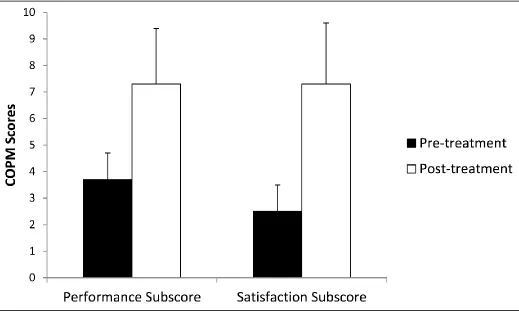
COPM scores improved following completion of the BeST program (see Figure 1). Performance scores—controlling for age,
gender, number of treatment sessions, and number of treating occupational therapists—increased by 3.4 points (95% CI = 2.7 to 4.2 points, p < 0.001) from a pretest score of 3.8 ± 1.5 to 7.2 ±
2.1. Similarly, satisfaction scores—controlling for age, gender, number of treatment sessions, and number of treating occupational therapists—
increased by 4.7 points (95% CI = 3.8 to 5.6 points, p < 0.001) from a pretest score of 2.5 ± 1.1 to 7.2 ± 2.3. None of the covariates interacted significantly with the pre to postintervention changes.
Figure 1. Mean pre and post BeST Canadian Occupational Performance Measure (COPM) scores in the performance and satisfaction categories. Error bars represent one standard deviation.
4 The Open Journal of Occupational Therapy, Vol. 5, Iss. 2 [2017], Art. 5
Discussion
The results of this study support the hypothesis that patients engaging in the BeST program have significant improvements in perceived occupational performance and satisfaction; however, without a control group, significant improvement cannot be solely attributed to the program. The magnitude of change in the COPM scores is reflective of the efficacy in using an integrative treatment team approach with the inclusion of occupational therapy. The success of the BeST program is dependent on the following factors: (a) continuity of feedback across all disciplines involved, (b) medical confirmation of a FMD, (c) patient readiness to change, (d) positive familial or peer support system, (e) positive rapport with therapist, and (f) affirmation that FMD is treatable. All of these factors combined are essential for the program format, patient
engagement, and continued improvement of the patient’s physical and psychological well-being.
The format of the program was particularly valuable for the patient to view his or her disease from a new perspective. In a study by Hallett (2009), a disruption in motivation pathways and diminished conscious awareness of movement was noted. These results are indicative of a disconnect between the intent to move and the ability to do so appropriately. A common theme in the literature regarding the preparation of the patient was to describe FMD as a dysfunction between the mind and body (Czarnecki et al., 2012; Hinson,
Weinstein, Bernard, Leurgans, & Goetz, 2006;
Speed, 1996). This same description is repeatedly expressed by all providers to the patient throughout the program to encourage a sense of control over his or her symptoms. For continued success upon discharge from the program, the patient’s family should be encouraged to promote therapeutic techniques outside the sessions to help the patient break from his or her external reward system (Delargy, Peatfield, & Burt, 1986).
There was consideration of whether patient demographics, number of sessions, or number of therapist might hinder patient progress. The results of the covariant analysis, however, showed no significant impact of those variables on the final COPM results. This did not include co-morbidities, patient psychological history, or symptom length, which may impact the patient’s progress.
According to Czarnecki et al. (2012), length of disease diagnosis is a predictor in poor long-term outcomes upon completion of the entire BeST program.
Some limitations of the study may constrain its generalizability. The study used a retrospective observational single-group pretest-posttest design. A limitation of the design is that a cause and effect relationship cannot be established. The patients improved and all participated in the BeST program, but without a control group, the improvement in COPM scores should not be attributed directly to participation in the BeST program. A related limitation of this study is the placebo effect may have occurred with the participants. Engaging in a program at a well-reputed facility may skew the
5 Dahlhauser et al.: Satisfaction and Occupational Performance
patient’s perceptions of his or her improvement due to one’s expectations of the institution. The best way to test for this bias would be to train another institution, with no affiliation with the primary facility, to administer the BeST program and use the same outcome tool. Another future investigation could compare short-term and long-term outcomes of the patient using the COPM to assess the
longevity of his or her progress. Without a control group in which occupational therapy was withheld, we cannot conclude that participating in
occupational therapy caused the improvements in COPM outcomes. While the findings imply that participating in occupational therapy as part of the multidisciplinary BeST program may improve occupational performance and satisfaction, prospective randomized controlled trials are recommended to examine the effectiveness of occupational therapy in this patient population.
There is scant research regarding treatment of FMD, but with continued research, health care providers can work together to help a population that is largely misunderstood. This study is another step toward broadening the general understanding of viable treatment solutions for treating FMD. What is certain is that occupational therapy can play a role in the health and continued wellness of this population outside of a mental health setting.
References
Barsky, A. J, Orav, E. J., & Bates, D. W. (2005). Somatization increases medical utilization and costs independent of psychiatric and medical comorbidity. Archives of General Psychiatry, 62(8),903-910.
https://doi.org/10.1001/archpsyc.62.8.903
Bhatia, K. P., & Schneider, S. A. (2007). Psychogenic tremor and related disorders. Journal of Neurology, 254, 569-574. https://doi.org/10.1007/s00415-006-0348-z
Czarnecki, K., Thompson, J. M., Seime, R., Geda, Y. E., Duffy, J. R., & Ahlskog, J. E. (2012). Functional movement disorders: Successful treatment with a physical therapy rehabilitation protocol.
Parkinsonism and Related Disorders, 18(3), 247-251.
https://doi.org/10.1016/j.parkreldis.2011.10.011
Delargy, M. A., Peatfield, R. C., & Burt, A. A. (1986). Successful rehabilitation in conversion paralysis.
British Medical Journal, 292(6537), 1730-1731. https://doi.org/10.1136/bmj.292.6537.1730
Dimsdale, J. E. (2013). Overview of somatization. Retried from
http://www.merckmanuals.com/professional/psychiat ric-disorders/somatic-symptom-and
related-disorders/overview-of-somatization.
Ellenstein, A., Kranick, S. M., & Hallett, M. (2011). An update on psychogenic movement disorder. Current Neurology and Neuroscience Reports, 11, 396-403.
https://doi.org/10.1007/s11910-011-0205-z
Hallett, M. (2008). Physiology of psychogenic movement disorders. Journal of Clinical Neuroscience,
119I(S1),S14. https://doi.org/10.1016/s1388-2457(08)60058-9
Hinson, V. K., Weinstein, S., Bernard, B., Leurgans, S. E., & Goetz, C. G. (2006). Single blind clinical trial of psychotherapy for treatment of psychogenic movement disorders. Parkinsonism and Related Disorders, 12(3), 177-180.
https://doi.org/10.1016/j.parkreldis.2005.10.006
Jankovich, J., Vuong, K. D., & Thomas, M. (2006). Psychogenic tremor: Long-term outcome. CNS Spectrums: The International Journal of Neuropsychiatric Medicine, 11(7),501-508.
https://doi.org/10.1017/s1092852900013535
Kranick, S., Ekanayake, V., Martinez, V., Ameli, R., Hallett, M., & Voon, V. (2011). Psychopathology and psychogenic movement disorders. Movement Disorders, 26(10), 1844-1850.
https://doi.org/10.1002/mds.23830
Kroenke, K. (2007). Efficacy of treatment for somatoform disorders: A Review of randomized controlled trials.
Psychosomatic Medicine, 69(9), 881-888.
https://doi.org/10.1097/psy.0b013e31815b00c4
Law, M., Baptiste, S., Carswell, A., McColl, M. A., Polatajko, H., & Pollock, N. (2005). Canadian Occupational Performance Measure (4th ed.). Ottawa: CAOT Publications ACE.
6 The Open Journal of Occupational Therapy, Vol. 5, Iss. 2 [2017], Art. 5
Ness, D. (2007). Physical therapy management for conversion disorder: Case series. Journal of Neurologic Physical Therapy, 31, 30-39. Retrieved from
https://www.physiopedia.com/images/b/b1/Physical_ therapy_management_for_conversion_disorder_case _series.pdf
Reich, S. G. (2006). Psychogenic movement disorders.
Seminars in Neurology, 26(3), 289-296.
https://doi.org/10.1055/s-2006-947276
Speed, J. (1996). Behavioral management of conversion disorder: Retrospective study. Archives of Physical
Medicine and Rehabilitation, 77(2),147-154.
https://doi.org/10.1016/s0003-9993(96)90159-8
Trieschmann, R. B., Stolov, W. C., & Montgomery, E. D. (1970). An approach to the treatment of abnormal ambulation resulting from conversion reaction.
Archives of Physical Medicine and Rehabilitation,
51(4), 198-206.
7 Dahlhauser et al.: Satisfaction and Occupational Performance