The Open Journal of Occupational Therapy
Volume 2
Issue 4Fall 2014 Article 3
10-1-2014
Home-based Constraint Induced Movement
Therapy Poststroke
Stephen Isbel
University of Canberra, [email protected]
Christine Chapparo
University of Sydney, [email protected]
David McConnell
University of Alberta, [email protected]
Judy Ranka
University of Sydney, [email protected]
Follow this and additional works at:https://scholarworks.wmich.edu/ojot Part of theOccupational Therapy Commons
This document has been accepted for inclusion in The Open Journal of Occupational Therapy by the editors. Free, open access is provided by ScholarWorks at WMU. For more information, please [email protected].
Recommended Citation
Home-based Constraint Induced Movement Therapy Poststroke
Abstract
Background:This study examined the efficacy of a home-based Constraint Induced Movement Therapy (CI Therapy) protocol with eight poststroke survivors.
Method:Eight ABA, single case experiments were conducted in the homes of poststroke survivors. The intervention comprised restraint of the intact upper limb in a mitt for 21 days combined with a home-based and self-directed daily activity regime. Motor changes were measured using The Wolf Motor Function Test (WMFT) and the Motor Activity Log (MAL).
Results:Grouped results showed statistically and clinically significant differences on the WMFT (WMFT [timed items]): Mean 7.28 seconds, SEM 1.41, 95% CI 4.40 – 10.18, p = 0.000; WMFT (Functional Ability): z = -4.63, p = 0.000). Seven out of the eight participants exceeded the minimal detectable change on both subscales of the MAL.
Conclusion:This study offers positive preliminary data regarding the feasibility of a home-based CI Therapy protocol. This requires further study through an appropriately powered control trial.
Keywords
Stroke, Rehabilitation, Upper limb
Cover Page Footnote
Grant and Financial Support: Financial and technical assistance was granted through the George Burniston-Cumberland Foundation and the ACT Primary Health Care Research Education and Development scholarship.
Credentials Display
Stephen Isbel, HScD; Christine Chappara, PhD; David McConnel, PhD; Judy Ranka, PhD
Copyright transfer agreements are not obtained by The Open Journal of Occupational Therapy (OJOT). Reprint permission for this Applied Research should be obtained from the corresponding author(s). Click
hereto view our open access statement regarding user rights and distribution of this Applied Research. DOI: 10.15453/2168-6408.1120
Constraint-Induced Therapy (CI Therapy)
is a treatment method that has shown promising
results for people who have reduced upper limb
function as a result of stroke (Wolf et al., 2006).
While there is some debate about the mechanism
and magnitude of change following CI Therapy
(van der Lee, 2003), the consensus is that CI
Therapy is one treatment method that can improve
upper limb function in people with chronic stroke
who also have some motor return. This opinion is
reflected in the Australian National Stroke
Foundation Clinical Guidelines for Stroke
Management (2010).
Stevenson, Thalman, Christie, and Poluha
(2012) conducted a systematic review of the CI
Therapy literature that involved dose-matched
control interventions. They reported results for 22
trials in relation to four categories of outcome
measures: upper limb motor capacity, upper limb
ability, comprehensive function, and self-report
measures. Meta-analysis of the trials that
included these outcome measures showed
significant effects favoring CI Therapy: Trials that
reported upper limb motor capacity assessments
favored CI Therapy (SMD = 0.47, 95% CI,
0.27-0.66), trials that reported measures of upper limb
ability favored CI Therapy (SMD = 0.80, 95% CI,
0.57-1.02), and trials that reported measures of
comprehensive function favored CI Therapy
(SMD = 5.05, 95% CI, 2.23-7.87). The trials
included in this systematic review used CI
Therapy in a range between 15-60 hr in total and
over a range of 3-10 weeks.
Peurala et al. (2011) also conducted a
systematic review of the literature addressing CI
Therapy. The 27 randomized controlled trials
included in this review were categorized by the
hours per week that the subjects received CI
Therapy. The results of this review reported
improved mobility of the affected upper limb
when CI Therapy was conducted for 60-72 hr over
two weeks; 20-56 hr over two weeks; 30 hr over
three weeks; and 15-30 hr over 10 weeks.
The reported limitations of CI Therapy
include the intensity required of the patients and
the resources required to administer the treatment
(Daniel, Howard, Braun, & Page, 2012; Page,
Levine, Sisto, Bond, & Johnson, 2002). These
results have prompted clinicians to argue for
refinements of the CI Therapy protocols to
address issues of patient engagement and resource
allocation when administering CI Therapy.
The 22 randomized controlled trials in the
Stevenson et al. (2012) systematic review
included hospital- and clinic-based CI Therapy
protocols. However, there have been published
papers investigating the effect of a home-based CI
Therapy model in both stroke and cerebral palsy
therapy (Al-Oraibi and Eliasson, 2011; Azab et
al., 2009; Tariah, Almalty, Sbeith, & Al-Oraibi,
2010). Tariah et al. (2010) conducted a
randomized controlled trial in Jordan (n = 18)
using a home-based CI Therapy protocol
consisting of treatment for 2 hr per day, 7 days per
week, for 2 months. There were significant
differences at 4 months between the CI Therapy
group and a group receiving Neurodevelopmental
Treatment (NDT) in the Wolf Motor Function
Test in Functional Ability (WMFT) (t(9) = 6.52, p
< 0.001) and timed items (t(9) = 5.82, p < 0.001).
In response to these promising results,
type of model for use in other cultures with
different social and economic demands. This
paper reports on the feasibility of a home-based
CI Therapy protocol in Australia. Australia has
specific challenges in delivering health care to
33.7% of Australians who live in regional and
remote areas (Australian Bureau of Statistics,
2004), along with an increase in the aged-care
population (who are more likely to have a stroke)
and a decrease in the health workforce
(Productivity Commission, 2005). There is a clear
need to develop health interventions that are both
effective and efficient. A home-based CI Therapy
model is one that eliminates the requirement for
hospital-based supervision, and therefore becomes
a potentially useful treatment in a country like
Australia.
The study was guided by the following research
question:
What is the effect of a home-based and
self-directed CI Therapy protocol on upper
limb activity following stroke?
Method Participants
Approval to conduct the study was granted
by the Human Ethics and Research Committees of
ACT Health and the University of Sydney.
Fifteen people volunteered for the study, and eight
people met the inclusion criteria. The criteria for
participating in the study included a clinical
diagnosis of cerebrovascular accident (CVA), a
minimum poststroke period of 6 months, and the
ability to demonstrate the following physical
signs: 20 degrees of active wrist extension and 10
degrees of active extension of all
metacarpophalangeal (MCP) joints on the
hemiplegic side; good balance as evidenced by the
ability to maintain balance during moderate
physical distractions in standing while the intact
hand was in the constraint mitt; and the ability to
walk independently up and down two stairs. All
of the participants had been discharged from
formal rehabilitation programs.
Design and Intervention
This study tested the effect of the
home-based and self-directed CI Therapy protocol on
upper limb function. An ABA single subject
research design (SSRD) was used where baseline
measures were taken (A), the intervention was
applied (B), and outcome measures were taken
following the treatment (A).
The intervention was 21 days of constraint
of the less affected upper limb for as many waking
hours as possible, along with periods of intense
upper limb activity. The participants were asked
to undertake the CI Therapy-specific tasks as well
as usual activities of daily living while wearing
the constraint mitt. The key factors in the design
of the mitt were that it was lightweight, washable,
and restrictive to sensory input and hand use on
the palmar surface. This type of restraint is
similar to the restraints described in the literature
(Wolf et al., 2006).
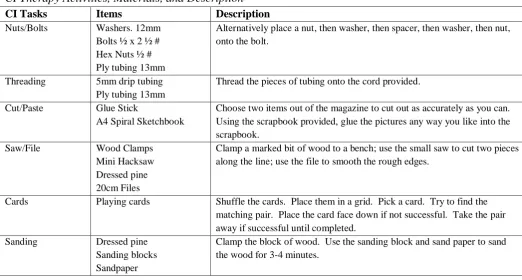
The participants were asked to practice 15
upper limb activities (see Table 1) for 2-3 hr a day
and also asked to conduct the practice in at least 1
hr blocks. The massed practice component refers
to the engagement in these 15 activities in blocks
of time. The intensity of the treatment is a
reported limitation of the applicability of CI
Therapy (Page et al., 2002). Given that this CI
home-based, it was thought that a less intense but longer
duration treatment protocol would increase the
chance of compliance with the treatment. With
this in mind, the participants were asked to
undertake 2-3 hr of massed practice per day for 21
days. This lower intensity protocol has been
successful in improving upper limb function and
self-reported upper limb use (Lin et al., 2009; Lin
et al., 2007; Wu, Lin, Chen, Chen, & Hong,
2007).
The massed practice exercise component
of the CI Therapy protocol was important, as it
had to be intense enough to produce a treatment
effect, but not so intense as to reduce compliance.
The massed practice was to be completed at home
in a self-directed way, so the participant had to
find the practice interesting and relevant. In order
to achieve this, the researchers convened a panel
consisting of six occupational therapists with an
average of 13 years of experience working in
adult neurological rehabilitation. This panel was
asked to name five upper limb activities that they
believed to be the best for improving upper limb
function while also being interesting and relevant.
Many of the responses were similar and were
grouped together to form 14 activities. These 14
activities were designed and presented to the same
panel along with a group consisting of three
people who had upper limb dysfunction following
stroke. Both groups were asked to comment on
the practicality and ease of use of the activities in
a home setting. Following these consultations,
one extra activity was added. These 15 activities
were then task analyzed to biomechanically
validate that they practiced all of the critical
components of reach and grasp. These 15
activities became the massed practice exercise
component of the CI Therapy protocol. See Table
1.
Table 1
CI Therapy Activities, Materials, and Description
CI Tasks Items Description
Nuts/Bolts Washers. 12mm Bolts ½ x 2 ½ # Hex Nuts ½ # Ply tubing 13mm
Alternatively place a nut, then washer, then spacer, then washer, then nut, onto the bolt.
Threading 5mm drip tubing Ply tubing 13mm
Thread the pieces of tubing onto the cord provided.
Cut/Paste Glue Stick
A4 Spiral Sketchbook
Choose two items out of the magazine to cut out as accurately as you can. Using the scrapbook provided, glue the pictures any way you like into the scrapbook.
Saw/File Wood Clamps Mini Hacksaw Dressed pine 20cm Files
Clamp a marked bit of wood to a bench; use the small saw to cut two pieces along the line; use the file to smooth the rough edges.
Cards Playing cards Shuffle the cards. Place them in a grid. Pick a card. Try to find the matching pair. Place the card face down if not successful. Take the pair away if successful until completed.
Sanding Dressed pine Sanding blocks Sandpaper
Clips Paper Laminate Containers Clips
Put the colored bits of paper in the box provided. Shake the box so the paper is mixed up. Gather all of the same colors and put them in numerical order. Put a bulldog clip on each pile once in order.
Coloring Markers Templates
Pick a stencil and color 2-3 items into the exercise book using the markers provided.
Folding Material Unpeg the pieces of material and fold into the smallest possible squares. Pegging Pegs Unfold the square bits of material and peg them onto the rope provided. Tracing Cardboard
Markers
There are two laminated bits of cardboard. With the marker provided, trace over the line and then complete the writing tasks.
Dowel Game Dowel pieces Using the small dowel pieces placed in the wood block, jump adjacent dowel pieces until only one remains.
Rice Rice
Lunchbox Containers
Using the cup provided, pour the rice into the containers up to the mark shown. When you have finished, pour the rice back into the main container.
Notice board
Corkboard Velcro hook Signs
Pick one of the 10 notice board plans. Change the notices as the plan requests.
Ball Ball Bounce the ball against the wall so it comes back to you. Let the ball bounce once and then catch it. Do this 30 times.
The CI Therapy Manual and Kit
The CI Therapy manual contained three
sections: detailed instructions, brief instructions,
and documentation. The detailed instructions
contained photographs and written, step-by-step
instructions for each activity. The brief
instruction sheet was a two paged, laminated, and
condensed form of the detailed instructions.
Documentation consisted of a daily log to record
the amount of time spent wearing the constraint
mitt each day as well as the amount of time spent
doing the activities. Each of the participants was
given all of the materials required to complete the
CI Therapy protocol. This was the CI Therapy
manual (including all instructions and recording
sheets) and two CI Therapy mitts. Together, this
was the CI Therapy kit, which was contained in a
ten-litre storage container.
The multiple baseline design used to
structure this study was similar to that described
in the literature (Ottenbacher, 1986; Zhan &
Ottenbacher, 2001). The participants were
randomly selected to begin their baseline
measurements. All of the participants were tested
four times for all outcome measures for baseline
measurements. The time between baseline
measurements was one day. Once the participant
was determined to have achieved a stable baseline
(i.e., less than one second deviation on the timed
WMFT scores on three consecutive
measurements), the intervention commenced. The
stable baseline measure was determined through
the pilot testing of two normal participants.
All of the participants were given standard
instructions and were visited during the 21-day
intervention period as follows. On day one of the
intervention, a visit was made to the participant’s
home to set up the CI Therapy kit, comprising a
manual, two mitts, and 15 activities. During the
visit, all of the activities were demonstrated, and
then the participant attempted the activities while
and any significant others had the opportunity to
ask questions and to clarify any aspect of the
protocol. On day three of the intervention phase,
all of the participants were contacted by telephone
and given the opportunity to address any concerns
or questions, as well as to receive encouragement
to complete the treatment as outlined.
All of the participants were asked to spend
2-3 hr doing the 15 activities in 1-hr blocks.
These activities were set up around the
participants’ homes to be used in a circuit style
arrangement. The participants were requested to
attempt all of the activities but not in a particular
order. While the activities were not specifically
graded, they were designed to practice all aspects
of reach and grasp.
The participants were asked to identify the
activities they completed and the amount of time
that it took to complete them on a recording form.
The participants also were asked to wear the mitt
for as many waking hours as possible. They were
asked to record how long they wore the restraint
mitt each day. After the 21-day intervention
phase, all of the participants were assessed a
further four times using the same procedures as
outlined for the baseline phase.
Outcome Measures
The two primary outcome measures used
were the WMFT and the Motor Activity Log
(MAL) (CIT Research Group, 2002). The WMFT
is a 17 item test of motor ability that tests speed of
movement during 15 functional tasks and tests
strength for two items. It also contains a
Functional Ability Scale (FA scale) that uses a
5-point observer rated scale to determine the quality
of movement throughout the 15 timed items.
The MAL is a structured interview used to
determine how much (amount of movement) and
how well (quality of movement) the participants
used their hemiplegic upper limb before and after
the CI Therapy treatment. The participants were
asked a series of up to 30 functionally based
questions and asked to self-rate using separate
5-point scales on how much they performed the
activity and how well theyused their hemiplegic
upper limb. The WMFT test and the MAL are
commonly used outcome measures when
determining the effects of CI Therapy on upper
limb motor ability and self-reported improvements
in upper limb movement (Stevenson et al., 2012).
The MAL and WMFT have established validity
and reliability in sub-acute stoke populations
(Morris, Uswatte, Crago, Cook, & Taub, 2001;
Uswatte, Taub, Morris, Light, & Thompson,
2006).
Data Analysis
Results for the timed items and functional
ability (FA) on the WMFT were analyzed at an
individual and group level. Grouped data was
analyzed using the Statistical Package for Social
Sciences (SPSS) version 19.0. Paired sample
t-tests were used to compare the mean times at all
data points at baseline and posttreatment.
Wilcoxen signed ranked tests were used to
compare the means of the FA scores at all data
points at baseline and posttreatment. The MAL
was analyzed by comparing the quantum of
change at an individual level.
Data from the WMFT has been grouped and
analyzed in relation to minimal detectable
differences and clinical importance. In relation to
clinically important changes for a stroke group for
the WMFT is 1.5-2 s for timed items and 0.2-0.4
points on the FA scale. For a stroke population,
the minimal detectable change in the MAL is
reported as 14.4% for quality of movement and
16.8% for amount of movement (Chen, Wolf,
Zhang, Thompson, & Winstein, 2012).
The WMFT contains timed items that can
be broadly clustered into fine motor activities and
gross motor activities. For the purposes of this
study, a gross motor activity was defined as an
activity that is primarily completed using the
shoulder, arm, or forearm. A fine motor activity
was defined as an activity that required hand,
wrist, and finger function as primary capacities to
complete the task. In this way, the gross motor
tasks were defined as: forearm to table, forearm
to box, extend elbow, extend elbow with weight,
hand to table, hand to box, reach and retrieve, lift
basket, and lift can. Fine motor tasks were
defined as: lift pencil, lift paper clip, stack
checkers, flip cards, turn key in lock, and fold
towel. Grouped gross motor and fine motor data
were analyzed in the same way as the entire
WMFT.
Results Participants
The average age of the participants was
55 years (SD 9.86). The average age of onset of
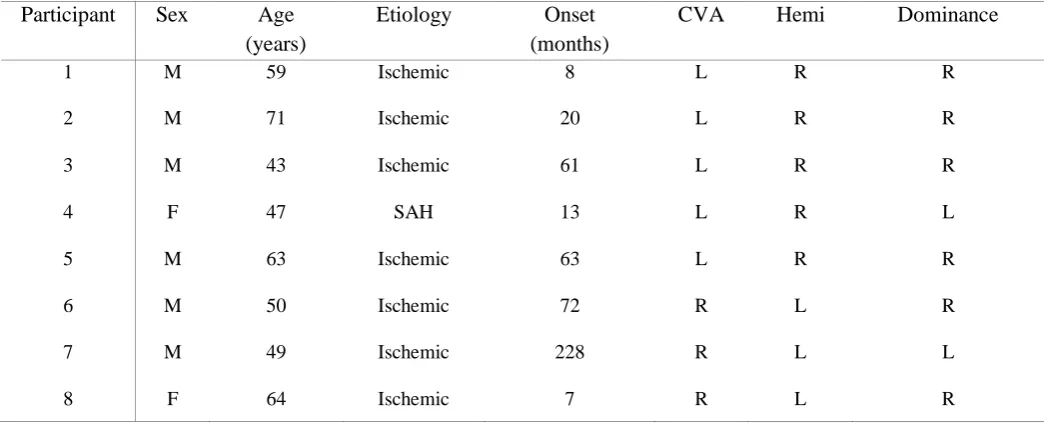
stroke was 59 months (SD 68.64). Table 2
describes the participants’ characteristics,
including the type of stroke (ischemic or
hemorrhagic), the onset (time since stroke), the
hemisphere of the stroke (CVA), the side of
hemiplegia (hemi), and the participant’s hand
dominance. Five out of the eight participants had
a caregiver present at their home during the
intervention. Three out of eight lived alone during
the intervention.
Table 2
Summary of Participant Characteristics Participant Sex Age
(years)
Etiology Onset (months)
CVA Hemi Dominance
1 M 59 Ischemic 8 L R R
2 M 71 Ischemic 20 L R R
3 M 43 Ischemic 61 L R R
4 F 47 SAH 13 L R L
5 M 63 Ischemic 63 L R R
6 M 50 Ischemic 72 R L R
7 M 49 Ischemic 228 R L L
8 F 64 Ischemic 7 R L R
The Wolf Motor Function Test
Grouped data showed clinically important
improvements that reached statistical significance
(alpha = 0.05) in the timed items of the WMFT
and FA (timed items: t = 5.15, p = 0.000; FA: z =
items of the WMFT were divided into gross motor
and fine motor activities. Clinically important
improvements that reached statistical significance
(alpha = 0.05) were seen in the timed fine motor
activities and the associated FA scores (the fine
motor items: t = 5.51, p = 0.000; FA: z = -4.33, p
= 0.000). While the gross motor improvement
exceeded the clinically important threshold for
timed items, it did not reach statistical
significance (p = 0.12). The gross motor FA
exceeded the minimal detectable change and was
statistically significant (the gross motor items: t =
2.68, p = 0.12: FA: z = -3.97, p = 0.000).
Table 3
Grouped Wolf Motor Function Test Results: Timed Items
Paired Samples Test
Mean Std. Deviation
Std. Error Mean
95% Confidence Interval of the Difference
t df
Sig (2 tailed) Lower Upper
Total
WMFT 7.29* 8 1.42 44 10.18 5.15 31 .000
Fine Motor 11.07* 11.37 2.01 6.97 15.17 5.51 31 .000
Gross
Motor 4.76* 10.07 1.13 1.13 8.39 2.68 31 .12
Note. *Exceeds clinically important change of 1.5 seconds.
Table 4
Grouped Wolf Motor Function Test Results: Functional Ability
Wilcoxon Signed Ranks Test
z value p - value Mean Change A1-A2
Total WMFT -4.63 .000 0.34*
Fine Motor -4.33 .000 0.45*
Gross Motor -3.97 .000 0.38*
Note. *Exceeds minimal clinically detectable change of > 0.2.
The Motor Activity Log
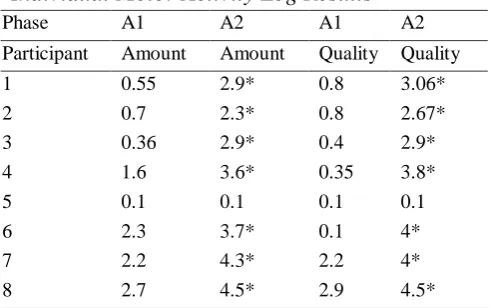
All of the participants except for
participant 5 improved on both subscales of the
MAL. All of the participants except for
participant 5 exceed the minimum detectable
change for both subscales of the MAL (see Table
5).
Table 5
Individual Motor Activity Log Results
Phase A1 A2 A1 A2
Participant Amount Amount Quality Quality
1 0.55 2.9* 0.8 3.06*
2 0.7 2.3* 0.8 2.67*
3 0.36 2.9* 0.4 2.9*
4 1.6 3.6* 0.35 3.8*
5 0.1 0.1 0.1 0.1
6 2.3 3.7* 0.1 4*
7 2.2 4.3* 2.2 4*
8 2.7 4.5* 2.9 4.5*
Compliance
Compliance with CI Therapy has been
reported as an issue (Page et al., 2002). A
home-based CI Therapy protocol potentially increases
the chances of non-compliance, as there is not
daily supervision and encouragement by a
therapist to complete the protocol. In this study,
the participants were asked to use their restraint
mitt for as many waking hours as possible and to
engage in the CI activities for 2-3 hr per day.
Six out of the eight participants achieved
the recommended 2-3 hr of engaging in the CI
Therapy activities. The participants who did not
achieve this level attended work or volunteer
activities during the day, and so they reported that
doing the activities was sometimes difficult after a
busy day. The average time spent wearing the
restraint mitt was 3.5 hr, and this was
considerably less than the “all waking hours” as
requested. The main reason for this was that some
participants were reluctant to wear the restraint
mitt out of the house. They reported that the mitt
looked strange to be wearing in public and so
most did not wear the mitt out of their homes.
Discussion
Currently, CI Therapy is mainly used in
hospitals or outpatient clinics (Atteya, 2004;
Boake et al., 2007; Dahl et al., 2008; Dromerick,
Edwards, & Hahn, 2000; Page, Levine, Leonard,
Szarflarski, & Kissela, 2008; Wolf et al., 2006).
There has been some research that examines
providing a home-based CI Therapy model
(Tariah et al., 2010). Widespread application of
this home-based model could improve access to
the treatment for those who are unable to travel to
hospitals or who do not have ready access to
outpatient services. This study applied a
home-based and self-directed CI Therapy protocol for 21
days for eight poststroke survivors with an
average poststroke time of 59 months. This study
was guided by the research question: What is the
effect of a home-based and self-directed CI
Therapy protocol on upper limb activity following
stroke?
When the WMFT data was grouped,
clinically and statistically significant changes
were seen in speed of movement and functional
ability. This is consistent with reported
improvements in arm function from CI Therapy
studies based in hospitals, outpatient clinics, and
in a home-based study (Dromerick et al., 2000;
Lin et al., 2007; Page et al., 2002; Page, Sisto,
Levine, & McGrath, 2004; Page et al., 2008;
Ploughman & Corbett, 2004; Tariah et al., 2010).
The gross motor WMFT timed items reached
clinical significance but did not reach statistical
significance. The reasons for this require further
investigation to determine the specific
contribution of fine motor and gross motor
capacity to overall motor improvement
post-stroke.
A traditional CI Therapy protocol involves
intense daily practice in a setting like a hospital or
clinic, where support staff is on hand to encourage
participants to complete the treatment. This CI
Therapy protocol was implemented at home and
used a lower intensity practice component while
showing improvement in speed and self-perceived
quality of movement. This is worthy of further
investigation, as compliance with a CI Therapy
program has been identified as a barrier by
less resource-intensive form of CI Therapy, as it
can be done at home without 1:1 therapist to client
interaction. It is also potentially more accessible,
as the participants do not need to leave their
homes to undertake the treatment, and this could
be of particular benefit to people living in regional
or remote areas.
Compliance with the intensity of the
treatment was mixed in this study. While most of
the participants attempted the CI activities for the
recommended hours per day (2-3 hr), not all of the
participants wore the restraint mitt for the
recommended time (all waking hours). One
reason for this was the perceived attention the
restraint mitt attracted when outside of the home.
All of the participants were instructed to take their
mitt off during self-care activities, so this could be
another reason for a low compliance to wearing
the mitt. As all of the participants were active
outside of their homes, the look of the restraint
mitt requires further attention when a larger trial is
conducted.
Limitations
This study has three main limitations.
First, the sample size is too small to generalize to
the stroke population. Second, the ABA design is
the weakest single subject research design. And
third, not all of the participants had the benefit of
the positive influence of a caregiver while
engaging in the treatment. Replication of the
study will contribute to the external validity of the
preliminary results obtained, as will further
controlled trials using larger numbers of
participants. A cluster randomized controlled trial
using a home-based CI Therapy protocol has been
planned by another research group (Barzel et al.,
2013). The methodology used in the proposed
controlled trial will address the main limitations
reported in this study.
Conclusion
The application of a home-based and
self-directed CI Therapy protocol resulted in clinically
and statistically significant improvement in upper
limb activity. Upper limb activity is critical for
many personal and instrumental activities of daily
living; therefore, these results may be of interest
to occupational therapists treating poststroke
survivors at home. This study has offered positive
preliminary data about the potential benefits of a
home-based and self-directed CI Therapy
protocol. If these results can be replicated, with
attention to the compliance issues noted, in a
larger controlled trial, stronger evidence may
References
Al-Oraibi, S., & Eliasson, A-C. (2011). Implementation of constraint-induced movement
therapy for young children with unilateral cerebral palsy in Jordan: A home-based
model. Disability and Rehabilitation, 33(21-22), 2006-2012.
http://dx.doi.org/10.3109/09638288.2011.555594
Atteya, A-A. (2004). Effects of modified constraint induced therapy on upper limb function
in subacute stroke patients. Neurosciences, 9(1), 24-29.
Australian Bureau of Statistics. (2004). Year Book Australia 2004. Retrieved 16 June, 2014
from http://www.abs.gov.au/
Australian National Stoke Foundation. (2010). Clinical Guidelines for Stroke Management.
Melbourne: Australia. Retrieved from
http://strokefoundation.com.au/site/media/Clinical_Guidelines_Acute_Management_
Recommendations_2010.pdf
Azab, M., Al-Jarrah, M., Nazzal, M., Maayah, M., Sammour, M., & Jamous, M. (2009).
Effectiveness of constraint-induced movement therapy (CIMT) as home-based
therapy on Barthel Index in patients with chronic stroke. Topics in Stroke
Rehabilitation, 16(3), 207-211. http://dx.doi.org/10.1310/tsr1603-207
Barzel, A., Ketels, G., Tetzlaff, B., Krüger, H., Haevernick, K., Daubmann, A., . . . Scherer,
M. (2013). Enhancing activities of daily living of chronic stroke patients in primary
health care by modified constraint-induced movement therapy (HOMECIMT): Study
protocol for a cluster randomized controlled trial. Trials, 14, 334.
http://dx.doi.org/10.1186/1745-6215-14-334
Boake, C., Noser, E., Ro, T., Baraniuk, S., Gaber, N., Johnson, R., . . . Levin, H. (2007).
Constraint-induced movement therapy during early stroke rehabilitation.
Neurorehabilitation and Neural Repair, 21(1), 14-24.
http://dx.doi.org/10.1177/1545968306291858
Chen, S., Wolf, S., Zhang, Q., Thompson, P., & Winstein, C. (2012). Minimal detectable
change of the actual amount of use test and the motor activity log: The EXCITE trial.
NeuroRehabilitation and Neural Repair, 26(5), 507-514.
http://dx.doi.org/10.1177/1545968311425048
CIT Research Group. (2002). The motor activity log. Birmingham, AL: University of
Daniel, L., Howard, W., Braun, D., & Page, S. (2012). Opinions of constraint-induced
movement therapy among therapists in southwestern Ohio. Topics in Stroke
Rehabilitation, 19(3), 268-275. http://dx.doi.org/10.1310/tsr1903-268
Dahl, A. E., Askim, T., Stock, R., Langørgen, E., Lydersen, S., & Indredavik, B. (2008).
Short- and long-term outcome of constraint-induced movement therapy after stroke:
A randomized controlled feasibility trial. Clinical Rehabilitation, 22(5), 436-447.
http://dx.doi.org/10.1177/0269215507084581
Dromerick, A. W., Edwards, D. F., & Hahn, M. (2000). Does the application of
constraint-induced movement therapy during acute rehabilitation reduce arm impairment after
ischemic stroke? Stroke, 31(12), 2984-2988.
http://dx.doi.org/10.1161/01.STR.31.12.2984
Lin, K-C., Hsieh, Y-W., Wu, C-Y., Chen, C-L., Jang, Y., & Liu, J-S. (2009). Minimal
detectable change and clinically important difference of the Wolf Motor Function
Test in stroke patients. NeuroRehabilitation and Neural Repair, 23(5), 429-434.
http://dx.doi.org/10.1177/1545968308331144
Lin, K-C., Wu, C-Y., Wei, T-H., Chang, G., Lee, C-Y, & Liu, J-S. (2007). Effects of
modified constraint-induced movement therapy on reach-to-grasp movements and
functional performance after chronic stroke: A randomized controlled study. Clinical
Rehabilitation, 21(12), 1075-1086. http://dx.doi.org/10.1177/0269215507079843
Morris, D., Uswatte, G., Crago, J., Cook, E., & Taub, E. (2001). The reliability of the Wolf
Motor Function Test for assessing upper extremity function after stroke. Archives of
Physical Medicine Rehabilitation, 82(6), 750-755.
http://dx.doi.org/10.1053/apmr.2001.23183
Ottenbacher, K. (1986). Evaluating clinical change: Strategies for occupational and physical
therapists. Baltimore, MD: Williams and Wilkins.
Page, S. J., Levine, P., Leonard, A., Szaflarski, J. P., & Kissela, B. M. (2008). Modified
constraint-induced therapy in chronic stroke: Results of a single-blinded randomized
controlled trial. Physical Therapy, 88(3), 333-340.
http://dx.doi.org/10.2522/ptj.20060029
Page, S. J., Levine, P., Sisto, S., Bond, Q., & Johnston, M. V. (2002). Stroke patients' and
therapists' opinions of constraint-induced movement therapy. Clinical Rehabilitation,
Page, S. J., Sisto, S., Levine, P., McGrath, R. E. (2004). Efficacy of modified
constraint-induced movement therapy in chronic stroke: A single-blinded randomized
controlled trial. Archives of Physical Medicine Rehabilitation, 85(1), 14-18.
http://dx.doi.org/10.1016/S0003-9993(03)00481-7
Peurala, S., Kantanen, M., Sjögren, T., Paltamaa, J., Karhula, M., & Heinonen, A. (2011).
Effectiveness of constraint-induced movement therapy on activity and participation
after stroke: A systematic review and meta-analysis of randomized controlled trials.
Clinical Rehabilitation, 26(3), 209-223.
http://dx.doi.org/10.1177/0269215511420306
Ploughman, M., & Corbett, D. (2004). Can forced-use therapy be clinically applied after
stroke? An exploratory randomized controlled trial. Archives of Physical Medicine
and Rehabilitation, 85(9), 1417-1423.
http://dx.doi.org/10.1016/j.apmr.2004.01.018
Productivity Commission. (2005). Australia's Health Workforce, Research Report, Canberra.
SPSS for Windows (2010). Chicago: SPSS Inc.
Stevenson, T., Thalman, L., Christie, H., & Poluha, W. (2012). Constraint-induced
movement therapy compared to dose-matched interventions for upper-limb
dysfunction in adult survivors of stroke: A systematic review with meta-analysis.
Physiotherapy Canada, 64(4), 397-413. http://dx.doi.org/10.3138/ptc.2011-24
Tariah, H. A., Almalty, A-M., Sbeih, Z., & Al-Oraibi, S. (2010). Constraint induced
movement therapy for stroke survivors in Jordan: A home-based model.
International Journal of Therapy and Rehabilitation, 17(12), 638-645.
http://dx.doi.org/10.12968/ijtr.2010.17.12.638
Uswatte, G., Taub, E., Morris, D., Light, K., & Thompson, P. (2006). The motor activity
log-28: Assessing daily use of the hemiparetic hand after stroke. Neurology, 67(7),
1189-1194.
http://dx.doi.org/10.1212/01.wnl.0000238164.90657.c2
van der Lee, J. H. (2003). Constraint-induced movement therapy: Some thoughts about
theories and evidence. Journal of Rehabilitation Medicine, 35(41), 41-45.
http://dx.doi.org/10.1080/16501960310010133
Journal of Therapy and Rehabilitation, 18(2), 116-117.
http://dx.doi.org/10.12968/ijtr.2011.18.2.116
Wolf, S. L., Winstein, C. J., Miller, J. P., Taub, E., Uswatte, G., Morris, D., Giuliani, C., . . .
Nichols-Larson, D. (2006). Effect of constraint-induced movement therapy on upper
extremity function 3 to 9 months after stroke. Journal of the American Medical
Association, 296(17), 2095-2104. http://dx.doi.org/10.1001/jama.296.17.2095
Wu, C-Y., Lin, K-C., Chen, H-C., Chen I-H., & Hong, W-H. (2007). Effects of modified
constraint-induced movement therapy on movement kinematics and daily function in
patients with stroke: A kinematic study of motor control mechanisms.
NeuroRehabilitation and Neural Repair, 21(5), 460-466.
http://dx.doi.org/10.1177/1545968307303411
Zhan, S., & Ottenbacher, K. J. (2001). Single subject research designs for disability research.
Disability and Rehabilitation, 23(1), 1-8.