The Open Journal of Occupational Therapy
The Open Journal of Occupational Therapy
Volume 5
Issue 4 Fall 2017 Article 14
October 2017
Movement Without Boundaries
Movement Without Boundaries
Jennifer Fortuna
Western Michigan University - USA, [email protected]
Follow this and additional works at: https://scholarworks.wmich.edu/ojot
Part of the Occupational Therapy Commons
Recommended Citation Recommended Citation
Fortuna, J. (2017). Movement Without Boundaries. The Open Journal of Occupational Therapy, 5(4).
https://doi.org/10.15453/2168-6408.1462
This document has been accepted for inclusion in The Open Journal of Occupational Therapy by the editors. Free, open access is provided by ScholarWorks at WMU. For more information, please contact
Movement Without Boundaries Movement Without Boundaries
Abstract Abstract
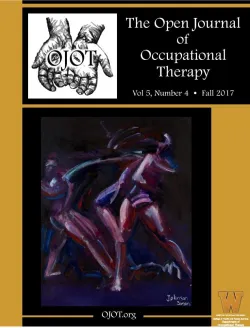
Johnson Simon, an artist based in West Palm Beach, FL, provided the cover art for the Fall 2017 edition of The Open Journal of Occupational Therapy (OJOT). “Dancing in Motion” is a 36” x 60” painting made from acrylic on canvas. Johnson always wanted to become a dancer. He was born with cerebral palsy, and therefore physical limitations make it difficult for Johnson to coordinate his body movements. Through use of vibrant colors and bold strokes, Johnson’s expressionist paintings evoke movement and motion. Occupational therapy helped Johnson discover his artistic abilities. Painting empowered him to move without limitations.
Keywords Keywords
Occupational therapist, occupational therapy, Johnson Simon, art, painting, Model of Human Occupation, cerebral palsy
Credentials Display Jennifer Fortuna, MS, OTR/L Jennifer Fortuna, MS, OTR/L
Copyright transfer agreements are not obtained by The Open Journal of Occupational Therapy (OJOT). Reprint permission for this Occupation and the Artist should be obtained from the corresponding author(s). Click here to view our open access statement regarding user rights and distribution of this Occupation and the Artist.
DOI: 10.15453/2168-6408.1462
Motivation is a powerful agent for change.
For an individual with a physical disability,
motivation to participate in a new occupation may
be low when the match between the person,
occupation, and environment is not optimal. In
contrast, successful participation in a meaningful
occupation provides motivation for repeated efforts.
Over time, body movements become more
automatic. Practice leads to skill refinement. Skill
mastery brings an enhanced sense of self.
Successful participation in meaningful occupations
helps to create our occupational identity (Cole &
Tufano, 2008). Motivation and occupational
identity are key concepts in the field of occupational
therapy. Several theories of motivation exist, but
perhaps none as well-known as the Model of
Human Occupation (MOHO) (Kielhofner, 1995).
The MOHO is a holistic and client-centered model.
Internal subsystems include volition (motivation),
habituation (behaviors), and performance
(mind-brain-body) capacity. Function involves competent
performance in meaningful occupations.
The Model of Human Occupation (MOHO)
emphasizes that through therapy, persons are
helped to engage in occupational behaviors
that maintain, restore, reorganize, or develop
their capacities, motives, and lifestyle.
Through participation in therapeutic
occupations, persons transform themselves
into more adaptive and healthy beings.
(Kielhofner & Barrett, 1997, 204-205)
Identity develops through self-appraisal, accepting
personal responsibility, and knowing what one
wants in life (Cole & Tufano, 2008).
Johnson Simon provided the cover art for
the Fall 2017 issue of TheOpen Journal of
Occupational Therapy (OJOT) (see Figure 1). The piece, titled “Dancing in Motion,” is a 36” x 60”
painting made from acrylic on canvas. Johnson
always wanted to be a dancer. Born with cerebral
palsy, physical limitations have made it difficult for
Johnson to coordinate his body movements. In a
recent interview, Johnson shared how occupational
therapy helped him discover his artistic abilities,
and how painting empowered him to move without
limitations.
Figure 1. Cover of Fall 2017 issue of OJOT
Johnson Simon was born in 1990 on Grand
Turk Island in the Turks and Caicos archipelago.
Originally from Haiti, Johnson’s parents moved to
the Turks and Caicos to pursue job opportunities.
1 Fortuna: Movement without boundaries
Johnson’s mother, Esperanta Pierre, was pregnant
during this time. Doctors anticipated a troubled
birth, so Esperanta chartered a plane to Grand Turk
Island to deliver Johnson at the main hospital.
Johnson was born with the umbilical cord wrapped
around his neck. His brain was deprived of oxygen
for several minutes. As a result, Johnson was
diagnosed with spastic quadriplegic cerebral palsy.
Cerebral palsy (CP) is caused by damage to
the developing brain before, during, or shortly after
birth. Oxygen deprivation, or intrapartum asphyxia,
during labor is a known cause of CP (Centers for
Disease Control and Prevention, 2017). According
to Reddihough (2011), CP is the most common
cause of physical disability in childhood. Although
many cases of CP are genetic, other risk factors
include abnormal brain development, premature
birth, and bleeding in the brain. Individuals with
CP exhibit a variety of symptoms that affect
movement, balance, and posture. Functional
implications include lack of muscle coordination
during voluntary movements, stiff muscles,
exaggerated reflexes, weakness in one or more
extremity, difficulty with precise motor movements,
and difficulty speaking (Cerebral Palsy Foundation,
2017). Therapeutic intervention services are
typically provided by a multidisciplinary team of
medical professionals, including occupational
therapy, physical therapy, and speech therapy. The
role of occupational therapy in early intervention
includes addressing function and independence in
occupations related to self-care, school, and play
(Case-Smith & O’Brien, 2010). Early intervention
can lead to improved function, independence, and
quality of life.
In 1991, Esperanta delivered her second son,
Johnnie. Johnson’s parents left Turks and Caicos in
search of a better life for their family in the United
States. Johnson and Johnnie were sent to Haiti to
live with their grandparents. They remained in their
care for five years. Johnnie was enrolled in school;
however, Johnson was denied access due to his
disability. “The staff was not equipped to support a
child with cerebral palsy,” he said. In 1996, the
family was reunited in West Palm Beach, Florida.
Johnson was six years old. “My grandparents
raised me. When we moved to Florida, it was like
meeting my parents for the first time,” he said.
One advantage to relocating to the United
States was that Johnson was now eligible to attend
school and receive therapeutic intervention services.
School-based intervention services are available to
children with disabilities through the Individuals
with Disabilities Education Act (IDEA) (U.S.
Department of Education, 2017). Originally passed
in 1975, IDEA guarantees children with a disability
access to a free appropriate public education in the
least restrictive environment. Johnson looked
forward to attending school and interacting socially
with his peers. Unfortunately, the school could not
provide an inclusive environment where Johnson
could learn alongside his non-disabled peers. This
created a new set of challenges for Johnson. “The
school thought since I had a disability I belonged in
special education,” he said. “They did not want to
take the time to accommodate me.” Under the
MOHO, environmental conditions influence one’s
source of motivation, behavior, and performance
(Cole & Tufano, 2008). “I wasn’t getting an
appropriate education. It was too easy for me. This
2 https://scholarworks.wmich.edu/ojot/vol5/iss4/14
put me behind my peers academically,” he said.
Johnson also believes some of his teachers gave him
special privileges that were not afforded to his
peers. “I just wanted to be treated normally,” he
said. Johnson knew he did not belong in special
education. He was determined to work his way out
of the system.
Johnson began receiving occupational
therapy services in the first grade. “My OT (Linda)
was like a second mom to me. I could go to her if I
needed anything,” he said. Johnson often went out
of his way to see Linda during the day. Linda used
activities that were meaningful to Johnson, such as
sports, to help him develop new skills. She tapped
into his love for sports, and often took him to the
playground to play basketball and kickball.
Johnson credits Linda for helping him discover his
artistic abilities. “I always knew I wanted to become an artist,” Johnson said. “Linda encouraged me to
start drawing and develop my skills.” Through the
therapeutic use of occupations, Linda facilitated
occupational competence and adaptive performance
in Johnson. Occupational therapy practitioners
appreciate the internal subsystems of their clients,
and how the environment provides opportunities
and/or barriers for occupational performance (Cole
& Tufano, 2008). One afternoon, Johnson returned
to class with a drawing he completed during a
session with Linda. His peers were very impressed.
“A classmate asked me, ‘How did you do that?’ It felt good,” Johnson said. The positive feedback he
received provided motivation to further develop his
skills. “Linda introduced me to a whole new world.
This changed my life,” said Johnson.
When Johnson’s father left the family home,
Esperanta began working seven days a week as a
home care nurse. She often brought the boys along
to avoid leaving them home alone after school. In
2001, Esperanta introduced Johnson and Johnnie to
Michael Tischler, one of her patients. Michael
experienced limited mobility due to juvenile
rheumatoid arthritis. He looked forward to Johnson
and Johnnie’s visits, and he quickly developed a
bond with the boys. Johnson regarded Michael as
his mentor. “Michael always wanted children of his
own. He took me and my brother under his wing
and made sure we stayed in school,” he said.
Michael also took an interest in Johnson’s artistic
abilities. During elementary school, Johnson
focused solely on developing his drawing skills. It
was not until middle school that Johnson discovered
his love for painting. “Painting opened up a whole
new world for me,” he said. Johnson was excited to
share his new talent with his mentor. “Michael
knew I could draw, but he had no idea I could
paint!” said Johnson. Michael encouraged Johnson
to enter one of his paintings in the middle school art
competition. Johnson felt honored when he learned
his painting earned second place. The
encouragement, support, and positive feedback
Johnson received provided incentive to rise above
challenges and chart a path for the future.
Throughout his life, Johnson has overcome several
difficult challenges. For example, in elementary
school, administrators told Esperanta that Johnson
had a low IQ and would never graduate high school
or go to college. Johnson attended several different
public schools over the years, yet with each move
one thing always remained the same. He was the
3 Fortuna: Movement without boundaries
target of relentless teasing from his peers. “Being
different makes you stick out,” he said. “Growing
up was rough. It got to the point where I did not
want to go to school anymore.” Johnson believes
nothing in life is easy. “It’s about how bad you
want to be successful.”
In 2009, Johnson transferred to Alexander
W. Dreyfoos Junior School of the Arts to complete
his senior year of high school. “I received a much
better education and I could focus on my art,” he
said. Unfortunately, this was the same time
Johnson’s mentor, Michael Tischler, passed away. “I knew he wanted me to graduate from high school
and go to college. I knew he would be proud of me.
That’s what kept me going,” Johnson said. Since
Michael’s passing, Johnson has remained in close
contact with Molly and Stephen Tischler, Michael’s
parents. “Still to this day, Michael’s mom and dad
are like my grandparents. They are part of our
family.”
Through many difficult challenges, Johnson
has always found the strength to carry on. One
source of strength comes from his art, or
occupational identity. According to Erikson (1980),
identity formation is the optimal outcome of a crisis
resolution process in which exploration and
experimentation leads to a commitment (i.e.,
investment in a sense of values, beliefs, interests,
and an occupation) to a positive sense of identity.
Johnson says his strongest sources of motivation
has always been his faith. “It’s what keeps me
positive in life,” he said. “My faith has made me the
man I am today.”
As Johnson began to prepare for college, he
made the decision to move out of state to gain
independence as an adult. “I was my mother’s first
child, and I have a disability on top of it. I can’t
have my mother do everything for me.” Johnson
knew moving out of state was the only way he
would learn to live independently. He applied to
two art programs; the Frostic School of Art at
Western Michigan University and the Boston
University School of Visual Arts. Johnson was
accepted into both programs; however, in the end he
decided to attend Western Michigan University.
“My brother Johnnie was there on a football scholarship,” he said. “I looked forward to
attending his football games.” In 2011, Johnson
moved from West Palm Beach, FL, to Kalamazoo,
MI, to begin his freshman year of college. “It was
one of the best decisions I’ve ever made,” he said.
For Johnson, painting is all about
self-discovery. “Watching the picture come together is
a wonderful gift,” he said. Johnson has always been
intrigued by creative expression. “I always wanted
to become a dancer because I loved how they
move,” he said. Johnson’s disability prevented him
from pursuing this dream, so he decided to learn
more about what his body could not do. While
enrolled at Western Michigan University, Johnson
developed an independent study course that allowed
him to research human movement. He attended
classes held at the Department of Dance to observe
and sketch bodies in motion. “I studied the dancers
body movements. It was amazing!” he said. As
Johnson observed, he replicated the movements on
his sketch pad. At the end of the semester, the
sketches culminated into a series of paintings, and a
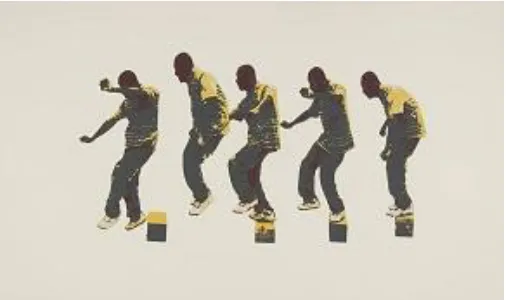
piece titled “Disability Without No Boundaries”
(see Figure 2). This 10” x 14” screen print features
4 https://scholarworks.wmich.edu/ojot/vol5/iss4/14
a sequence of pictures of Johnson’s body in motion.
It appears he is jumping across several large bricks.
Johnson finds this piece very empowering. “I may
have a disability, but I can do the unthinkable,” he
said.
Figure 2. “Disability Without No Boundaries” by Johnson Simon
In 2015, Johnson achieved the unthinkable.
He graduated from Western Michigan University
with a bachelor’s degree in fine arts. “Not only did
I graduate from college, I graduated with honors,”
he said. Johnson decided to continue his education
by pursuing a master’s degree. He was accepted
into the Herron School of Art and Design at Indiana
University. In addition to his regular course work,
Johnson was also assigned a position as a teaching
assistant. Johnson has enjoyed his role of instructor
and looks forward to teaching independently next
semester. Johnson is on schedule to graduate in
2018 with a master’s degree in fine arts. Johnson
says his dream is to return to the Frostic School of
Art at Western Michigan University as a full-time
professor.
Johnson Simon refused to let cerebral palsy
stop him from pursuing his dreams. Occupational
therapy helped Johnson discover his artistic
abilities; however, the occupation of painting
empowered him to move without boundaries.
Johnson has several future aspirations, including
opening an after-school center for at-risk youth.
Johnson wants to do for others the same thing his
mentor, Michael Tischler, did for him. “I want to
provide support and encouragement to youth to
keep them on the right track so they graduate from
high school,” he said. Johnson wants to use the
challenges he has endured to encourage others to
succeed. If Johnson could offer advice to a young
person with a disability who was feeling
discouraged, he would say the same thing his
mentor, Michael Tischler, said to him. “Never, ever
give up. If you don’t give up, you will overcome
your challenges. Keep pushing, and never give up
and you are going to surprise yourself.”
References
Case-Smith, J., & O’Brien, J. C. (2010). Occupational therapy for children (6th ed.).
Maryland Heights, MO: MOSBY Elsevier.
Centers for Disease Control and Prevention. (2017). Cerebral Palsy. Retrieved from
https://www.cdc.gov/ncbddd/cp/facts.html
Cerebral Palsy Foundation. (2017). Key facts. Retrieved from
http://yourcpf.org/statistics/
Cole, M. B., & Tufano, R. (2008). Applied theories in occupational therapy: A practical
approach. Thorofare, NJ: SLACK Incorporated. Erikson, E. H. (1980). Identity and the life cycle. New York,
NY: W.W. Norton and Company.
Kielhofner, G. (1995). A model of human occupation: Theory and application (3rd ed.). Baltimore, MD: Williams & Wilkins.
Kielhofner, G., & Barrett, L. (1997). An overview of occupational behavior. In H. Hopkins & H. Smith (Eds.), Willard & Spackman’s occupational therapy. Philadelphia, PA: JB
Lippincott.
Reddihough, D. (2011). Cerebral palsy in childhood.
Australian Family Physician, 40(4), 192- 196.
5 Fortuna: Movement without boundaries
U.S. Department of Education. (2017). About IDEA. Retrieved from
https://sites.ed.gov/idea/about-idea/
Additional Information
OJOT Gallery:
http://scholarworks.wmich.edu/ojot_occupat
ionandartist/20/
Visit Johnson Simon’s website at:
www.artbyjohnsonsimon.com
WMU Stories:
https://www.youtube.com/watch?v=hQPL4h
cYSrQ
6 https://scholarworks.wmich.edu/ojot/vol5/iss4/14