Vol. 17, 2019, 73-89
ISSN: 2349-0632 (P), 2349-0640 (online) Published 6 August 2019
www.researchmathsci.org
DOI: http://dx.doi.org/10.22457/jmi.149av17a7
73
Journal of
Depth Motion Maps and Log-Gabor Features Based
Human Action Recognition Using Support Vector
Machine
Biplab Madhu, Md. Zahidul Islam and Lasker Ershad Ali* Mathematics Discipline, Science Engineering and Technology School
Khulna University, Khulna-9208, Bangladesh.
*
Corresponding author. Email: [email protected]
Received 7 July 2019; accepted 4 August 2019
Abstract. In this paper, an efficient scheme is introduced for the human action recognition from depth video sequence. In particular, we have proposed an effective feature extraction technique which is based on Depth Motion Maps (DMMs) and Log-Gabor wavelet. Firstly, three Depth Motion Maps (DMMs) are projected from front, side and top views to accumulate DMMs features. Then, the Log-Gabor filter is employed on DMMs to attain complex wavelet features illustration. In Log-Gabor feature, we have evaluated two parts of a depth sequence called real and imaginary information for front, side and top sequence of DMMs projections. After that, we have adopted principal component analysis to reduce the dimension of the feature matrix. Finally, support vector machine (SVM) is utilized for action classification. The experimental results on the public Microsoft Research Action3D dataset suggest that our proposed DMM-Log-Gabor features based action recognition method is efficiently achieved the best performance on human action recognition.
Keywords: Human action recognition, depth motion maps, Log-Gabor feature, principal component analysis, support vector machine.
AMS Mathematics Subject Classification (2010):68T10
1. Introduction
74
surveillance [3], human computer interaction [2], detect dangerous events, security surveillance, entry/exit control, video retrieval, analysis of sports events, healthcare system, gestures recognition, monitor people living alone, robotics, telemedicine, content-based video search, video game etc. Understanding human action can help to find illegal events such as cheating, snatching, thefts, violent actions, etc. It is a significant challenge to identify human actions from RGB video for a long time. For the reason that the appearance of depth sensors such as the Microsoft Action, the inconvenience of human action recognition has been diminished as it can track the human motion. However, due to the several characteristics of human behaviors, it is still tough to extract the feature from the depth of the motion of the action to identify actual human actions. Specifically, there are numerous difficulties to be solved in action recognition, such as sudden pauses, nonlinear stretching, repetitions and to extract suitable feature.
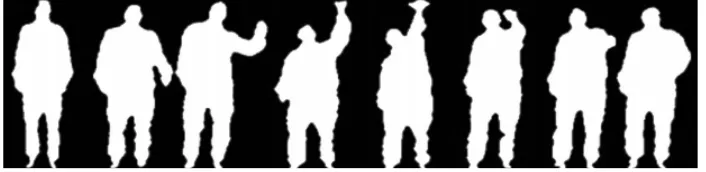
In this paper, we have described how to identify human actions from depth image sequence. However, some of the prevailing methods immediately operate on point of depth maps where the calculation is very large. An example of depth map sequence is shown in Figure 1. In this work we suggest an efficient method to recognize human actions by extracting Log-Gabor features from depth motion maps. Firstly, for every depth video, all its video frames are projected onto three orthogonal Cartesian planes to make the projected maps equivalent to three projection views (front, side and top). For each projection view, the collection of absolute differences between consecutive projected maps forms the matching DMMs (i.e., DMMf,DMMs,DMMt) [4]. The depth
maps sequences are separated into segments and then the Log-Gabor filters are applied to every segment to extract features. The produced features in a DMM are presented as a feature vector. Since there are numerous DMMs for a depth video, the feature-level orientation method is examined using Gabor function to learn machines. In order to analyze our introduced method, we perform it on a benchmark depth action dataset known Microsoft Research Action3D dataset and we compare our recognition accuracy with other methods.
The other parts of our paper are arranged as follows. In section 2, some related works have been discussed. In section 3, proposed methodology has been deliberated. In section 4, Feature extraction and classification has been stated. Also, in section 5, Experimental setup has been deliberated. In section 6, Results and discussion have been narrated in brief. Again, in section 8, Conclusions have been alluded. Finally, equivalent helping sources have been alluded as references.
Support Vector Machine
75
2. Related work
Action means the assortment of well-organized attitudes of human. Besides, for action recognition two key issues are measured such as the illustration of human behavior features, and also the model of human movement. Although, based on depth images, various illustrations have been established for action recognition, like hyper-surface normal [5,6], cloud points [7,8,9], skeleton joints [10,11] and depth motion maps (DMMs) [12] etc. The remaining depth-based action recognition ways uses depth maps or skeletal joint’s position for human actions identification. Our work relies on DMMs since they will effectively capture the behavior and clues of human actions. Yang et al. [12] introduced DMMs in their work, they projected depth maps onto three orthogonal planes and accumulated global actions through entire video sequences to create DMMs, then histogram of oriented gradient (HOG) features were calculated from DMMs as the illustration of the sequences. Liu et al. [15] signifies every depth frame using as a bag of 3D points on the human silhouette, and employs HMM to model the dynamics of action. Chen et al. [13] changed the DMMs by neglecting the threshold for real-time action recognition, and they castoff local binary patterns (LBP) to illustrate texture information of DMMs [14]. Wang et al. [16] investigated random occupancy pattern (ROP) features were extracted from depth sequence using a weighted sampling theme. A distributed writing method was implemented to encipher ROP features and the features were shown as robust to occlusion. More recently, Wang et al. [17] designed three DMMs and every DMM served as an input to a Deep Convolutional Neural Network (D-CNN) for classification. In all of above works, DMMs were designed from the whole video sequence and also the temporal information of an action. So, it is tough to recognize two actions with likeactions but opposite temporal orders, like actions “stand up" and “sit down".
76
In this paper, we have a tendency to propose an efficient method to handle the above problems. At first, a completely unique descriptor called as Depth Motion Maps (DMMs) is proposed to capture the sequential material of actions. The DMMs are designed over multi-size sequential windows, therefore they encode more specifics of motion and shape information. Secondly, Log-Gabor features evaluation the information of DMMs are extracted to further improvement of the discriminative capacity of our descriptors. So, we have investigated the DMM-Log Gabor as feature. Thirdly, after diminishing the dimensions by Principle Component Analysis (PCA), the final illustrations are classified by Support vector machine (SVM). The proposed technique cannot only represent the motion and shape information, but also take sequential order and action speed differences into attention. Our method is estimated on Microsoft-Action3D datasets and achieves better performance over the existing approaches.
3. Methodology
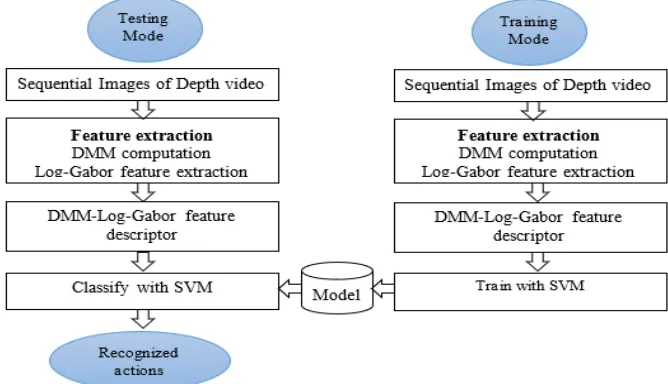
An enormous investigation has been showed within the fields as well as Human action recognition employing a variety of methods. So, here we have suggested a new procedure using DMM-Log Gabor feature extraction for human action recognition. This procedure has enriched the accuracy of action recognition compared to some previous investigators. In Figure 2 the details of our proposed method have been declared. Also, the process has been discussed step by step in the following illustrations.
Figure 2: Proposed frame works
Support Vector Machine
77
3.1. Depth motion maps as feature extraction
Depth map can be accustomed to capture the 3D structure and shape information. Yang et al. [24] planned to project depth frames onto three orthogonal Cartesian planes for the determination of describing the motion of an action. Because of its computational simplicity, the same method in [24] is adopted in this work while the process to obtain DMMs is modified. More specifically, each 3D depth frame is castoff to create three 2D projected maps corresponding to front, side, and top views, denoted by
map
{f s t, , }. For apoint
( , , )
x y z
in a depth frame denoting the depth value in a right-handed coordinatesystem, the pixel value in three projected maps is showed by
z x
, and
y
respectively. Different from [24], for every projected map, the motion energy is calculated here as the absolute difference between two consecutive maps without thresholding. For a depth video sequence withN
frames, DMM{f, , s t} is attained by loading the motion energyacross the total depth video sequence as follows:
{ } { } { }
1
, , , , , ,
b
j j
f s t f s t f s t j a
DMM map+ map
=
=
∑
− , (1)where
j
represents the frame index;map
{jf s t, , } is the projected map ofj
th
frameunder projection view{ , , }f s t ; a∈
{
2,...,N}
and b∈{
2,...,N}
denote the starting frame and the end frame index. It should be noted that not all the frames in a depth video sequence are used to generate DMMs. This point is discussed further in the experimental setup section. A bounding box is then set to extract the non-zero region as the foreground in each DMM.Let the foreground extracted DMM be denoted by DMM{f, , s t} hereafter. An
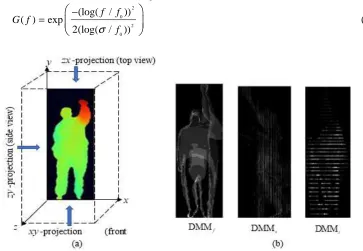
example of DMM{f, , s t} generated from the High through sequences is shown in Figure3. DMMs from the three projection views effectively capture the characteristics of the motion in a distinguishable system. So, the reason here for using DMMs as feature descriptors for action recognition. Since DMM{f, , s t} of different action video sequences
may have different sizes, bi-cubic interpolation is used to resize all DMM{f, , s t} under the same projection view to a fixed size in order to reduce the intra-class variability, for example due to different subject heights.
3.2.Log-Gabor feature representation
78
the frequency domain because of the uniqueness in the log function at origin. The Log-Gabor function is defined as following:
2 0
2 0
(log( / ))
( ) exp
2(log( / ))
f f G f
f σ
−
=
(2)Figure 3: (a) Projection views of depth video frame and (b) DMM{f, , s t} generated from
High throw action video sequence.
where
f
0 andσ
are the parameters of the Log-Gabor filter. The parameterf
0will give the center frequency of the Log-Gabor filter andσ
will affects the bandwidth of the Log-Gabor filter. To maintain the similar shape when the frequency is changed. For this, the ratio σ / f0 should remain constant. Log-Gabor filter have a null DC component and which can be optimized to produce filters with minimal spatial extent. Log-Gabor filter can be divided into two mechanisms: radial and angular filters. So, Log-Gabor filter is defined as follows:2 2
0 0
2 2
0
(log( / )) ( )
( , ) exp exp
2(log( f / )) 2( )
f f G f
f θ
θ θ θ
σ σ
− − −
=
(3)where f is the center frequency,0 θ0is the orientation angle, σf determine the width
parameter for the frequency,
σ
θ determine the parameter of orientation.3.3.Support vector machine classification
Support Vector Machine
79
algorithm in 1963. Depending on the nature of the data, such a separation might be linear or non-linear.
Let us consider a linear classifier (or, hyperplane) f x( )=wT
x
+bwhere
w
represents weight vector,x
is the input feature vector and b represents the position of the hyperplane. Here,i) if the input vector is 2-dimensional, the linear equation will represent a straight line. ii) if the input vector is 3-dimensional, the linear equation will represent a plane.
iii) if input vector more than 3-dimension, the linear equation will represent a hyperplane.
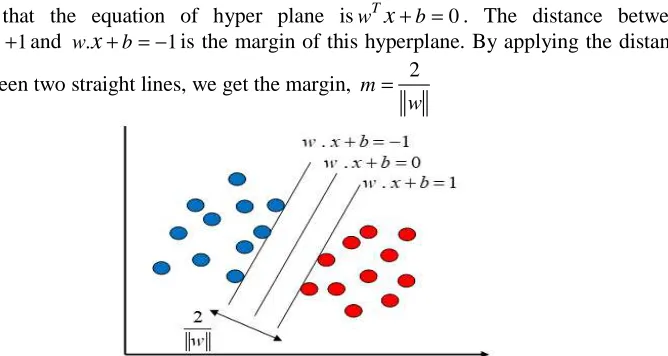
The SVM algorithm is to find an optimal hyperplane for classification of two classes. Assume that the equation of hyper plane iswT
x
+ =b 0. The distance between. 1
w
x
+ = +b and w.x
+ = −b 1is the margin of this hyperplane. By applying the distancerule between two straight lines, we get the margin, m 2 w
=
Figure 4: Maximum margin of hyperplane for SVM trained with samples
For non-linear classifier SVM use kernel function to separate the data points. Obtain a nonlinear SVM regression model by replacing the dot product x1T.x2 with a nonlinear
kernel function K x x( ,1 2)=<ϕ( ), (x1 ϕ x2)> where, ϕ( )x is a transformation that maps
x
to a high-dimensional space. Popular kernel functions arei) Linear kernel function: ( j, k) j k T K x x =x x
ii) Gaussian kernel function: K x x( ,j k)=exp(− xj−xk 2)
iii) Polynomial kernel function: K x( j,xk)= +(1 xjTxk)q
iv) Radial basis kernel function:
2
2
( , ) exp( )
2 j k j k
x x
K x x
σ −
= −
wherexi and xj are support vector where support vector is the input vectors that just
80
4. Experimental setups
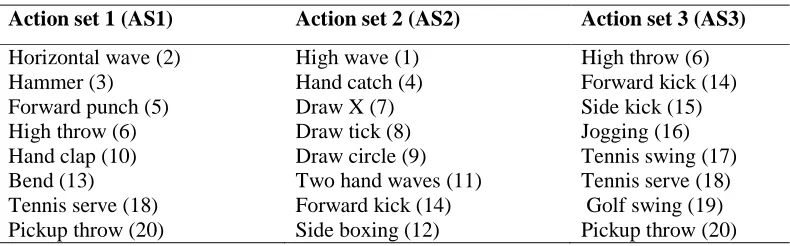
In this section, it is explained however our methodology was applied to the general public domain Microsoft Research (MSR) Action3D dataset [15] with the depth map sequences captured by associate an RGBD camera. Our method is then compared with the prevailing strategies. The MSR-Action3D dataset includes 20 actions performed by 10 subjects. The sort of 20 human actions are: high wave, horizontal wave, hammer, hand catch, forward punch, high throw, draw x, draw tick, draw circle, hand clap, two hand wave, side boxing, bend, forward kick, side kick, jogging, tennis swing, tennis serve, golf swing, and pickup throw. Every subject achieved every action 2 or 3 times. Each subject performed the same action differently. As a result, the dataset incorporated the intra-class variation. For instance, the speed of performing an action varied with different subjects. The resolution of every depth map was 320×240. To facilitate a fair comparison, the same experimental settings is done in [15,29-31]were considered. The actions were divided into three subsets (AS1, AS2, AS3) which are listed in Table 1. For every action subset, three totally different tests were performed. In our method for Test One, 1/3 of the illustrations were used as training examples and the others as test examples. In Test Two, 2/3 of the examples were used as training examples and the others as test examples. In Cross Subject Test (or Test Three), half of the themes were used as training and the others as test themes. In the investigational system described in [15], in Test One (or Two), for every action and every subject, the first (or first two) action sequences were castoff for training, while in Cross Subject Test, subjects 1, 3, 5, 7, 9 (if existed) were castoff for training. Noting that the examples or themes used for training and testing were static, they are discussed to as Fixed Tests here.
Table 1: Three action subsets and test used for Microsoft-Action3D dataset
Action set 1 (AS1) Action set 2 (AS2) Action set 3 (AS3)
Horizontal wave (2) High wave (1) High throw (6)
Hammer (3) Hand catch (4) Forward kick (14)
Forward punch (5) Draw X (7) Side kick (15)
High throw (6) Draw tick (8) Jogging (16)
Hand clap (10) Draw circle (9) Tennis swing (17) Bend (13) Two hand waves (11) Tennis serve (18) Tennis serve (18) Forward kick (14) Golf swing (19) Pickup throw (20) Side boxing (12) Pickup throw (20)
Another research was showed by arbitrarily selecting training examples or training theme equivalent to the three tests. On the other hand, the action sequences of every theme for every action were arbitrarily selected to assist as training examples in Test One and Test Two. For Cross Subject Test, half of the themes were arbitrarily selected for training and the rest castoff for testing. These tests are denoted to as Random Tests here.
Support Vector Machine
81
shape with large pixel values along the edges which paid to a large quantity of renewal error. Therefore, the primary and terminal frame elimination was done to eliminate no motion condition. Other frame choice systems may be castoff here to attain the same. To get three fixed sizes forDMM{f, , s t}, the sizes of the DMMs of all the examples (training and test samples) were create under every projection view. For the training feature set and the test feature set, principal component analysis (PCA) was applied to diminish the dimensionality. The PCA transform matrix was intended using the training feature set and then applied to the test feature set. This dimensionality reduction step provided computational effectiveness for the classification.
4.1. Evaluation of DMM-Log Gabor
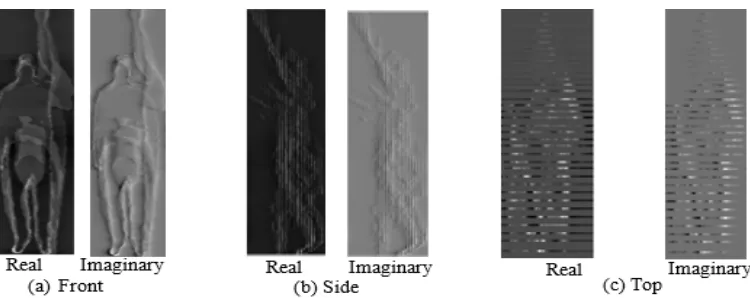
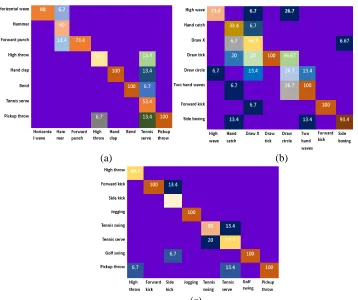
We first analyze the effect of DMM normalization size for recognizing performances. As elaborate in Section 4.1, we normalize the three depth motion maps to a fixed size. Then we evaluate the effect of Log-Gabor filter to extract new feature. For applying Log-Gabor feature every image transform into a real and imaginary image label. Since DMM is measured from the front, side and top. As for action set AS1 the size of front, side and top are respectively 100×50, 100×82, 82×47. While for action set cross subject AS1CrSub the size of front, side and top are respectively same action set AS1. For action set AS2 the size of front, side and top are respectively 102×51, 103×67, 67×51. While for action set cross subject AS2CrSub the size of front, side and top are respectively same action set AS2.And for action AS3 the size of front, side and top are respectively 104×53, 104×84, 84×53. While for action set cross subject AS3CrSub the size of front, side and top are respectively same action set AS3.Although lower resolutions are able to reduce computational cost in computing DMM, we extract Log-Gabor filter for each depth motion maps from front, side and top. So, for each video sequence is converted to real and imaginary parts. We examine every depth image for real, imaginary and real-imaginary with respectively. The difference of computation time between different and Log-Gabor is differed. The following experimental results are based on this process. After Log-Gabor filtering the real, imaginary and real-imaginary depth sequence is shown in Figure5, In Cross Subject Test, different subjects perform actions with great variations but the number of subjects is limited, which results in considerable intra-class variations. Furthermore, some actions in AS2 are quite similar, e.g. Draw X, Draw Tick, and Draw Circle, which generates small inter-class variations. The performances on cross subject test might be enhanced by accumulating in more subjects.
4.2. Parameter selection
82
Figure 5: Real and imaginary sequence of (a) Front view (b) Side view and (c) Top view
In our experiment, in test one test one for action set AS1, we choose the parameter value number of scale parameter
υ
=
4
, minimum wavelengthλ
=
3
, multiplication time=1.7 and sigma on frequencyσ
=
0.15
. For these parameters our method recognizes the action 93.4%. In test two, we choose the parameter value number of scale parameterυ
=
6
, minimum wavelengthλ
=
0.92
, multiplication time=1.7 and sigma on frequencyσ
=
0.15
. For these parameters our method recognizes the action 92%. In test three, we choose the parameter value number of scale parameterυ
=
5
, minimum wavelengthλ
=
3
, multiplication time=1.7 and sigma on frequencyσ
=
0.15
. For these parameters our method recognizes the action 95.4%. In test four, we choose the parameter value number of scale parameterυ
=
5
, minimum wavelengthλ
=
3
, multiplication time=0.2 and sigma on frequencyσ
=
0.15
. For these parameters our method recognizes the action 94%. In test five, we choose the parameter value number of scale parameterυ
=
5
, minimum wavelengthλ
=
3
, multiplication time=1.2 and sigma on frequencyσ
=
0.15
. For these parameters our method recognizes the action 96.7%.Support Vector Machine
83
Then for action set AS3, in test one, we choose the parameter value number of scale parameter
υ
=
4
, minimum wavelengthλ
=
3
, multiplication time=1.7 and sigma on frequencyσ
=
0.15
. For these parameters our method recognizes the action 94.3%. In test two, we choose the parameter value number of scale parameterυ
=
6
, minimum wavelengthλ
=
0.92
, multiplication time=1.7 and sigma on frequencyσ
=
0.15
. For these parameters our method recognizes the action 96.6%. In test three, we choose the parameter value number of scale parameterυ
=
5
, minimum wavelengthλ
=
3
, multiplication time=1.7 and sigma on frequencyσ
=
0.15
. For these parameters our method recognizes the action 97.3%. In test four, we choose the parameter value number of scale parameterυ
=
5
, minimum wavelengthλ
=
3
, multiplication time=0.2 and sigma on frequencyσ
=
0.15
. For these parameters our method recognizes the action 95.3%. In test five, we choose the parameter value number of scale parameterυ
=
5
, minimum wavelengthλ
=
3
, multiplication time=1.2 and sigma on frequencyσ
=
0.15
. For these parameters our method recognizes the action 96.0%.In our experiment for cross subject test in test one, we choose the parameter value number of scale parameter
υ
=
4
, minimum wavelengthλ
=
3
, multiplication time=1.7 and sigma on frequencyσ
=
0.15
. For these parameters our method recognizes the action 86.2%. In test two, we choose the parameter value number of scale parameter6
υ
=
, minimum wavelengthλ
=
0.92
, multiplication time=1.7 and sigma on frequencyσ
=
0.15
. For these parameters our method recognizes the action 89.2%. In test three, we choose the parameter value number of scale parameterυ
=
5
, minimum wavelengthλ
=
3
, multiplication time=1.7 and sigma on frequencyσ
=
0.15
. For these parameters our method recognizes the action 88.6%. In test four, we choose the parameter value number of scale parameterυ
=
5
, minimum wavelengthλ
=
3
, multiplication time=0.2 and sigma on frequencyσ
=
0.15
. For these parameters our method recognizes the action 87%. In test five, we choose the parameter value number of scale parameterυ
=
5
, minimum wavelengthλ
=
3
, multiplication time=1.2 and sigma on frequencyσ
=
0.15
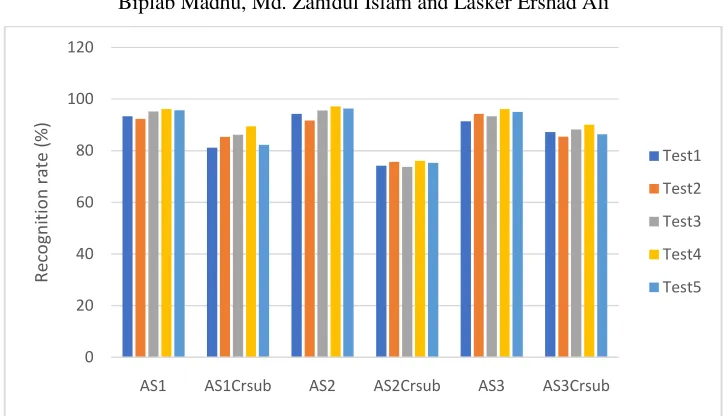
. For these parameters our method recognizes the action 90.1%.The optimal recognition rates are found at
υ
=
4
,λ
=
3
. As a result, in all the experiments reported here, the value ofυ
=
4
,υ
=
4
,σ
=
0.15
were thus chosen. Above discussed results are shown in figure 6.5. Results and discussions
84
Figure 6: The recognition rates (%) of DMM-Log-Gabor with different parameter values
under a variety of test sets
5.1. Recognition results
In this approach, we have proposed an easy algorithm using a novel feature descriptor, because the proposed algorithm would not be useful in practical applications if it needs tuning lots of parameters. Therefore, we want to find our smart assignments for the parameters within the algorithm and then fix these parameters for all test cases. For instance, in the step of Log-Gabor wavelet, how to control the DMM size, the number of action levels and the assortment of the wavelength? In order to improve the computational efficiency in the classification step, Principle Component analysis (PCA) is adopted to reduce the dimension of the Log-Gabor feature vector. The PCA transform matrix is calculated using the training feature set and then applied to the test feature set. In our experiments, we resized DMM to three different sizes of front, side, top and then utilized Log-Gabor filter for action set AS1 are respectively 100×50, 100×82, 82×47, Then we transformed it into Log-Gabor filter. Every DMMs sequence divided into two images after Log-Gabor feature apply. The front image is featured into real part and imaginary part. Then along real and imaginary is featured into a new featured as total front feature. We used real, imaginary and total featured individually for recognition. After feature extraction of front, side and top we used SVM for training and testing for classification. Since Log-Gabor is a wavelet feature, it has some parameter. In Log-Gabor feature we use the number of scales, wavelength, multiplication and ratio between window width and wavelength which are discussed in (4.2).
Firstly, we adopted our method for real part of front, side and top. In real part of these images, we recognized the Action 96.0% whereas for cross subject test the recognition action is 85%. These action recognition rates are evaluated by the average recognition rate of AS1, AS2 and AS3. Secondly, we adopted our method for imaginary part of front, side and top. In imaginary part of these images, we recognized the Action 97.5% whereas for cross subject test the recognition action is 78%. These action recognition rates are evaluated by the average recognition rate of AS1, AS2 and AS3.
0 20 40 60 80 100 120
AS1 AS1Crsub AS2 AS2Crsub AS3 AS3Crsub
R
e
co
g
n
it
io
n
r
a
te
(
%
)
Support Vector Machine
85
Finally, we adopted our method for total part of front, side and top. In total part of these images, we recognized the Action 96.3% whereas for cross subject test the recognition action is 85.1%. These action recognition rates are evaluated by the average recognition rate of AS1, AS2 and AS3. The overall recognition rate is 92.8%.
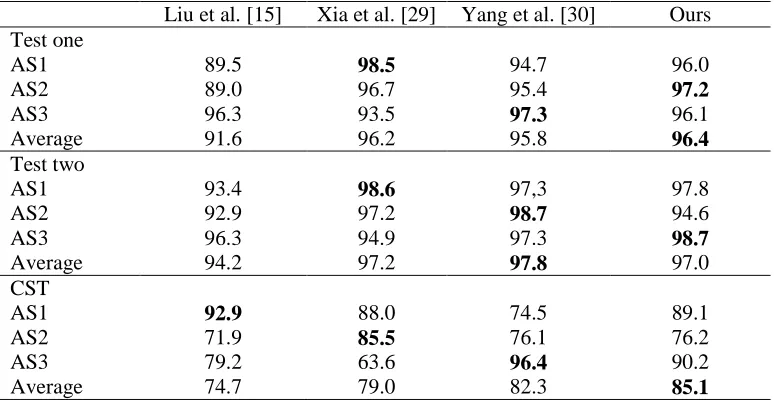
Table 2: Recognition rates (%) of our method compared to the others method on MSR
Action3D dataset
Liu et al. [15] Xia et al. [29] Yang et al. [30] Ours Test one
AS1 89.5 98.5 94.7 96.0
AS2 89.0 96.7 95.4 97.2
AS3 96.3 93.5 97.3 96.1
Average 91.6 96.2 95.8 96.4
Test two
AS1 93.4 98.6 97,3 97.8
AS2 92.9 97.2 98.7 94.6
AS3 96.3 94.9 97.3 98.7
Average 94.2 97.2 97.8 97.0
CST
AS1 92.9 88.0 74.5 89.1
AS2 71.9 85.5 76.1 76.2
AS3 79.2 63.6 96.4 90.2
Average 74.7 79.0 82.3 85.1
5.2. Comparison with state-of-the-art methods
In this study we compare our DMM-Log Gabor technique with some related existing techniques on the Microsoft Action3D dataset. The comparison results are shown in Table 2. The highest average recognition rate for each test case is highlighted in bold. The average recognition rates of our method outperform all the other methods listed in Table 2 for each test case except the method proposed by Yang et al. [30]. We have to point out that Yang et al. used several parameters for the proposed learning, and the values of all parameters were not fixed. So, it’s very clear that we should governance the experiment on each range for many times to find a suitable corresponding value of the parameter. However, if we don’t use fixed values for all parameters our method is also capable of showing expected higher performance, like the method reported in [15]. To suggest a suitable and faster algorithm with higher recognition accuracies, we fixed the parameter values.
86
recognition rate is better than [15,29] which is shown in Figure 7. It can be seen that the DMM-LogGabor descriptor shows higher state of being more acc.
Figure 7: Recognition rates (%) of comparison with the state-of-the-art methods
(a) (b)
(c)
Figure 8: Confusion matrix of proposed method: (a)AS1(CST), (b)AS2(CST), (c)
AS3(CST).
0 20 40 60 80 100 120
Liu et al. Xia et al. Yang et al. Ours
R
e
co
g
n
it
io
n
r
a
te
(
%
)
Support Vector Machine
87
6. Conclusion
We have investigated an efficient technique for human action recognition and established a novel feature descriptor known as DMM-Log-Gabor feature extraction technique in this research. For recognizing human action, support vector machine is adopted as the basic classifier in this approach. The experimental results on MSR Action3D dataset reveal that our approach considerably outperforms of the present progressive techniques. Since, Log-Gabor descriptor transform an image in two part called real and imaginary. We have investigated our method both real and imaginary part of front, side and top views. After that we have adopted the real and imaginary features with one descriptor called DMM-Log Gabor. Then PCA is employed to reduce the dimension of data set. Our mentioned algorithm improves the average recognition rate of human action than Liu et al. [15] and Xia et al. [29]. Therefore, it is shown by the empirical results that DMM-Log-Gabor feature descriptor is better than the above-alluded existing recognition technique.
REFERENCES
1. J.K.Aggarwal, M.S.Ryoo and J.K.Aggarwal, Semantic representation and recognition of continued and recursive human activities, International Journal of Computer Vision, 82(1) (2009) 1-24.
2. I.Rodomagoulakis, N.Kardaris and V.Pitsikalis, Multimodal human action recognition in assistive human-robot interaction, in IEEE International Conference on Acoustics, Speech and Signal Processing (ICASSP) (2006) 2702–2706.
3. W.Lin, M.Sun, R.Poovendran and Z.Zhang, Activity recognition using a combination of category components and local models for video surveillance, IEEE transactions on circuits and systems for video technology, 18(8) (2008) 1128–1139.
4. C.Chen, K.Liu and N.Kehtarnavaz, Real-time human action recognition based on depth motion maps, Journal of Real-Time Image Processing,2013.
5. X.Yang and Y.Tian, Super normal vector for activity recognition using depth sequences, in IEEE Conference on Computer Vision and Pattern Recognition, (2014) 804– 811.
6. O.Oreifej and Z.Liu, Hon: Histogram of oriented 4Dnormals for activity recognition from depth sequences, in IEEE Conference on Computer Vision and Pattern Recognition, (2013) 716–723.
7. W.Li, Z.Zhang and Z.Liu, Action recognition based on a bag of 3d points, in IEEE Computer Society Conference on Computer Vision and Pattern Recognition Workshops, (2010) 9–14.
8. J.Wang, Z.Liu, J.Chorowski, Z.Chen and Y.Wu, Robust 3d action recognition with random occupancy patterns, in ECCV, (2012) 872–885.
9. L.Xia and J.K.Aggarwal, Spatio-temporal depth cuboid similarity feature for activity recognition using depth camera, in IEEE Computer Society Conference on Computer Vision and Pattern Recognition, (2013) 2834–2841.
88
11. M.Zanfir, M.Leordeanu and C.Sminchisescu, The moving pose: An efficient 3d kinematics descriptor for low-latency action recognition and detection, in IEEE International Conference on Computer Vision, (2013) 2752–2759.
12. X.Yang, C.Zhang and Y.Tian, Recognizing actions using depth motion maps-based histograms of oriented gradients, in ACM International Conference on Multimedia, (2012) 1057–1060.
13. C.Chen, K.Liu and N.Kehtarnavaz, Real-time human action recognition based on depth motion maps, Journal of Real-Time Image Processing, (2013) 1–9.
14. C.Chen, R.Jafari and N.Kehtarnavaz, Action recognition from depth sequences using depth motion maps based local binary patterns, IEEE Winter Conference on Applications of Computer Vision, (2015) 1092–1099.
15. W.Li, Z.Zhang and Z.Liu, Action recognition based on a bag of 3D points, IEEE Workshop on CVPR for Human Communicative Behavior Analysis.
16. J.Wang, Z.Liu, J.Chorowski, Z.Chen and Y.Wu, Robust 3D action recognition with random occupancy patterns, In ECCV, (2012) 872-885.
17. P.Wang, W.Li, Z.Gao, C.Tang, P.Zhang, and J.Ogunbona, Conv-nets-based action recognition from depth maps through virtual cameras and pseudo coloring, ACM International conference on Multimedia, (2015) 1119–1122.
18. R.Vemulapalli, F.Arrate and R.Challappa, Human action recognition by representing 3D skeletons as points in a Lie group, IEEE Conference on Computer Vision and Pattern Recognition, 2014.
19. M.Lades, J.C.Vorbruggen, J.Buhmann, J.Lange, C.Von-der Malsburg, R.P.Wurtz and W.Konen, Distortion invariant object recognition in the dynamic link architecture, IEEE Transaction on Comput., 42 (1993) 300–311.
20. M.J.Lyons, J.Budynek, A.Plante and S.Akamatsu, Classifying facial attributes using a 2-D Gabor wavelet representation and discriminant analysis, in Proc. 4th IEEE Int. Conf. Automatic Face and Gesture Recognition, 2000.
21. M.J.Lyons, J.Budynek and S.Akamatsu, Automatic classification of single facial images, IEEE Transactions on Pattern Analysis and Machine Intelligence, 21 (1999) 1357–1362.
22. L.Wiskott, J.M.Fellous, N.Kruger and C.Von-der Malsburg, Face recognition by elastic bunch graph matching, IEEE Transactions on Pattern Analysis and Machine Intelligence, 19 (1997) 775–779.
23. G.M.Donato, S.Bartlett, J.C.Hager, P.Ekman and J.T.Sejnowski, Classifying facial actions, IEEE Transactions on Pattern Analysis and Machine Intelligence, 21 (1999) 974–989.
24. X.Yang, C.Zhang and Y.Tian, Recognizing actions using depth motion maps-based histograms of oriented gradients, Proceedings of ACM International Conference on Multimedia, (2012) 1057–1060.
25. J.G.Daugman, Complete discrete 2-D Log-Gabor transforms by neural networks for image analysis and compression, IEEE Transactions on Pattern Analysis and Machine Intelligence, 36 (1988) 1169–1179.
Support Vector Machine
89
27. J.Jones and L.Palmer, An evaluation of the two-dimensional Gabor filter model of simple receptive fields in cat striate cortex, J. Neurophys, (1987) 1233–1258.
28. C.Liu and H.Wechsler, Evolutionary pursuit and its application to face recognition, IEEE Transactions on Pattern Analysis and Machine Intelligence, 22 (2000) 570– 582.
29. L.Xia, C.Chen and J.K.Aggarwal, View invariant human action recognition using histograms of 3D joints, Proceedings of IEEE Conference on Computer Vision and Pattern Recognition Workshops, (2012) 20–27.
30. X.Yang and Y.Tian, Eigen joints-based action recognition using Naive-Bayes-Nearest-Neighbor, Proceedings of IEEE Conference on Computer Vision and Pattern Recognition Workshops, (2012) 14–19.