Electrical Coal Dryer
Tanveer Aslam Inamdar
TREE Innovative Foundation, Pune, Maharashtra, India
Abstract
India’s coal consumption was reported at 423.967 TOE mn in Dec 2017 but the moisture in coal is one of the biggest industrial problems, the moisture contained coal reduces the machinability, productivity, combustion capacity, and also calorific value of coal and coal-related operations. Industries are facing these issues and have come up with couple of traditional methods to de-moisturize coal, but this industrial method also has various adverse impacts on production capacity, larger processing cost, required large area, physical and chemical properties of coal. The traditional method also creates adverse impact on the life and health of human operators who are directly engaged with these traditional methods. Coal is the major source of power in industries like the Cement industry, Power generation stations, and others. The present experimental setup is designed and manufactured to solve the above-mentioned problems. The compact electrical furnace and semi-automated system have the capacity to de- moisturize 1 ton of coal per day for heavy industrial use. The specialized design of the experimental setup has the capacity to reduce processing costs and increases the production rate of coal without damaging the physical and chemical property of coal. The present experimental setup required 70% less land, 50% less processing cost, 60% less manpower than the traditional method but also it increases the production rate of industries by 50% than the traditional.
Keywords: Coal, Coal Moisture, Calorific Value, Health, SDG, Small Scale Industries, Production Rate, Land, Processing, Processing Coast, Electric, Electric Furnace, Compact, Traditional
_______________________________________________________________________________________________________
I. INTRODUCTION
India is the developing country and has second ranking in world coal consumption. (Energy, n.d.) India’s coal consumption was reported at 423.967 TOE mn in Dec 2017. This records an increase from the previous number of 405.644 TOE mn for DEC 2016. India’s coal consumption data is updated rarely, averaging 116.756 TOE mn from Dec 1965 to Dec 2017. (Consumption, 2018) Coal is the major source of power in industries like the Cement industry, Power generation stations, and others. Industries are facing major problems of moisture contained in coal. The presence of moisture reduces the efficiency of various combustion operations and also affects the quality of physical operations like coal transportation and coal grinding.
While internal moisture affects the coal combustion process, external (mechanical) moisture gives rise to;
1) Difficulties in handling [transfer and flow ability] of coal with severe capacity reduction of all equipment in the coal handling plant ranging from crushers to conveyors.
2) External moisture also creates combustion difficulties by creating thermal lag during the combustion process. (Mahapatra, 2015)
The cement industry, and some chemical industries that use coal. In these industries, at least 50% of lignite needs to be ground under 75 microns. (Deniz1, February 2014) The moisture of coal is an important parameter, which influences the grind ability of coal. This has a significant effect on the coal with average moisture levels being approximately 2.5% higher in the winter than summer. (Deniz1, February 2014)
Considering physical and chemical property of coal there is two types of moisture i.e. hydroscopic moisture, mineral moisture which affects the efficiency of the various industrial procedure.
Hydroscopic moisture: water held by capillary action within the microfractures of the coal.
Mineral moisture: water which comprises part of the crystal structure of hydrous silicates such as clays Moisture in coal consists of inherent moisture (IM) and surface moisture (SM). There is no simple and reliable method of determining the water of hydration of mineral matter. The average value of 8 % of the ash is used as the value for the water of hydration of mineral matter in coals in the United States. This value is acceptable, although it is an average of values that range from 2–3 % up to 15–30 %. The water of hydration values is used to correct ash to the form of hydrated minerals in mineral matter calculations. Then total moisture (TM) is a sum of IM and SM. Total moisture in coal is used to determine the amount of drying that is
needed to reach a given moisture requirement and to determine the amount of dust proofing and freeze-proofing agents to add. In coking processes, coals with high moisture content require more heat for vaporization of the moisture, which leads to longer coking cycles and decreased production. The total moisture of the coal used must be accurately known to allow for proper charging of the coke ovens and overall control of the coking process. Hence TM is affected by the criticality of SM. This brings down the GCV of coal [thermal content of coal] (Mahapatra, 2015)
There are mainly three cost effects of moisture in coal: (Mahapatra, 2015)
1) Increase in operating costs due to decreased boiler efficiency and decreased overall unit efficiency (increase in heat rate) 2) Increase in operation and maintenance costs attributed to the handling of wet coal.
Traditionally two methods i.e. conventional ovens and microwave ovens are used where the moisture is lost through vaporization following heating (Mahapatra, 2015). In small industries, venders, and individual entrepreneurs use to heat the coal on the big pan by using fuels like petrol and other fuel or expose the coal to solar heat. This procedure or method of small industry and individual entrepreneurs is expensive, time-consuming, required a large area with having very low production rate.
The traditional methods of small industries and individual entrepreneurs have a very low production rate, high amount of fuel consumption, low efficiency, and also season vice variation in production rate. This study is presenting the experimental setup to solve the following problems.
This experimental setup of an electrical coal dryer is designed to de-moisturize the coal with an effective setup of a close round electric furnace, semi-automatic system, and Electrical heater along with the specialized close system. The design of electrical coal dryer is to de-moisturize the coal with low power consumption, low processing cost, minimum land requirement, and high production rate.
II. EXPERIMENTAL SETUP
The experimental setup is designed to de-moisturize the coal and to improve the grind ability of coal. The electrical coal dryer is the assembly of a horizontal cylindrical furnace, Outer shell, cylindrical heaters, actuation system, prime movers, and control panel. The experimental setup is designed to de-moisturize 1Ton of coal per day (8 working hours) with the requirement of a 3kwatt electric supply.
Fig. 1: Electrical Coal Dryer
Cylindrical Furnace
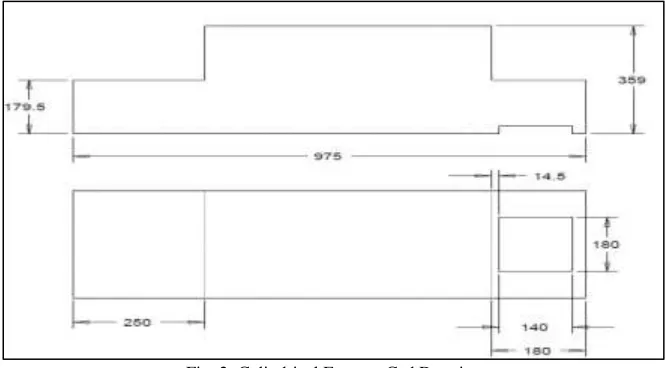
The cylindrical furnace is a close horizontal chamber, it has two openings for feeding and discharge of coal. The furnace is designed with the capacity of 60 kg to operate in a single cycle, there is an arrangement to set cylindrical heaters on the outer periphery of a furnace.
Fig. 2: Cylindrical Furnace Cad Drawing
Cylindrical Heaters
Fig. 3: Ceramic Heater
Semi Actuating System
During the process cycle, the Moisturized coal has to stir in specific time intervals to create space for water vapors to escape from the chamber. Where the actuating system is powered by electric motor, gearbox, and chain drive and blades which are designed by considering two parameters
To actuate in the forward and backward direction Minimizing damage to coal
Outer Shell
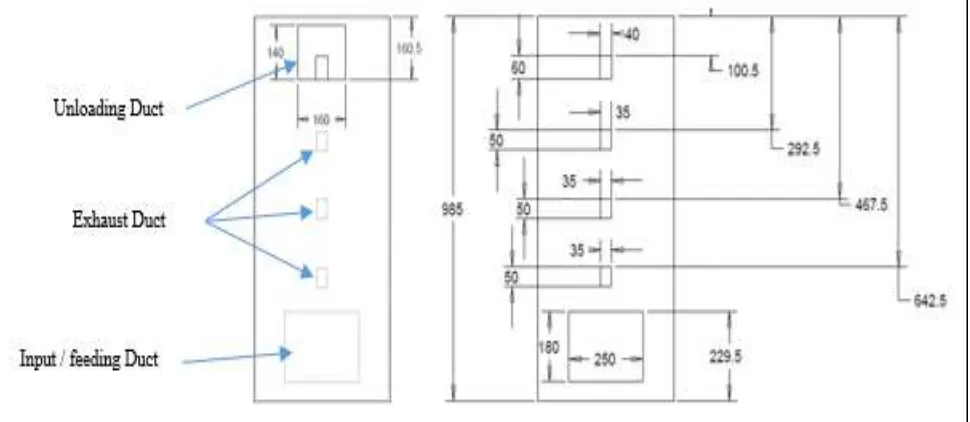
The outer shell is the safety shell which is design to hold the entire internal setup and instruments, to cut-off the heat transfer from furnace body to the outer shell, & to minimize human contact with internal instruments and heaters.
The empty space in the assembly of the furnace and the outer shell is incorporated with the glass wool to minimize the heat transfer from furnace to the outer shell via Conduction and convection.
Fig. 4: Outer Shell Cad Drawing
Prime Movers and Control Panel
To have control over actuation, heating arrangement, and temperature. The control panel is designed which has control over the temperature of heaters, frequency of time interval, actuation system, mechanical actuating system, and prime movers.
It also has the safety panel and arrangement, it has the ability to shut down all the system if it exceeds the required exceeds in temperature or fluctuation in input voltage, and accidental human contact.
III. METHODOLOGY
Fig. 5: Fully Constructed Electrical Coal Dryer
Preheating Cycle
Before starting the working cycle the system have to set on the ideal temperature of 3000C, for the same the preheating cycle is introduced into the process. The complete system runs for the time interval of 3 min on full load condition along with heaters and actuation, which also helps to observe the working accuracy of the system and to achieve ideal temperature.
Feeding Cycle
After the preheating cycle the actual working comes into the picture, as per the capacity of the furnace, 60kg of moisturized coal is poured into the furnace through the hopper and outer shell. The hopper has a capacity of 20kg per batch, for the same coal is feed into the system in three cycles of hopper. The forward actuation is used to travel and set the coal through the length of furnace chamber, where the time duration for each hopper cycle is 30 sec.
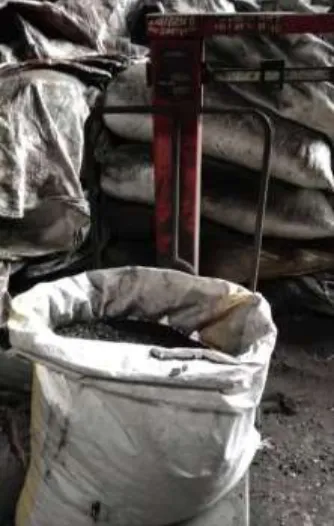
Fig. 6: Moisturize Coal Sample
Working Cycle
The working cycle has a time duration of 14 min of heating the moisturized coal within the furnace temperature of 2500C to 4000C. The temperature of heating is directly proportional to the moisture content into the coal, where the moisture proportion is also depended on the atmospheric condition and environmental condition.
The control panel indicates all the time intervals by the sound beep to the operator which directly helps to increases the accuracy and efficiency of the working cycle. It also indicates the furnace temperature and indicates operator to make a change if required.
Loading-Unloading Cycle
After the 14 min cycle, the de-moisturized coal is unloaded by the forward actuation in three actuation cycles, simultaneously the furnace is reloaded with moisturized coal. This simultaneous process helps to increases efficiency and to save time in operation. The opening and closing of the output mouth have to handle manually.
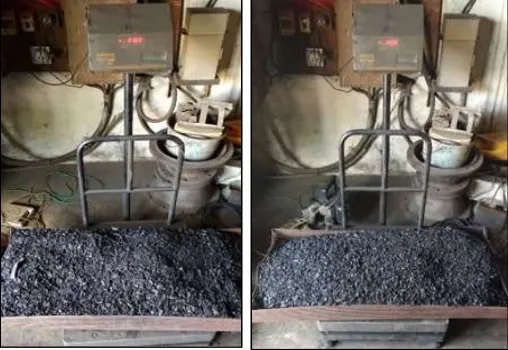
Fig. 7: De-moisturize Coal
IV. TESTING
It is important to understand the efficiency and impact of experimental setup on the physical and mechanical properties of operated/de-moisturized coal.
Physical Observation
The physical observation from naked eyes states that there is no physical damage to the coal after the de-moisturizing operation within the experimental setup.
Fig. 8: De-moisturize Coal
De-moisturization
The comparison and difference between the pre-weight and post-weight of coal indicated the amount of water/ moisture removed from the coal.
Time Consumption
The experimental setup runs for the eight hours with the constant working, the observation states that the experimental setup has the capacity to de-moisturized One Ton of moisturized coal per day. Where traditional method takes two days to de-moisturized one ton of coal, i.e. the experimental setup reduces the 50% of time in de-moisturizing.
Machinability
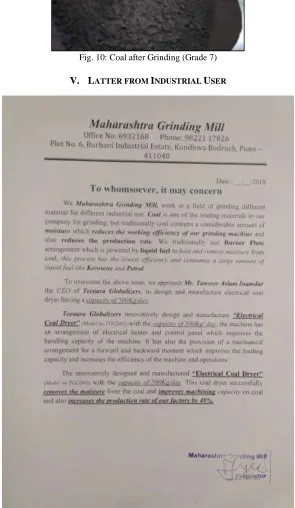
After the grinding operation on operated coal, it is observed that the grindability is much better than the traditional method i.e. the coal has achieved the 7th grade of fineness.
Fig. 10: Coal after Grinding (Grade 7)
VI. CONCLUSION
The study of the working of electrical coal dryer operated coal and testing we can conclude the following conclusion.
The experimental setup consumes 50 % less power and time than the traditional method, which directly or indirectly helps to reduce the operational cost and to increase the production rate than the traditional method.
The experimental setup efficiently reduce the 90 to 95% of moisture from the coal without creating any physical damage to the coal. It also helps to increase the grindability of coal. The efficient grindability by coal is directly or indirectly supportive to increases the efficiency of coal as the fuel.
The experimental setup reduces the required number of manpower and semi actuation system helps to increase the productivity and efficiency of the system. The experimental setup reduces the direct human contact with coal and coal dust which helps to minimize the physical problem to labor and operated and also serves the SDG goal 3 & 8.
The control panel gives accurate notification and mechanical readings which helps to have effective control over the operation and its working. The mechanical actuation system works to give efficient control over the loading, unloading, and stirring the coal.
REFERENCES
[1] Consumption, I. C. (2018). CEIC. etrieved from https://www.ceicdata.com/en/indicator/india/coal-consumption
[2] Deniz1, V. (February 2014). The Effects of Moisture Content and Coal Mixtures on the Grinding Behavior of Two Different Coals. Taylor & Francis Group,
LLC, 292.
[3] Energy. (n.d.). school energy&environment. Retrieved from http://www.eniscuola.net/en/mediateca/world-coal-consumption-top-10-countries-2017/