ISSN: 2306-9007 Ganesh, Haslinda & Raghavan (2017) 1543
I
www.irmbrjournal.com December 2017I
nternationalR
eview ofM
anagement andB
usinessR
esearchVol. 6 Issue.4
R
M
B
R
An investigation of Academic and Social integration in Private
Higher Education Institution in Malaysia as a Moderating
Variable in Relations to Satisfaction Toward Students’
Retention.
GANESH, R
OUM Business School, Open University Malaysia Email: [email protected]
Tel: +6017-6598790
HASLINDA, A
Professor, Faculty of Management and Strategic Studies, National Defence University of Malaysia Email: [email protected]
Tel: +603-9051 3400
SANTHI RAGHAVAN
Associate Professor, Open University Malaysia Email: [email protected]
Tel: +603-8913 5508
Abstract
Satisfaction is an antecedent to retention and students’ retention is moderated by academic and social integration in private higher education institution in Malaysia. Therefore, the purpose of this study is to investigate the relationship between service delivery dimension that moderates satisfaction towards retention. The variable used in this study is academic and social integration as moderator between the variables of satisfaction and retention among undergraduate students’ from Malaysian private higher education institutions. To accomplish the objectives proposed with hypotheses, a model reflecting the relationship between service delivery dimension of academic and social integration and satisfaction with retention is applied. The model is tested with pearson product-moment correlation, linear regression and PROCESS Procedure for moderating effect. This empirical study focused with probability stratified random sampling with final sample size of 309 students. In theoretical concentration, this study achieved statistically significant positive results by emphasizing academic and social integration as an important moderating variable to achieve students’ retention by linking Perceived Performance Theory and Tinto’s Interactionist Theory from satisfaction to retention.
Keywords: Service Delivery Quality Dimensions, Students’ Satisfaction, Students’ Retention, Perceived Performance, Academic and Social Integration.
Introduction
ISSN: 2306-9007 Ganesh, Haslinda & Raghavan (2017) 1544
I
www.irmbrjournal.com December 2017I
nternationalR
eview ofM
anagement andB
usinessR
esearchVol. 6 Issue.4
R
M
B
R
According to Lovelock and Wirtz (2007), service is an economic activity between two parties, implying an exchange of value between seller and buyer in the marketplace. They describe service as performances that are most commonly time-based, and they believe that purchasers buy services because they are looking for desired results. Service quality can essentially be indicated as a strategic force and it is a key issue in the current business environment (Raghavan & Ganesh, 2015; Eraghi & Atharinejad, 2012). It is no surprise that business practitioners as well as education institutions are making efforts to accurately measure and understand issues affecting service output for customer satisfaction. Education institutions and universities at large are driven towards commercial competition imposed by environmental challenges and private colleges, universities or university colleges. In this context, higher education institution has emphasised the increasing need to focus not only on what the society values in terms of the skills and abilities of their graduates, but essentially on how students feel about their learning experience as a whole, which has an effect on students’ satisfaction and retention (Ibraheem, 2016; Talmacean & Domnica, 2013; Lai et al., 2011).
Objectives of the Study
The general objective of this research is to examine the relationship of service delivery quality with student satisfaction towards retention. The specific objectives of the research are as follows:
1. To examine the relationship between academic and social integration with students’ satisfaction towards retention.
2. To examine the relationship between students’ satisfaction and retention.
Research Questions
The following research questions provide an overview of the area of concentration:
1. Is there a relationship between academic and social integration with students’ satisfaction towards retention?
2. Is there a relationship between students’ satisfaction and retention?
Hypotheses
The following hypotheses provide the essential research cconcentration and the issues in focus:
Ha1: Academic and social integration positively moderates students’ satisfaction towards retention. Ha2: Students’ satisfaction is positively related to students’ retention.
Research Framework
ISSN: 2306-9007 Ganesh, Haslinda & Raghavan (2017) 1545
I
www.irmbrjournal.com December 2017I
nternationalR
eview ofM
anagement andB
usinessR
esearchVol. 6 Issue.4
R
M
B
R
integration in the context of students’ coping as a key moderator for students’ satisfaction towards retention.
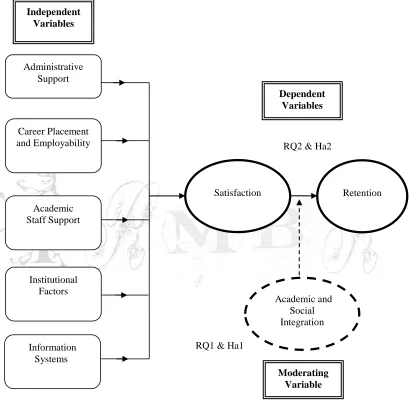
It is important to note that even though the research framework covers various independent, dependent and moderating variable, as for this research the satisfaction, moderated by academic and social integration, and finally retention is selected for discussion purposes. The research framework is presented in Figure 1.
Figure 1: Research Framework Model - The Relationship Between Service Delivery Quality Dimensions and Students’ Satisfaction and Retention Moderated by Academic and Social Integration
Satisfaction
Customer satisfaction is a very important element in the formation of customers’ desires for future purchases (Lai et al., 2011; Syed et al., 2011; Mittal & Kamakura, 2001). In addition, satisfied customers will probably talk to others about their good experience, which is regarded as positive word of mouth and is
Academic and Social Integration
Satisfaction Retention
Independent Variables
Dependent Variables
Moderating Variable RQ1 & Ha1
Administrative Support
Career Placement and Employability
Academic Staff Support
Institutional Factors
Information Systems
ISSN: 2306-9007 Ganesh, Haslinda & Raghavan (2017) 1546
I
www.irmbrjournal.com December 2017I
nternationalR
eview ofM
anagement andB
usinessR
esearchVol. 6 Issue.4
R
M
B
R
a common practice in all cultures, as social life has been shaped in such a way that social communication with other people improves the society (Jamal & Naser, 2002).
In respect of education institutions, students’ retention is important, as satisfied students are likely to be committed to their studies and to make greater effort to complete their programmes compared to unsatisfied students (Tessema, Ready & Yu, 2012).
Similar to a normal business environment, in the academic field, customer or student satisfaction is a key focus of concentration (Ibraheem, 2016; Sheikh & Moodi, 2013, Lee, 2013; Tuan, 2012; Danjuma & Rasli, 2012; Akhtar, 2011; Cengiz, 2010; Ling et al., 2010; Giese & Cote, 2002) There are large bodies of literature on customer satisfaction in many academic disciplines. Consumer satisfaction is a major research area and the central concept in modern business marketing thought and practice for companies’ long-run survival (Krishna, 2013; Ardabili & Daryani, 2012; Choy et al., 2012).
In the evaluation of satisfaction, it is essential to primarily define customer satisfaction in reference to the prevailing nature of customer satisfaction, and in reference to the education sector, students are referred to as customers. In this correlation, the discussion of theories that are considered as antecedents and their effects on customer satisfaction are emphasised. As mentioned earlier, in the context of higher education institutions, students are the primary customers (Abdullah, 2005a) and their satisfaction is crucial for the institution’s survival. It is also apparent that if they are dissatisfied, they may tend to withdraw from the respective higher education institution or even transfer to another institution (Danjuma & Rasli, 2012). This will lead to low student retention. Alternatively, if dissatisfied students stay in an institution because no alternative is available, they might not speak positively about the institution: this will affect the positive word of mouth referrals to future students, which in turn will affect the long-run survival of the institution (Anim & Mensah, 2015; Danjuma & Rasli, 2012).
Generally, satisfaction is defined as an attitude, similarly to the order of judgment which interprets a purchase act or a series of consumer product interactions or a person’s feeling of pleasure (Fararah & Al-Swidi, 2013; Guo, Ling & Liu, 2012; Ardabili & Daryani, 2012; Orsingher, Marzocchi & Valentini, 2011; Bose & Sarker, 2012; Tudoran, Olsen & Dopico, 2012, Syed et al., 2011; Lovelock & Wirtz, 2007). There is wide variance in the definition of satisfaction but a detailed analysis reveals that it encompasses three common components: one, satisfaction is a judgment response based on an emotional or cognitive feeling; two, the response is related to a particular focus, i.e. product performance, consumer value experiences in consumption and expectations or desires, or even some other norm of performance; finally, the occurrence of a response to concentration at a given time (Kayabasi et al., 2013; Vazquez et al., 2013; Hunt et al., 2012; Ardabili & Daryani, 2012 ; Syed et al., 2011; Giese & Cote, 2002).
Service Delivery Quality and Satisfaction in Education Institutions
Most of the empirical studies in education institutions have produced evidence that service delivery with quality leads to students’ satisfaction (Anwowie & Abrefa, 2015; Long et al., 2014; Talmacean et al., 2013; Lee & Ryu, 2013; Odeh, 2012; Al-Alak & Alnaser, 2012; Bergamo et al., 2012; Nesset & Helgesen, 2009) but a review of the literature highlights that there is a lack of consensus on the definition of satisfaction as a concept with service quality and generally there are no clearly accepted instruments to measure customer satisfaction in higher education institutions (Danjuma & Rasli, 2012; Al-Alak & Alnaser, 2012).
ISSN: 2306-9007 Ganesh, Haslinda & Raghavan (2017) 1547
I
www.irmbrjournal.com December 2017I
nternationalR
eview ofM
anagement andB
usinessR
esearchVol. 6 Issue.4
R
M
B
R
part of their process in order to be favoured by students as their primary fulfilment response, as satisfaction is indicated as the consumer’s fulfilment response and service quality is considered as the key performance measurement for excellence in the education industry (Talmacean & Domnica, 2013; Al-Alak & Alnaser, 2012; Ferguson & Phau, 2012; Iuliana & Mihai, 2011; Wei, 2011; Oliver, 1996; Tuan, 2012).
Some studies has shown satisfaction as mediator or moderator to reveal the possible linkage between independent and dependent variables for students perceived trust, loyalty and image of the institution (Mohamed, 2009; Ryu, Han & Kim, 2008). In looking into the position of satisfaction, it is emphasised that, perceived service quality is an antecedent to satisfaction, and it is also a major prerequisite for establishing and sustaining students’ satisfaction and retention (Vatta & Bhatara, 2013; Talmacean & Domnica, 2013; Zabadi, 2013; Danjuma & Rasli, 2012; Lawson et al., 2012; Hanaysha et al., 2011; Ling et al., 2010; Nadiri et al., 2009; Cronin & Taylor, 1992).
In concentration of this study the satisfaction construct is focused as having relationship to retention as put forward in the research framework to reveal the research findings indicating the relationship of service delivery quality, satisfaction, academic and social integration with retention in Malaysian private higher education institutions. This will show the effect that when students are satisfied or dissatisfied with the institution, they will display positive or negative attitudes and behaviour in related to the particular institution’s service delivery quality offered.
Students’ Retention in Education Institutions
Entering an education institution to earn a qualification is a major process of transition and sadly some students are not able to complete their studies and complete their qualifications because of their inability to adjust and cope with the academic system and the institution’s social environment (Raghavan & Ganesh, 2015; Hsu & Bailey, 2011). Studies have indicated that students’ involvement, good social fit between the student and the education institution and the quality of students’ interaction with the academic staff make key contributions to student retention as well to the institution’s success (Hsu & Bailey, 2011; Habley, 2004).
Customer retention is the key factor in business and it is defined as a particular firm’s capability to provide a customer not only with the purchased product, but also with a relationship pattern in a specific period of time (Bergamo, et al., 2012). As competition increases in the current turbulent education business environment and with the emergence of knowledge as a driver of economic development, higher education institutions and the industry worldwide encounter slower growth rates and price pressures, which have brought serious attention to customer satisfaction and retention (Danjuma & Rasli, 2012; Vedadi, Kolobandi & Pool, 2013; Rahman et al., 2012; Al-Alak & Alnaser, 2012).
Retention of customers will have a strong effect on the particular education institution’s profitability (Sheikh & Moodi, 2013, Lee, 2013; Tuan, 2012; Danjuma & Rasli, 2012; Lawson et al., 2012; Reichheld & Sasser, 1990; Johnson & Fornell, 1991).
ISSN: 2306-9007 Ganesh, Haslinda & Raghavan (2017) 1548
I
www.irmbrjournal.com December 2017I
nternationalR
eview ofM
anagement andB
usinessR
esearchVol. 6 Issue.4
R
M
B
R
In addition, other terms which are used in reference to retention include customer attachment, repurchase intent/repeat purchase and consumer loyalty (Abubakar & Mokhtar, 2015; Bergamo, et al., 2012; Danjuma and Rasli, 2012; Curtis, Abratt, Dion & Rhoades, 2011).
Hagedorn (2005) has described four types of retention. The first is the institutional type, which is most commonly used by colleges and universities by calculating the percentage of students who return to the same education institution year after year.
The second is the system type, which basically involves tracking the students: i.e. a student who leaves one college but enrols at another and completes his/her studies there is considered retained in the “system” and is a difficult and costly effort.
The third type is academic discipline, which focuses on retention within an academic specialization, within a specific specialization discipline and finally by course, where by retention is measured at particular programme level.
Tinto’s Interactionist Theory
Tinto’s interactionist theory, which was developed in 1975, highlighted that persistence occurs when a student successfully integrates into the institution academically and socially (Bergamo, et al., 2012; Tinto, 1975). Generally, integration is influenced by pre-college characteristics and goals as well as interactions with peers and faculty in combination with out-of-classroom factors (Lawson et al., 2012; Bergamo et al., 2012; Tinto, 1975; Jensen, 2011).
Tinto’s interactionist theory works through the application of Émile Durkheim’s suicide theory, which states that suicide is a result of a person’s breaking from society due lack of value integration, inability to cope and an inadequate sense of affiliation to become part of the collective society (Tinto, 1975; Hatos & Zoltan, 2011, Beard, 2011).
If withdrawal in the case of suicide is explained by lack of value integration, then the causal mechanism might be the same for students who drop out of education institutions (Hatos & Zoltan, 2011). In detail, Tinto’s interactionist theory views withdrawal from post-secondary education as similar to suicidal behaviour and suggests that student attrition/dropping out is due to inadequate social and academic integration into the institutional culture.
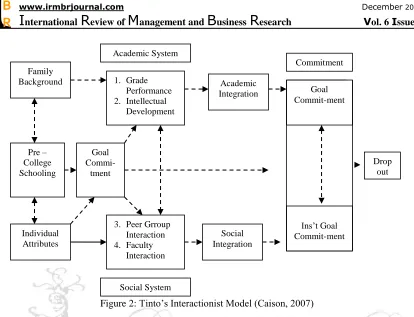
Tinto interprets that students enter an education institution with background characteristics, particularly family background, individual character, aptitude, and motivation. These become the basis for the student’s first stage of contact with the institution (Raghavan & Ganesh, 2015; Bergamo et al., 2012; Caison, 2007).
Further, the student interacts with the institutional environment and the experiences influence the student’s commitments and intentions to stay, and the longer students persist, from one semester to the next, the more likely they are to continue in the future (Bergamo et al., 2012; Schee, 2011, Tinto, 1993, Braxton, Hirschy, & McClendon, 2004). When students become more integrated into the institution’s culture, their goal commitment increases: this will encourage them to continue with their registration and academic progress will lead to retention (Bergamo et al., 2012; Braxton et al., 2004).
ISSN: 2306-9007 Ganesh, Haslinda & Raghavan (2017) 1549
I
www.irmbrjournal.com December 2017I
nternationalR
eview ofM
anagement andB
usinessR
esearchVol. 6 Issue.4
R
M
B
R
Figure 2: Tinto’s Interactionist Model (Caison, 2007)
In strengthening Tinto’s findings, Pascarella & Terenzini (1979) also demonstrated that the absence of sufficient contact with other members of the institution proves to be the single most important predictor of eventual student departure. These findings further confirm that coping socially in the context of students’ integration will influence students’ satisfaction and retention in the education institution.
Research also supports the need for social interaction, with students’ perceptions of support from peers, participation in extracurricular activities and social approach behaviours all being significant (Gerber et al., 2013; Neuville et al., 2007; Kuh, et al., 2007, Tinto 1975; Berger & Milem, 1999; Eaton & Bean, 1995; Bergamo et al., 2012; Christie & Dinham, 1991; Danjuma & Rasli 2012). Tinto also pointed out that for students to feel a sense of social integration, they need not fit in with the campus community at large as long as they feel that they fit within a particular subculture, which is sufficient to create a sense of belongingness (Tinto, 1993; Beard, 2011).
Given the above findings, it is essential that higher education institutions be aware of the detailed reasons why students depart prematurely. They should focus on proper strategy implementation to address students’ premature departure, as this will help students to overcome their barriers and ultimately to achieve their academic and career objectives with the institution (Bergamo et al., 2012; Lawson et al., 2012; Mannan, 2007).
Service delivery with quality is connected to retention. According to Ling et al. (2010), students’ performance and retention are particularly influenced by the service quality provided by the respective higher education institution. It is thus important to classify and identify the determinants of the total service quality. In addition, Sultan and Wong (2010), in looking at the future development of their performance-based service quality model, indicated that future research should concentrate on other aspects that are relevant to student retention. This clearly shows that students’ retention is an important element in the long run sustainable competitive advantage of education institutions.
Family Background
Pre – College Schooling
Individual Attributes
Goal Commi-
tment
1. Grade Performance 2. Intellectual
Development
3. Peer Grroup Interaction 4. Faculty
Interaction
Academic Integration
Social Integration
Goal Commit-ment
Ins’t Goal Commit-ment
Drop out Academic System
Social System
ISSN: 2306-9007 Ganesh, Haslinda & Raghavan (2017) 1550
I
www.irmbrjournal.com December 2017I
nternationalR
eview ofM
anagement andB
usinessR
esearchVol. 6 Issue.4
R
M
B
R
Academic and Social Integration
Students’ successful academic and social integration with the respective institution depends greatly on the extent to which they can cope with the demands and challenges faced during their course of study. In these contexts, coping is interpreted as constant changing of cognitive and behavioural efforts to manage goal-oriented processes and their specific external or internal demands through task, emotion and avoidance strategies (Ruus, Veisson, Leino, Ots, Pallas, Sarv & Veisson, 2007; Kausar, 2010; Heiman, 2008). In normal higher education institutions, the process of adapting and achieving university qualifications is generally stressful because students’ demands, expectations and goals each have their own weight. As revealed by Kausar (2010), students experience emotional and cognitive reactions to stress, especially due to external pressures and self-imposed expectations.
Further to that, academic and social integration was identified as a moderating factor quite some time ago, while personal and situational factors are key moderating variables in effectiveness of coping which relates to social environment (Spiter, Bar-Tal & Golander, 1995). Spiter et al. (1995) also demonstrated that academic factors are closely related to education progress through students’ adaptation, as well as the ability to search for information and the capacity for problem solving. Perception and discomfort in the university environment, academic enjoyment and motivation and psychological well-being were examined by Gavala and Flett (2005), who found that the moderating effect of perceived control in academic coping and the elements of high stress, greater perceived discomfort and lower sense of academic control led to a reduced sense of well-being and academic enjoyment and motivation, but that this was not the case under conditions where there was a high sense of academic control (Gavala & Flett, 2005).
This shows that a comfortable academic environment will increase perceived psychological well-being and academic enjoyment, which will contribute to motivation and will certainly have a positive effect on the institution’s student satisfaction and retention. In addition, research supports that coping socially in the context of students’ academic and social integration will influence students’ satisfaction and retention in the education institution, interacting with students’ perceptions of support from peers, participation in extracurricular activities and social approach behaviours (Gerber et al., 2013; Neuville et al., 2007; Kuh, et al., 2007, Tinto 1975; Berger & Milem, 1999; Eaton & Bean, 1995; Bergamo et al., 2012; Danjuma & Rasli 2012).
A particular student will encounter different types of interaction factors during a semester or period of education, namely academic demands, social adjustment and student engagement (Lawson et al., 2012; Kausar, 2010; Gerber et al., 2013). This is clearly explained in Tinto’s theory, which emphasises the need for students to cope and adapt to the academic and social demands, with a particular focus on the relationship of students’ ability to integrate within the university environment, improves their likelihood of remaining at the university and obtaining a degree (Gerber et al., 2013; Kuh et al., 2007; Pike, Gary, Simpson & Ellen, 1997).
Coping academically and socially in terms of how well the student integrates will influence student satisfaction and retention in the education institution (Neuville et al., 2007; Kuh et al., 2007, Tinto 1975; Bergamo et al., 2012; Gerber et al., 2013; Gavala & Flett, 2005, Pike et al., 1997). In academic terms, it refers to satisfactory compliance with passing grades and intellectual development (Hatos & Zoltan 2011). Social aspects particularly refer to students’ adjusting to university life, living apart from friends and family in a new environment within a short period of time and integrating with their peer groups and faculty. Studies have shown that students who are satisfied with their courses tend to score highly in social aspects as well (Al-Alak & Alnaser, 2012; Hatos & Zoltan 2011). This is an important element to consider when managing students’ retention.
ISSN: 2306-9007 Ganesh, Haslinda & Raghavan (2017) 1551
I
www.irmbrjournal.com December 2017I
nternationalR
eview ofM
anagement andB
usinessR
esearchVol. 6 Issue.4
R
M
B
R
academic and social aspects. This is in line with Tinto’s examination of retention from students’ perspectives, which revealed that students’ departure stems from two factors. The first is student goals, which are linked to background characteristics and intention for academic progress prior to and at the beginning of their study. The second is students’ integration into the university community (Neuville et al., 2007; Kuh et al., 2007). This takes place when the students have begun their study in the education institution and it relies upon the students’ ability to generate relationships with other institutional members, such as their classmates and faculty members, and also upon their ability to cope with the institution’s culture and its academic challenges (Bergamo et al., 2012; Tinto, 1975). In order to manage the above, the institution’s action to aid students’ socialisation is important.
Similarly, Vatta and Bhatara (2013) argue that to overcome the difficulty of assimilating a great deal of content in a short period of time in the student’s academic life, positive adaptation to the extensive formal and informal interaction with academic staff is important. When this association is applied, it will reduce stress in the student’s life and it will certainly improve retention and increase student persistence (Kausar, 2010; Van-Rooijen, 1986; Hatos & Zoltan 2011).
Relationship between Academic and Social Integration and Students’ Satisfaction towards Retention
Studies have shown that there is a significant relationship between academic and social integration in the context of students’ coping as a key moderator for students’ satisfaction towards retention or persistence in the education institution, and academic and social integration is also mentioned as a significant predictor. (Gerber, Mans-Kemp & Schlechter, 2013; Kausar, 2010; Braxton & Hirschy, 2004; Pike, Gary, Simpson & Ellen, 1997; Van-Rooijen, 1986; Tinto, 1975; Jensen, 2011; Hagedorn, 2005; Caison 2007; Ling et al., 2010; Kuh, Kinzie, Buckley, Bridges & Hayek, 2007; Spiter, Bar-Tal & Golander, 1995; Gavala & Flett, 2005). Social aspects and academic life are important elements for retention: it is seen that satisfied students tend to achieve high scores on social aspects and positive adaptation has a favourable effect if there is formal and informal contact with the academic environment of the institution (Braxton & Hirschy, 2004; Al-Alak & Alnaser, 2012; Vatta & Bhatara, 2013; Danjuma & Rasli, 2012).
Previous studies have also revealed that social integration in the context of students’ coping with support from peers, students’ participation in extracurricular activities and social approach behaviours used in education institutions will influence students’ perception and affect their satisfaction and retention in the education institution (Gerber et al., 2013; Neuville, Frenay, Schmitz, Boudrenghien, Noel & Wertz, 2007; Kuh, et al., 2007, Tinto, 1975; Berger & Milem, 1999; Eaton & Bean, 1995; Bergamo et al., 2012; Danjuma & Rasli 2012).
Relationship between Students’ Satisfaction and Students’ Retention
Findings have indicated that satisfaction is considered as a key factor in the retention of an organisation’s customers, or students in reference to education institutions (Tessema et al., 2012; Tuan 2012; Rahman et al., 2012; Al-Alak & Alnaser, 2012; Lawson et al., 2012, Wei, 2011; Thomas, 2011; Hanaysha, 2011). With satisfaction in place, retention of primary customers will have a strong effect on the particular institution’s profitability (Sheikh & Moodi, 2013; Lee, 2013; Tuan, 2012; Danjuma & Rasli, 2012; Lawson et al., 2012; Reichheld & Sasser, 1990; Johnson & Fornell, 1991).
ISSN: 2306-9007 Ganesh, Haslinda & Raghavan (2017) 1552
I
www.irmbrjournal.com December 2017I
nternationalR
eview ofM
anagement andB
usinessR
esearchVol. 6 Issue.4
R
M
B
R
Sampling Methods and Sampling Techniques
This study used a probability stratified random sampling design with guidance from the participating education institutions to obtain an effective way to target respondents.
The process of selecting the respondents was based on the total size of the population (students of private higher education institutions) was identified as N = 460,145. According to Krejcie and Morgan (1970, cited in Sekaran, 2005), the population size decision indicates that a sample of 384 respondents is appropriate for a study involving a population of more than 100,000. In addition, with an increase of 30% to achieve a large sample size without errors, the total sample size was adjusted to 500 students. This similarly argued by Delice (2010) indicating that it is important and sufficient to emphasise a sample size of 500 at 5% confidence level and in addition, according to Cohen (2000) it is advisable to always overestimate the sample size.
Data Collection Methods
The data collection methods used for this correlational study were collected via a structured questionnaire which was distributed to students of private higher education institutions, irrespective of whether they were full-time or part-time, local or international, male or female. The questionnaire is the research instrument and the units of analysis are the responses to the questions or statement posed to the students in relation to the study. The survey was handled with close supervision.
Data Analysis Techniques
The total number of questionnaires received was 358, from 406 students approached. This sample yielded 309 fully completed questionnaires, of which 152 were from colleges/institutions, 46 from university colleges and 111 from universities. Thus, a sample size of 309 was used for the final analysis and the findings were analysed accordingly and systemically interpreted with justification. Factor analysis and normality testing were first conducted to identify the structure within the observed variables.
Results and Discussions
Moderation analysis and finding on the relationship between academic and social integration and students’ satisfaction to towards retention
Moderation analysis was used to determine whether academic and social integration affects the relationship between satisfaction and retention. The interaction effect of academic and social integration with the context of coping focuses on the link between satisfaction and retention through the application of this research framework and its theoretical identification of the perceived performance view and Tinto’s interactionist view on students’ academic and social integration.
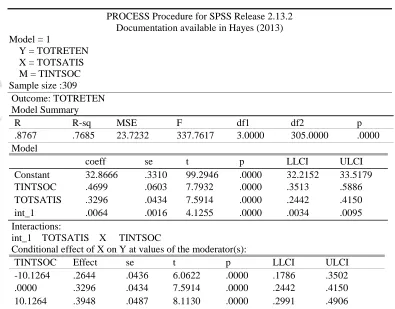
The model summary shown in Table 1 reveals that R = .88 and R2 = .77. This clearly indicates that the model is predicting 77% of the variance in retention. The F, dfs, and p-values indicate that academic and social integration and satisfaction significantly predicts retention (F (3, 305) = 337.76, p < .001). This indicates that the moderator (academic and social integration) is moderating the relationship between satisfaction and retention. According to Cohen (1988), this is considered as a large effect size and demonstrates a statistically significant positive relationship between satisfaction and retention. The interaction effect is highly significant, at b = 0.0064, 95% CI [0.0034, 0.0095], t = 4.13, p< .001 (Table 1).
ISSN: 2306-9007 Ganesh, Haslinda & Raghavan (2017) 1553
I
www.irmbrjournal.com December 2017I
nternationalR
eview ofM
anagement andB
usinessR
esearchVol. 6 Issue.4
R
M
B
R
relationship also holds when academic and social integration is at the mean (b = .33, 95% CI [.24, .41], t = 7.59, p < .001) and when it is high (b = .39, 95% CI [.30, .49], t = 8.11, p < .001). These findings indicate that the relationship between students’ satisfaction and retention is moderated by academic and social integration in Malaysian private higher education institutions. It is thus possible to accept Hypothesis 1 – Academic and social integration positively moderates students’ satisfaction towards retention.
This finding is conceptually and empirically consistent with previous studies indicating that increasing the coping factors in academic and social integration as a dimension of education institutions’ service delivery quality will increase students’ retention and control dropouts. A comfortable academic environment will increase students’ perceived psychological well-being and academic enjoyment, which will produce a positive effect on the institution’s student satisfaction and retention. Interaction with peers, participation in extracurricular activities and social approach behaviours in the context of students’ social integration will also influence students’ satisfaction and retention (Gerber et al., 2013; Neuville., et al 2007; Kuh, et al., 2007, Tinto 1975; Berger & Milem, 1999; Eaton & Bean, 1995; Bergamo et al., 2012; Danjuma & Rasli 2012).
Table 1: PROCESS Procedure - Moderation Effect
In short, the finding of a positive significant role of academic and social integration as a moderating variable between satisfaction and retention not only support other previous empirical findings (Beard, 2011; Gavala & Flett, 2005) but also lends credence to Tinto’s Interactionist theory in the view of recognising the interaction effect of academic and social integration with students’ experience in education institutions. This finding also lends evidence to the argument on the importance of integrating both academic and social factors for students’ satisfaction and retention in private education institutions (Gerber
PROCESS Procedure for SPSS Release 2.13.2 Documentation available in Hayes (2013) Model = 1
Y = TOTRETEN X = TOTSATIS M = TINTSOC Sample size :309 Outcome: TOTRETEN Model Summary
R R-sq MSE F df1 df2 p
.8767 .7685 23.7232 337.7617 3.0000 305.0000 .0000 Model
coeff se t p LLCI ULCI
Constant 32.8666 .3310 99.2946 .0000 32.2152 33.5179
TINTSOC .4699 .0603 7.7932 .0000 .3513 .5886
TOTSATIS .3296 .0434 7.5914 .0000 .2442 .4150
int_1 .0064 .0016 4.1255 .0000 .0034 .0095
Interactions:
int_1 TOTSATIS X TINTSOC
Conditional effect of X on Y at values of the moderator(s):
TINTSOC Effect se t p LLCI ULCI
-10.1264 .2644 .0436 6.0622 .0000 .1786 .3502
.0000 .3296 .0434 7.5914 .0000 .2442 .4150
ISSN: 2306-9007 Ganesh, Haslinda & Raghavan (2017) 1554
I
www.irmbrjournal.com December 2017I
nternationalR
eview ofM
anagement andB
usinessR
esearchVol. 6 Issue.4
R
M
B
R
et al., 2013; Neuville. et al 2007; Kuh, et al., 2007, Tinto 1975; Tinto 1993; Berger & Milem, 1999; Eaton & Bean, 1995; Bergamo et al., 2012; Danjuma & Rasli 2012).
In addition, most importantly, this research finding clearly highlights that despite the experience of satisfaction, it is the conditional effect of academic and social integration which will determine the students’ retention level in private higher education institutions. Thus, from this research framework, it can be interpreted that the relationship between satisfaction and retention will be greater for students who have experienced the coping of academic and social integration as a service delivery quality compared to those who have not experienced it. This indicates that private higher education institutions should give primary importance to academic and social integration service delivery quality to achieve a high level of students’ retention.
Overall, this finding not only supports other previous empirical findings but also lends credence to Tinto’s interactionist view and reaffirms that when students cope successfully and integrate academically and socially into education institutions, student retention is achieved. This research further reveals that even though students’ pre-college or background characteristics are not considered, retention can be improved through exercising the perceived performance view of service delivery. The relationship between satisfaction and retention will be greater for students who have experienced academic and social integration in their respective institutions.
Finding on the relationship between students’ satisfaction and students’ retentionthe relationship between satisfaction and students’ retention was investigated using Pearson’s product-moment correlation coefficient. Table 2 highlights a strong, positive correlation between satisfaction and retention (r = 0.91, n
= 309, p < 0.01), with high levels of satisfaction being associated with high levels of retention. As for the variance shared between the two variables, the coefficient of determination (r² = 82.81) indicates that satisfaction helps to explain nearly 82% of the variance in retention.
Table 2: Correlation Between Satisfaction and Retention
total
satisfaction total retention Total satisfaction Pearson Correlation 1 .914**
Sig. (2-tailed) .000
N 309 309
Total retention Pearson Correlation .914** 1
Sig. (2-tailed) .000
N 309 309
**. Correlation is significant at the 0.01 level (2-tailed).
In order to strengthen the findings on the relationship between satisfaction and retention, simple linear regression was used, and the model was able to explain 83.5% (Table 3) of the variance in satisfaction (F
(1, 307) = 1562.00, p < 0.001: see Table 4). As shown in Table 5, satisfaction is statistically significant, with a beta value of 0.91 (p < 0.001). This finding supports Hypothesis 2: Students’ satisfaction is positively related to students’ retention.
Table 3:Model Summaryb – Satisfaction
Model R R Square
Adjusted R Square
Std. Error of the Estimate
1 .914a .836 .835 4.16519
ISSN: 2306-9007 Ganesh, Haslinda & Raghavan (2017) 1555
I
www.irmbrjournal.com December 2017I
nternationalR
eview ofM
anagement andB
usinessR
esearchVol. 6 Issue.4
R
M
B
R
Table 4:ANOVAa – Satisfaction
Table 5:Coefficientsa – Satisfaction
The significant positive relationship between satisfaction and retention in Pearson product-moment correlation coefficients and the simple linear regression model results are not unexpected, and support the conceptual findings of other previous studies, such as the works of Singh and Singh (2006), Abdullah (2005a), Nesset and Helgesen (2009), DeShields, Kara and Kaynak (2005), Danjuma and Rasli (2012), and Jensen (2011). In addition,Rahman et al. (2012) argue that the performance of service quality dimensions leads to satisfaction, and satisfaction has an impact on retention or dropout and on the academic accomplishment of the particular student.
These findings are similar to that of Suhre, Jansen and Harskamp (2007), who examined 186 degree students. They found that academic ability, satisfaction with degree program, motivation, study habits and tutorial attendance all had significant positive effects on academic accomplishment and these factors explained about 49% of the variance in the total number of credits students acquired and 31% of the variance in student retention. With the support of other previous empirical findings, this study also provides credibility for the perceived performance view on the significant relationship between students’ satisfaction and retention in private higher education institutions in Malaysia.
Conclusion
Satisfaction and retention among students in private higher education institutions are essential and will critically determine the education institution’s survival in the Malaysian education industry as Asia’s education hub. The performance of service delivery quality dimensions in relation to satisfaction and retention in private higher education institutions, with academic and social integration as a moderator, can effectively produce the required focus as to where each private higher education institutions should place its value proposition for a favourable outcome on its students’ satisfaction and eventually students’ retention for its business success.
References
Abubakar, M.M., & Mokhtar, S.S.M. (2015). Relationship Marketing, Long Term Orientation And Customer Loyalty In Higher Education, Mediterranean Journal of Social Sciences, 6(4), 466–474. Abdullah, F. (2005a). The development of HEdPERF: A New Measuring Instrument Of Service Quality
For Higher Education Sector, International Journal of Consumer Studies, 30, 569–581.
Model Sum of Squares df Mean Square F Sig.
1 Regression 27098.845 1 27098.845 1562.003 .000b
Residual 5326.074 307 17.349
Total 32424.919 308
a. Dependent Variable: total retention b. Predictors: (Constant), total satisfaction
Model
Unstandardized Coefficients
Standardized Coefficients
T Sig.
B Std. Error Beta
1 (Constant) 2.884 .790 3.649 .000
total
ISSN: 2306-9007 Ganesh, Haslinda & Raghavan (2017) 1556
I
www.irmbrjournal.com December 2017I
nternationalR
eview ofM
anagement andB
usinessR
esearchVol. 6 Issue.4
R
M
B
R
Abdullah, F. (2006).Measuring Service Quality in Higher Education: HEdPERF Versus SERVPERF,
Marketing Intelligence & Planning, 24(1), 31-47.
Akhtar, J. (2011). Determinants Of Service Quality And Their Relationship With Behavioural Outcomes: Empirical Study Of The Private Commercial Banks In Bangladesh, 6(11), 146-156.
Al-Alak, B., & Alnaser, A.S.M. (2012). Assessing The Relationship Between Higher Education Service Quality Dimensions And Student Satisfaction. Australian Journal of Basic and Applied Sciences, 6(1), 156-164.
Anim, S.K. & Mensah, J. (2015). Service Quality In Higher Education: A Comparative Study In Tertiary Institution In Sub Saharan Africa. Global Journal of Educational Studies, 1(2), 24-44.
Anwowie, S., Amoako, J., & Abrefa, A.A. (2015). Assessment Of Students’ Satisfaction Of Service Quality In Takoradi Polytechnic: The Stdents’ Perspective, Journal of Education and Practice, 6(29), 148-154.
Ardabili, F.S., & Daryani, S.M. (2012). Customer Satisfaction Based On The Missing Aspects: Instinct Factors And Emotion. Australian Journal of Basic And Applied Sciences, 6(12), 86-90.
Beard, J.B.(2011). Identifying Predictors Of Social Functing In College Students: A Meta Analysis,
Electronic Theses and Dissertation, Paper 89.
Bergamo, F.V.M., Giuliani, A.C., Camargo, S.H.C.R.V., Zambaldi, F., & Ponchio, M.C. (2012). Student Loyalty Based on Relationship Quality: An analysis On Higher Education Institutions. Brazilian
Business Review, 9(2), 26-46.
Berger, J. B., & Milem, J. F. (1999). The role of student involvement and perceptions of integration in a causal model of student persistence. Research in Higher Education, 40, 641-664.
Bose, T.K. & Sarker, S. (2012). Cognitive Dissonance Affecting Consumer Buying Decision Making: A Study Based On Khulna Metropolitan Area. Journal of Management Research, 4(3), 191-221.
Braxton, 1. M., & Hirschy, A. S. (2004). Reconceptualizing antecedents of social integration in student departure. In M. Yorke & B. Longden, Retention and success in higher education (pp. 113-128). Buckingham: Open University Press.
Cabrera, A. F., Nora, A., & Castenada, M. B. (1993). College persistence: Structural equations modeling test of an integrated model of student retention. Journal of Higher Education, 64(2), 123-139.
Caison, A.L. (2007). Analysis of Institutionally Specific Retention Research: A Comparison Between Survey And Institutional Database Methods. Research in Higher Education,48(4), 435-451.
Cengiz, E. (2010). Measuring Customer Satisfaction: Must Or Not?, Journal of Naval Science And Engineering, 6(2), 76–88.
Choy, J.E., Lam, S.Y., & Lee, T.C. (2012). Service Quality, Customer Satisfaction And Behavioural Intentions: Review of Literature And Conceptual Model Development. International Journal of Academic Research, 4(3), 11-15.
Christie, N.G., & Dinham, S. M. (1991). Institutional And External Influences On Social Integration In The Freshman Year. Journal of Higher Education, 62, 412- 436.
Cohen, J. (1988). Statistical Power Analysis For Behavioral Sciences. Lawrence Erlbaum Associates. New Jersey.
Cronin, J.J., & Taylor S.A. (1992). Measuring Service Quality: A Reexamination And Extension, Journal of Marketing, 56, 55-68.
Curtis, T., Abratt, R., Dion, P., & Rhoades, D. (2011). Customer Satisfaction, Loyalty And Repurchase: Some Evidence From Apparel Consumers. Review of Business Research, 32(1), 47-57.
Danjuma, I., & Rasli A. (2012). Service Quality, Satisfaction And attachment In Higher Education Institutions: A Theory Of Planned Behaviour Perspective. International Journal of Academic Research, 4(2), 96-103.
Davidson, W.B., Beck, H.P., & Milligan, M. (2009). The College Persistence Questionnaire: Development And Validation Of An Instrument That Predicts Students Attrition. Journal of College Student
Development, 50(4), 373-390.
DeShields, O.W., Kara, A., & Kaynak, E. (2005). Determinants of Business Student Satisfaction And Retention in Higher Education: Applying Herzberg’s Two-Factor Theory, International Journal of
ISSN: 2306-9007 Ganesh, Haslinda & Raghavan (2017) 1557
I
www.irmbrjournal.com December 2017I
nternationalR
eview ofM
anagement andB
usinessR
esearchVol. 6 Issue.4
R
M
B
R
Eaton, S. B., & Bean, J. P. (1995). An Approach/Avoidance Behavioral Model of College Student Attrition. Research in Higher Education, 36, 617-645.
Ebert R.J., & Griffin R. W. (2007). Business Essentials, (6th ed.). USA, Prentice Hall.
Eraghi, G.F., & Atharinejad, S.E.Y. (2012). A New Approach Based On Total Quality Management (TQM) For Improving Academic Libraries Qualities Services. International Journal of Natural and Engineering Sciences, 6(2), 33-38.
Fararah, F.S., & Al-Swidi, A.K., (2013). The Role of the Perceived Benefits On The Relationship Between Service Quality and Customer Satisfaction: A Study On The Islamic Microfinance And SMEs In Yemen Using PLS Approach, Asian Social Science, 9(10), 18-36.
Ferguson, G. & Phau, I. (2012). A Cross-National Investigation Of University Students’ Complaining Behaviour And Attitudes To Complaining. Journal of International Education in Business, 5(1), 50-70.
Gavala, J.R., & Flett, R. (2005). Influential Factors Moderating Academic Enjoyment/ Motivation And Psychological Well-Being For Maori University Students At Massey University. New Zealand Journal of Psychology, 34(1), 52-57.
Gerber, C., Mans-Kemp, N., & Schlechter, A. (2013). Investigating The Moderating Effect Of Students Engagement On Academic Performance. Acta Academica, 45(4), 256-274.
Giese, J.L., & Cote, J.A. (2002). Defining Consumer Satisfaction, Academic of Marketing Science Review,
1, 2–24.
Guo, X., Ling, C.L., & Liu, M. (2012). Evaluating Factors Influencing Consumer Satisfaction Towards Online Shopping In China, Asian Social Science, 8(13), 40–50
Habley, W. R. (2004). The Status of Academic Advising: Findings from the ACT Sixth National Survey.
National Academic Advising Association, 10, 14-26.
Hagedorn, L.S. (2005). How To Define Retention: A New Look At An Old Problem. The Transfer And
Retention of Urban Community College Student Project,1-26.
Hanaysha, J.R.M., Abdullah, H.H., & Warokka, A. (2011). Service Quality And Students’ Satisfaction at Higher Learning Institutions: The Competing Dimensions of Malaysian Universities’ Competitiveness.
Journal of Southeast Asian Research,201, 1–10.
Hatos, A., & Zoltan, G. (2011). Student Persistence In Higher. A Literature Review. Higher Education For
Social Cohesion-Cooperative Research And Development In A Cross-Border Area, 253-259.
Hayes, A.F. (2013). Introduction to Mediation, Moderation, and Conditional Process Analysis – A
Regression Based Approach. A Division of Guilford Publication Inc, New York.
Heiman, T. (2008). The Effects Of E-Mail Messages In A Distance Learning University On Perceived Academic And Social Support, Academic Satisfaction, And Coping. Quarterly Review of Distance Education, 9(3), 237–248.
Hsu, M., & Bailey, A. (2011). Retention In Business Education: Understanding Business Student Perceptions Of Academic Advising A College Life. International Journal of Business and Social Science, 2(21), 33-41.
Hunt, D.M., Oneto, S.G., & Varca, P.E. (2012). Satisfaction in The Context Of Customer Co-Production: A Behavioral Involvement Perspective. Journal of Consumer Behaviour, 11, 347–356.
Ibraheem, M. K. (2016). Relationship Between Perceived Service Quality And Student’s Satisfaction Among Undergraduate Students: A Case Study Of Private Higher Education Institute In Dubai.
International Journal of Emerging Research in Management Technology, 5(3), 70-74.
Iuliana, P., & Mihai, I.D. (2011). Knowing Our “Clients” For A Better Management In Higher Education Services. Journal of Academic Research In Economics.3(3), 355-362.
Jamal, A., & Naser, K. (2002). Customer Satisfaction And Retail Banking: An Assessment of Some Of The Key Antecedents of Customer Satisfaction In Retail Banking. International Journal of Bank Marketing, 20(4), 146-160.
ISSN: 2306-9007 Ganesh, Haslinda & Raghavan (2017) 1558
I
www.irmbrjournal.com December 2017I
nternationalR
eview ofM
anagement andB
usinessR
esearchVol. 6 Issue.4
R
M
B
R
Johnson, M.D. & Fornell, C. (1991). A framework For Comparing Customer Satisfaction Across Individuals And Product Categories. Journal of Economics Psychology, 12, 267-286.
Kausar, R. (2010). Perceived Stress, Academic Workloads And Use Of Coping Strategies By University Students. Journal of Behavioural Sciences,20, 31-45.
Kayabasi, A., Celik, B., & Buyukarslan, A. (2013). The Analysis Of The Relationship Among Perceived Electronic Service Quality, Total Service Quality And Total Satisfaction In Banking Sector.
International Journal of Human Sciences, 10(2), 304-325.
Kimani, S.W., Kagira, E.K., & Kendi, L. (2011). Comparative Analysis Of Business Students’ Perceptions Of Service Quality Offered In Kenyan Universities. International Journal of Business Administration, 2(1), 98-112.
Krejcie, R.V., & Morgan, D.W. (1970). Determining Sample Size For Resarch Activities, Educational and Psychological Measurement, 14, 607-610.
Krishna, K.G. (2013), A Study On Customer Satisfaction, Golden Research Thoughts, 2, 1–5.
Kuh, G.D., Kinzie, J., Buckley, J.A., Bridges, B.K., & Hayek, J.C. (2007). Major Theoretical Perspectives On Student Success In College. Piecing Together The Student Success Puzzle: Research, Propositions, And Recommendations. ASHE Higher Education Report, 32(5), 13-20.
Kunanusorn, A., & Puttawong, D. (2015). The Mediating Effect Of Satisfaction On Student Loyalty To Higher Education Institution, European Scientific Journal, 449-463.
Lai, M.M., Lou S.H., Yusof, N.A.M., & Chew, K.W. (2011). Perceived Factors And Value By Undergraduates On Private University Education, International Conference on Innovation,
Management and Service, 14, 34–38.
Lawson, A., Leach, M., & Burrows, S. (2012). The Implications For Learners, Teachers And Institutions of Using Student Satisfaction As A Measure Of Success: A Review Of The Literature. Education Journal,138, 7-11.
Lee, S.H. (2013). Major Moderators Influencing The Relationships Of Service Quality, Customer Satisfaction And Customer Loyalty, Asian Social Science, 9(2), 1-11.
Lee, Y.T. & Ryu, S.K. (2013). A Study On The Effect Of Education Information System On Internal Factors Of School Organisation. Applied Mathematics & Information Sciences.7(6), 2279-2283. Ling K.C., Piew T.H., & Chai L.T. (2010). The Input Model Of Education Quality on the Overall Students’
Perceived Service Quality, Canadian Social Science, 6(2), 125-144.
Long, C.S., Ibrahim, Z., & Kowang, T.O. (2014). An Analysis On The Relationship Between Lecturers’ Competencies And Students’ Satisfaction. International Education Studies,7(1), 37–46.
Lovelock, C., & Wirtz, J., (2007). Service Marketing: People, Technology & Strategy. (6th ed.). USA, Prentice Hall, Inc.
Mannan, M.A. (2007). Student Attrition And Academic And Social Integration: Application Of Tinto’s Model At The University Of Papua New Guinea. Higher Education, 53, 147-165.
Mittal, V., & Kamakura, W.A. (2001). Satisfaction, Repurchase Intent, And Repurchase Behavior: Investigating The Moderating Effect Of Customer Characteristics. Journal of Marketing Research, 38(1), 131-142.
Mohamad, M. (2009). Building Corporate Image And Securing Student Loyalty In MALAYSIAN Higher Learning Industry. The Journal of International Management Studies, 4(30), 30-40.
Nadiri, H., Kandampully, J., & Hussain, K. (2009). Students’ Perceptions Of Service Quality In Higher Education, Total Quality Management.20(5), 523-535.
Nesset, E., & Helgesen, Ø. (2009). Modeling and Managing Student Loyalty: A Study of a Norwegian University College. Scandinavian Journal of Educational Research,53(4), 327–345.
Neuville, S., Frenay, M., Schmitz, J., Boudrenghien, G., Noel, B., & Wertz, V. (2007). Tinto’s Theoretical Perspective And Expectancy-Value Paradigm: A Confrontation To Explain Freshmen’s Academic Achievement. Psychologica Belgica, 47(1/2), 31-50.
ISSN: 2306-9007 Ganesh, Haslinda & Raghavan (2017) 1559
I
www.irmbrjournal.com December 2017I
nternationalR
eview ofM
anagement andB
usinessR
esearchVol. 6 Issue.4
R
M
B
R
Orsingher, C., Marzocchi, G.L., & Valentini, S. (2011), Consumer (Goal) Satisfaction: A Means-Ends Chain Approach, Psychology & Marketing, 28(7), 730–748.
Pascarella, E.T. & Terenzini, P.T. (1979). Interaction Effects in Spady and Tinto’s Conceptual Models of College Attrition. Sociology of Education, 52(4), 197–210.
Pike, Gary, R., Simpson, & Ellen, M. (1997, May, 18-21). The Relationship Between Academic Achievement And Satisfaction: Evidence Of Moderating Effect For Academic And Social Integration. Paper presented at The Annual Forum of the Association for Institutional Research, Orlando.
Raghavan, S., & Ganesh, R. (2015). Addressing Service Quality to Increase Students’ Satisfaction and Retention in Malaysian Private Higher Education Institutions. American Journal of Economics, 5(2), 243–250.
Rahman, S.M., Khan, H.A., & Haque, M.M. (2012). A Conceptual Study On The Relationship Between Service Quality Towards Customer Satisfaction: Servqual And Gronroos’s Service Quality Model Perspective. Canadian Centre of Science and Education, 8(13), 201–210.
Reichheld, F.F. & W.E. Sasser, Jr. (1990). Zero defections: Quality Comes To Services. Harvard Business
Review, September-October, 105-l 11.
Ruus, V.R., Veisson, M., Leino, M., Ots, L., Pallas, E.S.S., & Veisson, A. (2007). Students’ Well Being, Coping, Academic Success And School Climate. School Behavior and Personality, 35(7), 919–936. Ryu, K., Han, H., & Kim, T.H. (2008). The Relationship Among Overall Quick-Casual Restaurant Image,
Perceived Value, Customer Satisfaction and Behavioral Intention. International Journal of Hospitality Management, 27, 459-469.
Schee, B.A.V. (2011). Students As Consumers: Programming for Brand Loyalty. Service Marketing Quarterly, 32, 32–43.
Sheikh, R., & Moddi, N. (2013). New Approach In The Design Service Quality Using Axiomatic Design.
Australian Journal of Basic Applied Sciences, 7(4), 223-232.
Singh, G.K.G., & Singh S.K.G. (2008). Malaysian Graduates’ Employability Skills. UNITAR E- Journal, 4(1), 15-45.
Spitzer, A., Bar-Tal, Y., & Golander, H. (1995). The Moderating Effect Of Demographic Variables On Coping Effectiveness. Journal of Advanced Nursing, 22, 578-585.
Suhre, C.J.M., Jansen, E.P.W.A., & Harskamp, E.G. (2007). Impact Of Degree Program Satisfaction On The Persistence Of College Students. Higher Education, 54, 207-226.
Sultan, P., & Wong, H. (2010). Performance-Based Service Quality Model: An Empirical Study On Japanese Universities, Quality Assurance in Education,18(2) 126–143.
Syed, T.H., Akhtar, N., & Khan, N. (2011). Consumer or Customer – Does The Literature Care For A Difference?. Interdisciplinary Journal of Contemporary Research In Business, 2(12), 618-628.
Talmacean, I., & Domnica, M.D. (2013). Viewpoints Concerning Educational Quality Management At A Superior Level. Management and Economics, Nicolae Balcescu Land Forces Academy, 2(70), 198-204.
Talmacean, I., Georgescu, N., Domnica, M.D., & Anttila, C. (2013). Case Study Regarding The Students Assessment of The Service Provided By Private Universities. Accredited vs Approved Universities.
Management and Economics, Nicolae Balcescu Land Forces Academy,3(71), 314-320.
Tessema, M.T., Ready, K., & Yu, W.C.W. (2012). Factors Affecting College Students’ Satisfaction With Major Curriculum: Evidence From Nine Years Data. International Journal of Humanities and Social Science, 2(2), 34-44.
Tinto,V. (1975). Dropout From Higher Education: A Theoretical Synthesis of Recent Research. Review of
Educational Research,45, 89-125.
Tinto,V. (1993). Leaving College; Rethinking The Causes And Cures Of Student Attrition. (2nd ed.). Chicago, USA, University of Chicago Press.
Tuan N. M. (2012). Effects Of Service Quality And Price Fairness On Student Satisfaction, International
Journal of Business and Social Science, 3(19), 132 – 150.
ISSN: 2306-9007 Ganesh, Haslinda & Raghavan (2017) 1560
I
www.irmbrjournal.com December 2017I
nternationalR
eview ofM
anagement andB
usinessR
esearchVol. 6 Issue.4
R
M
B
R
Vatta, S., & Bhatara, M. (2013). Quality Of Service And Satisfaction Among Students In Private Higher Education Institutes In India. Golden Research Thoughts, 2(9), 1-7.
Van-Rooijen, L. (1986). Advanced Students' Adaptation To College. Higher Education, 15(3-4), 197-209. Vazquez, M. V., Camacho, M.A.R., & Silva, F.J.C. (2013). The Value Co-creation Process as A
Determinant of Customer Satisfaction. Management Decision, 51(10), 1945-1953.
Vedadi, A., Kolobandi, A., & Pool, H.K. (2013). The Effect of Customer Value And Satisfaction on Customer Loyalty: The Moderating Role of Ethical Reputation. International Journal of Basic Sciences & Applied Research,2(5), 453-458.
Wei, C.C. (2011). Students Satisfaction Towards The University: Does Service Quality Matters?.
International Journal of Education,3(2), 1–15.