_____________________________________________________________________________________________________ *Corresponding author: E-mail: [email protected];
(Past name: British Journal of Pharmaceutical Research, Past ISSN: 2231-2919, NLM ID: 101631759)
The Effect of Nursing Communication Skills Training
on Satisfaction of Patients Undergoing
Hemodialysis
Zahra Salmani
1, Hossein Shiri
2*, Malahat Nikravan Mofrad
2and Malihe Nasiri
31
Student Research Committee, School of Nursing and Midwifery, Shahid Beheshti University of Medical Sciences, Tehran, Iran.
2
Department of Medical Surgical Nursing, School of Nursing and Midwifery, Shahid Beheshti University of Medical Sciences, Tehran, Iran.
3
Department of Basic Sciences, School of Nursing and Midwifery, Shahid Beheshti University of Medical Sciences, Tehran, Iran.
Authors’ contributions
This work was carried out in collaboration among all authors. Authors ZS and HS designed the study, performed the statistical analysis, wrote the protocol and wrote the first draft of the manuscript. Authors MN and ZS managed the analyses of the study. Author MNM managed the literature searches. All authors read and approved the final manuscript.
Article Information
DOI: 10.9734/JPRI/2019/v31i630383 Editor(s): (1) Dr. Syed A. A. Rizvi, Department of Pharmaceutical Sciences, Nova Southeastern University, USA. Reviewers: (1)Rajathi Sakthivel, Hindu Mission College of Nursing, The Tamil Nadu Dr. M.G.R. Medical University, India.
(2)Agnieszka Turoń – Skrzypińska, Pomeranian Medical University, Poland. (3)Ekaete Francis Asuquo, University of Calabar, Nigeria. Complete Peer review History: http://www.sdiarticle4.com/review-history/53894
Received 11 November 2019 Accepted 15 January 2020 Published 22 January 2020
ABSTRACT
Background: Communication skills of nurses include two important verbal and non-verbal communication dimensions and have of great importance in hemodialysis patients. This study aimed to investigate the effect of nursing communication skills training on satisfaction of patients undergoing hemodialysis.
Methods: This quasi-experimental (pretest and posttest design) was carried out on 64 nurses working in the dialysis ward and 90 hemodialysis patients in the hospitals affiliated with Alborz University of Medical Sciences. In this study, nurses and patients were selected by convenience
and randomized sampling methods, respectively. In this regard, subjects were selected from the hemodialysis wards of Bahonar, Rajaei and Shariati hospitals in Karaj.
Results: Most nurses were female (76.7%) and the age range of the participants was 23-54 years. Nurses achieved a high score in all dimensions of communication skills and a high total score of communication skills after the intervention, and none of them obtained a low score. There was a significant increase in nurses' communication skills after the intervention, compared to before the intervention (106.98±4.18 and 117.97±3.35) (P<0.001). Moreover, the results showed a significant change in nurses’ perception after the intervention in various dimensions of communication skills, such as ability to receive and send messages, emotional control, listening skills, nurses' insight into the communication process and assertive communication skills, compared to before the intervention (66.90±5.15 and 95.62±5.34) (P<0.001).
Conclusion: Studying communication skills in the form of educational workshops could increase these skills in nurses and clinical personnel in general. More importantly, improved communication skills in nurses could increase patient satisfaction, which is the ultimate goal of healthcare centers.
Keywords: Communication skill; training; satisfaction; hemodialysis.
1. INTRODUCTION
Among different groups, nurses are the largest group of service providers in the health and treatment system [1]. Communication with the patient reveals the patient's unconscious responses in areas of mood, understanding, or behaviors such as anxiety and pain. Unfortunately, research has been indicative of poor communication between nurses and other healthcare staff with patients [2]. Communication skills include two important verbal and non-verbal communication dimensions [3]. In this regard, effective communication is defined as the explicit transfer and reception of message content, where information is created by a person consciously or unconsciously and is transferred to the receiver through verbal and non-verbal patterns [4]. Communication with patients is a clinical skill and one of the most important factors affecting patient satisfaction, improvement of healthcare results, and proper communication between physicians and nurses with patients [5].
The strongest communication is formed when the two communication components benefit from the relationship in a suitable environment and receive proper feedback [6]. In fact, nurse-patient interactions can be used as an effective and dynamic mandate to care [7]. In a research, Abedi et al. concluded that the quality of nurse-patient communication is declining, and providing educational programs for nurses might improve this issue [8]. There was a moderate level of nursing staff communication skills, reported by Rezaei [9]. In addition, Zeyghami and Haghighi in a descriptive–correlative study marked favorable and unfavorable communication skills in 68% and 32% of nurses, respectively [10]. Nurses’
communication skills were poor in a descriptive-analytical study by Rostami [11].
Lack of efficient nurse-patient communication decreases patients’ satisfaction, their desire to properly adhere to the treatment instructions, and the effectiveness of the treatment and patient recovery [6]. In addition, lack of communication skills affects patient satisfaction and accessibility to the health services and worth information provided by nurses to patients [12]. In a clinical trial, Farahani et al. evaluated the effect of communication skills training of nurses on patients' satisfaction with the communication method, demonstrating a significant difference between the test and control groups regarding patient satisfaction before and after the intervention. Results have shown that communication skills training for nurses had a positive effect on patient satisfaction [13].
Given the important effect of lack of satisfaction on patients undergoing hemodialysis, the effect of communication skills training on the satisfaction of patients undergoing hemodialysis was assessed.
2. MATERIALS AND METHODS
hemodialysis ward. Inclusion criteria of patients were age between 18-80 years and ability to answer questions. Exclusion criterion of patients was low level of consciousness. In this regard, subjects were selected from the hemodialysis wards of Bahonar, Rajaei and Shariati hospitals in Karaj.
Data collection tools were demographic characteristics form, Patient Satisfaction with Nursing Care Quality Questionnaire (PSNCQQ) and Queendom communication skills test.
Demographic characteristics form: for nurses, the form included age, gender, work experience (in months), level of education and marital status. For patients, the variables were age, gender, level of education, marital status, occupational status, diagnosis of disease and type of insurance. Notably, the test and control
groups were homogenized in terms of demographic information, that is why the patients
were divided randomly into two groups sing random allocation software.
The patient satisfaction with nursing care quality
questionnaire (PSNCQQ): the standard
PSNCQQ was translated into Farsi and modified in Iran. In this regard, some slight changes have been made in the questionnaire to evaluate patient satisfaction with professional skills and knowledge of nurses based on patients’ cultural and religious beliefs. The primary questionnaire encompasses 26 items (six items on professional technical care sub-scale, 13 items on trust subscale, and six items on patient education subscale). Each item was scored based on a five-point Likert scale from completely agree (five scores) to completely disagree (one score). In addition, 14 items were positive while 12 items were negative. It is notable that these items were scored reversely. In this questionnaire, the score of below 78 shows dissatisfaction, whereas the scores of 78-104 and 104 show moderate and high satisfaction, respectively. In the present study, the reliability of the questionnaire was confirmed at the correlation coefficient of 0.92 using a retest [14].
Queendom communication skills test: this 24-item questionnaire has a score range of 30-150. The dimensions of communication skills include the ability to send and receive a message, emotional control, listening skills, insight into the process of communication, and communication with assertiveness. The probable score range for each individual is between 34-170. In this
questionnaire, the score range of 68-102 is indicative of moderate communication skills while a score above 102 shows high communication skills. The interclass correlation coefficient was obtained at 0.88 for both nurse and patient groups.
The intervention was conducted for the group of nurses in the form of a three-day educational workshop using focused group discussions and development of communication skills scenarios. In the end, the satisfaction of patients with nurses’ communication skills was compared to their level of satisfaction after the intervention. The education method was determined by considering educational techniques and common communication skills training methods (Harvey Calgary Cambridge) in combination with the Iranian culture. The five-section framework includes individuals’ skills and involved the topics presented in the educational syllabus. In this study, a three-day workshop was held for three weeks (a session per week which lasted 3 hours) using lectures, Q&A sessions, group work, general discussion, role-playing and practical assignments. The control group perceived routine actions without new intervention.
2.1 Statistical Analysis
All data were analyzed using SPSS version 22. In order to express quantitative values, we used mean ± SD. Comparison between groups was performed using Man Whitney and independent t-test. The results with p <0.05 were considered as statistically significant.
3. RESULTS
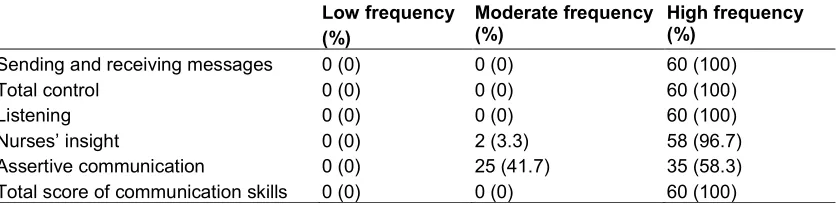
after the intervention, and none of them obtained a low score.
It should be noted that only 3.3% of the subjects received a moderate score in the field of vision and 41.7% obtained a moderate score in the area of assertive communication, and the rest of the nurses scored high in all areas (Table 2). According to the table above, there was a significant increase in nurses' communication skills after the intervention, compared to before the intervention (P<0.001). Moreover, the table showed a significant change in nurses’ perception after the intervention in various dimensions of communication skills, such as ability to receive and send messages, emotional control, listening skills, nurses' insight into the
communication process and assertive
communication skills, compared to before the intervention (P<0.001) (Table 3).
The majority of patients were female (61.5%), had a level of education below BSc, and were married (81.3%) and Shia (69.8%). In terms of occupational status, they were either housewives or self-employed. Moreover, 36.5% of the patients had special insurance and almost 50% of the subjects were from Imam Ali Center. Furthermore, the age range of the patients was 18-78 years with a mean age of 51.60 years. Only 5.2% gave a moderate total satisfaction score, 34.4% moderate score of satisfaction with
technical and professional care, 5.2% moderate score of satisfaction with trusting nurses, and 2.1% moderate score of satisfaction with patient education by nurses (Table 4).
Patients were satisfied in terms of overall satisfaction score and satisfaction with technical and professional nursing care and were dissatisfied (1%) with only two areas of trusting nurses and patient education by nurses. There was a significant increase in nurses' communication skills after the intervention,
compared to before the intervention
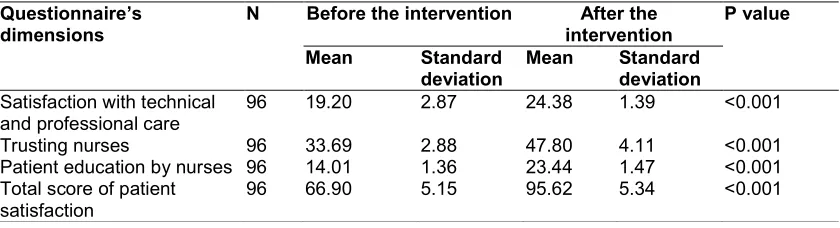
(106.98±4.18 and 117.97±3.35) (P<0.001). Meanwhile, most patients had moderate satisfaction with the total satisfaction score and satisfaction with three nursing work dimensions. According to the table below, 3.1% of patients were completely satisfied in the total satisfaction score, whereas 2.1%, 18.8% and 46.9% were completely satisfied in the area of technical and professional care, trusting nurses, and patient education by nurses (Table 5). Patients' satisfaction with all aspects of professional technical care, trust, education and overall satisfaction score after the intervention had a significant increase compared to before the intervention (P<0.001). This shows that the intervention of education of communication skills increased patients’ satisfaction in all dimensions (Table 6). At the end, it should be stated that the hypothesis of this study was accepted.
Table 1. Nurses' communication skills range before intervention
Low frequency (%)
Moderate frequency (%)
High frequency (%)
Sending and receiving messages 0 (0) 2 (3.3) 58 (96.7)
Total control 0 (0) 20 (33.3) (66.7)40
Listening 0 (0) 37 (61.7) 23 (38.3)
Nurses’ insight 0 (0) 19 (31.7) 41 (68.3)
Assertive communication 0 (0) 1 (1.7) 59 (98.3)
Total score of communication skills 0 (0) 8 (13.3) 52 (86.7)
Table 2. Nurses' communication skills range after intervention
Low frequency (%)
Moderate frequency (%)
High frequency (%)
Sending and receiving messages 0 (0) 0 (0) 60 (100)
Total control 0 (0) 0 (0) 60 (100)
Listening 0 (0) 0 (0) 60 (100)
Nurses’ insight 0 (0) 2 (3.3) 58 (96.7)
Assertive communication 0 (0) 25 (41.7) 35 (58.3)
Table 3. Comparison of the nurses’ communication skills and their different dimensions before and after the intervention
Questionnaire’s Dimensions Before the intervention
After the intervention
Paired t-test Mean Standard
deviation
Mean Standard deviation
P value
Nurses’ ability to send and receive messages
30.32 1.85 32.98 1.88 <0.001
Nurses’ emotional control skills 27.50 1.69 30.47 1.34 <0.001
Nurses’ listening skills 17.18 1.44 22.38 1.19 <0.001
Nurses’ insight into the communication process
15.33 1.43 17.07 1.76 <0.001
Nurses’ assertive communication skills 16.65 1.32 15.07 1.73 <0.001
Total score of nurses’ communication skills
106.98 4.18 117.97 3.35 <0.001
Table 4. Range of total patient satisfaction and satisfaction in three working aspects of nurses before and after the intervention
Dissatisfaction frequency (%)
Moderate satisfaction frequency (%)
Total satisfaction frequency (%)
Satisfaction with technical and professional care
63 (65.6) 33 (34.4) 0 (0)
Trusting nurses 91 (94.8) 5 (5.2) 0 (0)
Patient education by nurses 94 (97.9) 2 (2.1) 0 (0)
Total score of patient satisfaction 91 (94.8) 5 (5.2) 0 (0)
Table 5. Range of total satisfaction of patients and their satisfaction in three working aspects of nurses before and after the intervention
Dissatisfaction frequency (%)
Moderate satisfaction frequency (%)
Total satisfaction frequency (%)
Satisfaction with technical and professional care
0 (0) 94 (97.9) 2 (2.1)
Trusting nurses 1 (1.0) 77 (80.2) 18 (18.8)
Patient education by nurses 1 (1.0) 51 (53.1) 45 (46.9)
Total score of patient satisfaction 0 (0) 93 (96.9) 3 (3.1)
Table 6. Comparison of total satisfaction of patients and their satisfaction based on the questionnaire’s dimensions before and after the intervention
Questionnaire’s dimensions
N Before the intervention After the intervention
P value
Mean Standard deviation
Mean Standard deviation
Satisfaction with technical and professional care
96 19.20 2.87 24.38 1.39 <0.001
Trusting nurses 96 33.69 2.88 47.80 4.11 <0.001
Patient education by nurses 96 14.01 1.36 23.44 1.47 <0.001
Total score of patient satisfaction
96 66.90 5.15 95.62 5.34 <0.001
4. DISCUSSION
In the present study, the overall rate of communication skills was high in most nurses
sending and delivering messages, emotional control, insight into communication skills, and assertive communication skills. However, the participants obtained a moderate score in terms of the dimension of listening skills. According to these results, it could be concluded that nurses had weaker listening skills, compared to other communication skills. In a research by Siamian et al. to evaluate interpersonal communication skills among healthcare personnel in Sari, Iran, the results were indicative of good skills of general communication, listening, awarding and punishing in participants. Nonetheless, they had moderate skills in the areas of talking, interpretation, clarification, and feedback. In this scale, the mean and standard deviation of communication skills were (4.0±11.37), which was regarded as moderate [15]. However, the overall communication skills were high before the intervention in the present study.
According to the results of the study, the overall communication skills of nurses increased after the intervention, and the poor score was obtained in none of the dimensions. Meanwhile, moderate scores were obtained by two and 25 individuals regarding nurses’ insight and assertive communication skills, respectively and the rest of the subjects had high skills in all
dimensions. The results revealed an
improvement in the listening skills of nurses after training. In this respect, 100% of the participants achieved a high score in this dimension after the intervention. The results were also indicative of a significant increase in the overall communication skills of nurses and all dimensions of communication skills after the intervention, compared to before the intervention (P<0.001). In this regard, our findings are in line with the results obtained by Hojat Pirzadi et al., who found an improvement in the communication skills of nurses after education [16]. Our findings are also congruent with the results obtained by Rezaei et al., who marked a significant increase in the communication skills of nurses after holding a relevant program [9]. Sabet Dizkohi also reported a significant difference in the overall communication skill score and all of its dimensions in nursing students after the intervention, compared to before the intervention, which increased students’ satisfaction [17].
Regarding the significant impact of the
intervention program on improved
communication skills of nurses, the content of the intervention has a very significant effect on the education of communication skills. In a study,
Rask et al. reported a lack of effect of communication skills training on improvement of this index after the intervention, which might be due to the use of different tools, types of educational content, and follow-up methods after the intervention [18]. In the present study, full patient satisfaction was detected in none of the areas, and most patients were dissatisfied with the overall satisfaction level and satisfaction with three nursing work dimensions. Only 5.2% had a moderate total satisfaction score while 34.4%, 5.2%, and 2.1% had moderate satisfaction with technical and professional care, trusting nurses, and patient education by nurses, respectively. Meanwhile, Farmahini-Farahani et al. showed that most patients were almost satisfied (or had moderate satisfaction), which was indicative of a proper score regarding satisfaction with nurses before the intervention [19].
In a study by Salehian et al., 66.5% of the participants were satisfied with nurses’ skills [20], which demonstrated favorable satisfaction with nurses in most patients. This was inconsistent with our findings. It should be noted, however, that high satisfaction in research clients does not necessarily mean a good quality of care. Rather, it may indicate that they have lower expectations of health care providers. Therefore, it should not be assumed that the care provided is of high quality with a high average satisfaction rating and that the low level of dissatisfaction should be taken very seriously [19]. Even one case of lack of complete satisfaction with nurses in the present study was reflective. According to the results, after the intervention, patients were not dissatisfied with a total score of satisfaction with nurses and satisfaction with technical and professional care and there was only 1% dissatisfaction with trusting nurses and patient education by nurses. Meanwhile, most patients expressed moderate satisfaction in terms of total satisfaction scores and satisfaction in three working aspects of nurses.
score was higher in the test group [22]. In a study by Hosseini et al., patients’ satisfaction with the quality of nursing services significantly increased after the intervention and training of communication skills [23].
5. CONCLUSION
According to the results of the present study, studying communication skills in the form of educational workshops could increase these skills in nurses and clinical personnel in general. More importantly, improved communication skills in nurses could increase patient satisfaction, which is the ultimate goal of healthcare centers. Without a doubt, increased patient satisfaction will enhance healthcare provision quality. Therefore, it seems necessary to incorporate a learning credit of communication types and communication skills into nurses' academic courses and even all medical and paramedical disciplines. It is also recommended that communication skill learning workshops be held for all healthcare personnel in hospitals as necessary in-service classes.
6. RESEARCH LIMITATIONS
Some of the major drawbacks of the present study included economic status, type of disease and mental states of patients, which might have affected their level of satisfaction. Another limitation of the current research was including only the nurses of one ward. In this regard, if the participants were randomly selected from all nurses of the hospital, there would be a greater chance for generalization of results. In addition, the lack of honesty of the subjects in filling the questionnaire was another confounding factor.
CONSENT AND ETHICAL APPROVAL
This study was approved by the Ethics Committee of the Shahid Beheshti University of
Medical Sciences (IR.SBMU.PHARMACY.
REC.1398.150). All procedures performed in studies involving human participants in accordance with the ethical standards of the institutional and national research committee and with the 1964 Helsinki declaration and its later amendments. All participants provided written and informed consent.
COMPETING INTERESTS
Authors have declared that no competing interests exist.
REFERENCES
1. Razi M, Reyhani T, Nekah A, Mohsen S, Rajabpoor M. The effect of training on communication skills of nurses with child through small groups discussion. Future of Medical Education Journal. 2016;6(4): 38-43.
2. Igier V, Mullet E, Sorum PC. How nursing personnel judge patients’ pain. European Journal of Pain. 2007;11(5):542-50. 3. Buckman R. Communication skills in
palliative care: A practical guide. Neurologic Clinics. 2001;19(4):989-1004. 4. Clancy CM, Farquhar MB, Sharp BAC.
Patient safety in nursing practice. Journal of Nursing Care Quality. 2005;20(3):193-7. 5. Cinar O, Ak M, Sutcigil L, Congologlu ED,
Canbaz H, Kilic E, et al. Communication skills training for emergency medicine residents. European Journal of Emergency Medicine. 2012;19(1):9-13.
6. Bramhall E. Effective communication skills in nursing practice. Nursing Standard (2014+). 2014;29(14):53.
7. Araújo IMdA, Silva RMd, Bonfim IM, Fernandes AFC. Nursing communication in nursing care to mastectomized women: A grounded theory study. Revista latino-americana de enfermagem. 2010;18(1):54-60.
8. Abedi H, Alavi M. Aseman rafat N, Yazdani M. Nurse-elderly patients relationship experiences in hospital wards-a qualitative study. Iranian Journal of Nursing and Midwifery Research. 2005;5(29):5-16. 9. Rhezaii S, Hosseini A, Fallahi M.
Evaluating impact of communication skills training on level of job stress among nursing personnel working at rehabilitation centers in cities: Ray-Tehran-Shemiranat. Tehran University Medical Journal TUMS Publications. 2006;64(1):6-21.
10. Zeyghami Mohammadi S, Haghighi S. The
association between nurses’
communication skills and nurse-physician relationship and collaboration in Alborz hospital of Karaj in 2008. Medical Science Journal of Islamic Azad Univesity-Tehran Medical Branch. 2009;19(2):121-7.
11. Rostami H, Mirzaei A, Golchin M. Evaluation of communication skills of nurses from hospitalized patients' perspective. The Journal of Urmia Nursing and Midwifery Faculty. 2012;10(1):27-34. 12. Pytel C, Fielden NM, Meyer K, Albert N.
emergency department. Journal of Emergency Nursing. 2009;35(5):406-11. 13. Farmahini FM, Kashaninia Z, Hosseini MA,
Biglarian A. Impact of training communication skills to nurses on patients'satisfaction with nurse-patient relationship; 2007.
14. Bastami MR, Kianian T, Borji M, Amirkhani M, Saber S. Assessment of cultural competence among nurses. Medical Ethics Journal. 2016;10(36):65-72.
15. Siamian H, Bagheri-Nesami M, Nia RD, Nezhad FR, Akbari H, Balaghafari A, et al.
Assessment of interpersonal
communication skills among sari health centers’ staff. Materia Socio-medica. 2014; 26(5):324.
16. Pirzadi H, Fathi A, Ashtiani, Shokoohi M, Yekta. Effectiveness of group cognitive-behavioral training on physiological indicators and communication skills in the hospital staffs. Journal of Nursing Education. 2015;4(1):60-71.
17. Sabet Dizkohi S, Nasrabadi T, Ebrahim Abyaneh E. The effect of communication skills training on satisfaction of nursingstudents in communication with patients. Journal of Health Promotion Management. 2016;5(5):8-14.
18. Rask MT, Jensen ML, Andersen J, Zachariae R. Effects of an intervention aimed at improving nurse-patient
communication in an oncology outpatient clinic. Cancer Nursing. 20091;32(1):E1-1. 19. Farmahini FM, Kashaninia Z, Hosseini MA,
Biglarian A. Impact of training communication skills to nurses on patients'satisfaction with nurse-patient relationship. Iranian Journal of Nursing Research. 2007;1(3):47-54.
20. Salehian T, Safdari Dah Cheshmeh F, Pirak A. Patients’ satisfaction from medical and nursing services in Khatam Alanbia Hospital in Iranshahr. Journal of Research Development in Nursing and Midwifery. 2010;7(2):33-41.
21. Nikmanesh P, Kavosi Z, Sadeghi A, Yusefi AR. Effect of communication skills training of nurses on patient satisfaction about nursing services in hospitals affiliated to Shiraz University of Medical Sciences. Hospital. 2018;17(2):59-70.
22. Yazdi NA, Tavafian SS, Emadzadeh A,
Kazemnejad A, Ghofranipour F.
Communication training and patient satisfaction: A randomized trial study from Mashhad, Iran. Patient Preference and Adherence. 2008;2:137.
23. Hosieni F, Ravari A, Akbari A. The effect of communicating with patients using peplau model on patients’ satisfaction with the provided nursing cares at the cardiac intensive care unit. Iran Journal of Nursing. 2017;29(104):36-45.
© 2019 Salmani et al.; This is an Open Access article distributed under the terms of the Creative Commons Attribution License
(http://creativecommons.org/licenses/by/4.0), which permits unrestricted use, distribution, and reproduction in any medium,
provided the original work is properly cited.
Peer-review history: