Published online February 10, 2015 (http://www.sciencepublishinggroup.com/j/pamj) doi: 10.11648/j.pamj.s.2015040201.18
ISSN: 2326-9790 (Print); ISSN: 2326-9812 (Online)
On Some Point Groups
Y. Sun
1, S. Kanemitsu
2, H. Kitajima
31
Dept. of Electr. Engrg, Kyushu Inst. Techn., 1-1 Senshuimachi, Tobata, Kitakyushu, Fukuoka 804-8550, Japan
2
Grad. School of Adv. Tech., Kinki Univ.,11-6 Kayanomori, Iizuka, Fukuoka 820-2555, Japan
3
Grad. School of Sci. & Engrg, Saga Univ.,1 Honjocho, Saga840-8502, Japan
Email address:
[email protected] (Y. Sun)
To cite this article:
Y. Sun, S. Kanemitsu, H. Kitajima. On Some Point Groups. American Journal of Software Engineering and Applications. Special Issue: Abridging over Troubled Water---Scientific Foundation of Engineering Subjects. Vol. 4, No. 2-1, 2015, pp. 42-46.
doi: 10.11648/j.pamj.s.2015040201.18
Abstract:
In this note, we indicate the coincidence as abstract groups of some point groups which belong to differentmolecular orbitals. This elucidates somewhat vague presentation in many existing textbooks on molecular orbitals, thus abridging between group theory and quantum chemistry.
Keywords:
Point Group Molecular Orbitals, Symmetry Transformations: Characters1. Introduction
Point groups are indispensable tools for analysis of molecular orbitals. However, there is one point missing in most of the textbooks (given in references) to the effect that one group is associated to several orbitals, cf. e.g. Example 4, which has been a tradition in the theory because there is always associated a figure of the molecule. Since one group is associated to many molecules, it would be preferable to have a clear description of the correspondence between the molecules and the point group. In this note we shall show that some of the point groups which have different labels are isomorphic as abstract groups. Classification being the strong point of mathematics, this manifestation of the classification of point groups hopefully gives rise to better and clear understanding of the theory of point groups. We have treated the easiest case and apparently, we may go on classifying all the point groups, which task will be conducted subsequently.
In the remainder of this section, we assemble fundamentals on group theory for readers' convenience.
We are concerned with finite groups only. We take basic definitions of a group for granted. The number of elements of a group G is called the order of G denoted |G|. A subgroup H of a group H is a subset of G, which itself forms a group under the operation (called product) of G. A group with commutative product is called an Abelian group (or a commutative group).
For finite groups, the following is fundamental.
Lemma 1 (Lagrange). Let G be a finite group and let H be its subgroup. Then the order of H divides that of G:
|H| | | |.
Lemma 1 is used e.g. in the following context.
Recall that the cyclic subgroup <a> generated by a in a group G is the set of all powers of a:
< >= { | ∈ ℤ}
Since there are only finitely many different powers of a,
we must have = , whence we may conclude that
= { ∈ ℕ| = 1} ≠ ∅. Choosing = min , we may conclude that l divides all members of X and that all elements
1, , … , are distinct, so that | < > | = , | < > | = { ∈ ℕ| = 1}. The order of the subgroup generated by <a> is called the order of a and denoted by o(a).
By Lemma 1, l | |G| and so | |= ( |"#$|)| |/|"#$|= 1.
Thus, we have the generalized Fermat's little theorem:
| |= 1. (1.1)
Corollary 1. A group G of prime order is cyclic.
For, any element a of G generates a cyclic subgroup whose order o(a) divides the prime ' = | |, and so either
(( ) = 1 or (( ) = '. The former case leads to = +
(identity) and the latter case leads to =< >.
of G of prime power order '- are contained in the Sylow p
subgroup S. All Sylow p subgroups are conjugate.
Notation. To avoid confusion with the rotary reflection ./,
we denote the nth symmetric group by
S
n. Care must be taken also in treating the dihedral group 0/ which is denoted byD
2n in mathematics.D
2nis the semi-directproduct of a cyclic group of order n and one of order 2:
D
2n=< 1 >⋊< >, where o(b)=n, o(a)=2 and there is the
relation 1 = 1/ .
2. Point Groups
By [7, p.8] point groups are rotational parts of the space group which leave the molecule (lattice) invariant and in the case of crystals there are 32 of them.
Definition 1. We choose the principal axis of symmetry as the one which goes through the maximum number of molecules (lattice points). If there are some of them, then we choose the one. If there is no such an axis we choose it arbitrarily. The plane of symmetry is chosen so that it contains the maximum number of molecules. The intersection of the principal axis and the plane of symmetry is chosen to be the origin.
3/ is the rotation w.r.t. the principal axis through 25/ .
6 is a reflection. 67 (h=horizontal) is a reflection
through a plane perpendicular to the axis of symmetry;
68 (v=vertical) is a reflection through a plane
containing a principal axis of symmetry; 69
(d=dihedral) is a reflection through a plane containing a principal axis of symmetry and bisects the angle between two 2-fold axes perpendicular to the principal axis. They are all of order 2.
i is the inversion w.r.t. the origin.
./ is the rotation through 25/ followed by a
reflection through a plane perpendicular to the axis of rotation, and is called rotary reflection (improper rotation).
In what follows we often write the group itself by its typical element.
Remark 1.
(1)In the case of crystals, rotations are only those which rotate through integral multiples of 5/3, 5/2 or the products of such rotations and the inversion. 6 = 3;,
where 3; is the rotation through 25/2.
(2)It seems that the introduction of the rotary reflection
./ leads to confusion because it is the product of two
operations:
./= 673/ (2.1)
and ./ = 67 3/ for any integer m. Hence
./ = 3/ m even, (2.2)
./ = 673/ m odd and . = 673 = 67.
Example 1. We have
3;8≅ 3=.
Example 2. The group 3= consists of the following 4
elements whose multiplication table is given below.
(i) 3= is the rotation through 25/4 and 3=== + is the
identity.
(ii) 3=;= 3; is the rotation through 5.
(iii)3=? is the rotation through 35/2.
Table 1. Character table of 3=
@ e A
B ABC ABD
EF 1 1 1 1
E 1 -1 1 -1
E; 1 ; ?
E? 1 ? ;
Example 3. The group 3G consists of 6 elements whose multiplication table is given below.
(i) 3= is the rotation through 5/6 and 3GG is the identity.
(ii) 3? is the rotation through 25/3 and 3?= 3G;.
(iii)3; is the rotation through 25/2 and 3;= 3G?.
(iv)3?; is the rotation through 45/3 and 3
?;= 3G=.
(v) 3?I is the rotation through 55/3.
Table 2. Multiplication table of 3
G (r indicates 3G).
o e K K; K? K= KI
e e K K; K? K= KI
K K K; K? K= KI e
K; K; K? K= KI e K
K? K? K= KI e K K;
K= K= KI e K K; K?
KI KI e K K; K? K=
Table 3. Multiplication table of
3
S
o e K K; s K;L KL
e e K K; s K;L KL
K K K; e KL s K;L
K; K; e K K;L KL s
s s K;L KL E K K;
K;L K;L KL S K; E K
KL KL s K;L K K; e
Table 4. Regular multiplication table of
3
S
o e M? M; M K; K
e e M? M; M K; K
M? M? e K; K M; M
M; M; K e K; M M
?
M M K; K e M
? M;
K K M; M M? e K;
K; K; M M
Theorem 1. We have C3v=D3, and they are≅S3.
Example 4. To 3?8 belong ammonia NH?, chloroform
CHCl?, cyclopropenylcation radical, phosphorus sesqui -sulfide P=.?, etc. To 0? belong Boron trifluoride BF?,
triphenylmethyl radical, trans-perhydrotripolyphenylene, staggered conformation of ethane, etc.
We note that the following table appears on [9, p.29] and the elucidation appears on [9, p.6].
Table 5. Multiplication table of 3?7
o e TDU T
D
V A
D U= T
D
B A
D C= T
D
C W
X= TDD e e .? .?I .?= .?;= 3?; .??
.? .? 3?; e .?I .?; 3?
.?I .?I e .?== 3? .??= 67 .? .?;= 3?;
3?= .?= 3? .?I .??= 67 .?;= 3?; e .?
3?;= .?; 3?; .??= 67 .? e .?== 3? .?I
67= .?? 67 .?== 3? .?;= 3?; .? .?I e
Theorem 2.
3?7≅ 3G. (2.3)
Theorem3. We have
D
3h≅
D
6≅
D
12 and3v 3 6
D
≅
D
≅
D
is its subgroup. Consequently, we maytreat planar molecules belonging to 0?7 as those belonging
to 0?.
3. Characters
Definition 2. In a (matrix) representation Γ of a finite group G, the trace of the matrix .Z corresponding to 6 ∈
is called a character of Γ and denoted by χ(6).
χ(6) = Tr(.Z)
There are |G| characters of G. Those which corresponding to irreducible representations are called simple characters.
χF(6), … , χ7 (6).
Theorem 4. Any irreducible representation of a finite Abelian group must be of degree 1, and so the representation
^ itself is equal to the trace of the representation matrix, i.e. it is a character.
Theorem 5. Any finite Abelian group is expressed as a direct product of cyclic groups of prime power order.
Lemma 3. Any cyclic group 3/ of order n is isomorphic to
the additive group of residue classes modulo n:
3/≅ _/ _.
Theorem 6. Suppose 3/=< > be a cyclic group of order n. Since /= + it follows that the values of a character
χ ∶ 3/→ ℂ× must be the nth roots of 1. Hence it suffices to
restrict the range to the torus group d = {z ∈ ℂ ||z| = 1}. Then the character χ is determined by its value at a, say
χ( ) = +;fg// , the piervotny primitive root of 1. The correspondence χ → h + ℤ gives rise to the isomorphism
X(3/) ≅ ℤ/ ℤ ≅ 3/.
This theorem follows from Lemma 3 since the correspondence a ↔ +;fg// give rise to an isomorphism
between the groups <a> and l/ of the group of nth roots of 1.
Now combining Theorem 5 and Theorem 6, we deduce
Theorem 7. Any finite Abelian group is isomorphic to its character group X(G) = {χ: G → d|χ is a homomorphism}:
≅ X( ).
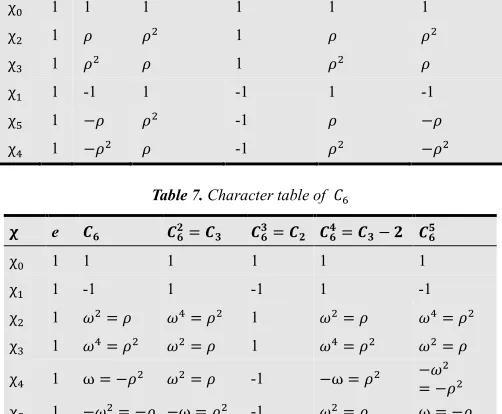
Let ^ = +;fg/? be the piervotny primitive 3rd root of unity and let o = +;fg/G the piervotny primitive 6th root of unity.
Table XXI [7, p.16] after changing the columns of 3? and .?
reads.
Table 6. Character table of 3 ?
@ e pD TDC= ADC TDD= WX TDB= AD
TDB
= WXADC
χF 1 1 1 1 1 1
χ; 1 ^ ^; 1 ^ ^;
χ? 1 ^; ^ 1 ^; ^
χ 1 -1 1 -1 1 -1
χI 1 −^ ^; -1 ^ −^
χ= 1 −^; ^ -1 ^; −^;
Table 7. Character table of 3 G
@ e A
r ArC= AD ArD= AC ArB= AD− C ArV
χF 1 1 1 1 1 1
χ 1 -1 1 -1 1 -1
χ; 1 o;= ^ o== ^; 1 o;= ^ o== ^;
χ? 1 o== ^; o;= ^ 1 o== ^; o;= ^
χ= 1 ω = −^; o;= ^ -1 −ω = ^; −o;
= −^;
χI 1 −o;= −^ −ω = ^; -1 o;= ^ ω = −^
By changing the 5th and 6th rows in Table 5, it coincides with Table 6, so that these character groups are isomorphic. By Theorem 7, we reprove Theorem 2.
4. Rotations as Matrices
In this section we elucidate the rotations and reflections as matrices.
Theorem 7. Let
cos sin
sin cos
Aθ
θ
θ
θ
θ
−
=
(4.1)
and
cos sin . sin cos
Bφ
φ
φ
φ
φ
=
−
Then the linear transformation y=Aθxby
A
θ means the rotation (in the positive direction, i.e. counterclockwise)w.r.t. the origin by
θ
and that the linear transformationBφ =
y x by
B
φmeans the reflection w.r.t. the lineℓ
whichgoes through the origin and is subtended to the positive
direction of the
x
-axis by the angle2
φ
.Proof. We give a proof that makes full use of Euler's identity. Expressing the Cartesian coordinates as the complex number in polar coordinates:
cos
cos sin ,
sin
r x
z x iy r ir
r y
Θ
= = ⇔ = + = Θ + Θ
Θ
z
we see that the rotation
e z
iθ=
ze
iθ ofz
byθ
is( )
(
)
(
)
(
)
(
)
cos sin
cos cos sin s in sin cos cos sin
cos sin sin cos ,
i i
e z re r ir
r r
i r r
x x i x y
θ
θ θ θ
θ θ
θ θ
θ θ θ θ
Θ+
= = Θ + + Θ +
= Θ − Θ −
+ Θ − Θ
= − + +
which is the linear transformation
cos ysin
. sin ycos y
x x
A
x θ
θ
θ
θ
θ
−
=
+
Of course,
argA zθ = Θ +θ. (4.3) For the treatment of
B
φwe note that0,
Bφ=A Bφ (4.4)
which we now check. Since
B
0means the reflection w.r.t. thex
-axis, it corresponds to taking the complex conjugate. Therefore, the effect ofB
φ onz
corresponds toe z
iθ .Hence with
arg
z
= Θ
, we have0
argB z= − Θθ . (4.5) Now since
B z
θ is the vector obtained fromz
by therotation by 1
2θ
− Θ −
, it follows that 1 1
arg
2 2
B zθ θ θ
= − Θ −
,
which is equal to (4.5). Hence (4.4) follows.
Corollary 1. We have the following identities which have the geometric meaning.
A A
θ φ=
A A
φ θ=
A
θ φ+ , (4.6)A B
θ φ=
B
θ φ+ , (4.7)B A
θ φ=
B
θ φ− , (4.8) andB B
θ φ=
A
θ φ− . (4.9)It is easy to deduce (4.7) etc. from (4.3) and (4.5). Indeed, we find that
argA Bθ φz= + − Θ
θ φ
, (4.10)which is
B
θ φ+ , i.e. (4.7).Similarly, since argAφz= Θ+
φ
, we have(
) (
)
arg
B A
θ φz
= − Θ +
θ
φ
=
θ φ
−
− Θ
,whence (4.9). Finally,
(
) (
)
arg
B B
θ φz
= −
θ
φ
− Θ =
θ φ
−
+ Θ
,whence (4.10) follows..
Lemma 4.
We have the following identities
0
B Aθ =B−θ, (4.11)
0
B Bφ =Aφ. (4.12)
Proof. We make use of (4.4) to express
B
φ asA B
φ 0.E.g. (4.12) follows by writing
B B
φ 0=
A B B
φ 0 0and noting that 20 B =E.
With aid of Lemma 4, we may give a lucid proof of Corollary 1.
0 0
A B
θ φ=
A A B
θ φ=
A
θ φ+B
=
B
θ φ+ , (4.13)i.e. (4.7). To prove (4.8), we use (4,4), (4.11), (4.7) to deduce that
0
B A
θ φ=
A B A
θ φ=
A B
θ −φ=
B
θ φ− , (4.14)whence (4.8). Finally,
0 0 0
B B
θ φ=
A B A B
θ φ=
A B B
θ −φ=
A A
θ −φ=
A
θ φ− (4.15)by (4.11), (4.12) and (4.6) successively.
The following examples give rudiments of matrix representations of the group C3v.
Example 5. Given a regular triangle ABC, let O be the center of gravity and let the mid points of AB,BC, CA be D,
E, F, respectively and choose DO to be the
x
-axis. Let2
E=E,
2
3 2 3 4
3 3
,
C
=
A
πC
=
A
π , (4.16)( )
( )
( )
4 3 2 3 0 1 3 2 2 1 , 3 1 2 2 1 3 2 2 2 3 1 2 2 1 0 3 . 0 1 v v v B B B π π σ σ σ − − = = − − = = = = − , (4.17)
Then
( ) ( ) ( )
{
2}
3 3
, , , v 1 , v 2 , v 3
G= E C C σ σ σ (4.18)
forms a group w.r.t. the multiplication of matrices and is isomorphic to the group
C
3vor the symmetric group of order 6 (cf. Theorem 1).Example 6. Let
E
=
E
3,2
3 3
0 1 0 0 0 1
0 0 1 , 1 0 0 ,
1 0 0 0 1 0
C C = = (4.19) and
( )
( )
( )
1 0 0 0 0 1
1 0 0 1 , 2 0 1 0 ,
0 1 0 1 0 0
0 1 0
3 1 0 0 .
0 0 1
v v v σ σ σ = = = (4.20) Then
( ) ( ) ( )
{
2}
3 3
' , , , v 1 , v 2 , v 3
G = E C C σ σ σ (4.21)
forms a group w.r.t. the multiplication of matrices and is isomorphic to the group
C
3v (cf. Example 5).Example 7. We find a regular matrix 1
1 1 1 1 a b
X b a
= such that 1 3
cos sin 0
sin cos 0 ,
1
0 0 1
A
X C X θ
θ θ θ θ − − = = o
o (4.22)
i.e. similar to
C
3.To this end, it suffices to consider
3
1 A C X =X θ
o o
or
1 a cos sin sin cos 1
1 1 1 a sin cos a cos sin 1
1 cos sin sin cos 1
b a b a b
b b
a b
θ θ θ θ
θ θ θ θ
θ θ θ θ
+ − + = + − + − + whence
a cos sin
sin cos b θ θ θ θ = + = − + .
References
[1] M. A. Armstrong, Groups and symmetry, Springer, New York-Berlin etc. 1988.
[2] D. M. Bishop, Group theory and chemistry, OUP, Oxford 1973; 2nd ed. Dover, New York 1993.
[3] A. Carbone and M. Gromov, A mathematical slices of molecular biology, Supplement to volume 88 of Gazette des Mathématiciens, French Math. Soc. (SMF), Paris 2001. [4] J. H. Conway, Atlas of Finite Groups: Maximal Subgroups and
Ordinary Characters for Simple Groups, Cambridge UP, Cambridge 1985.
[5] Theo Hahn, International tables for crystallography, Reidel Publ. Co. 1983.
[6] H. Kitajima and S. Kanemitsu, Math-Phys-Chem approaches to life, Intern. J. Math. Math. Sci., Volume 2012, Article ID 371825, 29 pages (doi:10.1155/2012/371825), published May 13, 2012.
[7] G. F. Koster, Space groups and their representations, Academic Press, New York1957.
[8] K. Morikawa, A new view point of solid structure of proteins, Kodan-sha, Tokyo 1991 (in Japanese)
[9] M. Nakasaki, Symmetry of molecules and group theory Tokyo Kagaku-dohjin, Tokyo1973 (in Japanese).
[10] M. Ohiwa, Group theory and molecules, Kagaku-dohjin, Tokyo 1969 (in Japanese).
[11] M. Ohya and S. Matsunaga, Coding and genes, J. Electr. Inf. Comm, Soc. J74-A (1991), 1075-1084 (in Japanese).