© 2019 AIDCOM
23
CATCHING THEM YOUNG: AN ASSESSMENT OF HYGIENE
KNOWLEDGE IN GOVERNMENT SCHOOL CHILDREN IN DELHI
Ankita Bhalla
Anil Cherukupalli
Sudhir Bhatnagar
Abstract
Children are recognised as change agents in hygiene promotion. Though numerous efforts are being made to sensitise them on the importance of hygiene it is necessary to gauge their current understanding. For the 2015 Global Handwashing Day, WaterAid India and Society for All Round Development (SARD) conducted quizzes to reinforce the importance of hygiene within schools and recognise children as school health ambassadors and nurture them as change agents between their schools and communities. The quiz helped us analyse the current understanding of the school children on different aspects of hygiene and design targeted interventions needed to further their understanding on the subject. Based on the analysis of the responses of the children to the quiz questionnaire we found that the children from different age groups, classes and gender had different levels of understanding on various aspects of hygiene.
Keywords: handwashing, hygiene, quizzes
______________________________________________________________________________________
Introduction
24
Objective
The main objective of the quiz was to reinforce the importance of good hygiene within schools and recognise children as school health ambassadors and nurture them as change agents between their schools and communities. In addition, the data collected through the written quizzes helped us analyse the current understanding of the children on different aspects of hygiene. The data will further be used to plan specific advocacy and programme interventions with government and other stakeholders to sensitise students on hygiene and handwashing.
Methodology
The hygiene quiz programme consisted of two rounds of written quiz and a final round of oral quiz on handwashing and hygiene. The first written quiz round was conducted on 8 October 2015 at the school level in 589 schools of Najafgarh Zone, West Zone, Central Zone and South Zone within the South Delhi Municipal Corporation (SDMC) jurisdiction reaching over 1,50,000 children studying in the 3rd, 4th and 5th
classes in these schools and neighbouring communities. Based on the written quiz results, the top 3 winners from each school were awarded and the first position winners were selected for the second stage. In the second stage, a zonal level quiz was conducted in all four zones on 13 October 2015 where the first position winners from each of the zone competed and the top 3 winners (First, Second & Third) from each of the four zones were awarded and the first placed teams of each zone were selected for the final oral quiz round. On the final quiz on 15 October 2015, four teams representing the four zones with each team consisting of four students competed and the top scoring team at the end of the quiz was declared the winner of the quiz competition.
The quiz was conducted in Hindi as that was the best medium to connect with children in the targeted schools. The question paper was designed in collaboration with teachers and experts to assess the knowledge, attitude, behaviour and practices of children with questions on different aspects of water, sanitation & hygiene (WASH). This paper analyses the responses of the children to the quiz questionnaire used in the first written round.
Analysis and Results
The total numbers of schools covered in the quiz competition were 589. In each school around 200 children, girls and boys, participated in the first written quiz round. As a result, more than 100,000 questionnaires were generated. For the purposes of this study, we undertook zone wise random sampling of the questionnaires to analyse them for trends on knowledge, attitude, behaviour and practices. The random sampling consisted of questionnaires from 185 schools from the Central, Najafgarh, South and West zones of Delhi. These included 74 from Central zone, 60 from Najafgarh, 31 from South and 20 from South zone. During random sampling, we wanted to focus on the responses from rural and semi-rural school students. Since Central zone has the maximum number of schools that fall under the category, maximum samples were analysed from this location. South zone has the maximum urban schools so they had the minimum number of samples. The total number of questionnaire analysed were 24,530 out of which 10,654 were of boys and 14,090 of girls. Due to time constraints, we did not undertake a baseline study to understand the level of hygiene education and behaviours of school students before the quiz. The analysis and interpretations made have been arrived at by analysis of data collected during the quiz.
KABP Analysis
25
Table 1: Number and Types of Questions in Each Category
Themes Number of
Questions Questions
Knowledge 15 questions How many germs are present on our hands a particular time? What is the date of Global Handwashing Day?
Which year was the first Global Handwashing Day celebrated? Which is the disease caused by contaminated and polluted water? Where is the mosquito of dengue born?
What are germs? What is diarrhoea? Reasons for having diarrhoea
What is required for growth and development of germs? How can we see germs?
When is World Toilet Day? Which mosquitos cause dengue fever? What should be taken during dehydration? How does malaria spread?
Attitude 6 questions Why is it necessary to wash our hands? Where do you put garbage and trash?
What precaution should be taken in case of illness? What comes under schools to provide clean environment? Things that motivate us to keep our school clean Which diseases happen if we do not clean our teeth daily?
Behaviour 4 questions What do we require to wash our hands? What is required to dry our hands after washing?
What precautions should be taken to prevent diseases from spreading? How many times should we wash utensils used to store water?
Practice 5 questions When do we wash our hands?
For how long should we wash our hands with soap and water? How many times a day should we brush our teeth? How should we clean our eyes?
How often should we wash our hands?
A percentage analysis of the questionnaires for students scoring in full in a particular category (Table 2) revealed that the behaviour category had the maximum percentage of students scoring in full (31%) on these questions, while the knowledge category had the least percentage (5%) of the students scoring in full.
Table 2: Percentage of Students Who Scored Full Marks in a Particular Category
Zones Knowledge Attitude Behaviour Practice Total
Central 6% 18% 37% 11% 72%
Najafgarh 2% 10% 25% 12% 49%
West 3% 7% 23% 11% 44%
South 4% 10% 23% 8% 45%
Total 5% 13% 31% 11% 60%
26
Table 3: Percentage of Students Who Secured Zero Marks in a Particular Category
Zones Knowledge Attitude Behaviour Practice Total
Central 2% 4% 4% 3% 12%
Najafgarh 1% 4% 5% 6% 15%
West 4% 8% 9% 9% 29%
South 4% 7% 7% 8% 26%
Total 2% 4% 5% 5% 17%
Table 3 depicts the performance of students who scored nothing (zero) on the questions of the different categories. The behaviour and practice categories had the maximum percentage (5%) of students scoring nothing, followed by the attitude and knowledge categories with average scores of 4% and 2% respectively. Students of the West zone performed the worst in all four categories.
Question Mapping
We analysed the responses of students to the various questions in the questionnaire (Tables 4 & 5). We found that the question with the best result across all classes and both genders was SR No 1 (Table 4) with 19,619 students (80%) answering this question correctly. The question with the lowest result across all classes and both genders was SR No 3 (Table 5) with only 10,256 students (42%) answering this question correctly. This question was also the least important question in terms of individual behaviour and impacts on health. The results indicate that children were able to answer better general questions on hygiene than questions that tested their factual knowledge.
Table 4: Top Three Questions Which Were Answered By Students Correctly
SR No Questions Number of Students
1 What do we require to wash our hands? 19,619 (80%)
2 What is required to dry our hands after washing hands? 19,026 (78%)
3 Where do you put garbage & trash? 17,912 (73%)
Table 5: Bottom Three Questions Answered by Students Correctly
SR No Questions Number of students
1 How is malaria spread? 11,554 (47%)
2 What is required for growth & development of germs responsible for diseases? 11,161 (46%)
27
Figure 1: Class Wise Performance of Students Based on the Questionnaire Categories (KABP) Source: WaterAid India/SARD
Figure 1 represents the overall knowledge across the four categories class wise. The results show that students in older classes scored better across all categories. Students of all classes performed best on the questions in the behaviour category.
28
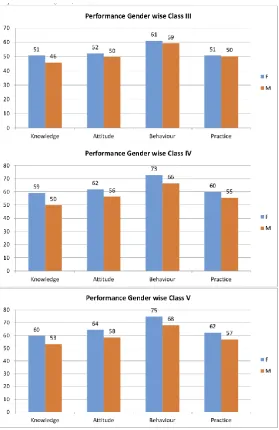
When we analysed the data on the performance of the students according to gender and by class (Figure 2), we found that in general female students performed better in all four categories and across all three classes, with the average difference increasing by class. The results indicate that the level of hygiene knowledge is similar in lower classes but the gap starts to increase between girls and boys as they go to higher classes and grow older, with girls outscoring boys from 1% to 9% across the knowledge and behaviour categories.
Discussion and Way Forward
Knowledge and practice of good hygiene behaviours is the first step towards reduction in incidences of diarrhoeal diseases. Children, being one of the primary sufferers of such diseases, are an important target group for hygiene awareness programmes. But while implementing such large scale awareness programmes it is also important to assess the existing knowledge, behaviours, attitudes and practices among them. The hygiene quiz programme that WaterAid India and SARD had implemented in 589 schools in Delhi attempted to gain an understanding of the same. While our results seem to indicate that children who participated in the written quiz had better understanding of behavioural aspects of hygiene over specific knowledge aspects, more detailed studies are needed as the quiz had more number of questions on knowledge than on behaviour. But what was clear was that girls scored better than boys across all classes and categories indicating that girls are more receptive to hygiene messages and can perhaps are an effective target for hygiene interventions. The results also showed a zone wise difference in scoring of students with students from central zone outperforming students from other zones of Delhi. An in depth review is needed of the practices being followed by schools in the central zone to understand their better performance so that other schools can adopt the same. A detailed study is also needed to map out the current hygiene and handwashing practices among children vis-a-vis their theoretical understanding of the same. The findings from the analysis of the answers stress on the need for more focussed sensitisation of children on hygiene messages in these schools.
While innovative hygiene promotion activities such as this quiz can be appealing to children and may help in improving their knowledge, it is important to have sustained all year round efforts, including integration of hygiene in educational curriculum, to ensure that children are constantly exposed to good hygiene messaging and thereby adopt good hygiene behaviours. It is also important to note that awareness programmes are probably only one of the possible factors needed for long term behaviour change and a successful hygiene intervention programme may also need to consider cultural, economic and geographic factors.
WaterAid India and SARD plan to expand the quizzes and include more schools in Delhi. Similar quizzes are also being proposed in the other states of India where we work currently. We will be sharing the findings of the quiz with the government and other stakeholders to advocate for robust programmes and interventions on handwashing and hygiene so that children can act as effective change agents in their communities and lead a healthy life.
References
Bhan, M. K. (2013). Accelerated progress to reduce under-5 mortality in India.Lancet Glob Health, 1(4), e172–173. https://doi.org/10.1016/S2214-109X(13)70076-7 Clinton, B. D., & Kohlmeyer, J. M. (2005). The effects of group quizzes on performance and motivation to learn: Two experiments in cooperative learning.Journal of
Accounting Education, 23(2), 96-116. https://doi.org/10.1016/j.jaccedu.2005.06.001
Curtis, V., & Cairncross, S. (2003). Effect of washing hands with soap on diarrhoea risk in the community: A systematic review.The Lancet Infectious Disease, 3(5), 275–281.
Guinness World Records. (2015). Most people washing their hands - multiple locations. Retrieved from http://www.guinnessworldrecords.com/world-records/most-people-washing-their-hands-multiple-locations
Laxminarayan, R., Chow, J., & Shahid-Salles, S. A. (2006). Intervention cost-effectiveness: Overview of main messages. In D. T. Jamison, J. G. Breman & A. R. Measham (Eds.), Disease control priorities in developing countries (pp. 35–58). New York: Oxford University Press.
Million Death Study Collaborators. (2010). Causes of neonatal and child mortality in India: A nationally representative mortality survey.The Lancet, 376(9755), 1853–1860. https://doi.org/10.1016/S0140-6736(10)61461-4
29
Acknowledgement
The authors would like to extend thanks to the entire team of WaterAid India country office, SARD and teachers, principals and officials at the South Delhi Municipal Corporation for their help in making the hygiene quiz programme possible.
______________________________________________________________________________________
Ankita Bhalla is Web and Social Media Coordinator at WaterAid India. Email: [email protected]
Anil Cherukupalli is currently Communication Lead, PATH and was previously Manager, Media and Communications at WaterAid India. Email: [email protected]