Learning the Structure and Parameters of Large-Population
Graphical Games from Behavioral Data
Jean Honorio [email protected]
Computer Science and Artificial Intelligence Laboratory Massachusetts Institute of Technology
Cambridge, MA 02139, USA
Luis Ortiz [email protected]
Department of Computer Science Stony Brook University
Stony Brook, NY 11794-4400, USA
Editor:Shie Mannor
Abstract
We consider learning, fromstrictly behavioral data, the structure and parameters oflinear influence games (LIGs), a class of parametric graphical games introduced by Irfan and Or-tiz (2014). LIGs facilitate causal strategic inference (CSI): Making inferences from causal interventions on stable behavior in strategic settings. Applications include the identifi-cation of the most influential individuals in large (social) networks. Such tasks can also support policy-making analysis. Motivated by the computational work on LIGs, we cast the learning problem as maximum-likelihood estimation (MLE) of a generative model defined bypure-strategy Nash equilibria (PSNE). Our simple formulation uncovers the fundamental interplay between goodness-of-fit and model complexity: good models capture equilibrium behavior within the data while controlling the true number of equilibria, including those unobserved. We provide a generalization bound establishing the sample complexity for MLE in our framework. We propose several algorithms including convex loss minimiza-tion (CLM) and sigmoidal approximations. We prove that the number of exact PSNE in LIGs is small, with high probability; thus, CLM is sound. We illustrate our approach on synthetic data and real-world U.S. congressional voting records. We briefly discuss our learning framework’s generality and potential applicability to general graphical games. Keywords: linear influence games, graphical games, structure and parameter learning, behavioral data in strategic settings
1. Introduction
Game theory has become a central tool for modeling multi-agent systems in AI. Non-cooperative game theory has been considered as the appropriate mathematical framework in which to formally study strategic behavior in multi-agent scenarios.1 The core
solu-tion concept of Nash equilibrium (NE) (Nash, 1951) serves a descriptive role of the stable outcome of the overall behavior of systems involving self-interested individuals interacting strategically with each other in distributed settings for which no direct global control is
possible. NE is also often used in predictive roles as the basis for what one might call
causal strategic inference, i.e., inferring the results of causal interventions on stable
ac-tions/behavior/outcomes in strategic settings (See, e.g., Ballester et al. 2004, 2006; Heal and Kunreuther 2003, 2006, 2007; Kunreuther and Michel-Kerjan 2007; Ortiz and Kearns 2003; Kearns 2005; Irfan and Ortiz 2014, and the references therein). Needless to say, the computation and analysis of NE in games is of significant interest to the computational game-theory community within AI.
The introduction of compact representations to game theory over the last decade have extended computational/algorithmic game theory’s potential for large-scale, practical ap-plications often encountered in the real-world. For the most part, such game model repre-sentations are analogous to probabilistic graphical models widely used in machine learning and AI.2 Introduced within the AI community about a decade ago,graphical games(Kearns
et al., 2001) constitute an example of one of the first and arguably one of the most influential graphical models for game theory.3
There has been considerable progress on problems of computing classical equilibrium solution concepts such as NE and correlated equilibria (CE) (Aumann, 1974) in graphical games (see, e.g., Kearns et al. 2001; Vickrey and Koller 2002; Ortiz and Kearns 2003; Blum et al. 2006; Kakade et al. 2003; Papadimitriou and Roughgarden 2008; Jiang and Leyton-Brown 2011 and the references therein). Indeed, graphical games played a prominent role in establishing the computational complexity of computing NE in general normal-form games (see, e.g., Daskalakis et al. 2009 and the references therein).
An example of a recent computational application of non-cooperative game-theoretic graphical modeling and causal strategic inference (CSI) that motivates the current paper is the work of Irfan and Ortiz (2014). They proposed a new approach to the study of influence and the identification of the “most influential” individuals (or nodes) in large (social) networks. Their approach is strictly game-theoretic in the sense that it relies on non-cooperative game theory and the central concept ofpure-strategy Nash equilibria (PSNE)4as an approximatepredictor ofstable behavior instrategicsettings, and, unlike other models of behavior in mathematical sociology,5 it is not interested and thus avoids explicit modeling
of the complex dynamics by which such stable outcomes could have arisen or could be achieved. Instead, it concerns itself with the “bottom-line” end-state stable outcomes (or steady state behavior). Hence, the proposed approach provides an alternative to models based on the diffusion of behavior through a social network (See Kleinberg 2007 for an introduction and discussion targeted to computer scientists, and further references).
2. The fundamental property such compact representation of games exploit is that ofconditional
inde-pendence: each player’s payoff function values are determined by the actions of the player and those
of the player’s neighbors only, and thus are conditionally (payoff ) independent of the actions of the non-neighboring players,given the action of the neighboring players.
3. Other game-theoretic graphical models includegame networks (La Mura, 2000), multi-agent influence
diagrams (MAIDs)(Koller and Milch, 2003), andaction-graph games(Jiang and Leyton-Brown, 2008).
4. In this paper, because we concern ourselves primarily with PSNE, whenever we use the term “equilib-rium” or “equilibria” without qualification, we mean PSNE.
The underlying assumption for most work in computational game theory that deals with algorithms for computing equilibrium concepts is that the games under consideration are
already available, or have been “hand-designed” by the analyst. While this may be possible
for systems involving a handful of players, it is in general impossible in systems with at least tens of agent entities, if not more, as we are interested in this paper.6 For instance,
in their paper, Irfan and Ortiz (2014) propose a class of games, called influence games. In particular, they concentrate on linear influence games (LIGs), and, as briefly mentioned above, study a variety of computational problems resulting from their approach,assuming
such games are given as input.
Research in computational game theory has paid relatively little attention to the problem
oflearning (both the structure and parameters of) graphical games from data. Addressing
this problem is essential to the development, potential use and success of game-theoretic models in practical applications. Indeed, we are beginning to see an increase in the avail-ability of data collected from processes that are the result of deliberate actions of agents in complex system. A lot of this data results from the interaction of a large number of individuals, being not only people (i.e., individual human decision-makers), but also com-panies, governments, groups or engineered autonomous systems (e.g., autonomous trading agents), for which any form of global control is usually weak. The Internet is currently a major source of such data, and the smart grid, with its trumpeted ability to allow individual customers to install autonomous control devices and systems for electricity demand, will likely be another one in the near future.
Inthispaper, we investigate in considerable technical depth the problem oflearning LIGs
from strictly behavioral data: We do not assume the availability of utility, payoff or cost
information in the data; the problem ispreciselyto infer that information from just the joint behavior collected in the data, up to the degree needed to explain the joint behavior itself. We expect that, in most cases, the parameters quantifying a utility function or best-response
condition are unavailable and hard to determine in real-world settings. The availability of
data resulting from the observation of an individual public behavior is arguably a weaker assumption than the availability of individualutility observations, which are oftenprivate. In addition,we do not assume prior knowledge of the conditional payoff/utility independence structure as represented by the game graph.
Motivated by the work of Irfan and Ortiz (2014) on a strictly non-cooperative game-theoretic approach to influence and strategic behavior in networks, we present a formal framework and design algorithms for learning the structure and parameters of LIGs with a
large number of players. We concentrate on data about what one might call “the bottom
line:” i.e., data about“end-states”, “steady-states” or final behavior as represented by
pos-sibly noisy samples of joint actions/pure-strategies from stable outcomes, which we assume
come from ahidden underlying game. Thus, we do not use, consider or assume available any
temporal data about the detailed behavioral dynamics. In fact, the data we consider does
not contain the dynamics that might have possibly led to the potentially stable joint-action
outcome! Since scalability is one of our main goals, we aim to propose methods that are polynomial-time in the number of players.
Given that LIGs belong to the class of 2-action graphical games (Kearns et al., 2001)
with parametric payoff functions, we first needed to deal with the relative dearth of work
on the broader problem of learning general graphical games from purely behavioral data. Hence, in addressing this problem, while inspired by the computational approach of Irfan and Ortiz (2014), the learning problem formulation we propose is in principle applicable to arbitrary games (although, again, the emphasis is on the PSNE of such games). In particular, we introduce a simple statistical generative mixture model, built “on top of” the game-theoretic model, with the only objective being to capture noise in the data. Despite the simplicity of the generative model, we are able to learn games from U.S. congressional voting records, which we use as a source of real-world behavioral data, that, as we will illustrate, seem to capture interesting, non-trivial aspects of the U.S. congress. While such models learned from real-world data are impossible to validate, we argue that there exists a considerable amount of anecdotal evidence for such aspects as captured by the models we learned. Figure 1 provides a brief illustration. (Should there be further need for clarification as to the why we present this figure, please see Footnote 14.)
As a final remark, given that LIGs constitute a non-trivial sub-class of parametric graph-ical games, we view our work as a step in the direction of addressing the broader problem of learning general graphical games with a large number of players from strictly behavioral data. We also hope our work helps to continue to bring and increase attention from the machine-learning community to the problem of inferring games from behavioral data (in which we attempt to learn a game that would “rationalize” players’ observed behavior).7 1.1 A Framework for Learning Games: Desiderata
The following list summarizes the discussion above and guides our choices in our pursuit of a machine-learning framework for learning game-theoretic graphical models from strictly behavioral data.
• The learning algorithm
– must output an LIG (which is a special type of graphical game); and
– should be practical and tractably deal with alarge number of players (typically in the hundreds, and certainly at least 4).
• The learned model objective is the “bottom line” in the sense that the basis for its evaluation is the prediction of end-state (or steady-state) joint decision-making behavior, and not the temporal behavioral dynamics that might have lead to end-state or the stable steady-end-state joint behavior.8
7. This is a type of problem arising from game theory and economics that is different from the problem of learning in games (in which the focus is the study of how individual playerslearn to play a game by a sequence of repeated interactions), a more matured and perhaps better known problem within machine learning (see, e.g., Fudenberg and Levine 1999).
8. Note that we are in no way precluding dynamic models as a way to end-state prediction. But there is no inherent need to make any explicit attempt or effort to model or predict the temporal behavioral
dynamics that might have lead to end-state or the stable steady-state joint behavior, including pre-play
Figure 1: 110th US Congress’s LIG (January 3, 2007-09): We provide an illustra-tion of the applicaillustra-tion of our approach to real congressional voting data. Irfan and Ortiz (2014) use such games to address a variety of computational problems, including the identification of most influential senators. (We refer the reader to their paper for further details.) We show the graph connectivity of a game learned by independent `1-regularized logistic regression (see Section 6.5). The
reader should focus on the overall characteristics of the graph and not the de-tails of the connectivity or the actual “influence” weights between senators. We highlight some particularly interesting characteristics consistent with anecdotal evidence. First, senators are more likely to be influenced by members of the same party than by members of the opposite party (the dashed green line denotes the separation between the parties). Republicans were “more strongly united” (tighter connectivity) than Democrats at the time. Second, the current US Vice President Biden (Dem./Delaware) and McCain (Rep./Arizona) are displayed at the “extreme of each party” (Biden at the bottom-right corner, McCain at the bottom-left) eliciting their opposite ideologies. Third, note that Biden, McCain, the current US President Obama (Dem./Illinois) and US Secretary of State Hillary Clinton (Dem./New York) have very few outgoing arcs; e.g., Obama only directly influences Feingold (Dem./Wisconsin), a prominent senior member with strongly liberal stands. One may wonder why do such prominent senators seem to have so little direct influence on others? A possible explanation is that US President Bush was about to complete his second term (the maximum allowed). Both parties had
very longpresidential primaries. All those senators contended for the presidential
• The learning framework
– would only have available strictly behavioral data on actual decisions/actions taken. It cannot require or use any kind of payoff-related information.
– should be agnostic as to the type or nature of the decision-maker and does not assume each player is a single human. Players can be institutions or govern-ments, or associated with the decision-making process of a group of individuals representing, e.g., a company (or sub-units, office sites within a company, etc.), a nation state (like in the UN, NATO, etc.), or a voting district. In other words, the recorded behavioral actions of each player may really be a representative of larger entities or groups of individuals, not necessarily a single human.
– must provide computationally efficient learning algorithm with provable guaran-tees: worst-case polynomial running time in the number of players.
– should be “data efficient” and provide provable guarantees on sample complexity (given in terms of “generalization” bounds).
1.2 Technical Contributions
While our probabilistic model is inspired by the concept of equilibrium from game theory, our technical contributions are not in the field of game theory nor computational game theory. Our technical contributions and the tools that we use are the ones in classical machine learning.
Our technical contributions include a novel generative model of behavioral data in Sec-tion 4 for general games. Motivated by the LIGs and the computaSec-tional game-theoretic framework put forward by Irfan and Ortiz (2014), we formally define “identifiability” and “triviality” within the context of non-cooperative graphical games based on PSNE as the solution concept for stable outcomes in large strategic systems. We provide conditions that ensure identifiability among non-trivial games. We then present the maximum-likelihood estimation (MLE) problem for general (non-trivial identifiable) games. In Section 5, we show a generalization bound for the MLE problem as well as an upper bound of the func-tional/strategic complexity (i.e., analogous to the“VC-dimension” in supervised learning) of LIGs. In Section 6, we provide technical evidence justifying the approximation of the original problem by maximizing the number of observed equilibria in the data as suitable for a hypothesis-space of games with smalltrue number of equilibria. We then present our convex loss minimization approach and a baseline sigmoidal approximation for LIGs. For completeness, we also present exhaustive search methods for both general games as well as LIGs. In Section 7, we formally define the concept of absolute-indifference of players and show that our convex loss minimization approach produces games in which all players
arenon-absolutely-indifferent. We provide a bound which shows that LIGs have smalltrue
number of equilibria with high probability.
2. Related Work
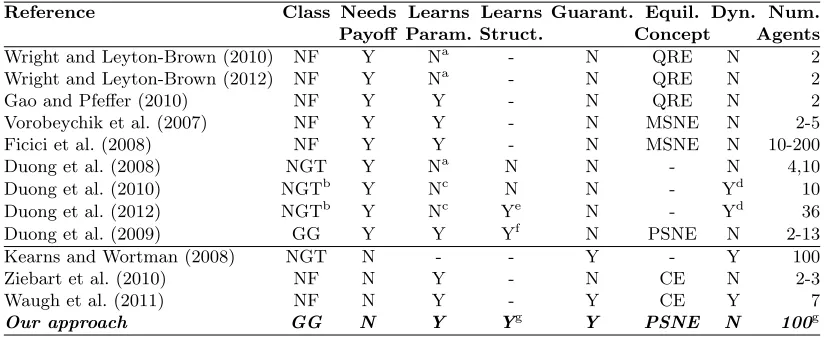
Reference Class Needs Learns Learns Guarant. Equil. Dyn. Num. Payoff Param. Struct. Concept Agents
Wright and Leyton-Brown (2010) NF Y Na - N QRE N 2
Wright and Leyton-Brown (2012) NF Y Na - N QRE N 2
Gao and Pfeffer (2010) NF Y Y - N QRE N 2
Vorobeychik et al. (2007) NF Y Y - N MSNE N 2-5
Ficici et al. (2008) NF Y Y - N MSNE N 10-200
Duong et al. (2008) NGT Y Na N N - N 4,10
Duong et al. (2010) NGTb Y Nc N N - Yd 10
Duong et al. (2012) NGTb Y Nc Ye N - Yd 36
Duong et al. (2009) GG Y Y Yf N PSNE N 2-13
Kearns and Wortman (2008) NGT N - - Y - Y 100
Ziebart et al. (2010) NF N Y - N CE N 2-3
Waugh et al. (2011) NF N Y - Y CE Y 7
Our approach GG N Y Yg Y PSNE N 100g
Table 1: Summary of approaches for learning models of behavior. See main text
for a discussion. For each method we show its model class (GG: graphical games, NF: normal-form non-graphical games, NGT: non-game-theoretic model); whether it needs observed payoffs, learns utility parameters, learns graphical structure or provides guarantees(e.g., generalization, sample complexity or PAC learnability); its equilibria concept (PSNE: pure strategy or MSNE: mixed strategy Nash equi-libria, CE: correlated equiequi-libria, QRE: quantal response equilibria), whether it is dynamic (i.e., behavior predicted from past behavior); and the number of agents in the experimental validation. Note that there are relatively fewer models that do not assume observed payoff; among them, our method is the only one that learns the structure of graphical games, furthermore, we provide guarantees and a polynomial-time algorithm. aLearns only the “rationality parameter”. bA
graph-ical game could in principle be extracted, after removing the temporal/dynamic part. cIt learns parameters for the “potential functions.” dIf the dynamic part
is kept, it is not a graphical game. eIt performs greedy search by constraining
the maximum degree. fIt performs branch and bound. gIt has polynomial
time-complexity in the number of agents, thus it can scale to thousands.
without affecting expert readers who may want to get to the technical aspects of the paper without much delay.
Table 1 constitutes our best attempt at a simple visualization to fairly present the differences and similarities of previous approaches to modeling behavioral data within the computational game-theory community in AI.
The research interest of previous work varies in what they intend to capture in terms of different aspects of behavior (e.g., dynamics, probabilistic vs. strategic) or simply different settings/domains (i.e., modeling “real human behavior,” knowledge of achieved payoff or utility, etc.).
from Ziebart et al. (2010); Kearns and Wortman (2008) because of their focus on system dynamics, in which future behavior is predicted from a sequence of past behavior. Kearns and Wortman (2008) proposed a learning-theory framework to model collective behavior based onstochastic models.
Our problem is clearly different from methods in quantal response models (McKelvey and Palfrey, 1995; Wright and Leyton-Brown, 2010, 2012) andgraphical multiagent models
(GMMs) (Duong et al., 2008, 2010) that assume known structure and observed payoffs.
Duong et al. (2012) learns the structure of games that are not graphical, i.e., the payoff depends on all other players. Their approach also assumes observed payoff and consider a
dynamicconsensus scenario, where agents on a network attempt to reach a unanimous vote.
In analogy to voting, we do not assume the availability of the dynamics (i.e., the previous actions) that led to thefinalvote. They also use fixed information on the conditioning sets of neighbors during their search for graph structure. We also note that the work of Vorobeychik et al. (2007); Gao and Pfeffer (2010); Ziebart et al. (2010) present experimental validation mostly for 2 players only, 7 players in Waugh et al. (2011) and up to 13 players in Duong et al. (2009).
In several cases in previous work, researchers define probabilistic models using knowledge of the payoff functions explicitly (i.e., aGibbs distribution with potentials that are functions of the players payoffs, regrets, etc.) to model joint behavior (i.e., joint pure-strategies); see, e.g., Duong et al. (2008, 2010, 2012), and to some degree also Wright and Leyton-Brown (2010, 2012). It should be clear to the reader that this is not the same as our generative model, which is defineddirectly on the PSNE (or stable outcomes) of the game, which the players’ payoffs determine only indirectly.
In contrast, in this paper, we assume that the joint actions are the only observable information and that both the game graph structure and payoff functions are unknown,
unobserved and unavailable. We present the first techniques for learning the structure and
parameters of a non-trivial class of large-population graphical games from joint actions only. Furthermore, we present experimental validation in games of up to 100 players. Our convex loss minimization approach could potentially be applied to larger problems since it
haspolynomial time complexity in the number of players.
2.1 On Learning Probabilistic Graphical Models
There has been a significant amount of work on learning the structure of probabilistic graphical models from data. We mention only a few references that follow a maximum likelihood approach for Markov random fields (Lee et al., 2007), bounded tree-width dis-tributions (Chow and Liu, 1968; Srebro, 2001), Ising models (Wainwright et al., 2007; Banerjee et al., 2008; H¨ofling and Tibshirani, 2009), Gaussian graphical models (Banerjee et al., 2006), Bayesian networks (Guo and Schuurmans, 2006; Schmidt et al., 2007b) and directed cyclic graphs (Schmidt and Murphy, 2009).
structure impliesstrategicdependence between players, and has no immediate probabilistic implication. Furthermore, our general model differs from Schmidt and Murphy (2009) since our generative model does not decompose as a multiplication of potential functions.
Finally, it is very important to note that our specific aim is to model behavioral data that isstrategic in nature. Hence, our modeling and learning approach deviates from those
forprobabilistic graphical models which are of course better suited for other types of data,
mostly probabilistic in nature (i.e., resulting from a fixed underlying probability distribu-tion). As a consequence, it is also very important to keep in mind that our work is not in competition with the work in probabilistic graphical models, and is not meant to replace it (except in the context of data sets collected from complex strategic behavior just men-tioned). Each approach has its own aim, merits and pitfalls in terms of the nature of data sets that each seeks to model. We return to this point in Section 8 (Experimental Results).
2.2 On Linear Threshold Models and Econometrics
Irfan and Ortiz (2014) introduced LIGs in the AI community, showed that such games are useful, and addressed a variety of computational problems, including the identification of
most influential senators. The class of LIGs is related to the well-known linear threshold
model (LTM) in sociology (Granovetter, 1978), recently very popular within the social
network and theoretical computer science community (Kleinberg, 2007).9 Irfan and Ortiz
(2014) discusses linear threshold models in depth; we briefly discuss them here for self-containment. LTMs are usually studied as the basis for some kind of diffusion process. A typical problem is the identification of most influential individuals in a social network. An LTM is not in itself a game-theoretic model and, in fact, Granovetter himself argues against this view in the context of the setting and the type of questions in which he was most interested (Granovetter, 1978). Our reading of the relevant literature suggests that subsequent work on LTMs has not taken a strictly game-theoretic view either. The problem of learning mathematical models of influence from behavioral data has just started to receive attention. There has been a number of articles in the last couple of years addressing the problem of learning the parameters of a variety ofdiffusion models of influence (Saito et al., 2008, 2009, 2010; Goyal et al., 2010; Gomez Rodriguez et al., 2010; Cao et al., 2011).10
Our model is also related to a particular model ofdiscrete choice with social interactions in econometrics (see, e.g. Brock and Durlauf 2001). The main difference is that we take a strictly non-cooperative game-theoretic approach within the classical “static”/one-shot game framework and do not use a random utility model. We follow the approach of Irfan and Ortiz (2014) who takes a strictly non-cooperative game-theoretic approach within the classical “static”/one-shot game framework, and thus we do not use arandom utility model. In addition, we do not make the assumption of rational expectations, which in the context
9. L´opez-Pintado and Watts (2008) also provide an excellent summary of the various models in this area of mathematical social science.
of models of discrete choice with social interactions essentially implies the assumption that all players useexactly the same mixed strategy.11
3. Background: Game Theory and Linear Influence Games
In classical game-theory (see, e.g. Fudenberg and Tirole 1991 for a textbook introduction),
a normal-form game is defined by a set of players V (e.g., we can let V = {1, . . . , n} if
there are n players), and for each player i, a set of actions, or pure-strategies Ai, and a
payoff function ui : ×j∈VAj → R mapping the joint actions of all the players, given by
the Cartesian product A ≡ ×j∈VAj, to a real number. In non-cooperative game theory
we assume players are greedy, rational and act independently, by which we mean that each playerialways want to maximize their own utility, subject to the actions selected by others, irrespective of how the optimal action chosen help or hurt others.
A core solution concept in non-cooperative game theory is that of anNash equilibrium. A joint action x∗ ∈ A is a pure-strategy Nash equilibrium (PSNE) of a non-cooperative game if, for each player i, x∗
i ∈ arg maxxi∈Aiui(xi,x
∗
−i); that is, x∗ constitutes a mutual
best-response, no player i has any incentive to unilaterally deviate from the prescribed
actionx∗i, given the joint action of the other playersx∗−i∈ ×j∈V−{i}Aj in the equilibrium.
In what follows, we denote a game byG, and the set of all pure-strategy Nash equilibria of
G by12
N E(G)≡ {x∗|(∀i∈V) x∗i ∈arg maxxi∈Aiui(xi,x
∗ −i)}.
A (directed) graphical game is a game-theoretic graphical model (Kearns et al., 2001).
It provides a succinct representation of normal-form games. In a graphical game, we have a (directed) graphG= (V, E) in which each node in V corresponds to a player in the game. The interpretation of the edges/arcsE of Gis that the payoff function of playeriis only a function of the set of parents/neighbors Ni ≡ {j |(i, j) ∈E} in G(i.e., the set of players
corresponding to nodes that point to the node corresponding to player iin the graph). In the context of a graphical game, we refer to theui’s as thelocal payoff functions/matrices.
Linear influence games (LIGs)(Irfan and Ortiz, 2014) are a sub-class of 2-action
graphi-cal games withparametricpayoff functions. For LIGs, we assume that we are given a matrix of influence weights W ∈Rn×n, with diag(W) =0, and a threshold vector b ∈ Rn. For
each playeri, we define the influence functionfi(x−i)≡Pj∈Niwijxj−bi=wi,−i Tx
−i−bi
and the payoff function ui(x) ≡ xifi(x−i). We further assume binary actions: Ai ≡
{−1,+1} for all i. The best response x∗i of player i to the joint action x−i of the other
players is defined as
wi,−iTx−i > bi ⇒x∗i = +1, wi,−iTx−i < bi ⇒x∗i =−1 and wi,−iTx−i =bi ⇒x∗i ∈ {−1,+1}
⇔x∗i(wi,−iTx−i−bi)≥0.
11. A formal definition of “rational expectations” is beyond the scope of this paper. We refer the reader to the early part of the article by Brock and Durlauf (2001) where they explain why assuming rational expectations leads to the conclusion that all players use exactly the same mixed strategy. That is the relevant part of that work to ours.
Intuitively, for any other playerj, wecan think of wij ∈Ras aweightparameter quantifying
the “influence factor” thatj has oni, and wecan think of bi∈Ras athreshold parameter
quantifying the level of “tolerance” that playerihas for playing −1.13
As discussed in Irfan and Ortiz (2014), LIGs are also a sub-class of polymatrix games (Janovskaja, 1968). Furthermore, in the special case of b = 0 and symmetric W, a LIG becomes a party-affiliation game (Fabrikant et al., 2004).
In this paper, the use of the verb “influence” strictly refers to influences defined by the model.
Figure 1 provides a preview illustration of the application of our approach to congres-sional voting.14
4. Our Proposed Framework for Learning LIGs
Ourgoalis to learn the structure and parameters of an LIG from observed joint actions only (i.e., without any payoff data/information).15 Yet, for simplicity, most of the presentation
in this section is actually in terms of general 2-action games. While we make sporadic references to LIGs throughout the section, it is not until we reach the end of the section that we present and discuss the particular instantiation of our proposed framework with LIGs.
Our mainperformance measure will be average log-likelihood (although later we will be considering misclassification-type error measures in the context of simultaneous-classification, as a result of an approximation of the average log-likelihood). Our emphasis on a
PSNE-13. As we formally/mathematically define here, LIGs are 2-action graphical games with linear-quadratic payoff functions. Given our main interest in this paper on the PSNE solution concept, for the most part, we simply view LIGs as compact representations of the PSNE of graphical games that the algorithms
of Irfan and Ortiz (2014) use for CSI. (This is in contrast to a perhaps more natural, “intuitive” but
stillinformal description/interpretation one may provide for instructive/pedagogical purposes based on “direct influences,” as we do here.) This view of LIGs is analogous to the modern, predominant view of Bayesian networks as compact representations of joint probability distributions that are also very useful for modeling uncertainty in complex systems and practical for probabilistic inference (Koller and Fried-man, 2009). (And also analogous is the “intuitive” descriptions/interpretations of BN structures, used for instructive/pedagogical purposes, based on “causal” interactions between the random variables Koller and Friedman, 2009.)
14. We present this game graph because many people express interest in “seeing” the type of games we learn on this particular data set. The reader should please understand that by presenting this graph we are
definitely not implying or arguing that we can identify the ground-truth graph of “direct influences.”
(We say this even in the very unlikely event that the “ground-truth model” be an LIG that faithfully capture the “true direct influences” in this U.S. Congress, something arguablyno modelcould ever do.) As we show later in Section 4.2, LIGs arenot identifiable with respect to theirlocal compact parametric representation encoding the game graph through their weights and biases, but only with respect to their PSNE, which are joint actions capturing aglobal property of a game that we really care about for CSI. Certainly, we could never validate the model parameters of an LIG at thelocal, microscopic level of “direct influences” using only the type ofobservational data we used to learn the model depicted by the graph in the figure. For that, we would need help from domain experts to designcontrolledexperiments that would yield the right type of data for proper/rigorous scientific validation.
based statistical model for the behavioral data results from the approach to causal strategic inference taken by Irfan and Ortiz (2014), which is strongly founded on PSNE.16
Note that our problem isunsupervised, i.e., we do not know a priori which joint actions are PSNE and which ones are not. If our only goal were to find a game G in which all the given observed data is an equilibrium, then any “dummy” game, such as the “dummy” LIG
G = (W,b),W =0,b=0, would be an optimal solution because |N E(G)|= 2n.17 In this
section, we present a probabilistic formulation that allows finding games that maximize the
empirical proportion of equilibria in the data while keeping thetrue proportion of equilibria
as low as possible. Furthermore, we show thattrivial games such as LIGs withW=0,b=
0, obtain the lowest log-likelihood.
4.1 Our Proposed Generative Model of Behavioral Data
We propose the following simple generative (mixture) model for behavioral data based strictly in the context of “simultaneous”/one-shot play in non-cooperative game theory, again motivated by Irfan and Ortiz (2014)’s PSNE-based approach to causal strategic
in-ference (CSI).18 Let G be a game. With some probability 0 < q < 1, a joint action x
is chosen uniformly at random from N E(G); otherwise, x is chosen uniformly at random from its complement set {−1,+1}n− N E(G). Hence, the generative model is a mixture
model with mixture parameter q corresponding to the probability that a stable outcome (i.e., a PSNE) of the game is observed, uniform over PSNE. Formally, the probability mass function (PMF) over joint-behaviors {−1,+1}n parameterized by (G, q) is
p(G,q)(x) =q
1[x∈ N E(G)]
|N E(G)| + (1−q)
1[x∈ N E/ (G)]
2n− |N E(G)| , (1)
where we can think ofq as the “signal” level, and thus 1−qas the “noise” level in the data set.
Remark 1 Note that in order for Eq. (1)to be a valid PMF for any G, we need to enforce
the following conditions |N E(G)| = 0⇒ q = 0 and |N E(G)| = 2n ⇒ q = 1. Furthermore,
note that in both cases (|N E(G)| ∈ {0,2n}) the PMF becomes a uniform distribution. We
also enforce the following condition:19 if 0<|N E(G)|<2n thenq6∈ {0,1}.
16. The possibility that PSNE may not exist in some LIGs does not present a significant problem in our case becausewe are learning the game, and can require that the LIG output has at least one PSNE.Indeed, in our approach, games with no PSNE achieve the lowest possible likelihood within our generative model of the data; said differently, games with PSNE have higher likelihoods than those that do not have any PSNE.
17. Ng and Russell (2000) made a similar observation in the context of single-agentinverse reinforcement
learning (IRL).
18. Model “simplicity” and “abstractions” are not necessarily a bad thing in practice. More “realism” often leads to more “complexity” in terms of model representation and computation; and to potentially poorer generalization performance as well (Kearns and Vazirani, 1994). We believe that even if the data could be the result of complex cognitive, behavioral or neuronal processes underlying human decision making and social interactions, the practical guiding principle of model selection in ML, which governs the fundamental tradeoff between model complexity and generalization performance, still applies.
4.2 On PSNE-Equivalence and PSNE-Identifiability of Games
For any valid value of mixture parameterq, the PSNE of a game G completely determines our generative model p(G,q). Thus, given any such mixture parameter, two games with the
same set of PSNE will induce the same PMF over the space of joint actions.20
Definition 2 We say that two games G1 and G2 are PSNE-equivalent if and only if their
PSNE sets are identical, i.e., G1 ≡N E G2⇔ N E(G1) =N E(G2).
We often drop the “PSNE-” qualifier when clear from context.
Definition 3 We say a set Υ∗ of valid parameters(G, q)for the generative model is PSNE-identifiable with respect to the PMF p(G,q) defined in Eq. (1), if and only if, for every pair
(G1, q1),(G2, q2)∈Υ∗, ifp(G1,q1)(x) =p(G2,q2)(x) for allx∈ {−1,+1}
n thenG
1 ≡N E G2 and
q1 =q2. We say a game G is PSNE-identifiable with respect to Υ∗ and the p(G,q), if and
only if, there exists a q such that (G, q)∈Υ∗.
Definition 4 We define the true proportion of equilibria in the game G relative to all possible joint actions as
π(G)≡ |N E(G)|/2n. (2)
We also say that a gameG is trivialif and only if|N E(G)| ∈ {0,2n}(or equivalentlyπ(G)∈
{0,1}), and non-trivial if and only if 0<|N E(G)|<2n (or equivalently 0< π(G)<1).
The following propositions establish that the conditionq > π(G) ensures that the prob-ability of an equilibrium is strictly greater than a non-equilibrium. The condition also guarantees that non-trivial games are identifiable.
Proposition 5 Given a non-trivial gameG, the mixture parameterq > π(G) if and only if p(G,q)(x1)> p(G,q)(x2) for anyx1 ∈ N E(G) and x2 ∈ N E/ (G).
Proof Note that p(G,q)(x1) = q/|N E(G)| > p(G,q)(x2) = (1−q)/(2n− |N E(G)|) ⇔ q >
|N E(G)|/2n and given Eq. (2), we prove our claim.
Proposition 6 Let (G1, q1) and(G2, q2) be two valid generative-model parameter tuples.
(a) If G1≡N E G2 and q1 =q2 then (∀x) p(G1,q1)(x) =p(G2,q2)(x),
(b) Let G1 and G2 be also two non-trivial games such that q1 > π(G1) and q2 > π(G2). If
(∀x) p(G1,q1)(x) =p(G2,q2)(x), then G1≡N E G2 and q1 =q2.
Proof Let N Ek ≡ N E(Gk). First, we prove part (a). By Definition 2, G1 ≡N E G2 ⇒
N E1 = N E2. Note that p(Gk,qk)(x) in Eq. (1) depends only on characteristic functions
1[x∈ N Ek]. Therefore, (∀x) p(G1,q1)(x) =p(G2,q2)(x).
Second, we prove part (b) by contradiction. Assume, wlog, (∃x) x∈ N E1∧x∈ N E/ 2.
Then p(G1,q1)(x) =p(G2,q2)(x) implies by Eq. (1) that q1/|N E1|= (1−q2)/(2
n− |N E
2|) ⇒
q1/π(G1) = (1−q2)/(1−π(G2)) by Eq. (2). By assumption, we haveq1> π(G1), which
im-plies that (1−q2)/(1−π(G2))>1⇒q2< π(G2), a contradiction. Hence, we haveG1 ≡N E G2.
Assume,q1 6=q2. Then we havep(G1,q1)(x) =p(G2,q2)(x) implies by Eq. (1) andG1 ≡N E G2
(and after some algebraic manipulations) that (q1−q2)
1[x∈N E(G
1)]
|N E(G1)| −
1[x∈N E/ (G1)]
2n−|N E(G
1)|
= 0⇒
1[x∈N E(G1)]
|N E(G1)| =
1[x∈N E/ (G1)]
2n−|N E(G
1)|, a contradiction.
The last proposition, along with our definitions of “trivial” (as given in Definition 4) and “identifiable” (Definition 3), allows us to formally define ourhypothesis space.
Definition 7 Let H be a class of games of interest. We call the set Υ ≡ {(G, q) | G ∈
H ∧0< π(G) < q <1} the hypothesis space of non-trivial identifiable games and mixture
parameters. We also refer to a game G ∈ H that is also in some tuple(G, q)∈Υ for some q, as a non-trivial identifiable game.21
Remark 8 Recall that a trivial game induces a uniform PMF by Remark 1. Therefore,
a non-trivial game is not equivalent to a trivial game since by Proposition 5, non-trivial
games do not induce uniform PMFs.22
4.3 Additional Discussion on Modeling Choices
We now discuss other equilibrium concepts, such as mixed-strategy Nash equilibria (MSNE) and quantal response equilibria (QRE). We also discuss a more sophisticated noise process as well as a generalization of our model to non-uniform distributions; while likely more realistic, the alternative models are mathematically more complex and potentially less tractable computationally.
4.3.1 On Other Equilibrium Concepts
There is still quite a bit of debate as to the appropriateness of game-theoretic equilibrium concepts to model individual human behavior in a social context. Camerer’s book on behavioral game theory (Camerer, 2003) addresses some of the issues. Our interpretation
21. Technically, we should call the set Υ “the hypothesis space consisting of tuples of non-trivial games from
Hand mixture parameters identifiable up to PSNE, with respect to the probabilistic model defined in Eq. (1).” Similarly, we should call such game G “a non-trivial game fromHidentifiable up to PSNE, with respect to the probabilistic model defined in Eq. (1).” We opted for brevity.
of Camerer’s position is not that Nash equilibria is universally a bad predictor but that it is
notconsistently the best, for reasons that are still not well understood. This point is best
illustrated in Chapter 3, Figure 3.1 of Camerer (2003).
(Logit) quantal response equilibria (QRE) (McKelvey and Palfrey, 1995) has been
pro-posed as an alternative to Nash in the context of behavioral game theory. Models based on QRE have been shown superior duringinitial play in some experimental settings, but prior work assumes known structure and observed payoffs, and only the “precision/rationality parameter” is estimated, e.g. Wright and Leyton-Brown (2010, 2012). In a logit QRE, the precision parameter, typically denoted by λ, can be mathematically interpreted as the inverse-temperature parameter of individual Gibbs distributions over the pure-strategy of each playeri.
It is customary to compute the MLE for λ from available data. To the best of our knowledge, all work in QRE assumes exact knowledge of the game payoffs, and thus, no method has been proposed to simultaneously estimate the payoff functionsui when they are
unknown. Indeed, computing MLE for λ, given the payoff functions, is relatively efficient for normal-form games using standard techniques, but may be hard for graphical games; on the other hand, MLE estimation of the payoff functions themselves within a QRE model of behavior seems like a highly non-trivial optimization problem, and is unclear that it is even computationally tractable, even in normal-form games. At the very least, standard techniques do not apply and more sophisticated optimization algorithms or heuristics would have to be derived. Such extensions are clearly beyond the scope of this paper.23
Wright and Leyton-Brown (2012) also considers even more mathematically complex variants of behavioral models that combine QRE with different models that account for constraints in “cognitive levels” of reasoning ability/effort, yet the estimation and usage of such models still assumes knowledge of the payoff functions.
It would be fair to say that most of the human-subject experiments in behavioral game theory involve only a handful of players (Camerer, 2003). The scalability of those results to games with a large population of players is unclear.
Now, just as an example, we do not necessarily view the Senators final votes as those
of a single human individual anyway: after all, such a decision is (or should be) obtained
with consultation with their staff and (one would at least hope) the constituency of the state they represent. Also, the final voting decision is taken after consultation or meetings between the staff of the different senators. We view this underlying process as one of “cheap talk.” While cheap talk may be an important process to study, in this paper, we just concentrate on the end result: the final vote. The reason is more than just scientific; as the congressional voting setting illustrates, data for such process is sometimes not available, or would seem very hard to infer from the end-states alone. While our experiments concentrate on congressional voting data, because it is publicly available and easy to obtain, the same would hold for other settings such as Supreme court decisions, voluntary vaccination, UN voting records and governmental decisions, to name a few. We speculate that in almost
all those cases, only the end-result is likely to be recorded and little information would be available about the “cheap talk” process or “pre-play” period leading to the final decision. In our work we consider PSNE because of our motivation to provide LIGs for use within the casual strategic inference framework for modeling “influence” in large-population net-works of Irfan and Ortiz (2014). Note that the universality of MSNE does not diminish the importance of PSNE in game theory.24 Indeed, a debate still exist within the game
theory community as to the justification for randomization, specially in human contexts. While concentrating exclusively on PSNE may not make sense inall settings, it does make sense in some.25 In addition, were we to introduce mixed-strategies into the inference and
learning framework and model, we would be adding a considerable amount of complexity in almost all respects, thus requiring a substantive effort to study on its own.26
4.3.2 On the Noise Process
Here we discuss a more sophisticated noise process as well as a generalization of our model to non-uniform distributions. The problem with these models is that they lead to a significantly more complex expression for the generative model and thus likelihood functions. This is in contrast to the simplicity afforded us by the generative model with a more global noise process defined above. (See Appendix A.2.1 for further discussion.)
In this paper we considered a “global” noise process, modeled using a parameterq cor-responding to the probability that a sample observation is an equilibrium of the underlying hidden game. One could easily envision potentially better and more natural/realistic “local” noise processes, at the expense of producing a significantly more complex generative model, and less computationally amenable, than the one considered in this paper. For instance, we could use a noise process that is formed of many independent, individual noise processes, one for each player. (See Appendix A.2.2 for further discussion.)
4.4 Learning Games via MLE
We now formulate the problem of learning games as one of maximum likelihood estimation with respect to our PSNE-based generative model defined in Eq. (1) and the hypothesis space of non-trivial identifiable games and mixture parameters (Definition 7). We remind
24. Research work on the properties and computation of PSNE include Rosenthal (1973); Gilboa and Zemel (1989); Stanford (1995); Rinott and Scarsini (2000); Fabrikant et al. (2004); Gottlob et al. (2005); Sureka and Wurman (2005); Daskalakis and Papadimitriou (2006); Dunkel (2007); Dunkel and Schulz (2006); Dilkina et al. (2007); Ackermann and Skopalik (2007); Hasan et al. (2008); Hasan and Galiana (2008); Ryan et al. (2010); Chapman et al. (2010); Hasan and Galiana (2010).
25. For example, in the context of congressional voting, we believe Senators almost always have full-information about how some, if not all other Senators they care about would vote. Said differently, we believe uncertainty in a Senator’s final vote, by the time the vote is actually taken, is rare, and certainly not the norm. Hence, it is unclear how much there is to gain, in this particular setting, by considering possible randomization in the Senators’ voting strategies.
the reader that our problem is unsupervised; that is, we do not know a priori which joint actions are equilibria and which ones are not. We base our framework on the fact that
games are PSNE-identifiable with respect to their induced PMF, under the condition that
q > π(G), by Proposition 6.
First, we introduce a shorthand notation for the Kullback-Leibler (KL) divergence be-tween two Bernoulli distributions parameterized by 0≤p1 ≤1 and 0≤p2≤1:
KL(p1kp2)≡KL(Bernoulli(p1)kBernoulli(p2))
=p1logpp12 + (1−p1) log11−−pp12 .
(3)
Using this function, we can derive the following expression of the MLE problem.
Lemma 9 Given a data set D={x(1), . . . ,x(m)}, define the empirical proportion of equi-libria, i.e., the proportion of samples in D that are equilibria ofG, as
b
π(G)≡ 1 m
P
l1[x(l)∈ N E(G)]. (4)
The MLE problem for the probabilistic model given in Eq. (1) can be expressed as finding:
(Gb,qb)∈arg max(G,q)∈ΥLb(G, q),whereLb(G, q) =KL(bπ(G)kπ(G))−KL(bπ(G)kq)−nlog 2,
(5)
where H andΥ are as in Definition 7, and π(G) is defined as in Eq.(2). Also, the optimal
mixture parameter bq= min(bπ(G),1− 1 2m).
Proof LetN E ≡ N E(G),π≡π(G) andπb≡πb(G). First, for a non-trivialG, logp(G,q)(x(l)) =
log|N E|q for x(l) ∈ N E, and logp(G,q)(x(l)) = log 1
−q
2n−|N E| for x(l) ∈ N E/ . The average
log-likelihood Lb(G, q) = m1 P
llogpG,q(x(l)) =πblog q
|N E|+ (1−bπ) log 1−q
2n−|N E| =bπlog q
π + (1−
b
π) log11−−πq−nlog 2. By adding 0 =−πblogbπ+πblogbπ−(1−bπ) log(1−πb) + (1−bπ) log(1−πb), this can be rewritten asLb(G, q) =πblogπb
π+(1−πb) log 1−bπ
1−π−bπlog
b
π
q−(1−πb) log 1−bπ
1−q−nlog 2,
and by using Eq. (3) we prove our claim.
Note that by maximizing with respect to the mixture parameter q and by properties of the KL divergence, we getKL(bπkqb) = 0⇔bq=πb. We define our hypothesis space Υ given the conditions in Remark 1 and Propositions 5 and 6. For the caseπb= 1, we “shrink” the
optimal mixture parameter qbto 1− 1
2m in order to enforce the second condition given in
Remark 1.
Remark 10 Recall that a trivial game (e.g., LIG G = (W,b),W =0,b = 0, π(G) = 1)
induces a uniform PMF by Remark 1, and therefore its log-likelihood is −nlog 2. Note that
the lowest log-likelihood for non-trivial identifiable games in Eq. (5) is −nlog 2 by setting
the optimal mixture parameter qb=πb(G) and given that KL(πb(G)kπ(G))≥0.
Furthermore, Eq. (5) implies that for non-trivial identifiable gamesG, we expect thetrue
proportion of equilibria π(G) to be strictly less than the empirical proportion of equilibria
b
π(G) in the given data. This is by setting the optimal mixture parameterbq=πb(G) and the
4.4.1 Learning LIGs via MLE: Model Selection
Our main learning problem consists of inferring the structure and parameters of an LIG from data with the main purpose being modeling the game’s PSNE, as reflected in the
generative model. Note that, as we have previously stated, different games (i.e., with
dif-ferent payoff functions) can be PSNE-equivalent. For instance, the three following LIGs, with different weight parameter matrices, induce the same PSNE sets, i.e., N E(Wk,0) =
{(−1,−1,−1),(+1,+1,+1)} fork= 1,2,3:27
W1=
0 0 0 1/2 0 0 0 1 0
, W2 =
0 0 0 2 0 0 1 0 0
, W3 =
0 1 1 1 0 1 1 1 0
.
Thus, not only the MLE may not be unique, but also all such PSNE-equivalent MLE games will achieve the same level ofgeneralization performance. But, as reflected by our generative model, our main interest in the model parameters of the LIGs is only with respect to the PSNE they induce, not the model parametersper se. Hence, all we need is a way to select among PSNE-equivalent LIGs.
In our work, the indentifiability or interpretability of exact model parameters of LIGs is
not our main interest. That is, in the research presented here, we did not seek or attempt to
work on creating alternative generative models with the objective to provide a theoretical guarantee that, given an infinite amount of data, we can recover the model parameters of an unknown ground-truth model generating the data, assuming the ground-truth model is an LIG. We opted for a more practical ML approach in which we just want to learn asingleLIG that has good generalization performance (i.e., predictive performance in terms of average log-likelihood) with respect to our generative model. Given the nature of our generative model, this essentially translate to learning an LIG that captures as best as possible the PSNE of the unknown ground-truth game. Unfortunately, as we just illustrated, several LIGs with different model parameter values can have the same set of PSNE. Thus, they all would have the same (generalization) performance ability.
As we all know, model selection is core to ML. One of the reason we chose an ML-approach to learning games is precisely the elegant way in which ML deals with the problem of how to select among multiple models that achieve the same level of performance: invoke the principle of Ockham’s razor and select the “simplest” model among those with the same (generalization) performance. This ML philosophy is not ad hoc. It is instead well established in practice and well supported by theory. Seminal results from the various theories of learning, such as computational and statistical learning theory and PAC learning, support the well-known ML adage that “learning requires bias.” In short, as is by now
27. Using the formal mathematical definition of “identifiability” in statistics, we would say that the LIG examples prove that the model parameters (W,b) of an LIGGare not identifiable with respect to the generative model p(G,q) defined in Eq. (1). We note that this situation is hardly exclusive to
game-theoretic models. As example of an analogous issue in probabilistic graphical models is the fact that two Bayesian networks with different graph structures can represent not only the same conditional independence properties but also exactly the same set of joint probability distributions (Chickering, 2002; Koller and Friedman, 2009).
standard in an ML-approach, we measure the quality of our data-induced models via their generalization ability and invoke the principle of Ockham’s razor to bias our search toward simpler models using well-known and -studied regularization techniques.
Now, as we also all know, exactly what “simple” and “bias” means depends on the problem. In our case, we would prefer games with sparse graphs, if for no reason other than to simplify analysis, exploration, study, and (visual) “interpretability” of the game modelby
human experts, everything else being equal (i.e., models with the same explanatory power
on the data as measured by the likelihoods).28 For example, among the LIGs presented
above, using structural properties alone, we would generally prefer the former two models to the latter, all else being equal (e.g., generalization performance).
5. Generalization Bound and VC-Dimension
In this section, we show a generalization bound for the maximum likelihood problem as well as an upper bound of the VC-dimension of LIGs. Our objective is to establish that with probability at least 1−δ, for some confidence parameter 0< δ <1, the maximum likelihood estimate is within > 0 of the optimal parameters, in terms of achievable expected log-likelihood.
Given the ground-truth distribution Q of the data, let ¯π(G) be the expected proportion of equilibria, i.e.,
¯
π(G) =PQ[x∈ N E(G)],
and let ¯L(G, q) be theexpected log-likelihood of a generative model from gameGand mixture parameterq, i.e.,
¯
L(G, q) =EQ[logp(G,q)(x)].
Let θb≡(Gb,qb) be a maximum-likelihood estimate as in Eq. (5) (i.e., θb∈arg maxθ∈ΥLb(θ)),
and ¯θ ≡ ( ¯G,q¯) be the maximum-expected-likelihood estimate: ¯θ ∈ arg maxθ∈ΥL¯(θ).29 We
use, without formally re-stating, the last definitions in the technical results presented in the remaining of this section.
Note that our hypothesis space Υ as stated in Definition 7 includes a continuous pa-rameter q that could potentially have infinite VC-dimension. The following lemma will allow us later to prove that uniform convergence for the extreme values ofqimplies uniform convergence for allq in the domain.
28. Just to be clear, here we mean “interpretability” not in any formal mathematical sense, or as often used in some areas of the social sciences such as economics. But, instead, as we typically use it in ML/AI textbooks, such as for example, when referring to shallow/sparse decision trees, generally considered to be easier to explain and understand. Similarly, the hope here is that the “sparsity” or “simplicity” of the game graph/model would make it also simpler for human experts to explain or understand what about the model is leading them to generate novel hypotheses, reach certain conclusions or make certain inferences about theglobal strategic behavior of the agents/players, such as those based on the game’s PSNE and facilitated by CSI. We should also point out that, in preliminary empirical work, we have observed that
the representationally sparser the LIG graph, thecomputationally easier it is for algorithms and other
heuristics that operate on the LIG, as those of Irfan and Ortiz (2014) for CSI, for example.
Lemma 11 Consider any game G and, for 0< q00 < q0 < q <1, let θ= (G, q), θ0 = (G, q0)
and θ00= (G, q00). If, for any >0 we have |Lb(θ)−L¯(θ)| ≤/2 and |Lb(θ00)−L¯(θ00)| ≤/2,
then|Lb(θ0)−L¯(θ0)| ≤/2.
Proof Let N E ≡ N E(G), π ≡ π(G), πb ≡ bπ(G), ¯π ≡ π¯(G), and E[·] and P[·] be the
expectation and probability with respect to the ground-truth distribution Q of the data. First note that for anyθ= (G, q), we have ¯L(θ) =E[logp(G,q)(x)] =E[1[x∈ N E] log|N E|q + 1[x∈ N E/ ] log2n1−|N E|−q ] = P[x ∈ N E] log
q
|N E| +P[x ∈ N E/ ] log
1−q
2n−|N E| = ¯πlog q
|N E| + (1−
¯
π) log2n1−|N E|−q = ¯πlog
q 1−q ·
2n−|N E|
|N E|
+ log2n1−|N E|−q = ¯πlog
q 1−q ·
1−π π
+ log11−−πq −nlog 2. Similarly, for any θ = (G, q), we have Lb(θ) = bπlog
q 1−q·
1−π π
+ log11−−πq −nlog 2. So thatLb(θ)−L¯(θ) = (bπ−π¯) log
q 1−q·
1−π π
.
Furthermore, the function 1−qq is strictly monotonically increasing for 0 ≤ q < 1. If
b
π >π¯ then−/2≤Lb(θ00)−L¯(θ00)<Lb(θ0)−L¯(θ0)<Lb(θ)−L¯(θ) ≤/2. Else, if b
π <π¯, we have /2 ≥ Lb(θ00)−L¯(θ00) >Lb(θ0)−L¯(θ0) > Lb(θ)−L¯(θ) ≥ −/2. Finally, if πb = ¯π then
b
L(θ00)−L¯(θ00) =Lb(θ0)−L¯(θ0) =Lb(θ)−L¯(θ) = 0.
In the remaining of this section, denote by d(H) ≡ |∪G∈H{N E(G)}| the number of all possible PSNE sets induced by games in H, the class of games of interest.
The following theorem shows that the expected log-likelihood of the maximum likelihood estimate θbconverges in probability to that of the optimal ¯θ = ( ¯G,q¯), as the data size m
increases.
Theorem 12 The following holds with Q-probability at least1−δ: ¯
L(θb)≥L¯(¯θ)−
log max(2m, 1
1−q¯) +nlog 2 q
2
m logd(H) + log 4 δ
.
Proof First our objective is to find a lower bound forP[ ¯L(θb)−L¯(¯θ)≥ −]≥P[ ¯L(θb)−L¯(¯θ)≥
−+ (Lb(θb)−Lb(¯θ))] ≥ P[−Lb(θb) + ¯L(θb) ≥ −
2,Lb(¯θ)−L¯(¯θ) ≥ −2] = P[Lb(θb) −L¯(θb) ≤
2,Lb(¯θ)−L¯(¯θ)≥ −2] = 1−P[Lb(θb)−L¯(θb)> 2 ∨Lb(¯θ)−L¯(¯θ)<−2].
Letqe≡max(1− 1
2m,q¯). Now, we haveP[Lb(θb)−L¯(θb)>
2∨Lb(¯θ)−L¯(¯θ)<−
2]≤P[(∃θ∈
Υ, q ≤ qe)|Lb(θ)−L¯(θ)|> 2] = P[(∃θ,G ∈ H, q ∈ {π(G),qe})|Lb(θ)−L¯(θ)| > 2]. The last
equality follows from invoking Lemma 11.
Note that E[Lb(θ)] = ¯L(θ) and that since π(G) ≤q ≤ e
q, the log-likelihood is bounded as (∀x) −B≤logp(G,q)(x)≤0, where B = log1−1qe+nlog 2 = log max(2m,
1
1−q¯) +nlog 2.
Therefore, by Hoeffding’s inequality, we haveP[|Lb(θ)−L¯(θ)|> 2]≤2e
−m2
2B2.
Furthermore, note that there are 2d(H) possible parameters θ, since we need to con-sider only two values of q ∈ {π(G),eq}) and because the number of all possible PSNE sets induced by games in H is d(H) ≡ |∪G∈H{N E(G)}|. Therefore, by the union bound we get the following uniform convergence P[(∃θ,G ∈ H, q ∈ {π(G),qe}) |Lb(θ)−L¯(θ)| >
2] ≤
4d(H)P[|Lb(θ)−L¯(θ)|> 2]≤4d(H)e
−m2
Remark 13 A more elaborate analysis allows to tighten the bound in Theorem 12 from
O(log 1−1q¯)toO(log1−q¯q¯). We chose to provide the former result for clarity of presentation. The following theorem establishes the complexity of the class of LIGs, which implies that the term logd(H) of the generalization bound in Theorem 12 is only polynomial in the number of playersn.
Theorem 14 If H is the class of LIGs, then d(H)≡ |∪G∈H{N E(G)}| ≤2n
n(n+1)
2 +1 ≤2n3.
Proof The logarithm of the number of possible pure-strategy Nash equilibria sets supported byH(i.e., that can be produced by some game inH) is upper bounded by the VC-dimension of the class of neural networks with a single hidden layer ofnunits andn+ n2
input units, linear threshold activation functions, and constant output weights.
For every LIGG = (W,b) inH, define the neural network with a single layer ofnhidden units,nof the inputs corresponds to the linear termsx1, . . . , xnand n2
corresponds to the quadratic polynomial terms xixj for all pairs of players (i, j), 1 ≤ i < j ≤ n. For every
hidden unit i, the weights corresponding to the linear terms x1, . . . , xn are −b1, . . . ,−bn,
respectively, while the weights corresponding to the quadratic terms xixj are −wij, for all
pairs of players (i, j), 1 ≤i < j ≤n, respectively. The weights of the bias term of all the hidden units are set to 0. Alln output weights are set to 1 while the weight of the output bias term is set to 0. The output of the neural network is 1[x∈ N E/ (G)]. Note that we define the neural network to classify non-equilibrium as opposed to equilibrium to keep the convention in the neural network literature to define the threshold function to output 0 for input 0. The alternative is to redefine the threshold function to output 1 instead for input 0.
Finally, we use the VC-dimension of neural networks (Sontag, 1998).
From Theorems 12 and 14, we state the generalization bounds for LIGs.
Corollary 15 The following holds with Q-probability at least 1−δ:
¯
L(θb)≥L¯(¯θ)−
log max(2m,1−1q¯) +nlog 2 qm2 n3log 2 + log4 δ
,
where H is the class of LIGs, in which case Υ ≡ {(G, q) | G ∈ H ∧0 < π(G) < q < 1}
(Definition 7) becomes the hypothesis space of non-trivial identifiable LIGs and mixture
parameters.
6. Algorithms
In this section, we approximate the maximum likelihood problem by maximizing the number of observed equilibria in the data, suitable for a hypothesis space of games with small true proportion of equilibria. We then present our convex loss minimization approach. We also discuss baseline methods such as sigmoidal approximation and exhaustive search.
Algorithm 1 Sample-Picking for General Games
Input: Data set D=x(1), . . . ,x(m).
Compute the unique samplesy(1), . . . ,y(U)and their frequency
b p(1), . . . ,
b
p(U)in the data set
D. Sort joint actions by their frequency such thatpb
(1)
≥pb
(2)
≥ · · · ≥bp
(U).
for each unique samplek= 1, . . . , U do
Define Gk by the Nash equilibria setN E(Gk) ={y(1), . . . ,y(k)}.
Compute the log-likelihood Lb(Gk,qbk) in Eq. (5) (Note that qbk =bπ(G) = m1(pb(1)+· · ·+pb(k)),
π(G) = k
2n). end for
Output: The gameGbk such thatbk= arg maxkLb(Gk,qbk).
#P-complete; thus, computing the log-likelihood function, and therefore MLE, is NP-hard.30 General approximation techniques such as pseudo-likelihood estimation do not
lead to tractable methods for learning LIGs.31 From an optimization perspective, the
log-likelihood function is not continuous because of the number of equilibria. Therefore, we cannot rely on concepts such as Lipschitz continuity.32 Furthermore, bounding the number
of equilibria by known bounds for Ising models leads to trivial bounds.33
6.1 An Exact Quasi-Linear Method for General Games: Sample-Picking
As a first approach, consider solving the maximum likelihood estimation problem in Eq. (5) by an exact exhaustive search algorithm. This algorithm iterates through all possible Nash equilibria sets, i.e., for s= 0, . . . ,2n, we generate all possible sets of size s with elements
from the joint-action space{−1,+1}n. Recall that there exist 2n s
of such sets of sizesand sinceP2s=0n 2sn
= 22n
the search space is super-exponential in the number of players n. Based on few observations, we can obtain anO(mlogm) algorithm formsamples. First, note that the above method does not constrain the set of Nash equilibria in any fashion. Therefore, only joint actions that are observed in the data are candidates of being Nash equilibria in order to maximize the log-likelihood. This is because the introduction of an
30. This is not a disadvantage relative to probabilistic graphical models, since computing the log-likelihood function is also NP-hard for Ising models and Markov random fields in general, while learning is also NP-hard for Bayesian networks.
31. We show that evaluating the pseudo-likelihood function for our generative model is NP-hard. Consider a non-trivial LIGG= (W,b). Furthermore, assumeG has a singlenon-absolutely-indifferent playeriand
absolutely-indifferentplayers∀j6=i; that is, assume that (wi,−i, bi)6=0and (∀j6=i) (wj,−j, bj) =0(See
Definition 19). Let fi(x−i)≡wi,−iTx−i−bi, we have 1[x∈ N E(G)] = 1[xifi(x−i)≥0] and therefore
p(G,q)(x) =q
1[xifi(x−i)≥0]
|N E(G)| + (1−q)
1−1[xifi(x−i)≥0]
2n−|N E(G)| . The result follows because computing |N E(G)| is #P-complete, even for this specific instance of a singlenon-absolutely-indifferentplayer (Irfan and Ortiz, 2014).
32. To prove that counting the number of equilibria is not (Lipschitz) continuous, we show how small changes in the parameters G = (W,b) can produce big changes in |N E(G)|. For instance, consider two games
Gk= (Wk,bk), whereW1=0,b1=0,|N E(G1)|= 2nandW2=ε(11T−I),b2=0,|N E(G2)|= 2 for
ε >0. Forε→0, any`p-normkW1−W2kp→0 but|N E(G1)| − |N E(G2)|= 2n−2 remains constant.
33. The log-partition function of an Ising model is a trivial bound for counting the number of equilibria. To see this, let fi(x−i) ≡ wi,−iTx−i−bi, |N E(G)| = Px
Q
i1[xifi(x−i)≥0] ≤ Px
Q
ie
xifi(x−i) =
P
xe
xTWx−bTx =Z(1
2(W+W
T
),b), whereZ denotes the partition function of an Ising model. Given the convexity ofZ (Koller and Friedman, 2009), and that the gradient vanishes atW=0,b=0, we know thatZ(1
2(W+W
T