25 | http://mojes.um.edu.my/ EISSN: 2289-3024
MALAYSIAN ONLINE JOURNAL OF EDUCATIONAL SCIENCES
APRIL 2019, 7 (2)INTRODUCTION
Division by zero is often unclear and confusing, and teachers at various grade levels may encounter difficulties in conveying this concept to their students. The concept of dividing by zero plays a crucial role in developing an understanding of certain mathematical concepts, such as rational numbers and the relationship between multiplication and division (Quin, Lamberg, & Perrin, 2008). Therefore, in order to provide students with a strong conceptual understanding about division by zero, it is important to examine the in-service teachers’ knowledge. Over the last four decades, researchers are increasingly focusing on the content knowledge of teachers and its role in teaching. In research on the teaching of mathematics, several researchers examined teachers’ beliefs and attitude about some mathematical concepts (Dede & Karakuş, 2014; Thompson, 1992; Zikre & Kwan Eu, 2016). These studies show that teachers’ beliefs and attitude affect their teaching. Other researchers focused on teachers’ and pre-service teachers’ understandings of some mathematical concepts such as zero, fraction or decimal numbers (Baki, 2013; Ball, 1990; Even, 1993; Even & Tirosh, 1995; Gökkurt, Şahin & Soylu, 2012; Toluk-Uçar, 2011). They investigate how teachers think about their mathematical
ELEMENTARY MATHEMATICS TEACHERS’ SPECIALIZED CONTENT KNOWLEDGE RELATED TO DIVISION BY ZERO
*Fatih KARAKUS
Department of Mathematics Education, Faculty of Education, Sivas Cumhuriyet University, Turkey
Bünyamin AYDIN
Department of Mathematics Education, Faculty of Education, Alanya Alaaddin Keykubat University, Turkey
ABSTRACT
Division by zero is often unclear and confusing, and teachers at various grade levels may encounter difficulties in conveying this concept to their students. The concept of dividing by zero plays a crucial role in developing an understanding of certain mathematical concepts, such as rational numbers and the relationship between multiplication and division. Therefore, in order to provide students with a strong conceptual understanding about division by zero, it is important to examine the in-service teachers’ knowledge. The aim of this study was to explore the in-service teachers’ specialized content knowledge concerning division by zero, as well as the effects of variables which are years of service and education status on teachers’ specialized content knowledge. The study consisted of a case-study and was carried out with 82 in-service teachers of elementary mathematics at Afyonkarahisar in Turkey. To determine the in-service teachers’ specialized content knowledge, a written questionnaire was used. Data were analyzed by using inductive and deductive analysis. Analysis of the results revealed that although most of the in-service teachers gave correct answers related to division by zero, few of them provided conceptual explanations. Rather, those who gave correct explanations mainly responded with rule-based statements.
26 | http://mojes.um.edu.my/ EISSN: 2289-3024
MALAYSIAN ONLINE JOURNAL OF EDUCATIONAL SCIENCES
APRIL 2019, 7 (2)knowledge and how they explain and justify their mathematical ideas. Ball, Thames, and Phelps (2008) developed a model called “mathematical knowledge for teaching (MKT)” for understanding teacher knowledge in the field of mathematics education. In this study, it was intended to assess the in-service teachers’ special content knowledge based on the Ball et al. (2008) framework.
Mathematical Knowledge for Teaching
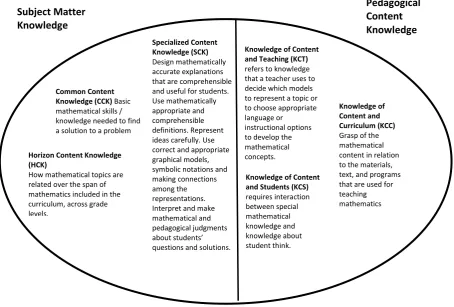
Teachers’ knowledge is one of the most important factors relating to the quality of teaching. For over 40 years, researchers have examined teachers’ knowledge and suggested some models on it. One of the most commonly used and widely accepted model of teachers’ knowledge was given by Shulman (1986) who divided teacher content knowledge into three categories which are subject matter knowledge (SMK), pedagogical content knowledge (PCK) and curricular knowledge (CK). Shulman’s (1986) model has been accepted as a framework for most of the researches on teacher knowledge (Ball, 1990; Ball & McDiarmid, 1990; Ball, Thames & Phelps, 2008). Ball et al. (2008) improved Shulman’s (1986) model and developed a framework for mathematics teaching. The focus of their framework was all the things that teachers do in their mathematics teaching. All the things refer to having a strong knowledge of the subject matter, choosing appropriate examples and representations, identifying students’ errors and misconceptions, examining the sources of these misconceptions, being aware of the students’ preliminary knowledge and using mathematical language correctly (Hill, Rowan & Ball, 2005). In other words, it refers to what teachers need to do in teaching mathematics called “mathematical knowledge for teaching (MKT)” (Ball et al., 2008). Ball et al. (2008)’s purpose in developing MKT was not to replace Shulman’s model, but instead to provide further understanding of teachers’ knowledge by building on it. MKT is comprised of two halves, each of which includes three components. These components can be categorized under Shulman’s two types of knowledge, PCK and SMK (refer to Figure 1).
Figure 1. Domains of mathematical knowledge for teaching. Adapted from Bair and Rich (2011) and Ball et al. (2008).
Pedagogical
Content
Knowledge
Subject Matter
Knowledge
Common Content Knowledge (CCK) Basic mathematical skills / knowledge needed to find a solution to a problemHorizon Content Knowledge (HCK)
How mathematical topics are related over the span of mathematics included in the curriculum, across grade levels.
Specialized Content Knowledge (SCK) Design mathematically accurate explanations that are comprehensible and useful for students. Use mathematically appropriate and comprehensible definitions. Represent ideas carefully. Use correct and appropriate graphical models, symbolic notations and making connections among the representations. Interpret and make mathematical and pedagogical judgments about students’ questions and solutions.
Knowledge of Content and Teaching (KCT) refers to knowledge that a teacher uses to decide which models to represent a topic or to choose appropriate language or
instructional options to develop the mathematical concepts.
27 | http://mojes.um.edu.my/ EISSN: 2289-3024
MALAYSIAN ONLINE JOURNAL OF EDUCATIONAL SCIENCES
APRIL 2019, 7 (2)Specialized Content Knowledge (SCK) is a specific knowledge used for teaching that someone other than a teacher does not need to possess (Aslan-Tutak, 2009). Ball et al. (2008) explained this idea as “accountants have to calculate and reconcile numbers and engineers have to mathematically model properties of materials, but neither group needs to explain why, when you multiply by 10, you ‘add a zero” (p. 401). SCK involves teacher knowledge about how to explain and justify a student’s mathematical ideas and how to choose, make and use mathematical models and representations. For example, when a teacher explains and justifies why you invert and multiply to divide fractions, the teacher uses specialized content knowledge.
Research on Teachers’ Knowledge of Division by Zero
In the literature, there are some studies investigating teachers’ and pre-service teachers’ knowledge based on MKT (Aslan-Tutak, 2009; Burke, 2013; Contreas, Batanero, Diaz & Fernandes, 2011; Nolan, Dempsey, Lovatt & O’Shea, 2015). These studies indicate that teachers’ mathematical content knowledge and pedagogical content knowledge has a direct influence on their mathematics teaching. Teachers design mathematically accurate activities, pose good mathematical problems and make appropriate instructional materials and models based on this knowledge. The mathematical content knowledge is directly affected by teacher’s pedagogical content knowledge. Brown and Borko (1992) expressed that limited mathematical content knowledge is an obstacle on pre-service teachers’ pedagogical content knowledge. Even (1993) found that many of the pre-service teachers in her study lacked the necessary subject matter knowledge. This fact had affected their pedagogical content knowledge. There must be a tight connection between pedagogical content knowledge and subject matter knowledge for it to not be an obstacle instead. Many mathematics teachers have low levels of the SCK and PCK required to teach the subject effectively (Tirosh, 2000; Ball, 1990). The concept of division by zero is one of the important topics in mathematics that pre-service teachers often seem to have insufficient knowledge. Ball (1990) studied elementary and secondary pre-service teachers’ specialized mathematical knowledge of division by zero and found that pre-service teachers had significant difficulty with the meaning of division by zero. Ball (1990) expressed that pre-service teachers mostly gave rule-based explanations such as “it is undefined because this is a rule, and you cannot divide by zero”. Likewise, Wheeler and Feghali (1983) reached a similar conclusion, reporting that pre-service elementary school teachers did not have an adequate understanding of the number zero or the division of items with zero as a dividend or a divisor. Crespo and Nicol (2006) also examined the effects of two teacher education tasks on pre-service teachers’ understanding of division by zero. According to their findings, the participants made progress during these instructional experiences; as such, their initial ideas were extended, and their later explanations became more conceptually based than rule-bound.
Beside pre-service teachers, there are some studies in which in-service teachers’ knowledge have also been discussed (Cankoy, 2010; Even & Tirosh, 1995; Quinn et al., 2008). For instance, Even and Tirosh (1995) asked secondary mathematics teachers to explain why 4 divided by 0 is undefined. They found that most of the teachers could not supply any appropriate explanation. Similar to Ball’s (1990) findings, some teachers provided rule-based explanations such as “in mathematics this is a rule that one cannot divide by zero”. Likewise, Quinn et al. (2008) investigated the perceptions of fourth through eighth grade teachers concerning division by zero and reported that, although a few teachers had a conceptual understanding, most did not. In addition, Cankoy (2010) investigated high-school mathematics teachers’ topic-specific pedagogical content knowledge about “a0=1, 0!=1 and a÷0, where a≠0.” He found that experienced teachers proposed conceptual explanations more frequently than novice teachers, but all the participants’ explanations were procedural and fostered memorization.
Division by Zero in the Turkish Educational Setting
28 | http://mojes.um.edu.my/ EISSN: 2289-3024
MALAYSIAN ONLINE JOURNAL OF EDUCATIONAL SCIENCES
APRIL 2019, 7 (2)7th grade. At this level, textbooks define rational numbers as “can be written as a/b where a and b (b≠0) are integers” (Bağcı, 2015, p. 37). According to this definition, numbers such as are considered as rational numbers, since their denominators and dividends are integers. On the other hand, although their denominators and dividends are also integers, numbers such as are not considered as rational numbers, because their denominators are zero (Bağcı, 2015). This textbook, as well as others, presents as undetermined but there is no explanation as to why this is the case. Then, in the 9th through 12th grades, students frequently encounter such undefined and undetermined cases while solving equations, as well as in defining functions and finding limits of functions. As with the 7th grade, rather than offering conceptual explanations related to division by zero, the focus on solving this undefined case is on the rules and procedural operations.
PURPOSE OF THE STUDY AND RESEARCH QUESTIONS
The aim of this study was to explore the in-service teachers’ specialized content knowledge of dividing by zero. Therefore, the research problems of this study were as follows:
1. What are the elementary in-service mathematics teachers’ specialized content knowledge of division by zero?
2. Does the years of service have any effect on the elementary in-service mathematics teachers’ specialized content knowledge of division by zero?
3. Does the education status have any effect on the elementary in-service mathematics teachers’ specialized content knowledge of division by zero?
METHODOLOGY
The research methodology of this study was a case study. In a case study, the researcher is primarily focused on understanding a specific individual or situation (Fraenkel, Wallen, & Hyun, 2012). Case study research focuses on individuals’ experiences of certain phenomenon and describes the cases in depth.
Participants
Data were collected from the 82 in-service elementary mathematics teachers at the end of the spring semester of the 2016-2017 academic year. In order to investigate the in-service teachers’ SCK of division by zero, in-service teachers in city center of Afyonkarahisar, Turkey were selected. Teachers with different years of service and education status were purposively selected based on certain criteria. The aim in selecting in-service teachers from different years of service and education status was to compare the novice and expert teachers’ explanations and to investigate the differences in teachers’ explanations depending on the experiment. Demographic characteristics of 82 in-service teachers were given in Table 1.
Table 1
Demographic characteristics of in-service teachers
f %
Years of service
1-5 years 21 26
6-10 years 24 29
11-15 years 26 32
16-20 years 11 13
Total 82 100
Education status License degree Master degree 68 14 83 17
29 | http://mojes.um.edu.my/ EISSN: 2289-3024
MALAYSIAN ONLINE JOURNAL OF EDUCATIONAL SCIENCES
APRIL 2019, 7 (2)A pre-service elementary mathematics teacher graduates from teacher education program at the end of four years with teaching degree in Turkey. Depending the result of teacher proficiency exam, the pre-service mathematics teacher starts to work as a mathematics teacher. Moreover, the pre-service teachers can arbitrarily get master education after working as a mathematics teacher.
Instrument and Data Collection Procedure
To determine the in-service teachers’ SCK, a written questionnaire was developed. The first questionnaire item was, “Suppose that a student asks you what 7 divided by 0 is. How would you respond?” The second questionnaire item was, “Suppose that a student asks you what 0 divided by 0 is. How would you respond?” The aim of these questions was to reveal the in-service teachers’ SCK concerning division by zero. The questions were adapted from the literature relating to teachers’ knowledge and perceptions about division by zero (Ball, 1990; Cankoy, 2010; Quinn et. al, 2008). The questionnaire was administered to the participants in the spring term of the 2016-2017 academic year. The in-service teachers were given sufficient time to complete their responses. Before administering the final form of the questionnaire, two mathematics educators checked the validity of the questions and agreed that they were valid and appropriate for measuring in-service teachers’ SCK.
Data analysis
After the instrument was administered to 82 in-service teachers, the researchers and two mathematics educators chose the explanations of 25 of the participants at random and used inductive and deductive analysis (McMillan & Schumacher, 2006) to determine the categories and themes in the written responses. The qualitative analysis of the data led to the development of four categories of explanation. Ball’s (1990) model explained the understanding of dividing by zero guided of coding. The first category included in-service teachers who gave accurate explanations that are comprehensible for students and provided meaning for students. Explanation of in-service teachers who provided meaning were separated into five sub-categories in the form of “inverse of multiplication”, “sharing/dividing evenly”, “intuitive notion of limit”, “part-whole comparisons” and “deductive reasoning”. The second category included in-service teachers who knew that the operation is undefined/undetermined, but could not provide any explanation as to why this is the case. Explanations of in-service teachers who gave the correct rule were separated into three sub-categories in the form of “explain as a rule”, “the meaning of zero”, and “definition of rational number”. The third category included in-service teachers who gave incorrect explanation. Explanation of in-service teachers who provided incorrect answers were separated into two sub-categories in the form of “explain as an infinite”, and “write a number”. The last category included in-service teachers who did not give any explanation. All teachers’ names were covered and added codes such as T1, T2, … in order to identify them. Aside from that, direct quotations were drawn from teachers' explanations when the data were presented.
FINDINGS
In-service Teachers’ SCK Related to 7÷0 with regard to years of service
30 | http://mojes.um.edu.my/ EISSN: 2289-3024
MALAYSIAN ONLINE JOURNAL OF EDUCATIONAL SCIENCES
APRIL 2019, 7 (2)Table 2
Frequencies and percentages of in-service teachers’ explanations on 7÷0 with regard to years of service
Category Theme 1-5 years 6-10 years 11-15 years 16-20 years Total
Meaning
Inverse of
multiplication f % 6 7 11 13 12 15 9 11 38 47
Sharing/ dividing evenly
f 2 2 3 - 7
% 2 2 4 - 9
Intuitive
notion of limit f % 1 1 - - 2 2 - - 3 3
Part-whole
comparisons f % - - - - 2 2 - - 2 2
Correct rule
Explain as a
rule f % 2 2 5 6 5 6 2 2 14 17
The meaning
of zero f % 3 4 4 5 1 1 - - 8 10
Definition of rational
number
f 2 - - - 2
% 2 2
Incorrect rule
Explain as
infinite f % 4 5 2 2 1 1 - 7 9
Write a
number f % 1 1 - - - - - - 1 1
Table 2 shows that nearly 61% of the in-service teachers explained the meaning of division by zero, while 39% of them responded by stating rules, ten of which were incorrect. Four approaches were used on explanations focused on meaning: (1) inverse of multiplication, (2) sharing/dividing evenly (3) intuitive notion of limit and (4) part-whole comparisons.
T28 who is a teacher with 1-5 years of service chose the inverse of multiplication approach:
Original explanation Translation from Turkish to English
7/0 is undefined, because, if 7/0=a then we can write 7=0.a. If we multiply a number by zero, the result is always zero. Clearly, there is no number that can be placed in a to make the equation true.
T54 who is a teacher with 11-15 years of service chose the second approach:
Original explanation Translation from Turkish to English
31 | http://mojes.um.edu.my/ EISSN: 2289-3024
MALAYSIAN ONLINE JOURNAL OF EDUCATIONAL SCIENCES
APRIL 2019, 7 (2)T19 who is a teacher with 11-15 years of service chose the third approach:
Original explanation Translation from Turkish to English
7÷1=7, 7÷0.5=14, 7÷0.1=70, 7÷0.001=7000, 7÷0.0001=70000, … If we decrease the dominator, the result increases. If the denominator gets closer to zero result will be very huge. For that reason 7÷0 is undefined. This topic will be
explained more deeper in grade 12 in the concept of limit
T27 who is a teacher with 11-15 years of service chose the fourth approach:
Original explanation Translation from Turkish to English
First of all, I will explain the 0÷7. A whole is cut into seven parts, but no part taken.
So, it is zero.
In the case of 7÷0, the whole is not cut any part, but seven parts were taken. I will
explain it is undefined.
Table 2 shows that 29% of in-service teachers explained division by zero in terms of a rule such as “7÷0 is undefined, because this is a rule in mathematics.” Unlike those who focused on meaning, these in-service teachers did not try to show why this was so. Three approaches were used division by zero in terms of a rule: (1) explain as a rule, (2) the meaning of zero and (3) definition of rational number.
T18 who is a teacher with 1-5 years of service chose the first approach:
Original explanation Translation from Turkish to English
A number divided by zero is undefined. It should be emphasized that this is a rule.
T40 who is a teacher with 1-5 years of service chose the second approach:
Original explanation Translation from Turkish to English
We should know how many zero are there in 7. For example, There are seven union groups in 7. But, zero means nothing. So, we cannot find how many zero are there in 7. Because, we can group nothing into something that exits. For that reason this
32 | http://mojes.um.edu.my/ EISSN: 2289-3024
MALAYSIAN ONLINE JOURNAL OF EDUCATIONAL SCIENCES
APRIL 2019, 7 (2)T49 who is 1-5 years of service chose the third approach:
Original explanation Translation from Turkish to English
By the definition of rational numbers, the denominator cannot be zero. So we
cannot calculate this operation.
Table 2 shows that unlike those who gave correct rule-based explanations, 10% of in-service teachers gave incorrect answer or misleading explanations on division by zero. There were two incorrect explanations on division by zero: (1) explain as an infinite and (2) write a number.
T23 who is 11-15 years of service chose the first incorrect explanation:
Original explanation Translation from Turkish to English
7/0=∞, I express this is a rule.
T48 who is 1-5 years of service chose the second incorrect approach:
Original explanation Translation from Turkish to English
if we divide a whole into zero that do not represent anything, then nothing happens,
so the result is zero
According to Table 2, the most frequently given explanation in the explanations focusing on meaning were the “inverse of multiplication” at all years of service levels. Moreover, the in-service teachers with 11-15 years of service were mostly focusing on the meaning of division by zero and they gave more varied conceptual explanations. However, the least given explanations were “intuitive notion of limits” and “part-whole comparisons.” Similarly, the most frequently given explanations in the correct rule category was the “explain as a rule” at all years of service levels. The second preferred correct rule explanation was the “meaning of zero.” Moreover, only service teachers with just 1-5 years of experience gave explanations in the category of “definition of rational number”. The in-service teachers who gave the most incorrect answers were in their 1-5 years of service.
33 | http://mojes.um.edu.my/ EISSN: 2289-3024
MALAYSIAN ONLINE JOURNAL OF EDUCATIONAL SCIENCES
APRIL 2019, 7 (2)Figure 2. The distribution of the in-service teachers’ explanations about 7÷0 with respect to years of service
As shown in Figure 2, the frequency of explanations focusing on meaning was high for in-service teachers in both 11-15 years and 16-20 years of service and there was an increase in the conceptual explanations from 1-5 years to 16-20 years of service. In addition, while there was a slight increase in the correct rule-based explanations in 6-10 years of service, there was a decrease in those rule-based explanations for the other years. Moreover, the number of incorrect explanations decreased from 1-5 years to 16-20 years.
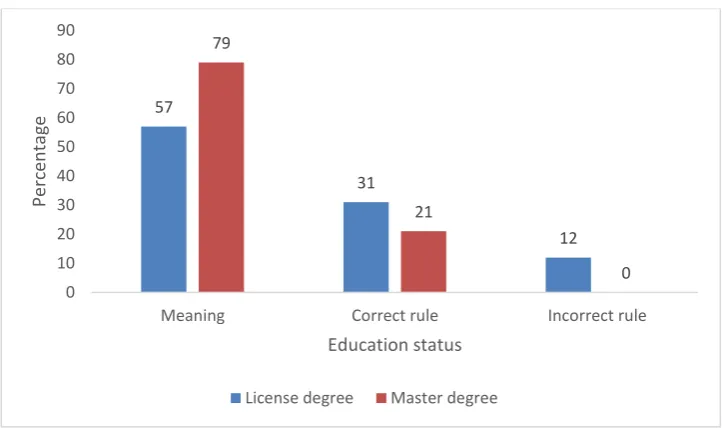
The distribution of the in-service teachers’ explanations on 7÷0 with regard to education status is shown in Figure 3.
Figure 3. The distribution of the in-service teachers’ explanations about 7÷0 with respect to education status
According to Figure 3, the percentage of master degree teachers’ explanations focused on meaning was higher than license degree teachers. In contrast, the percentage of license degree teachers’ both correct rule and incorrect explanations were higher than master degree teachers. This shows that education status has an effect on the teachers’ explanations.
43
54
73
82
33 38
23
18 24
8
4 0
0 10 20 30 40 50 60 70 80 90
1-5 years 6-10 years 11-15 years 16-20 years
Perc
en
ta
ge
Years of service
Meaning Correct rule Incorrect rule
57
31
12 79
21
0
0 10 20 30 40 50 60 70 80 90
Meaning Correct rule Incorrect rule
Perc
en
ta
ge
Education status
34 | http://mojes.um.edu.my/ EISSN: 2289-3024
MALAYSIAN ONLINE JOURNAL OF EDUCATIONAL SCIENCES
APRIL 2019, 7 (2)In-service Teachers’ SCK Related to 0÷0 with regard to years of service
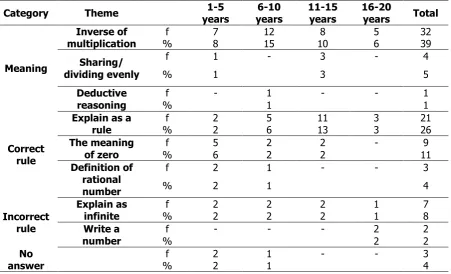
The frequencies and percentages of the in-service teachers’ explanations on 0÷0 with regard to years of service are given in Table 4.
Table 4
Frequencies and percentages of in-service teachers’ explanations on 0÷0 with regard to years of service
Category Theme years 1-5 years 6-10 11-15 years 16-20 years Total
Meaning
Inverse of
multiplication % f 7 8 12 15 10 8 5 6 32 39
Sharing/ dividing evenly
f 1 - 3 - 4
% 1 3 5
Deductive reasoning
f - 1 - - 1
% 1 1
Correct rule
Explain as a
rule % f 2 2 5 6 11 13 3 3 21 26
The meaning
of zero % f 5 6 2 2 2 2 - 11 9
Definition of rational number
f 2 1 - - 3
% 2 1 4
Incorrect rule
Explain as
infinite % f 2 2 2 2 2 2 1 1 7 8
Write a
number % f - - - 2 2 2 2
No
answer % f 2 2 1 1 - - 3 4
Table 4 shows that nearly 45% of the in-service teachers explained the meaning of 0÷0, while 51% of them responded by stating rules, and ten of which were found to be incorrect. Moreover, four in-service teachers did not give any explanations about 0÷0. Three approaches were used on explanations focused on meaning: (1) inverse of multiplication, (2) sharing/dividing evenly and (3) deductive reasoning.
T3 who is a teacher with 6-10 years of service chose the first approach:
Original explanation Translation from Turkish to English
Let’s assume that 0/0=a. It would satisfy the equation 0=0a. In this equation, we can write any number as
35 | http://mojes.um.edu.my/ EISSN: 2289-3024
MALAYSIAN ONLINE JOURNAL OF EDUCATIONAL SCIENCES
APRIL 2019, 7 (2)T54 who is a teacher with 11-15 years of service chose the second approach:
Original explanation Translation from Turkish to English
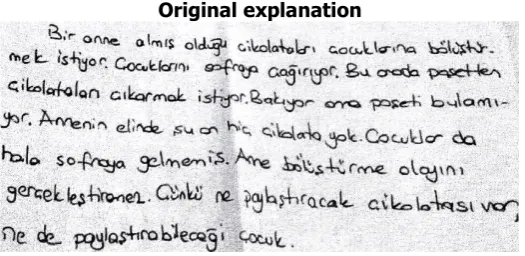
A mother share chocolates with her children evenly. She wants to take off chocolates from the bag, but she cannot find the bag. Moreover, no children are coming. There are no chocolates and no children. Because there are no children or chocolates to share, mother cannot share evenly.
T50 who is a teacher with 6-10 years of service chose the last approach:
Original explanation Translation from Turkish to English
The above calculation has three results 1. Since the numerator and the denominator are both same, result is 1
2. Since the numerator is zero, the result is zero
3. Since the denominator is zero, the result is undefined
In sum, since there are three different results, the result of calculation should be undetermined.
Table 4 shows that 41% of in-service teachers explained division by zero in terms of a rule such as “0÷0 is undefined, because this is a rule.” Unlike those who focused on meaning, these in-service teachers did not try to show why this was so. Three approaches were used division by zero in terms of a rule: (1) explain as a rule, (2) the meaning of zero and (3) definition of rational number.
T37 who is a teacher with 1-5 years of service chose the first approach:
Original explanation Translation from Turkish to English
I’d just say it is undetermined, but I don’t know why this is so. If there is a define answer of this calculation, I will learn and
explain to student.
T6 who is a teacher with 1-5 years of service chose the second approach:
Original explanation Translation from Turkish to English
36 | http://mojes.um.edu.my/ EISSN: 2289-3024
MALAYSIAN ONLINE JOURNAL OF EDUCATIONAL SCIENCES
APRIL 2019, 7 (2)T44 who is a teacher with 1-5 years of service chose the last approach:
Original explanation Translation from Turkish to English
0/0 = undetermined. The students know that the denominator cannot be zero, they already express that it is undetermined.
Table 4 shows that unlike those who gave correct rule-based explanations, 10% of in-service teachers gave incorrect answer or misleading explanations on division by zero. There were two incorrect explanations on division by zero: (1) explain as an infinite and (2) write a number.
T18 who is a teacher with 1-5 years of service chose the first approach:
Original explanation Translation from Turkish to English
We have to explain with limit which we have learned in high school and university. But I’d say to students that the calculation result is infinite, it is not equal to zero.
T35 who is a teacher with 16-20 years of service chose the second approach:
Original explanation Translation from Turkish to English
As dividing a number to the same number is one, 0/0 is equal to one.
According to Table 4, the most frequently given explanation in the explanations focusing on meaning was the “inverse of multiplication” at all years of service levels. Moreover, in-service teachers in both 6-10 and 11-15 years of service were mostly focusing on the meaning of division by zero and they gave more varied conceptual explanations. However, the least given explanations were “deductive reasoning” and “part-whole comparisons.” Similarly, the most frequently given explanations in the correct rule category was the “explain as a rule”. The second preferred correct rule explanation was the “meaning of zero.” In addition, most frequently given explanation in the category of incorrect rule was the “explain as infinite” at all years of service levels. There were also two in-service teachers in 16-20 years of service explained that the result should be a number. Only three teachers in both 1-5 and 6-10 years of service teachers gave no answer about 0÷0.
37 | http://mojes.um.edu.my/ EISSN: 2289-3024
MALAYSIAN ONLINE JOURNAL OF EDUCATIONAL SCIENCES
APRIL 2019, 7 (2)Figure 4. The distribution of the in-service teachers’ explanations about 0÷0 with respect to years of service
As shown in Figure 4, the frequency of explanations focusing on meaning was high for in-service teachers in both 6-10 years and 16-20 years of service and there was an increase in the conceptual explanations from 1-5 years to 16-20 years of service. Also, while there was an increase in the correct rule-based explanations in 11-15 years of service, there was a decrease those rule-based explanations in 20 years of service. Contrary to that, the number of incorrect explanations is the highest in 16-20 years. Moreover, some teachers in both 1-5 and 6-10 years in service gave no any answer to division by zero.
The distribution of the in-service teachers’ explanations on 0÷0 with regard to education status is shown in Figure 5.
Figure 5. The distribution of the in-service teachers’ explanations about 0÷0 with respect to education status.
According to Figure 5, the percentage of master degree teachers’ explanations focused on meaning was higher than license degree teachers. Similarly, the percentage of master degree teachers’ correct rule explanations were higher than license degree teachers. In contrast, the percentage of license degree teachers’ incorrect rule explanations were higher than master degree teachers. This shows that education status has an effect on the teachers’ explanations.
38
44
9 9
54
34
8
4 42
50
8
0 46
27 27
0
0 10 20 30 40 50 60
Meaning Correct rule Incorrect rule Don't know
Perc
en
ta
ge
Years of service
1-5 years 6-10 years 11-15 years 16-20 years
43
40
13
4 57
43
0 0
0 10 20 30 40 50 60
Meaning Correct rule Incorrect rule Don't know
Perc
en
ta
ge
Education status
38 | http://mojes.um.edu.my/ EISSN: 2289-3024
MALAYSIAN ONLINE JOURNAL OF EDUCATIONAL SCIENCES
APRIL 2019, 7 (2)DISCUSSION
The results of this study demonstrate that most of teachers could give correct answers for both 7÷0 and 0÷0. Although most of the teachers provided correct answers related to division by zero, half of them had significant difficulty with the meaning of division by zero. The difficulties experienced by the teachers indicated a narrow understanding of division by zero. Studies reported that most of teachers knew that division by zero is undefined, but when asked to explain why, most could not supply any appropriate explanation (Cankoy, 2010; Even & Tirosh, 1995; Quin et al., 2008). Teachers who gave the meaning of division by zero correctly, mostly preferred “inverse of multiplication” strategy. However, few of them gave different strategies such as “intuitive notion of limit” and “deductive reasoning”. This revealed that teachers had limited subject matter knowledge for teaching division by zero. Similar findings were observed by Ball (1990) and Cankoy (2010).
In comparing the responses according to years of service experienced teachers suggested more conceptual-based explanations for teaching division by zero than the novice teachers. Previous studies have reported that most of novice teachers do not have a solid understanding related to specific mathematical topics such as concept of zero, division and function (Even & Tirosh, 1995; Kinach, 2002; Ma, 1999; Toluk-Uçar, 2011). When the years of service increased, teachers conceptual-based explanations increased and became varied. This indicates that the years of service (experiment) impacted the teachers’ specific content knowledge related to specific mathematical topics.
The results revealed that over half of teachers for teaching dividing by zero gave correct answer, while half of them responded by stating a rule. These teachers suggested explanations which promote procedural/rule-based understanding. Teachers who gave rule-based explanations mostly preferred “explain as a rule” and “the meaning of zero” strategies. Teachers in both 1-5 years and 6-10 years of service mostly gave rule-based explanations. Moreover, when the years of service increased, teachers’ rule-based explanations decreased. Hutchinson (1996) notes that because novice teachers have weak pedagogical content knowledge, they prefer more rule-based explanations. So, teaching experience may be considered as an important factor in the development of teachers’ specific content knowledge as seen in studies reporting that both teachers and pre-service teachers primarily gave rule-based explanations such as “this is a rule, you cannot divide by zero” to justify their answers (Ball, 1990; Cankoy, 2010; Crespo & Nicol, 2006; Quin et al., 2008). The result of this study showed that some teachers, especially novice teachers, provided incorrect explanations. Parallel to this result, studies (Ball, 1990; Charalambos et al., 2011; Kinach, 2002; Leinhardt, 2001) stated that for the pre-service and novice teachers especially, they provide incomplete, error-prone and unrelated explanations. One reason for this may be that, novice teachers had taken courses in Calculus where they had frequently encountered the concept of undefined in the topic of limit and derivative. These teachers had the tendency to think of number/zero=infinite. Moreover, some novice teachers gave a numerical result. Tsamir, Ruth, and Tirosh (2000) noted that students may have an intuitive belief that all mathematical operations should have a numerical result.
In comparing the responses according to educational status, teachers with a master’s degree suggested more conceptual-based explanations than teachers in license degree. This indicates that the master degree programs did impact teachers’ specialized content knowledge positively. Similarly, license degree teachers gave more rule-based and incorrect explanations than master’s degree teachers. Previous studies have reported that education status may positively affect the teachers’ knowledge (Goldhaber & Brewer, 1996).
CONCLUSION
39 | http://mojes.um.edu.my/ EISSN: 2289-3024
MALAYSIAN ONLINE JOURNAL OF EDUCATIONAL SCIENCES
APRIL 2019, 7 (2)It was also found that the experienced teachers provided more conceptual-based explanations than novice teachers. This conclusion shows that the experience is a factor for teachers’ SCK.
The results of this study showed that when the teachers’ education is higher, their SCK also increased and became varied. In this study, teachers with master’s degree gave more conceptual-based explanations about division by zero than teachers with just an undergraduate degree.
EDUCATIONAL IMPLICATIONS
The results of this study showed that although some teachers could give meaningful explanations about division by zero, most of their explanations were narrow. In this context, the reasons of these narrow explanations can lead to further research. The results also show that novice teachers provide more rule-based explanations on division by zero. In this context, the effects of the content and method courses that pre-service teachers have on these explanations need to be examined in depth. Moreover, it is necessary to make some changes in courses about teachers’ pedagogical content knowledge in teacher education programs. The results of this study indicate that when the educational status of teachers increase, their meaningful explanations increase, too. For that reason, more opportunities should be given to teachers in order to increase their educational status.
REFERENCES
Aslan-Tutak, F. (2009). A study of geometry content knowledge of elementary preservice teachers: The case of quadrilaterals (Unpublished doctoral dissertation). University of Florida, Gainesville, Florida.
Bağcı, O. (2015). Ortaokul matematik 7 ders kitabı. [Grade 7 elementary school mathematics textbook] Ankara: Tutku Yayıncılık.
Bair, S. L., & Rich, B. S. (2011). Characterizing the development of specialized mathematical content knowledge for teaching in algebraic reasoning and number theory. Mathematical Thinking and Learning, 13(4), 292-321.
Baki, M. (2013). Pre-service classroom teachers' mathematical knowledge and instructional explanations associated with division. Egitim ve Bilim-Education and Science, 38(167), 300-311. Ball, D. L. (1990). Prospective elementary and secondary teachers’ understanding of division. Journal
for Research in Mathematics Education, 21(2), 132-144.
Ball, D. L., & McDiarmid, G. W. (1990). The subject matter preparation of teachers. In W. R. Houston, M. Haberman, & J. Sikula (Eds.), Handbook of Research on Teacher Education (pp. 437-449). New York: Macmillan.
Ball, D. L., Thames, M. H., & Phelps, G. (2008). Content knowledge for teaching: What makes it special? Journal of Teacher Education, 59(5), 389-407.
Brown, C., & Borko, H. (1992). Becoming a mathematics teacher. In D. A. Grouws (Ed.), Handbook of Research on Mathematics Teaching and Learning. New York: Macmillan Publishing.
Burke, B. M. (2013). Experiential professional development: A model for meaningful and long-lasting change in classrooms. Journal of Experiential Education, 36(3), 247-263.
Cankoy, O. (2010). Mathematics teachers' topic-specific pedagogical content knowledge in the context of teaching a0, 0! and a÷0. Educational Sciences: Theory and Practice, 10(2), 749-769.
Charalambous, C. Y., Hill, H. C., & Ball, D. L. (2011). Prospective teachers’ learning to provide instructional explanations: How does it look and what might it take? Journal of Mathematics Teacher Education, 14(6), 441-463.
Contreras, J. M., Batanero, C., Díaz, C., & Fernandes, J. A. (2011). Prospective teachers’ common and specialized knowledge in a probability task. In Seventh Congress of the European Society for Research in Mathematics Education (pp. 766-775). European Society for Research in Mathematics Education.
40 | http://mojes.um.edu.my/ EISSN: 2289-3024
MALAYSIAN ONLINE JOURNAL OF EDUCATIONAL SCIENCES
APRIL 2019, 7 (2)Dede, Y., & Karakuş, F. (2014). The effect of teacher training programs on pre-service mathematics teachers’ beliefs towards mathematics. Educational Sciences: Theory & Practice, 14(2), 804-809.
Even, R. (1993). Subject-matter knowledge and pedagogical content knowledge: Prospective secondary teachers and the function concept. Journal for Research in Mathematics Education, 24(2), 94-116.
Even, R., & Tirosh, D. (1995). Subject-matter knowledge and knowledge about students as sources of teacher presentations of the subject-matter. Educational Studies in Mathematics, 29(1), 1-20. Fraenkel, J. R., Wallen, N. E., & Hyun, H. H. (2012). How to design and evaluate research in
education (8th Ed.). New York: McGram-Hill.
Goldhaber, D. D., & Brewer, D. J. (1996). Evaluating the effect of teacher degree level on educational performance. Retrieved from https://files.eric.ed.gov/fulltext/ED406400.pdf
Gökkurt, B., Şahin, Ö., & Soylu, Y. (2012). An analysis on the relationship between the pedagogical and mathematical content knowledge of mathematics teachers. The Journal of Academic Social Science Studies, 5(8), 997-1012.
Hill, H. C., Rowan, B., & Ball, D. L. (2005). Effects of teachers’ mathematical knowledge for teaching on student achievement. American Educational Research Journal, 42(2), 371-406.
Hutchinson, W. G. (1996). The relationship among stress, teacher efficacy and person environment fit for Western Australian high school teachers (Unpublished doctoral dissertation). The University of Western Australia, Perth, WA.
Kinach, B. M. (2002). A cognitive strategy for developing pedagogical content knowledge in the secondary mathematics methods course: Toward a model of effective practice. Teaching and Teacher Education, 18(1), 51-71.
Leinhardt, G. (1990). Towards understanding instructional explanations. Retrieved March, 10, 2017 from ERIC database.
Leinhardt, G. (2001). Instructional explanations: A commonplace for teaching and location for contrast. Handbook of research on teaching, 4, 333-357.
Ma, L. (1999). Knowing and teaching elementary mathematics: Teachers’ understanding of fundamental mathematics in China and the United States. Mahwah, NJ: Erlbaum.
McMillan, J. H., & Schumacher, S. (2006). Research in education. Evidence-based inquiry (6th Ed.). Boston: Pearson Education.
Nolan, B., Dempsey, M., Lovatt, J., & O'Shea, A. (2015). Developing mathematical knowledge for teaching (MKT) for pre-service teachers: A study of students’ developing thinking in relation to the teaching of mathematics. Proceedings of the British Society for Research into Learning Mathematics, 35(1), 54-59.
Quinn, R. J., Lamberg, T. D., & Perrin, J. R. (2008). Teacher perceptions of division by zero. The Clearing House: A Journal of Educational Strategies, Issues and Ideas, 81(3), 101-104.
Shulman, L. S. (1986). Those who understand: Knowledge growth in teaching. Educational researcher, 15(2), 4-14.
Thompson, A. G. (1992). Teachers' beliefs and conceptions: A synthesis of the research. Macmillan. Tirosh, D. (2000). Enhancing prospective teachers’ knowledge of children's conceptions: The case of
division of fractions. Journal for Research in Mathematics Education, 31(1), 5-25.
Toluk-Uçar, Z. (2011). Preservice teachers’ pedagogical content knowledge: Instructional explanations. Turkish Journal of Computer and Mathematics Education, 2(2), 87-102.
Tsamir, P., Sheffer, R., & Tirosh, D. (2000). Intuitions and undefined operations: The cases of division by zero. Focus on Learning Problems in Mathematics, 22(1),1-16.
Wheeler, M. M., & Feghali, I. (1983). Much ado about nothing: Preservice elementary school teachers' concept of zero. Journal for Research in Mathematics Education, 14(3), 147-155.