© Shiraz University
Static Analysis of Rectangular Nanoplates Using Exponential Shear Deformation Theory Based on Strain Gradient Elasticity Theory
M. R. Nami and M. Janghorban*
School of Mechanical Engineering, Shiraz University, Shiraz, Iran
Abstract: In this research, the bending analysis of rectangular nanoplates subjected to mechanical loading is investigated. For this purpose, the strain gradient elasticity theory with one gradient parameter is presented to study the nanoplates. Navier method for static analysis of rectangular plates is obtained to solve the governing equations and boundary conditions. The suggested model is justified by a very good agreement between the results given by the present model and available data. Additionally, the effects of different parameters such as internal length scale parameter, length to thickness ratio and aspect ratio on the numerical results are also investigated.
Keywords: Static analysis, exponential shear deformation theory, strain gradient elasticity theory, small scale effects, nanoplates
1. Introduction
In recent years, gradient elasticity theories have attracted many attentions because of the necessity of modeling and analysis of very small sized mechanical structures and devices in the rapid developments of micro-/nanotechnologies [1]. Gao and Park [2] provided a detailed variational formulation for a simplified strain gradient elasticity theory by using the principle of minimum total potential energy. This leaded to the simultaneous determination of the equilibrium equations and the complete boundary conditions of the theory for the first time. Ramezani [3] studied a micro scale non-linear Timoshenko beam model based on a general form of strain gradient elasticity theory. The von Karman strain tensor was used to capture the geometric non-linearity. It was shown that both strain gradient effect and that of geometric non-linearity increase the beam natural frequency. Daneshmand et al [4] introduced a gradient-enriched shell formulation based on the first order shear deformation shell model and the stress gradient and strain-inertia gradient elasticity theories were used for dynamic analysis of single walled carbon nanotubes. The proposed shell formulation includes two length scale size parameters related to the strain gradients and inertia gradients. Ashoori Movassagh and Mahmoodi [5] presented a Kirchhoff micro-plate model based on the modified strain gradient elasticity theory to capture size effects, in contrast with the classical plate theory. The above analysis was general and could be reduced to the modified couple stress plate model or classical plate model. It was shown that the differences between the deflection predicted by the modified strain gradient model, the couple stress model and the classical model are large when the plate thickness is small and comparable to the material length scale parameters. A multi-cell homogenization procedure with four geometrically different groups of cell elements (respectively for the bulk, the boundary surface, the edge lines and the corner points of a body) was envisioned, which is able not only to extract the effective constitutive properties of a material, but also to assess the “surface effects” produced by the boundary surface on the near bulk material by Polizzotto [6]. Applying this procedure to a (finite) body suitably modelled as a simple material cell system, in association with the principle of the virtual power (PVP) for
quasi-static actions, an equivalent structural system was derived, featured by a (macro-scale) PVP having the typical format as for a second strain gradient material model. Sahmani and Ansari [7] predicted the free vibration behavior of microplates made of functionally graded materials (FGMs). On the basis of strain gradient elasticity theory, a non-classical higher-order shear deformable plate model containing three material length scale parameters was developed which can effectively capture the size dependencies. It was found that by approaching the thickness of microplates to the value of internal material length scale parameter, the natural frequency increases considerably. Zhang et al [8] developed a novel size-dependent curved microbeam model made of functionally graded materials based on the strain gradient elasticity theory and n shear deformation theory. The material properties of the FGM curved microbeam were assumed to vary in the thickness direction and were estimated through the Mori–Tanaka homogenization technique. The results indicated that the inclusion of size effect results in an increase in microbeam stiffness, and leads to a reduction of deflection and an increase in natural frequency. Yi et al [9] proposed a new strain gradient theory based on energy nonlocal model and the theory was applied to investigate the size effects in thin metallic wire torsion, ultra-thin beam bending and micro-indentation of polycrystalline copper. First, an energy nonlocal model was suggested. Second, based on the model, a new strain gradient theory was derived. Akgöz and Civalek [10] studied the size effect of microtubules via modified strain gradient elasticity theory for buckling. MTs were modeled by Bernoulli–Euler beam theory. The results based on the modified couple stress theory, nonlocal elasticity theory and classical elasticity theories had been presented for comparison purposes. Lazopoulos and Lazopoulos [15] discussed the torsion and the stretching of stress fibers into the context of strain gradient elasticity theory and their size effects. It was proven for the torsion problem that the torsion moment varies with the axial length of the bar for constant twist angle. The proposed theory was supported by experimental evidence. Amanatidou and Aravas [16] treated the strain-gradient elasticity theories developed by Mindlin and co-workers in the 1960s in detail. If traditional finite elements are used for the numerical solution of such problems, then displacement continuity is required. They developed a variational formulation which can be used for both linear and non-linear strain-gradient elasticity theories. Peerlings and Fleck [17] determined the effective higher-order elasticity constants required in the Toupin-Mindlin strain gradient theory. The method had been applied to a matrix-inclusion composite, showing that higher-order terms become more important as the stiffness contrast between inclusion and matrix increases. Based on the above review, as a first attempt, a new strain gradient elasticity theory using exponential shear deformation theory is presented for bending analysis of isotropic rectangular nanoplates. An analytical method is adopted to solve the governing equations. In order to validate the accuracy of the results of this analysis, our results are compared with numerical solutions found in the literature. This shows that the present model is appropriate for prediction of the displacements of rectangular nanoplates.
2. Review of Strain gradient theory
The gradient elasticity theory was developed by combining Eringen stress-gradient and stable strain-gradient theory [1]. Various formats of strain-gradient elasticity are used in the studies of nano structures [11, 22-23]. In the present work, the strain gradient theory used by Askes and Aifantis [11] is adopted to derive the governing equations. It reads as,
, , (1)
(2a-e)
where and are stress and strain tensors, contains the elastic moduli, and denote internal length scales static and dynamic analysis. For the static analysis, can be equaled to zero and the above constitutive equation may be the same as Papargyri-Beskou and Beskos [12]. A difference between Eringen’s theory and equation (1) concerns how the balance of momentum is formulated: Eringen uses the divergence of whereas above strain gradient elasticity theory uses the divergence of the right-hand side of equation (1). This difference implies an interchange of the roles of stress and strain [11]. Comparisons of experimental results from torsion and bending of beams with theoretical ones reveal that the gradient coefficient l (internal length) has values of the same order of magnitude as the diameter of the basic building block of the material microstructure, e.g., the grain in metals or ceramics, the osteon in bones or the cell in foams [12].
3. Governing equations
The exponential shear deformation theory for macro plates accounts for a parabolic distribution of the transverse shear strains across the thickness, and it satisfies the zero traction boundary conditions on both of the top and bottom surfaces of the plate without using shear correction factors[13].
The displacement field of the proposed plate theory is given by [13],
, , , 2
h ∅ ,
, , , 2
h ,
, , ,
(3)
Three normal and three shearing strain components are defined which are leading to a total of six independent components that completely describe small deformation theory. This set of equations is normally referred to as the strain-displacement relations [14].
ε ∂u
∂x z
∂ w ∂x
∅
ε ∂v
∂y z
∂ w ∂y
2 ∅
where , and are the displacements in the , and , respectively and 2 . The
unknown functions φ and ψ are the functions related with the shear slopes. According to the classical exponential shear deformation plate theory, the governing equations for buckling analysis of a rectangular
plate can be written as [13],
2 ° ° 2 ° , 0
+ 0 + 0 (5) where , , , , / / , , , , / / , / , / (6) In order to find the governing equations for studying rectangular nanoplates with considering the internal length constant, the following mathematical formulations are used,
Q
dz
z
f
d
y
Q
dz
z
df
x
Q
dz
z
df
Q
dz
z
df
G
equation
xz 3 3 2 2 2 2:
2(e)
(10)
22 22 3 3:
2(d)
dz
z
f
d
y
dz
z
df
x
dz
z
df
dz
z
df
G
equation
yz
(11)The following equations can be obtained if the above equations are integrated;
y x Q v D y x w D v y x Q v D y w x w v D y D y w D x Q vD x w vD N dz equation z f sy h h
7 3 2 4 1 3 3 3 3 6 4 4 4 4 1 6 2 2 1 6 2 2 1 2 2 1 : ) 8 ( (16)
x y Q D y x y Q D y x w D x x y Q D y x w D x y Q D y x w D N dz equation z f sxy h h 9 2 3 3 3 8 3 4 4 3 3 2 3 8 3 4 4 8 2 4 2 2 2 2 2 : ) 9 ( (17)
Q D y Q D x Q D Q D N dz dz z df equation Tcx h h 11 2 2 10 2 2 10 10 22 (10) :
(18)
2 112 10 2 2 10 10 2
2 (11) :
D y D x D D N dz dz z df equation Tcy h h (19) Where
12 1 1
2
2 2
h
h f z dz
1
2
2
h
h zf z dz 1
2 2 2 2 hh z dz
z f z f 1
2 2 2 2 hh z dz
z f
z 2 1
2
2 2
h
h f z dz
24 1 2 1
2
2 2
2
h
h z d z
z f z f
2 1
2
2
h
h zf z dz
2 1
2 2 2 hh dz dz
z df 2 1
2 2 2 2 hh z dz
z f z 2 1
2 2 3 3 hh dz dz
At this step, through differentiating of the above equations, some terms in classical exponential shear deformation theory will appear considering the gradient constant. As the last step, by adding the above equations with considering the classical governing equations, the exponential shear deformation equations will achieve based on the strain gradient elasticity theory in investigating nanoplates.
It is important to mention that from equation (20), one can easily obtain the gradient Kirchhoff plate theory which was presented by Papargyri-Beskou and Beskos [12] as follow,
) , (
6
4w D w q x y
D
. (23)
Now, consider a simply supported rectangular nanoplate under transverse loading. One of the major difficulties in using strain gradient theory is finding non-classical Boundary conditions [21]. This reason may cause researchers to rarely use gradient theory for nanoplates and they usually use nonlocal theory however the results of strain gradient seems to be more accurate in comparison with the nonlocal theory. Moreover there isn't any way to find nonlocal parameters without experimental test and MD but one can find different methods for finding gradient parameters. Based on the explanations mentioned above, it is important to use gradient theory. The present research suggested a simple method to use gradient theory. It was assumed that the unknown boundary conditions are satisfied with Navier solution. To prove this assumption then, the results were verified with the results of Papargyri-Beskou et al [12, 21] . As the results are in a good agreement with their results so it is found that the assumption was correct. Based on the Navier approach [24], the solutions were assumed as
y
x
y
x
Q
Q
y
x
W
W
mn mn mn
cos
sin
sin
cos
sin
sin
(24)
Where
b n a
m
, . It is worth mentioning that the convergency of the analytical solutions isstudied the same as Papargyri-Beskou and Beskos [12]. The loading is
y
b
n
x
a
m
q
n m
mn
sin
sin
21 ,
and mn
a b
ydxdyb n x a m y x q
ab 0 0 , sin sin
4
. For plates subjected to uniform pressure, theloading can be defined as
y
b
n
x
a
m
mn
q
q
n m
sin
sin
16
, 0
. Moreover, the above governing equations have allterms for investigating both static and buckling of nanoplates however, in the present study only the
results of bending analysis are presented. Therefore, other researchers can follow the same procedure to
study other analysis for nanoplates [24, 26]. In order to solve the above equations, it is suitable to convert
the equations to the matrices form as follow,
0
0
33 32 31
23 22 21
13 12
11 mn
mn mn
mn
Q
Q
W
K
K
K
K
K
K
K
K
K
(25)
4. Numerical results
Consider a simply supported all-around rectangular nanoplate with sides a and b along the x and y directions with constant thickness h subjected to transverse loading. In the present research, the Young's modulus is assumed to be 30 GPa and the Poisson's ratio is assumed to be 0.3. In Fig. 1, a simply supported square rectangular nanoplate subjected to uniform pressure is considered. The comparison study demonstrates that the deflections obtained using the present new strain gradient elasticity theory and other gradient theories are almost identical. In this figure, the deflection ratios can be defined as follow,
Deflection ratio Deflection using strain gradient theory Deflection using local theory
and the normalized gradient coefficient is . In Table 1, our results for macro plates are compared with
the results of classical plate theory. Although we verified our results in Fig. 1 but this table may be helpful
for understanding the differences between our theory and classical plate theory.
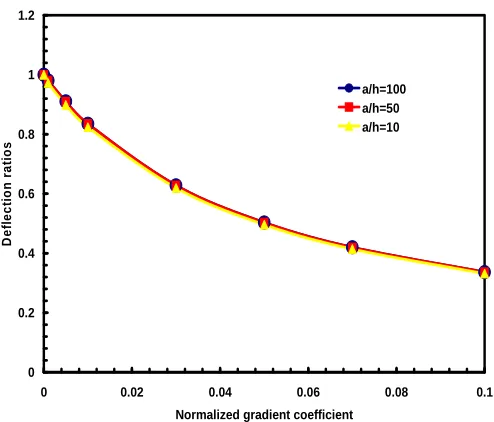
Fig. 1. Normalized central deflection of a square simply supported gradient elastic plate under a uniformly distributed lateral load versus the normalized gradient coefficient.
Table 1. Comparing the results with the results of classical plate theory for macro plates
b/a
1 2 3 4 5
Present 0.08127 0.2183 0.2872 0.3204 0.3381 CPT 0.09342 0.2391 0.3026 0.3310 0.3455
In Fig. 2, the influences of both thickness to length ratio and normalized gradient coefficient on the deflection of simply supported square nanoplates under sinusoidal loading are demonstrated. It can be seen that by increasing of the thickness of the nanoplate from thin to moderately thick plate, the maximum displacement ratios does not change too much but by increasing the gradient coefficient, the displacements decrease rapidly although for normalized gradient coefficient of more than 0.08, the slopes are going to be zero for both thin and thick nanoplates.
0.2 0.3 0.4 0.5 0.6 0.7 0.8 0.9 1
0 0.01 0.02 0.03 0.04 0.05 0.06 0.07 0.08 0.09 0.1
Normalized gradient coefficient
D
e
fl
e
c
ti
on ra
tios
Fig. 2. Normalized central deflection of thin and moderately thick square nanoplate under sinusoidal loading.
Figure 3 illustrates the effect of aspect ratio on the deflection ratios of simply supported nanoplate subjected to uniform load. As the figure indicates, when the aspect ratio increases it makes the deflection ratios decrease. In addition, it can be seen that the gradient coefficient effect in square nanoplate is more significant in comparison with rectangular nanoplate. It can be found easily form Figs. 1-3 that local plate theories cannot apply to nanoplate in general and the small scale effects should be considered in most of nanoplate studies. Similar results can be found in the literature, too [18-20].
Fig. 3. Normalized central deflection of square and rectangular nanoplates under uniform load.
According to the author's opinion, it is not sufficient to study the nonlocal to local deflection ratio and the deflections of nanoplates should be investigated since the behaviors of these two parameters are not the same. It is noted that the nonlocal to local deflection ratio can only be used to show the importance of considering size effects in studying nano structures. In Fig. 4, the effects of static gradient parameter and
0 0.2 0.4 0.6 0.8 1 1.2
0 0.02 0.04 0.06 0.08 0.1 Normalized gradient coefficient
D
e
fl
e
c
tio
n
ra
tio
s
a/h=100 a/h=50 a/h=10
0.2 0.3 0.4 0.5 0.6 0.7 0.8 0.9 1
0 0.02 0.04 0.06 0.08 0.1
Normalized gradient coefficient
D
e
fl
ect
ion r
a
ti
os
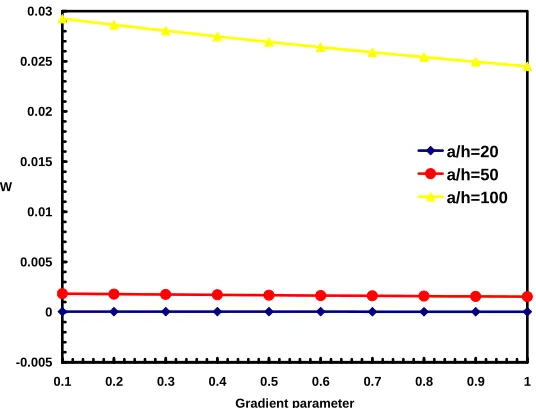
aspect ratio on the transverse displacement to thickness ratio are shown. It can be seen that by increasing the gradient parameter, the displacement to thickness ratio will decrease however, by increasing the aspect ratios, the displacement to thickness ratio will increase. Figure 5 depicts the influences of gradient parameter and length to thickness ratio on the static analysis of nanoplates. It is figured that by increasing the length to thickness ratio, the transverse displacement to thickness ratio will also increase. From this figure, it is found that in lower length to thickness ratios, the influences of gradient parameter may be ignored. From Figs. 3 and 5, one can also find the behaviors of the nonlocal to local deflection ratio and understand that the deflections of nanoplates are not similar to each other.
Fig. 4. The effects of different parameters on the displacement to thickness ratio.
Fig. 5. The effects of different parameters on the displacement to thickness ratio.
5. Conclusion
This study presented a strain gradient elasticity formulation of exponential shear deformation theory to analyze the static behavior of rectangular nanoplates. Navier solutions for flexure analysis of simply supported rectangular nanoplates were presented. Numerical comparison was presented to validate the
0 0.005 0.01 0.015 0.02 0.025 0.03
0.1 0.2 0.3 0.4 0.5 0.6 0.7 0.8 0.9 1 Gradient parameter
W
b/a=0.5 b/a=0.7 b/a=0.9
-0.005 0 0.005 0.01 0.015 0.02 0.025 0.03
0.1 0.2 0.3 0.4 0.5 0.6 0.7 0.8 0.9 1 Gradient parameter
W
accuracy of the present method. The effects of gradient coefficient on the bending behavior of rectangular nanoplates were investigated in numerical examples. It was established that by increasing the gradient coefficient, the deflections will decrease for both thin and thick rectangular nanoplates.
6. References
[1] E. Ghavanloo and S. A. Fazelzadeh, Free vibration analysis of orthotropic doubly-curved shallow shells based on the gradient elasticity. Composite: Part B, 45 (2013) 1448–1457.
[2] X. L. Gao and S. K. Park, Variational formulation of a simplified strain gradient elasticity theory and its application to a pressurized thick-walled cylinder problem, International Journal of Solids and Structures, 44 (2007) 7486-7499.
[3] S. Ramezani, A micro scale geometrically non-linear Timoshenko beam model based on strain gradient elasticity theory, International Journal of Non-Linear Mechanics, 47 (2012) 863-873.
[4] F. Daneshmand, M. Rafiei, S. R. Mohebpour and M. Heshmati, Stress and strain-inertia gradient elasticity in free vibration analysis of single walled carbon nanotubes with first order shear deformation shell theory, Applied
Mathematical Modelling 37 (2013) 7983-8003.
[5] A. Ashoori Movassagh and M. J. Mahmoodi, A micro-scale modeling of Kirchhoff plate based on modified strain-gradient elasticity theory, European Journal of Mechanics A/Solids, 40 (2013) 50-59.
[6] C. Polizzotto, A second strain gradient elasticity theory with second velocity gradient inertia – Part I: Constitutive equations and quasi-static behavior, International Journal of Solids and Structures 50 (2013) 3749-3765.
[7] S. Sahmani and R. Ansari, On the free vibration response of functionally graded higher-order shear deformable microplates based on the strain gradient elasticity theory, Composite Structure 95 (2013) 430-442.
[8] B. Zhang, Y. He, D. Liu, Z. Gan and L. Shen, A novel size-dependent functionally graded curved mircobeam model based on the strain gradient elasticity theory, Composite Structure 106 (2013) 374-392.
[9] D. Yi, T. C. Wang and S. Chen, New strain gradient theory and analysis. Acta Mechanica Solida Sinica 22 (2009) 45-52.
[10]B. Akgöz and O. Civalek, Application of strain gradient elasticity theory for buckling analysis of protein microtubules, Current Applied Physics 11 (2011) 1133-1138.
[11]E. C. Aifantis and H. Askes, Gradient elasticity and flexural wave dispersion in carbon nanotubes, Physics
Review B, 80 (2009) 195412.
[12]S. Papargyri-Beskou and D. E. Beskos, Static, stability and dynamic analysis of gradient elastic flexural Kirchhoff plates, Archive of Applied Mechanics 78 (2008) 625–635.
[13]A. S. Sayyad and Y. M. Ghugal, Buckling analysis of thick isotropic plates by using exponential shear deformation theory, Applied Computer Mechanics 6 (2012) 185–196.
[14]M. H. Sadd. Elasticity, Theory, Applications, and Numerics. Elsevier (2009).
[15]K. A. Lazopoulos and A. K. Lazopoulos, Strain gradient elasticity and stress fibers, Archive of Applied
Mechanics 83 (2013) 1371-1381.
[16]Amanatidou, N. Aravas, Mixed finite element formulations of strain-gradient elasticity problems. Computer
Methods in Applied Mechanics and Engineering, 191 (2002) 1723–1751.
[17]R. H. J. Peerlings and N. A. Fleck, Computational evaluation of strain gradient elasticity constants. Int. J.
Multiscale Comput. Engineering 2 (2004) 599-619.
[18]Y. Z. Wang, H. T. Cui, F. M. Li and K. Kishimoto, Thermal buckling of a nanoplate with small-scale effects.
Acta Mechanica, 224 (2013) 1299-1307.
[20]M. Bedroud, S. Hosseini-Hashemi, R. Nazemnezhad, Buckling of circular/annular Mindlin nanoplates via nonlocal elasticity. 224 (2013) 2663-2676.
[21]S. Papargyri-Beskou, A. E. Giannakopoulos and D. E. Beskos, , Variational analysis of gradient elastic flexural plates under static loading, International Journal of Solids and Structures, 47(20), (2010) 2755–2766
[22]S. Papargyri-Beskou and D. Beskos, Static analysis of gradient elastic bars, beams, plates and shells, The Open
Mechanics Journal, 4 (2010), 65-73.
[23]B. Wang, S. Zhou, J. Zhao and X. Chen, A size-dependent Kirchhoff micro-plate model based on strain gradient elasticity theory, European Journal of Mechanics - A/Solids, 30(4) (2011), 517–524.
[24]M. R. Nami & M. Janghorban, Resonance behavior of FG rectangular micro/nano plate based on nonlocal elasticity theory and strain gradient theory with one gradient constant, Composite Structures, 111(2014) 349– 353.
[25]M. R. Nami & M. Janghorban, Static analysis of rectangular nanoplates using trigonometric shear deformation theory based on nonlocal elasticity theory, Beilstein Journal of Nanotechnology, 4 (2013) 968–973.
[26]M. R. Nami & M. Janghorban, Wave propagation in rectangular nanoplates based on strain gradient theory with one gradient parameter with considering initial stress. Mod. Phys. Lett. B, 28 (2014) 28, 1450021 (9 pages).
Appendix
The components of stiffness matrix can be expressed as follow,
2 5 3 2 4 4 4 3 2 5 1 2 2 3 2 1 2 4 3 1 2 1 13 2 5 4 4 2 3 4 2 2 2 3 1 3 2 5 1 2 4 2 1 3 1 12 4 2 3 2 4 3 4 2 6 2 4 2 4 4 2 6 2 2 3 4 2 2 4 11 2 2 2 2 2 2 2 2 4 4 1 1 4 2 D D D D D vD vD D D vD K D D D vD vD D D D vD D K D D D v D vD D v vD D D D vD D K
9 3 8 3 8 7 3 6 8 6 23 11 2 2 10 2 9 4 8 2 2 8 2 7 4 6 10 2 8 2 6 22 4 4 2 3 4 2 3 1 4 1 5 1 2 4 2 1 3 121 2 1 2 2
D D D vD vD D vD K D D D D D D D D D D K D D D v vD D D vD D K
2 2
8 11 2 10 2 10 2 9 4 8 2 7 4 6 10 2 8 2 6 33 9 3 8 3 8 7 3 6 8 6 32 3 2 4 4 4 3 2 1 5 1 4 1 2 4 3 1 2 1
31 2 1 2 2