_____________________________________________________________________________________________________ *Corresponding author: E-mail: [email protected];
(Past name: British Journal of Pharmaceutical Research, PastISSN: 2231-2919, NLM ID: 101631759)
Nicotine Replacement Therapy and Electronic
Cigarettes: Awareness among Medical Students
Ahmad Taha Khalaf
1*, Jun Wan
1#, Karim Al-Jashamy
2,
Samiah Yasmin Abdul Kadir
3, Jamaludin Zainol
3, Saeid Reza Doustjalali
3,
Negar Shafiei Sabet
3, May Kyi Aung
3, Yassin Hani Arafeh
3,
Jessica Lok Xia Shin
3, Izzatul Akmal Binti Sahrom
3and A. E. Muftah
31
College of Medicine (College of Nursing), Chengdu University, Chengdu, China.
2
Departmentof Biomedical, Bilad Al-Rafidain University College, Iraq.
3
Faculty of Medicine, SEGi University Kota Damansara, Malaysia.
Authors’ contributions
This work was carried out in collaboration among all authors. Authors ATK and JW designed the study, wrote the protocol and wrote the first draft of the manuscript. Authors KAJ, SYAK, JZ, SRD, NSS,
AEM and MKA managed the analyses of the study. Authors YHA, JLXS and IABS performed the statistical analysis and managed the literature searches. All authors read and approved the final manuscript.
Article Information
DOI: 10.9734/JPRI/2019/v31i230296 Editor(s): (1) Dr. Carlos M. Contreras, Unidad Periferica Xalapa, Instituto de Investigaciones Biomedicas, UNAM, Mexico and
Instituto de Neuroetologia, Universidad Veracruzana, Mexico. Reviewers: (1) Jakeline Ribeiro, Oswaldo Cruz Foundation, Brazil. (2)Said Usman, Syiah Kuala University (Universitas Syiah Kuala), Indonesia. (3)Veeravan Lekskulchai, Srinakharinwirot University, Thailand. Complete Peer review History:http://www.sdiarticle4.com/review-history/52103
Received 17 August 2019 Accepted 27 October 2019 Published 05 November 2019
ABSTRACT
Background: Whereas the use of electronic nicotine devices, such as e‐cigarettes and nicotine replacement therapy, is on the rise, the awareness of these treatment options among health workers especially medical students is not well investigated.
Objective: This study was aimed to determine the knowledge and perception of the nicotine,
nicotine replacement therapy (NRT) and e‐cigarettes among medical students.
Methodology: This study is a descriptive study in which the research is measuring the knowledge
and perception regarding tobacco cigarettes, nicotine, NRT and e‐cigarettes, as well as observing
the smoking rate in a given population simultaneously. A questionnaire was designed and applied to medical students in all 5 years. The sample size targeted was 200 with equal distribution among pre-clinical and clinical medical students. However, the number of responses obtained during the process of data collection was 184.
Results: The results of this study showed the knowledge and perception of the tobacco smoking hazards towards health and its substitutes had 46.0% and 53.6% on moderate knowledge levels and the majority 91.0% and 97.6% did not smoking among the preclinical and clinical respectively. The overall findings regarding opinion and knowledge on health risk among all participants are shown the majority participants 93 (76.9%) the tobacco cigarettes caused health risk. Regarding NRT, majority of preclinical 42(57.6%) and clinical 33 (69.8%) participants having low knowledge of NRT of health risk with a P value of 0.08 between the two groups. Also, majority of participants showed extremely agreed the smoking-related to the lung cancer, atherosclerosis in coronary and peripheral arteries. Majority of the participants in both preclinical and clinical agreed with the smoking addiction and agreed that facts on electronic cigarettes contain tobacco. Majority of preclinical and clinical students showed low knowledge of health risk and dependence potential.
Conclusion: medical students are not reasonable and overestimate the true hazards of tobacco smoking towards health. Additionally they are not knowledgeable about nicotine, NRT and e-cigarettes. Although, a large proportion of participants were exposed frequently to smokers, especially clinical phase students, they lack the knowledge and the correct perception regarding nicotine replacement therapy.
Keywords: Medical students; nicotine; smoking reduction; e‐cigarettes; NRT.
1. INTRODUCTION
Smoking is a practice of inhalation and exhalation of fumes, produced by burning substances such as tobacco in cigars, cigarettes and pipes. Smoking is extremely harmful. Tobacco use is a risk factor for six out of the eight causes leading of death in the world. Smoking tobacco causes 87% of lung cancer diseases [1-4]. In Malaysia, there are above 27200 people who died annually from tobacco-caused disease, most deaths are among men age of 15 to 24 that they become a habit and the addiction to nicotine becomes unpredictable [5-8]. Cigarettes are made out of many ingredients and additives- approximately 600 that make tobacco products to be more acceptable and non-toxic. In fact, at least 69 of the chemicals are carcinogenic, agreed also by a research on the awareness of carcinogenic effect of tobacco smoke, while many others are poisonous. These harmful substances include nicotine, carbon monoxide, tar and many others [1-4]. Tobacco smoking leads to a dependence on nicotine that is indistinguishable from other forms of drug dependence. Nicotine Replacement Therapy (NRT) is a low-level nicotine substance, free of tar, carbon monoxide and other harmful chemicals found in tobacco smoke. NRTs, which are FDA-approved devices, act on nicotinic acetylcholine receptors to mimic or replace the effects of nicotine, the highly addictive chemical from tobacco products. NRTs are available over
the counter (OTC) and by prescription. NRTs provide only nicotine. No any other carcinogenic or toxic contents are contained in it, making it safer than tobacco cigarette smoking [9,10].
E‐cigarettes are the most recent expansion in
tobacco effect lessening. An electronic cigarette is an alternative to traditional smoking by using a battery-operated device which emits doses of evaporated nicotine, or non-nicotine solutions, that the smoker inhales to minimize the harmful effect of smoking. These battery operated gadgets create an airborne “smoke” by warming a fluid which may contain nicotine and other nourishment affirmed fixings, including flavours, nicotine is famously known to be addictive [9,10]. The six out of eight primary causes of deaths that tobacco smoking can cause are cancers of
respiratory tract, ischemic heart disease,
commercially forms of NRT (gum, transdermal patch, nasal spray, inhaler and sublingual tablets/lozenges) are available and can help people who make a quit attempt to increase their chances of successfully stopping smoking. NRTs increase the rate of quitting by 50 to 70%, regardless of setting [9,10]. This study was
aimed to determine the knowledge and
perception of the nicotine, nicotine replacement
therapy (NRT) and e‐cigarettes among medical
students. Thus, this study will help in continuing medical education for doctors which ensures that
they possess indispensable knowledge to
provide better health services for the community.
2. MATERIALS AND METHODS
This research is implemented as a cross-sectional study, which is a type of observational study that involves the analysis of data collected from a population at one specific point in time. This type of study is a descriptive study in which the research is measuring the knowledge and perception regarding tobacco cigarettes, nicotine,
NRT and e‐cigarettes, as well as observing the
smoking rate in a given population
simultaneously. The study population of interest for the research includes medical students that are currently studying in SEGi University, hence the population size of participants was 374 a total number of pre-clinical (year 1 and 2) and clinical medical students (year 3,4 and 5) 170 and 204 respectively. Using sample size calculator from the Survey Monkey site, percentage of 95% is inserted as the confidence level and 5% as for margin of error. The inclusive criteria includes into two categories; clinical and pre-clinical year regardless of age, gender and ethnicity, or whether they are smokers or otherwise. However, the exclusion criteria was individuals which are not taking medicine and also the respondents that answered less than 80% of the questions.
2.1 Study Questionnaire
A questionnaire was modified, printed out and circulated among the clinical and preclinical medical students. At first, members needed to read a brief presentation of the study purposes and agree to an informed consent. Then they were directed to the questions of the survey. The poll had five principle segments, requesting data about: (1) demographics of the members, including age, gender, phase of medical degree and ethnicity. 2) Smoking status, 3) knowledge and perception about the rate of involvement of
nicotine to smoking-related diseases, 4)
information about the adequacy and dependence
potential of nicotine replacement therapies and 5)
knowledge about e‐cigarettes. The survey was
anonymous and participants were informed through the consent form that they could leave the poll at any time. The survey was included a serial number with the only purpose to remove double entries and easier recording of data. The questionnaire used in this research is referred to a public article which gives free authority for sharing and distribution of the material in any medium or format [12]. Modification was made to the existing questionnaire to accommodate into the research conducted and the area that the research is based on.
2.2 Independent/Dependent Variable
The independent variables of the research were the participants’ comparison of data between male and female, the dependable variables of the research were the rate of knowledge and perception of both of the groups of medical students.
3. RESULTS
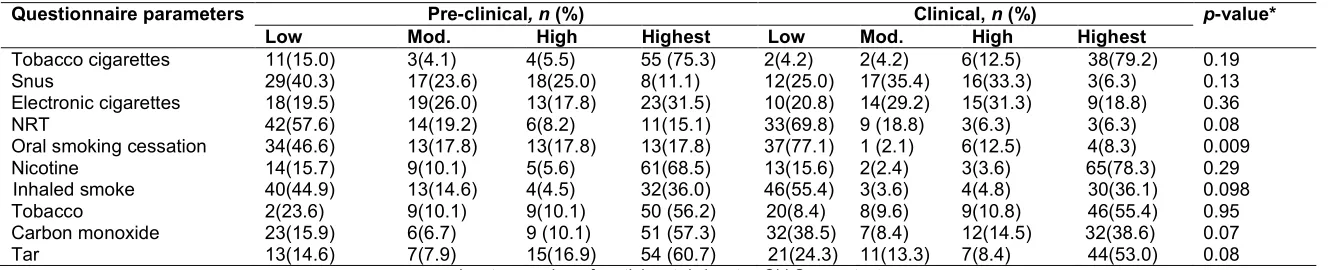
The results of this study showed the knowledge and perception of the tobacco smoking hazards towards health and its substitutes had 46.0% and 53.6% on moderate knowledge levels in the preclinical and clinical respectively. While majority 91.0% and 97.6% did not smoking in the preclinical and clinical respectively a P value of 0.059.
The overall findings regarding opinion and knowledge on health risk among all participants are shown the majority participants 93 (76.9%) the tobacco cigarettes caused health risk. About 60 (49.5%) mentioned the Electronic cigarettes
caused high health risk. 75(60.0%) of
participants have low knowledge on NRT and 48 (40.0%) have also low knowledge on oral smoking cessation. However, 126 (73.3%) of participants showed a highest knowledge on components of tobacco cigarettes and nicotine that caused health risk, while 69(40.1%) have low knowledge an inhaled smoke that caused health risk. While 96(55.8%), 83(48.3%) and 98(57.0%) of participants confirmed a highest knowledge on the tobacco, carbon monoxide and Tar that caused health risk (Table 2).
moderate 17(35.4%) of health risk. Majority of preclinical 23(31.5%) and clinical 15(31.3%) participants mentioned the highest knowledge of electronic cigarettes that caused health risk. Regarding NRT, majority of preclinical 42(57.6%) and clinical 33 (69.8%) participants mentioned the low knowledge of health risk to NRT users with a P value of 0.08 between the two groups. There was no difference between the two groups with regard to their lack of awareness of the health risks of tobacco smoking alternatives.
However, preclinical 34(46.6%) and clinical participants 37(77.1%) have low knowledge about oral smoking cessation with significant at p-value at 0.009. Majority of preclinical 61(68.5%) and clinical 65(78.3%) participants with highest agreement the nicotine caused the health risk. Both preclinical 40(44.9%) and clinical 46(55.4%) participants confirmed with low agreement the inhaled smoke caused the health risk, while the Tobacco showed the highest agreement in both preclinical 50 (56.2%) and clinical participants 46 (55.4%) mentioned the highest knowledge that tobacco caused the health risk. The health risk caused by Carbon monoxide and Tar showed highest confirmation from both preclinical
51(57.3%) and 54(60.7%), and clinical
participants 32 (38.6%) and 44 (53.0%) with a P value of 0.07 and 0.08 respectively (Table 1).
Based on the participants’ opinion regarding regulations of Malaysian Health Ministry on
e‐cigarettes, a substantial proportion of the
preclinical participants agree for e‐cigarettes to
be available only through prescription the half disagree. More 72.6% among clinical participants also disagreed for it to be available only through
prescription while only 27.4% agreed with the
p-value of 0.001, 39% of the preclinical participants
agree for e‐cigarettes to be licensed as medicinal
product, while more (61%) disagreed. More clinical participants (83.3%) also disagreed for it to be licensed as medicinal product while only
16.7% agreed to the opposite. Finally, with the
p-value of 0.009, 35% of the preclinical participants
agreed for e‐cigarettes to be sold only in
pharmacies, while more (65%) disagreed. More clinical participants (82.1%) also disagree.
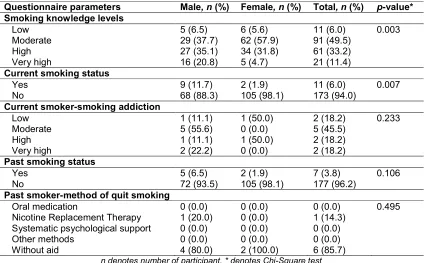
The findings among the participants based on
the cigarette smoking knowledge levels habits
among genders showed the female more male in the moderate level of evaluation with
significant at p-value of 0.003, while the male
showed the highest level. Majority of male and female confirm no smoking and there significant
differences between smoking and nonsmoking at p-value of 0.007. About 6.5% of male participants admitted low, 37.7% as moderate, 35.1% as high and 20.8% as very high. 5.6% of female participants admitted low level of smoking knowledge, 57.9% as moderate, 31.8% as high and 4.7% as very high. On the current smoking status, a p-value of 0.007 was obtained. 11.7% of male participants are smokers, while 88.3% are not. 98.1% of female participants are not smokers (Table 2).
The results of study showed that majority with extremely agreed the diseases, smoking-related lung cancer, smoking related cancer in other
organs, smoking-related atherosclerosis in
coronary and peripheral arteries have strongly related to the smoking, these results also strongly confirmed among clinical phase students (Table 3).
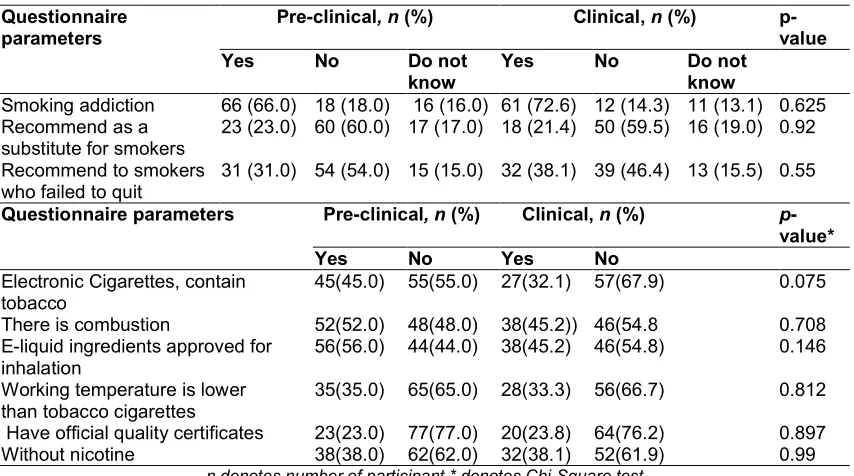
Whereas the knowledge of electronic cigarettes
and nicotine replacement therapy were
compared to smoking. Majority of the participants in both preclinical and clinical agreed the smoking addiction while majority of participants did not recommend as a substitute for smokers and recommend to smokers those who failed to quit form the cigarettes smoking. In addition, a majority of preclinical and clinical students agreed that facts on electronic cigarettes contain tobacco and there is combustion and e-liquid ingredients approved for inhalation. While the majority of preclinical and clinical students did not agree that working temperature is lower than
tobacco cigarettes, have official quality
certificates and an e-cigarette has not nicotine (Table 4).
According to the knowledge of nicotine
replacement therapy compared to smoking, the majority of preclinical and clinical students showed low knowledge of health risk, while majority of preclinical students did not show knowledge dependence potential, but the majority of the clinical students showed low knowledge about dependence potential risk. However, the majority of preclinical and clinical students showed high knowledge of health risk among beneficial for heavy smokers >15 cigarettes per day (Table 5).
5
Table 1. Opinion/knowledge on health risk
Questionnaire parameters Pre-clinical, n (%) Clinical, n (%) p-value* Low Mod. High Highest Low Mod. High Highest
Tobacco cigarettes 11(15.0) 3(4.1) 4(5.5) 55 (75.3) 2(4.2) 2(4.2) 6(12.5) 38(79.2) 0.19
Snus 29(40.3) 17(23.6) 18(25.0) 8(11.1) 12(25.0) 17(35.4) 16(33.3) 3(6.3) 0.13
Electronic cigarettes 18(19.5) 19(26.0) 13(17.8) 23(31.5) 10(20.8) 14(29.2) 15(31.3) 9(18.8) 0.36
NRT 42(57.6) 14(19.2) 6(8.2) 11(15.1) 33(69.8) 9 (18.8) 3(6.3) 3(6.3) 0.08
Oral smoking cessation 34(46.6) 13(17.8) 13(17.8) 13(17.8) 37(77.1) 1 (2.1) 6(12.5) 4(8.3) 0.009
Nicotine 14(15.7) 9(10.1) 5(5.6) 61(68.5) 13(15.6) 2(2.4) 3(3.6) 65(78.3) 0.29
Inhaled smoke 40(44.9) 13(14.6) 4(4.5) 32(36.0) 46(55.4) 3(3.6) 4(4.8) 30(36.1) 0.098
Tobacco 2(23.6) 9(10.1) 9(10.1) 50 (56.2) 20(8.4) 8(9.6) 9(10.8) 46(55.4) 0.95
Carbon monoxide 23(15.9) 6(6.7) 9 (10.1) 51 (57.3) 32(38.5) 7(8.4) 12(14.5) 32(38.6) 0.07
Tar 13(14.6) 7(7.9) 15(16.9) 54 (60.7) 21(24.3) 11(13.3) 7(8.4) 44(53.0) 0.08
Table 2. Cigarette smoking habits of the participants
Questionnaire parameters Male, n (%) Female, n (%) Total, n (%) p-value*
Smoking knowledge levels
Low 5 (6.5) 6 (5.6) 11 (6.0) 0.003
Moderate 29 (37.7) 62 (57.9) 91 (49.5)
High 27 (35.1) 34 (31.8) 61 (33.2)
Very high 16 (20.8) 5 (4.7) 21 (11.4)
Current smoking status
Yes 9 (11.7) 2 (1.9) 11 (6.0) 0.007
No 68 (88.3) 105 (98.1) 173 (94.0)
Current smoker-smoking addiction
Low 1 (11.1) 1 (50.0) 2 (18.2) 0.233
Moderate 5 (55.6) 0 (0.0) 5 (45.5)
High 1 (11.1) 1 (50.0) 2 (18.2)
Very high 2 (22.2) 0 (0.0) 2 (18.2)
Past smoking status
Yes 5 (6.5) 2 (1.9) 7 (3.8) 0.106
No 72 (93.5) 105 (98.1) 177 (96.2)
Past smoker-method of quit smoking
Oral medication 0 (0.0) 0 (0.0) 0 (0.0) 0.495
Nicotine Replacement Therapy 1 (20.0) 0 (0.0) 1 (14.3)
Systematic psychological support 0 (0.0) 0 (0.0) 0 (0.0)
Other methods 0 (0.0) 0 (0.0) 0 (0.0)
Without aid 4 (80.0) 2 (100.0) 6 (85.7)
n denotes number of participant, * denotes Chi-Square test
Table 3. Opinion/knowledge on contribution of nicotine to diseases development
Questionnaire parameters/n (%) Less important
Important Very important
Extremely important
Smoking related diseases 14 (7.6) 37 (20.1) 66 (35.9) 67 (36.4)
Smoking-related lung cancer 16 (8.7) 32 (17.4) 55 (29.9) 81 (44.0)
Smoking related cancer in other organs 20 (10.8) 53 (28.8) 63 (34.2) 48 (26.1)
Smoking-related atherosclerosis in coronary and peripheral arteries
14 (7.6) 39 (21.2) 60 (32.6) 71 (38.6)
Smoking related wrinkling of skin 28 (15.7) 48 (26.1) 59 (32.1) 48 (26.1)
More hazardous type of nicotine/ Synthetically produced
57 (31.0) 64 (34.8) 62 (33.7)
n denotes number of participant, * denotes Chi-Square test
4. DISCUSSION
Before fact-based questions were asked, the respondents were questioned on their smoking habits and their perceived knowledge regarding smoking in general. 6.0% of the respondents had rated low, 49.5% admitted to having moderate knowledge on smoking, 33.2% rated high and the remaining 11.4% of participants had rated themselves as having a high knowledge on smoking. This shows that most medical students had admitted to having moderate knowledge level on smoking and the lowest number shows they have only low level of knowledge on smoking. Smoking facts in general are common to be known to the public, since smoking is a norm in society. It is likely the participants
regarded themselves as moderately
knowledgeable about smoking, considering that medical students should be more aware on the facts on smoking since they will be exposed to
patients that smoke and smoking-related
diseases.
The participants overestimated the relative risk of smoking and the hazards of nicotine towards health. Additionally, our study demonstrates that medical students have poor knowledge about alternative tobacco and nicotine delivery products and many would not recommend NRT
therapy for long‐term smoking cessation. The
overestimating of the harmful effects of cigarette smoking and a poor knowledge about the function and features of e-cigarettes. Studies conducted in Norway, Swedish and British showed that health workers overestimated the hazards of tobacco smoking and had little attention or understanding about alternative
nicotine products, like electronic cigarettes.
These findings are consistent with our study results [18-20]. However, a larger sample with more generalized healthcare professionals is advised for future studies.
Opinion on Malaysian Health Ministry Regulation
on e‐cigarettes was asked. The opinion that
e-cigarettes should only be available only through prescription and in pharmacies is not quite well received by majority of the respondents. This might be because pharmacy and prescriptions generally reflect medicinal care, however the
majority of them might not think of e‐cigarettes as
a medicinal alternative to smoking cessation. Banning of nicotine from e-cigarettes is agreed upon by majority of the respondents (58.7%), which the respondents may take concern on the bad effects of nicotine to the body. However, banning of flavours is not highly recommended by them, which 65.8% had disagreed upon due to e-cigarettes being commercially known for their variety of flavours. Banning sales to youngsters aged younger than 18 years old and the prohibition of its use in public places are very much supported. Licensing e-cigarettes as a medicinal product is not agreed by the majority. This may be because the participants do not see
e‐cigarettes as a medicinal alternative to
smoking cessation. Reducing the variability of the products in the market is not agreed by the majority. Banning advertisement of e-cigarettes as substitutes for smoking and including a warning as equally harmful to smoking are well received by the participants, because public
Table 4. Knowledge of electronic cigarettes
Questionnaire parameters
Pre-clinical, n (%) Clinical, n (%) p-value Yes No Do not
know
Yes No Do not know
Smoking addiction 66 (66.0) 18 (18.0) 16 (16.0) 61 (72.6) 12 (14.3) 11 (13.1) 0.625
Recommend as a substitute for smokers
23 (23.0) 60 (60.0) 17 (17.0) 18 (21.4) 50 (59.5) 16 (19.0) 0.92
Recommend to smokers who failed to quit
31 (31.0) 54 (54.0) 15 (15.0) 32 (38.1) 39 (46.4) 13 (15.5) 0.55
Questionnaire parameters Pre-clinical, n (%) Clinical, n (%) p -value*
Yes No Yes No
Electronic Cigarettes, contain tobacco
45(45.0) 55(55.0) 27(32.1) 57(67.9) 0.075
There is combustion 52(52.0) 48(48.0) 38(45.2)) 46(54.8 0.708
E-liquid ingredients approved for inhalation
56(56.0) 44(44.0) 38(45.2) 46(54.8) 0.146
Working temperature is lower than tobacco cigarettes
35(35.0) 65(65.0) 28(33.3) 56(66.7) 0.812
Have official quality certificates 23(23.0) 77(77.0) 20(23.8) 64(76.2) 0.897
Without nicotine 38(38.0) 62(62.0) 32(38.1) 52(61.9) 0.99
n denotes number of participant.* denotes Chi-Square test
Table 5. Opinion/knowledge of nicotine replacement therapy compared to smoking
Questionnaire parameters Pre-clinical, n (%) Clinical, n (%) p-value* Lower Higher Do not
know
Lower Higher Do not know
Health risk 46 (46.0) 28(28.0) 26(26.0) 43(51.2) 12(14.2) 29(34.5) 0.13
Dependence potential 28 (28.0) 40(40.0) 32(32.0) 33(39.3) 25(29.8) 26(31.0) 0.373
Beneficial for heavy smokers (>15 cigarettes per day)
18 (18.0) 59(59.0) 23(23.0) 19(22.6) 50(59.5) 15(17.9)
should know that even e-cigarettes have their
own bad effects. Banning e‐cigarettes as a
leading step to smoking cessation was not agreed by the majority and the remaining 16.8% is unsure of the regulation [21-23].
Less than the half of both preclinical and clinical medical students are sufficiently knowledgeable regarding NRT and e-cigarettes. It is not clarified whether they overestimated or underestimated it due to their answers. Additionally, they have poor knowledge about it. In the genders comparison of
both genders having moderate level of
knowledge, admitting that they do not really know about tobacco smoking although there has been advertisements and awareness campaigns done by the government. It has always been advertised that smoking causes all kinds of fatal diseases, but what it specifically causes and how it affects the health or the presence of any substitutes for tobacco smoking is admittedly not clear to the participants. Moreover, more male participants are having higher knowledge regarding this matter than female participants. In addition, more than 80% of both genders were non-smokers. This is a pleasingly good phenomenon as medical students who are future doctors should show good decent examples of not smoking to society. According to a study nicotine is known to have major systemic side
effects instead, besides the addictive
characteristic that it inputs in its users [20]. It can negatively affect the heart, lung, kidney and even the reproductive system etc. Nicotine only causes a minimal contribution to those cancers as in the questionnaire. Tobacco in cigarettes is the actual cause for most of the cancers as surveyed in the questionnaire, mainly lung cancer [9-12,21]. However, WHO estimated around 1.27 billion tobacco users throughout the world [2].
On the perception of e‐cigarettes, male
participants more than females thinking that the health risk of passive e-cigarette vapor is not lower than tobacco smoke exposure but this is wrong. Male and females participants both would
rather not recommend e‐cigarettes as a
substitute to smokers who are not willing to take medication as a step in smoking cessation. This is, in reality, a mistaken perception. As another point, most female participants agree to ban e-cigarettes as the leading step to smoking cessation in Malaysia while the male participants mostly disagree. This shows a contraindicating opinion to take note on. There was also a small group of participants that chose “do not know”
when answering. It was stated that e‐cigarettes
doesn’t have tobacco but they have nicotine substance. Although, some packaging of these cigarettes were labelled as nicotine-free, but from the initial FDA lab tests conducted in 2009, there were traceable levels of nicotine found [11,12].
5. CONCLUSION
Medical students are not reasonable and overestimate the true hazards of tobacco smoking towards health. Additionally they are not knowledgeable about nicotine, NRT and e-cigarettes. Although, a large proportion of participants were exposed frequently to smokers, especially clinical phase students, they lack the knowledge and the correct perception regarding nicotine replacement therapy.
CONSENT AND ETHICAL APPROVAL
The proposed questionnaire had been approved for distribution after it was inspected by the assessor. The consent form by the Faculty of Medicine of SEGi University has been given to proceed with the data collecting process, the consent form along with a brief detail of the group member, also been given to participants. The questionnaire also informs the participants about the confidentiality of the participant if they were to participate in the questionnaire. The research proposal was approved by the Ethics Committee of SEGi University.
ACKNOWLEDGEMENTS
We would like to thank the members and staffs of the Faculty of Medicine of SEGi University for their kind support. In addition, we are grateful to our participants for sparing time to participate in this research.
COMPETING INTERESTS
Authors have declared that no competing interests exist.
REFERENCES
1. Brewer NT, Jeong M, Mendel JR, et al.
Cigarette pack messages about toxic chemicals: A randomised clinical trial Tobacco Control; 2018.
DOI: 10.1136/tobaccocontrol-2017-054112.
2. Wigand JS. Additives, cigarette design and
3. Khalaf AT, Li W, Jinquan T, Arch Immunol. Current advances in the management of urticaria Ther. Exp. 2008;56:103.
4. Mathers CD, Loncar D. Projections of global mortality and burden of disease from 2002 to 2030. PLoS Med. 2006;3 (11):e442.
5. Saeid Reza Doustjalali, et al. Correlation between Body Mass Index (BMI) and Fasting Total Blood Cholesterol Level among Undergraduate Students. Pakistan Journal of Nutrition. 2016; 15:873-877. 6. Eriksen M, Mackay J, Schluger N,
Gomeshtapeh F, Drope J. The tobacco
atlas. 5th ed. Brighton, United Kingdom:
American Cancer Society; 2015.
7. World Health Organization. World No Tobacco Day: 31 May 2017. Geneva, Switzerland: World Health Organization; 2017.
8. Islami F, Torre LA, Jemal A. Global trends of lung cancer mortality and smoking prevalence. Transl Lung Cancer Res. 2015;4:327–38.
9. Trehy ML, Ye W, Hadwiger ME, et al. Analysis of electronic cigarette cartridges, refill solutions, and smoke for nicotine and
nicotine related impurities. J Liquid
Chromatogr Relat Technol. 2011;34:1442– 58.
10. Schroeder MJ, Hoffman AC. E‐cigarettes
and nicotine clinical pharmacology. Tob Control. 2014;23:30-35.
11. Hartmann-Boyce J, Chepkin SC, Ye W,
Bullen C, Lancaster T. Nicotine
replacement therapy versus control for smoking cessation. Cochrane Database of Systematic Reviews. 2018;5.
[Art. No.: CD000146]
12. Moysidou A, Farsalinos KE, Voudris V, et
al. Knowledge and perceptions about nicotine, nicotine replacement therapies and electronic cigarettes among healthcare professionals in Greece. Int J Environ Res Public Health; 2016.
13. Kandra KL, Ranney LM, Lee JG, Goldstein
AO. Physicians’ attitudes and use of
e-cigarettes as cessation devices,
North Carolina. PLoS ONE. 2014;9:
e103462.
14. Saeid Reza Doustjalali, et al. Correlation
between Body Mass Index (BMI) and Waist to Hip Ratio (WHR) among undergraduate students. Pakistan Journal of Nutrition. 2016;15:618-624.
15. Khalaf AT, Feng LL, Abdul Kadir Samiah,
et al. Integrative and holistic approach for
immunological disorders using
electroacupuncture. International Journal
of Applied Business and Economic
Research. 2017;15:255-261.
16. Franks AM, Hawes WA, McCain
KR, Payakachat N. Electronic cigarette use, knowledge, and perceptions among health professional students. Curr Pharm Teach Learn. 2017;9(6):1003-1009.
17. Dockrell M, Morrison R, Bauld L, McNeill A.
E-cigarettes: Prevalence and attitudes in
Great Britain. Nicotine Tob.
Res. 2013;15:1737–1744.
18. Tang Y, Khalaf AT, Liu X, Xu C, Zhao W,
Cheng SY, Zhang R. Zinc finger A20 and NF-κ B correlate with high-risk human papillomavirus of squamous cell carcinoma patients. Tumor Biology. 2014;35:11855-11860.
19. Lund I, Scheffels J. Perceptions of the
relative harmfulness of snus among Norwegian general practitioners and their effect on the tendency to recommend snus
in smoking cessation. Nicotine Tob.
Res. 2012;14:169–175.
20. Patwardhan SR, Murphy MA. Survey of
GPs’ understanding of tobacco and nicotine products. Drug Alconol Today. 2013;13:119–150.
21. Mishra P, Chaturvedi S, Datta S,
Sinukumar P, Joshi A, Garg. Harmful effects of nicotine. Indian J Med Paediatr Oncol. 2015;36(1):24-31.
22. Goniewicz ML, Hajek P, McRobbie H.
Nicotine content of E‐cigarettes, its release
in vapour and its consistency across batches: Regulatory implications. Addiction. 2014;109(3):500-7.
23. Omair S. E. Alam, T. H. Kazmi. Smoking
prevalence and awareness about tobacco related diseases among medical students of Ziauddin Medical University. J Pak Med Assoc. 2002;52 (9):389-92.
© 2019 Khalaf et al.; This is an Open Access article distributed under the terms of the Creative Commons Attribution License (http://creativecommons.org/licenses/by/4.0), which permits unrestricted use, distribution, and reproduction in any medium, provided the original work is properly cited.
Peer-review history: