V. Shobhitha et al, International Journal of Computer Science and Mobile Applications, Vol.5 Issue. 8, August- 2017, pg. 48-54 ISSN: 2321-8363 Impact Factor: 4.123
EFFICIENT NETWORK CODING USING
SECURE CLOUD STORAGE PROTOCOL
V. Shobhitha
1, C. Shoba Bindu
2, P. Dileep Kumar Reddy
3 1Department of CSE, JNTUA College of Engineering, Ananthapuramu, Andhra Pradesh, India E-mail: [email protected]
2
Department of CSE, JNTUA College of Engineering, Ananthapuramu Andhra Pradesh, India E-mail: [email protected]
3
Department of CSE, JNTUA College of Engineering, Ananthapuramu Andhra Pradesh, India E-mail: [email protected]
Abstract
Cloud computing is an interesting technology which provides a platform to use remote sources to store user‟s information, manage and exercise data, instead of local systems. There are many advantages from cloud computing and also some disadvantages, like it is not secure to keep the data on cloud because it is handled by cloud service provider. In this stora ge system, data is moving from one end to another end passing through many nodes which may cause Data Manipul ation. There is a chance of illegal modifications for an encoded packet. That will spread all over network this is all because of router combines the received packets and polluted ones. This is also known as the pollution attack. To overcome this attack, this paper introduces the Homomorphic Schemes for Encryption and Decryption using Network Coding.
Keywords: Homomorphic schemes (Encryption, Decryption), Security, Network coding, Cloud computing
1. Introduction
Cloud computing is a kind of area where users can able to store data and can be accessed easily. Cloud server will manage the data that is to be stored under the user account. This helps to manage user‟s data safely and overcome the traditional drawback of storing the data in systems hardware. Cloud is being used not only to store data but also as an inexpensive, efficient, and flexible to access. By using cloud we can do work on the data at any time at any place. Cloud server provides a chance to store our data in server through internet instead of storing at our local server. As we normally store our data in the cloud server there may be a chance of data loss which is difficult to recover. So, in order to solve this problem there is a need of secure cloud which will handle these kinds of problems. Based on this problem one of the researchers [8] introduced the concept called Network coding in order to improve network capacity, but it leads to pollution attacks. It is a powerful attack which can succeed even when the number of normal nodes is more than the lower bound. In this attack the attacked node is mislead to a special location, which leads to confusion of compromised node with normal node. It is also adds malicious packets while travelling in the networks. To overcome this, we implement the Homomorphic scheme; this technique provides data security while data is passing through nodes.
V. Shobhitha et al, International Journal of Computer Science and Mobile Applications, Vol.5 Issue. 8, August- 2017, pg. 48-54 ISSN: 2321-8363 Impact Factor: 4.123
2. Related work
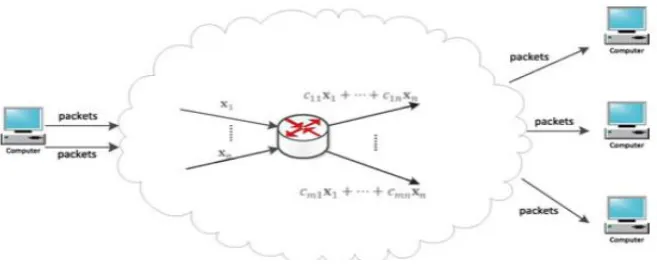
Figure 1: Secure Network Coding
Fig: 1 represents Network coding. It is a routing model where a router in the network sends out encrypted data packets [7] which are a function of received packets, instead of traditional store and forward approach. (One drawback of this approach is that the number of total “Sentinels” is finite. Thus, auditing can only be done a finite number of times.) If an encoded packet is modified illegally the modification can quickly spread to the whole network [1]. Secure network coding can be explained through this paradigm. Sender sends the data in the form of packets by authenticating it with some keys. The router en-routes the packets in the form of linear combinations and the receiver decodes the packet data received by the router. By using the Homomorphic Mac technique secure network coding has been generated [3]. It includes the five algorithms (setup, keygen, Auth, Combine, and Verify). The setup algorithm is carried by data owner to setup an account on a doubtful server. (On input a security level parameters and the number of cipher text classes). Keygen algorithm is carried by the owner of data to generate a random public key or master secret key. Authentication can be done for input of first packet to be sent out in the network, the sender computes the authentication information as follows: First, compute the values and the authentication information is sent out. Combine can be done for received a group of packets and their authentication information. A router runs this algorithm to generate a combined packet. A router also computes the combined authentication information and the router sends out. Verify algorithm is run by the receiver on input packet and its authentication information, if packet is correct it represents 0 otherwise 1 as outputs. However, Network coding has been shown to be ideally use bandwidth in a network. A node can inject malicious packets that can quickly affect many receivers, but the scheme is very inherently accessible to pollution attacks by infected nodes in the network [2]. A node is injecting a garbage can quickly affect many receivers. An attacker can easily pollute a packet even if it is encrypted by a forging signature or by a collision under hash function [4][5][6].
2.1 Pollution Problem
V. Shobhitha et al, International Journal of Computer Science and Mobile Applications, Vol.5 Issue. 8, August- 2017, pg. 48-54 ISSN: 2321-8363 Impact Factor: 4.123
3. Proposed Approach
In network coding, the job of intermediate nodes is to actively mix input packets in order to produce output packets. While mixing, the attacker nodes may inject malicious packets into the network, which leads to “pollution attack”. The polluted packets spread quickly into the network and they totally destroy all the packets which are not malicious. An attacker may produce collision under hash function or forging the signature to easily pollute a packet even if the packet is encrypted. In the proposed approach, we address pollution attacks which are occurred in network coding systems. In order to overcome this problem, we proposed a scheme called “Homomorphic Schemes for Encryption and Decryption”. The Homomorphic property of the signatures allows nodes to sign any linear combination of the incoming packets without contacting the signing authority. In this scheme, it is difficult to find which linear combination was used in the generation of packet. That‟s why it is computationally tough to crack the packets.
Using this technique, we can perform computations on encrypted information without decrypting it. Because, it could make network coding more secure. During this, we need to keep our cloud files cryptographically scrambled using a secret key. This helps to decrypt the files after encryption. The main advantage of scrambling is, no attacker can able to crack the data. The user performs computations on the encrypted data so that he can decrypt it easily. User cannot decrypt the data in network. Instead he must download the data and perform computations locally. By this, the attacker cannot be able to decrypt the packets in network and add malicious ones.
With this technique, cloud can perform computations locally rather than the user and returns the encrypted result. It allows arbitrary computations on encrypted data. The process of computing on encrypted data means if a user has a function „f‟ and want to obtain f( p1,p2..pn ) for some inputs (p1,p2….pn). We need to do
computations on f(p1,p2…pn) and obtain (r1r2,…r n) results for the input. This process allows producing a secret
key using a master key which is dependent on a function „f‟. Given a cipher text, the secret key allows the user to know the value of „f‟ that is applied to the plain text. This technique grants control over the functions that can be applied on the data via a master key holder. The encrypted text consists of cipher text along with the authentication. The authenticated user can decrypt the result into plain text using the secret key. Network coding consists of the following algorithms:
A. Keygen (1λ)→ (PK, SK)
With the help of a security parameter λ, this algorithm generates a public key and a secret key.
B. Encryption (PK, M) → E (M)
The encryption algorithm encrypts the message „M‟ with the help of the public key.
C. Authentication (Ci, SK)→ CT
By taking ith packet as input a string of cipher texts and the secret key to produce the authentication to the user along with the cipher text (CT).
D. Combine (Pi, CT) → CP
It considers group of packets (Pi) and their authentication information (CT) in order to generate the combined
information and sends to the authenticated user.
E. Decryption (CT, SK)
V. Shobhitha et al, International Journal of Computer Science and Mobile Applications, Vol.5 Issue. 8, August- 2017, pg. 48-54 ISSN: 2321-8363 Impact Factor: 4.123 3.1 Defence against pollution attack
In network coding, there is a problem called pollution attack in order to address this problem there are standard methods or signatures. But, in the setting of network coding those methods or signatures are not directly applicable. So, we developed a Homomorphic mechanism to prevent pollution attack in network coding.
Homomorphic scheme comprises of four phases (Key generation, encryption, authentication, combine and decryption). Every file has a file identifier and whenever a user sends the file, file identifiers helps to bind all the related packets into a given file. In key generation phase, based on the user credentials and file identifiers, three keys are generated (keys for encryption, decryption and authentication). After that in encryption phase, by considering the encryption key and plain text we generate a cipher text along with the authentication which is ready to send through the network. As this Homomorphic scheme explains the calculations that can be done for encrypted text without decrypting it, the sender computes some calculations before sending it to the network.
User sends the encrypted data to server (enc (a), enc (b) where a and b are packets) and sends a request to the server asking for calculation of f(a,b). Server stores the encrypted data and it calculates the result of request sent by the sender (f(a,b)) based on the ciphers of a and b. Server also computes (f(enc(a), enc(b))) without decrypting a and b. Upon receiving the request of f(a,b) server sends (f(enc(a), enc(b))) to the sender. Now, user decrypts the result of (f(enc(a), enc(b))) using private key. Based on the above procedure, for every file that user sends, the server can make sure that the calculation is for the encryption data and not for the actual data. It helps to ease the decryption process for a genuine user and complicated for the malicious user. So, that we can prevent pollution attacks in the network.
4. Performance Evaluation
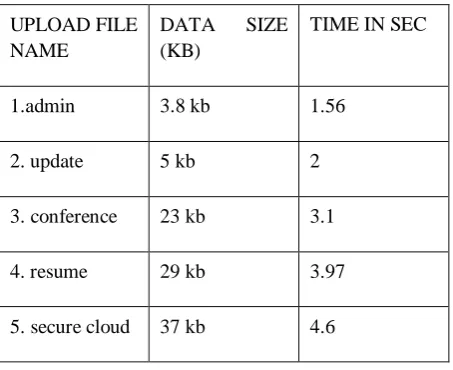
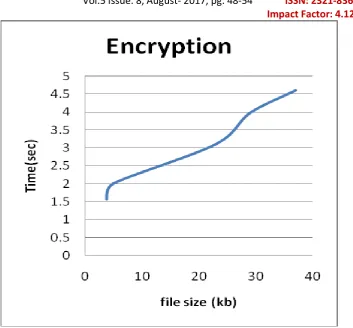
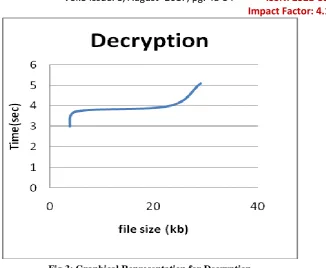
4.1 Encryption and Decryption TimeIn this paper we evaluate the paper based on Encryption and Decryption of the files belongs to the user. We considered the file size and time as the parameters for Encryption and Decryption process as shown in the table 1 and 2 and the graphical representation of Encryption and Decryption process for different files as shown the figure 2 and 3.
Table 1: Encryption time for data files
UPLOAD FILE NAME
DATA SIZE (KB)
TIME IN SEC
1.admin 3.8 kb 1.56
2. update 5 kb 2
3. conference 23 kb 3.1
4. resume 29 kb 3.97
V. Shobhitha et al, International Journal of Computer Science and Mobile Applications, Vol.5 Issue. 8, August- 2017, pg. 48-54 ISSN: 2321-8363 Impact Factor: 4.123
Fig 2: Graphical Representation for Encryption
DOWNLOAD FILE NAME
DATA SIZE (KB)
TIME IN SEC
1. admin 3.8 kb 2.64
2. update 5 kb 3.73
3. conference 23 kb 4
4. resume 29 kb 5
V. Shobhitha et al, International Journal of Computer Science and Mobile Applications, Vol.5 Issue. 8, August- 2017, pg. 48-54 ISSN: 2321-8363 Impact Factor: 4.123
Fig 3: Graphical Representation for Decryption
5. Conclusion
With the knowledge of relationship between the secure cloud storage and secure network coding, this Homomorphic scheme helps in increasing the security for the files of user. We used Homomorphic mechanism to make the security stronger. It provides security in addition to detecting pollution attacks. Using Homomorphic Scheme only the authenticated user can decrypt the data. By using this technique we get the feasible time for both encryption an also the decryption process which helps the users to upload as well download the files in a stipulated time.
References
[1] Fei Chen, Tao Xiang, Yuanyuan yang, and Sherman S.M. Chow “Secure cloud storage meets with secure network coding” in Proc. IEEE Transactions on computers, Vol.65, No 6. 2016
[2] Q. Li, J. C. Lui, and D.-M. Chiu, “On the security and efficiency of content distribution via network coding,” IEEE Trans. Dependable Secure Comput., vol. 9, no. 2, pp. 211–221, Mar./Apr. 2012.
[3] S. Agrawal and D. Boneh, “Homomorphic macs: Mac-based integrity for network coding,” in Proc. Int. Conf. Appl. Cryptography Netw. Security, 2009, pp. 292–305.
[4] F. Zhao, T. Kalker, M. M_edard, and K. J. Han, “Signatures for content distribution with network coding,” in Proc. IEEE Int. Symp. Inf. Theory, 2007, pp. 556–560.
[5] D. Charles, K. Jain, and K. Lauter,“Signatures for network coding,” Int. J. Inf. Coding Theory, vol. 1, no. 1, pp. 3–14, 2009.
[6] Nuttapong Attrapadung, and Beno_t Libert, “Homomorphic network coding signatures in the standard model”
V. Shobhitha et al, International Journal of Computer Science and Mobile Applications, Vol.5 Issue. 8, August- 2017, pg. 48-54 ISSN: 2321-8363 Impact Factor: 4.123
[8] N. Cai and R. W. Yeung, “Secure network coding,” in Proc. IEEEInt. Symp. Inf. Theory, 2002, p. 323.
[9] Wikipedia (online) available at : https://en.wikipedia.org/wiki/Homomorphic_signatures_for_network_coding