Performance Analysis of Heterogenous WSN for
Application in IoT
T. M. BeHerA*, S. K. MoHAPATrA and o. P. AcHAryA
School of Electronics Engineering, Kalinga Institute of Industrial Technology Bhubaneswar, India.
Abstract
Extending the Internet to connect any physical device with smart technology can be called as the Internet of Things (IoT).It is a proposed development of the Internet in which everything can be connected to the internet enabling them to send and receive data. Selection of energy efficient routing protocols has become an essential step in designing any IoT network. Moreover, the protocol should also be selected to enhance the lifetime of the network. In this article, we evaluate the performance analysis of DEEC (Distributed Energy Efficient Clustering), DDEEC (Developed DEEC), EDEEC (Enhanced DEEC) and TDEEC (Threshold DEEC) for the application in IoT. From MATLAB simulation, it was observed that TDEEC outperforms other routing protocols and is well suited for IoT application.
oriental Journal of computer Science and Technology
Journal Website: www.computerscijournal.org
Article History
Received: 13 December 2017
Accepted:23 December 2017
Keywords IoT, WSN DEEC, DDEEC, EDEEC, TDEEC.
coNTAcT T. M. Behera [email protected] School of Electronics Engineering, Kalinga Institute of Industrial Technology, Bhubaneswar, India.
© 2017 The Author(s). Published by Techno Research Publishers
This is an Open Access article licensed under a Creative Commons Attribution-NonCommercial-ShareAlike 4.0 International License (https://creativecommons.org/licenses/by-nc-sa/4.0/ ), which permits unrestricted NonCommercial use, distribution, and reproduction in any medium, provided the original work is properly cited.
To link to this article: http://dx.doi.org/10.13005/ojcst/10.04.05
Introduction
IoT includes three major components for seamless communication between the source and end user. The first is the hardware which is comprised of sensors or actuators and entrenched communicating hardware like Radio Frequency Identification (RFID), Wireless Sensor Network (WSN), etc. The second is a middleware which performs on-demand storage and computing tools for data analytics. The last part of IoT is a presentation of novel and easy to understand conception and interpretation tools that can be widely accessed on different platforms that are designed for different applications1.
The emerging IoT has a diversified application scenar io equipped with a wide range of heterogeneous devices. As WSN also has a wide range of application in the various working domain and is also well suited for long-term data acquisition, hence WSN will be the best sensor interfacing device in the IoT environment2,3.
are made by using routing. The routing is a process of transmission of data from a source node to the destination node5. Various types of routing protocol
are used for the communication purpose. These routing protocols are affected in WSN by several exigent factors like throughput, scalability, bandwidth utilization, network lifetime, etc. Cluster-based hierarchical routing protocols have been proved to have good energy utilization rate6 when compared to
the non-cluster routing algorithm. The classification of a routing protocol can be done according to:
• the establishment of routing paths,
• the network structure,
• the protocol operation, • the initiator of communications
• Selection of protocol based on the next hop on the route of the forwarded message.
When energy efficiency and stability is required, then the cluster-based routing protocols7 are
incorporated. Energy-efficient protocols can be designed which will adapt with the various characteristics of WSNs, in order to enhance the network lifetime8. The hierarchical cluster-based
protocol is more energy efficient because nodes with higher energy are random data selected to process the information and nodes with low energy are used to sense and send the data to the clustered (Ch). In this process, a lifetime of the network and stability period is increased. Distributed Energy-Efficient Clustering (DEEC)8,9 is one of the
cluster-based hierarchical protocol used especially for multilevel communication in a heterogeneous routing environment. In DEEC10 protocol, the Chs
are selected based on the ratio between the residual energy of each node and the average energy of the network8,11.The DEEC protocol functions with the
estimation of the idealistic value of network lifetime in order to compute a reference energy which will be consumed by a node for each round. So that lower energy nodes have less probability than the higher initial and residual energy node to be the Ch. Thus DEEC protocol is more stable than the other heterogeneous protocols12.
Heterogeneous WSN
Most of the algorithms proposed for routing of data are meant to enhance the network lifetime and its
stability period. The LEACh13 protocol was designed
for a homogeneous sensor network. however, many algorithms have also been developed considering different heterogeneity levels in terms of energy. Depending on energy, the sensor nodes are categorized as normal nodes, advanced nodes or super nodes14. In a co-operative communication
network, where the Chs need to communicate with each other, a low energy path is desired. DEEC is a clustering protocol for two and multilevel heterogeneous networks15.
Deec
The DEEC protocol8 was proposed for networks
with different energy level, where the selection of Ch can be decided on the basis of both initial as well as residual energy. For homogenous networks all nodes are assigned with equal initial energy hence popt is used for reference energy of probability pi. In this network, sensor nodes are either normal or advanced nodes. If E0 is the energy given to normal node, then E0(1+a) be the energy assigned to advanced nodes, where ‘a’ will be the extra fraction of energy given to advanced nodes. If ‘m’ is the fraction of advanced sensors, then N(1-m) will be the amount of normal sensors and Nm is the total amount of advanced nodes. hence the overall preliminary energy of the network is the summation of energies of normal as well as advanced nodes10
and is written as:
ETotal =N(1-m)E0 + Nm(1+a)E0 ...(1)
ETotal = NE0(1+am) ...(2)
In a heterogeneous network, popt depends on the value of initial energy of normal and advanced nodes; hence popt can be given as:
1
opt adv
p p
am =
+ ...(3)
(1 )
(1 )
opt nrm
p a
p
am + =
+ ...(4)
If Eavg is the average energy network for round r then
for normal modes ...(5)
for advanced nodes ...(6)
In multi-level networks, all the nodes are assigned with different energy levels. The primary power of nodes can be dispersed over a set ranging from {E0,E0(1+amax)} with E0 being the lower bound where amax is the value of the maximum energy assigned. The overall initial energy of the network can be given as:
0 0
1
1
(1 ) ( N )
N
total i i i
i
E =E a E N a
=
=
∑
+ = +∑
...(7)Similarly for multilevel heterogeneous networks as written in8 can be given as:
1 (1 ) ( ) opt i multi N i i
p N a
p N a = + = +
∑
...(8)And the probability for the network can be given as: 1 (1 ) ( ) opt avg i N i avg i
p N a E
p
N a E
= + =
+
∑
...(9)
If the overall energy of the sensing field is represented as Etotal and Eround is the energy expended during each round, then the average energy of the field Eavg for round r can be given as:
1 (1 )
avg total r
E E
N R
= − ...(10)
where R represents the number of rounds in the network given by Etotal / Eround
DDeec
In a two-level heterogeneous network as in DEEC, it becomes obvious for the advanced nodes to be elected as Ch repeatedly due to more residual
energy. As a result, there comes a point in the network, where all the advanced nodes will have the same residual energy as that of normal nodes. hence to overcome this unbalanced situation, Distributed-DEEC was proposed to modify equations 8 and 9 by taking a threshold residual energy value as given in16 written as:
Rev 0(1 disNN ) ( )107 0
disNN disAN aE
Th E E
E E
= +
− � ...(11)
Under this condition, normal and advanced nodes will have the same probability to be elected as Ch. Therefore, the average probability for selection of Ch is now rewritten as
; (1 ) opt avg i avg p E p am E = +
for normal nodes with Eavg >ThRev
...(12) (1 ) ; (1 ) opt avg i avg
p a E
p am E + = +
for advanced nodes with Eavg >
ThRev ...(13)
(1 ) ; (1 ) opt avg i avg a p E
p c
am E
+
= +
for normal and advanced nodes
with Eavg >ThRev ...(14)
eDeec
It is a 3-level heterogeneous network with normal, advanced and super nodes10 categorized based on
energy level. The normal and advanced nodes follow the same principle as that of the two-level network. The super-nodes of fraction ‘m0’ have ‘b’ times more
energy than normal nodes10. hence the energy of
super-nodes can be written as E0(1+b). If the number
of sensors in the network is N, then Nmm0 is the
number of super-nodes. Similarly, Nm(1-m0) will be
the number of advanced nodes10. hence the overall
preliminary energy of the network is the summation of energies of all type of node, i.e. normal, advanced nodes and super-node which is given as:
ETotal = N(1-m)E0 + Nm(1-m0)(1+a)E0 + Nm0E0(1+b)
...(15)
0(1 ( 0 ))
total
E NE m a m b
∴ = + + ...(16)
The value of pi is given as:
;
(1
opt avg)
i
p E
p
am
=
+
(1 ) ; (1 ) opt avg i avgp a E
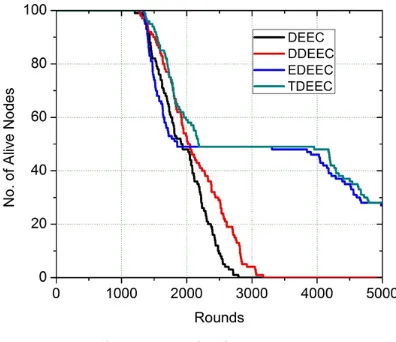
Figure 1 shows the number of nodes alive with each round. It was found that the first node for DEEC, DDEEC, EDEEC, and TDEEC dies at 1119,1404,1415,1482 rounds respectively. It is clear that the TDEEC protocol is the most stable protocol out of DEEC, DDEEC and EDEEC. Since the probabilities of TDEEC and EDEEC are separately specified for each type of heterogeneous nodes, hence they have higher stability period than that of DDEEC and DEEC that uses same probabilities.
0 ;
(1 ( b))
opt avg i
avg p E p
m a m E
= + +
Eele 50/nj/bit
ETx 50/nJ/bit
EDA 5/nJ/bit
d0 87 meters
for normal nodes ...(17)
0
(1 ) ;
(1 ( b))
opt avg i
avg
p a E
p
m a m E
+
= + +
for advanced nodes ...(18)
0 (1 )
;
(1 ( b))
opt avg i
avg
p b E
p
m a m E
+
=
+ +
for super nodes ...(19)
TDeec
In TDEEC, for each round, every node decides to be a Ch by choosing a number randomly between 0 and 1. A threshold level Ts is defined by equation 20 as given in17. Only when the number is less than
Ts, the node can be elected as Ch for that particular round. If the optimal number of Ch in the network can be written as kopt, then Ts is given as:
1 ( mo
d )
op
s t
Residual energy of a node k Average energy of the ne p
T
w
p r p t ork
= − × ×
...(20)
Simulation & result
Considering 100 nodes deployed in a random manner in a network of 100 m×100 m to perform MATLAB simulation. The sink node is placed at the center of the network field and is assumed to have unlimited energy. Simulation for all the four protocols in two-level, 3-level heterogeneous WSN is done to evaluate the network performances. To generate MATLAB simulation, we consider these parameters as listed below.
Symbol Value
m 0.5
a 1.5
b 3
m0 0.4
popt 0.1
ERx 0.0013/pJ/bit/ m4
Efs 10/pJ/bit/m2
Eamp 100/pJ/bit/m2
Fig. 1: No. of Alive nodes
The overall power consumption for the network for all the protocols can be evaluated from Figure 2. The initial energy for the normal node, advanced node, and super nodes are assumed to be 75J, 100J and 123J respectively. It is found that the energy dissipation rate is much slower for TDEEC and EDEEC as compared to DEEC and DDEEC due to the usage of different levels of energy in nodes. As a result, the network energy is totally dissipated at around 3000 rounds for DEEC and DDEEC whereas the nodes are still functioning for EDEEC and TDEEC even after 5000 rounds.
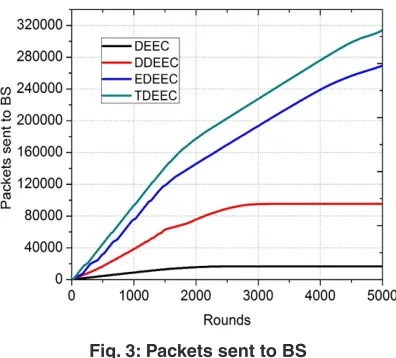
network energy. It is clear that TDEEC and EDEEC perform well as compared to DEEC and EDEEC
but a maximum number of data transfer occurs in case TDEEC.
Fig. 2: Total energy consumption Fig. 3: Packets sent to BS conclusion
One of the important applications of WSN is designing an IoT system. The sensors used for IoT should be able to sense the environment continuously as long as possible to transmit data to the end user. Communicating the data should be done in an efficient way to conserve energy in order to enhance the overall network lifetime. In this article, the performance analysis of heterogeneous sensor network with DEEC, DDEEC, EDEEC and TDEEC routing protocols have been done using MATLAB. It was found that the protocol using nodes of different energy levels performs well in terms of
stability period, energy dissipation and throughput. Since TDEEC outperforms all other protocols it can be suggested for IoT application.
Acknowledgement
The authors would like to thank to the School of Electronics Engineering, Kalinga Institute of Industrial Technology (Deemed to be University), Bhubaneswar, Odisha, India for providing the necessary financial support. We would also like to show our gratitude to the “anonymous” reviewers for their so-called insights.
reference
1 A. P. Renold and R. J. Rani, “An internet-based RFID library management system,” in
Information & Communication Technologies (ICT), 2013 IEEE Conference on, 2013, pp.
932–936.
2 P. Bellavista, G. Cardone, A. Corradi, and L. Foschini, “Convergence of MANET and WSN in IoT urban scenarios,” IEEE Sens. J., vol.
13, no. 10, pp. 3558–3567, 2013.
3 M. T. Lazarescu, “Design of a WSN platform for long-term environmental monitoring for IoT applications,” IEEE J. Emerg. Sel. Top. Circuits
Syst., vol. 3, no. 1, pp. 45–54, 2013.
4 S. P. Singh and S. C. Sharma, “A survey on cluster-based routing protocols in wireless sensor networks,” Procedia Comput. Sci., vol.
45, pp. 687–695, 2015.
5 L. Yadav and C. Sunitha, “Low Energy Adaptive Clustering hierarchy in Wireless Sensor Network (LEACh),” Int. J. Comput.
Sci. Inf. Technol., vol. 5, no. 3, pp. 4661–4664, 2014.
6 Y. Li, N. Yu, W. Zhang, W. Zhao, X. You, and M. Daneshmand, “Enhancing the performance of LEACh protocol in wireless sensor networks,” in Computer Communications
IEEE Conference on, 2011, pp. 223–228. 7 W. B. heinzelman, A. P. Chandrakasan, and
h. Balakrishnan, “An application-specific protocol architecture for wireless microsensor networks,” IEEE Trans. Wirel. Commun., vol.
1, no. 4, pp. 660–670, 2002.
8 L. Qing, Q. Zhu, and M. Wang, “Design of a distributed energy-efficient clustering algorithm for heterogeneous wireless sensor networks,” Comput. Commun., vol. 29, no. 12, pp. 2230–2237, 2006.
9 N. Javaid, T. N. Qureshi, A. h. Khan, A. Iqbal, E. Akhtar, and M. Ishfaq, “EDDEEC: Enhanced developed distributed energy-efficient clustering for heterogeneous wireless sensor networks,” Procedia Comput. Sci., vol.
19, pp. 914–919, 2013.
10 T. N. Qureshi, N. Javaid, M. Malik, U. Qasim, and Z. A. Khan, “On performance evaluation of variants of DEEC in WSNs,” in Broadband,
Wireless Computing, Communication and Applications (BWCCA), 2012 Seventh International Conference on, 2012, pp.
162–169.
11 T. M. B. SK Mohapatra, P Mukherjee, hK Sahoo, “DEEC-VD: A hybrid Energy Utilization Cluster-based Routing Protocol for WSN for application in IoT,” in 16th
International Conference on Information Technology, 2017.
12 T. Sharma, B. Kumar, and G. S. Tomar, “Performance Comparision of LEACh, SEP and DEEC Protocol in Wireless
Sensor Network,” in Proc. of the Intl. Conf.
on Advances in Computer Science and Electronics Engineering, 2012.
13 M. J. handy, M. haase, and D. Timmermann, “Low energy adaptive clustering hierarchy with deterministic cluster-head selection,” in Mobile and Wireless Communications
Network, 2002. 4th International Workshop
on, 2002, pp. 368–372.
14 M. Naeem, M. Patwary, and M. Abdel-Maguid, “Universal and Dynamic Clustering Scheme for Energy Constrained Cooperative Wireless Sensor Networks,” IEEE Access, 2017. 15 N. Javaid, S. N. Mohammad, K. Latif, U.
Qasim, Z. A. Khan, and M. A. Khan, “hEER: hybrid energy efficient reactive protocol for wireless sensor networks,” in Electronics,
Communications and Photonics Conference (SIECPC), 2013 Saudi International, 2013,
pp. 1–4.
16 B. Elbhiri, R. Saadane, D. Aboutajdine, and others, “Developed Distr ibuted Energy-Efficient Clustering (DDEEC) for heterogeneous wireless sensor networks,” in I/V Communications and Mobile Network
(ISVC), 2010 5th International Symposium on,
2010, pp. 1–4.
17 P. Saini and A. K. Sharma, “Energy efficient scheme for clustering protocol prolonging the lifetime of heterogeneous wireless sensor networks,” Natl. Inst. Technol. Jalandhar, Dep.
Comput. Sci. Eng. Int. J. Comput. Appl., vol.