OPEN A
CCE
SS
JZ
AR R
esearch article
OPEN A
CCE
SS
Social interactions and the role of kin recognition within juveniles of a
solitary species, the giant panda (
Ailuropoda melanoleuca
)
Kelly M. Jackson1,, Anna M. Young1*, and James E. Ayala2 1Department of Biology and Earth Science, Otterbein University, Westerville, Ohio 2Chengdu Research Base of Giant Panda Breeding, Chengdu, Sichuan, P.R. China
*Correspondance: Anna Young,[email protected]
Keywords: behaviour, giant panda, kin
recognition, management
Article history:
Received: 11 Oct 2018 Accepted: 01 Oct 2019 Published online: 31 Oct 2019
Abstract
Kin recognition has been extensively documented in social species, but is less well studied in solitary species, especially in sub-adults. Although giant pandas (Ailuropoda melanoleuca) are acknowledged as solitary animals in the wild, in captive settings cubs engage in frequent bouts of affiliative behaviour and evidence suggests that adults are capable of kin recognition. This project examined whether one-year old giant panda cubs displayed kin-biased behavioural interactions based on either genetic relatedness or time spent housed together. Fourteen giant panda cubs were observed at the Chengdu Research Base of Giant Panda Breeding in Sichuan, China during a six-week period in the summers of 2015 and 2016. Focal and instantaneous recording were used to document the behaviour performed by each cub. Neither relatedness nor time spent with other cubs were significant predictors of the amount of time cubs engaged in social interactions. The present study proposes alternatives to explain rates of social engagement of giant panda cubs. Further long-term assessment should be conducted exploring the behavioural impacts of socially housing a solitary species.
Introduction
Kin recognition, the ability to detect related individuals amongst a group, has been exhibited by a range of animal species (Waldman 1987; Holmes and Sherman 1983; Mateo and Johnston 2000; Mateo 2003; Wahaj et al. 2004; Penn and Frommen 2010). Two commonly proposed functional mechanisms for using direct cues to recognise and discriminate kin are prior association and phenotypic matching. Prior association, otherwise known as familiarity, primarily occurs when animals are reared together. During this stage they familiarise themselves with distinctive cues of other animals in their natal range, which are typically kin (Sherman and Holmes 1985; Penn and Frommen 2010). Later in life, animals will identify kin based on the distinguishing characteristics
Using these mechanisms of kin recognition, animals engage in different social behaviours when interacting with kin vs. non-kin. Cooperation with kin members to increase inclusive fitness is well illustrated in the Belding’s ground squirrel (Urocitellus belding), where an individual will alarm call to relatives when a predator is nearby (Sherman 1981; Mateo 2003). The function of kin biased affiliative interactions has been well documented within social species (see Waldman 1988 for a review), however, it is less common within solitary animals (Eberle and Kappeler 2006; Lizé et al. 2006; Lodé 2008; Flores-Prado and Niemeyer 2010; Kessler et al. 2012). Solitary species interact with siblings on various levels, such as establishing territory (Støen et al. 2005), where kin recognition is advantageous for inbreeding avoidance or to reduce competition with a relative (Simmons 1989; Støen et al. 2005; Fischer et al. 2015).
Although wild solitary species engage in relatively minimal interactions over the duration of their lifespan, captive solitary animals are often socially housed and, as a result, may participate in affiliative interactions more often. Brown bears (Ursus arctos) were observed participating in play behaviour more often when housed with another individual than when placed in enclosures by themselves (Montaudouin and Le Pape 2005). As social interactions within wild solitary species are rare, they are difficult to study in situ. Ex situ holdings offer a plausible setting in which to assess what degree kin recognition mechanisms influence social interactions in solitary species.
The role of kin recognition is still not entirely understood in the giant panda (Ailuropoda melanoleuca; Dungl et al. 2008; Gilad et al. 2016). The giant panda, a solitary ursid, is thought to devote only a small portion of its life to social activities, such as during mating and cub rearing (Schaller et al. 1985). However, outside of the mating season, wild adult giant pandas will share overlapping home ranges, providing opportunities for social interactions between potential kin (Zhang et al. 2014; Hull et al. 2015). Previous studies on kin and individual recognition in giant pandas have investigated the potential of chemo-sensory, acoustic and visual cues, suggesting phenotypic matching and prior association may be mechanisms used by the species (Charlton et al. 2009a; Charlton et al. 2009b; Dungl et al. 2008; Gilad et al. 2016; Liu et al. 2008; Zhan et al. 2007; Zhang et al. 2014). These investigations warrant further questioning on whether these mechanisms facilitate future associations within giant pandas, and at what life stage they develop.
Due to the scarcity of the species and resources available to monitor them, understanding sociality within wild giant pandas has proved challenging. Previous studies have specifically focused on conducting behavioural research on giant pandas within captive settings (Mainka and Zhang 1994; Liu et al. 2003; Liu et al. 2017; Martin-Wintle et al. 2017). However, there remains a lack of exploration surrounding cub social behaviour. Elements of play between mother and cub dyads have been the focus of prior studies (Snyder et al. 2003; Wilson 2005; Wilson et al. 2009), as social play only occurs between a dam and her cub in the wild (Wilson 2005). In captive settings, more than one cub of the same age may be housed with a dam at a time, thus providing an opportunity for differential interactions. When given the opportunity, cubs were found to engage for longer periods of time in play behaviours, such as biting and pawing, with another conspecific than with a dam. Individual differences and the relationship between cubs were not documented (Wilson et al. 2009).
An increased understanding of the social complexity of a naturally solitary creature in captive conditions can be further understood through analysing giant panda cub behaviour. As solitariness is thought to predate sociality (Hamilton 1964a; Hamilton 1964b; Alexander 1974), looking for mechanisms of kin recognition in a solitary species could shed light on how mechanisms emerged and
evolved, such as for establishing territory, refraining from parental care, or avoiding inbreeding (Lodé 2008; Kessler et al. 2012; Fischer et al. 2015). The goal of this project was to determine if kin recognition is an underlying factor facilitating interactions within giant panda cubs. The study predicted that affiliative interactions would be influenced by either the degree of genetic relatedness between individuals, i.e. phenotypic matching, or by the amount of prior association amongst the cubs.
Materials and Methods
Animals
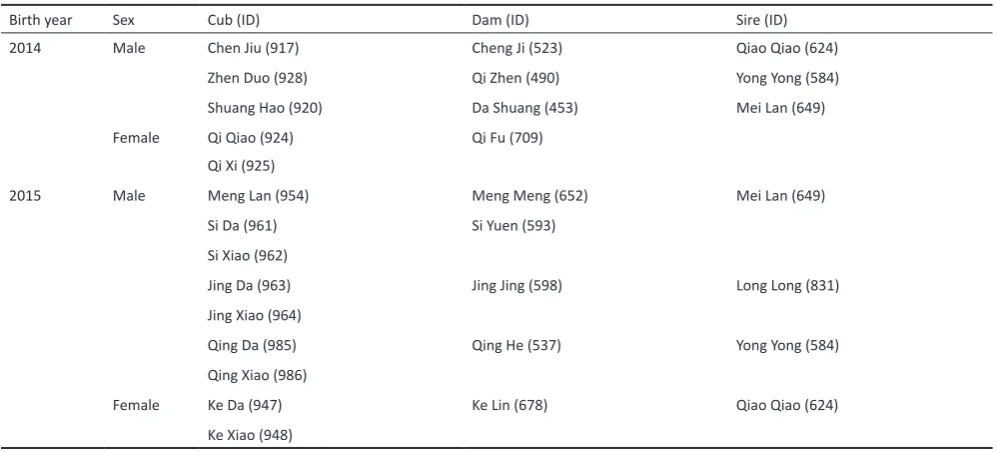
A total of 14 giant panda cubs were observed at the Chengdu Research Base of Giant Panda Breeding in Sichuan, China during the summers of 2015 and 2016. Two sets of female twins, three sets of male twins, and four male singletons were differentiated by three observers using visual identifiers, such as ear size and shape of the black eye spots. All cubs were born at the facility and were approximately one year in age during the time of the study (Table 1). Kinship between the cubs was assessed on three levels: (1) full-kin (twins), (2) half-kin (paternally related), (3) non-kin (do not share a mother or father). Information on how long each cub was housed with one another prior to the study was unknown. Thus, the time each cub was housed with one another was noted by the minutes cubs were observed together from the beginning of the data collection period.
Behavioural observations
Groups consisting of three or more panda cubs were observed, to allow cubs opportunities to interact with more than one panda. As there were no observation sessions where three or more pandas had shared kinship, mixed housing situations were the focus for this study. Mixed housing of the pandas indicated there was at least one kin member and one non-kin member amongst the group. Observations of the cubs’ behaviour occurred in one outdoor enclosure (400.0 m2) and seven indoor rooms (62.0 m2 [2
areas], 135.0 m2 [2 areas], 24.2 m2 [1 area]), which ranged in size
and public viewing access. Enclosures contained bamboo, as well as enrichment, such as slides, toys, boxes and/or crates. Focal and instantaneous recording at one-minute intervals were employed to collect behavioural data performed by a specific cub.
proximity to another panda cub were noted as solitary behaviour and not specifically analysed as part of this study.
To determine inter-observer reliability, seven 30-minute video clips were analysed amongst the three observers who collected data. One observer documented behaviour in both 2015 and 2016, and the other two observers each documented behaviour in a single year. Through the usage of Fleiss’ alpha, a modified Cohen’s kappa specifically for three or more raters (McHugh 2012), a kappa score was calculated in RStudio (version 1.1.442, RStudio Inc., Boston, MA). A kappa score of 0.694 was determined amongst the three observers, indicating fair reliability.
Data analyses
The average percentage of time per session that the cubs spent engaging in social behaviour was calculated and the interactions between the cub pairings were classified by relationship: full-kin, half-kin, or non-kin. A two-way nested ANOVA was used in JMP 14.0 (SAS Institute, Cary, NC) to determine if there was a significant difference in the mean percentage of time cubs interacted per session, and if it was influenced by relationship or behaviour. A linear regression was also performed to examine if there was any influence of time housed on the mean percentage of interactions that occurred between cubs. The amount of time cubs were housed with one another prior to the initiation of the study was not available to be factored into the analysis.
Results
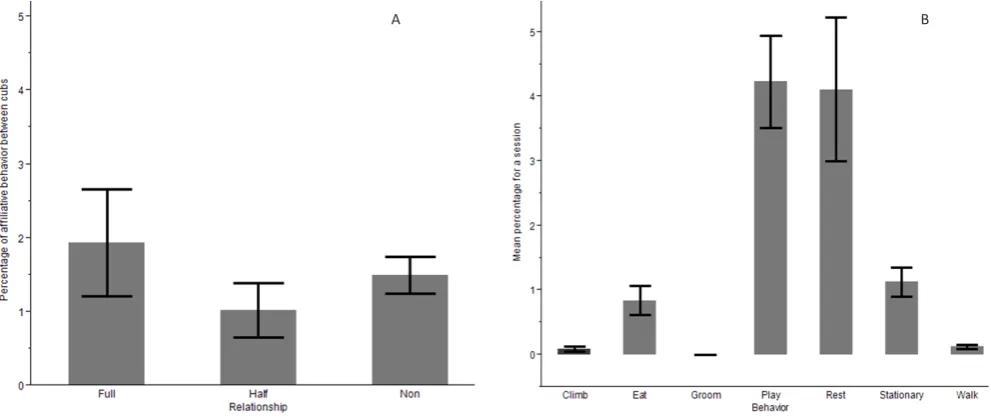
A total of 90 complete behavioural sessions were collected across both years, yielding 45 hours of observational data that the cubs were in a mixed housing situation. On average, cubs spent more time displaying solitary behaviours (85.3%), predominantly resting
alone (57.5%). The most prevalent social behaviours observed on average amongst all cubs were play (4.1%), rest (3.9%) and stationary (1.1%). The social interactions of walk and eat were observed less than 1.0% of time, while groom and climb with other pandas was rarely noted, with mean percentages less than 0.1%.
Birth year Sex Cub (ID) Dam (ID) Sire (ID)
2014 Male Chen Jiu (917) Cheng Ji (523) Qiao Qiao (624)
Zhen Duo (928) Qi Zhen (490) Yong Yong (584)
Shuang Hao (920) Da Shuang (453) Mei Lan (649)
Female Qi Qiao (924) Qi Fu (709)
Qi Xi (925)
2015 Male Meng Lan (954) Meng Meng (652) Mei Lan (649)
Si Da (961) Si Yuen (593)
Si Xiao (962)
Jing Da (963) Jing Jing (598) Long Long (831)
Jing Xiao (964)
Qing Da (985) Qing He (537) Yong Yong (584)
Qing Xiao (986)
Female Ke Da (947) Ke Lin (678) Qiao Qiao (624)
Ke Xiao (948)
Table 1. Identification of one-year old giant panda cubs observed within study. Nicknames were assigned to each cub, dam and sire when applicable. Studbook ID numbers are indicated in parentheses (Zhong 2015). Cubs with the same dam and sire were classified as full-kin, cubs with either the same dam or same sire were identified as half-kin, and any cubs that did not share the same dam or sire were noted as non-kin.
Behaviour Definition
Climb Move up or down a climbing structure.
Eat Put mouth in water; chew, consume, and/or mouth
bamboo.
Groom Lick and/or scratch own fur.
Play Bite, charge, chew, head-butt, lunge, paw, pull fur, push,
sit on, and/or wrestle another panda.
Rest Lay down with or without eyes closed, unreactive to surroundings.
Stationary Eyes open in a stationary position, attentive to surroundings.
Walk Take two or more steps in the same direction.
Full-kin spent approximately 1.9% of their time per session engaging socially, whereas cubs that shared no relationship interacted 1.4% of the time and half-kin 1.0% of the time (Figure 1A). A nested, two-way ANOVA revealed no significant difference regarding relationship and time spent interacting (F2, 258=0.51, P=0.61), or effect of specific panda cub pairings (F41, 258=1.17, P=0.30). A significant difference was found within types of behaviour performed (F6, 258=13.23, P<0.001); a post-hoc Tukey
test revealed that cubs spent a significantly larger percentage of their time playing and resting with other cubs over other social actions (Figure 1B), although this did not interact with relationship in any way.
To assess whether non-kin acted differently towards each other across housing types, when kin were present or absent, a nested, two-way ANOVA was performed on mixed and non-kin social behaviours. Again, a difference was observed in the amount of certain types of behaviours being performed (F6, 384 =9.18, P<0.001), but no effect of housing (F1, 384 =2.38, P=0.13) or of specific panda cub pairings (F63, 384 =0.92, P=0.65), meaning that cubs’ interactions with non-kin does not differ across housing contexts.
The amount of time giant panda cubs were housed together varied amongst individual pairings. Some cubs were never seen in the same enclosure; those who were observed together ranged from three to 29 sessions. A linear regression demonstrated that the time giant panda cubs were housed together did not influence the mean percentage of time cubs interacted per session (F1,
306=0.45, P=0.50, R2=0.001; Figure 2).
Discussion
Kin recognition has been well studied in social animals, but its origins and how it develops and manifests in solitary species is not well understood. The aim of this study was to assess whether patterns of affiliative interactions in sub-adults of a solitary species can be explained by kin recognition. While it was observed that cubs spent more time playing and resting near other cubs than other social behaviours, similar to formerly described panda activity budgets (Liu et al. 2003; Snyder et al. 2003), no evidence was found that giant panda cubs display social interactions in a kin-biased manner based on the mechanisms of phenotypic matching or prior association. Cubs interacted socially with kin and non-kin at similar rates, and there was no linear relationship between time observed together and time cubs spent interacting. Furthermore, it was found that the presence of kin does not change the frequency that cubs interact with non-kin. This raises questions about whether recognising kin at a young age confers a
Figure 1. Mean percentage of time full, half, and non-kin spent engaging in affiliative behaviours. There was no significant difference in time spent
interacting with cubs based on relationship (A), however there was a difference in observed social behaviours (B) (F6,322=5.2, P<0.001*).
A B
Figure 2. Percentage of time cubs spent interacting over the course of the study. There was no predictive relationship between duration of time panda cubs were observed housed together and time cubs engaged with
is varied, as infant twins are rotated between different mothers and incubators to increase the survival rate of both twins (Zhu et al. 2001; Swaisgood et al. 2003; Edwards et al. 2006). For the first few months of its life, during the time a cub is not with a mother, it is placed into an incubator to receive care from the staff. When the cub becomes old enough, it is introduced to a group of other cubs of the same age and development, presenting opportunities to engage in various social behaviours. Foster mothering, as well as mixed kin housing at an early age, may have confused and prevented kin recognition from developing appropriately. If this were the case then cubs would show no difference in their social preferences because they falsely believe all of the cubs are kin.
Based on this study, it is suggested to continue researching to elucidate if giant panda cubs are capable of kin recognition. If cub interactions are random and not governed by other factors, then follow-up studies to determine if kin recognition behaviour develops during sexual maturation would shed light on whether social housing practices should be reviewed. Given the species’ poor history of natural mating in captivity (Zhang et al. 2004), it is possible that mating pairs that were socially reared together, or shared the same foster mothers, may falsely believe they are kin and fail to show appropriate breeding behaviours. If prior association in females is the main force dictating kin recognition, then a mixed-sex, mixed-kin social group of cubs could lead to potential difficulties in the captive breeding program. Long-term investigations on the affiliative behaviour of young solitary animals housed in mixed-kin social groups could reveal vital information towards future management of giant pandas and provide insight on captive management of other solitary species.
Acknowledgements
We thank the faculty and staff at the Chengdu Research Base of Giant Panda Breeding, especially Hou Rong, Liu Songrui, and Yuan Bo. Without their collaboration and assistance, our work would not be possible. A special thank you to Macie Smith and Taryn Chudo, who partook as observers and data collectors. This project was funded by Otterbein University’s Student Research Fund, the Department of Biology and Earth Science, Faculty-Scholar Development Committee, Bert and Jane Horn Endowed Student Research Award, and the Kyle Miller Memorial Fund.
References
Alexander R.D. (1974) The evolution of social behavior. Annual Review of Ecology, Evolution, and Systematics 325–383.
Charlton B.D., Huang Y., Swaisgood R.R. (2009a) Vocal discrimination of potential mates by female giant pandas (Ailuropoda melanoleuca). Biology Letters 5(5): 597–599.
Charlton B.D., Zhihe Z., Snyder R.J. (2009b) Vocal cues to identity and
relatedness in giant pandas (Ailuropoda melanoleuca). Journal of the
Acoustical Society of America 126(5): 2721–2732.
Dawkins, R. (1982) The extended phenotype. New York, USA: Oxford
University Press.
Dungl E., Schratter D., Huber L. (2008) Discrimination of face-like patterns in the giant panda (Ailuropoda melanoleuca). Journal of Comparative Psychology 122(4): 335–343.
Eberle M., Kappeler P.M. (2006) Family insurance: kin selection and cooperative breeding in a solitary primate (Microcebus murinus). Behavioral Ecology and Sociobiology 60(4): 582–588.
Edwards M.S., Wei R., Hawes J., Sutherland-Smith M., Tang C., Li D., Hu D. and Zhong D. (2006) The neonatal giant panda: hand rearing and medical management. In: Giant pandas: biology, veterinary medicine and management. Cambridge, UK: Cambridge University Press, 315 – 333.
Fischer K., Karl I., Heuskin S., Janowitz S., Dötterl S. (2015) Kin recognition
and inbreeding avoidance in a butterfly. Ethology 121(10): 977–984.
Flores-Prado L., Niemeyer H.M. (2010) Kin recognition in the largely
solitary bee, Manuelia postica (Apidae: Xylocopinae). Ethology 116(5):
466–471.
benefit to giant pandas, and if so, how it is expressed. Alternative explanations are explored below that could account for the lack of difference in social interactions between kin and non-kin in giant panda cubs.
As cubs do not reach sexual maturity until five to six years of age (Zhu et al., 2001), no mating behaviours occurred within this study. It is possible that kin recognition does not manifest in affiliative behaviours within cubs, but rather is only relevant for adults. Kin recognition in adults could occur either through phenotypic matching in a mating context (Liu et al. 2008) or through prior association (Gilad et al. 2016) after dispersal at the onset of territory establishment. The level of inbreeding within giant pandas is particularly high for a solitary mammal (Hu et al. 2017); therefore, as the levels of kin assessment were based solely on parentage, it is also possible that insufficient genetic differences are present in the focal animals to trigger differential behaviour.
It is important to note the duration of observations for this study occurred in the same season and six-week time span. It is possible that giant panda cubs are basing their social behaviours on kin recognition and this study was too short to detect differences, or that differences are only present in certain seasons, as is the case for adult males (Liu et al. 2008). Longer studies conducted continuously across seasons, such as in predatory mites (Phytoseiulus persimilis; Schausberger 2007) and barbary macaques (Macaca sylvanus; Kuester et al. 1994), may reveal different patterns within panda cub social interactions, although studies on zebra finch (Taeniopygia guttata) fledglings detected kin-recognition behaviour in less than 25 days (Krause et al. 2012). As noted, prior association primarily takes place when animals are raised together in a cohort (Penn and Frommen 2010), which relies heavily on time for repeated encounters. The amount of time cubs were kept together preceding the project was not available to be incorporated into the analysis. Cubs may have been housed with specific kin or non-kin for varying periods; however, record of this was unknown. Giant panda cubs may use prior association, but to definitively elucidate this, the time cubs are housed with one another must be varied and documented.
It is also possible that giant panda cubs do not employ kin recognition and social interactions are random, or are governed by other aspects such as personality or sex. Personality was not a focus within this study, but could yield information as to why specific individuals engage more often with one another (Weinstein et al. 2008). Defining differences in panda personalities has been of interest for mate selection pairings (Powell and Svoke 2008; Martin-Wintle et al. 2017). Exploring personality characteristics in juveniles can provide information as to which individuals are more likely to engage in affiliative social behaviours and can further improve captive breeding, management and welfare of certain species, including the giant panda. Furthermore, within this study, there were no kin that were of mixed sex. Previous literature has noted that both kinship and sex can bias interactions between organisms (Kappeler 1993; MacCormick et al. 2012; Morton et al. 2015). Female rhesus macaques were more affiliative with female half-kin than non-kin (Widdig et al. 2001). Future studies should also focus on how sex and relationship can facilitate interactions within giant panda cubs and other solitary animals.
Gilad O., Swaisgood R.R., Owen M.A., Zhou X. (2016) Giant pandas use
odor cues to discriminate kin from nonkin. Current Zoology 62(4):
333–336.
Hamilton W.D. (1964a) The genetical evolution of social behaviour. I. Journal of Theoretical Biology 7(1): 1–16.
Hamilton W.D. (1964b) The genetical evolution of social behaviour. II. Journal of Theoretical Biology 7(1): 17–52.
Hauber M.E., Sherman P.W. (2001) Self-referent phenotype matching:
theoretical considerations and empirical evidence. Trends in
Neuroscience 24(10): 609–616.
Holmes W.G., Sherman P.W. (1983) Kin recognition in animals: the prevalence of nepotism among animals raises basic questions about how and why they distinguish relatives from unrelated individuals. American Scientist 71(1): 46–55.
Hu Y., Yonggang N., Wei W., Ma T., Van Horn R., Zheng X., Swaisgood R.R., Zhou Z., Zhou W., Yan L., Zhang Z., Wei F. (2017) Inbreeding and
inbreeding avoidance in wild giant pandas. Molecular Ecology 26(20):
5793–5806.
Hull V., Zhang J., Zhou S., Huang J., Li R., Liu D., Xu W., Huang Y., Ouyang Z.,
Zhang H., Liu J. (2015) Space use by endangered giant pandas. Journal
of Mammalogy 96(1): 230–236.
Kappeler P.M. (1993) Variation in social structure: the effects of sex and
kinship on social interactions in three lemur species. Ethology 93(2):
125–145.
Kessler S.E., Scheumann M., Nash L.T., Zimmermann E. (2012) Paternal kin recognition in the high frequency / ultrasonic range in a solitary
foraging mammal. BMC Ecology 12(26): 1–13.
Komdeur J., Hatchwell B.J. (1999) Kin recognition: function and mechanism in avian societies. Trends in Ecology and Evolution 14(6): 237–241. Krause E.T., Krüger O., Kohlmeier P., Caspers B.A. (2012) Olfactory kin
recognition in a songbird. Biology Letters 8(3): 327–329.
Kuester J., Paul A., Arnemann J. (1994) Kinship, familiarity and mating avoidance in Barbary macaques, Macaca sylvanus. Animal Behaviour 48(5): 1183–1194.
Lacy R.C., Sherman P.W. (1983) Kin recognition by phenotype matching. The American Naturalist 121(4): 489–512.
Li D., Wintle N.J.P., Zhang G., Wang C., Luo B., Martin-Wintle M.S., Owen M.A., Swaisgood R.R. (2017) Analyzing the past to understand the future: Natural mating yields better reproductive rates than artificial insemination in the giant panda. Biological Conservation 216: 10–17. Liu D.Z., Wang Z., Tian H., Yu C., Zhang G., Wei R., Zhang H. (2003) Behavior
of giant pandas (Ailuropoda melanoleuca) in captive conditions:
gender differences and enclosure effects. Zoo Biology 22: 77–82.
Liu D.Z., Weir R.P., Zhang C.Q., Yuan H., Wang Z.P. Sun L., Zhang J.X., Zhang
H.M. (2008) Male panda (Ailuropoda melanoleuca) urine contains
kinship information. Chinese Science Bulletin 53(18): 2793–2800. Liu H., Duan H., Wang C. (2017) Effects of ambient environmental factors on
the stereotypic behaviors of giant pandas (Ailuropoda melanoleuca). PloS one 12: 1–13.
Lizé A., Carval D., Cortesero A.M., Fournet S., Poinsot D. (2006) Kin discrimination and altruism in the larvae of a solitary insect. Proceedings of the Royal Society B Biological Sciences 273(1599): 2381–2386.
Lodé T. (2008) Kin recognition versus familiarity in a solitary mustelid, the European polecat Mustela putorius. Comptes Rendus Biologies 331(3): 248–254.
MacCormick H.A., MacNulty D.R., Bosacker A.L., Lehman C., Bailey A., Collins D.A., Packer C. (2012) Male and female aggression: lessons from sex, rank, age, and injury in olive baboons. Behavioral Ecology 23: 684–691.
Mainka S.A., Zhang H. (1994) Daily activity of captive giant pandas
(Ailuropoda melanoleuca) at the Wolong Reserve. Zoo Biology 13(1):
13–20.
Martin-Wintle M.S., Shepherdson D., Zhang G., Huang Y., Luo B., Swaisgood R.R. (2017) Do opposites attract? Effects of personality matching in breeding pairs of captive giant pandas on reproductive success. Biological Conservation 207: 27–37.
Mateo J.M. (2003) Kin recognition in ground squirrels and other rodents.
Journal of Mammalogy 84(4): 1163–1181.
Mateo J.M. (2010) Self-referent phenotype matching and long-term maintenance of kin recognition. Animal Behaviour 80(5): 1–7. Mateo J.M., Johnston R.E. (2000) Kin recognition and the ‘armpit effect’:
evidence of self–referent phenotype matching. Proceedings of the
Royal Society B Biological Sciences 267(1444): 695–700.
McHugh M.L. (2012) Interrater reliability: the kappa statistic. Biochemia
Medica 22(3): 276–282.
Montaudouin S., Pape G.L. (2005) Comparison between 28 zoological parks: stereotypic and social behaviours of captive brown bears (Ursus arctos). Applied Animal Behaviour Science 92: 129–141.
Morton F.B., Weiss A., Buchanan-Smith H.M., Lee P.C. (2015) Capuchin monkeys with similar personalities have higher-quality relationships
independent of age, sex, kinship and rank. Animal Behaviour 105:
163–171.
Penn D.J., Frommen J.G. (2010) Kin recognition: An overview of conceptual
issues, mechanisms and evolutionary theory. In Animal Behaviour:
evolution and mechanisms (ed. P Kappeler), chap. 3, 55–86. Petrie M., Krupa A., Burke T. (1999) Peacocks lek with relatives even in
the absence of social and environmental cues. Nature 401(6749):
155–157.
Pfefferle D., Ruiz-Lambides A.V., Widdig A. (2014) Female rhesus macaques discriminate unfamiliar paternal sisters in playback experiments:
support for acoustic phenotype matching. Proceedings of the Royal
Society B: Biological Sciences 281(1774): 20131628.
Powell D.M., Svoke J.T. (2008) Novel environmental enrichment may provide a tool for rapid assessment of animal personality: a case study with giant pandas (Ailuropoda melanoleuca). Journal of Applied Animal Welfare Science 11(4): 301–318.
Schaller G.B., Hu J., Pan W., Zhu J. (1985) The Giant Pandas of Wolong. Chicago, USA: University of Chicago Press.
Schausberger P. (2007) Kin recognition by juvenile predatory mites:
prior association or phenotype matching? Behavioral Ecology and
Sociobiology 62(1): 119–125.
Sherman P.W. (1981) Kinship, demography, and Belding’s ground squirrel nepotism. Behavioral Ecology and Sociobiology 8(4): 251–259. Sherman P.W., Holmes W.G. (1985) Kin recognition: issues and evidence. In
Experimental Behavioral Ecology and Sociobiology (ed. B. Hölldobler and M. Lindauer), 437–460.
Simmons L.W. (1989) Kin recognition and its influence on mating preferences of the field cricket, Gryllus bimaculatus (de Geer). Animal Behaviour 38(1): 68–77.
Snyder R.J., Zhang A.J., Zhang Z.H., Li G.H., Tian Y.Z., Huang X.M., Luo L., Bloomsmith M.A., Forthman D.L., Maple T.L. (2003). Behavioral and developmental consequences of early rearing experience for captive
giant pandas (Ailuropoda melanoleuca). Journal of Comparative
Psychology 117(3): 235–245.
Støen O.G., Bellemain E., Saebø S., Swenson J.E. (2005) Kin-related spatial structure in brown bears Ursus arctos. Behavioral Ecology and Sociobiology 59: 191–197.
Swaisgood R.R., Zhou X., Zhang G., Lindburg D.G., Zhang H. (2003) Application of behavioral knowledge to conservation in the giant
panda. International Journal of Comparative Psychology 16(2–3):
65–84.
Wahaj S.A., Van Horn R.C.., Van Horn T.L., Dreyer R., Hilgris R., Schwarz J., Holekamp K.E. (2004) Kin discrimination in the spotted hyena
(Crocuta Crocuta): nepotism among siblings. Behavioral Ecology and
Sociobiology 56(3): 237–247.
Waldman B. (1987) Mechanisms of kin recognition. Journal of Theoretical
Biology 128(2): 159–185.
Waldman B. (1988) The ecology of kin recognition. Annual Review of Ecology, Evolution, and Systematics 19: 543–571.
Weinstein T.A.R., Capitanio J.P., Gosling S.D. (2008) Personality in animals. In: Handbook of personality: theory and research. New York, USA: The Guilford Press, 328–348.
Westermarck E.A. (1891) The History of Human Marriage. Macmillian,
London.
Widdig A., Nürnberg P., Krawczak M., Streich W.J., Bercovitch F.B. (2001) Paternal relatedness and age proximity regulate social relationships
among adult female rhesus macaques. Proceedings of the National
Academy of Sciences of the United States of America 98(24): 13769– 1377.
Wilson M.L. (2005) An investigation into the factors that affect play
fighting behavior in giant pandas. Ph.D. dissertation, Georgia Institute of Technology.
Wilson M.L., Snyder R.J., Zhang Z.H., Lan L., Li C.L., Maple T.L. (2009) Effects of partner on play fighting behavior in giant panda cubs. In: Transactions at Play. University Press of America 104–123.
Zhan X.J., Zhang Z.J., Wu H., Goossens B., Li M., Jiang S.W., Bruford M.W., Wei F.W. (2007) Molecular analysis of dispersal in giant pandas.
Molecular Ecology 16(18): 3792–3800.
Zhang G., Swaisgood R.R., Zhang H. (2004) Evaluation of behavioral factors influencing reproductive success and failure in captive giant pandas.
Zhang Z., Sheppard J.K., Swaisgood R.R., Wang G., Nie Y., Wei W., Zhao N., Wei F. (2014) Ecological scale and seasonal heterogeneity in the spatial behaviors of giant panda. Integrative Zoology 9(1): 46–60.
Zhong X. (2015) The 2015 International Studbook For Giant Panda
(Ailuropoda melanoleuca). Chinese Association of Zoological Gardens,
1–244.
Zhu X., Lindburg D.G., Pan W., Forney K.A., Wang D. (2001) The reproductive strategy of giant pandas (Ailuropoda melanoleuca): infant growth and
development and mother–infant relationships. Journal of Zoology