Vol. 8, No. 3, 2016 Article ID IJIM-1602-00827, 6 pages Research Article
Set a bi-objective redundancy allocation model to optimize the
reliability and cost of the Series-parallel systems using NSGA II
problem
M. R. Shahriari ∗†
Received Date: 2015-04-01 Revised Date: 2015-10-11 Accepted Date: 2016-01-21
————————————————————————————————–
Abstract
With the huge global and wide range of attention placed upon quality, promoting and optimize the reliability of the products during the design process has turned out to be a high priority. In this study, the researcher have adopted one of the existing models in the reliability science and propose a bi-objective model for redundancy allocation in the series-parallel systems in accordance with the redundancy policy- given that failure rate depends on the number of the active elements. The objective behind the proposed model is to maximize the reliability and to minimize the total cost of the system. Internal connection cost, which is the most common parameter in electronic systems, put in this model in order to simulate the real-world conditions. As the proposed model is an NP-Hard one(for getting results), the researcher adopted a Non-dominated Sorting Genetic Algorithm (NSGA II) after optimizing its operators rate by using Response Surface Methodology (RSM).
Keywords : Reliability; Series; Parallel System; Redundancy Allocation Problem; Non-dominated Sorting Genetic Algorithm; Response Surface Methodology.
—————————————————————————————————–
1
Introduction
T
himprove and optimize the reliability of thee main goal of the reliability science is to systems. During the initial stages of the de-sign, the redundancy allocation directly enhances the system reliability. Fyffe and his colleagues first introduced redundancy Allocation Problem (RAP) in 1986. RAP is a combinatorial opti-mization problem, which focuses on determining an optimal assignment for the components in a system, and is widely used in system designing in a variety of practical circumstances, especially in electrical, computer and industrial engineering∗Corresponding author. [email protected] †Faculty of Management, South Tehran Branch, Is-lamic Azad University, Tehran, Iran.
(Ramirez-Marquez and Coit, 2004) [12]. RAP involves the simultaneous selection of the com-ponents and configuration of system-level design, which can collectively meet all design constraints in order to optimize some objective functions such as system cost and/or reliability. RAP can be cat-egorized into RAP with and without component mixing (Coit, 2001 [4], Coit and Smith, 1995 [2]). Over the recent years, researchers have developed reliability models, especially in series-parallel and redundancy problems. The historical develop-ment of the redundancy problem in a series-parallel problem is being summarized in Table 1. This section describes briefly the literature and concept of the redundancy allocation problem in series-parallel systems. The proposed model will be presented in the next section. Section 3
views the concept and results of the Response Surface Methodology for optimizing the opera-tors rate of Non-dominated Sorting Genetic Al-gorithm (NSGA II). In Section4, the test results of applying non-dominated sorting genetic algo-rithm to solve the proposed model are presented and finally Section 5discusses the conclusions.
2
Problem formulation
The purpose of the proposed model is to maxi-mize the reliability and to minimaxi-mize the total cost of a series-parallel system considering different re-dundancy strategies without component mixing (RAPCM) in each subsystem and the failure rate of active elements in a subsystem, which are de-pendent on the number of the active elements. The selected strategies for each subsystem are ac-tive and cold standby. To formulate the problem, first the assumptions are defined in Section 2.1, and then the parameters are presented in section 2.2.
Eventually, the proposed model is presented in section 2.3.
Table 1: History of the development of the redun-dancy problem in a series-parallel problem
2.1 Assumptions
• The system consists of some series subsys-tem which redundant elements in these sub-systems are parallel.
• Only one kind of element can be assigned to each subsystem.
• Each subsystem can only choose on active or
cold standby strategy in redundancy alloca-tion.
• For each redundancy strategy, the failure rate of elements depends on active elements.
• Elements of system and subsystem have in-tact or failed state.
• For redundant elements, internal connection cost will be used.
• Costs and weights of the elements are defi-nite.
• The reliability of the elements is determinis-tic and definite.
• None of the elements use preventive mainte-nance strategy.
• The failure of the elements is independent.
• Inactive elements do not harm the system.
• The failure of the switch only happens in re-sponse to a failure.
2.2 Parameters
i subsystems index (i= 1,2, ..., s)
j redundant element index (j= 1,2, ..., mi)
Ki The kind of the element assigned toith sub-system indexKi ∈ {1,2, ..., mi}
k (k1, k2, ..., ks)
ni Number of the elements in ith subsystem
ni∈ {1,2, ..., nmax,i}
n (n1, n2, ..., ns)
sti Redundancy strategy chosen for ith subsys-tem sti ∈ {A}or{S}
st {st1, st2, ..., sts}
s Number of subsystems
mi number of the kind of the elements for as-signing in ith subsystem
nmax,i Upper limit forni
t Mission time of the system
cij(t) Cost ofjthelement assigned toithsubsystem
wij(t) Weight ofjthelement assigned toith subsys-tem
C Upper limit of the cost of the system
W Upper limit of the weight of the system
ρi switching success probability in failure detec-tion
Fi,k(j)
i(t) Probability function distribution for j
th
fail-ure in ith subsystem with assigning element
ki to subsystem in timet
A Set of subsystems with active strategy
S Set of subsystems with cold stand by strat-egy
λj Failure rate of thejth kind of the element
λi,ni Failure rate of the elements ini
thsubsystem
when ni elements are active
ρij Internal connection cost ofjthelement toith subsystem
R(t;st, k, n) Reliability of the system in time t with as-signing vector k of all kind of elements and vectornof number of the elements
2.3 Proposed model
maxZ1=R(t;st, k, n) (2.1)
minZ2= s ∑ i=1 mi ∑ j=1
(cij(ni+eρikini)) (2.2)
s.t s ∑ i=1 mi ∑ j=1
(wijni)≤W (2.3)
ni≤nmax,i∀i∈s
ni, kilnt, sti∈ {0,1}
(2.4)
2.3.1 First objective
Total reliability of the system is evaluated by Equation (2.1) and for the cold standby and ac-tive subsystem and total reliability of the sys-tem are calculated by Equation (2.5), Equation (2.6), and Equation (2.7) respectively (Sharifi et al., 2010) [13], considered the effects of the com-ponent failure on remaining comcom-ponents failure rates. They proved that the failure rate of each element in ith subsystem with ki kind and ni ac-tive element, which is described in Equation (2.8). They also proposed that the best value forδis 0.5.
R(t;S, k, n) = Πi∈S
(
ri,ki(t) +
n∑i−1
j=1
∫0
t ρi(u)F (j)
i,ki(u)ri,ki(t−u)du
)
(2.5)
R(t;A, k, n) =
(
Πmj=1λi,ni
)
m
∑
i=k
{ ni!
i(k−1)!{
1
∏m
θ=k,θ̸=i(θλθ−iλi,ni)}
e−iλi,nit
λi }
(2.6)
λi,ni =
ni−(δ(ni−1))
ni ∗
λki (2.7)
R(t;st, k, n) =∏i∈A(∏mj=1λi,ni
)
m
∑
i=k
{ ni!
i(k−1)!{
1
∏m
θ=k,θ̸=i(θλθ−iλi,ni)}
e−iλi,nit
λi } ∗∏i∈S
(
ri,ki(t) +
n∑i−1
j=1
∫0
t ρi(u)F (j)
i,ki(u)ri,ki(t−u)du
)
(2.8)
2.3.2 Second objective
Total cost of the system consists of the assign-ment of the redundant eleassign-ments and the internal connection of elements. Internal connection cost has an exponential nature because of the limited space in electronic systems as surcharging each redundant element to each subsystem incurs pro-gressive costs. This constraint is shown in Equa-tion (2.2).
2.3.3 Constraints
upper bound that is being presented in Equation (2.3), and Equation (2.4). Finally, the objective of the model is to define the best strategy, num-ber and kind of redundant component assigned to each subsystem considering the constraints.
3
Optimizing
the
operators
rates
Non-dominated Sorting Genetic Algorithm (NSGA II) has been adopted for solving the problem and getting test results upon optimizing the operators rate of the algorithm using Re-sponse Surface Methodology (RSM). ReRe-sponse Surface Methodology (RSM) explores the rela-tionships between several explanatory variables and one or more response variables (Box and Wilson, 1951) [1]. The main philosophy behind RSM is to use a sequence of designed experiments to obtain an optimal response. The non-linear programing model and the best solution of applying RSM for optimizing the operators of the NSGA II are presented in Equations (3.9) to (3.12) and Table 2.
minM ID/DIV =−9.77404 + 0.0862565∗
npop+ 9.29748∗pc−74.7459∗pm −0.156791∗npop∗pc−1.19643∗
npop∗pm+ 101.616∗pc∗pm
+0.000919053∗npop∧2 + 23.6708∗
pc∧2 + 548.207∗pm∧2;
(3.9)
S.T.
100≤npop≤200 (3.10)
0.4≤pc≤0.8 (3.11)
0.1≤pm≤0.3 (3.12)
npop is an integer variable
4
Numerical results
Non-dominated Sorting Genetic Algorithm II (NSGA II) is one of the most widely-utilized and applicable multi-objective optimization algo-rithms.
To evaluate the model, the researchers put to test the very example that, for the first time, Coit (2003) [5] used in his study.
Table 2: The best solution for operators rate of the NSGA II.
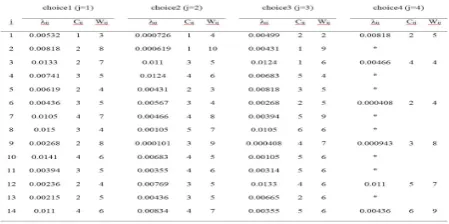
Consider a series-parallel system with 14 series subsystems. Each subsystem can assign up to six elements from three to four different kinds of ele-ments. Inter-failure time for all of the assignable elements follows negative exponential distribu-tion with deterministic parameter. Cost, weight and exponential distribution parameter of the el-ements are presented in Table 3. Each subsys-tem can choose one of the redundancy strate-gies: active or cold standby. In the subsystems with cold standby strategy, the switch reliabil-ity is 0.99. The objective is to increase the re-liability of the system in time 100 under cost (C = 130, M ax) and weight (W = 170, M ax) constraint. To find the best solutions for the
Table 3: Values of the parameters.
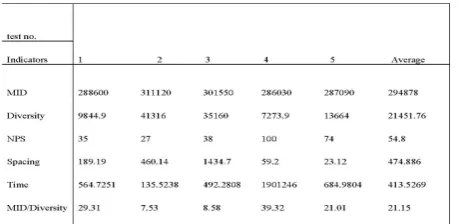
model, the algorithm was implemented 5 times and the best feasible solution in these steps was recorded, we repeated these steps 5 times and fi-nally, the averages of each multi-objective algo-rithm indicator were concluded, the results are shown in Table 4.
5
Conclusion
Table 4: The results of solving the model using NSGA II.
with regard to the dependence of the component failure rates work and the interconnection cost of the system. In other words, the purpose of this paper was to allocate components and the redundancy strategy to any subsystem without allocating the component mixing to any subsys-tems in order to increase system reliability and to reduce the total cost of the system under cer-tain physical restrictions. Then, the results of solving the proposed model using a famous ex-ample and a multi-objective algorithm were pre-sented. Presenting multi-objective models, con-sidering new restrictions such as volume and fac-tors like weight, possible cost, and more than two active and cold standby strategies for each sub-system are recommended for further research into the development of the future models.
References
[1] G. E. P. Box, K. B. Wilson, On the Exper-imental Attainment of Optimum Conditions (with discussion), Journal of the Royal Sta-tistical Society Series 13 (1951) 1-45.
[2] A. Chambari, S. A. Rahmati, A. Najafi, A. Karimi,A bi-objective model to optimize reli-ability and cost of system with a choice of re-dundancy strategies. Computers and Indus-trial Engineering, 63, 109-119. Coit, D. W., Smith, A. 1995. Optimization approaches to the redundancy allocation to the redun-dancy allocation problem for series parallel systems. Proceedings of the fourth industrial engineering research conference.
[3] D. W. Coit, A. Smith, Stochastic Formula-tions of the Redundancy Allocation Problem, Proceedings of the Fifth Industrial Engineer-ing Research Conference, Minneapolis.
[4] D. W. Coit,Cold Standby Redundancy Opti-mization for Non-repairable Systems, IEEE Transactions 33 (2001) 471-478.
[5] D. W. Coit, Maximization of System Reli-ability with a Choice of Redundancy Strate-gies, IIE Transactions, 35 (2003) 535-544. [6] D. W. Coit, A. Konak, Multiple Weighted
Objectives Heuristic for the Redundancy Al-location Problem, IEEE Transactions on Re-liability 55 (2006) 551-558.
[7] D. E. Fyffe, W. W. Hines, N. K. Lee,System Reliability Allocation and a Computational Algorithm, IEEE Transactions on Reliability, 17 (1968) 64-69.
[8] K. Khalili-Damghani, M. Amiri, Solving binary-state multi-objective reliability redun-dancy allocation series-parallel problem us-ing efficient epsilon-constraint, multi-start partial bound enumeration algorithm, and DEA, Reliability Engineering and System Safety 103 (2012) 35-44.
[9] Y. C. Liang, A. Smith,An Ant Colony Opti-mization Algorithm for the Redundancy Al-location Problem (RAP), IEEE Trans Relia-bility 53 (2013) 417-423.
[10] Y. C. Liang, C. C. Wu,A Variable Neighbor-hood Descent Algorithm for the Redundancy Allocation Problem, Industrial Engineering Management Systems 4 (2005) 109-116.
[11] Y. C. Liang, Y. C. Chen,Redundancy Alloca-tion of Series-Parallel Systems Using a Vari-able Neighborhood Search Algorithm, Reli-ability Engineering and System Safety 92 (2007) 323-331.
[12] J. E. Ramirez-Marquez, D. W. Coit, A Heuristic for Solving the Redundancy Alloca-tion Problem for Multi-State Series-Parallel Systems, Reliability Engineering and System Safety 83 (2004) 341-349.
[13] M. Sharifi, A. Memariani, R. Noorossana,
[14] Z. Wang, T. Chen, K. Tang, X. A. Yao,
Multi-objective Approach to Redundancy Al-location Problem in Parallel- series Systems, IEEE Explore. Restrictions apply.
[15] W. Y. Yun, J. W. Kim, Multi-Level Redun-dancy Optimization in Series Systems, Com-puters and Industrial Engineering 46 (2004) 337-346.