Int. J. IndustrialMathematics (ISSN 2008-5621)
Vol. 11, No. 2, 2019 Article ID IJIM-0986, 14 pages Research Article
Hybrid PSOS Algorithm For Continuous Optimization
A. Jafarian ∗†, B. Farnad ‡
Received Date: 2018-03-30 Revised Date: 2018-11-02 Accepted Date: 2019-03-11 ————————————————————————————————–
Abstract
Particle swarm optimization (PSO) is one of the practical metaheuristic algorithms which is applied for numerical global optimization. It benefits from the nature inspired swarm intelligence, but it suffers from a local optima problem. Recently, another nature inspired metaheuristic called Symbiotic Organisms Search (SOS) is proposed, which doesn’t have any parameters to set at start. In this paper, the PSO and SOS algorithms are combined to produce a new hybrid metaheuristic algorithm for the global optimization problem, called PSOS. In this algorithm, a minimum number of the parameters are applied which prevent the trapping in local solutions and increase the success rate, and also the SOS interaction phases are modified. The proposed algorithm consists of the PSO and the SOS phases. The PSO phase gets the experiences for each appropriate solution and checks the neighbors for a better solution, and the SOS phase benefits from the gained experiences and performs symbiotic interaction update phases. Extensive experimental results showed that the PSOS outperforms both the PSO and SOS algorithms in terms of the convergence and success rates.
Keywords: PSO; SOS; Meta-Heuristic Optimization; Hybrid Algorithm
—————————————————————————————————–
1
Introduction
O
pbest solution.timization is the process of finding theThe best solution means that there could be more than one solution for a problem, while only one of them is the best. Based on the optimization method, the optimization algorithms are categorized into exact algorithms and approximate algorithms. Exact algorithms are mainly applied to find the absolute solution for the problems, but they are not effective in solving the hard optimization problems and may increase the time of optimiza-tion exponentially [1]. However, approximate∗Corresponding author. [email protected], Tel: +98(914)1893041.
†Young Researchers and Elite Club, Urmia Branch, Is-lamic Azad University, Urmia, Iran.
‡Department of Computer Engineering, Urmia Branch, Islamic Azad University, Urmia, Iran.
algorithms are the best choice for solving hard optimization problems and can find the best solution in a minimum execution time.
Approximate algorithms themselves can be classified into Heuristic algorithms and Meta-Heuristic algorithms. However, heuristic algo-rithms suffer from the local solutions, but meta-heuristic algorithms are aimed to avoid the lo-cal solutions which causes their popularity and widespread usage in various applications [2]. Metaheuristic algorithms combine various intel-ligent procedures and guide basic heuristic meth-ods [3]. These algorithms are inspired from dif-ferent things such as natural phenomena, natu-ral selections and social behaviors and applied in solving the optimization problems. Examples of the recently metaheurtistc algorithms are HTS (heat transfer search) [4], NBA (novel bat algo-rithm) [5], Vortex search [6], MBA (mine blast
algorithm) [7], WCA (water cycle algorithm) [8], and SFS (stochastic fractal search) [9].
The symbiotic organism search (SOS) [10] is one of the nature inspired [11] algorithms pre-sented to solve numerical optimization which is aimed to simulate the symbiotic interaction be-tween the organisms, and applying them to find a better survival opportunity. Symbiotic interac-tions are categorized into three phases: Mutual-ism, Commensalism and Parasitism. These inter-actions are performed between a pair of organ-isms in the ecosystem, for example, Mutualism is like the interaction between bees and follow-ers, and both of the organisms which participate in the Mutualism benefit from the interaction. These phases in SOS algorithm are the updating section in which the position of the organisms are changed according to the interaction. Organisms (individuals) in SOS interact with each other and only the most compatible organisms are survived and benefit from the ecosystem. At the end, the fittest organism to the ecosystem is selected as the solution to the problem.
The PSO [12] is the other metahearuistic al-gorithm which has been utilized in the optimiza-tion of many problems. This algorithm uses the strategy of birds and folks in migration for find-ing better solutions. Individuals in the PSO are called as particles and each particle has velocity in the searching space. Particles are distributed randomly in the searching space and positions of the particles are changed based on the velocity which has been calculated. These particles tend to move toward the best positions which causes to seek a better position and find the best.
One of the deficiencies that can be specified for PSO is that it often falls to the local minimum quickly, missing better opportunities when fac-ing multimodal functions [13]. Researchers have tried to change the original version of the PSO for boosting its efficiency in finding solutions. Gen-erally the deficiencies of the PSO and other meta-heuritic optimization algorithms can be solved by two methods: first, improving the algorithm and designing the new version. Many variants of the PSO has been proposed in recent years such as: modified particle swarm optimizer (GPSO) [14], Dynamic multi-swarm particle swarm opti-mizer (DMS-PSO) [15], adaptive particle swarm optimizer (APSO) [16], fully informed particle swarm (FIPS) [17], comprehensive learning
par-ticle swarm optimizer (CLPSO) [18]. Second, PSO may be combined with other more efficient optimization algorithms to produce hybrid opti-mization algorithms. Examples of such hybrid algorithms are HP-CRO [19], ICA-PSO [20] and CS/PSO [21]. In ICA-PSO, exploration ability has been boosted by combining imperialist com-petitive algorithm (ICA) [22]. HP-CRO is the al-gorithm based on the chemical reaction optimiza-tion (CRO) [23] and CS/PSO is a combination of cuckoo search (CS) [24]. The main purpose from combing the algorithms is covering each others deficiency and boosting the problem solving abil-ity and decreasing the number of function evalua-tion (NFE). Thus, the resulted hybrid algorithm should be able to solve most of the problems effi-ciently and with fast convergence.
In this paper, we combine the PSO and SOS algorithms to achieve a new hybrid metaheuris-tic algorithm for the global optimization. Com-bination of these two algorithms is aimed to re-solve some problems which cannot be re-solved by the SOS and the PSO. The main reason for this improvement is originated from the modifications which have been performed in the SOS part of the proposed algorithm. These modifications cause preventing from trapping in the local solutions and increase in the success rate. Since the SOS al-gorithm doesn’t have any parameters, the PSOS applies minimum number of the parameters and only uses the PSO parameters. In this hybrid algorithm, the PSO has the role of gaining expe-riences and selecting the best from them to use in the SOS interaction phases, which helps in fast convergence.
The rest of the paper is organized as follows: Section 2 describes the generic form of the opti-mization problems, Section 3illustrates the PSO and SOS algorithms, and section 4 discusses the PSOS algorithm, its parameters and boundary control. Finally, the last section presents the con-cluding remarks.
1.1 Optimizatoin problems
lo-cal, but only one of them is the global maximum or minimum. The point x* is the global minimum if f(x*)≤f(x) for all the x in the searching space S. Optimization problem may consist of one or more mathematical functions which need to be optimized. The general form of the optimization problem is indicated in Eq. (1.1).
M inF(f1(x), ..., fm(x)), x= (x1, ..., xn)∈S.
(1.1)
Where n is the decision variables, m is the num-ber of objectives, x is decision vector and S is searching space. If the problem has one objective function (m=1), then it should be indicated as Eq. (1.2).
M inf(x), x= (x1, ..., xn)∈S. (1.2)
2
PSO and SOS
2.1 Particle Swarm Optimization (PSO)
The PSO is the one of the metaheuristic algo-rithms which is originated from the nature. This algorithm was introduced by Kenndy and Eber-ahart in 1995 [12]. The PSO is originated from the birds and folks migration behavior, living in small and large numbers of groups. The birds use a method for finding food and migration, which has been used in this algorithm. In this method, only the birds know their distance from food, but they don’t know the location of the food thus, following the other neighboring birds is the best way for surviving.
The PSO consist of elements with the name of particles which is a probable solution in the searching space. The main steps in the PSO algorithm are as follow: first, particles are dis-tributed randomly in the searching area and PSO starts the process with these particles. In this searching process, particles only follow the one which is nearer to the goal and has better fit-ness value. Each particle has a velocity which is represented byVi and calculated by Eq. (2.3) in
the D-dimensional searching space. Particles are under the effect of personal (P bestti) and swarm experiences (Gbestti) and the position is updated by Eq. (2.4).
Vit+1=w.Vit+c1.r1.(P bestti−Xit)
+c2.r2.(Gbestti−Xit) (2.3)
Xit+1 =Xit+Vit+1 (2.4)
In Eq. (2.3) and (2.4), Xi represents the ith
particle of the population,c1andc2are the learn-ing coefficients, r1 and r2 are random values be-tween [0 1], w is the inertia weight, and Vi is
the ith member of particles velocity. P bestti and
Gbesttare the personal best and generation best.
Figure 1: Flowchart of the PSOS algorithm.
PSO algorithm:
1: Initialize locationsXi and velocityVi of n particles.
2: Find Gbestfrom min{f(X1), ..., f(Xn)} (at t = 0)
3: While( criterion ) 4: fori=1,2,...,n do
5: Generate new velocityVit+1 using Eq. (2.3).
6: Calculate new locationsXit+1 =Xit+Vit+1
7: Evaluate objective functions at new locationsXit+1
8: If Xit+1 is better thanP bestti then
9: SetXit+1 to beP bestti
10: end if
11: end for
12: Find the Generation best Gbesttfrom particles P bestt
13: iter = iter + 1 (pseudo time or iteration counter) 14: end while
15: Output the final result Gbest
Table 1: Unimodal test functions (D: dimensions)
Function D Range Min Formulation
F1(Beale) 2 [-4.5,4.5] 0 f(x) = (1.5−x1+x1x2) 2
+(2.25−x1+x1x22
)2
+(2.625−x1+x1x32
)2
F2(Easom) 2 [-100,100] -1 f(x) =−cos (x1) cos (x2)exp(−(x1−π) 2
−(x2−π) 2
)
F3(Matyas) 2 [-10,10] 0 f(x) = 0.26(x2 1+x22
)
−0.48x1x2
F4(Colville) 4 [-10,10] 0 f(x) = 100(x2 1−x2
)2
+ (x1−1) 2
+ (x3−1) 2
+90(x23−x4
)2
+ 10.1(x2−1) 2
+ (x4−1) 2
+19.8 (x2−1) (x4−1)
F5(Zakharov) 10 [-5,10] 0 f(x) =∑Di=1x2
i +
(∑D i=10.5ixi
)2
+(∑Di=10.5ixi
)4
F6(Schwefel 2.22) 30 [-10,10] 0 f(x) =∑Di=1|xi| +∏Di=1|xi|
F7(Schewefel 1.2) 30 [-100,100] 0 f(x) =∑Di=1(∑ij=1xj
)2
F8(Dixon-price) 30 [-10,10] 0 f(x) = (x1−1) 2
+∑Di=2i(2x2
i −xi−1
)2
F9(Step) 30 [-5.12,5.12] 0 f(x) =∑Di=1(xi+ 0·5)
2
F10(Sphere) 30 [-100,100] 0 f(x) =∑Di=1x2
i
F11(SumSquares) 30 [-10,10] 0 f(x) =∑Di=1ix2
i
F12(Quartic) 30 [-1.28,1.28] 0 f(x) =∑Di=1ix4
i +Rand
2.2 Symbiotic Organisms Search (SOS)
The SOS is introduced by Cheng and Prayogo in 2014 [10] and is the one of nature inspired
Table 2: Multimodal test functions (D: dimensions)
Function D Range Min Formulation
F13(Schaffer) 2 [-100,100] 0 f(x) = 0.5 + sin
2(√x2
1+x22)−0.5
(1+0.001(x2 1+x22))
2
F14(6 H Camel) 2 [-5,5] -1.03163 f(x) = 4x2
1−2.1x41+ 1 3x
6
1+x1x2−4x22+ 4x42
F15(Bohachevsky2) 2 [-100,100] 0 f(x) =x2
1+ 2x22−0.3 cos (3πx1) (4πx2) + 0.3
F16(Bohachevsky3) 2 [-100,100] 0 f(x) =x21+ 2x22−0.3 cos (3πx1+ 4πx2) + 0.3
F17(Shubert) 2 [-10,10] -186.73 f(x) = (∑i˙5=1icos (i+ 1)x1+i)
(∑5i˙=1icos ((i+ 1)x2+i))
F18(Rosenbrock) 30 [-30,30] 0 f(x) =∑iD=1−1100(xi+1−x2i
)2
+ (xi−1)2
F19(Griewank) 30 [-600,600] 0 f(x) = 40001 (∑Di=1(xi−100)
2)
−(∏D i=1cos
(
xi−√100
i
)) + 1
F20(Ackley) 30 [-32,32] 0 f(x) =−20 exp (
−0.2 √
1
n
∑D i=1x2i
)
−exp (
1
n
∑D
i=1cos (2πxi)
)
+ 20 +e
F21(Bohachevsky1) 2 [-100,100] 0 f(x) =x21+ 2x2
2−0·3 cos (3πx1)
−0.4 cos (4πx2) + 0.7
F22(Booth) 2 [-10,10] 0 f(x) = (x1+ 2x2−7) 2
+ (2x1+x2−5) 2
F23(Michalewicz2) 2 [0,π] -1.8013 f(x) =−∑Di=1sin(xi)
(
sin(ix2i/π))20
F24(Michalewicz5) 5 [0,π] -4.6877 f(x) =−∑Di=1sin(xi)
(
sin(ix2i/π))20
F25(Michalewicz10) 10 [0,π] -9.6602 f(x) =−∑Di=1sin(xi)
(
sin(ix2i/π))20
F26(Rastrigin) 30 [-5.12,5.12] 0 f(x) =∑Di=1(x2i −10 cos (2πxi) + 10
)
Figure 3: Schematic view of the PSOS algorithm.
which are common between the organisms. In this algorithm, organisms have the role of points in the searching space and each organism represents a possible solution to the problem. The adaption to the intended goal has been measured by the fitness for each organism. the same as the real GA [26] and continuous PSO, the SOS is likewise designed for the continuous
Table 3: PSOS comparison with GA, DE, PSO, BA, PBA and SOS (unimodal function set), bold values represent the best.
Function GA DE PSO BA PBA SOS PSOS
(F1)Mean 0 0 0 1.88E-05 0 0 0
StdDev 0 0 0 1.94E-05 0 0 0
Rank 1 1 1 2 1 1 1
(F2)Mean -1 -1 -1 -0.99994 -1 -1 -1
StdDev 0 0 0 4.50E-05 0 0 0
Rank 1 1 1 2 1 1 1
(F3)Mean 0 0 0 0 0 0 0
StdDev 0 0 0 0 0 0 0
Rank 1 1 1 1 1 1 1
(F4)Mean 0.01494 0.04091 0 1.11760 0 0 0
StdDev 0.00736 0.08198 0 0.46623 0 0 0
Rank 2 3 1 4 1 1 1
(F5)Mean 0.01336 0 0 0 0 0 0
StdDev 0.00453 0 0 0 0 0 0
Rank 2 1 1 1 1 1 1
(F6)Mean 11.0214 0 0 0 7.59E-10 0 0
StdDev 1.38686 0 0 0 7.10E-10 0 0
Rank 3 1 1 1 2 1 1
(F7)Mean 7.40E+03 0 0 0 0 0 0
StdDev 1.14E+03 0 0 0 0 0 0
Rankv 2 1 1 1 1 1 1
(F8)Mean 1.22E+03 0.66667 0.66667 0.66667 0.66667 0.66667 0.003727
StdDev 2.66E+02 E-9 E-8 1.16E-09 5.65E-10 0 0.002166
Rank 3 2 2 2 2 2 1
(F9)Mean 1.17E+03 0 0 5.12370 0 0 0
StdDev 76.56145 0 0 0.39209 0 0 0
Rank 3 1 1 2 1 1 1
(F10)Mean 1.11E+03 0 0 0 0 0 0
StdDev 74.21447 0 0 0 0 0 0
Rank 2 1 1 1 1 1 1
(F11)Mean 1.48E+02 0 0 0 0 0 0
StdDev 12.40929 0 0 0 0 0 0
Rank 2 1 1 1 1 1 1
(F12)Mean 0.18070 0.00136 0.00116 1.72E-06 0.00678 9.13E-05 2.45E-05 StdDev 0.02712 0.00042 0.00028 1.85E-06 0.00133 3.71E-05 1.96E-05
Rank 7 5 4 1 6 3 2
Average rank 2.41 1.58 1.33 1.58 1.58 1.25 1.08
Overall rank 5 4 3 4 4 2 1
the organisms benefit, similar to the relationship between bees and flowers. In second phase If one benefits and the other unaffected, it is called as Commensalism, remora fish and sharks have this kind of relationship where remora receives some benefits, while shark is unaffected from this relationship (neither benefits nor suffers). The relationship that one benefits and the other is harmed, is called Parasitism and this is the last phase. This relationship is seen in anopheles mosquito relation with humans where mosquito
benefits and human is harmed and may die. In each generation of the SOS, updating the position of an organism occurs if the specific relationship (Mutualism/Commensalism/Parasitism) causes a better fitness value for organisms iorj.
Table 4: PSOS comparison with GA, DE, PSO, BA, PBA and SOS (multimodal function set), bold values represent the best.
Function GA DE PSO BA PBA SOS PSOS
(F13)Mean 0.00424 0 0 0 0 0 0
StdDev 0.00476 0 0 0 0 0 0
Rank 2 1 1 1 1 1 1
(F14)Mean -1.03163 -1.03163 -1.03163 -1.03163 -1.03163 -1.03163 -1.03163
StdDev 0 0 0 0 0 0 0
Rank 1 1 1 1 1 1 1
(F15)Mean 0.06829 0 0 0 0 0 0
StdDev 0.07822 0 0 0 0 0 0
Rank 2 1 1 1 1 1 1
(F16)Mean 0 0 0 0 0 0 0
StdDev 0 0 0 0 0 0 0
Rank 1 1 1 1 1 1 1
(F17)Mean -186.73 -186.73 -186.73 -186.73 -186.73 -186.73 -186.73
StdDev 0 0 0 0 0 0 0
Rank 1 1 1 1 1 1 1
(F18)Mean 1.96E+05 18.20394 15.088617 28.834 4.2831 1.04E-07 0
StdDev 3.85E+04 5.03619 24.170196 0.10597 5.7877 2.95E-07 0
Rank 7 5 4 6 3 2 1
(F19)Mean 10.63346 0.00148 0.01739 0 0.00468 0 0
StdDev 1.16146 0.00296 0.02081 0 0.00672 0 0
Rank 5 2 4 1 3 1 1
(F20)Mean 14.67178 0 0.16462 0 3.12E-08 0 0
StdDev 0.17814 0 0.49387 0 3.98E-08 0 0
Rank 4 1 3 1 2 1 1
(F21)Mean 0 0 0 0 0 0 0
StdDev 0 0 0 0 0 0 0
Rank 1 1 1 1 1 1 1
(F22)Mean 0 0 0 0.00053 0 0 0
StdDev 0 0 0 0.00074 0 0 0
Rank 1 1 1 2 1 1 1
(F23)Mean -1.8013 -1.8013 -1.57287 -1.8013 -1.8013 -1.8013 -1.8013
StdDev 0 0 0.11986 0 0 0 0
Rank 1 1 2 1 1 1 1
(F24)Mean -4.64483 -4.68348 -2.4908 -4.6877 -4.6877 -4.6877 -4.6877
StdDev 0.09785 0.01253 0.25695 0 0 0 0
Rank 3 2 4 1 1 1 1
(F25)Mean -9.49683 -9.59115 -4.0071 -9.6602 -9.6602 -9.65982 -9.6602
StdDev 0.14112 0.06421 0.50263 0 0 0.00125 0
Rank 4 3 5 1 1 2 1
(F26)Mean 52.92259 11.71673 43.97714 0 0 0 0
StdDev 4.56486 2.53817 11.72868 0 0 0 0
Rank 4 2 3 1 1 1 1
Average rank 2.64 1.64 2.28 1.42 1.35 1.14 1
Overall rank 7 5 6 4 3 2 1
2.2.1 Mutualism phase
In this updating phase, both of the organisms benefit from the relationship and need to update their positions. Two organisms applied in this phase are indicated withXi and Xj in which
or-ganism Xi is related to the ith member of the
population and organismXj is selected randomly
SOS algorithm:
1:Input: objective function f, Lb (Lower bound), Ub (Upper bound) and the dimensions of the problem (D)
2:\\Initialization
3: Initial parameters n (population size)
4: Let population be the set of organism 1, 2, . . . , n 5:for each of organismdo
6: Assign random real number between (Lb , Ub) to the organism position 7: Calculate fitness (cost) for assigned position
8:end for
9:\\iterations
10:while (the stopping criterion is not met)do
11: Identify best organism Xbest
11: for each of Organism i (Xi) do
12: \\Apply Mutualism to Xj and Xi
13: Select one organism randomly, Xj, where Xj ̸=Xi
14: Determine mutual relationship vector (Mutual Vector) by Eq. (2.7) 14: Calculate Xinew and Xjnew by Eq. (2.5) and (2.6)
15: if Xinew fitter than Xi then
16: Update Xi position with Xinew
17: end if
18: if Xjnew fitter than Xj then
19: Update Xj position with Xjnew
20: end if
21: \\Apply Commensalism to Xi
22: Select one organism randomly, Xj, where Xj ̸=Xi
22: Calculate Xinew by Eq. (2.8)
23: if Xinew fitter than Xi then
24: Update Xi position with Xinew
25: end if
26: \\Apply Parasitism to Xj
27: Select one organism randomly, Xj, where Xj ̸=Xi
28: Create a Parasite (Parasite Vector) from Organism Xi
29: if Parasite Vector fitter than Xj then
30: Update Xj position with Parasite Vector
31: end if
32: end for
33:endwhile 34:\\the final stage
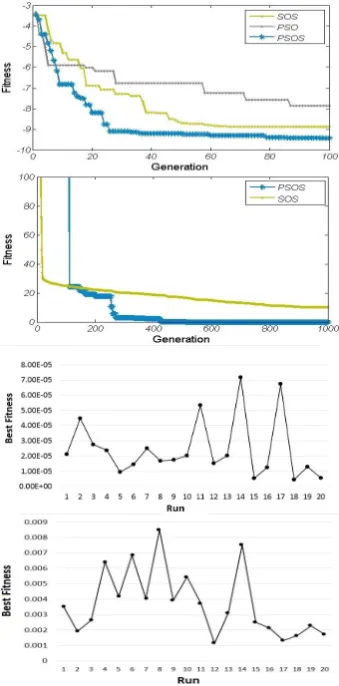
Figure 4: Convergence diagram for functions (a) F25 and (b) F18, stability diagram for functions (c) F12 and (d) F8. Stability diagram has been showed for 20 runs.
Eq. (2.5) and (2.6).
Xinew=Xi+rand(0,1)
∗(Xbest−M utual vector∗BF1) (2.5)
Xjnew=Xj+rand(0,1)
∗(Xbest−M utual vector∗BF2) (2.6)
M utual vector = Xi+Xj
2 (2.7)
The relationship characteristic between organ-isms Xi and Xj is indicated by M utal vector in
Eq. (2.7). BF1 and BF2 in Eq. (2.5) and (2.6) represent the level of benefits to each organism from the interaction being a benefit factor which is randomly chosen, either 1 or 2. Xbest is the
best solution that has ever been found.
2.2.2 Commensalism phase
Xj is selected randomly from the searching space
and interacts with organism Xi, but this time,
only Xi benefits from this relationship and will
be updated, and nothing happens to the organ-ismXj. Update equation for this phase has been
showed in Eq. (2.8) .
Xinew=Xi+rand(−1,1)∗(Xbest−Xj) (2.8)
2.2.3 Parasitism phase
In this relationship, only the organism which ben-efits from the relation, will be updated, and the other will be killed or harmed and will need to be replaced with the other. Organism Xj is
se-lected randomly and serves as a victim for the parasite vector. Parasite vector is created in the search space by duplicating Xi, then modifying
the randomly selected dimension using random numbers. If the parasite vector is more adopted than the selectedXj, then it killsXj and takes its
place; otherwise, Xj will have inviolability from
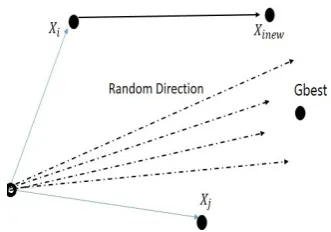
the parasite and can live longer than that. The exploitation and exploration are two main abil-ities for finding a solution in the metaheuristic algorithms. Our proposed algorithm is aimed to balance the exploitation and exploration by com-bining the SOS and PSO algorithms. Generally, the SOS algorithm doesn’t have learning strate-gies and swarms intelligence which could be pro-vided by the PSO. In the SOS, personal expe-riences don’t have any effect on the process of finding a solution and each organism is under the effect of symbiotic interactions by using Gbest. The PSO tries to move the population to the best by using the swarm intelligence and personal ex-periences. Proposed hybrid algorithm PSOS has been created By using the swarm intelligence of the PSO and combining the components of these two algorithms. Flowchart of this algorithm is presented in Fig. 1. In this hybrid algorithm, neighbors of every possible solution is checked by the PSO update equation, and personal experi-ences (Pbest) have also effects on finding a so-lution. For a better performance of the PSOS, the commensalism phase update equation is also changed by using a R which is a random integer number between 1 and D (dimension). The al-teration in the commensalism leads into checking the neighbors greatly than before.
searching the initial population (pop) and ini-tial size (n). Each possible solution is consisted of 5 variables: velocity, position, cost, best per-sonal experience Pbest (which itself consists of two fields position and cost). After initializing, the main iteration of algorithm starts with the PSO. In this phase, each element of the popu-lation is checked by the PSO for finding better experiences. If the movement causes a greater position for the organism, updating best experi-ence (Pbest) is applied for it, otherwise nothing changes. If the personal best experience (Pbest) for organisms is better than Gbest, then Gbest is also updated. Since the personal best experiences have been gained for each organism and best so-lution (Gbest) has been chosen from them, Gbest is used for having a better symbiotic interaction (Mutualism, Commensalism, Parasitism). In the SOS phase, a process is performed being the same as the original SOS, but this time only uses a dif-ferent equation in commensalism phase of this al-gorithm. The process in this phase is like this, if the specific interaction led into a greater place, the organism position (Xi) and personal best
ex-perience (Pbest) are updated by the SOS inter-action phases, otherwise nothing changes. Fig. 3
demonstrates the schematic view of the PSOS. The iteration best is Gbest and the algorithm stops if the ending conditions are acceptable, oth-erwise, the next iteration starts generating solu-tions and passing the another generation.
2.3 Modified Commensalism Phase
The variation in commensalism performed by R, which is a random dimension from{1,2,...,D}, has been showed in Eq. (9). For example in problem with 5 dimensional variables, Random dimension could be R = 1,2,3,4 or 5. Choosing random dimension causes movement toward the best in different directions and seek the neighbor areas greatly than previous mode of commensalism up-date equation Fig. 2. The advantage of this al-teration is a faster convergence and avoidance of trapping in local solutions.
Xinew=Xi+rand(−1,1)∗(Gbest(R)−Xj)
(2.9)
For further explanation of How random di-mension (R) working in commensalism equation, Following numerical example has been proposed. Suppose that:
Xi=[0.4 0.2 0.3 0.7], Xj =[0.3 0.3 0.2 0.4], Xbest=[0.2 0.3 0.5 0.6].
rand(-1,1)=0.3
Select R from {1,2,3,4} randomly. For example R=4 then Xbest(R)= 0.6
Xinew calculated as follow:
Xinew= [0.4 0.2 0.3 0.7]
+ 0.3∗(0.6−[0.3 0.3 0.2 0.4]) =
[0.4 0.2 0.3 0.7] + 0.3∗[0.3 0.3 0.4 0.2] =
[0.4 0.2 0.3 0.7] + [0.09 0.09 0.12 0.06] =
[0.49 0.29 0.42 0.76]
2.4 Parameter adjustments and boundary control
To get a better result in solving various prob-lems it is needed to adjust the parameters of the algorithms properly and control the bound-ary when the algorithm finds a new solution [27]. The PSOS needs boundary control for a probable solution Xi because it needs a solution to be in
the searching space, which is a boundary between [Lb Ub] ( Lb is the lower bound and Ub is the upper bound of the searching space). There are many different methods for the boundary control, in this article, it is specified in Eq. (10).
a=M aximum(X, Lb), b=M inimum(a, U b) (2.10)
Where Minimum and Maximum are the functions that select minimum and maximum among the input pairs, X is the input and b is the output which have been controlled in the boundary range [Lb U b]. The PSOS parameters are n (popula-tion size), w (inertia weight), c1 (cognitive/local weight), c2 (social/global weight) which need to be adjusted properly for solving benchmark func-tions.
3
Benchmark test functions
PSOS algorithm:
1:Input: objective function f, constraints and the dimensions of the problem (D) 2:\\Initialization
3: Initial parameters n (population size), w, c1, c2 4: Let population be the set of organism 1, 2, . . . , n 5:foreach of organismdo
6: Assign random real number between (varmin , varmax) to the organism position 7: Calculate fitness (cost) for assigned position and set velocity=0
9: Set calculated position and cost as best experience (Pbest) position and cost too. 10:end for
11:while(the stopping criterion is not met)do 12: foreach of Organism i (Xi)do
13: Calculate Xinewfor Xi with PSO update operator Eq. (2.3)& (2.4)
14: if Xinew fitter than Xiexperience (Pbest)then
15: Update Xi experience (Pbest) with Xinew
16: if Xiexperience better than Gbestthen
17: Update Gbest with Xiexperience (Pbest)
18: end if 19: end if 20: end for
21: foreach of Organism j (Xj)do
22: \\Apply Mutualism to Xr and Xj
23: Select one organism randomly, Xr, where Xr̸=Xj
24: Determine mutual relationship vector (Mutual Vector) by Eq. (2.7) 25: Calculate Xjnew and Xrnewby Eq. (2.5) and (2.6)
26: if Xjnew fitter than Xjthen
27: Update Xj experience and position with Xjnew
28: end if
29: if Xrnew fitter than Xr then
30: Update Xr experience and position with Xrnew
31: end if
32: \\Apply Commensalism to Xj
33: Select one organism randomly, Xr, where Xr̸=Xj
34: Calculate Xjnew by Eq. (2.9)
35: if Xjnew fitter than Xjthen
36: Update Xj experience and position with Xjnew
37: end if
38: \\Apply Parasitism to Xr
39: Select one organism randomly, Xr, where Xr̸=Xj
40: Create a Parasite (Parasite Vector) from Organism Xj
41: if Parasite Vector fitter than Xr then
42: Update Xr experience and position with Parasite Vector
43: end if 44: end for
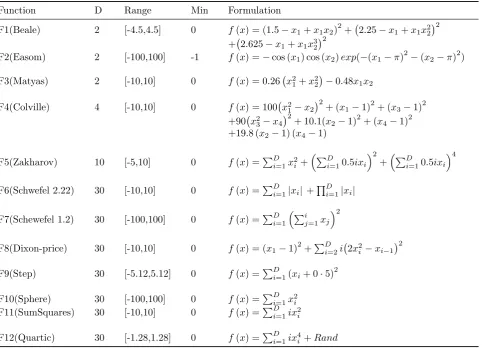
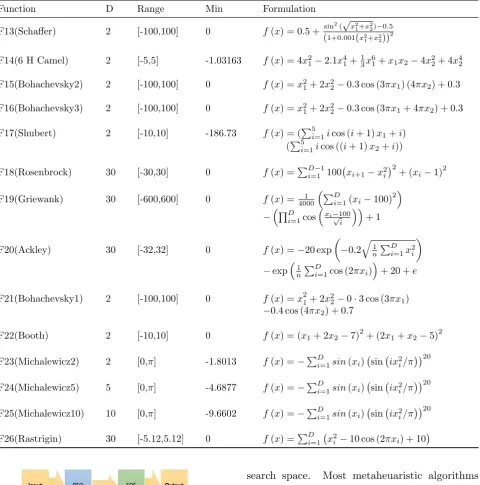
various dimensions such as 2, 4, 10 and 30. Ta-bles 1 and 2 present the unimodal and multi-modal benchmark functions. The PSOS has been tested by these functions and tries to find mini-mum solution for them. the obtained result was compared with other famous algorithms GA [28], DE [29], PSO, BA [30], PBA [31] and SOS and comparsion result has been presented in Tables3
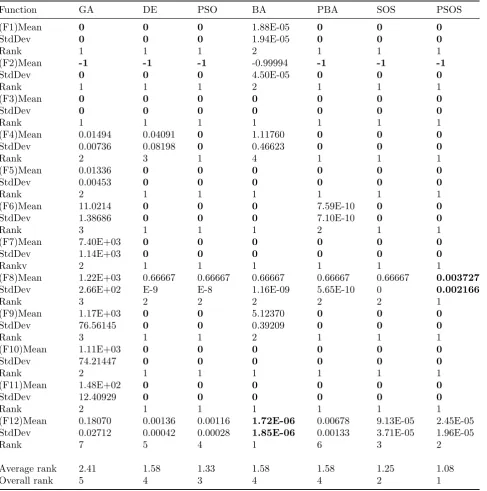
and 4. All conditions of the experiments by al-gorithms are the same and previously mentioned by Cheng and Lien who have used the popula-tion size of n=50. Parameters for the PSOS was set to the c1 and c2 =2 and w=1. The following testing setup is applied in this scheme: CPU 2.1 GHZ, Ram 8 GB and Matlab 2013 running on computer with windows 8. Stopping criteria was set to reach number of function evaluation NFE= 500,000 and the results minimum than 1E-12, re-ported as 0 like the other algorithms. Table 3
and 4 show the results for this experiment and It could be concluded from these tables that the PSOS can solve all the problems except Quartic (F12) and Dixon-price (F8) which have not been solved with others ,either. In these tables, if the algorithm could solves the specific function, rank 1 can be given, otherwise rank is 0. At the end of each table the average and overall for these ranks show that the PSOS has superiority in solving benchmark functions than the others. The Mean value and StdDev (standard deviation) have been calculated from 30 independent runs. For further examining of the PSOS algorithm, convergence and stability diagrams have been proposed in Fig.
4. Convergence curves in Fig. 4(a) and (b) show that the proposed hybrid method could reach the best solution faster with a minimum number of the generations. It could solve functions F25 and F18 in minimum generation than the PSO and SOS. For further evaluation, stability diagrams presented in Fig. 4(c) and (d) for 20 continu-ous runs of functions F12 and F8. Points in this diagram presents the best solution on a specific run. It can be concluded from the stability dia-grams that the PSOS solutions are concentrated in a specific boundary for the noisy function like the Quartic function (F12).
4
Conclusion & Future Works
The SOS is a recently proposed nature in-spired metaheuristic algorithm, which has shown
good performance in various optimizing numeri-cal problems. One of the practinumeri-cal metaheuristic algorithms which has been used most widely in the optimization is the PSO. However, the orig-inal PSO has some deficiencies in facing multi-modal functions which cause trapping in the lo-cal solutions and converging to them quickly. In this paper, we have combined the SOS and PSO algorithms to produce a new hybrid algorithm for finding the global minimum. Also the PSOS ap-plies a minimum number of the parameters which have simplified it. In the proposed algorithm, some parts of the SOS algorithm is modified to prevent trapping in the local solutions and to in-crease the success rate. Moreover, changes ap-plied in the SOS Commensalism operator, have led into solving most benchmark problems with a better performance than the PSO and SOS al-gorithms. The proposed hybrid algorithm begins to search from the PSO algorithm and gain expe-riences for the SOS. The SOS algorithm uses the best experience which has been gained from the PSO and tries to find better positions. We have concluded from the experiments that the PSOS is more dominant in the optimization of the pro-posed functions than the other mentioned algo-rithms and it could score the best rank for solving benchmark problems and reach the global mini-mum in a limited number of function evaluations. Our future work would consist of using the pro-posed hybrid method for optimizing the con-strained benchmark problems and engineering de-sign problems. Also, the future researches can include a comparison of our hybrid method with the recently proposed algorithms in solving the economic dispatch problem.
References
[1] C. Grosan, A. Abraham, Intelligent systems a modern approach,Intelligent Systems Ref-erence Library, Springer Berlin Heidelberg 7 (2011) 2-11.
[2] X-S. Yang, Introduction to Mathematical Optimization: From Linear Programming to Metaheuristics, Cambridge International Science Publishing (2008).
In: Handbook of Metaheuristics, Springer, US 6 (2010) 61-86.
[4] V. K. Patel, V. J. Savsani, Heat transfer search (hts): a novel optimization algorithm,
Information Sciences 324 (2015) 217-246.
[5] X. B. Meng, X. Gao, Y. Liu, H. Zhang, A novel bat algorithm with habitat selection and doppler effect in echoes for optimization,
Expert Systems with Applications 42 (2015) 6350-6364.
[6] B. Do˘gan, T. ¨Olmez, A new metaheuristic for numerical function optimization: Vortex search algorithm, Information Sciences 293 (2015) 125-145.
[7] A. Sadollah, A. Bahreininejad, H. Eskan-dar, M. Hamdi, Mine blast algorithm for optimization of truss structures with dis-crete variables,Computers & Structures 103 (2012) 49-63.
[8] H. Eskandar, A. Sadollah, A. Bahreinine-jad, M. Hamdi, Water cycle algorithm a novel metaheuristic optimization method for solving constrained engineering optimiza-tion problems, Computers & Structures 111 (2012) 151-166.
[9] H. Salimi, Stochastic fractal search: A pow-erful metaheuristic algorithm, Knowledge-Based Systems 75 (2015) 1-18.
[10] M. Y. Cheng, D. Prayogo, Symbiotic organ-isms search: A new metaheuristic optimiza-tion algorithm,Computers & Structures 139 (2014) 98-112.
[11] X. S. Yang, Nature-Inspired Metaheuristic Algorithms: Second Edition, Luniver Press
(2010).
[12] J. Kennedy, R. Eberhart, Particle swarm op-timization. In: Proceedings of the IEEE in-ternational conference on neural networks. Perth,Australia 11 (1995) 1942-1948.
[13] T. KAY CHEN , Advances in Swarm Intel-ligence, First International Conference, ICSI 2010, Beijing, China, June 12-15, 2010, Pro-ceedings, Part I,Springer-Verlag Berlin Hei-delberg, 6145 (2010).
[14] Y. Shi, R.C. Eberhart, A modified parti-cle swarm optimizer, In: Proceedings of the IEEE Congress on Evolutionary Computa-tion 7 (1998) 69-73.
[15] J. J. Liang, P. N. Suganthan, Dynamic multi-swarm particle swarm optimizer, In: Proceedings of Swarm Intelligence Sympo-sium 7 (2005) 124-129.
[16] Z. Zhan, J. Zhang, Y. Li, H. S. Chung, Adaptive particle swarm optimization,IEEE Trans. Syst. Man Cybern, Part B 39 (2009) 1362-1381.
[17] R. Mendes, J. Kennedy, J. Neves, The fully informed particle swarm: simpler, maybe better, IEEE Trans. Evol. Comput.
83 (2004) 204-210.
[18] J. J. Liang, A. k. Qin, P. N. Suganthan, S. Baskar, Comprehensive learning particle swarm optimizer for global optimization of multimodal functions, IEEE Trans. Evol. Comput.103 (2006) 281-295.
[19] T. T. Nguyen, Z. Li, S. Zhang, T. K. Truong, A hybrid algorithm based on particle swarm and chemical reaction optimization, Expert Systems with Applications 41 (2014) 2134-2143.
[20] L. Idoumghar, N. Chrin, P. Siarry, R. Roche, A. Miraoui, Hybrid ICA-PSO algorithm for continuous optimization,Applied Mathemat-ics and Computation, 219 (2013) 11149-11170.
[21] A. Ghodrati, S. Lotfi, A hybrid cs/pso algo-rithm for global optimization, In: J. S. Pan, S. M. Chen, N. Nguyen (Eds.), Intelligent Information and Database Systems, Lecture Notes in Computer Science, Springer Berlin Heidelberg 17 (2012) 89-98.
[22] E. Atashpaz-Gargari, C. Lucas, Imperialist Competitive Algorithm: An algorithm for optimization inspired by imperialistic com-petition, IEEE Congress on Evolutionary Computation 7 (2007) 4661-4666.
[23] A. Y. Lam, V. O. Li, Chemical reaction op-timization: A tutorial, Memetic Computing
[24] X. S. Yang; S. Deb, Cuckoo search via Lvy flights. World Congress on Nature & Bio-logically Inspired Computing (NaBIC 2009),
IEEE Publications 8 (2009) 210-214.
[25] S. Boyd, L. Vandenberghe, Convex Op-timization, Cambridge University Press, 8 (2004) 129-140.
[26] L. J. Eshelman, D. J. Shaffer, Real-coded ge-netic algorithms and intervalschemata In D. L.Whitley (ed.),Foundations of Genetic Al-gorithms 2. San Mateo, CA: Morgan Kauf-man (1993) 187-202.
[27] W. Chu, X. Gao, S. Sorooshian, Handling boundary constraints for particle swarm op-timization in high-dimensional search space,
Information Sciences 181 (2011) 4569-4581.
[28] D. E. Goldberg, Genetic Algorithms in Search, Optimization and Machine Learning, 1st Edition, Addison-Wesley Longman Pub-lishing Co., Inc., Boston, MA, USA (1989).
[29] R. Storn, K. Price, Differential evolution a simple and efficient heuristic for global opti-mization over continuous spaces, Journal of Global Optimization 11 (1997) 341-359.
[30] D. Pham, A. Ghanbarzadeh, E. Ko, S. Otri, S. Rahim, M. Zaidi, The bees algorithm a novel tool for complex optimisation prob-lems, in: D. Pham, E. Eldukhri, A. Soroka (Eds.),Intelligent Production Machines and Systems, Elsevier Science Ltd, Oxford. 5 (2006) 454-459.
[31] M. Cheng, L. Lien, Hybrid artificial intelli-gencebased pba for benchmark functions and facility layout design optimization, Journal of Computing in Civil Engineering 26 (2012) 612-624.
Ahmad Jafarian was born in 1978 in Tehran, Iran. He received B. Sc (1997) in Applied mathematics and M.Sc. in applied mathemat-ics from Islamic Azad University Lahi-jan Branh to Lahijan, Fer-dowsi University of Mashhad re-spectively. He is a Assistant Prof. in the depart-ment of mathematics at Islamic Azad University,
Urmia Branch, roumieh, in Iran. His current in-terest is in artificial intelligence, solving nonlinear problem and fuzzy mathematics.
Behnam Farnad was born in 1990
in Urmia, Iran. He Studied