Research Article
Effectiveness of Safety Training on
Knowledge and Practice of Operating
Room Personnel Regarding Fire Prevention
© 2017 Davoudian Talab et al; licensee Iran University of Medical Sciences. This is an open access article distributed
un-Background and Objectives
Death and damage to property by fire is always stressful. Hospital fire is associated with worrying repeat, and potentially with catastrophic consequences around the world. Hospital fires usually are derived from 3 sources: (1) flammable liquids such as liquids containing alcohol (Prep solution) and volatile chemicals such as ether and acetone used in the operating room. In the presence of oxygen and nitrogen dioxide the materials are a good source of fire; (2) small spark or heat from equipment that work in the area of use of oxygen to patients; and (3) combinations of oxygen gas pipelines, storage tanks
*Corresponding Author: Gholamreza Azari, Department of Basic Scienc-es, University of Social Welfare and Rehabilitation sciencScienc-es, Tehran, Iran. Tel: +989177441365, Email: [email protected]
Amir Hossein Davoudian Talab
1, Gholamreza Azari
2*, Gholamreza Badfar
3,
Hoda Kiani
4, Somayeh Parvin
41 Department of Occupational Health, Behbahan Faculty of Medical Sciences, Behbahan, Iran. 2 Department of Basic Sciences, University of Social
Welfare and Rehabilitation Sciences, Tehran, Iran. 3 Department of nursing, Behbahan Faculty of Medical Sciences, Behbahan, Iran. 4 Behbahan Faculty of Medical Sciences, Behbahan, Iran.
Background and Objectives: Fire is an inherent and permanent risk in the health settings and the prevention of it in the operating room require the knowledge of risks and effective communication among the staffs. Thus the purpose of this study was to explore the knowledge and the practice of the operating room staff about fire prevention and the relevant effectiveness of safety training.
Methods: This quasi-experimental intervention was carried out by involving 64 staff in the operating room from 5 hospitals in Khuzestan province (southwest of Iran). Sampling was done randomly for the case and the control groups. After matching the samples based on age, work experience, and previous training, the case group was trained on fire management, and compared with the control group. The collected data were analyzed by paired and independent t tests.
Findings: The mean of the awareness and performance in the case group before the intervention were found to be 2.6 and 3.93, respectively and after the intervention, 3.1 and 3.9, respectively. This difference was statistically significant for awareness (P < 0.05) but insignificant for the practice (P > 0.05). While there was no significant difference in the knowledge of the case and control groups before the intervention (P > 0.05), after the intervention, a significant difference appeared (P < 0.05). The performance of the study groups showed no significant difference before and after the intervention (P > 0.05).
Conclusions: Our results show that safety training has potentially positive impact on knowledge and practice of operating room personnel, regarding fire management.
Keywords: Safety training, Awareness, practice, Fire prevention, Operating room personnel
Abstract
of liquid oxygen and cylinders containing pure oxygen.1
According to the ECRI report, from 550 to 650 fires occur annually, of which 100 to 200 fires are related to the surgery fires.2 Thus, many small fires happen in the
operating room and it is estimated that about 20 to 30 fires that occur in the operating room of America hospitals, or disabling event and one to two events have resulted in death.3
ECRI also states that the majority of the places of fire is in the head and face and most fire sources are electrosurgical and laser equipment respectively 68% and 13%.4 However, nowadays fire safety in the operating
room is not a topic of high priority, and its cause is the lack of sufficient information in this regard. Some of the most common misconceptions in this field include (1) fire in the operating room in the hospital does not happen today; (2)
IJHR
Open Access
Abstract
Background and Objectives: Endometrial hyperplasia (EH) is an abnormal overgrowth of endometrium that may lead to endometrial cancer, especially when accompanied by atypia. The treatment of EH is challenging, and previous studies report conflicting results. Metformin (dimethyl biguanide) is an anti-diabetic and insulin sensitizer agent, which is supposed to have antiproliferative and anticancer effects and the potential to decrease cell growth in endometrium. While some studies have evaluated the anticancer effect of metformin, studies on its potential effect on endometrial hyperplasia are rare. To address this gap, in this comparative trial study, we evaluate the effect of additive metformin to progesterone in patients with EH.
Methods: In this clinical trial, 64 women with EH were randomized in two groups. The progesterone-alone group received progesterone 20 mg daily (14 days/month, from the 14th menstrual day) based on the type of hyperplasia, and the progesterone-metformin group received metformin 1000 mg/day for 3 months in addition to progesterone. Duration of bleeding, hyperplasia, body mass index (BMI), and blood sugar (BS) of the patients were then com-pared between the two groups.
Findings: NA mean age of 44.5 years, mean BMI of 29 kg/m2 and mean duration of bleeding of 8 days were calcu -lated for the study sample. There was no significant difference in age, BMI, gravidity, bleeding duration, and duration of disease at baseline between the two groups. While all patients in the progesterone-metformin group showed bleeding and hyperplasia improvement, only 69% of the progesterone-alone patients showed such an improvement, with the difference between the two groups being significant (P = 0.001). Although the difference between two groups in the post treatment endometrial thickness was not significant (P = 0.55), post treatment BMI in the progesterone-metformin group was significantly lower than in the progesterone-alone group (P = 0.01). In addition, the BS reduction in the progesterone-metformin group was significantly larger than that in the progesterone-alone group (P = 0.001). Conclusions: Our results indicated that administration of progesterone 20 mg/day plus metformin 1000 mg/day can significantly decrease bleeding duration, hyperplasia, BMI and BS in women with EH.
Keywords: Endometrial hyperplasia, Metformin, Progesterone
Background and Objectives
Endometrial hyperplasia (EH) is an abnormal over
-growth of endometrium that may lead to endometrial cancer, especially when accompanied by atypia [1].
Although the effect appears only in 5% of asymptom-atic patients, its prevalence in patients with PCOS
and oligomenorrhea is about 20% [2]. Body mass index (BMI) and nulliparity are two main risk factors for EH. Other risk factors include chronic
anovula-tion, early menarche, late onset of menopause and
diabetes [3], which are related to increased
circulat-ing estrogen [4]. The treatment of EH is challengcirculat-ing and previous studies report conflicting results [5]. Age, fertility, and severity of EH in histology are the most important factors determining the treatment op -tion [5]. Most studies have addressed hysterectomy
in patients with atypical EH [5], particularly those
with PCOS, and have led to conflicting results [5-11].
Evaluation of the Effect of Additive
Metformin to Progesterone on Patients
with Endometrial Hyperplasia
Afsaneh Tehranian 1, Nasim Zarifi 1*, Akram Sayfolahi 2, Sara Payami 2, Faezeh Aghajani 2
1 Department of Gynecology and Obstetrics, Arash Women's Hospital, Tehran University of Medical Sciences, Tehran, Iran 2 School of Medicine, Tehran
University of Medical Sciences, Tehran, Iran
*Corresponding author: Afsaneh Tehranian, Department of Gynecology and Ob-stetrics, Arash Women's Hospital, Tehran University of Medical Sciences, Tehran, Iran, P.O.Box: 1653915981, Tel: +98 21 77719922, Fax: +98 21 2177883196, E-mail: [email protected]
RESEARCH ARTICLE
Cre-if fire happen, it can be preventable; (3) fire occurs only in inferior equipment; and (4) all operating room staffs know how to do when the fire happens.5 However, studies show
that fire in the operating room is inherent6 and permanent
risk and unfortunately operating room staff’s sensitive to this risk has dropped over the past 25 years.7 But
the important point in relation to the fire is that the fire is completely preventable.8
Fire prevention in the operating room necessitates the staff’s awareness of the risks, and effective communication between staffs of the surgery, anesthesia, and nursing in the operating room. To understand fire prevention, at first we must know how it happens. Fire may happen at any time when the three sides of the fire (combustible, oxidized and heat materials) will put together.9 Since
surgery processes and the existing instruments have these three are side, staffs must be trained in the field of and compounds related to fire triangle in the operating room and be involved also in the maneuvers related to fire prevention in the operating room.2 According to the
Sentinel Event Alert statement on June 2003, all the staffs related to the care of the patient must be trained in the field of fire safety and fire prevention. Therefore, the present study was conducted to determine the effect of safety training on awareness and performance of fire prevention.
Methods
This quasi-experimental intervention study was conducted on 64 staffs working in operating rooms in 5 teaching hospitals in the Khuzestan province. The subjects were selected by simple random sampling and divided into 2 groups: case and control. After the samples were matched for gender, age, work experience and previous training level, the staffs in the case group were trained indirectly in the fire field. Then, in order to evaluate the effectiveness of training, they were compared with the control group.
Teaching Methods
After determining the level of awareness of fire prevention, intervention training was conducted through posters to raise awareness and performance. Since the hospital staff workload is high, so there is not opportunity for cooperation in face to face education and lecture in a hospital environment. For this same reason, education was done for operating room staffs indirectly using a poster. For this purpose, an appropriate poster of fire prevention was designed and attached in the place of traffic and rest of operating room staff due to the accumulation of these employees. After attaching the posters, within 20 days the employee’s awareness and performance of the fire prevention was measured and compared with
pre-intervention levels. The tools used in this study included demographic questionnaires and questionnaires of fire prevention and educational posters.
Fire Prevention Questionnaire: The questionnaire included 11 questions with four choices that measured the level of knowledge (the first factor consists of 5 questions) and performance (the latter includes 6 questions) of operating room staffs about ways to prevent fires in the operating room. The questionnaire was designed based on the Likert scale (1 = full knowledge, 2 = moderate awareness, 3 = poor awareness and 4 = without awareness) and the points of 1, 2, and 4 and zero were considered for the four options. The second factor was the performance that was 4 choices, and scoring methods were the opposite. So that the scores of zero, 1, 2 and 4 were considered for the four options and on this basis, they were divided into four options: high-performance, moderate high-performance, weak performance and non-performance. The second questionnaire included demographic characteristics of participants (age, gender, work experience, qualifications, previous training in the field of fire prevention and the need for training).
The tool used in the study was of acceptable validity and reliability. Validity and reliability of fire prevention questionnaire were examined and approved in Davudian Talab and colleagues’ study at hospitals affiliated to Shiraz University of Medical Sciences.10
Fire education poster: this poster consists of essential factors and important information in relation to the prevention and control measures in the field of fire. The poster was designed in A3 size based on the faculty’s comment of the operating room department and Occupational Health of Medicine Sciences School and was attached to the resting and traffic places according to the analysis of the working environment for the operating room staffs. The number of posters for each hospital was considered according to the size and space of operating room and a survey of employees in these wards. In this study, at first, the research objectives and how to respond to questions about the necessary explanations were given to the participants, and then the questionnaire was available to them. Due to the workload and the time limit of the participants, completed questionnaires were collected the next day and the posters were attached. Twenty days after attaching the posters, the questionnaires were completed by participants again. The data analysis was performed using SPSS version 16.
Results
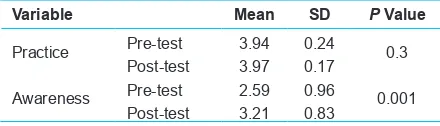
province. Of these, 34 people were selected as cases and 31 people as controls. The average age of the control group was 32 ± 5.3 years and the average age of case group was 32 ± 7.4 years, which there was not a statistically significant difference between age of people in the case and control groups (P = 0.9). In addition, the experience of the participants in this study for the case and control groups, was respectively 1.1 ± 7.6 years and 8.5 ± 5.8 years, which there were statistically not significantly different between cases and controls (P = 0.3). However, there were significant differences between the groups in education degree (P = 0.04). Table 1 shows demographic data, including mean age, work experience, gender and education degree. Also, this table shows the differences between the case and control groups in the demographic variables. Table 2 shows the amount of knowledge and performance before and after intervention that both variables of knowledge and performance after intervention show more values. The results of the study also showed that there is no significant difference in the average score of awareness between the case and control groups before the intervention (P = 0.7); but after the intervention, this difference was (P = 0.003).
Furthermore, there was not a statistically significant difference in mean performance score before the intervention between the case and control groups (P = 0.9). After the intervention, the difference was not significant, as well (P
= 0.6); Table 3 shows its values. Table 4 shows the effect of safety training in case group performed with the paired t test.
Discussion
Since the fire in the hospital is a special status because different from other modes of fire, when fire the patients cannot save themselves,11 and surgical services is
one of the most basic health care services in hospital and %70 of these fires is related to the electro surgical equipment.12 So, first, this study investigated the level
of knowledge and performance of the staffs in relation to fire prevention, which its results showed that the awareness of fire prevention is in moderate and low, but the performance level is high. The results of knowledge level, compared with another study of the operating room staffs, conducted by Davudian Talab et al in 2012 at Shiraz University of Medical Sciences and 2014 in Behbehan showed higher levels.10,13 And consistent
with other studies in Iran, they have expressed that awareness of the fire in the operating room is at the moderate level.14,15 Among other related studies, we
can point out to Habibi and colleagues’ study at the hospitals of Isfahan University of Medical Sciences. In this study, none of the hospitals surveyed did not have a decent safety status.16 In terms of average the results
Table 1. Demographic Characteristics of the Sample and Determining Differences Between Groups
Variable Group Frequency Percent Mean SD P Value
Age Case - - 32 7.4 0.9
Control - - 32 5.3
Experience Case - - 10.1 7.6 0.9
Control - - 8.5 5.8
Sex
Case Men 10 29.4 -
-0.3
Women 24 70.4 -
-Control Men 9 29 -
-Women 22 71 -
-Education
Case Associate 17 50 -
-0.04
Bachelor 17 50 -
-Control Associate 22 71 -
-Bachelor 9 28 -
-Table 2. Level of Awareness and Practice of Fire Prevention, Pre- and Post-intervention
Variable Time Level
High Moderate Low Very Low
Awareness Pre-test 21.6 21.6 51.4 5.4
Post-test 43.8 37.5 15.6 3.1
Practice Pre-test 94.1 5.9 -
-of this study showed that 45% -of the hospitals are at the moderate level of safety and 55% of the hospitals are at the poor level of safety. By studying the hospitals affiliated to Gilan University of Medical Sciences, Safavi et al highlighted that there is the greatest amount of deviation from the standards of safety at the stage of preparation of the operating room. Due to the impact on the physical structure and expendable and non-expendable equipment, this stage plays a significant role in the safety of the operating room.17
According to the results obtained in this study and previous studies, we can conclude that the awareness level of fire prevention is low and safety in the operating room is not satisfying. According to Podnos and Williams study, as a result of the increasing awareness of the factors creating combustion, safety factor in staffs and patients as well as the usefulness and effectiveness of the operation room staffs increased.18 According to
Bruley and colleagues’ study, prevention of combustion in an operating room necessitated the awareness of the risks and established effective communication between employees including Department of Surgery, Department of Anesthesiology and Nursing.7 Daane
and Toth also suggested that increased awareness of operating room staffs increased the safety factor of staffs and patients.19
Andersen stated that a tutorial on combustion sources was the main thing to recognize potential hazards in the operating room.20 Shahbazi et al suggested that in
addition to standardizing the operating room, training the operating room staffs regarding the 3 main combustion
factors, understanding the causes of combustion and its control was effective in fire prevention.15
Therefore, in this study the necessary training in the field of fire training in the form of posters was provided to staffs. The results showed that training in fire prevention was effective and awareness level has shown training higher values than before. This result is consistent with the study conducted by Salehi et al.21 But in relation to the performance of operating
room staffs on fire prevention, education did not have a great impact on increase of performance. Therfore, it would be caused by the high level of performance of employees before offering the training. Approximately 94% of the staffs, prior to be trained, had a high performance; however, after training, this performance increased to 97%, but this difference was not statistically significant.
Conclusions
Consistent with previous studies, our results confirmed that training is effective in improving awareness and practice of the operating room staffs. Therefore, constant education using up-to-date training methods may reduce the fire incident in operating room and promote patient and staff safety.
Competing Interests
The authors declare no competing interest.
Authors’ Contributions
The authors made the same contritions to this study.
Acknowledgements
We would like to sincerely thank the staff and management of the Behbahan Faculty of Medical Sciences for their cooperation and financial assistance in the course of this study and the vital information they provided.
References
1. Chowdhury K. Fires in Indian hospitals: root cause analysis and recommendations for their prevention. J Clin Anesth. Table 3. Comparison Awareness and Practice to Fire Prevention Between Case and Control Group
Variable Group Mean SD P Value
Awareness
Pre test Case 2.95 0.89 0.7
Control 2.66 0.77
Post test Case 3.21 0.83 0.003
Control 2.61 0.81
Practice
Pre test Case 3.94 0.23 0.9
Control 3.94 0.22
Post test Case 3.97 0.16 0.6
Control 3.94 0.32
Table 4. Effect of Safety Training on Awareness and Practice to Fire Prevention
Variable Mean SD P Value
Practice Pre-test 3.94 0.24 0.3 Post-test 3.97 0.17
2014;26(5):414-424. doi:10.1016/j.jclinane.2013.12.014. 2. Flowers J. Fire Safety in Procedural Areas. J Radiol
Nurs.31(1):13-19. doi:10.1016/j.jradnu.2011.10.007. 3. Yardley IE, Donaldson LJ. Surgical fires, a clear and
present danger. Surgeon. 2010;8(2):87-92. doi:10.1016/j. surge.2010.01.005.
4. Beyea SC. Preventing fires in the OR. AORN J. 2003;78(4):664.
5. Hart SR, Yajnik A, Ashford J, Springer R, Harvey S. Operating room fire safety. Ochsner J. 2011;11(1):37-42. 6. Watson DS. New recommendations for prevention of
surgical fires. AORN J. 2010;91(4):463-469. doi:10.1016/j. aorn.2009.12.023
7. Bruley ME. Surgical fires: perioperative communication is essential to prevent this rare but devastating complication. Qual Saf Health Care. 2004;13(6):467-471. doi:10.1136/ qhc.13.6.467.
8. Goldberg JL, Feldman DL. Implementing AORN recommended practices for prevention of retained surgical items. AORN J. 2012;95(2):205-216. doi:10.1016/j. aorn.2011.11.010.
9. Smith LP, Roy S. Operating room fires in otolaryngology: risk factors and prevention. Am J Otolaryngol. 2011;32(2):109-114. doi:10.1016/j.amjoto.2009.11.004.
10. Davoudian Talab AH, Akbari F, Bazdar SH, Kiani H, Yaghoubi SH, Yousefi F. Assessment of awareness and practice of operating room personnel to fire prevention and effective factors. Iran Occup Health J. 2016;13(4):77-84. 11. Lalla RK, Koteswara CM. Fire in the operating room due
to equipment failure. J Anaesthesiol Clin Pharmacol. 2013;29(1):141. doi:10.4103/0970-9185.105836.
12. Melekie TB, Getahun GM. Compliance with Surgical Safety Checklist completion in the operating room of University of Gondar Hospital, Northwest Ethiopia. BMC Res Notes. 2015;8:361. doi:10.1186/s13104-015-1338-y.
13. Davoodian Talab A, Zadeh F, Moshkani M, Ahmad S, Afshin A, Mofidi A. Evaluation of awareness concerning fire prevention and control methods among personnel of
operating room in a hospital. Journal Health Safety at Work. 2012;2(2):69-78.
14. Bagheri H, Ebrahimi H, Amozade H, Najafi N, Darisavi A, Abedi S, et al. Survey of awareness of operating room staff about fire sources and its prevention methods in operating room in Shahroud. Journal of Knowledge Health. 2007;2(2):11-16.
15. Shahbazi S, Heidari M, Aliakbari F, Goddosi M. Knowledge of Operating Room Staff on Fire Resources and Fire prevention Measurements. Preventive Care in Nursing Midwifery Journal. 2012;2(1):31-35.
16. Habibi E, Soleymanei B, Nateghei R, Lotfirosbehani M, Yarmohammadian M. Risk management in radiology units of Isfahan University of Medical Sciences’ Hospitals. Health Information Management. 2008;4(1):133-141.
17. safavi M, Mahjobipor H, Mohammadzadeh M, Honarmand A. Education and Treatment Guideline for Evaluation of Applying Basic Standards of Anesthesia Care in Surgery. Iran J Med Educ. 2011;10(4):357-363.
18. Podnos YD, Williams RA. Fires in the operating room. Bull Am Coll Surg. 1997;82(8):14-17.
19. Daane SP, Toth BA. Fire in the operating room: principles and prevention. Plast Reconstr Surg. 2005;115(5):73e-75e. 20. Andersen K. Safe use of lasers in the operating room-what
perioperative nurses should know. AORN J. 2004;79(1):171-188.
21. Salehi Zahed L, Asadi M, kordmir K. The effect of risk management education on the knowledge and performance of Operating room personnel at hospitals affiliated with Islamic Azad University Tehran Medical Sciences Branch in 1392. Iran J Nurs Res. 2016;11(1):42-50.
Please cite this article as: