http: // www.gjesrm.com © Global Journal of Engineering Science and Research Management
IMPLEMENTATION OF LEAN TECHNIQUE THROUGH VOLVO PRODUCTION
SYSTEM ATTRIBUTE IN EXCAVATOR ASSEMBLY LINE
Prof Suraj J Patil*1 P Lakshmanan2 Shrusti D Shah3
*1Ast Professor, Department of Mechanical Engineering, Gogte Institute of Technology Belgaum,
Karnataka, India.
2Ast Manager, Volvo Construction Equipment, Bangalore, India.
3Department of Mechanical Engineering, Gogte Institute of Technology Belgaum, Karnataka, India.
KEYWORDS: Productivity, Time study, Line balancing, largest candidate rule method, Value stream map.
ABSTRACT
Volvo Construction Equipment, Bangalore is a worldwide known brand company that deals with the production of excavator and road machinery. The work was carried out in the excavator assembly line, where three models of excavator were assembled. The key objective of the work was to improve the productivity of the line by identifying and eliminating non-value added activities. Value stream mapping tool are used to understand current state of assembly line by understanding the bottle neck in each operations and provide future state forecast by reducing the bottle neck in the line. The solutions were implemented, validated and standardized, as line of balance which supports value stream mapping tool for analyzing ,reducing of buffer station in Excavator assembly line in Volvo construction equipment .
INTRODUCTION
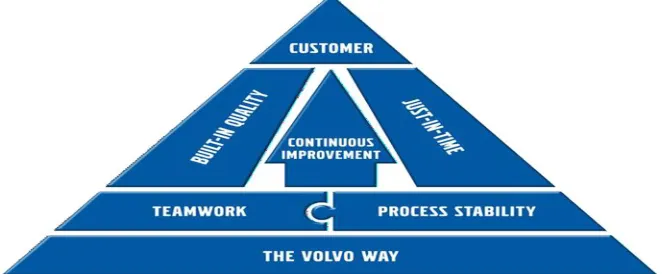
Volvo Production System [1] was first introduced in 2007 as a way to continuously improve quality, delivery and productivity. VPS is the Volvo Way in actions – how Volvo goes from words to action. It contains practical tools that when used correctly, helps the organization to work towards its shared goal. VPS has five core principles which are thought to assist and guide the organization towards its goal.
Fig 1.1 Volvo Production System
Volvo Production System Core Principles
Teamwork creates an efficient organization where all employees are involved and committed to the continuous improvement work. This way, all employee contribution to the overall goal of the organization, everyone’s experience, knowledge and creativity is captured.
Only by establishing deep knowledge and understanding a stable process can be created. This means reduced variation and waste which makes the process predictable and efficient.
Doing things right the first time is referred to as built-in quality. Conforming to a built-in quality philosophy means fixing problems as they occurs which in turn helps the organization to move towards a zero-defect production.
Just-in-time means producing and delivering what is needed, when it is needed in the quantity needed.
http: // www.gjesrm.com © Global Journal of Engineering Science and Research Management
Apply continuous improvements. It will require a long term approach but are at the same time the driving force in the organization
Modules in Volvo Production System
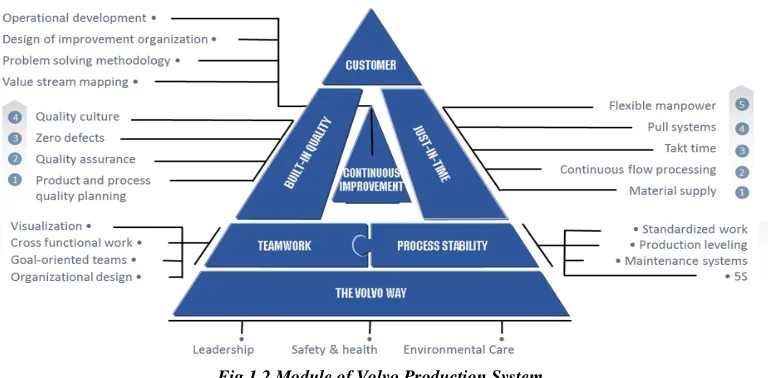
Fig 1.2 Module of Volvo Production System
Volvo Production System (VPS) [1] is a customer-driven, people-oriented unifying system that serves as the source of common principles and practices to help us reach world class performance. VPS facilitates achieving Operational Excellence and sustainable profitability by holding true to our Volvo Way values.
We in Volvo construction equipment Bangalore facility are committed to Volvo production system with strong leadership, structured approach and total employee involvement. In our journey of operation excellence we adopt continuous coaching and feedback mechanism as the way to improve our processes. We also enhance our processes by well-planned internal and Global audits.
Our focus is centered on 7+1 wastes; we measure wastes and minimize them with continuous improvement journey through QRPS .Root causes are eliminated by Kaizen’s, Pokayoke’s, OPL’S and employee training.
The Volvo Way
Leadership Purpose:
Leadership with a clear vision and ability to lead the organization in this direction.
Leaders that use coaching and feedback as the way to improve.
Leadership that deliver results and change.
Safety and Health Purpose:
Safety is a core value within the Volvo group. As with our concerns for the safety of the end users of our products, we are equally concerned about the safety and health of our employees. Safety & Health is one of the important performance indicators and a structured way of measuring and acting on problems is essential.
Environmental care is a core value for the Volvo Group and the vision is to be the leader of sustainable development in our segment and use this in public relations.
Volvo’s environmental programmes shall be characterized by a holistic view, continuous improvement, technical development and resource efficiency.
Team Work
Goal Oriented Teams - On all levels in the organization, are the foundation on working with operational as well as development goals.
Purpose:
Alignment of goals throughout the whole organization
Empower the team members to improve performance and deliver results
Give pre-requisites for the team to react and when needed.
Cross functional work- keeps standardized operations alive, increases understanding and co-operation, facilitates sharing of best practices, creates better conditions to improve the operation both for current and future production, and finally prepares the ground for flexible manpower system.
Purpose:
Develop competence and make full use of the collect knowledge in the full range of the company.
Developing the ability to cooperate to enhance learning and sharing of knowledge.
Increase flexibility and create variation in work tasks, whilst securing safety, quality and productivity.
Ensure that the standardized work is kept alive.
Organizational Design- sets the right structure for good teamwork. Purpose:
Value stream focused design of the organization, supporting shop floor needs
Alert organization, with ability to handle deviation
To ensure the organizational design is effective and efficient.
Visualization- creates awareness and transparency for everyone about status, problems and need for actions.
Just-In-Time
Flexible Manpower Purpose:
Flexible manpower is a factory-wide method for optimizing labour productivity across changing levels of customer demand by utilizing flexibility levers such as resource pool, overtime and manpower allocation.
Pull Systems Purpose:
Pull systems rely on the customer pulling the material through the production system when it is required. Each operation pulls from its supplying operation(s) using replenishment principles. The design of the pull systems can be sequential, fill-up or mixed pull.
Takt Time Purpose:
Takt time translates true customer demand into production targets. It is used to set the pace of production and alert workers whenever they are getting ahead or behind.
Continuous Flow Processing Purpose:
throughout the entire factory.
Material Supply Purpose:
To ensure that the material supply to the front line shop floor is stable and presented in a logical and efficient manner. This could involve milk runs, two bin systems or kitting.
Continuous Improvement
Operational Development: Purpose:
To understand where are the improvement opportunities and to attack the problems with the right tool.
To have an understanding of the competition and the level of performance.
To understand the gaps from the best in industry level
Design of Improvements : Purpose:
Create the right conditions and structure for an effective improvement work.
Secure that an improvement work organization that drives improvement activities is in place.
Secure that an improvement support organization is in place providing training and coaching.
Problem Solving Methodology : Purpose:
Systematic approaches to solving problems in timely manner by determining root causes and implementing corrective and preventative measures to ensure zero recurrences. To develop the problem solving capabilities of the shop floor members.
Value Stream Mapping : Purpose:
To realize the business objectives by driving the organization forward through a structured improvement approach.
To have a culture to always look for improved customer value.
Involve all personnel, encourage operator (and individual) ownership of Continuous Improvement.
Process Stability
Standardized Work : Purpose:
To ensure that the best method is used to secure safety, quality and productivity
To reduce mura (variation) between operators
To provide a foundation for efficient and effective training and flexibility
To provide a foundation for line balancing and production leveling
Production Levelling : Purpose:
Production Levelling means smoothing out the volume and mix of items produced so there is little variation in production from day to day, week to week, month to month.
Levelling out the schedule is a foundation for Just-in-Time and for minimizing inventory in the supply chain.
Production levelling is necessary to keep the system stable and to allow for minimum inventory.
Maintenance System : Purpose:
To maximize equipment reliability and availability at an economical cost
To achieve zero breakdowns and process failure losses with the cooperation of production people (AM) and quality people (QC).
5s : Purpose:
Create an efficient and safe workplace by making it organized and tidy
Teach operator respect for standards (preparation for standardized work)
To be able to visualize abnormalities quickly and easily
A foundation for good work place design and standardized work
Built-In-Quality
Quality Assurance : Purpose
To install a quality assurance system that minimizes the occurrence of poor quality
To ensure that in the event of quality issues the problems are detected as close to the source of the problem as possible and never reach the customer
To ensure that quick and robust problem solving is performed in response to defects found internally and externally
To ensure that suppliers are performing and that thorough root cause analysis is performed quickly by the supplier in response to supplier related quality issues
Zero Defects : Purpose
To work proactively to ensure defects and errors cannot occur through the use of mistake avoidance techniques (poka yoke).
To highlight abnormalities or problems as they occur and if necessary to stop the process to prevent poor quality from being passed on to the next process/station.
Quality Assurance : Purpose
To install a quality assurance system that minimizes the occurrence of poor quality
To ensure that in the event of quality issues the problems are detected as close to the source of the problem as possible and never reach the customer
To ensure that quick and robust problem solving is performed in response to defects found internally and externally
To ensure that suppliers are performing and that thorough root cause analysis is performed quickly by the supplier in response to supplier related quality issues
Product and process quality planning: Purpose:
Product and Process Quality Planning
The goal is to establish a system for handling manufacturing related projects using standard way of working with project gates, project targets, visual planning and resource planning based on the project member’s competence.
Customer and manufacturing experiences are considered in early phases in the projects and pro-active risk analysis is used extensively.
Products & process in the complete supply chain are validated to ensure targeted quality.
An outstanding PPQP can show positive effects in project target fulfilment, no disturbances at new product and process launches and improved SQDC levels.
PROBLEM IDENTIFICATON
At present, Volvo construction equipment has: 1) 8 main stations and 13 feeders in the line.
3) Ergonomically designed with respect to the workers safety and comfort.
4) Testing drive inspection area (TDI), where the machines undergo enormous testing. 5) Painting section, where they strip the entire paint of the body and re-paint it again. 6) The assembly line is automated to assemble various models of excavators.
Implementation of Lean Technique through Volvo Production system attribute in Excavator Assembly Line which includes some limitations given below:
1. Lead time for customer delivery
2. Reducing Non Value Activities in the process 3. Fluctuations in customer demand
4. Reduction work in process 1. Lead time for customer delivery:
To assemble an excavator it takes 55 hours, which almost takes 2 and half days to get a complete excavator product, identification of the waste or non-value added activities in this process is not yet found.
2. Reducing Non Value Activities in the process:
At times, due to unavoidable circumstances there is break down in the assembly process, like required materials is not there to carry out the assembly, the part to be assemble is not of the required shape or size, which brings a stop to the assembly process. Due to which it takes a lot of time to complete the assembly. It requires daily analysis of the andon signal.
3. Fluctuations in customer demand:
The reason for decline in the global construction equipment market is largely due to the growing uncertainties regarding the market and its regulations as well as rising capital costs leading to slowdown in key industries like construction, infrastructure and mining.
4. Reduction work in process:
Partially finished goods waiting for completion and eventual sale or the value of these items. These items are either just being fabricated or waiting for further processing in a queue or a buffer storage. Work in process requires storage space, represents bound capital not available for investment and carries an inherent risk of earlier expiration of shelf life of the products. A queue leading to a production step shows that the step is well buffered for shortage in supplies from preceding steps, but may also indicate insufficient capacity to process the output from these preceding steps.
VOLVO PRODUCTION SYSTEM IMPLIMENTATION
Volvo production system module are implemented in the excavator assembly line. The techniques are:
1. Lean manufacturing techniques [2][3] implementation requires a system-level change for the factory-a change that will impact every segment of the company from accounting to shipping. Some of the following steps used in
Lean implementation are:-
1) Develop and simplify the flow of materials 2) Reduce and eliminate the setup in the cells 3) Integrate the quality control
4) Integrate Preventative Maintenance 5) Level and Balance and synchronize 6) Integrate Production Control 7) Integrate Inventory control 8) Automation
2. Time study: Time study [4] [5] [6] [7] was used to understand the workprocedures carried out at each station. It also helped to identify the non-value added activities and value added activities and the total time taken to complete the operation in each station.
After data collections as shown Table 1, the following observations were made:
Table 1: Data collection
Activity No. Percent VA 872 35% NVA 1033 42% SVA 583 23% Total 2488
There were 1033 NVA which accounted to 42% of the activities. Hence, it was inferred that some of the activities can be eliminated in order to increase the VA activities.
3. Line Balancing: Line balancing was carried out to provideproper allocation of workers across the work station.
At present, the number of operators was around 29 as shown in Fig-1.3 It was noticed that by optimal allocation of man power the no. of operators could be reduced, which shall result in cost saving for the company.
Present Layout
Fig-1.3: Present layout
Calculation of existing line & balance efficiency
Tws = To assemble a product the total time taken is called the work content time = 2190 minutes
n = no of existing work station = 14
Tw=Tc=The maximum available workstation time = 205 minutes
Balancing efficiency of existing layout
Tws/nTw 2190/ (14*205) = 76.30%
Line efficiency (η) of existing layout =Rp/Rc
Where Rp=average production rate (unit/hr) = Da/52*S*H
S =number of shifts/week; H= number of hr/shift =396/ (52*5*8)
=0.190
RC=cycle rate for the line
(Cycles/hr) = 60 minutes/Tc =60/205=0.29
η=0.190/0.29=64.9%
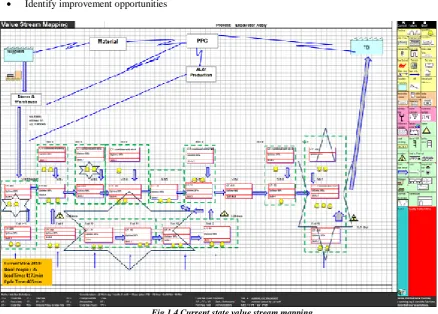
4.Value Stream Mapping: Value Stream Mapping was used toidentify and eliminate non value added activities. In this project the value stream map was used to map the current state and identify the unnecessary use of stations or feeders. And the future state was mapped.
Current State Map
The purpose of current state map is to provide a detailed visual description of the current value stream. Objectives:
Show a holistic view of the entire current system
Highlight waste and its sources throughout the system
Identify improvement opportunities
Fig 1.4 Current state value stream mapping
The Current state of excavator assembly line identifies the bottleneck at each station and feeder with cycle time is 465min, lead time is 4172min and number of people are 35.
RESULT AND CONCULSION
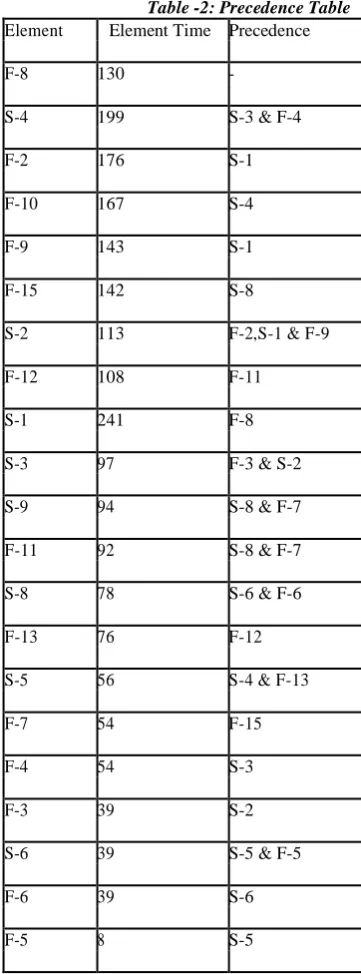
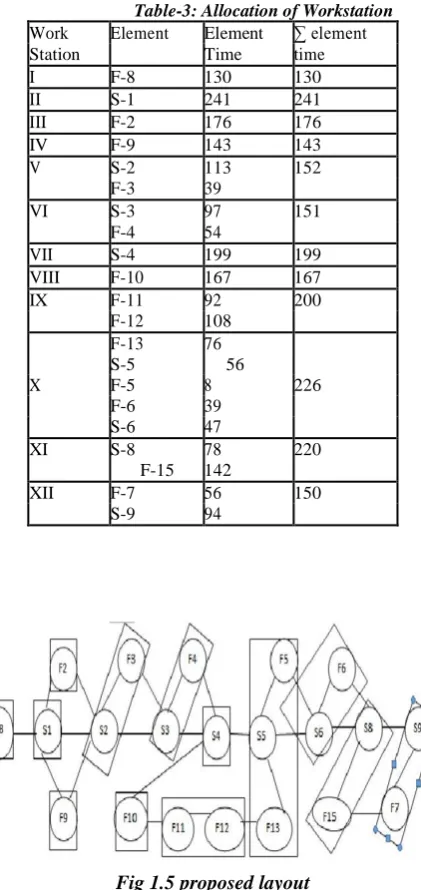
Largest Candidate Rule method [5] was used to balance the line using data in Table 2 and Fig-1.5
Table -2: Precedence Table
Element Element Time Precedence
F-8 130 -
S-4 199 S-3 & F-4
F-2 176 S-1
F-10 167 S-4
F-9 143 S-1
F-15 142 S-8
S-2 113 F-2,S-1 & F-9
F-12 108 F-11
S-1 241 F-8
S-3 97 F-3 & S-2
S-9 94 S-8 & F-7
F-11 92 S-8 & F-7
S-8 78 S-6 & F-6
F-13 76 F-12
S-5 56 S-4 & F-13
F-7 54 F-15
F-4 54 S-3
F-3 39 S-2
S-6 39 S-5 & F-5
F-6 39 S-6
F-5 8 S-5
Table-3: Allocation of Workstation
Work Element Element ∑ element
Station Time time
I F-8 130 130
II S-1 241 241
III F-2 176 176
IV F-9 143 143
V S-2 113 152
F-3 39
VI S-3 97 151
F-4 54
VII S-4 199 199
VIII F-10 167 167
IX F-11 92 200
F-12 108
F-13 76
S-5 56
X F-5 8 226
F-6 39
S-6 47
XI S-8 78 220
F-15 142
XII F-7 56 150
S-9 94
Proposed Layout:
Fig 1.5 proposed layout
Tws = 2155 minutes from Table 3. n = no of proposed work station = 12
Tw=Tc=The maximum available workstation time
241 minutes
Line efficiency of proposed layout (η) =Rp/Rc
Where Rp=0.190; Rc=60/241=0.248
η=76.61%
Eliminating Feeder-1 and Feeder-14:
1) By eliminating Feeder-1 as shown in Fig-1.6
Fig-1.6: Feeder-1 elimination
2) By eliminating Feeder-14 as shown in Fig-1.7
Fig-1.7: Before eliminating feeder-14
Fig-1.8: After eliminating feeder-14
Lifting and placing on pallet is eliminated after doing the sub assembling as shown in Fig-1.8.
Moving the Trolley from feeder to station is eliminated as it comes directly from the stores and placed on the trolley of station-1.
A total of 38 minutes is eliminated.
3) By using the technique of line balancing, the number of work station is reduced from 14 to 12.
Fig-1.9: Before eliminating the stations
Fig-2.0 After eliminating the stations
The Distribution of load among workers as shown in Fig 1.9 & Fig 2.0:
Since feeder-1 is eliminated, the load of 1 & Operator -2 is given to 17 & Operator-18 and a load of 46 minutes is added to operator-17.
In feeder-10 & 11, Operator -4 is eliminated and the load of 11 minutes is given to Operator -6 to do the cleaning of track motor assembly.
Operator-5 gives load of 40 minutes to Operator-15 to do the track motor assembly.
In feeder-7 & station 9, Operator-7 takes a load of 14 minutes from Operator-8 to fix the mirror stand and draining of oil from the lube pipe.
In feeder-7 & station 9, Operator-8 takes a load of 90 minutes to do Testing Drive inspection.
In feeder-2 & station 2, Operator-12 gives a load of 30 minutes to Operator- 9 to do the seat sub assemble.
Feeder 14 is eliminated and load of Operator-13 of 37 minutes is given to Operator-10 to do the hydraulic and fuel tank assembly.
In engine sub assembly, Operator-27 is given a load of 35 minutes from Operator-20, i.e. Operator 27 can help cowl RH & LH mounting along with OP-20.
In station-1, Operator-18 takes a load of 11 minutes from Operator-20 who is working in cowl and frame. He can work on battery and tool box mounting along with Operator-19.
The costs benefit analysis:
=29*8000 =Rs 2,32,000/-
After eliminating the work station & doing line balancing it is proposed that the company can save:
6 workers are eliminated i.e. 6*8000 =Rs 48000/-
A savings of Rs 48,000/- per month.
1) The cost associated with eliminating the feeder-1 is:
Elimination of lifting the upper frame of the excavator using a sling which cost Rs 40,000/-.Hence there no requirement of sling, resulting in savings of Rs 40,000/-.
2) The cost associated with eliminating Feeder-14 is:
Use of fixture costing Rs 4,00,000/-used for placing the fuel and hydraulic tank is eliminated. Hence a saving of Rs 4, 00,000/- to the company.
Value Stream mapping:
Fig-2.1: Future state of value stream mapping
Result: The Future state of excavator assembly line after identification of bottleneck at each station and feeder the cycle time is 448min, lead time is 2060 min and number of people are 24.
REFERENCES
1. Volvo Construction Equipment brochure, Volvo VPS (Volvo Production System) our way, 02/2008, Issue 36.
Case Study for Margarine Production in Zimbabwe”, International Journal of Innovative Technology andExploring Engineering (IJITEE) ISSN: 2278-3075, Volume-1, Issue-5, October 2012.
3. Dinesh Sethy and Vaibhav Gupta, “Application of value streammapping for lean operations and cycle time reduction: an Indian case study”, Production Planning & Control, Vol. 16, No. 1, January 2005,pp 44–59.
4. Mikell P.Groover, “Automation Production Systems and Computer-Integrated manufacturing”, second edition, PHI.
5. Hung-Da Wan and F. Frank Chen, “A leanness measure ofmanufacturing systems for quantifying impacts of lean initiatives”, International Journal of Production Research, Vol. 46, No. 23, December 2008, pp 6567–6584.
6. Naveen Kumar & Dalgobind Mahto, “Assembly Line Balancing: AReview of Developments and Trends in Approach to Industrial Application”, Global Journal of Researches in Engineering, IndustrialEngineering, Volume 13, Issue 2, Version 1.0, 2013.