Medical Journal of the Islamic Republic of Iran (MJIRI)
Med J Islam Repub Iran. 2019(25 Dec);33.150. https://doi.org/10.34171/mjiri.33.150
Determining the effect of platelet-rich plasma (PRP) on
improving endoscopic sinus surgery: A randomized
clinical trial study (RCT)
Alireza Mohebbi1, Farideh Hosseinzadeh1, Saleh Mohebbi*2, Ali Dehghani1
Received: 11 Nov 2018 Published: 25 Dec 2019
Abstract
Background: Rhinosinusitis is an inflammatory disease of the nasal and paranasal sinus mucosa, and it becomes chronic when it lasts longer than 3 months without symptom improvement. The aim of this study was to determine the effect of PRP on improvement of endoscopic sinus surgery.
Methods: This was a randomized clinical trial (RCT) designed and implemented on 21 patients with chronic rhinosinusitis in Rasool Akram hospital in Tehran during 2016-2017. In this study, one side of the nose was randomly selected as the control and the other side as the case, and at the end of the surgery, PRP was sprayed onto the surface where the polyp was removed in the side that was intended as the case. The nasal endoscopy findings were graded according to Meltzer’s criteria before and after surgery and CT findings were classified according to the Lund-Mackay scoring system. Then, all patients were followed for 6 months. The SNOT-22 questionnaire, Meltzer’s criteria, and Lund-Mackay were used for data collection. Kolmogorov–Smirnov test, Wilcoxon Signed Rank test, and Mann-Whitney U test were used to analyze data in SPSS-22 software. P value<0.05 was considered significant.
Results: The mean and standard deviation of patients' age were 36.55 and 7.91, respectively. The median Lund-McKay Pre-op CT score before treatment was 10 (9.5-11), and no significant difference was found between the 2 sides of the nose (left and right). The items that showed statistically significant improvement after surgery was SNOT-22 (p<0.05). The mean of Meltzer scores in each side of the nose was significantly different before and after intervention (p<0.05). However, the mean of Meltzer scores in the 2 sides of the nose was not significantly different before and after intervention.
Conclusion: The treatment by PRP may be effective in reducing symptoms of patients showing recurrence of CRS symptoms following endoscopic sinus surgery subjectively but not objectively.
Keywords: PRP, Endoscopic Sinus Surgery, Randomized Clinical Trial Study, Tehran
Conflicts of Interest: None declared
Funding:ENT Head and Neck Research Center, Iran University of Medical Sciences
*This work has been published underCC BY-NC-SA 1.0 license. Copyright© Iran University of Medical Sciences
Cite this article as:Mohebbi A, Hosseinzadeh F, Mohebbi S, Dehghani A. Determining the effect of platelet-rich plasma (PRP) on improving endoscopic sinus surgery: A randomized clinical trial study (RCT). Med J Islam Repub Iran. 2019 (25 Dec);33:150. https://doi.org/10.34171/mjiri.33.150
Introduction
Chronic rhinosinusitis (CRS) is an inflammation of the mucus that covers the nasal sinuses and the surrounding area and lasts more than 12 weeks (2-4). Clinical signs of CRS include facial fullness, nasal congestion, postnasal
discharges, rhinorrhea, hyposmia or anosmia, headache, fa-tigue, toothache, cough, and overpressure in the ear. In the absence of treatment, it can lead to serious complications such as periosteal cellulitis, abscess, and bowls eye (4,5).
______________________________
Corresponding author: Dr Saleh Mohebbi, [email protected]
1.ENT and Head & Neck Research Center, The Five Senses Institute, Iran University of
Medical Sciences, Tehran, Iran
2.Skull Base Research Center, The Five Senses Institute, Iran University of Medical
Sciences, Tehran, Iran
↑What is “already known” in this topic:
Several studies have reported the effectiveness of PRP in sinonasal surgery and improvement of healing process. Since, there has been no study to date on the effect of PRP on the nasal polyp, which is a very common disease with a very high chance of recurrence, this study was conducted to examine this theory.
→What this article adds:
The present study found a strong association between PRP and improvement of healing process in nasal polyposis. Rate of recurrence in these patients was significantly decreased.
Platelet-rich plasma and endoscopic sinus surgery
In the United States, the epidemiology of sinusitis is con-sidered parallel with the epidemiology of common colds: the incidence of colds is 2-3 and 6-8 /person/year in adults and children, respectively. Also, in the United States, bac-terial sinus infection occurs in 0.5%-2% of adults and 6%-13% of children. This problem has made sinusitis one of the most common infections in patients referring to doctors. In the United States, in 2009, about 11% of adults who re-ferred to health centers had sinusitis. Risk factors for chronic sinusitis are as follow: allergic rhinitis; asthma; na-sal congestion due to polyps; foreign bodies or tumors; im-mune system suppression due to such diseases as agam-maglobulinemia, AIDS, and chronic granulomatous dis-ease; structural defects such as cleft palate; defects in mu-cocilliary system performance; and reflux (6-9).
Generally, treatment for chronic sinusitis is based on 3 principles: controlling the growth of bacteria, reducing mu-cosal inflammation, and reducing the flow of fluid within the sinuses. Based on existing guidelines, the main pharma-cotherapeutic approaches are glucocorticosteroids and an-tibiotics. However, these approaches have failed many times, especially in the following cases: adult nasal polypo-sis, aspirin-exacerbated respiratory disease, allergic fungal rhinosinusitis, comorbid asthma, and symptomatic patients in whom maximal medical therapy has failed. Usually, in such cases, the patient should be referred to an otolaryngol-ogist for consideration of sinus surgery (10).
In general, the most important goals in endoscopic sinus surgery are as follow: reducing the recurrence and severity of sinus infections; improving the symptoms of sinusitis; improving the airflow through nasal passages; and enhanc-ing the sense of smell of the patient (11). An important chal-lenge in CRS is the recurrence of the disease and the need for surgery. To avoid the recurrence of sinusitis and re-vision surgery, the following actions have been proposed: different antibiotics; time low-dose antibiotics; long-time low-dose steroids; nasal steroids; and different medi-cations such as antiukotriene, antihistamine desensitiza-tion, vaccinadesensitiza-tion, and platelet-rich plasma (PRP) (12). PRP is concentrated blood plasma that has plentiful amounts of platelets and is provided by the patient. PRP works by degranulating the alpha granules in platelets containing a number of growth factors which can lead to early wound healing. These growth factors accelerate healing by in-creasing cellular proliferation, matrix formation, osteoid production, and collagen synthesis (13). Therefore, the aim of this study was to determine the effects of PRP on im-proving endoscopic sinus surgery.
Methods
This was a randomized clinical trial (RCT) study de-signed and implemented on 21 patients with chronic rhi-nosinusitis in Rasool Akram hospital in Tehran during
2016–2017. The study protocol was approved by Iranian Registry of Clinical Trials (IR.IUMS.REC.1397.687). In this study, inclusion criteria for patients were bilateral chronic rhinosinusitis with polyposis, refractory to medical management, candidate for functional endoscopic sinus surgery (FESS), and age older than 18 years. The exclusion criteria also included pt. with unilateral disease, patients with platelet function disorders, thrombocytopenia and his-tory of other comorbidities. The random number table was used to determine the PRP was used for which of the right or left sides of the nose. If the selected number of tables was paired, PRP was used for the right side of the nose, otherwise it was used for the left side.
In this study, surgery was performed in the classic man-ner. One side was randomly considered as the control by the researcher; and at the end of the surgery, PRP was sprayed onto the surface where the polyp was removed in the side that was intended as the case such as maxillary si-nus, sphenoidal sisi-nus, ethmoidal sisi-nus, and frontal recess. Also, for more durability, gel like form of PRP was used. No medication therapy was done before the surgery; how-ever, cephalexin was described for 7 days after operation. The steps to prepare PRP was as follow: (1) 10 milliliters of patient’s blood was collected; (2) 9 milliliters of blood + 1 milliliters of acid/citrate/dextrose was used as an antico-agulant; (3) blood was centrifuged 2 times at 1500 & 2000 rpm for 10 minutes; (4) 3 to 4 milliliters of PRP was pro-vided as the supernatant with platelet concentration of about 5 times more than normal concentration; (5) Prepared PRP was used in the form of spray and gel.
The procedure was performed only once. Then, all pa-tients were followed for 6 months and the results were doc-umented and analyzed after 6 months. In the research, The SNOT-22 questionnaire was used for data collection. This questionnaire was completed before and after surgery inter-vention for patients. All items of this questionnaire are based on a scale of 0 to 5, where 0 defines no problems with the given symptom and 5 defines maximal problems. The SNOT-22 questionnaire has already been used in various studies and has been validated (14-16).
Also, in this study, nasal endoscopy findings were graded according to Meltzer’s criteria before and after surgery. Ta-ble 1 shows Meltzer scores which are used to classify nasal endoscopic findings. Polypoid sinonasal cavity was scored endoscopically from 0-4 according to degree of involve-ment (17). CT findings were classified according to the Lund-Mackay. Table 2 also shows Lund-Mackay scores which is used to classify CT findings. The collected data were entered into SPSS-22 software and analyzed using Kolmogorov–Smirnov test, Wilcoxon Signed Rank test, and Mann-Whitney U test. P value < 0.05 was considered significant. The protocol of the study was approved by In-stitutional Review Board and Ethics Committee of Iran
Table 1. Meltzer scores used to classify nasal endoscopic findings
Endoscopic findings (Meltzer et al., 2006) (1) 0- No polyps
1- Small polyps in the middle meatus/edema 2- Blocked middle meatus
3- Polyps extending beyond the middle meatus, without complete obstruction 4- Massive nasal polyposis
University of Medical Sciences. Moreover, the study was performed by tenets of Declaration of Helsinki (IR.IUMS.REC.1397.687).
Results
The present study was conducted on 21 patients. The mean and standard deviation of patients' age were 36.55 and 7.91, respectively. The median Lund-McKay Pre-op CT score before treatment was 10 (9.5-11), which showed no significant difference between the 2 sides of the nose (p=0.143).
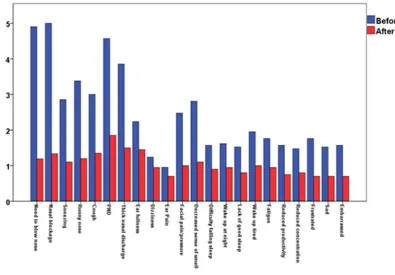
Chart 1 demonstrates the median and interquartile range (IQR) values of before and after SNOT- 22 items and probability values. The items that showed statistically sig-nificant improvements after surgery were as follow: the need to blow nose, nasal blockage, sneezing, runny nose, cough, PND, thick, nasal discharge, ear fullness, facial pain/pressure, decreased sense of smell, difficulty in falling sleep, wake up at night, lack of good night sleep, wake up
tired, fatigue, reduced productivity, reduced concentration, frustrated, sadness, and embarrassed (p<0.05).
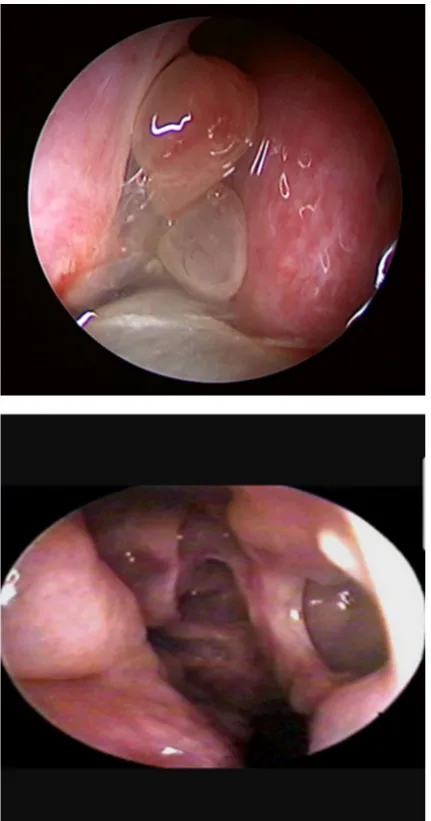
Given that the results of Kolmogorov–Smirnov test showed that data did not have normal distribution, the nonparametric tests of Wilcoxon Signed Rank test (within each sides of the right and left) and Mann-Whitney U test (between the two sides of the right and left) were used to compare the Meltzer scores before and after PRP interven-tion. The results of Mann-Whitney U test showed that the mean of Meltzer scores in the 2 sides did not have a signif-icant difference before and after PRP intervention (p=0.083, p=0.326, respectively). The results of the Wil-coxon Signed Rank test, which were used to compare the mean of Meltzer scores before and after PRP intervention within each of the sides, showed that the mean of Meltzer scores in each of the sides was significantly different before and after PRP intervention (p<0.05) (Table 3). Chart 2 shows the mean of Meltzer scores before and after PRP in-tervention. Figure 1 shows a photo of the patient before and
Table 2. Lund-Mackay scores used to classify paranasal sinuses CT scan findings (1)
Sinus System Left Right
Maxillary Anterior ethmoid Posterior ethmoid Sphenoid Frontal
Ostiomeatal complex Total points for each side
0-2 0-2 0-2 0-2 0-2 0 or 2 0 -24
0-2 0-2 0-2 0-2 0-2 0 or 2 0 -24 Scoring for all sinus systems
0= With no abnormalities 1= Partial opacification 2=Total opacification
For the Ostiomeatal complex: 0 = not occluded, 2= occluded
Chart 1. The Median and IQR values of SNOT- 22 items before and after the intervention
Platelet-rich plasma and endoscopic sinus surgery
after the surgery. Discussion
Rhinosinusitis is an inflammatory disease of the sinus mucosa and nasal cavities. Chronic rhinosinusitis means that the symptoms last more than 3 months without signif-icant improvement.
Diagnostic criteria include the presence of symptoms such as purulent nasal discharge, nasal obstruction, facial pain, pressure or fullness on frontal and maxillary sinus, hyposmia, inflammation in endoscopic examination, puru-lent discharge on ostium of maxillary sinus and osteomatal complex, mucosal edema of the middle meatus or eth-moidal sinus, polyps in the nasal cavity or the middle mea-tus, and radiographic imaging showing opacification or in-flammation of the paranasal sinuses (18,19). Chronic rhi-nosinusitis is more commonly attributed to CRS with nasal polyps (CRSwNP) and CRS without nasal polyps (CRSsNP) (20). The pathogenesis of CRS is controversial. The inflammatory process begins when bacteria, fungi, vi-ruses, allergens, or environmental toxins interact with host environment. Defects in the normal functioning of the epi-thelial barriers, including the reduction of the expression of antimicrobial products, the loss of integrity of the barrier, and colonization by fungi and bacteria, have a significant effect on chronic inflammation. This chronic inflammation is characterized by increase in inflammatory cytokines and chemokine, including IL-5, thymic stromal lymphopoietin, and CCL11, which help to initiate chronic inflammatory re-sponse. Thus, gathering of immune cells, including eosino-phils, mast cells, group 2 innate lymphoid cells, and lym-phocytes in the chronic inflammatory response leads to na-sal polyps (21-23). To date, various treatments have been developed to improve CRS. The most effective nonsurgical treatment has been intranasal steroids and nasal saline irri-gation. There are inadequate data on using oral steroid in CRS without nasal polyposis. Topical antibiotics do not show any benefit in CRS without nasal polyps. Long-term antibiotics have shown possible therapeutic response after treatment for 12 weeks; however, there is concern for de-velopment of antibiotic resistant bacteria with subsequent infections. Endoscopic sinus surgery in CRS has been shown to be safe and effective when medical treatment
Table 3. The Comparison the Meltzer scores before and after PRP
Variables Before After Wilcoxon Signed Rank test
P – value
PRP treated side 3 (2 – 4) 1 (0 – 2) < 0.001
Control side 2 (2 – 4) 1 (1 – 2) < 0.001
Mann-Whitney U test P- value 0.083 0.326
Chart 2. The Comparison the Meltzer scores before and after PRPintervention
Fig. 1. A sample of the photo before and after the surgery of a
pa-tient
has failed and in the patients with long-term maintenance medical therapy (24,25). On the other hand, after FESS, pa-tients may experience high level of recurrence of rhinosi-nusitis symptoms and nasal polyposis. Therefore, to im-prove and reduce postsurgical recurrence rate and mucosal healing, in this study, it was aimed to use PRP because of its anti-inflammatory mechanism to decrease the number of FESS revisions and decrease resistance to antibiotics.
Platelet-rich plasma consists of multiple growth and heal-ing factors such as platelet derived growth factor, trans-forming growth factor, and vascular endothelial growth factor.
These agents are released by activating platelets that can be controlled by a variety of substances or stimulants such as thrombin, calcium chloride, collagen, or adenosine 5c-diphosphat. In addition to growth factors, PRP contains fi-brinogen and a number of sticky glycoproteins that support cell migration antibacterial activity by increasing the local concentration of white blood cells and antibiotic proteins, resulting in the use of products in postoperative patients as an additive to standard therapy in an effort to prevent infec-tion.
PRP has an effective role in proliferation and differentia-tion of human dermal fibroblasts and myofibroblasts, which improves wound healing. Because of these properties, PRP has been used in various fields of surgery such as dental re-generative surgery, trauma, orthopedic surgery, and oph-thalmology (26-28). The effects of PRP on rhinosinusitis have been studied previously. Rice et al in 2006 designed a study to assess the healing properties of platelet-rich plasma (PRP) after endoscopic sinus surgery in 30 patients with bilateral and symmetrical chronic rhinosinusitis who did not respond to medical treatment. After 13 operations, follow-up evaluations demonstrated no benefit for using PRP, and the study was terminated early. Further research was not done until Salah El Din et al in 2012 performed a randomized single blinded study on 60 patients with infe-rior turbinate hypertrophy. They used PRP in one group and saline in the other group (29). In their follow-up, nasal mucocilliary clearance was considered and the clearance of mucocilliary was improved in both groups, but it was sta-tistically more significant in patients with PRP insertion. Due to positive effects of PRP and its anti-inflammatory properties, in this study, it was decided to reevaluate its ef-fects on CRS patients after FESS intraoperatively.
According to SNOT-22, the most common symptoms which were reported by the patients were as follow: the need to blow nose, nasal obstruction, and postnasal dis-charges, which were reduced significantly 6 months after PRP was instilled. There was a significant difference in Meltzer score before and after treatment in the both treated and control sides. Overall analysis of patients’ symptoms according to the scores recorded from SNOT-22 question-naire data revealed statistically significant reduction after 6 months. This analysis showed the positive effect of both FESS and PRP. However, endoscopic grading of that side of the nasal cavity treated by PRP showed a difference; however, the reduction was nonsignificant when compared to the control side after 6 months.
Conclusion
Findings of this study suggested that treatment by PRP may be effective in reducing symptoms of patients showing recurrence of CRS symptoms following endoscopic sinus surgery subjectively but not objectively. Therefore, further studies should be conducted to obtain more accurate results on the effect of PRP on the nasal polyp. Also, taking more photos before and after the surgery and longer follow-ups can be helpful in studying polyp revision cases. The CSS group without a nasal polyp can also be considered to study PRP even in cases that are not candidates for surgery and can be checked for symptom relief.Moreover, it is better to have a longer follow-up. Also, it may be possible to im-prove PRP on the surgical site (not necessarily by spraying) and achieve the best effect of PRP on the nasal polyps. However, the above-mentioned will require further investi-gation in future studies.
Informed consent
Informed consent was obtained from all individual participants included in the study.
Conflict of Interests
The authors declare that they have no competing interests.
References
1. de Freitas MR, Vasconcelos DN, Freitas ÂEdHA, Maia Filho JH, e Silva CdCJBjoo. Nasal endoscopic and CT scan alterations of the paranasal sinuses as predictors of severity in patients with cystic fibrosis. Braz J Otorhinolaryngol. 2013;79(4):480-486.
2. Sedaghat AR, Phipatanakul W, Cunningham MJJIjopo. Prevalence of and associations with allergic rhinitis in children with chronic rhinosinusitis. Braz J Otorhinolaryngol. 2014;78(2):343-347. 3. Wood AJ, Douglas RG. Pathogenesis and treatment of chronic
rhinosinusitis. Postgrad Med J. 2010;86(1016):359-364.
4. Mustafa M, Patawari P, Iftikhar H, Shimmi S, Hussain S, Sien MJ. Acute and chronic rhinosinusitis, pathophysiology and treatment. Int J Pharm Sci Invent. 2015;4(2):30-36.
5. Hirsch AG, Stewart WF, Sundaresan AS, Young AJ, Kennedy TL, Scott Greene J, et al. Nasal and sinus symptoms and chronic rhinosinusitis in a population‐based sample. Allergy. 2017;72(2):274-281.
6. Blaiss MS. Pediatric allergic rhinitis: physical and mental complications. Paper presented at: Allergy Asthma Proc. 2008. 7. Tan BK, Chandra RK, Pollak J, Kato A, Conley DB, Peters AT, et al.
Incidence and associated premorbid diagnoses of patients with chronic rhinosinusitis. J Allergy Clin Immunol. 2013;131(5):1350-1360. 8. Sedaghat AR, Phipatanakul W, Cunningham MJ. Prevalence of and
associations with allergic rhinitis in children with chronic rhinosinusitis. Int J Pediatr Otorhinolaryngol. 2014;78(2):343-347. 9. Sih T, Mion O. Allergic rhinitis in the child and associated
comorbidities. Pediatric Pediatr Allergy Immunol. 2010;21(1‐Part‐II). 10. Bachert C, Zhang L, Gevaert P. Current and future treatment options
for adult chronic rhinosinusitis: focus on nasal polyposis. J Allergy Clin Immunol. 2015;136(6):1431-1440.
11. Al Badaai Y, Valdés C, Samaha M. Outcomes and cost benefits of functional endoscopic sinus surgery in severely asthmatic patients with chronic rhinosinusitis. J Laryngol Otol. 2014;128(6):512.
12. Nakayama T, Asaka D, Kanaya H, Kuboki A, Haruna SI. Prognostic factors for recurrence after endoscopic sinus surgery for chronic rhinosinusitis with nasal polyps. Auris Nasus Larynx. 2016;43(6):641-647.
13. Rice DH. Platelet-rich plasma in endoscopic sinus surgery. Ear Nose Throat J. 2006;85(8):516.
14. Kennedy JL, Hubbard MA, Huyett P, Patrie JT, Borish L, Payne SC. Sino-nasal outcome test (SNOT-22): a predictor of postsurgical
Platelet-rich plasma and endoscopic sinus surgery
improvement in patients with chronic sinusitis. Ann Allergy Asthma Immunol. 2013;111(4):246-251. e242.
15. Schalek P, Otruba L, Hahn A. Quality of life in patients with chronic rhinosinusitis: a validation of the Czech version of SNOT-22 questionnaire. Eur Arch Otorhinolaryngol. 2010;267(3):473-475. 16. Jalessi M, Farhadi M, Kamrava SK, Amintehran E, Asghari A,
Hemami MR, et al. The reliability and validity of the persian version of sinonasal outcome test 22 (snot 22) questionnaires. Iran Red Crescent Med J. 2013;15(5):404.
17. Meltzer EO, Hamilos DL, Hadley JA, Lanza DC, Marple BF, Nicklas RA, et al. Rhinosinusitis: Developing guidance for clinical trials. Otolaryngol Head Neck Surg. 2006 Nov;135(5 Suppl):S31-80. 18. Daramola OO, Lidder AK, Ramli R, Chandra RK, Shintani-Smith S,
Conley DB, et al. Patient knowledge and perception of computed tomography scan in the management of chronic rhinosinusitis symptoms. Laryngoscope. 2015;125(4):791-795.
19. Garneau J, Ramirez M, Armato SG, 3rd, Sensakovic WF, Ford MK, Poon CS, et al. Computer-assisted staging of chronic rhinosinusitis correlates with symptoms. Int Forum Allergy Rhinol. 2015;5(7):637-642.
20. Hirsch AG, Stewart WF, Sundaresan AS, Young AJ, Kennedy TL, Scott Greene J, et al. Nasal and sinus symptoms and chronic rhinosinusitis in a population-based sample. Allergy. 2017;72(2):274-281.
21. van Drunen CM, Mjosberg JM, Segboer CL, Cornet ME, Fokkens WJ. Role of innate immunity in the pathogenesis of chronic rhinosinusitis: progress and new avenues. Curr Allergy Asthma Rep. 2012;12(2):120-126.
22. Peric A, Gacesa D. Etiology and pathogenesis of chronic rhinosinusitis. Vojnosanit Pregl. 2008;65(9):699-702.
23. Stevens WW, Lee RJ, Schleimer RP, Cohen NA. Chronic rhinosinusitis pathogenesis. J Allergy Clin Immunol. 2015;136(6):1442-1453.
24. Rahman T, Alam MM, Ahmed S, Karim MA, Rahman M, Wahiduzzaman M. Outcome of Endoscopic Sinus Surgery in the Treatment of Chronic Rhinosinusitis. Mymensingh Med J. 2016;25(2):261-270.
25. Chen FH, Zuo KJ, Guo YB, Li ZP, Xu G, Xu R, et al. Long-term results of endoscopic sinus surgery-oriented treatment for chronic rhinosinusitis with asthma. Laryngoscope. 2014;124(1):24-28. 26. Guney A, Akar M, Karaman I, Oner M, Guney B. Clinical outcomes
of platelet rich plasma (PRP) as an adjunct to microfracture surgery in osteochondral lesions of the talus. Knee Surg Sports Traumatol Arthrosc. 2015;23(8):2384-2389.
27. Gonzalez M, Arteaga-Vizcaino M, Benito M, Benito M. [Application of platelet rich plasma (PRP) and its derivatives in dental implantologie and plastic surgery]. Invest Clin. 2012;53(4):408-418.
28. Albanese A, Licata ME, Polizzi B, Campisi G. Platelet-rich plasma (PRP) in dental and oral surgery: from the wound healing to bone regeneration. Immun Ageing. 2013;10(1):23.
29. Salaheldin AH, Hussein A. Effect of platelet-rich plasma on nasal mucociliary clearance after submucous diathermy of inferior turbinate. Egypt J Ear Nose Throat Allied Sci. 2012;13(2):71-75.